

The DOI matches its Crossref record; 197 of the 198 references it cites were found in a registry or an index, and 1 are not checked yet.
Neuroactive Steroids and GABAergic Involvement in the Neuroendocrine Dysfunction Associated With Major Depressive Disorder and Postpartum Depression
Open accessAbstract
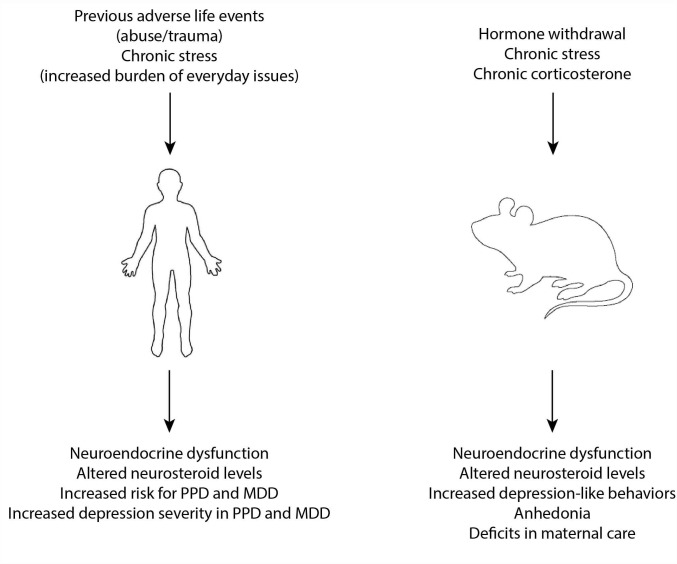
Stress and previous adverse life events are well-established risk factors for depression. Further, neuroendocrine disruptions are associated with both major depressive disorder (MDD) and postpartum depression (PPD). However, the mechanisms whereby stress contributes to the underlying neurobiology of depression remains poorly understood. The hypothalamic-pituitary-adrenal (HPA) axis, which mediates the body’s neuroendocrine response to stress, is tightly controlled by GABAergic signaling and there is accumulating evidence that GABAergic dysfunction contributes to the impact of stress on depression. GABAergic signaling plays a critical role in the neurobiological effects of stress, not only by tightly controlling the activity of the HPA axis, but also mediating stress effects in stress-related brain regions. Deficits in neuroactive steroids and neurosteroids, some of which are positive allosteric modulators of GABAA receptors (GABAARs), such as allopregnanolone and THDOC, have also been implicated in MDD and PPD, further supporting a role for GABAergic signaling in depression. Alterations in neurosteroid levels and GABAergic signaling are implicated as potential contributing factors to neuroendocrine dysfunction and vulnerability to MDD and PPD. Further, potential novel treatment strategies targeting these proposed underlying neurobiological mechanisms are discussed. The evidence summarized in the current review supports the notion that MDD and PPD are stress-related psychiatric disorders involving neurosteroids and GABAergic dysfunction.
Overview
The claims and statistics of this paper haven’t been checked yet.
Run the check — free, no account needed. It reads the open-access text and checks the sources it cites.
Integrity signals
Registry
Cites
Statistics
Figures
Verification
Claims the paper makes
The claims and statistics of this paper haven’t been checked yet.
Run the check — free, no account needed. It reads the open-access text and checks the sources it cites.
Claims other papers make about this one
Each is checked against this paper’s own text: does it say what the citing paper says it does?
The cited source says what the claim attributes to it.
In the citing paper
“The pathophysiology of PPD is likely multifactorial,26,27 with evidence supporting a role for disruption of perinatal γ-aminobutyric acid (GABA) signaling, the major inhibitory signaling pathway of the central nervous system.28”
From Effect of Zuranolone vs Placebo in Postpartum Depression (2021) · cites this paper as [28]
Self-check
Percentages, sums and reported differences re-computed from the paper’s own numbers.
The self-check needs the paper’s full text.
Citations
Cites
Neural regulation of endocrine and autonomic stress responses
Ulrich-Lai, Y. M., & Herman, J. P. (2009) · Nature Reviews Neuroscience · doi:10.1038/nrn2647 · Cited by 3,318
Hammen, C. (2005) · Annual Review of Clinical Psychology · doi:10.1146/annurev.clinpsy.1.102803.143938 · Cited by 2,979
Slavich, G. M., & Irwin, M. R. (2014) · Psychological Bulletin · doi:10.1037/a0035302 · Cited by 2,206
Variations on an inhibitory theme: phasic and tonic activation of GABAA receptors
Farrant, M., & Nusser, Z. (2005) · Nature Reviews Neuroscience · doi:10.1038/nrn1625 · Cited by 2,081
The HPA axis in major depression: classical theories and new developments
Pariante, C. M., & Lightman, S. L. (2008) · Trends in Neurosciences · doi:10.1016/j.tins.2008.06.006 · Cited by 2,009
Antenatal risk factors for postpartum depression: a synthesis of recent literature
Robertson, E., Grace, S., Wallington, T., & Stewart, D. E. (2004) · General Hospital Psychiatry · doi:10.1016/j.genhosppsych.2004.02.006 · Cited by 1,886
Herman, J. P., Figueiredo, H., Mueller, N. K., Ulrich-Lai, Y., Ostrander, M. M., Choi, D. C., & Cullinan, W. E. (2003) · Frontiers in Neuroendocrinology · doi:10.1016/j.yfrne.2003.07.001 · Cited by 1,586
Sex differences in anxiety and depression clinical perspectives
Altemus, M., Sarvaiya, N., & Neill Epperson, C. (2014) · Frontiers in Neuroendocrinology · doi:10.1016/j.yfrne.2014.05.004 · Cited by 1,413
Paul, S. M., & Purdy, R. H. (1992) · The FASEB Journal · doi:10.1096/fasebj.6.6.1347506 · Cited by 1,413
GABAA receptors: immunocytochemical distribution of 13 subunits in the adult rat brain
Pirker, S., Schwarzer, C., Wieselthaler, A., Sieghart, W., & Sperk, G. (2000) · Neuroscience · doi:10.1016/s0306-4522(00)00442-5 · Cited by 1,344
Cited by
Sorted by citations
Neurosteroids as novel antidepressants and anxiolytics: GABA-A receptors and beyond
Zorumski, C. F., Paul, S. M., Covey, D. F., & Mennerick, S. (2019) · Neurobiology of Stress · doi:10.1016/j.ynstr.2019.100196 · Cited by 305
Effect of Zuranolone vs Placebo in Postpartum Depression
Deligiannidis, K. M., Meltzer-Brody, S., Gunduz-Bruce, H., Doherty, J., Jonas, J., Li, S., Sankoh, A. J., Silber, C., Campbell, A. D., Werneburg, B., et al. (2021) · JAMA Psychiatry · doi:10.1001/jamapsychiatry.2021.1559 · Cited by 277
Brexanolone for postpartum depression: A meta-analysis of randomized controlled studies
Zheng, W., Cai, D.-B., Zheng, W., Sim, K., Ungvari, G. S., Peng, X.-J., Ning, Y., Wang, G., & Xiang, Y. (2019) · Psychiatry Research · doi:10.1016/j.psychres.2019.07.006 · Cited by 223
Neuroprotective Potentials of Flavonoids: Experimental Studies and Mechanisms of Action
Bellavite, P. (2023) · Antioxidants · doi:10.3390/antiox12020280 · Cited by 235
Poromaa, I. S., Comasco, E., Sumner, R. L., & Eileen Luders, A. (2020) · Frontiers in Neuroendocrinology · doi:10.1016/j.yfrne.2020.100856 · Cited by 217
Metadata
- Authors
- Maguire, J.
- Affiliations
- Tufts University (US)
- Corresponding author
- Maguire, Jamie
- ORCID
- Maguire, Jamie
- Venue
- Frontiers in Cellular Neuroscience
- Publisher
- Frontiers Media SA
- Published
- 2019-03-08
- Volume
- 13
- Pages
- 83-83
- ISSN
- 1662-5102 (ISSN-L)
- PMC
- PMC6418819
- OpenAlex
- W2921588725
- Cited by
- 113
- References
- 197
- Citations by year
- 2026: 13 · 2025: 13 · 2024: 14 · 2023: 15 · 2022: 6 · 2021: 17 · 2020: 24 · 2019: 10
- FWCI
- 1.65
- Type
- journal article
- Language
- en
- Open access
- gold
- doi.org
- Licence
- Locations
- Frontiers in Cellular Neuroscience (publishedVersion, cc-by)
- Europe PMC (PubMed Central) (publishedVersion, cc-by)
- PubMed Central (publishedVersion, cc-by)
- PubMed (publishedVersion)
- DOAJ (DOAJ: Directory of Open Access Journals) (submittedVersion)
- Funders
- National Institutes of Health (NS102937, AA026256)
- Topics
- Life Sciences › Neuroscience › Behavioral Neuroscience › Stress Responses and Cortisol
- Health Sciences › Medicine › Public Health, Environmental and Occupational Health › Maternal Mental Health During Pregnancy and Postpartum
- Life Sciences › Neuroscience › Cellular and Molecular Neuroscience › Neuroscience and Neuropharmacology Research
- Keywords
- neurosteroids, GABAergic neurotransmission, GABAA receptor, major depressive disorder, postpartum depression, neuroendocrine dysfunction, hypothalamic-pituitary-adrenal axis, stress, allopregnanolone, positive allosteric modulators, life events
About these checks
Registry, retraction, Cites and statistics results are computed, not judged, with one exception: a printed reference that no index lists is read once by a model before it counts as a citation error. Claims are extracted by a model and kept only when their quote appears verbatim in the text; each cited source is then checked, with a model’s help, for whether it says what the claim relies on. Those verdicts can be wrong — read the claim’s quote and the cited source before relying on one.
Statistics and arithmetic are recomputed, not judged.
Confidence bands are shown only for fields calibrated on our annotated test set. None is calibrated yet, so no band is shown.
What counts as a claim ›How we measure confidence ›How we check this ›
Are you an author, or do you see a problem with this page? Request a review
