

The DOI matches its Crossref record; 31 of the 31 references it cites were found in a registry or an index; none of the 35 sources its claims cite is checked for support yet.
Hyperbaric oxygen therapy improves post-concussion symptoms in adults with childhood traumatic brain injury: a retrospective cohort study
Open accessAbstract
Post-concussion syndrome (PCS) following childhood traumatic brain injury (TBI) can result in persistent cognitive impairments that extend into adulthood, yet it remains significantly underdiagnosed and undertreated. This study evaluated the effects of hyperbaric oxygen therapy (HBOT) on chronic neurocognitive symptoms in adults with PCS stemming from pediatric TBI. We conducted a retrospective analysis of patients treated with HBOT at the “Sagol Center for Hyperbaric Medicine and Research” between 2017 and 2024. Inclusion criteria included TBI before age 17, HBOT initiation after age 20, and the availability of computerized cognitive assessments before and after treatment. All participants received at least 40 sessions of HBOT, consisting of 90 min of 100% oxygen at 2 ATA with air breaks. Twenty-six adults (mean age 31.7 ± 8.6 years) who sustained TBI in childhood (mean age at injury 7.7 ± 5.8 years) met inclusion criteria. Following HBOT, statistically significant improvements were observed in all cognitive domains except for motor skills (global cognition, memory, executive function, attention and information processing speed; all adjusted p < 0.05; effect sizes r = 0.62–0.78, Wilcoxon signed-rank test). These improvements were independent of time since injury (mean 23.6 ± 9.3 years) and initial TBI severity. Notably, individuals with a history of mild TBI exhibited similar impairments and treatment response to those with more severe injuries. These findings suggest that HBOT may induce meaningful neurocognitive improvement even decades after pediatric TBI, supporting its potential role in long-term rehabilitation strategies for this underserved population.
Overview
CoChat Summary
TL;DR
In a retrospective cohort of 26 adults with chronic post-concussion syndrome from childhood TBI, at least 40 sessions of HBOT were associated with significant improvements in global cognition, memory, executive function, attention, and information processing speed, but not motor skills. Benefits were independent of time since injury and initial TBI severity.
Key findings
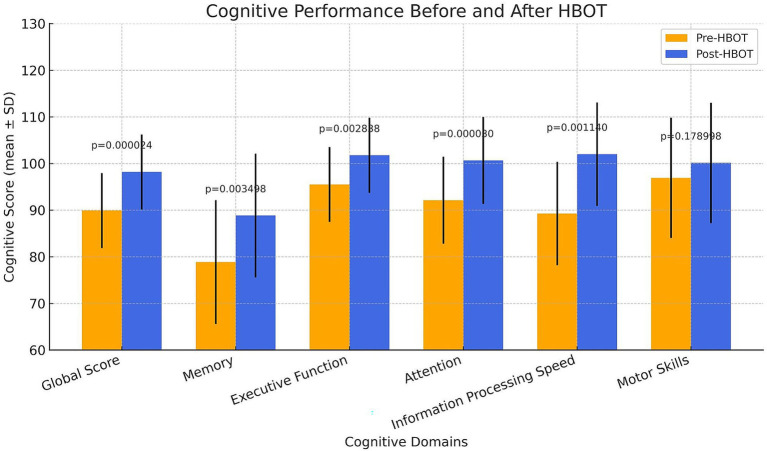
- Among 26 adults (mean age 31.7 ± 8.6 years; mean age at injury 7.7 ± 5.8 years; mean 23.6 ± 9.3 years since injury), HBOT (mean 60.0 ± 1.3 sessions) improved global cognition by 8.06 points (adjusted p = 0.000024; r = 0.779), attention by 8.50 points (p = 0.00003; r = 0.775), information processing speed by 9.84 points (p = 0.00114; r = 0.685), memory by 9.82 points (p = 0.003498; r = 0.620), and executive function by 5.94 points (p = 0.002838; r = 0.628).
- Motor skills did not significantly improve after Bonferroni correction (+3.10 points; adjusted p = 0.178998; r = 0.409).
- Time since injury showed weak-to-moderate negative correlations with cognitive improvement (r = −0.02 to −0.33; all p > 0.1), and mild vs. moderate TBI subgroups did not differ significantly in improvement (all p > 0.12).
- No adverse events or safety concerns were observed during or following the HBOT sessions.
Methods
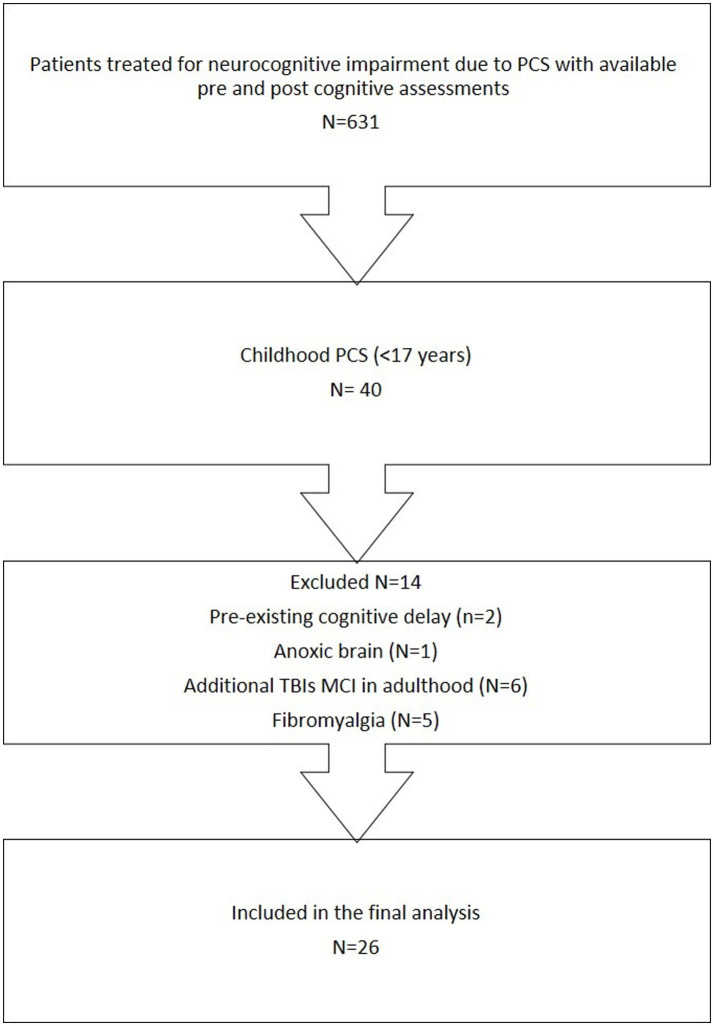
- Retrospective cohort at the Sagol Center for Hyperbaric Medicine and Research, 2017–2024; inclusion required TBI before age 17, HBOT initiation after age 20, and pre/post computerized cognitive assessments. Exclusions included anoxic brain injury, pre-existing cognitive impairment, or other confounding neurological conditions; final N = 26.
- HBOT protocol: at least 40 consecutive sessions, five times per week; each session was 90 min of 100% oxygen at 2 ATA with 5-min air breaks every 20 min. Participants completed a mean of 60.0 ± 1.3 sessions (range 40–70).
- Cognitive assessment used the NeuroTrax battery (memory, executive function, attention, information processing speed, motor skills; global score), normalized to an IQ-like scale (mean = 100, SD = 15) adjusted for age and education. Analysis used Wilcoxon signed-rank tests with Bonferroni correction, Mann–Whitney U tests for TBI severity subgroups, Spearman correlations for time since injury, and rank-based effect size r = Z/√N.
Limitations
- Stated: retrospective design, lack of a control group, and single-center setting; small sample size and highly selective inclusion criteria limit generalizability.
- Stated: no long-term follow-up; pre-treatment assessments were within 2 months before HBOT and post-treatment assessments within 1 month after the last session, so durability is unknown. Broader mood, sleep, and daily functioning improvements were not formally assessed.
- Evident: without a control group, pre-post improvements cannot be definitively attributed to HBOT rather than practice effects, placebo, or regression to the mean, although the authors cite alternate test versions and prior stability data.
Model-written summary. Check it against the paper before relying on it.
Integrity signals
Registry
Cites
Statistics
Figures
Verification
Claims the paper makes
0 Valid · 1 Not valid · 19 Not checked · 33 Own results and interpretations
A result the paper reports from its own data — it cites no other source for it, so there is none to check. The quote shows it is in the paper.
In the paper
“Global Cognitive Function improved by 8.06 ± 6.97 points (p = 0.000024; r = 0.779).”
§ Hyperbaric oxygen therapy improves post-concussion symptoms in adults with childhood traumatic brain injury: a retrospective cohort study > Results > Neurocognitive outcomes
plainstates a causen = 26- Asserted: passes — The authors put it forward as true.
- Checkable: passes — It can be checked against evidence.
- Load-bearing: passes — The paper’s conclusions depend on it.
- Based: passes — The paper gives a reason why it holds.
A result the paper reports from its own data — it cites no other source for it, so there is none to check. The quote shows it is in the paper.
In the paper
“In this study, patients with mild TBI demonstrated improvements in multiple cognitive domains, underscoring the need to reassess assumptions regarding the benign nature of mild pediatric TBI.”
§ Hyperbaric oxygen therapy improves post-concussion symptoms in adults with childhood traumatic brain injury: a retrospective cohort study > Discussion > Clinical implications
boostedstates a cause- Asserted: passes — The authors put it forward as true.
- Checkable: passes — It can be checked against evidence.
- Load-bearing: passes — The paper’s conclusions depend on it.
- Based: passes — The paper gives a reason why it holds.
A result the paper reports from its own data — it cites no other source for it, so there is none to check. The quote shows it is in the paper.
In the paper
“No adverse events or safety concerns were observed during or following the HBOT sessions.”
§ Hyperbaric oxygen therapy improves post-concussion symptoms in adults with childhood traumatic brain injury: a retrospective cohort study > Results > Patient selection and characteristics
plainn = 26- Asserted: passes — The authors put it forward as true.
- Checkable: passes — It can be checked against evidence.
- Load-bearing: unclear — It is unclear whether the paper’s conclusions depend on it.
- Based: passes — The paper gives a reason why it holds.
A result the paper reports from its own data — it cites no other source for it, so there is none to check. The quote shows it is in the paper.
In the paper
“All patients reported persistent cognitive symptoms attributed to their childhood TBI.”
§ Hyperbaric oxygen therapy improves post-concussion symptoms in adults with childhood traumatic brain injury: a retrospective cohort study > Results > Patient selection and characteristics
plainn = 26- Asserted: passes — The authors put it forward as true.
- Checkable: passes — It can be checked against evidence.
- Load-bearing: unclear — It is unclear whether the paper’s conclusions depend on it.
- Based: passes — The paper gives a reason why it holds.
A result the paper reports from its own data — it cites no other source for it, so there is none to check. The quote shows it is in the paper.
In the paper
“Memory Function improved by 9.82 ± 13.63 points (p = 0.003498; r = 0.620).”
§ Hyperbaric oxygen therapy improves post-concussion symptoms in adults with childhood traumatic brain injury: a retrospective cohort study > Results > Neurocognitive outcomes
plainstates a causen = 26- Asserted: passes — The authors put it forward as true.
- Checkable: passes — It can be checked against evidence.
- Load-bearing: passes — The paper’s conclusions depend on it.
- Based: passes — The paper gives a reason why it holds.
25 more claims
Create a free account to see all 53 claims and to verify the 34 references still open.
- Probably not a substantial claim. 16
- It may state two separate claims as one. 11
Self-check
Percentages, sums and reported differences re-computed from the paper’s own numbers.
Each contradiction between two passages listed here was confirmed by an independent check.
Rated major: it would touch a result — a value a result rests on, reported and recomputed p-values on opposite sides of the significance level, two passages that conflict with no sign which is right, or a cited work retracted before this paper was published.
In the paper
§ Hyperbaric oxygen therapy improves post-concussion symptoms in adults with childhood traumatic brain injury: a retrospective cohort study > Results > Neurocognitive outcomes
“Motor Skills improved by 3.10 ± 7.47 points”
§ Hyperbaric oxygen therapy improves post-concussion symptoms in adults with childhood traumatic brain injury: a retrospective cohort study > Results > Neurocognitive outcomes
“| Motor Skills | 94.20 ± 24.44 | 97.30 ± 25.05 | 3.10 ± 12.66 |”
Rated minor: it would not touch a result — a value no result rests on, a p-value that stays on the same side of the significance level, or a conflict that is clerical, resolved elsewhere in the paper, or outside its own findings.
In the paper
§ Hyperbaric oxygen therapy improves post-concussion symptoms in adults with childhood traumatic brain injury: a retrospective cohort study > Results > Patient selection and characteristics
“the average time elapsed from injury to treatment was 23.6 ± 9.3 years (range: 3–35 years).”
§ Hyperbaric oxygen therapy improves post-concussion symptoms in adults with childhood traumatic brain injury: a retrospective cohort study > Discussion
“With time from trauma ranging widely—from as little as 3 years to as long as 37 years post-injury”
Rated minor: it would not touch a result — a value no result rests on, a p-value that stays on the same side of the significance level, or a conflict that is clerical, resolved elsewhere in the paper, or outside its own findings.
In the paper
§ Hyperbaric oxygen therapy improves post-concussion symptoms in adults with childhood traumatic brain injury: a retrospective cohort study > Results > Neurocognitive outcomes
“Memory Function improved by 9.82 ± 13.63 points”
§ Hyperbaric oxygen therapy improves post-concussion symptoms in adults with childhood traumatic brain injury: a retrospective cohort study > Results > Neurocognitive outcomes
“| Memory | 77.17 ± 26.97 | 86.99 ± 25.78 | 9.82 ± 13.26 |”
Rated minor: it would not touch a result — a value no result rests on, a p-value that stays on the same side of the significance level, or a conflict that is clerical, resolved elsewhere in the paper, or outside its own findings.
In the paper
§ Hyperbaric oxygen therapy improves post-concussion symptoms in adults with childhood traumatic brain injury: a retrospective cohort study > Results > Neurocognitive outcomes
“Attention improved by 8.50 ± 9.09 points”
§ Hyperbaric oxygen therapy improves post-concussion symptoms in adults with childhood traumatic brain injury: a retrospective cohort study > Results > Neurocognitive outcomes
“| Attention | 89.26 ± 20.82 | 97.76 ± 21.62 | 8.50 ± 9.33 |”
Rated minor: it would not touch a result — a value no result rests on, a p-value that stays on the same side of the significance level, or a conflict that is clerical, resolved elsewhere in the paper, or outside its own findings.
In the paper
§ Hyperbaric oxygen therapy improves post-concussion symptoms in adults with childhood traumatic brain injury: a retrospective cohort study > Results > Neurocognitive outcomes
“Information Processing Speed improved by 9.84 ± 12.31 points”
§ Hyperbaric oxygen therapy improves post-concussion symptoms in adults with childhood traumatic brain injury: a retrospective cohort study > Results > Neurocognitive outcomes
“| Information Processing Speed | 88.60 ± 23.53 | 98.44 ± 25.73 | 9.84 ± 11.04 |”
2 more findings
Create a free account to see every finding of this check.
Citations
Cites
Taylor, C. A., Bell, J. M., Breiding, M. J., & Xu, L. (2017) · MMWR. Surveillance Summaries · doi:10.15585/mmwr.ss6609a1 · Cited by 2,328
King, N. S., Crawford, S., Wenden, F. J., Moss, N. E. G., & Wade, D. T. (1995) · Journal of Neurology · doi:10.1007/bf00868811 · Cited by 1,460
Epidemiology of Postconcussion Syndrome in Pediatric Mild Traumatic Brain Injury
Barlow, K. M., Crawford, S., Stevenson, A., Sandhu, S. S., Belanger, F., & Dewey, D. (2010) · Pediatrics · doi:10.1542/peds.2009-0925 · Cited by 573
BAZARIAN, J. J., WONG, T., HARRIS, M., LEAHEY, N., MOOKERJEE, S., & DOMBOVY, M. (1999) · Brain Injury · doi:10.1080/026990599121692 · Cited by 332
Validity of a novel computerized cognitive battery for mild cognitive impairment
Dwolatzky, T., Whitehead, V., Doniger, G. M., Simon, E. S., Schweiger, A., Jaffe, D., & Chertkow, H. (2003) · BMC Geriatrics · doi:10.1186/1471-2318-3-4 · Cited by 314
Mild Traumatic Brain Injury: Toward Understanding Manifestations and Treatment
Kushner, D. (1998) · Archives of Internal Medicine · doi:10.1001/archinte.158.15.1617 · Cited by 259
Hadanny, A., & Efrati, S. (2020) · Biomolecules · doi:10.3390/biom10060958 · Cited by 204
Self-citationBoussi-Gross, R., Golan, H., Fishlev, G., Bechor, Y., Volkov, O., Bergan, J., Friedman, M., Hoofien, D., Shlamkovitch, N., Ben-Jacob, E., et al. (2013) · PLoS ONE · doi:10.1371/journal.pone.0079995 · Cited by 160
Self-citationEfrati, S., Fishlev, G., Bechor, Y., Volkov, O., Bergan, J., Kliakhandler, K., Kamiager, I., Gal, N., Friedman, M., Ben-Jacob, E., et al. (2013) · PLoS ONE · doi:10.1371/journal.pone.0053716 · Cited by 145
Self-citationSymptom frequency and persistence in the first year after traumatic brain injury: a TRACK-TBI study
Machamer, J., Temkin, N., Dikmen, S., Nelson, L. D., Barber, J., Hwang, P., Boase, K., Stein, M. B., Sun, X., Giacino, J., et al. (2022) · Journal of Neurotrauma · doi:10.1089/neu.2021.0348 · Cited by 129
Research works printed but not linked: 2
- Harch, 2023, Hyperbaric oxygen therapy in chronic traumatic brain injury: oxygen, pressure, and gene therapy, Neuro Rehabilitation, 52, 277
- Schweiger, 2003, Reliability of a novel computerized neuropsychological battery for mild cognitive impairment, Acta Neuropsychol, 1, 407
Cited by
Wang, H., Zhou, H., Nie, J., Du, S., Ning, W., Ding, S., & Zhang, H. (2026) · Complementary Therapies in Medicine · doi:10.1016/j.ctim.2026.103417
Wei, T., Gu, W., Ye, L., & Wang, G. (2026) · International Journal of Medical Sciences · doi:10.7150/ijms.128159
Metadata
- Authors
- Shabi Shlifer, A., Suzin, G., Shorer, R., Lang, E., Finci, S., Elman-Shina, K., Doenyas-Barak, K., & Efrati, S.
- Affiliations
- Tel Aviv University (IL)
- Corresponding author
- Efrati, Shai
- ORCID
- Elman-Shina, Karin
- Venue
- Frontiers in Neurology
- Publisher
- Frontiers Media SA
- Published
- 2025-09-03
- Volume
- 16
- Pages
- 1641033-1641033
- ISSN
- 1664-2295 (ISSN-L)
- PMC
- PMC12440767
- OpenAlex
- W4413962456
- Semantic Scholar
- 1a06a99624eb7faef69c68a9219764d0914cdc38
- Cited by
- 2
- References
- 31
- Citations by year
- 2026: 2
- FWCI
- 1.00
- Type
- journal article
- Language
- en
- Open access
- gold
- doi.org
- Licence
- Locations
- Frontiers in Neurology (publishedVersion, cc-by)
- Europe PMC (PubMed Central) (publishedVersion, cc-by)
- PubMed (publishedVersion)
- PubMed Central (publishedVersion, cc-by)
- DOAJ (DOAJ: Directory of Open Access Journals) (submittedVersion, cc-by-sa)
- Topics
- Health Sciences › Medicine › Clinical Neurology › Traumatic Brain Injury Research
- Health Sciences › Medicine › Clinical Neurology › Traumatic Brain Injury and Neurovascular Disturbances
- Health Sciences › Medicine › Clinical Neurology › Long-Term Effects of COVID-19
- Keywords
- hyperbaric oxygen therapy, post-concussion syndrome, pediatric traumatic brain injury, pediatric brain injury, neurocognitive impairment, memory, executive function, attention, processing speed, long-term rehabilitation, mild traumatic brain injury
About these checks
Registry, retraction, Cites and statistics results are computed, not judged, with one exception: a printed reference that no index lists is read once by a model before it counts as a citation error. Claims are extracted by a model and kept only when their quote appears verbatim in the text; each cited source is then checked, with a model’s help, for whether it says what the claim relies on. Those verdicts can be wrong — read the claim’s quote and the cited source before relying on one.
A language model drew the claims from the paper on 2026-11-14, under version 3 of the claim definition (model deepseek-v4.1-flash, prompt extract-v3).
A second model labelled each claim on 2026-11-14 (model jev-1.13-20260917, definition revision gold-guideline-v0.2).
Statistics and arithmetic are recomputed, not judged.
Confidence bands are shown only for fields calibrated on our annotated test set. None is calibrated yet, so no band is shown.
What counts as a claim ›How we measure confidence ›How we check this ›
Are you an author, or do you see a problem with this page? Request a review
Data sources
Bibliographic data: Semantic Scholar, OpenAlex, Crossref.
Contains information from the Semantic Scholar Academic Graph Datasets, made available under the ODC Attribution License (ODC-BY 1.0).
Semantic Scholar’s data is described in: Kinney, R., et al. (2023). The Semantic Scholar Open Data Platform. arXiv:2301.10140.
