

The DOI matches its Crossref record; 85 of the 85 references it cites were found in a registry or an index.
Altered Processing and Integration of Multisensory Bodily Representations and Signals in Eating Disorders: A Possible Path Toward the Understanding of Their Underlying Causes
Open accessAbstract
According to the Diagnostic and Statistical Manual of Mental Disorders (DSM V) eating problems are the clinical core of eating disorders (EDs). However, the importance of shape and weight overvaluation symptoms in these disorders underlines the critical role of the experience of the body in the etiology of EDs. This article suggests that the transdiagnostic centrality of these symptoms in individuals with EDs may reflect a deficit in the processing and integration of multisensory bodily representations and signals. Multisensory body integration is a critical cognitive and perceptual process, allowing the individual to protect and extend her/his boundaries at both the homeostatic and psychological levels. To achieve this goal the brain integrates sensory data arriving from real-time multiple sensory modalities and internal bodily information with predictions made using the stored information about the body from conceptual, perceptual, and episodic memory. In this view the emotional, visual, tactile, proprioceptive and interoceptive deficits reported by many authors in individuals with EDs may reflect a broader impairment in multisensory body integration that affects the individual's abilities: (a) to identify the relevant interoceptive signals that predict potential pleasant (or aversive) consequences; and (b) to modify/correct the autobiographical allocentric (observer view) memories of body related events (self-objectified memories). Based on this view, the article also proposes a strategy, based on new technologies (i.e., virtual reality and brain/body stimulation), for using crossmodal associations to reactivate and correct the multisensory body integration processes.
Overview
The claims and statistics of this paper haven’t been checked yet.
Run the check — free, no account needed. It reads the open-access text and checks the sources it cites.
Integrity signals
Registry
Cites
Statistics
Figures
Verification
Claims the paper makes
The claims and statistics of this paper haven’t been checked yet.
Run the check — free, no account needed. It reads the open-access text and checks the sources it cites.
Claims other papers make about this one
Each is checked against this paper’s own text: does it say what the citing paper says it does?
The cited source says what the claim attributes to it.
In the citing paper
“These strategies are based on predictive coding theories [22].”
From Immersive Virtual Reality in Psychotherapeutic Interventions for Youth with Eating Disorders: A Pilot Study in a Rural Context (2025) · cites this paper as [22]
The cited source says what the claim attributes to it.
In the citing paper
“These findings reinforce the potential of immersive VR as a useful tool to generate prediction errors and provoke updating processes in the internal body model, reinforced with real-time multisensory body integration [22].”
From Immersive Virtual Reality in Psychotherapeutic Interventions for Youth with Eating Disorders: A Pilot Study in a Rural Context (2025) · cites this paper as [22]
The check wasn’t confident either way, so it gives no verdict — never disputed.
In the citing paper
“This decrease was more marked for trait anxiety, where the effect size suggested a moderate to large change [13,15,22].”
From Immersive Virtual Reality in Psychotherapeutic Interventions for Youth with Eating Disorders: A Pilot Study in a Rural Context (2025) · cites this paper as [22]
Experimental — accuracy not yet measured
Self-check
Percentages, sums and reported differences re-computed from the paper’s own numbers.
The self-check needs the paper’s full text.
Citations
Cites
Objectification Theory: Toward Understanding Women's Lived Experiences and Mental Health Risks
Fredrickson, B. L., & Roberts, T.-A. (1997) · Psychology of Women Quarterly · doi:10.1111/j.1471-6402.1997.tb00108.x · Cited by 5,531
Hohwy, J. (2013) · doi:10.1093/acprof:oso/9780199682737.001.0001 · Cited by 1,914
The theory of constructed emotion: an active inference account of interoception and categorization
Barrett, L. F. (2016) · Social Cognitive and Affective Neuroscience · doi:10.1093/scan/nsw154 · Cited by 1,426
Allostasis: A model of predictive regulation
Sterling, P. (2012) · Physiology & Behavior · doi:10.1016/j.physbeh.2011.06.004 · Cited by 1,073
Remembering the past and imagining the future: A neural model of spatial memory and imagery.
Byrne, P., Becker, S., & Burgess, N. (2007) · Psychological Review · doi:10.1037/0033-295x.114.2.340 · Cited by 1,011
Schmidt, U. H., & Treasure, J. L. (2006) · British Journal of Clinical Psychology · doi:10.1348/014466505x53902 · Cited by 963
Interoception in anxiety and depression
Paulus, M. P., & Stein, M. B. (2010) · Brain Structure and Function · doi:10.1007/s00429-010-0258-9 · Cited by 952
An Interoceptive Predictive Coding Model of Conscious Presence
Seth, A. K., Suzuki, K., & Critchley, H. D. (2012) · Frontiers in Psychology · doi:10.3389/fpsyg.2011.00395 · Cited by 950 · cited 1×
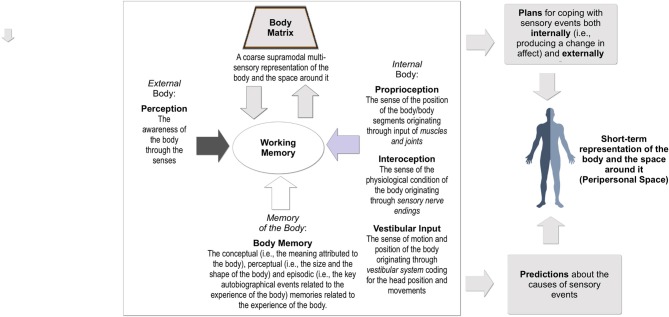
“…them both internally (i.e., producing a change in Frontiers in Human Neuroscience | www.frontiersin.org 2 February 2018 | Volume 12 | Article 49 FIGURE 1 | Multisensory integration of bodily signals. affect; Seth et al., 2012) and externally (i.e., by defining an action plan; Wang et al., 2014).”
BackgroundCognitive Behavior Therapy and Eating Disorders
Weiss, F. (2008) · American Journal of Psychotherapy · doi:10.1176/appi.psychotherapy.2008.62.4.422 · Cited by 838
Treasure, J., & Schmidt, U. (2013) · Journal of Eating Disorders · doi:10.1186/2050-2974-1-13 · Cited by 646
Culbert, K. M., Racine, S. E., & Klump, K. L. (2015) · Journal of Child Psychology and Psychiatry · doi:10.1111/jcpp.12441 · Cited by 642
An active inference theory of allostasis and interoception in depression
Barrett, L. F., Quigley, K. S., & Hamilton, P. (2016) · Philosophical Transactions of the Royal Society B: Biological Sciences · doi:10.1098/rstb.2016.0011 · Cited by 554
Lavender, J. M., Wonderlich, S. A., Engel, S. G., Gordon, K. H., Kaye, W. H., & Mitchell, J. E. (2015) · Clinical Psychology Review · doi:10.1016/j.cpr.2015.05.010 · Cited by 512 · cited 3×
“As reported by various authors, individuals with EDs have emotional (Bydlowski et al., 2005; Lavender et al., 2015), visual (Engel and Keizer, 2017; Feusner et al., 2017), tactile (Keizer et al., 2011; Gaudio et al., 2014), proprioceptive (Case et al., 2012; Guardia et al., 2012) and interoceptive…”
BackgroundMoseley, G. L., Gallace, A., & Spence, C. J. (2011) · Neuroscience & Biobehavioral Reviews · doi:10.1016/j.neubiorev.2011.03.013 · Cited by 464
Allocentric and Egocentric Updating of Spatial Memories.
Mou, W., McNamara, T. P., Valiquette, C. M., & Rump, B. (2004) · Journal of Experimental Psychology: Learning, Memory, and Cognition · doi:10.1037/0278-7393.30.1.142 · Cited by 359
Emotion-processing deficits in eating disorders
Bydlowski, S., Corcos, M., Jeammet, P., Paterniti, S., Berthoz, S., Laurier, C., Chambry, J., & Consoli, S. M. (2005) · International Journal of Eating Disorders · doi:10.1002/eat.20132 · Cited by 348
Caslini, M., Bartoli, F., Crocamo, C., Dakanalis, A., Clerici, M., & Carrà, G. (2016) · Psychosomatic Medicine · doi:10.1097/psy.0000000000000233 · Cited by 327
Self-citationSelf-objectification in women: Causes, consequences, and counteractions.
Calogero, R. M., Tantleff-Dunn, S., & Thompson, J. K. (2010) · American Psychological Association eBooks · doi:10.1037/12304-000 · Cited by 304
A Virtual Reality Full Body Illusion Improves Body Image Disturbance in Anorexia Nervosa
Keizer, A., van Elburg, A., Helms, R., & Dijkerman, H. C. (2016) · PLOS ONE · doi:10.1371/journal.pone.0163921 · Cited by 265
The neuroscience of body memory: From the self through the space to the others
Riva, G. (2017) · Cortex · doi:10.1016/j.cortex.2017.07.013 · Cited by 252
Self-citationPredictive coding and multisensory integration: an attentional account of the multisensory mind
Talsma, D. (2015) · Frontiers in Integrative Neuroscience · doi:10.3389/fnint.2015.00019 · Cited by 237
Dakanalis, A., Carrà, G., Calogero, R., Fida, R., Clerici, M., Zanetti, M. A., & Riva, G. (2015) · European Child & Adolescent Psychiatry · doi:10.1007/s00787-014-0649-1 · Cited by 230
Self-citationIntuitive eating is associated with interoceptive sensitivity. Effects on body mass index
Herbert, B. M., Blechert, J., Hautzinger, M., Matthias, E., & Herbert, C. (2013) · Appetite · doi:10.1016/j.appet.2013.06.082 · Cited by 220
Virtual Reality Body Swapping: A Tool for Modifying the Allocentric Memory of the Body
Serino, S., Pedroli, E., Keizer, A., Triberti, S., Dakanalis, A., Pallavicini, F., Chirico, A., & Riva, G. (2015) · Cyberpsychology Behavior and Social Networking · doi:10.1089/cyber.2015.0229 · Cited by 198
Self-citationBadoud, D., & Manos Tsakiris, A. (2017) · Neuroscience & Biobehavioral Reviews · doi:10.1016/j.neubiorev.2017.03.017 · Cited by 198
Gaudio, S., Brooks, S. J., & Riva, G. (2014) · PLoS ONE · doi:10.1371/journal.pone.0110087 · Cited by 182
Self-citationFrom efficacy to effectiveness to broad implementation: Evolution of the Body Project.
Becker, C. B., & Stice, E. M. (2017) · Journal of Consulting and Clinical Psychology · doi:10.1037/ccp0000204 · Cited by 181
Runfola, C. D., Von Holle, A., Trace, S. E., Brownley, K. A., Hofmeier, S. M., Gagne, D. A., & Bulik, C. M. (2013) · European Eating Disorders Review · doi:10.1002/erv.2201 · Cited by 179
Mölbert, S. C., Klein, L., Thaler, A., Mohler, B. J., Brozzo, C., Martus, P., Karnath, H., Zipfel, S., & Giel, K. E. (2017) · Clinical Psychology Review · doi:10.1016/j.cpr.2017.08.005 · Cited by 170
Tajadura-Jiménez, A., & Tsakiris, M. (2014) · Journal of Experimental Psychology: General · doi:10.1037/a0033171 · Cited by 167
Tactile body image disturbance in anorexia nervosa
Keizer, A., Smeets, M. A. M., Dijkerman, H. C., van den Hout, M., Klugkist, I. G., Elburg, A. A. V., & Postma, A. (2011) · Psychiatry Research · doi:10.1016/j.psychres.2011.04.031 · Cited by 163
Tajadura‐Jiménez, A., Banakou, D., Bianchi‐Berthouze, N., & Slater, M. (2017) · Scientific Reports · doi:10.1038/s41598-017-09497-3 · Cited by 156
A systematic review of multisensory cognitive–affective integration in schizophrenia
Tseng, H., Bossong, M. G., Modinos, G., Chen, K., McGuire, P. K., & Allen, P. (2015) · Neuroscience & Biobehavioral Reviews · doi:10.1016/j.neubiorev.2015.04.019 · Cited by 155
Gaudio, S., Wiemerslage, L., Brooks, S. J., & Schiöth, H. B. (2016) · Neuroscience & Biobehavioral Reviews · doi:10.1016/j.neubiorev.2016.09.032 · Cited by 154
Stice, E. M., Rohde, P., Shaw, H. E., & Gau, J. M. (2011) · Journal of Consulting and Clinical Psychology · doi:10.1037/a0024351 · Cited by 151
Stice, E. M. (2015) · Annual Review of Clinical Psychology · doi:10.1146/annurev-clinpsy-021815-093317 · Cited by 151
Preston, C., & Ehrsson, H. H. (2014) · PLoS ONE · doi:10.1371/journal.pone.0085773 · Cited by 148
Sexual objectification in women's daily lives: A smartphone ecological momentary assessment study
Holland, E., Koval, P., Stratemeyer, M., Thomson, F., & Haslam, N. (2016) · British Journal of Social Psychology · doi:10.1111/bjso.12152 · Cited by 136
Cooper, Z., & Fairburn, C. G. (2011) · Cognitive and Behavioral Practice · doi:10.1016/j.cbpra.2010.07.007 · Cited by 128
Neuroscience and eating disorders: The allocentric lock hypothesis
Riva, G. (2011) · Medical Hypotheses · doi:10.1016/j.mehy.2011.10.039 · Cited by 126
Self-citationGutiérrez‐Maldonado, J., Wiederhold, B. K., & Riva, G. (2015) · Cyberpsychology Behavior and Social Networking · doi:10.1089/cyber.2015.0412 · Cited by 115
Self-citationGrilo, C. M., Masheb, R. M., Brody, M. L., Burke‐Martindale, C. H., & Rothschild, B. S. (2005) · International Journal of Eating Disorders · doi:10.1002/eat.20130 · Cited by 110
Out of my real body: cognitive neuroscience meets eating disorders
Riva, G. (2014) · Frontiers in Human Neuroscience · doi:10.3389/fnhum.2014.00236 · Cited by 110
Self-citationEmbodied Medicine: Mens Sana in Corpore Virtuale Sano
Riva, G., Serino, S., Lernia, D. D., Pavone, E. F., & Dakanalis, A. (2017) · Frontiers in Human Neuroscience · doi:10.3389/fnhum.2017.00120 · Cited by 109
Self-citationRisk and maintenance factors for young women’s DSM-5 eating disorders
Dakanalis, A., Clerici, M., Bartoli, F., Caslini, M., Crocamo, C., Riva, G., & Carrà, G. (2017) · Archives of Women s Mental Health · doi:10.1007/s00737-017-0761-6 · Cited by 107
Self-citationObjectified body consciousness in relation to recovery from an eating disorder
Fitzsimmons‐Craft, E. E., Bardone‐Cone, A. M., & Kelly, K. A. (2011) · Eating Behaviors · doi:10.1016/j.eatbeh.2011.09.001 · Cited by 101
Illusory Obesity Triggers Body Dissatisfaction Responses in the Insula and Anterior Cingulate Cortex
Preston, C., & Ehrsson, H. H. (2016) · Cerebral Cortex · doi:10.1093/cercor/bhw313 · Cited by 101
Body-image distortion in anorexia nervosa
Dakanalis, A., Gaudio, S., Serino, S., Clerici, M., Carrà, G., & Riva, G. (2016) · Nature Reviews Disease Primers · doi:10.1038/nrdp.2016.26 · Cited by 100
Self-citationDiest, A. M. K. V., & Pérez, M. (2012) · Body Image · doi:10.1016/j.bodyim.2012.10.004 · Cited by 96
Allocentric lock in anorexia nervosa: New evidences from neuroimaging studies
Riva, G., & Gaudio, S. (2012) · Medical Hypotheses · doi:10.1016/j.mehy.2012.03.036 · Cited by 96
Self-citationAction planning and predictive coding when speaking
Wang, J., Mathalon, D. H., Roach, B. J., Reilly, J. L., Keedy, S., Sweeney, J. A., & Ford, J. M. (2014) · NeuroImage · doi:10.1016/j.neuroimage.2014.01.003 · Cited by 95
Calogero, R. M., Tylka, T. L., Donnelly, L. C., McGetrick, A., & Leger, A. M. (2017) · Body Image · doi:10.1016/j.bodyim.2017.02.008 · Cited by 92
The Neuropsychology of Self-Objectification
Riva, G., Gaudio, S., & Dakanalis, A. (2014) · European Psychologist · doi:10.1027/1016-9040/a000190 · Cited by 89
Self-citationRiva, G., & Gaudio, S. (2017) · Consciousness and Cognition · doi:10.1016/j.concog.2017.08.006 · Cited by 82
Self-citationEngel, M. M., & Keizer, A. (2017) · Scientific Reports · doi:10.1038/s41598-017-16362-w · Cited by 81
Case, L. K., Wilson, R. C., & Ramachandran, V. S. (2011) · Experimental Brain Research · doi:10.1007/s00221-011-2974-7 · Cited by 79
Dakanalis, A., Favagrossa, L., Clerici, M., Prunas, A., Colmegna, F., Zanetti, M. A., & Riva, G. (2014) · The Journal of Psychology · doi:10.1080/00223980.2013.842141 · Cited by 75
Self-citationObjectified Body Consciousness (OBC) in Eating Psychopathology
Dakanalis, A., Timko, C. A., Clerici, M., Riva, G., & Carrà, G. (2015) · Assessment · doi:10.1177/1073191115602553 · Cited by 72
Self-citationAn interoceptive model of bulimia nervosa: A neurobiological systematic review
Klabunde, M., Collado, D., & Bohon, C. (2017) · Journal of Psychiatric Research · doi:10.1016/j.jpsychires.2017.06.009 · Cited by 72
Dakanalis, A., Timko, C. A., Carrà, G., Clerici, M., Zanetti, M. A., Riva, G., & Caccialanza, R. (2014) · Appetite · doi:10.1016/j.appet.2014.07.022 · Cited by 71
Self-citationDakanalis, A., Clerici, M., Caslini, M., Gaudio, S., Serino, S., Riva, G., & Carrà, G. (2016) · International Journal of Eating Disorders · doi:10.1002/eat.22535 · Cited by 62
Self-citationBody distortions in Anorexia Nervosa: Evidence for changed processing of multisensory bodily signals
Zopf, R., Contini, E. W., Fowler, C., Mondraty, N., & Williams, M. (2016) · Psychiatry Research · doi:10.1016/j.psychres.2016.09.003 · Cited by 62
Out of body, out of space: Impaired reference frame processing in eating disorders
Serino, S., Dakanalis, A., Gaudio, S., Carrà, G., Cipresso, P., Clerici, M., & Riva, G. (2015) · Psychiatry Research · doi:10.1016/j.psychres.2015.10.025 · Cited by 61
Self-citationPredicting onset and maintenance of men's eating disorders
Dakanalis, A., Pla‐Sanjuanelo, J., Caslini, M., Volpato, C., Riva, G., Clerici, M., & Carrà, G. (2016) · International Journal of Clinical and Health Psychology · doi:10.1016/j.ijchp.2016.05.002 · Cited by 59
Self-citationProspective Psychosocial Predictors of Onset and Cessation of Eating Pathology amongst College Women
Dakanalis, A., Timko, C. A., Serino, S., Riva, G., Clerici, M., & Carrà, G. (2016) · European Eating Disorders Review · doi:10.1002/erv.2433 · Cited by 57
Self-citationRiva, G. (2016) · Frontiers in Human Neuroscience · doi:10.3389/fnhum.2016.00600 · Cited by 56
Self-citationCrossmodal illusions in neurorehabilitation
Bolognini, N., Russo, C., & Vallar, G. (2015) · Frontiers in Behavioral Neuroscience · doi:10.3389/fnbeh.2015.00212 · Cited by 55
The Role of Working Memory for Cognitive Control in Anorexia Nervosa versus Substance Use Disorder
Brooks, S. J., Funk, S. G., Young, S. Y., & Schiöth, H. B. (2017) · Frontiers in Psychology · doi:10.3389/fpsyg.2017.01651 · Cited by 53
A Novel Technique for Improving Bodily Experience in a Non-operable Super–Super Obesity Case
Serino, S., Scarpina, F., Keizer, A., Pedroli, E., Dakanalis, A., Castelnuovo, G., Chirico, A., Novelli, M., Gaudio, S., & Riva, G. (2016) · Frontiers in Psychology · doi:10.3389/fpsyg.2016.00837 · Cited by 47
Self-citationSpatial orientation constancy is impaired in anorexia nervosa
Guardia, D., Cottencin, O., Thomas, P., Dodin, V., & Luyat, M. (2011) · Psychiatry Research · doi:10.1016/j.psychres.2011.08.003 · Cited by 39
Riva, G. (1998) · Cyberpsychology, Behavior, and Social Networking · doi:10.1089/cpb.1998.1.129 · Cited by 39
Self-citationHerbozo, S., Schaefer, L. M., & Thompson, J. K. (2015) · Eating Behaviors · doi:10.1016/j.eatbeh.2015.01.007 · Cited by 34
A Principle for Learning Egocentric-Allocentric Transformation
Byrne, P., & Becker, S. (2007) · Neural Computation · doi:10.1162/neco.2007.10-06-361 · Cited by 32
Bodily illusions and weight-related disorders: Clinical insights from experimental research
Serino, S., & Dakanalis, A. (2016) · Annals of Physical and Rehabilitation Medicine · doi:10.1016/j.rehab.2016.10.002 · Cited by 32
Self-citationBody Image Disturbance and the Development of Eating Disorders
Kearney-Cooke, A. M., & Tieger, D. (2015) · doi:10.1002/9781118574089.ch22 · Cited by 31
Efforts to make clearer the relationship between body dissatisfaction and binge eating
Dakanalis, A., Carrà, G., Clerici, M., & Riva, G. (2014) · Eating and Weight Disorders - Studies on Anorexia Bulimia and Obesity · doi:10.1007/s40519-014-0152-1 · Cited by 29
Self-citationMultisensory integration induces body ownership of a handtool, but not any handtool
Weser, V. U., Finotti, G., Costantini, M., & Proffítt, D. R. (2017) · Consciousness and Cognition · doi:10.1016/j.concog.2017.07.002 · Cited by 19
Letter to the Editor: Virtual reality in the treatment of eating and weight disorders
Riva, G. (2017) · Psychological Medicine · doi:10.1017/s0033291717001441 · Cited by 19
Self-citationFeusner, J. D., Rangaprakash, D., & Strober, M. A. (2017) · International Journal of Eating Disorders · doi:10.1002/eat.22742 · Cited by 18
The Oxford Handbook of Eating Disorders, Second Edition
(2017) · Oxford University Press eBooks · doi:10.1093/oxfordhb/9780190620998.001.0001 · Cited by 18
The role of expectation in multisensory body representation – neural evidence
Ferri, F., Ambrosini, E., Pinti, P., Merla, A., & Costantini, M. (2017) · European Journal of Neuroscience · doi:10.1111/ejn.13629 · Cited by 17
Does owning a “fatter” virtual body increase body anxiety in college students?
Ferrer‐García, M., Porras-García, B., González-Ibañez, C., Gracia-Blanes, M., Vilalta‐Abella, F., Pla‐Sanjuanelo, J., Riva, G., Dakanalis, A., Achotegui-Loizate, J., Talarn, A., et al. (2017) · Dipòsit Digital de la Universitat de Barcelona (Universitat de Barcelona) · Cited by 16
Self-citationTowards novel paradigms for treating dysfunctional bodily experience in eating disorders
Dakanalis, A., Manzoni, G. M., Castelnuovo, G., Riva, G., & Clerici, M. (2017) · Eating and Weight Disorders - Studies on Anorexia Bulimia and Obesity · doi:10.1007/s40519-017-0361-5 · Cited by 14
Self-citationEffect of the mood produced by virtual reality exposure on body image disturbances.
Ferrer‐García, M., & Gutiérrez‐Maldonado, J. (2010) · PubMed · Cited by 8
Effect of the mood produced by virtual reality exposure on body image disturbances
Marta, F.-G. I. A., & eacute, G. E. R.-M. J. (2010) · Studies in health technology and informatics · doi:10.3233/978-1-60750-561-7-44 · Cited by 3
Research works printed but not linked: 2
- Gutiérrez-Maldonado, 2017, Virtual reality: applications to eating disorders, 146
- Riva, A healthy mind in a healthy virtual body: the future of virtual health care, 3
Cited by
Sorted by citations
Neuroscience of virtual reality: from virtual exposure to embodied medicine
Riva, G., Wiederhold, B. K., & Mantovani, F. (2019) · Cyberpsychology, Behavior, and Social Networking · doi:10.1089/cyber.2017.29099.gri · Cited by 608
Self-citationNeuroimaging the consciousness of self: Review, and conceptual-methodological framework
Frewen, P., Schroeter, M. L., Riva, G., Cipresso, P., Fairfield, B., Padulo, C., Kemp, A. H., Palaniyappan, L. K., Owolabi, M. O., Kusi‐Mensah, K., et al. (2020) · Neuroscience & Biobehavioral Reviews · doi:10.1016/j.neubiorev.2020.01.023 · Cited by 186
Self-citationWhat the Metaverse Is (Really) and Why We Need to Know About It
Riva, G., & Wiederhold, B. K. (2022) · Cyberpsychology Behavior and Social Networking · doi:10.1089/cyber.2022.0124 · Cited by 172
Self-citationVirtual reality in the treatment of eating disorders
Riva, G., Malighetti, C., & Serino, S. (2021) · Clinical Psychology & Psychotherapy · doi:10.1002/cpp.2622 · Cited by 138
Self-citationThe promise of the metaverse in mental health: the new era of MEDverse
Cerasa, A., Gaggioli, A., Marino, F., Riva, G., & Pioggia, G. (2022) · Heliyon · doi:10.1016/j.heliyon.2022.e11762 · Cited by 129
Self-citation
Metadata
- Authors
- Riva, G., & Dakanalis, A.
- Affiliations
- Università Cattolica del Sacro Cuore (IT)
- University of Pavia (IT)
- Corresponding author
- Riva, Giuseppe
- Venue
- Frontiers in Human Neuroscience
- Publisher
- Frontiers Media SA
- Published
- 2018-02-12
- Volume
- 12
- Pages
- 49-49
- ISSN
- 1662-5161 (ISSN-L)
- PMC
- PMC5816057
- OpenAlex
- W2789205455
- Cited by
- 103
- References
- 85
- Citations by year
- 2026: 7 · 2025: 12 · 2024: 18 · 2023: 19 · 2022: 11 · 2021: 5 · 2020: 15 · 2019: 10 · 2018: 6
- FWCI
- 10.58
- Type
- journal article
- Language
- en
- Open access
- gold
- doi.org
- Locations
- Frontiers in Human Neuroscience (publishedVersion, cc-by)
- Europe PMC (PubMed Central) (publishedVersion, cc-by)
- PubMed Central (publishedVersion, cc-by)
- PubMed (publishedVersion)
- BOA (University of Milano-Bicocca) (submittedVersion, cc-by)
- DOAJ (DOAJ: Directory of Open Access Journals) (submittedVersion, cc-by-sa)
- PubliCatt (Università Cattolica del Sacro Cuore) (submittedVersion, other-oa)
- Funders
- Ministero dell’Istruzione, dell’Università e della Ricerca (201597WTTM)
- Topics
- Social Sciences › Psychology › Clinical Psychology › Eating Disorders and Behaviors
- Health Sciences › Medicine › Psychiatry and Mental health › Psychosomatic Disorders and Their Treatments
- Health Sciences › Nursing › Nutrition and Dietetics › Nutrition, Health and Food Behavior
- Keywords
- eating disorders, representation of the body, interoception, cross-modal associations, autobiographical memory, virtual reality, brain stimulation, body perception, etiology of eating disorders
About these checks
Registry, retraction, Cites and statistics results are computed, not judged, with one exception: a printed reference that no index lists is read once by a model before it counts as a citation error. Claims are extracted by a model and kept only when their quote appears verbatim in the text; each cited source is then checked, with a model’s help, for whether it says what the claim relies on. Those verdicts can be wrong — read the claim’s quote and the cited source before relying on one.
Statistics and arithmetic are recomputed, not judged.
Confidence bands are shown only for fields calibrated on our annotated test set. None is calibrated yet, so no band is shown.
What counts as a claim ›How we measure confidence ›How we check this ›
Are you an author, or do you see a problem with this page? Request a review
