

The DOI matches its Crossref record; 225 of the 225 references it cites were found in a registry or an index.
Metabolic disturbances connecting obesity and depression
Open accessAbstract
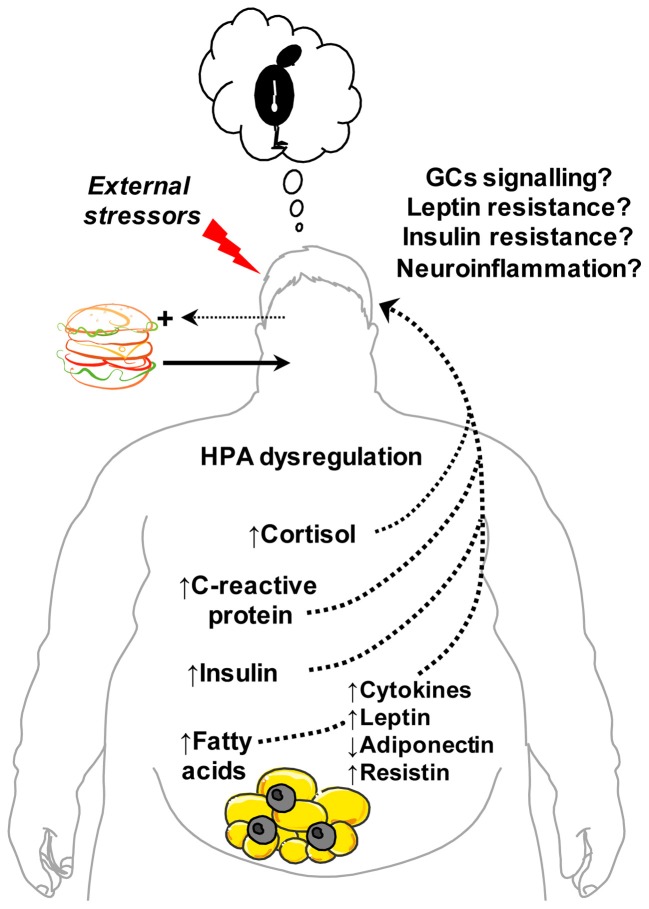
Obesity markedly increases the odds of developing depression. Depressed mood not only impairs motivation, quality of life and overall functioning but also increases the risks of obesity complications. Abdominal obesity is a better predictor of depression and anxiety risk than overall adipose mass. A growing amount of research suggests that metabolic abnormalities stemming from central obesity that lead to metabolic disease may also be responsible for the increased incidence of depression in obesity. As reviewed here, a higher mass of dysfunctional adipose tissue is associated with several metabolic disturbances that are either directly or indirectly implicated in the control of emotions and mood. To better comprehend the development of depression in obesity, this review pulls together select findings addressing the link between adiposity, diet and negative emotional states and discusses the evidence that alterations in glucocorticoids, adipose-derived hormones, insulin and inflammatory signaling that are characteristic of central obesity may be involved.
Overview
The claims and statistics of this paper haven’t been checked yet.
Run the check — free, no account needed. It reads the open-access text and checks the sources it cites.
Integrity signals
Registry
Cites
Statistics
Figures
Verification
Claims the paper makes
The claims and statistics of this paper haven’t been checked yet.
Run the check — free, no account needed. It reads the open-access text and checks the sources it cites.
Claims other papers make about this one
Each is checked against this paper’s own text: does it say what the citing paper says it does?
The source backs part of the claim, not all of it — or backs it for a different population, condition or comparison.
In the citing paper
“Moreover, increased cardio-metabolic dysfunction has been associated with worse mental and cognitive symptoms in those with schizophrenia [98], MDD [99], bipolar disorder [100] and binge eating disorder [101].”
From Exercise as Medicine for Mental and Substance Use Disorders: A Meta-review of the Benefits for Neuropsychiatric and Cognitive Outcomes (2020) · cites this paper as [99]
Experimental — accuracy not yet measured
Self-check
Percentages, sums and reported differences re-computed from the paper’s own numbers.
The self-check needs the paper’s full text.
Citations
Cites
1 retracted
RETRACTED: Primary Prevention of Cardiovascular Disease with a Mediterranean Diet
Estruch, R., Ros, E., Salas-Salvadó, J., Covas, M.-I., Corella, D., Arós, F., Gómez-Gracia, E., Ruiz-Gutiérrez, V., Fiol, M., Lapetra, J., et al. (2013) · New England Journal of Medicine · doi:10.1056/nejmoa1200303 · Cited by 4,257
RetractedYaşlı Kadınlarda Üreme Sağlığı
Kokanalı, D., & Engin Üstün, Y. (n.d.) · DergiPark (Istanbul University) · Cited by 170,090
From inflammation to sickness and depression: when the immune system subjugates the brain
Dantzer, R., O'Connor, J. C., Freund, G. G., Johnson, R. W., & Kelley, K. W. (2008) · Nature Reviews Neuroscience · doi:10.1038/nrn2297 · Cited by 7,395
Paradoxical Decrease of an Adipose-Specific Protein, Adiponectin, in Obesity
Arita, Y., Kihara, S., Ouchi, N., Takahashi, M., Maeda, K., Miyagawa, J.-I., Hotta, K., Shimomura, I., Nakamura, T., Miyaoka, K., et al. (1999) · Biochemical and Biophysical Research Communications · doi:10.1006/bbrc.1999.0255 · Cited by 4,856
The hormone resistin links obesity to diabetes
Steppan, C. M., Bailey, S. T., Bhat, S., Brown, E. J., Banerjee, R. R., Wright, C. M., Patel, H. R., Ahima, R. S., & Lazar, M. A. (2001) · Nature · doi:10.1038/35053000 · Cited by 4,755
Colman (2022) · doi:10.1073/pnas · Cited by 4,370
Abdominal obesity and metabolic syndrome
Després, J.-P., & Lemieux, I. (2006) · Nature · doi:10.1038/nature05488 · Cited by 4,354
Overweight, Obesity, and Depression: A Systematic Review and Meta-analysis of Longitudinal Studies
Luppino, F. S., de Wit, L. M., Bouvy, P. F., Stijnen, T., Cuijpers, P., Penninx, B. W. J. H., & Zitman, F. G. (2010) · Archives of General Psychiatry · doi:10.1001/archgenpsychiatry.2010.2 · Cited by 4,322
The Prevalence of Comorbid Depression in Adults With Diabetes
Anderson, R. J., Freedland, K. E., Clouse, R. E., & Lustman, P. J. (2001) · Diabetes Care · doi:10.2337/diacare.24.6.1069 · Cited by 3,926
Maffei, M., Halaas, J., Ravussin, E., Pratley, R. E., Lee, G. H., Zhang, Y., Fei, H., Kim, S., Lallone, R., Ranganathan, S., et al. (1995) · Nature Medicine · doi:10.1038/nm1195-1155 · Cited by 3,725
Research works printed but not linked: 1
- Liu J. Garza J. C. Bronner J. Kim C. S. Zhang W. Lu X. Y. (2010b). Acute administration of leptin produces anxiolytic-like effects: a comparison with fluoxetine. Psychopharmacology (Berl.) 207, 535– 545 10.1007/s00213-009-1684-3 19823809 PMC4057895 · DOI
Cited by
Sorted by citations
Intermittent metabolic switching, neuroplasticity and brain health
Mattson, M. P., Moehl, K., Ghena, N., Schmaedick, M., & Cheng, A. (2018) · Nature Reviews Neuroscience · doi:10.1038/nrn.2017.156 · Cited by 624
Obesity-Induced Cellular Senescence Drives Anxiety and Impairs Neurogenesis
Ogrodnik, M., Zhu, Y., Langhi, L. G. P., Tchkonia, T., Krüger, P., Fielder, E., Victorelli, S., Ruswhandi, R. A., Giorgadze, N., Pirtskhalava, T., et al. (2019) · Cell Metabolism · doi:10.1016/j.cmet.2018.12.008 · Cited by 536
The Rodent Forced Swim Test Measures Stress-Coping Strategy, Not Depression-like Behavior
Commons, K. G., Cholanians, A. B., Babb, J. A., & Ehlinger, D. G. (2017) · ACS Chemical Neuroscience · doi:10.1021/acschemneuro.7b00042 · Cited by 525
Ashdown-Franks, G., Firth, J., Carney, R., Carvalho, A. F., Hallgren, M., Koyanagi, A., Rosenbaum, S., Schuch, F. B., Smith, L., Solmi, M., et al. (2020) · Sports Medicine · doi:10.1007/s40279-019-01187-6 · Cited by 460
De Luca, M., Angrisani, L., Himpens, J., Busetto, L., Scopinaro, N., Weiner, R., Sartori, A., Stier, C., Lakdawala, M., Bhasker, A. G., et al. (2016) · Obesity Surgery · doi:10.1007/s11695-016-2271-4 · Cited by 296
Metadata
- Authors
- Hryhorczuk, C., Sharma, S., & Fulton, S. E.
- Affiliations
- Université de Montréal (CA)
- Corresponding author
- Fulton, Stephanie E.
- Venue
- Frontiers in Neuroscience
- Publisher
- Frontiers Media SA
- Published
- 2013
- Volume
- 7
- Pages
- 177-177
- ISSN
- 1662-453X (ISSN-L)
- PMC
- PMC3791387
- OpenAlex
- W2100391099
- Cited by
- 322
- References
- 225
- Citations by year
- 2026: 18 · 2025: 30 · 2024: 22 · 2023: 20 · 2022: 28 · 2021: 27 · 2020: 32 · 2019: 35 · 2018: 17 · 2017: 21 · 2016: 20 · 2015: 26 · 2014: 26
- FWCI
- 2.85
- Type
- journal article
- Language
- en
- Open access
- gold
- doi.org
- Licence
- cc-by
- Locations
- Frontiers in Neuroscience (publishedVersion, cc-by)
- Europe PMC (PubMed Central) (publishedVersion, cc-by)
- PubMed Central (publishedVersion, cc-by)
- PubMed (publishedVersion)
- DOAJ (DOAJ: Directory of Open Access Journals) (submittedVersion, cc-by-sa)
- Topics
- Health Sciences › Medicine › Endocrinology, Diabetes and Metabolism › Adipokines, Inflammation, and Metabolic Diseases
- Life Sciences › Neuroscience › Endocrine and Autonomic Systems › Regulation of Appetite and Obesity
- Life Sciences › Neuroscience › Biological Psychiatry › Tryptophan and brain disorders
- Keywords
- obesity, depression, abdominal obesity, metabolic disorders, glucocorticoids, adipokines, insulin resistance, inflammation, diet, mood regulation, anxiety
About these checks
Registry, retraction, Cites and statistics results are computed, not judged, with one exception: a printed reference that no index lists is read once by a model before it counts as a citation error. Claims are extracted by a model and kept only when their quote appears verbatim in the text; each cited source is then checked, with a model’s help, for whether it says what the claim relies on. Those verdicts can be wrong — read the claim’s quote and the cited source before relying on one.
Statistics and arithmetic are recomputed, not judged.
Confidence bands are shown only for fields calibrated on our annotated test set. None is calibrated yet, so no band is shown.
What counts as a claim ›How we measure confidence ›How we check this ›
Are you an author, or do you see a problem with this page? Request a review
