

The autonomic nervous system: A potential link to the efficacy of acupuncture
Open accessThe DOI matches its Crossref record; 94 of the 96 references it cites were found in a registry or an index.
Abstract
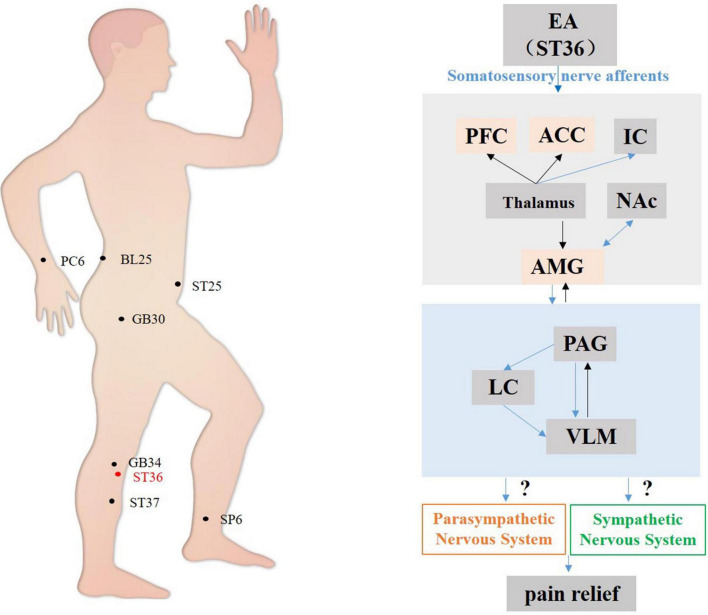
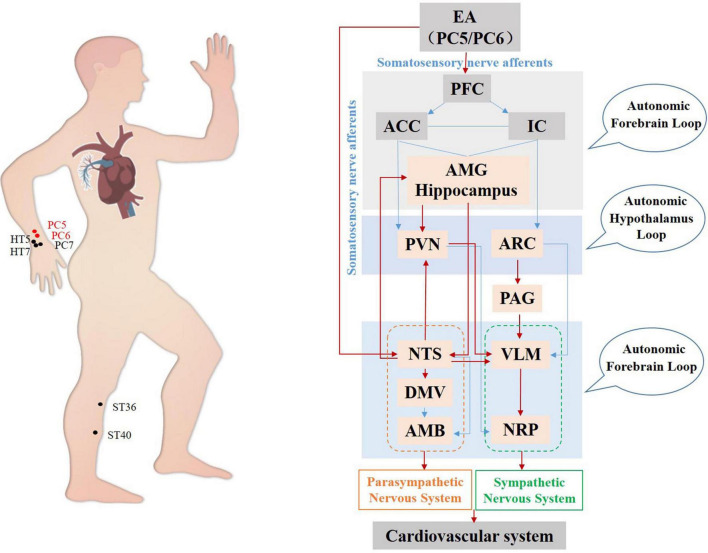
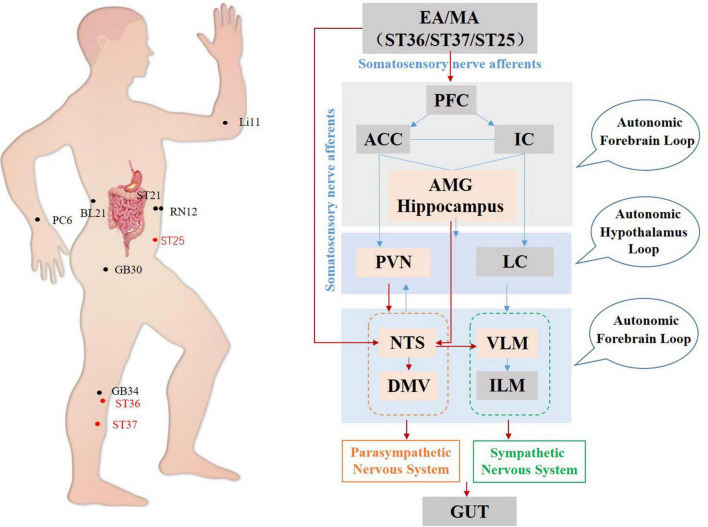
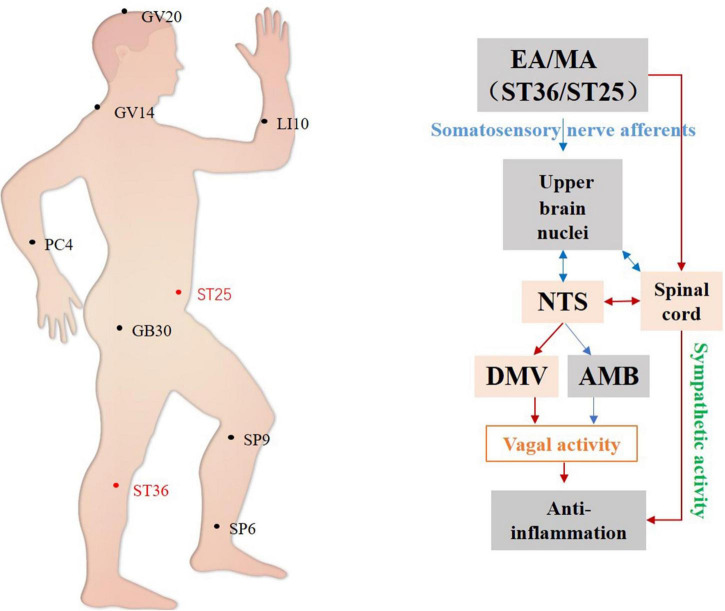
The autonomic nervous system (ANS) is a diffuse network that regulates physiological systems to maintain body homeostasis by integrating inputs from the internal and external environment, including the sympathetic, parasympathetic, and enteric nervous systems (ENS). Recent evidence suggests that ANS is one of the key neural pathways for acupuncture signal transduction, which has attracted worldwide attention in the acupuncture field. Here, we reviewed the basic and clinical research published in PubMed over the past 20 years on the effects of acupuncture on ANS regulation and homeostasis maintenance. It was found that acupuncture effectively alleviates ANS dysfunction-associated symptoms in its indications, such as migraine, depression, insomnia, functional dyspepsia, functional constipation. Acupuncture stimulation on some specific acupoints activates sensory nerve fibers, the spinal cord, and the brain. Using information integration and efferents from a complex network of autonomic nuclei of the brain, such as the insular cortex (IC), prefrontal cortex, anterior cingulate cortex (ACC), amygdala (AMG), hypothalamus, periaqueductal gray (PAG), nucleus tractus solitarius (NTS), ventrolateral medulla (VLM), nucleus ambiguus (AMB), acupuncture alleviates visceral dysfunction, inflammation via efferent autonomic nerves, and relieves pain and pain affect. The modulating pattern of sympathetic and parasympathetic nerves is associated with acupuncture stimulation on specific acupoints, intervention parameters, and disease models, and the relationships among them require further exploration. In conclusion, ANS is one of the therapeutic targets for acupuncture and mediates acupuncture’s actions, which restores homeostasis. A systemic study is needed to determine the rules and mechanisms underlying the effects of acupoint stimulation on corresponding organs mediated by specific central nervous networks and the efferent ANS.
Overview
The claims and statistics of this paper haven’t been checked yet.
Free: it reads the open-access text and checks the first 5 claims that cite a source we can check. Create a free account to check every claim.
Integrity signals
Registry
Cites
Statistics
Figures
Verification
Claims the paper makes
The claims and statistics of this paper haven’t been checked yet.
Free: it reads the open-access text and checks the first 5 claims that cite a source we can check. Create a free account to check every claim.
Claims other papers make about this one
Each is checked against this paper’s own text: does it say what the citing paper says it does?
The source backs part of the claim, not all of it — or backs it for a different population, condition or comparison.
In the citing paper
“we injected cholera toxin subunit B (CTB) into the liver and traced it back to the brain a week later, observing a fluorescent signal in the cholinergic neuron‐rich DMV area,[ 12 ] we observed colocalization of fluorescent signals with an anti‐choline acetyltransferase (ChAT) antibody (Figure 2A–C).”
From Electroacupuncture Promotes Liver Regeneration by Activating DMV Acetylcholinergic Neurons-Vagus-Macrophage Axis in 70% Partial Hepatectomy of Mice (2024) · cites this paper as [12]
Experimental — accuracy not yet measured
Self-check
Percentages, sums and reported differences re-computed from the paper’s own numbers.
The self-check needs the paper’s full text.
Citations
Cites
Vagus nerve stimulation attenuates the systemic inflammatory response to endotoxin
Borovikova, L. V., Ivanova, S., Zhang, M., Yang, H., Botchkina, G. I., Watkins, L. R., Wang, H., Abumrad, N., Eaton, J. W., & Tracey, K. J. (2000) · Nature · doi:10.1038/35013070 · Cited by 4,211 · cited 1×
“Typically, in acute inflammatory states, the HPA axis and SNS act synergistically or are coupled to each other, leading to enhanced release of cortisol and SNS neurotransmitters, which contribute to the regulation of immune cell activity (Borovikova et al., 2000; Straub, 2004).”
BackgroundKemp, A. H., Quintana, D. S., Gray, M. A., Felmingham, K. L., Brown, K., & Gatt, J. M. (2010) · Biological Psychiatry · doi:10.1016/j.biopsych.2009.12.012 · Cited by 1,286 · cited 7×
“A meta-analysis of 18 studies, including 673 depressed and 407 healthy people, found a negative correlation between depression severity and HRV (Kemp et al., 2010).”
MethodInfluentialMechanisms of Acupuncture–Electroacupuncture on Persistent Pain
Zhang, R., Lao, L., Ren, K., & Berman, B. M. (2014) · Anesthesiology · doi:10.1097/aln.0000000000000101 · Cited by 919 · cited 1×
“the ascending activating system and descending inhibition system (Zhang et al., 2014).”
BackgroundAutonomic innervation and regulation of the immune system (1987–2007)
Nance, D. M., & Sanders, V. M. (2007) · Brain, Behavior, and Immunity · doi:10.1016/j.bbi.2007.03.008 · Cited by 855 · cited 1×
“For instance, the ANS regulates the immune system by innervating immune organs such as the spleen, thymus, and lymph nodes and regulates the gastrointestinal tract, bladder, heart, and other organs by releasing neurotransmitters such as acetylcholine and norepinephrine that contribute to the maintenance of homeostasis…”
A neuroanatomical basis for electroacupuncture to drive the vagal–adrenal axis
Liu, S., Wang, Z., Su, Y., Qi, L., Yang, W., Fu, M., Jing, X., Wang, Y., & Ma, Q. (2021) · Nature · doi:10.1038/s41586-021-04001-4 · Cited by 823
Dopamine mediates vagal modulation of the immune system by electroacupuncture
Torres-Rosas, R., Yehia, G., Peña, G., Mishra, P., del Rocio Thompson-Bonilla, M., Moreno-Eutimio, M. A., Arriaga-Pizano, L. A., Isibasi, A., & Ulloa, L. (2014) · Nature Medicine · doi:10.1038/nm.3479 · Cited by 630 · cited 3×
“The target organs may be modified due to activating efferent nerves or neuro-endocrine pathways (Torres-Rosas et al., 2014; Liu S. et al., 2020, Liu et al., 2021; Ulloa, 2021, 2022).”
BackgroundSelf-citationThe vagus nerve and the nicotinic anti-inflammatory pathway
Ulloa, L. (2005) · Nature Reviews Drug Discovery · doi:10.1038/nrd1797 · Cited by 468 · cited 1×
“The ANS can regulate acute and chronic inflammatory responses at local and systemic levels (Ulloa, 2005).”
BackgroundSelf-citationYang, S., & Chang, M. C. (2019) · International Journal of Molecular Sciences · doi:10.3390/ijms20133130 · Cited by 408 · cited 1×
“Based on the underlying functional pathways and physiological roles of the ANS, we speculate that the ANS plays a significant role in the central nervous circuit activated by acupuncture, leading to the modulation of cardiovascular and gastrointestinal functions, as well as anti-inflammatory and analgesic functions (S…”
BackgroundLiu, S., Wang, Z.-F., Su, Y.-S., Ray, R. S., Jing, X.-H., Wang, Y.-Q., & Ma, Q. (2020) · Neuron · doi:10.1016/j.neuron.2020.07.015 · Cited by 385
Cardiac vagal control in depression: A critical analysis
Rottenberg, J. (2007) · Biological Psychology · doi:10.1016/j.biopsycho.2005.08.010 · Cited by 376 · cited 2×
“For instance, a meta-analysis of 13 rigorous cross-sectional studies, including 312 depressed and 374 non-depressed patients, showed an association between a diagnosis of depression and mild-to-moderate changes in cardiac vagal control, with resting vagal control being significantly reduced in depressed patients compa…”
BackgroundResult
Cited by
The immunomodulatory mechanisms for acupuncture practice
Wang, M., Liu, W., Ge, J., & Liu, S. (2023) · Frontiers in Immunology · doi:10.3389/fimmu.2023.1147718 · Cited by 172
“Frontiers in Immunology 06 inflammation, analgesic anesthesia,and more (84).”
BackgroundEffects of TCM on polycystic ovary syndrome and its cellular endocrine mechanism
Chen, H., Deng, C., Meng, Z., & Meng, S. (2023) · Frontiers in Endocrinology · doi:10.3389/fendo.2023.956772 · Cited by 61
“Acupuncture can control the function of the autonomic nervous system (ANS); it can balance the sympathetic and parasympathetic nerve activity, regulate the adaptive neurotransmitters in related brain regions, and reduce the autonomic response, which has been proved to have a certain curative effect on PCOS patients (1…”
BackgroundObjectivization study of acupuncture Deqi and brain modulation mechanisms: a review
Zhong, Z., Yao, L., Liu, Y., Wang, Y., He, M., Sun, M., Huang, H., Ma, S., Zheng, H., Li, M., et al. (2024) · Frontiers in Neuroscience · doi:10.3389/fnins.2024.1386108 · Cited by 46
Jiang, T., Chen, Z., Liu, J., Yin, X.-J., Tan, Z., Wang, G. G., Ли, Б., & Guo, J. (2024) · BMC Complementary Medicine and Therapies · doi:10.1186/s12906-024-04612-0 · Cited by 38
“The ACC, amygdala, and thalamus all belong to the autonomic nuclei of the brain and are affected by inputs from the internal and external environments [89].”
BackgroundGuo, J., Guo, J., Rao, X., Zhang, R., Li, Q., Zhang, K., Ma, S., Zhao, J., & Ji, C. (2024) · Frontiers in Microbiology · doi:10.3389/fmicb.2024.1456848 · Cited by 32
Metadata
- Authors
- Li, Y.-W., Li, W., Wang, S.-T., Gong, Y.-N., Dou, B.-M., Lyu, Z.-X., Ulloa, L., Wang, S.-J., Xu, Z.-F., & Guo, Y.
- Affiliations
- Tianjin University of Traditional Chinese Medicine (CN)
- Duke University (US)
- Corresponding author
- Wang, Shen-Jun
- Guo, Yi
- Venue
- Frontiers in Neuroscience
- Publisher
- Frontiers Media SA
- Published
- 2022-12-08
- Volume
- 16
- Pages
- 1038945-1038945
- ISSN
- 1662-453X (ISSN-L)
- PMC
- PMC9772996
- OpenAlex
- W4311858759
- Cited by
- 141
- References
- 96
- Citations by year
- 2026: 48 · 2025: 53 · 2024: 29 · 2023: 11
- FWCI
- 5.39
- Type
- journal article
- Language
- en
- Open access
- gold
- doi.org
- Licence
- Locations
- Frontiers in Neuroscience (publishedVersion, cc-by)
- PubMed Central (publishedVersion, cc-by)
- PubMed (publishedVersion)
- DOAJ (DOAJ: Directory of Open Access Journals) (submittedVersion, cc-by-sa)
- Funders
- National Natural Science Foundation of China (82030125, 81873369)
- Topics
- Health Sciences › Medicine › Complementary and alternative medicine › Acupuncture Treatment Research Studies
- Life Sciences › Neuroscience › Neurology › Vagus Nerve Stimulation Research
- Health Sciences › Medicine › Complementary and alternative medicine › Traditional Chinese Medicine Studies
- Keywords
- acupuncture, autonomic nervous system, homeostasis, sympathetic nervous system, parasympathetic nervous system, enteric nervous system, acupoint stimulation, migraine, depression, insomnia, functional dyspepsia, functional constipation, visceral dysfunction, inflammation, pain, insula, anterior cingulate cortex, amygdala, nucleus tractus solitarius, nucleus ambiguus, periaqueductal gray, ventrolateral medulla
About these checks
Registry, retraction, Cites and statistics results are computed, not judged, with one exception: a printed reference that no index lists is read once by a model before it counts as a citation error. Claims are extracted by a model and kept only when their quote appears verbatim in the text; each cited source is then checked, with a model’s help, for whether it says what the claim relies on. Those verdicts can be wrong — read the claim’s quote and the cited source before relying on one.
Statistics and arithmetic are recomputed, not judged.
Confidence bands are shown only for fields calibrated on our annotated test set. None is calibrated yet, so no band is shown.
What counts as a claim ›How we measure confidence ›How we check this ›
Are you an author, or do you see a problem with this page? Request a review
Data sources
Bibliographic data: Semantic Scholar, OpenAlex, Crossref.
Contains information from the Semantic Scholar Academic Graph Datasets, made available under the ODC Attribution License (ODC-BY 1.0).
Semantic Scholar’s data is described in: Kinney, R., et al. (2023). The Semantic Scholar Open Data Platform. arXiv:2301.10140.
