

The DOI matches its Crossref record; 230 of the 230 references it cites were found in a registry or an index.
Investigating the crosstalk between chronic stress and immune cells: implications for enhanced cancer therapy
Open accessAbstract
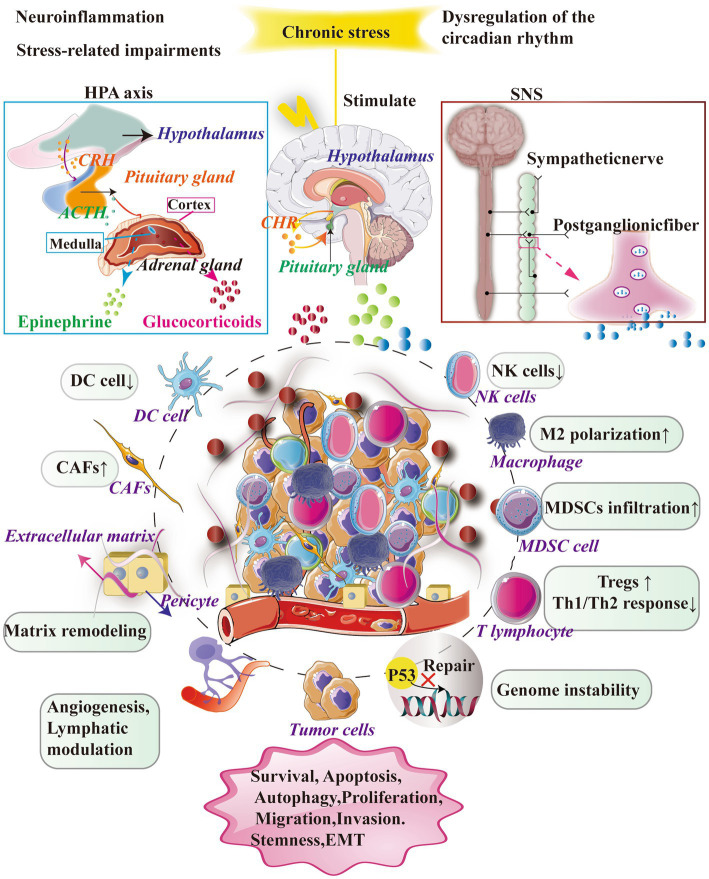
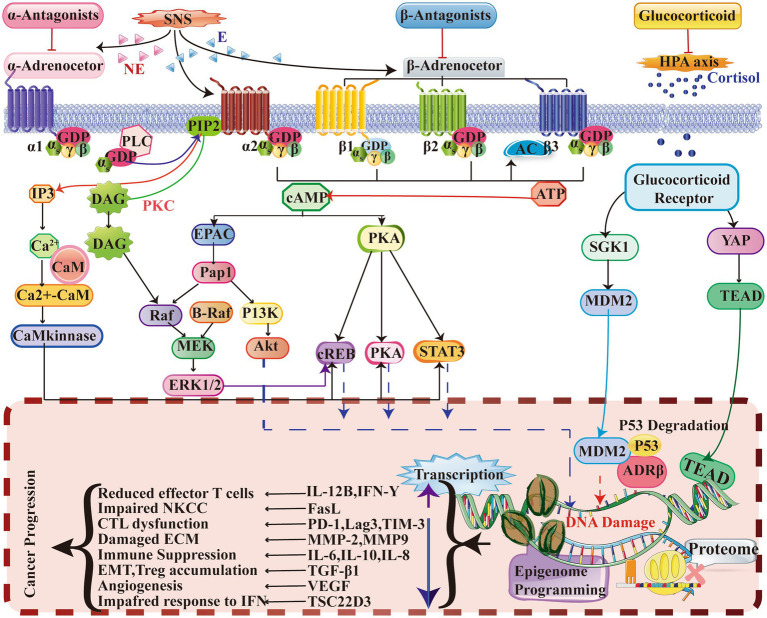
Chronic stress has a substantial influence on the tumor microenvironment (TME), leading to compromised effectiveness of anti-cancer therapies through diverse mechanisms. It disrupts vital functions of immune cells that play a critical role in anti-tumor immunity, such as the inhibition of dendritic cells (DCs) and lymphocytes, while simultaneously enhancing the activity of immune cells that support tumor growth, such as myeloid-derived suppressor cells and tumor-associated macrophages. Furthermore, chronic stress exerts a significant impact on crucial mechanisms within the TME, including angiogenesis, DNA repair, hypoxia, extracellular matrix deposition, and tumor metabolism. These alterations in the TME, induced by stress, result from the activation of the hypothalamic–pituitary–adrenal axis and sympathetic nervous system, in conjunction with epigenetic modifications. In conclusion, chronic stress significantly influences the TME and impedes the efficacy of anti-cancer treatments, underscoring the importance of targeting stress pathways to improve therapeutic results.
Overview
The claims and statistics of this paper haven’t been checked yet.
Run the check — free, no account needed. It reads the open-access text and checks the sources it cites.
Integrity signals
Registry
Cites
Statistics
Figures
Verification
Claims the paper makes
The claims and statistics of this paper haven’t been checked yet.
Run the check — free, no account needed. It reads the open-access text and checks the sources it cites.
Claims other papers make about this one
Each is checked against this paper’s own text: does it say what the citing paper says it does?
In the citing paper
“Chronic stress disrupts the critical immune cell functions involved in anti-tumor immunity, inhibiting dendritic cells and lymphocytes, while enhancing the activity of tumor-supportive cells such as myeloid-derived suppressor cells and tumor-associated macrophages [65].”
From Comprehensive review of chronic stress pathways and the efficacy of behavioral stress reduction programs (BSRPs) in managing diseases. (2024) · cites this paper as [65]
Self-check
Percentages, sums and reported differences re-computed from the paper’s own numbers.
The self-check needs the paper’s full text.
Citations
Cites
2 retracted
Kamiya, A., Hayama, Y., Kato, S., Shimomura, A., Shimomura, T., Irie, K., Kaneko, R., Yanagawa, Y., Kobayashi, K., & Ochiya, T. (2019) · Nature Neuroscience · doi:10.1038/s41593-019-0430-3 · Cited by 288
RetractedZhou, Z., Yan, S., Bao, H., Han, S., Liu, Z., Zhao, N., Yuan, W., Jian, C., & Shu, X. (2022) · Journal of Translational Medicine · doi:10.1186/s12967-022-03467-8 · Cited by 83
RetractedElements of cancer immunity and the cancer–immune set point
Chen, D. S., & Mellman, I. (2017) · Nature · doi:10.1038/nature21349 · Cited by 5,352
Inflammation and cancer: triggers, mechanisms, and consequences
Greten, F. R., & Grivennikov, S. I. (2019) · Immunity · doi:10.1016/j.immuni.2019.06.025 · Cited by 3,806
Macrophages as regulators of tumour immunity and immunotherapy
DeNardo, D. G., & Ruffell, B. (2019) · Nature reviews. Immunology · doi:10.1038/s41577-019-0127-6 · Cited by 2,619
Targeting macrophages: therapeutic approaches in cancer
Cassetta, L., & Pollard, J. W. (2018) · Nature Reviews Drug Discovery · doi:10.1038/nrd.2018.169 · Cited by 2,101
Turning foes to friends: targeting cancer-associated fibroblasts
Chen, X., & Song, E. (2018) · Nature Reviews Drug Discovery · doi:10.1038/s41573-018-0004-1 · Cited by 1,929
Macrophages as tools and targets in cancer therapy
Mantovani, A., Allavena, P., Marchesi, F., & Garlanda, C. (2022) · Nature Reviews Drug Discovery · doi:10.1038/s41573-022-00520-5 · Cited by 1,807
Therapeutic Targeting of the Tumor Microenvironment
Bejarano, L., Jordão, M. J. C., & Joyce, J. A. (2021) · Cancer Discovery · doi:10.1158/2159-8290.cd-20-1808 · Cited by 1,720
CD4+ T cell help in cancer immunology and immunotherapy
Borst, J., Ahrends, T., Bąbała, N., Melief, C. J. M., & Kastenmüller, W. (2018) · Nature Reviews Immunology · doi:10.1038/s41577-018-0044-0 · Cited by 1,585
Cited by
Sorted by citations
Immunology of stress: A review article
Alotiby, A. (2024) · Journal of Clinical Medicine · doi:10.3390/jcm13216394 · Cited by 253
Shchaslyvyi, A. Y., Antonenko, S. V., & Telegeev, G. D. (2024) · International Journal of Environmental Research and Public Health · doi:10.3390/ijerph21081077 · Cited by 73
Wang, L., Ge, J., Han, H., Jia, Y., & Qin, Y. (2024) · Cancer Letters · doi:10.1016/j.canlet.2024.216986 · Cited by 50
Pancreatic cancer: molecular pathogenesis and emerging therapeutic strategies
Rozengurt, E., & Eibl, G. (2026) · Signal Transduction and Targeted Therapy · doi:10.1038/s41392-025-02499-y · Cited by 49
Mitochondrial regulation in the tumor microenvironment: targeting mitochondria for immunotherapy
Ahn, M., Ali, A., & Seo, J. H. (2024) · Frontiers in Immunology · doi:10.3389/fimmu.2024.1453886 · Cited by 33
Chronic Psychological Stress in Oncogenesis: Multisystem Crosstalk and Multimodal Interventions
Huang, B., An, H., Wu, H., Qiu, Y., Su, Y., Chen, L., Georgakopoulou, V., Lin, J., Chen, W., Li, R., et al. (2025) · Research · doi:10.34133/research.0948 · Cited by 33
Brem, S. S. (2024) · Brain Behavior & Immunity - Health · doi:10.1016/j.bbih.2024.100859 · Cited by 32
The crosstalk between nerves and immunity: chronic stress as a driver of tumor progression
He, Y., Yu, H., Li, F., Liu, J., Chen, Z., Zhu, W., Yang, L., & Yan, T. (2026) · Frontiers in Immunology · doi:10.3389/fimmu.2026.1758894 · Cited by 12
Ge, M., Zhang, W., Zhang, W., Zhang, Z., Zeng, X., Deng, L., Wen, M., Lu, X., Shen, X., Li, Z., et al. (2025) · Journal of Advanced Research · doi:10.1016/j.jare.2025.11.001 · Cited by 8
Chang, Y.-L., Lin, G., Lin, S., Huang, R., Kuo, P., Chang, N. N.-S., & Tsai, K. (2025) · World Journal of Clinical Cases · doi:10.12998/wjcc.v13.i23.105762 · Cited by 6
Nervous system–gut microbiota–immune system axis: future directions for preventing tumor
Wang, J., Cheng, W., & Yang, R. (2025) · Frontiers in Immunology · doi:10.3389/fimmu.2025.1535955 · Cited by 7
Self-citationCNPY2 in Solid Tumors: Mechanisms, Biomarker Potential, and Therapeutic Implications
Chowdhury, S. M., Hong, F., Rolfo, C. D., Li, Z., He, K., Wesolowski, R., Mortazavi, A., & Meng, L. (2025) · Biology · doi:10.3390/biology14020214 · Cited by 3
Bubulac, L., Georgescu, T., Zivari, M., Popescu‐Spineni, D., Albu, C.-C., Bobu, A., Nemeth, S., Bogdan-Andreescu, C. F., Gurghean, A. L., & Alecu, A. A. (2025) · Bioengineering · doi:10.3390/bioengineering12111259 · Cited by 5
Hematological Changes and Immunomodulation of Neutrophil and Monocyte Populations in Shelter Dogs
Kulka, M., Szopa, I. M., & Klockiewicz, M. (2025) · Animals · doi:10.3390/ani15131988 · Cited by 3
Qin, N., Luo, J., Li, Y., Zhang, H., Duan, Y., Cheng, Q., Xie, J., & Cheng, A. S. K. (2025) · Asia-Pacific Journal of Oncology Nursing · doi:10.1016/j.apjon.2025.100817 · Cited by 2
Shen, J., Guan, Y., Myers, C., Anderson, R., Gaughan, E. M., & Zhao, H. (2026) · Cancers · doi:10.3390/cancers18040606 · Cited by 2
Du, X., Jiang, F., Fan, R., & Kong, J. (2025) · Psycho-Oncologie · doi:10.18282/po3596 · Cited by 2
Allergic comorbidities in fibromyalgia
Magen, E., Merzon, E., Green, I., Magen, I., Golan‐Cohen, A., Vinker, S., & Israel, A. (2025) · Allergy and Asthma Proceedings · doi:10.2500/aap.2025.46.240080 · Cited by 2
Varrassi, G., Myrcik, D., & Leoni, M. L. G. (2026) · Exploration of Immunology · doi:10.37349/ei.2026.1003240 · Cited by 1
ЕКСПЕРИМЕНТАЛЬНЕ ДОСЛІДЖЕННЯ ВПЛИВУ ГОРМОНІВ СТРЕСУ НА НЕСПЕЦИФІЧНУ ПРОТИПУХЛИННУ ІМУННУ ВІДПОВІДЬ
Gogol, S., Федосова, Н. І., & Чехун, В. Ф. (2026) · Oncology · doi:10.15407/oncology.2026.01.031 · Cited by 1
Chronic psychosocial stress: a role in breast cancer etiology?
Fosse, R., & Behr, C. (2026) · Frontiers in Oncology · doi:10.3389/fonc.2026.1790548 · Cited by 1
Lin, J.-J., Zhou, R., He, Z., Wang, T.-L., Zhang, Z.-X., Zhu, Y.-J., He, Y.-H., Chang, X., Chen, Y., & ZHANG, H.-B. (2026) · Frontiers in Oncology · doi:10.3389/fonc.2026.1836242 · Cited by 1
Dendritic Cells in the Tumor Microenvironment
Shurin, M. R., & Umansky, V. (2024) · Elsevier eBooks · doi:10.1016/b978-0-128-24465-4.00009-0
Chekhun, V. F., Burda, T., Mushii, O., Pavlova, A., Borikun, T., Zadvornyi, T., & Lukianova, N. Y. (2025) · Experimental Oncology · doi:10.15407/exp-oncology.2025.02.127 · Cited by 1
Intimate partner violence and cancer risk: A systematic review of evidence and gaps
Glavas, D., Makoudjou, M. A., Melis, G., Bernardele, L., Paolucci, F., Scarpa, M., Agrimi, J., & Spolverato, G. (2025) · European Journal of Surgical Oncology · doi:10.1016/j.ejso.2025.110685
The Role of Chewing and Chronic Stress in Breast Cancer Progression and Metastasis: A Review
Azuma, K., Ochi, S., Kajimoto, K., Suzuki, A., Iinuma, M., Yamada, K., Tamaki, T., & Kubo, K. (2026) · Stresses · doi:10.3390/stresses6020016
Wang, M., Pei, S., Wang, R., Liu, S., Hou, Z., & Liu, Z. (2026) · Applied Biochemistry and Biotechnology · doi:10.1007/s12010-026-05690-1
Chumakov, R. K., & Suprovych, T. M. (2026) · Scientific and Technical Bulletin оf State Scientific Research Control Institute of Veterinary Medical Products and Fodder Additives аnd Institute of Animal Biology · doi:10.36359/scivp.2026-27-1.05
Zhong, D., Chen, Z., Liu, X., Yu, M., Gao, J., Xie, R., Chen, M., Tang, M., & Mao, Y. (2026) · Research Square · doi:10.21203/rs.3.rs-9430022/v1
Yao, J., Zhang, S., Sun, F., Chen, M., & Liu, H. (2026) · Molecular Medicine · doi:10.1186/s10020-026-01526-0
Ding, X., Liu, H., Zhang, W., Shen, J., Zhang, Y., Zhao, D., Guo, M., Yuan, X., Wang, X., & Feng, D. (2026) · Cell Communication and Signaling · doi:10.1186/s12964-026-02998-7 · Cited by 1
Mechanisms of gut permeability in livestock
Pearce, S. E. (2026) · Frontiers in Animal Science · doi:10.3389/fanim.2026.1880810
Stress and microbiocenosis of the female reproductive tract
Tutova, A. V., Op, L., Kaluzhnova, E. P., Chadyuk, M. K., Kozarenko, O. N., Калашникова, И. В., Nagorny, A. V., & Селиванова, А. В. (2026) · Obstetrics Gynecology and Reproduction · doi:10.17749/2313-7347/ob.gyn.rep.2026.808
Patrad, E., & Alizadeh, A. M. (2026) · Experimental and Molecular Pathology · doi:10.1016/j.yexmp.2026.105083
Neuroimmune crosstalk in cancer: emerging immunotherapeutic opportunities
Dong, T., Ploeger, H., Eichwald, T., Brabenec, L., Rafei, M., Amit, M., Gargano, A., & Talbot, S. (2026) · Journal for ImmunoTherapy of Cancer · doi:10.1136/jitc-2026-015675
Metadata
- Authors
- Lei, Y., Liao, F., Tian, Y., Wang, Y., Xia, F., & Wang, J.
- Affiliations
- Army Medical University (CN)
- Chongqing University (CN)
- Corresponding author
- Xia, Feng
- Wang, JianHua
- ORCID
- Wang, JianHua
- Venue
- Frontiers in Neuroscience
- Publisher
- Frontiers Media SA
- Published
- 2023-11-28
- Volume
- 17
- Pages
- 1321176-1321176
- ISSN
- 1662-453X (ISSN-L)
- PMC
- PMC10713832
- OpenAlex
- W4389095810
- Cited by
- 35
- References
- 230
- Citations by year
- 2026: 17 · 2025: 12 · 2024: 6
- FWCI
- 1.59
- Type
- journal article
- Language
- en
- Open access
- gold
- doi.org
- Licence
- Locations
- Frontiers in Neuroscience (publishedVersion, cc-by)
- PubMed Central (publishedVersion, cc-by)
- PubMed (publishedVersion)
- DOAJ (DOAJ: Directory of Open Access Journals) (submittedVersion, cc-by-sa)
- Funders
- National Natural Science Foundation of China (21827812)
- Centre Scientifique et Technique du Bâtiment
- Topics
- Life Sciences › Biochemistry, Genetics and Molecular Biology › Cancer Research › Cancer, Stress, Anesthesia, and Immune Response
- Life Sciences › Immunology and Microbiology › Immunology › Immune cells in cancer
- Life Sciences › Neuroscience › Behavioral Neuroscience › Stress Responses and Cortisol
- Keywords
- chronic stress, tumor microenvironment, antitumor immunity, dendritic cells, lymphocytes, myeloid-derived suppressor cells, tumor-associated macrophages, angiogenesis, DNA repair, hypoxia, extracellular matrix, cancer metabolism, hypothalamic-pituitary-adrenal axis, sympathetic nervous system, epigenetic modifications, cancer therapy resistance
About these checks
Registry, retraction, Cites and statistics results are computed, not judged, with one exception: a printed reference that no index lists is read once by a model before it counts as a citation error. Claims are extracted by a model and kept only when their quote appears verbatim in the text; each cited source is then checked, with a model’s help, for whether it says what the claim relies on. Those verdicts can be wrong — read the claim’s quote and the cited source before relying on one.
Statistics and arithmetic are recomputed, not judged.
Confidence bands are shown only for fields calibrated on our annotated test set. None is calibrated yet, so no band is shown.
What counts as a claim ›How we measure confidence ›How we check this ›
Are you an author, or do you see a problem with this page? Request a review
