

Motor imagery EEG classification via wavelet-packet synthetic augmentation and entropy-based channel selection
Open accessThe DOI matches its Crossref record; 44 of the 46 references it cites were found in a registry or an index, and 1 are not checked yet; 1 of the 2 sources its claims cite were checked for support.
Abstract
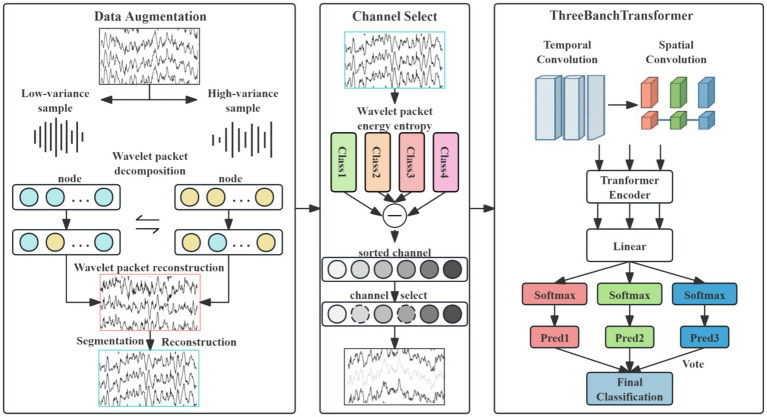
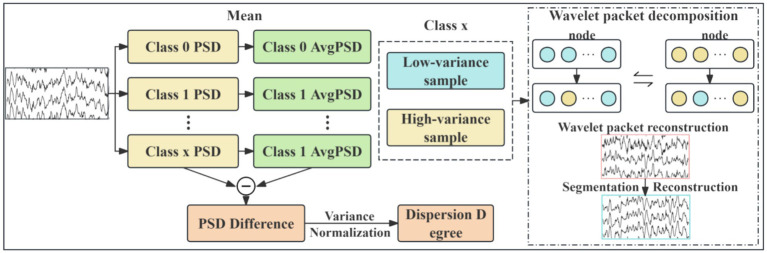
Introduction: Motor-imagery (MI) brain-computer interfaces often suffer from limited EEG datasets and redundant channels, hampering both accuracy and clinical usability. We address these bottlenecks by presenting a unified framework that simultaneously boosts classification performance, reduces the number of required sensors, and eliminates the need for extra recordings. Methods: A three-stage pipeline is proposed. (1) Wavelet-packet decomposition (WPD) partitions each MI class into low-variance "stable" and high-variance "variant" trials; sub-band swapping between matched pairs generates synthetic trials that preserve event-related desynchronization/synchronization signatures. (2) Channel selection uses wavelet-packet energy entropy (WPEE) to quantify both spectral-energy complexity and class-separability; the top-ranked leads are retained. (3) A lightweight multi-branch network extracts multi-scale temporal features through parallel dilated convolutions, refines spatial patterns via depth-wise convolutions, and feeds the fused spatiotemporal tensor to a Transformer encoder with multi-head self-attention; soft-voted fully-connected layers deliver robust class labels. Results: < 0.01). Discussion: Integrating WPD-based augmentation with WPEE-driven channel selection yields higher MI decoding accuracy with fewer channels and without extra recordings. The framework offers a computationally efficient, clinically viable paradigm for enhanced EEG classification in resource-constrained settings.
Verified 2026-11-22 · 1 reference not checked yet
Overview
CoChat Summary
TL;DR
The paper proposes DACS-TBTrans, a three-stage motor-imagery EEG framework combining wavelet-packet synthetic augmentation, wavelet-packet energy-entropy channel selection, and a multi-branch CNN–Transformer with voting. It reports 86.81% and 86.64% mean accuracy on BCI Competition IV 2a and PhysioNet MI while removing 27% of sensors.
Key findings
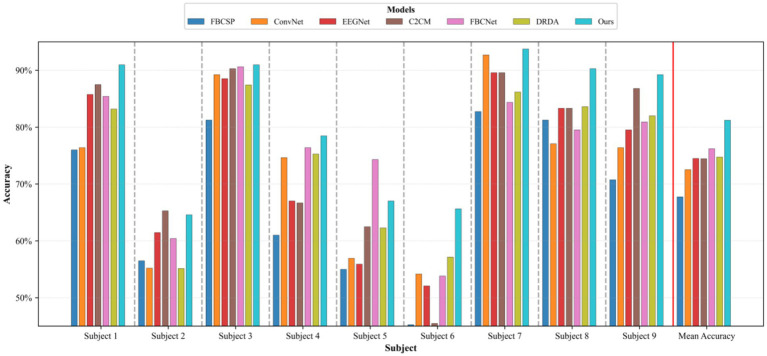
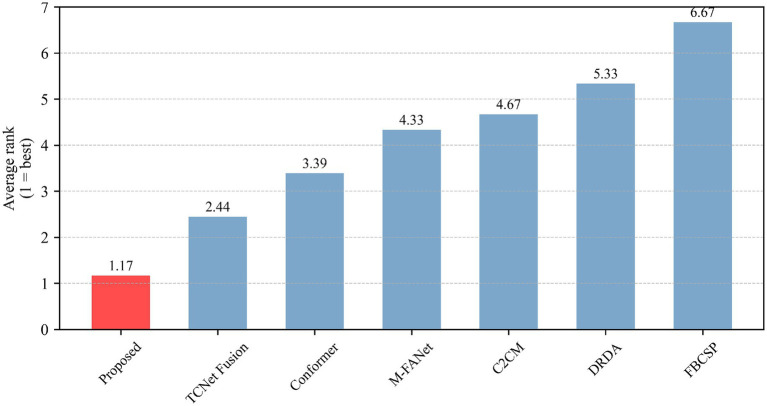
- On BCI Competition IV 2a, DACS-TBTrans achieved 86.81% mean accuracy and κ = 0.8125, outperforming baselines including TCNet fusion (83.73%), M-FANet (79.28%), and conformer (78.66%).
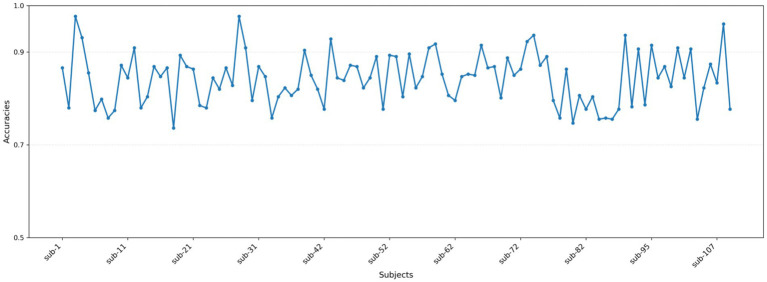
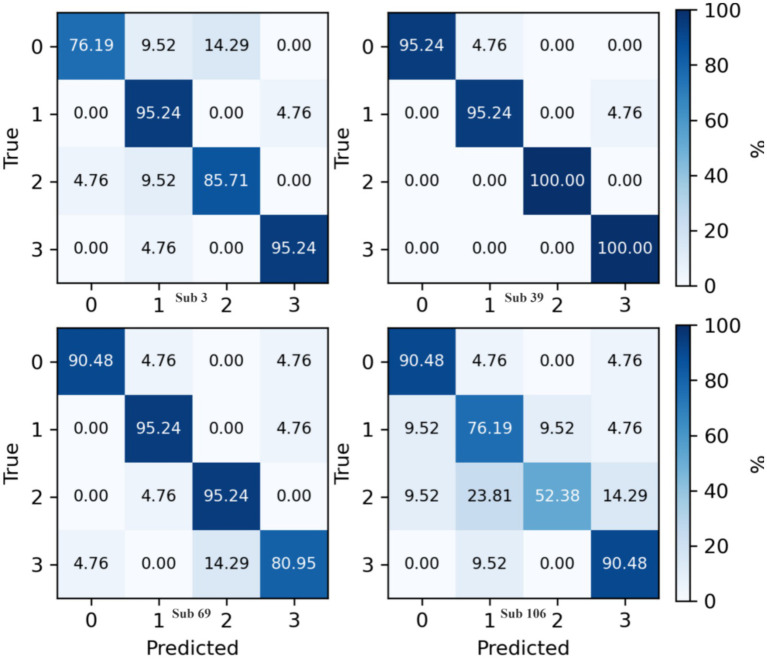
- On PhysioNet MI, it achieved 86.64% mean accuracy and F1 = 0.86, with peak subject accuracy of 97.61%, using 103 valid subjects after excluding 6.
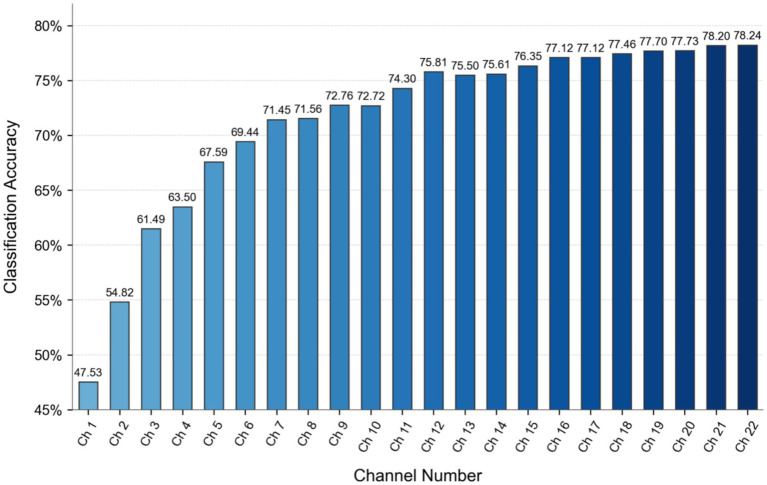
- The method removed 27% of sensors and outperformed the same network trained on all 22 channels, with paired t-tests reported as significant (p < 0.01).
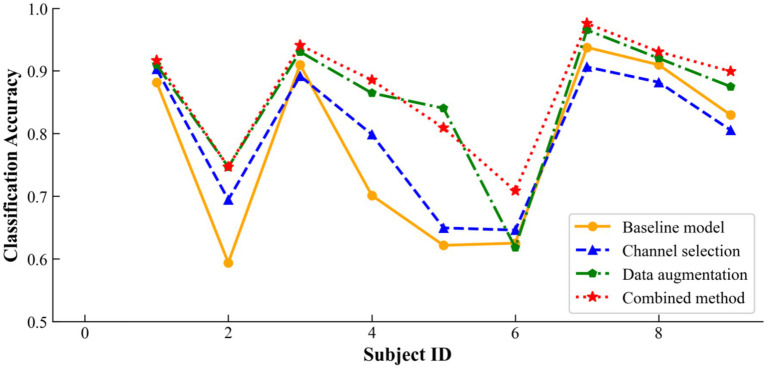
- Ablation on BCI IV 2a: channel selection alone improved average accuracy by 1.74%, data augmentation alone by 7.33%, and the combined DACS approach by 8.92% over the baseline TBTrans.
Methods
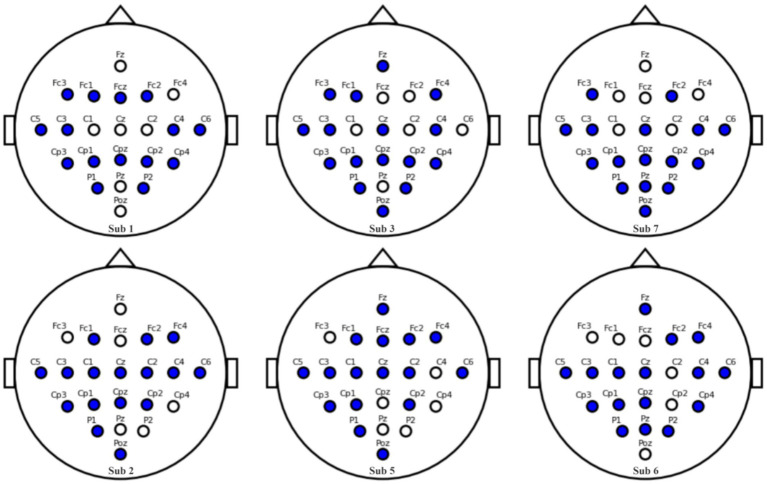
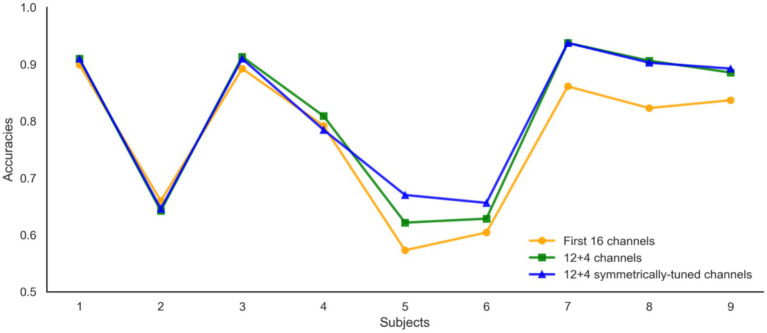
- Three-stage pipeline: (1) wavelet-packet decomposition with α/β sub-band swapping between low- and high-variance same-class trials for synthetic training data; (2) channel selection using wavelet-packet energy entropy differences, with a 12 + 4 symmetric configuration and n = 16 channels; (3) a three-branch temporal convolutional network with spatial convolutions, Transformer encoders, and soft-voted fully connected layers.
- Data: BCI Competition IV 2a (9 subjects, 4 MI classes, 288 trials/subject) and PhysioNet MI (109 subjects, 64 electrodes at 160 Hz; 103 subjects retained after exclusions). Preprocessing used 1 Hz high-pass, 50 Hz notch, 4–40 Hz band-pass, and overlapping 4-s windows from 2–6 s and 3–7 s post-cue.
- Evaluation: accuracy, Kappa, and F1; paired t-tests, Wilcoxon signed-rank tests with Holm–Bonferroni correction, Friedman ranking, ablation, window-length tests, and parameter/latency comparison.
Limitations
- The paper states the filter-only preprocessing cannot remove ocular, cardiac, or muscular artifacts whose spectra overlap α/β bands, so within-subject results may be slightly inflated; future work will explore ICA or ASR.
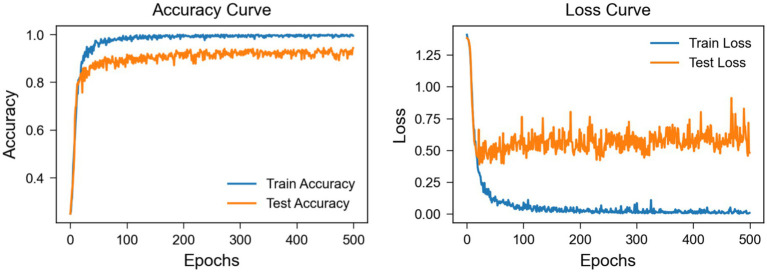
- The learning curve for Subject 3 shows training accuracy near 100% while testing accuracy stabilizes around 88%, with testing loss fluctuating and remaining relatively high, indicating a generalization gap and potential overfitting.
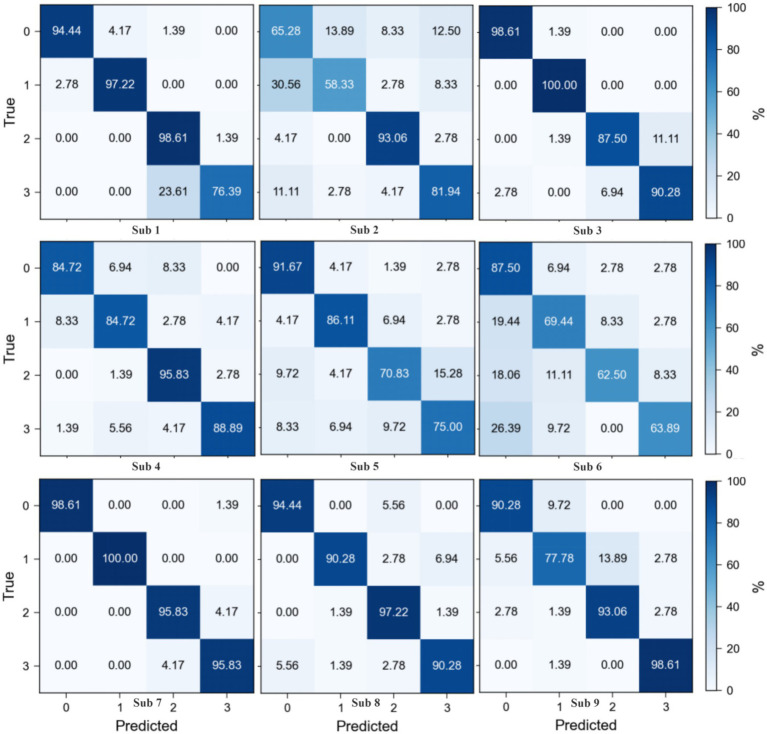
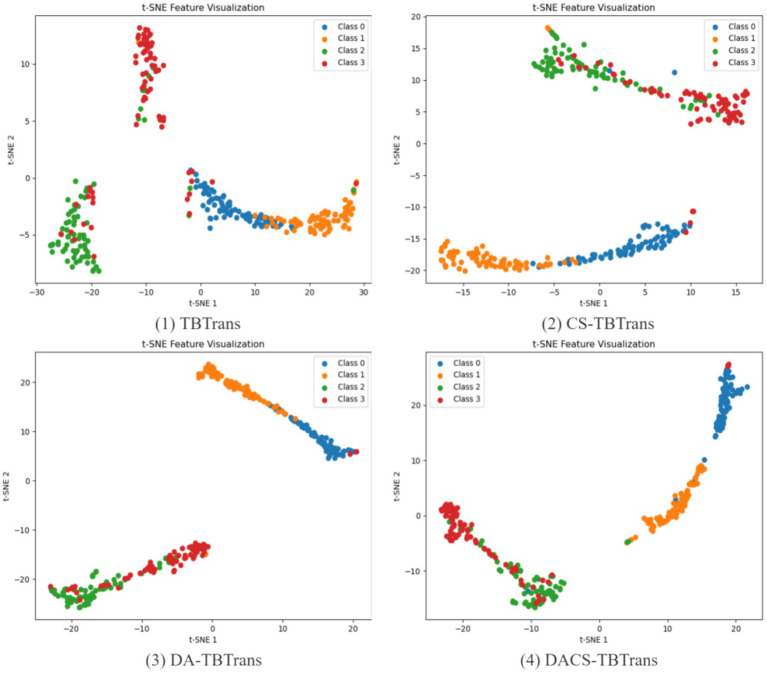
- The paper notes misclassification between tongue and feet in some subjects may be due to suboptimal channel selection, and future work should adapt channel selection to inter-subject variability. Evident from the text: the channel-selection description first says n = 12 is later verified, but the parameter experiment sets n = 16, an inconsistency in the reported hyperparameter.
Model-written summary. Check it against the paper before relying on it.
Integrity signals
Registry
Cites
Statistics
Figures
Verification
Claims the paper makes
1 Valid · 1 Not valid · 1 Not checked · 81 Own results and interpretations
Every source the paper cites for this claim was checked and supports it.
In the paper
“Consequently, exclusion of this subject’s data is methodologically justified.”
§ Motor imagery EEG classification via wavelet-packet synthetic augmentation and entropy-based channel selection > Experimental and results > Results of the public datasets
What the sources say
- Supportedcites Shuqfa et al., 2024 matched to “Increasing accessibility to a large brain–computer interface dataset: curation of PhysioNet EEG motor movement/imagery dataset for decoding and classification” (2024) source
The Experimental Design, Materials and Methods section says subjects with inconsistent trial counts or run lengths were excluded. Table 4 specifically lists S106 among the discarded subjects: its run had 5 relaxation trials, 2 motor execution/imagery trials, and a length of 36.30 seconds, compared with the typical values in Table 3. This supports the methodological justification for excluding Subject 106. (LLM, conf=0.94)
plainSingle case- Asserted: passes — The authors put it forward as true.
- Checkable: passes — It can be checked against evidence.
- Load-bearing: passes — The paper’s conclusions depend on it.
- Based: passes — The paper gives a reason why it holds.
- Supported
A result the paper states — it cites no source for it, so there is none to check. The quote shows it is in the paper.
In the paper
“This approach achieves comparable or superior classification performance to full-channel methods using fewer EEG channels.”
§ Motor imagery EEG classification via wavelet-packet synthetic augmentation and entropy-based channel selection > Introduction
plainstates a cause- Asserted: passes — The authors put it forward as true.
- Checkable: passes — It can be checked against evidence.
- Load-bearing: passes — The paper’s conclusions depend on it.
- Based: passes — The paper gives a reason why it holds.
- Rests on 3 assumptions not shown here.
The paper states this without a source or data behind it here, so there is nothing to check it against. The quote shows it is in the paper.
In the paper
“Evaluations of different channel group configurations demonstrate that symmetrically distributed channel groups yield optimal results.”
§ Motor imagery EEG classification via wavelet-packet synthetic augmentation and entropy-based channel selection > Introduction
boostedstates a cause- Asserted: passes — The authors put it forward as true.
- Checkable: passes — It can be checked against evidence.
- Load-bearing: passes — The paper’s conclusions depend on it.
- Based: unclear — It is unclear why the paper says it holds.
- Rests on an assumption not shown here.
A result the paper reports from its own data — it cites no other source for it, so there is none to check. The quote shows it is in the paper.
In the paper
“the combined approach achieved an 8.92% increase in accuracy over the baseline model”
§ Motor imagery EEG classification via wavelet-packet synthetic augmentation and entropy-based channel selection > Experimental and results > Results of the ablation experiment
plainstates a cause- Asserted: passes — The authors put it forward as true.
- Checkable: passes — It can be checked against evidence.
- Load-bearing: passes — The paper’s conclusions depend on it.
- Based: passes — The paper gives a reason why it holds.
A result the paper states — it cites no source for it, so there is none to check. The quote shows it is in the paper.
In the paper
“Experimental validation on public datasets confirms the effectiveness of our method in enhancing classification performance.”
- Also stated in: § Network architecture · plain
“Experimental validation on public datasets confirms the effectiveness of this architecture in enhancing classification performance.”
§ Motor imagery EEG classification via wavelet-packet synthetic augmentation and entropy-based channel selection > Introduction
plainstates a cause- Asserted: passes — The authors put it forward as true.
- Checkable: passes — It can be checked against evidence.
- Load-bearing: passes — The paper’s conclusions depend on it.
- Based: passes — The paper gives a reason why it holds.
- Also stated in: § Network architecture · plain
34 more claims
Create a free account to see all 84 claims and every source verdict.
- It may state two separate claims as one. 38
- Probably not a substantial claim. 9
Self-check
Percentages, sums and reported differences re-computed from the paper’s own numbers.
Each contradiction between two passages listed here was confirmed by an independent check.
Rated major: it would touch a result — a value a result rests on, reported and recomputed p-values on opposite sides of the significance level, two passages that conflict with no sign which is right, or a cited work retracted before this paper was published.
In the paper
§ Motor imagery EEG classification via wavelet-packet synthetic augmentation and entropy-based channel selection > Experimental and results > Results of the public datasets
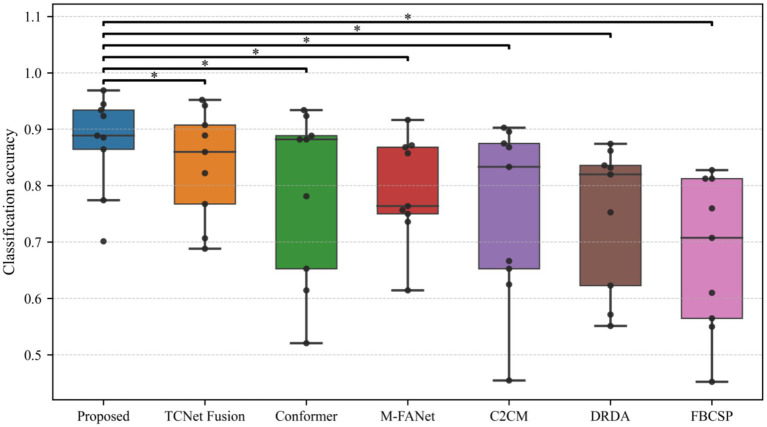
“All raw p-values were ≤ 0.001 (Wilcoxon signed-rank test).”
§ Motor imagery EEG classification via wavelet-packet synthetic augmentation and entropy-based channel selection > Experimental and results > Results of the public datasets
“| Proposed vs. conformer | 0.0117 | 0.0234 | 0.3951 | Medium |”
Rated major: it would touch a result — a value a result rests on, reported and recomputed p-values on opposite sides of the significance level, two passages that conflict with no sign which is right, or a cited work retracted before this paper was published.
In the paper
§ Motor imagery EEG classification via wavelet-packet synthetic augmentation and entropy-based channel selection > Experimental and results > Results of the public datasets
“After Holm–Bonferroni correction, every comparison yielded an adjusted p < 0.001”
§ Motor imagery EEG classification via wavelet-packet synthetic augmentation and entropy-based channel selection > Experimental and results > Results of the public datasets
“| Proposed vs. FBCSP | 0.0039 | 0.0234 | 0.8024 | Large |”
Rated minor: it would not touch a result — a value no result rests on, a p-value that stays on the same side of the significance level, or a conflict that is clerical, resolved elsewhere in the paper, or outside its own findings.
In the paper
§ Motor imagery EEG classification via wavelet-packet synthetic augmentation and entropy-based channel selection > Experimental and results > Results of the public datasets
“This consistent outperformance across all subjects suggests that our approach effectively captures the nuances of EEG signal patterns associated with motor imagery tasks.”
§ Motor imagery EEG classification via wavelet-packet synthetic augmentation and entropy-based channel selection > Experimental and results > Results of the public datasets
“Although TCNet Fusion achieved the highest accuracy in Subjects 3 and 5, our method attained the second highest.”
Rated minor: it would not touch a result — a value no result rests on, a p-value that stays on the same side of the significance level, or a conflict that is clerical, resolved elsewhere in the paper, or outside its own findings.
In the paper
§ Motor imagery EEG classification via wavelet-packet synthetic augmentation and entropy-based channel selection > Experimental and results > Results of the ablation experiment
“The experimental findings are systematically captured in Figures 7, 8, along with detailed results in Table 3.”
§ Motor imagery EEG classification via wavelet-packet synthetic augmentation and entropy-based channel selection > Experimental and results > Results of the ablation experiment
“Table: Table 4 Ablation study of proposed method on BCI competition IV 2a dataset.”
Rated minor: it would not touch a result — a value no result rests on, a p-value that stays on the same side of the significance level, or a conflict that is clerical, resolved elsewhere in the paper, or outside its own findings.
In the paper
§ Motor imagery EEG classification via wavelet-packet synthetic augmentation and entropy-based channel selection > Abstract > Methods
“soft-voted fully-connected layers deliver robust class labels.”
§ Motor imagery EEG classification via wavelet-packet synthetic augmentation and entropy-based channel selection > Methods > Overview
“Finally, the voting classification module determines the ultimate class prediction through majority voting based on the classification outputs from the three individual branches.”
4 more findings
Create a free account to see every finding of this check.
Citations
Cites
Grad-CAM: Visual Explanations from Deep Networks via Gradient-Based Localization
Selvaraju, R. R., Cogswell, M., Das, A., Vedantam, R., Parikh, D., & Batra, D. (2017) · 2017 IEEE International Conference on Computer Vision (ICCV) · doi:10.1109/iccv.2017.74 · Cited by 24,513
Goldberger, A. L., Amaral, L. A. N., Glass, L., Hausdorff, J. M., Ivanov, P. C., Mark, R. G., Mietus, J. E., Moody, G. B., Peng, C.-K., & Stanley, H. E. (2000) · Circulation · doi:10.1161/01.cir.101.23.e215 · Cited by 14,809
Grad-CAM: Visual Explanations from Deep Networks via Gradient-Based Localization
Selvaraju, R. R., Cogswell, M., Das, A., Vedantam, R., Parikh, D., & Batra, D. (2020) · International Journal of Computer Vision · doi:10.1007/s11263-019-01228-7 · Cited by 6,909
EEGNet: a compact convolutional neural network for EEG-based brain-computer interfaces
Lawhern, V. J., Solon, A. J., Waytowich, N. R., Gordon, S. M., Hung, C. P., & Lance, B. J. (2018) · Journal of Neural Engineering · doi:10.1088/1741-2552/aace8c · Cited by 5,115 · cited 1×
“For CS, EEGNet (Lawhern et al., 2018) and ShallowConvNet (Schirrmeister et al., 2017) learn channel weights through the first 1-”
Deep learning with convolutional neural networks for EEG decoding and visualization
Schirrmeister, R. T., Springenberg, J. T., Fiederer, L. D. J., Glasstetter, M., Eggensperger, K., Tangermann, M., Hutter, F., Burgard, W., & Ball, T. (2017) · Human Brain Mapping · doi:10.1002/hbm.23730 · Cited by 3,751
Assessing Agreement on Classification Tasks: The Kappa Statistic
Carletta, J. (1996) · arXiv · doi:10.48550/arxiv.cmp-lg/9602004 · Cited by 2,088 · cited 1×
“Three established metrics were employed: accuracy (Li et al., 2021), Kappa coefficient (Carletta, 1996), and F1-score (Li et al., 2019).”
Deep learning-based electroencephalography analysis: a systematic review
Roy, Y., Banville, H., Albuquerque, I., Gramfort, A., Falk, T. H., & Faubert, J. (2019) · Journal of Neural Engineering · doi:10.1088/1741-2552/ab260c · Cited by 1,532 · cited 1×
“Roy et al. (2019) swap left–right electrodes within the same class, yielding modest benefits.”
EEG Conformer: Convolutional Transformer for EEG Decoding and Visualization
Song, Y., Zheng, Q., Liu, B., & Gao, X. (2023) · IEEE Transactions on Neural Systems and Rehabilitation Engineering · doi:10.1109/tnsre.2022.3230250 · Cited by 1,095
Regularizing Common Spatial Patterns to Improve BCI Designs: Unified Theory and New Algorithms
Lotte, F., & Guan, C. (2011) · IEEE Transactions on Biomedical Engineering · doi:10.1109/tbme.2010.2082539 · Cited by 1,045
Learning Temporal Information for Brain-Computer Interface Using Convolutional Neural Networks
Sakhavi, S., Guan, C., & Yan, S. (2018) · IEEE Transactions on Neural Networks and Learning Systems · doi:10.1109/tnnls.2018.2789927 · Cited by 656 · cited 4×
“Specifically, it shows extremely statistically significant improvements over FBCSP ( p ≤ 0.001), and DRDA ( p ≤ 0.001), highly statistically significant improvement over M-FANet ( p ≤ 0.01), and C2CM ( p ≤ 0.01), statistically significant improvements over conformer ( p ≤ 0.05) and TCNet Fusion ( p ≤ 0.05).”
InfluentialPhysics-Informed Attention Temporal Convolutional Network for EEG-Based Motor Imagery Classification
Altaheri, H., Muhammad, G., & Alsulaiman, M. (2023) · IEEE Transactions on Industrial Informatics · doi:10.1109/tii.2022.3197419 · Cited by 519
Optimizing the Channel Selection and Classification Accuracy in EEG-Based BCI
Arvaneh, M., Guan, C., Ang, K. K., & Quek, C. (2011) · IEEE Transactions on Biomedical Engineering · doi:10.1109/tbme.2011.2131142 · Cited by 424 · cited 1×
“Arvaneh et al. (2011) introduced sparse CSP with L₁ regularization, achieving 85% accuracy with only 8 of 22 channels.”
The Berlin brain-computer Interface: accurate performance from first-session in BCI-naive subjects
Blankertz, B., Losch, F., Krauledat, M., Dornhege, G., Curio, G., & Muller, K.-R. (2008) · IEEE Transactions on Biomedical Engineering · doi:10.1109/tbme.2008.923152 · Cited by 338
Deep Representation-Based Domain Adaptation for Nonstationary EEG Classification
Zhao, H., Zheng, Q., Ma, K., Li, H., & Zheng, Y. (2021) · IEEE Transactions on Neural Networks and Learning Systems · doi:10.1109/tnnls.2020.3010780 · Cited by 253
A Channel-Projection Mixed-Scale Convolutional Neural Network for Motor Imagery EEG Decoding
Li, Y., Zhang, X.-R., Zhang, B., Lei, M.-Y., Cui, W.-G., & Guo, Y.-Z. (2019) · IEEE Transactions on Neural Systems and Rehabilitation Engineering · doi:10.1109/tnsre.2019.2915621 · Cited by 224
Zhang, C., Kim, Y.-K., & Eskandarian, A. (2021) · Journal of Neural Engineering · doi:10.1088/1741-2552/abed81 · Cited by 224 · cited 1×
“Zhang et al. (2021) used Deep MOPSO with CNN accuracy, trimming to 10 channels with ~3% accuracy gain.”
Musallam, Y. K., AlFassam, N. I., Muhammad, G., Amin, S. U., Alsulaiman, M., Abdul, W., Altaheri, H., Bencherif, M. A., & Algabri, M. (2021) · Biomedical Signal Processing and Control · doi:10.1016/j.bspc.2021.102826 · Cited by 224
Amin, S. U., Alsulaiman, M., Muhammad, G., Bencherif, M. A., & Hossain, M. S. (2019) · IEEE Access · doi:10.1109/access.2019.2895688 · Cited by 209
A Novel Deep Learning Approach With Data Augmentation to Classify Motor Imagery Signals
Zhang, Z., Duan, F., Sole-Casals, J., Dinares-Ferran, J., Cichocki, A., Yang, Z., & Sun, Z. (2019) · IEEE Access · doi:10.1109/access.2019.2895133 · Cited by 193 · cited 1×
“Zhang et al. (2019) first convert EEG to STFT spectrograms, then apply rotation and noise injection, enhancing geometric augmentation for image-based pipelines.”
Roy, A. M. (2022) · Engineering Applications of Artificial Intelligence · doi:10.1016/j.engappai.2022.105347 · Cited by 183 · cited 1×
“Amin et al. (2019) fused global and local representations via layer-wise weighted convolutions; Roy (2022) proposed a multi-scale CNN to harvest discriminative cues within separate frequency bands.”
Divergence-Based Framework for Common Spatial Patterns Algorithms
Samek, W., Kawanabe, M., & Muller, K.-R. (2014) · IEEE Reviews in Biomedical Engineering · doi:10.1109/rbme.2013.2290621 · Cited by 174 · cited 2×
“Early studies relied on hand-crafted features combined with digital filtering: the common spatial pattern (CSP) family—e.g., FBCSP (Chin et al., 2008), RCSP (Lotte and Guan, 2011), and TR-CSP (Samek et al., 2014)—decomposes the signal into multiple frequency bands or introduces regularization terms to derive spatial f…”
Li, Y., Guo, L., Liu, Y., Liu, J., & Meng, F. (2021) · IEEE Transactions on Neural Systems and Rehabilitation Engineering · doi:10.1109/tnsre.2021.3099908 · Cited by 171
A Multi-view CNN with Novel Variance Layer for Motor Imagery Brain Computer Interface
Mane, R., Robinson, N., Vinod, A. P., Lee, S., & Guan, C. (2020) · Annual International Conference of the IEEE Engineering in Medicine and Biology Society (EMBC) · doi:10.1109/embc44109.2020.9175874 · Cited by 150
MI-EEGNET: A novel convolutional neural network for motor imagery classification
Riyad, M., Khalil, M., & Adib, A. (2020) · Journal of Neuroscience Methods · doi:10.1016/j.jneumeth.2020.109037 · Cited by 123
A shallow mirror transformer for subject-independent motor imagery BCI
Luo, J., Wang, Y., Xia, S., Lu, N., Ren, X., Shi, Z., & Hei, X. (2023) · Computers in Biology and Medicine · doi:10.1016/j.compbiomed.2023.107254 · Cited by 95
Shovon, T. H., Nazi, Z. A., Dash, S., & Hossain, M. F. (2019) · International Conference on Advances in Electrical Engineering · doi:10.1109/icaee48663.2019.8975578 · Cited by 79
M-FANet: Multi-Feature Attention Convolutional Neural Network for Motor Imagery Decoding
Qin, Y., Yang, B., Ke, S., Liu, P., Rong, F., & Xia, X. (2024) · IEEE Transactions on Neural Systems and Rehabilitation Engineering · doi:10.1109/tnsre.2024.3351863 · Cited by 69 · cited 4×
“Specifically, it shows extremely statistically significant improvements over FBCSP ( p ≤ 0.001), and DRDA ( p ≤ 0.001), highly statistically significant improvement over M-FANet ( p ≤ 0.01), and C2CM ( p ≤ 0.01), statistically significant improvements over conformer ( p ≤ 0.05) and TCNet Fusion ( p ≤ 0.05).”
InfluentialHameed, A., Fourati, R., Ammar, B., Ksibi, A., Alluhaidan, A. S., Ayed, M. B., & Khleaf, H. K. (2023) · Biomedical Signal Processing and Control · doi:10.1016/j.bspc.2023.105359 · Cited by 63
A Systematic Review on Motor-Imagery Brain-Connectivity-Based Computer Interfaces
Brusini, L., Stival, F., Setti, F., Menegatti, E., Menegaz, G., & Storti, S. F. (2021) · IEEE Transactions on Human-Machine Systems · doi:10.1109/thms.2021.3115094 · Cited by 61
A novel hybrid CNN-Transformer model for EEG Motor Imagery classification
Ma, Y., Song, Y., & Gao, F. (2022) · International Joint Conference on Neural Networks (IJCNN) · doi:10.1109/ijcnn55064.2022.9892821 · Cited by 61
Compact convolutional transformer for subject-independent motor imagery EEG-based BCIs
Keutayeva, A., Fakhrutdinov, N., & Abibullaev, B. (2024) · Scientific Reports · doi:10.1038/s41598-024-73755-4 · Cited by 47
Xie, Y., & Oniga, S. (2023) · Sensors · doi:10.3390/s23041932 · Cited by 43
Chen, P., Wang, H., Sun, X., Li, H., Grebogi, C., & Gao, Z. (2022) · IEEE Transactions on Neural Systems and Rehabilitation Engineering · doi:10.1109/tnsre.2022.3211881 · Cited by 43
MIEEG-GAN: Generating Artificial Motor Imagery Electroencephalography Signals
Roy, S., Dora, S., McCreadie, K. A., & Prasad, G. (2020) · International Joint Conference on Neural Networks (IJCNN) · doi:10.1109/ijcnn48605.2020.9206942 · Cited by 40
Hierarchical Transformer for Motor Imagery-Based Brain Computer Interface
Deny, P., Cheon, S. H. C., Son, H., & Choi, K. W. (2023) · IEEE Journal of Biomedical and Health Informatics · doi:10.1109/jbhi.2023.3304646 · Cited by 34
Qin, C., Yang, R., Huang, M., Liu, W., & Wang, Z. (2023) · IEEE Transactions on Neural Systems and Rehabilitation Engineering · doi:10.1109/tnsre.2023.3314679 · Cited by 32 · cited 1×
“Qin et al. (2023) Yu and Stefan (2023) exchange time segments between same-class trials and swap matched frequency bands, achieving joint temporal–spectral augmentation.”
Song, Y., Yang, L., Jia, X., & Xie, L. (2021) · arXiv (Cornell University) · doi:10.48550/arxiv.2102.04456 · Cited by 32
Fine-Grained Spatial-Frequency-Time Framework for Motor Imagery Brain–Computer Interface
Liu, G., Zhang, R., Lan, T., & Zhou, W. (2025) · IEEE Journal of Biomedical and Health Informatics · doi:10.1109/jbhi.2025.3536212 · Cited by 23
Multiclass voluntary facial expression classification based on Filter Bank Common Spatial Pattern
Chin, Z. Y., Ang, K. K., & Guan, C. (2008) · Annual International Conference of the IEEE Engineering in Medicine and Biology Society (EMBC) · doi:10.1109/iembs.2008.4649325 · Cited by 22
Wei, Q., & Wang, Y. (2011) · International Conference on Biomedical Engineering and Informatics (BMEI) · doi:10.1109/bmei.2011.6098380 · Cited by 22
EEGNet classification of sleep EEG for individual specialization based on data augmentation
Xia, M., Zhao, X., Deng, R., Lu, Z. F., & Cao, J. (2024) · Cognitive Neurodynamics · doi:10.1007/s11571-023-10062-0 · Cited by 16
Shuqfa, Z., Lakas, A., & Belkacem, A. N. (2024) · Data in Brief · doi:10.1016/j.dib.2024.110181 · Cited by 16
CovMix: Covariance Mixing Regularization for Motor Imagery Decoding
Zoumpourlis, G., & Patras, I. (2022) · International Winter Conference on Brain-Computer Interface (BCI) · doi:10.1109/bci53720.2022.9734883 · Cited by 15
Wu, X., Ouyang, R., & Zhang, C. (2024) · Biomedical Signal Processing and Control · doi:10.1016/j.bspc.2024.107345 · Cited by 7
Guo, S., Wang, Y., Liu, Y., Zhang, X., & Tang, B. (2025) · Biomedical Signal Processing and Control · doi:10.1016/j.bspc.2025.107756 · Cited by 7
Vadivelan, D. S., & Sethuramalingam, P. (2025) · Neural Computing and Applications · doi:10.1007/s00521-025-10979-z · Cited by 6
Research works printed but not linked: 3
- Arvaneh M. Guan C. Ang K. K. Quek C. (2011). Optimizing the channel selection and regularization parameters of CSP for brain–computer interfaces. IEEE Trans. Biomed. Eng. 58, 1104– 1110. doi: 10.1109/TBME.2011.213114221156384 · doi:10.1109/tbme.2011.213114221156384
- Sakhavi S. Guan C. Yan S. “Parallel convolutional-linear neural network for motor imagery classification,” in Proc. EUSIPCO, Nice, France (2015).
- Xiong T. Hu R. Shao H. Song Y. Guo F. (2021). Control of upper limb rehabilitation robot based on steady-state visual evoked potential. Sci. Technol. Eng. 21, 7237– 7242. doi: 10.3969/j.issn.1671-1815.2021.17.037 · doi:10.3969/j.issn.1671-1815.2021.17.037
Cited by
Dynamic wavelet-based augmentation for enhanced EEG-based imagined speech classification
Mohan, A., & Anand, R. S. (2026) · Computers in Biology and Medicine · doi:10.1016/j.compbiomed.2026.111810
Metadata
- Authors
- Zheng, M., Qian, Z., & Zhao, T.
- Affiliations
- Putian University (CN)
- Corresponding author
- Zheng, Minmin
- ORCID
- Zheng, Minmin
- Venue
- Frontiers in Neuroscience
- Publisher
- Frontiers Media SA
- Published
- 2025-11-10
- Volume
- 19
- Pages
- 1689647-1689647
- ISSN
- 1662-453X (ISSN-L)
- PMC
- PMC12641008
- OpenAlex
- W4416096269
- Cited by
- 1
- References
- 35
- Citations by year
- 2026: 1
- FWCI
- 0.57
- Type
- journal article
- Language
- en
- Open access
- gold
- doi.org
- Licence
- Locations
- Frontiers in Neuroscience (publishedVersion, cc-by)
- Europe PMC (PubMed Central) (publishedVersion, cc-by)
- PubMed (publishedVersion)
- DOAJ (DOAJ: Directory of Open Access Journals) (submittedVersion, cc-by-sa)
- Funders
- Fujian Provincial Department of Science and Technology
- Topics
- Life Sciences › Neuroscience › Cognitive Neuroscience › EEG and Brain-Computer Interfaces
- Physical Sciences › Engineering › Biomedical Engineering › Muscle activation and electromyography studies
- Physical Sciences › Computer Science › Artificial Intelligence › Emotion and Mood Recognition
- Keywords
- motor imagery, EEG classification, brain-computer interface, wavelet packet decomposition, synthetic data augmentation, wavelet packet energy entropy, channel selection, Transformer encoder, event-related desynchronization, event-related synchronization, soft voting, resource-limited settings
About these checks
Registry, retraction, Cites and statistics results are computed, not judged, with one exception: a printed reference that no index lists is read once by a model before it counts as a citation error. Claims are extracted by a model and kept only when their quote appears verbatim in the text; each cited source is then checked, with a model’s help, for whether it says what the claim relies on. Those verdicts can be wrong — read the claim’s quote and the cited source before relying on one.
A language model drew the claims from the paper on 2026-10-10, under version 3 of the claim definition (model deepseek-v4.1-flash, prompt extract-v3).
A second model labelled each claim on 2026-10-10 (model jev-1.13-20260917, definition revision gold-guideline-v0.2).
Cited sources are checked with a language model’s help (gpt-6-sol).
Statistics and arithmetic are recomputed, not judged.
Confidence bands are shown only for fields calibrated on our annotated test set. None is calibrated yet, so no band is shown.
What counts as a claim ›How we measure confidence ›How we check this ›
Are you an author, or do you see a problem with this page? Request a review
Data sources
Bibliographic data: Semantic Scholar, OpenAlex, Crossref.
Contains information from the Semantic Scholar Academic Graph Datasets, made available under the ODC Attribution License (ODC-BY 1.0).
Semantic Scholar’s data is described in: Kinney, R., et al. (2023). The Semantic Scholar Open Data Platform. arXiv:2301.10140.
