

The DOI matches its Crossref record; 202 of the 203 references it cites were found in a registry or an index.
Optogenetic dissection of medial prefrontal cortex circuitry
Open accessAbstract
The medial prefrontal cortex (mPFC) is critically involved in numerous cognitive functions, including attention, inhibitory control, habit formation, working memory and long-term memory. Moreover, through its dense interconnectivity with subcortical regions (e.g., thalamus, striatum, amygdala and hippocampus), the mPFC is thought to exert top-down executive control over the processing of aversive and appetitive stimuli. Because the mPFC has been implicated in the processing of a wide range of cognitive and emotional stimuli, it is thought to function as a central hub in the brain circuitry mediating symptoms of psychiatric disorders. New optogenetics technology enables anatomical and functional dissection of mPFC circuitry with unprecedented spatial and temporal resolution. This provides important novel insights in the contribution of specific neuronal subpopulations and their connectivity to mPFC function in health and disease states. In this review, we present the current knowledge obtained with optogenetic methods concerning mPFC function and dysfunction and integrate this with findings from traditional intervention approaches used to investigate the mPFC circuitry in animal models of cognitive processing and psychiatric disorders.
Overview
The claims and statistics of this paper haven’t been checked yet.
Run the check — free, no account needed. It reads the open-access text and checks the sources it cites.
Integrity signals
Registry
Cites
Statistics
Figures
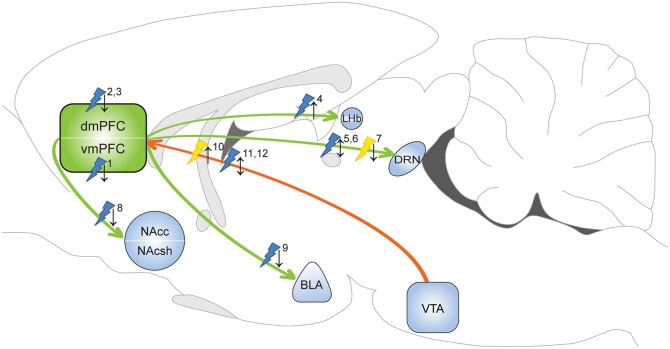
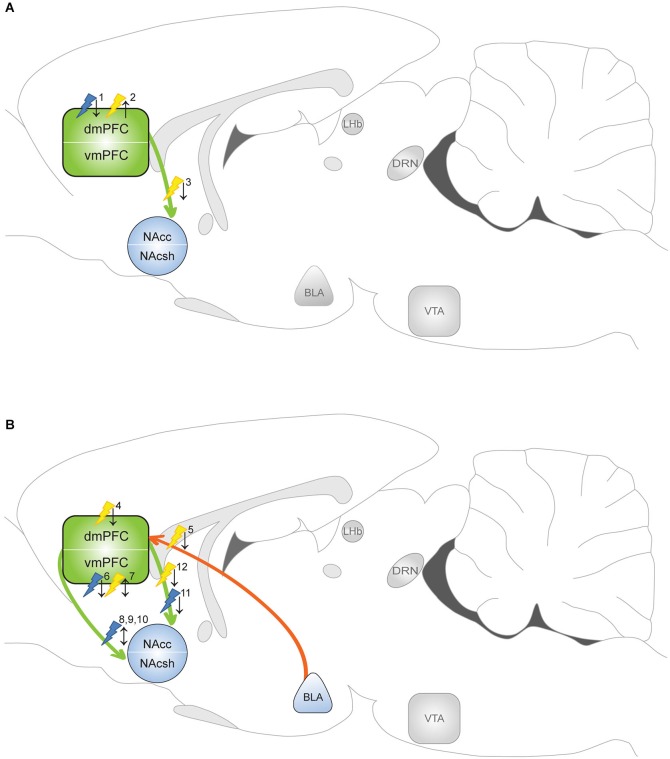
Verification
Claims the paper makes
The claims and statistics of this paper haven’t been checked yet.
Run the check — free, no account needed. It reads the open-access text and checks the sources it cites.
Claims other papers make about this one
Each is checked against this paper’s own text: does it say what the citing paper says it does?
The cited source says what the claim attributes to it.
In the citing paper
“The PFC is known to exert top-down control over a variety of subcortical regions, and recent research has identified a number of circuits originating in the PFC that control behaviors relevant to the treatment of depression, anxiety, and addiction (Figure 3) (56, 173).”
From Psychedelics and Other Psychoplastogens for Treating Mental Illness. (2021) · cites this paper as [56]
The cited source says what the claim attributes to it.
In the citing paper
“Our findings build upon prior studies showing that non-selective activation of the mPFC can reverse behavioral deficits in depression models [36–39]”
From A nucleus accumbens-projecting prefrontal cortex circuit underlies chronic social stress-induced depression-like behaviors (2026) · cites this paper as [39]
Self-check
Percentages, sums and reported differences re-computed from the paper’s own numbers.
The self-check needs the paper’s full text.
Citations
Cites
Diagnostic and Statistical Manual of Mental Disorders
American Psychiatric Association (2013) · doi:10.1176/appi.books.9780890425596 · Cited by 116,369
Diagnostic and Statistical Manual of Mental Disorders
Williams, J. B. W., & First, M. B. (2013) · Oxford University Press eBooks · doi:10.1093/acrefore/9780199975839.013.104 · Cited by 109,845
An Integrative Theory of Prefrontal Cortex Function
Miller, E. K., & Cohen, J. D. (2001) · Annual Review of Neuroscience · doi:10.1146/annurev.neuro.24.1.167 · Cited by 12,803
LeDoux, J. E. (2000) · Annual Review of Neuroscience · doi:10.1146/annurev.neuro.23.1.155 · Cited by 8,444
The neural basis of drug craving: An incentive-sensitization theory of addiction
Robinson, T. (1993) · Brain Research Reviews · doi:10.1016/0165-0173(93)90013-p · Cited by 7,346
Baddeley, A. (1992) · Science · doi:10.1126/science.1736359 · Cited by 5,258
Millisecond-timescale, genetically targeted optical control of neural activity
Boyden, E. S., Zhang, F., Bamberg, E., Nagel, G., & Deisseroth, K. A. (2005) · Nature Neuroscience · doi:10.1038/nn1525 · Cited by 5,015
Deep Brain Stimulation for Treatment-Resistant Depression
Mayberg, H. S., Lozano, A. M., Voon, V., McNeely, H. E., Seminowicz, D., Hamani, C., Schwalb, J. M., & Kennedy, S. H. (2005) · Neuron · doi:10.1016/j.neuron.2005.02.014 · Cited by 4,059
Stress signalling pathways that impair prefrontal cortex structure and function
Arnsten, A. F. T. (2009) · Nature Reviews Neuroscience · doi:10.1038/nrn2648 · Cited by 3,299
Neurodegenerative Disorders: Parkinson's Disease and Huntington's Disease
Hague, S., Klaffke, S., & Bandmann, O. (2006) · IMPERIAL COLLEGE PRESS eBooks · doi:10.1142/9781860948961_0007 · Cited by 2,767
Research works printed but not linked: 1
- World Health Organization, 2012, Depression Fact Sheet No. 290.
Cited by
Sorted by citations
The Role of the Medial Prefrontal Cortex in the Conditioning and Extinction of Fear
Giustino, T. F., & Maren, S. (2015) · Frontiers in Behavioral Neuroscience · doi:10.3389/fnbeh.2015.00298 · Cited by 519
Medial prefrontal cortex in neurological diseases
Xu, P., Chen, A., Li, Y., Xing, X., & Lü, H. (2019) · Physiological Genomics · doi:10.1152/physiolgenomics.00006.2019 · Cited by 360
The human BNST: functional role in anxiety and addiction
Avery, S. N., Clauss, J. A., & Blackford, J. U. (2016) · Neuropsychopharmacology · doi:10.1038/npp.2015.185 · Cited by 331
Ko, J. (2017) · Frontiers in Neural Circuits · doi:10.3389/fncir.2017.00041 · Cited by 229
Psychedelic-inspired drug discovery using an engineered biosensor
Dong, C., Ly, C., Dunlap, L. E., Vargas, M. V., Sun, J., Hwang, I.-W., Azinfar, A., Oh, W. C., Wetsel, W. C., Olson, D. E., et al. (2021) · Cell · doi:10.1016/j.cell.2021.03.043 · Cited by 213
Metadata
- Authors
- Riga, D., Matos, M. R., Glas, A., Smit, A. B., Spijker, S., & Van den Oever, M. C.
- Affiliations
- Amsterdam Neuroscience (NL)
- Corresponding author
- Van den Oever, Michel C.
- Venue
- Frontiers in Systems Neuroscience
- Publisher
- Frontiers Media SA
- Published
- 2014-12-09
- Volume
- 8
- Pages
- 230-230
- ISSN
- 1662-5137 (ISSN-L)
- PMC
- PMC4260491
- OpenAlex
- W2035346633
- Cited by
- 208
- References
- 203
- Citations by year
- 2026: 5 · 2025: 10 · 2024: 15 · 2023: 16 · 2022: 22 · 2021: 29 · 2020: 22 · 2019: 20 · 2018: 15 · 2017: 19 · 2016: 25 · 2015: 10
- FWCI
- 2.06
- Type
- journal article
- Language
- en
- Open access
- gold
- doi.org
- Licence
- cc-by
- Locations
- Frontiers in Systems Neuroscience (publishedVersion, cc-by)
- Europe PMC (PubMed Central) (publishedVersion, cc-by)
- PubMed Central (publishedVersion, cc-by)
- PubMed (publishedVersion)
- VU Research Portal (publishedVersion, other-oa)
- DOAJ (DOAJ: Directory of Open Access Journals) (submittedVersion, cc-by-sa)
- Data Archiving and Networked Services (DANS) (submittedVersion, other-oa)
- Funders
- ZonMw
- Hersenstichting
- FP7 People: Marie-Curie Actions (607508, FP7-PEOPLE-2013-ITN, FP7-PEOPLE-2013)
- Topics
- Life Sciences › Neuroscience › Cellular and Molecular Neuroscience › Neurotransmitter Receptor Influence on Behavior
- Life Sciences › Neuroscience › Cellular and Molecular Neuroscience › Neuroscience and Neuropharmacology Research
- Life Sciences › Neuroscience › Cognitive Neuroscience › Neural and Behavioral Psychology Studies
- Keywords
- medial prefrontal cortex, optogenetics, neural circuits, neuronal subpopulations, mental illness, cognitive processes, animal models
About these checks
Registry, retraction, Cites and statistics results are computed, not judged, with one exception: a printed reference that no index lists is read once by a model before it counts as a citation error. Claims are extracted by a model and kept only when their quote appears verbatim in the text; each cited source is then checked, with a model’s help, for whether it says what the claim relies on. Those verdicts can be wrong — read the claim’s quote and the cited source before relying on one.
Statistics and arithmetic are recomputed, not judged.
Confidence bands are shown only for fields calibrated on our annotated test set. None is calibrated yet, so no band is shown.
What counts as a claim ›How we measure confidence ›How we check this ›
Are you an author, or do you see a problem with this page? Request a review
