

Transfer learning for EEG-based BCIs: a comparative evaluation and optimization of data alignment methods
Open accessThe DOI matches its Crossref record; 51 of the 51 references it cites were found in a registry or an index; 9 of the 9 sources its claims cite were checked for support.
Abstract
Background: This paper addresses a critical challenge in developing practical EEG-based brain-computer interfaces (BCIs): enhancing cross-subject generalization by mitigating individual differences in brain signals. How can we effectively leverage data from existing subjects to improve performance for a new user with minimal subject-specific calibration? Methods: We systematically compare and optimize three prominent data alignment techniques, Riemannian Procrustes Analysis (RPA), Euclidean Alignment (EA), and Correlation Alignment (CORAL), designed to transform EEG data from multiple source subjects and a target subject into a common representation space, mitigating variability. Evaluation: We employed leave-one-subject-out cross-validation (LOSO-CV) framework on EEG-based attention decoding data to empirically evaluate the effectiveness of each alignment method compared to a baseline condition with no alignment. Key parameters, specifically the regularization parameter α for EA, were optimized to maximize cross-subject transfer performance. Results: ≈0.59; 95% confidence interval for the mean improvement [0.52%, 6.36%]). Because this α value was identified from the same sweep that produced the per-subject accuracies, this estimate together with the per-subject "best-parameter" results should be interpreted as an oracle sensitivity-analysis upper bound on subject-specific tuning rather than as a leakage-free LOSO estimate. While optimized EA showed the best mean performance, the analysis also demonstrated subject-specific differences in the most ideal alignment strategy. Conclusion: This comparison framework quantifies the benefits of different alignment approaches and highlights the valuable contribution of parameter optimization, particularly for EA. Significance: These results indicate the potential of optimized alignment techniques, EA in particular, to significantly enhance cross-subject transfer learning in EEG-based BCIs. This has practical ramifications for methodology selection and tuning, and maps a path toward more robust and generalizable BCI systems requiring less subject-specific calibration for real-world applications.
Overview
CoChat Summary
TL;DR
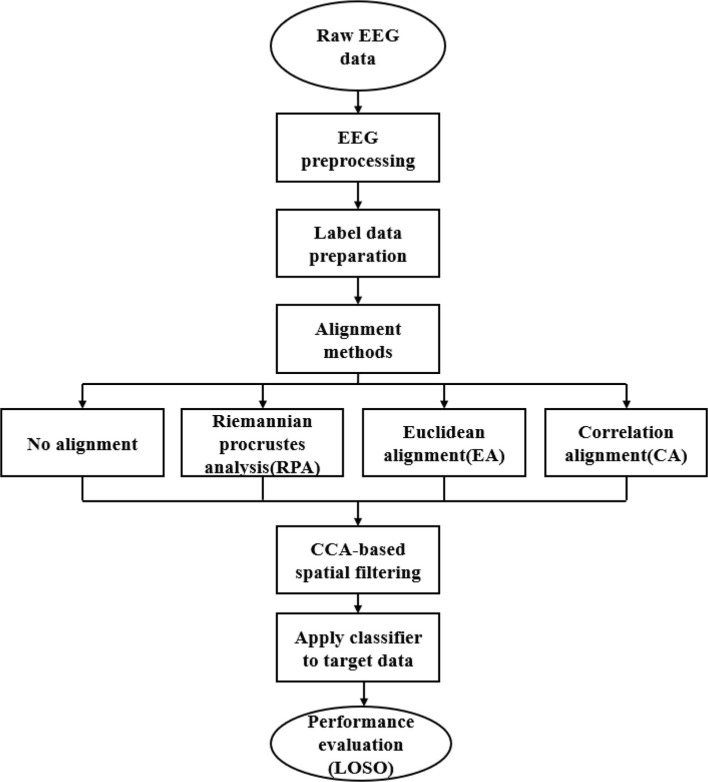
This paper comparatively evaluates three EEG data-alignment methods—RPA, EA, and CORAL—for cross-subject transfer in an attention-decoding BCI using leave-one-subject-out cross-validation. Optimized EA at α = 100 gave the largest mean improvement over no alignment, but the authors emphasize that per-subject tuning results are oracle upper bounds rather than leakage-free generalization estimates.
Key findings
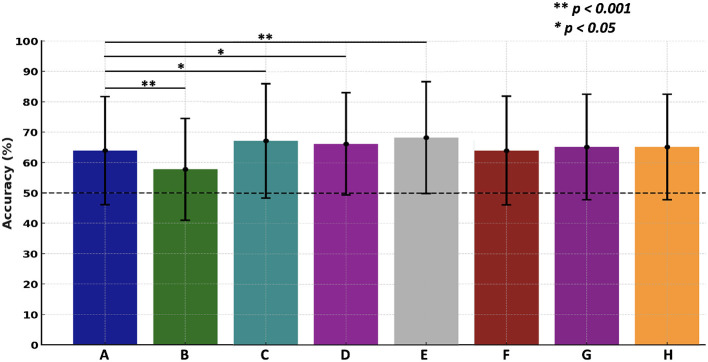
- Alignment improved classification over the no-alignment baseline; EA at α = 100 yielded a mean improvement of 3.44% (SD = 5.88), paired t(17) ≈ 2.48, p ≈ 0.024, Cohen’s dz ≈ 0.59, 95% CI [0.52%, 6.36%].
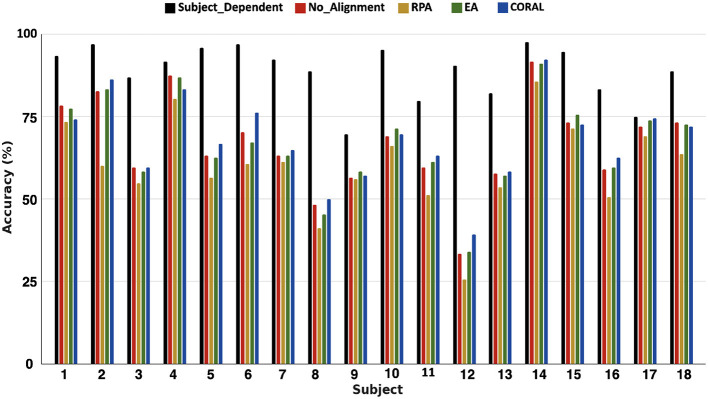
- CORAL was frequently the best alignment method, appearing as the top method for 9 out of 18 subjects, while EA often appeared as second-best.
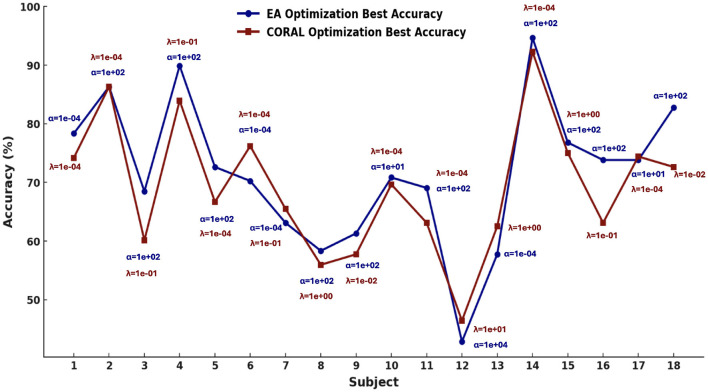
- Parameter sensitivity was substantial: CORAL generally performed best at low λ (≤ 0.1), while EA often favored high α (e.g., α = 100) and declined sharply beyond α = 1000.
- RPA’s best performance occurred when α was close to 1, which the authors interpret as evidence that RPA may not provide effective alignment because covariance structure is largely replaced by an identity matrix.
Methods
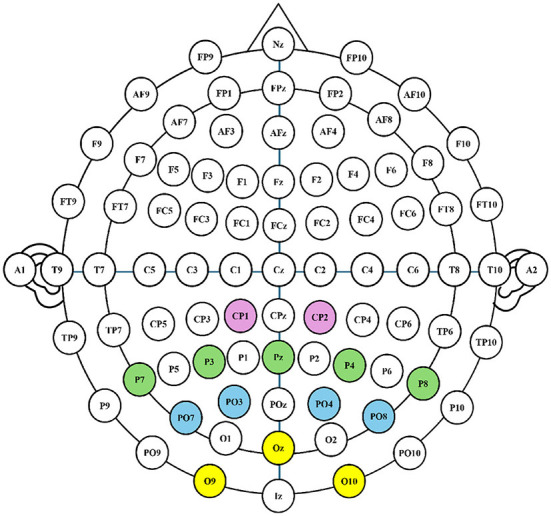
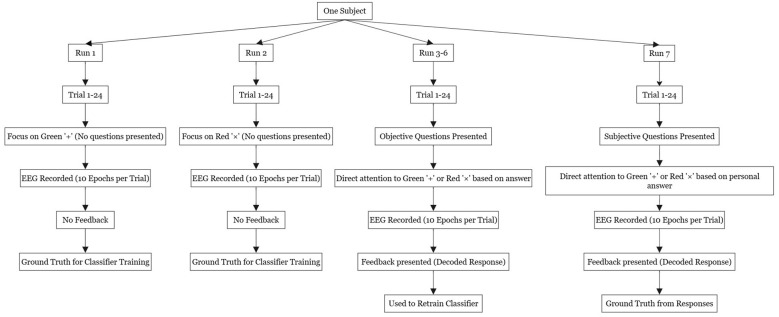
- Used the Reichert et al. (2020) covert spatial attention EEG dataset: 18 healthy participants, 14 parieto-occipital channels, 168 trials per subject, with preprocessing including mastoid re-referencing, 1.0–12.5 Hz band-pass filtering, 50 Hz resampling, and 750 ms epochs.
- Compared No Alignment, RPA, EA, and CORAL within a LOSO-CV framework; decoding used Canonical Correlation Analysis (CCA), and alignment parameters λ for CORAL and α for EA were swept over [10⁻⁴, 10⁴].
- Evaluated per-subject and mean decoding accuracy, with paired t-tests against the no-alignment baseline and subject-specific best-parameter analyses.
Limitations
- Stated: evaluation is restricted to a single covert spatial attention dataset with 18 subjects, limiting generalizability to other paradigms such as motor imagery or alternative ERP tasks.
- Stated: the study does not benchmark recent deep transfer, self-supervised, or foundation-model approaches.
- Stated: per-subject parameter sweeps and the fixed α = 100 result are not leakage-safe because parameters were selected using the held-out target subject’s accuracy; they are oracle upper bounds, and a leakage-free evaluation would require nested LOSO with parameter selection restricted to source subjects.
- Stated: the 1.0–12.5 Hz pass-band excludes higher-frequency activity that may be informative in other paradigms.
- Evident from text: no wall-clock timings are reported, as the authors state the goal was asymptotic behavior rather than hardware-specific benchmarks.
Model-written summary. Check it against the paper before relying on it.
Integrity signals
Registry
Cites
Statistics
Figures
Verification
Claims the paper makes
7 Valid · 1 Not valid · 0 Not checked · 83 Own results and interpretations
Every source the paper cites for this claim was checked and supports it.
In the paper
“One of the biggest challenges to making BCIs practical in daily life is high inter-subject variability in brain signals across individuals.”
§ Transfer learning for EEG-based BCIs: a comparative evaluation and optimization of data alignment methods > Introduction
What the sources say
- Supportedcites Jeng et al., 2020 source
The introduction describes variability in EEG data as an inevitable challenge to practical BCI use and says variability across users reduces decoding robustness. The Abstract likewise says human variability in EEG activity hinders practical EEG-based BCI applications. No page numbers are supplied in our copy. (LLM, conf=0.91)
plainstates a cause- Asserted: passes — The authors put it forward as true.
- Checkable: passes — It can be checked against evidence.
- Load-bearing: passes — The paper’s conclusions depend on it.
- Based: passes — The paper gives a reason why it holds.
- Supported
The cited sources support only part of this claim — read each source’s verdict below.
In the paper
“Inter-subject variability occurs since individuals' brains vary in anatomy, neural adaptability, and personal styles of cognition (Lebreton et al., 2019).”
§ Transfer learning for EEG-based BCIs: a comparative evaluation and optimization of data alignment methods > Introduction
What the sources say
- Partly supportedcites Lebreton et al., 2019 sourceExperimental — accuracy not yet measured
The Introduction (p. 2) discusses inter-individual differences in brain function and behavior, supporting the general premise that individuals vary. It does not identify anatomical differences, neural adaptability, or personal cognitive styles as the causes of that variability; searches for those terms and close paraphrases found no supporting passage. (LLM, conf=0.84)
plainstates a cause- Asserted: passes — The authors put it forward as true.
- Checkable: passes — It can be checked against evidence.
- Load-bearing: passes — The paper’s conclusions depend on it.
- Based: passes — The paper gives a reason why it holds.
- Partly supported
Every source the paper cites for this claim was checked and supports it.
In the paper
“This variability makes it difficult to develop models that can perform well for any individual without requiring time-consuming and lengthy calibration sessions for each individual (Jeng et al., 2020).”
§ Transfer learning for EEG-based BCIs: a comparative evaluation and optimization of data alignment methods > Introduction
What the sources say
- Supportedcites Jeng et al., 2020 source
The introduction (page not supplied) says EEG variability challenges practical BCI use and that collecting sufficient individual calibration data can be time-consuming or impractical. It also says variability across users reduces decoding robustness, supporting the cited paraphrase. (LLM, conf=0.93)
plainstates a cause- Asserted: passes — The authors put it forward as true.
- Checkable: passes — It can be checked against evidence.
- Load-bearing: passes — The paper’s conclusions depend on it.
- Based: passes — The paper gives a reason why it holds.
- Supported
The cited sources support only part of this claim — read each source’s verdict below.
In the paper
“A key strategy within inter-subject TL for EEG-BCIs is data alignment.”
§ Transfer learning for EEG-based BCIs: a comparative evaluation and optimization of data alignment methods > Introduction
What the sources say
- Partly supportedcites Sun et al., 2016 sourceExperimental — accuracy not yet measured
Figure 2 (Related Work, p. 2) describes aligning source and target data as a strategy for domain adaptation. The paper does not address EEG-BCIs or inter-subject transfer learning, so it does not establish the claim in that specific setting. (LLM, conf=0.87)
plain- Asserted: passes — The authors put it forward as true.
- Checkable: passes — It can be checked against evidence.
- Load-bearing: passes — The paper’s conclusions depend on it.
- Based: passes — The paper gives a reason why it holds.
- Partly supported
The cited sources support only part of this claim — read each source’s verdict below.
In the paper
“Finally, the 1.0–12.5 Hz pass-band, adopted from Reichert et al. (2020), is well-matched to the N2pc and posterior alpha signatures of covert spatial attention but excludes higher-frequency activity that may be informative in other paradigms.”
§ Transfer learning for EEG-based BCIs: a comparative evaluation and optimization of data alignment methods > Results > Limitations
What the sources say
- Partly supportedcites Reichert et al. (2020) sourceExperimental — accuracy not yet measured
Materials and Methods (Processing of EEG Data; page unavailable) confirms that the paper used a 1.0–12.5 Hz band-pass filter on parieto-occipital EEG to decode attention shifts. The Introduction discusses N2pc and mentions alpha activity in prior work, but the paper does not say that this pass-band is well-matched to both signatures or establish that it captures posterior alpha in this study. (LLM, conf=0.84)
boostedstates an association- Asserted: passes — The authors put it forward as true.
- Checkable: passes — It can be checked against evidence.
- Load-bearing: unclear — It is unclear whether the paper’s conclusions depend on it.
- Based: passes — The paper gives a reason why it holds.
- Partly supported
50 more claims
Create a free account to see all 91 claims and every source verdict.
- It may state two separate claims as one. 29
- Probably not a substantial claim. 11
Self-check
Percentages, sums and reported differences re-computed from the paper’s own numbers.
Each contradiction between two passages listed here was confirmed by an independent check.
Rated minor: it would not touch a result — a value no result rests on, a p-value that stays on the same side of the significance level, or a conflict that is clerical, resolved elsewhere in the paper, or outside its own findings.
In the paper
§ Transfer learning for EEG-based BCIs: a comparative evaluation and optimization of data alignment methods > Methodology > Optimization algorithms
“λ∈[0, 1]: Regularization parameter.”
§ Transfer learning for EEG-based BCIs: a comparative evaluation and optimization of data alignment methods > Results > Optimization results
“For the CORAL method, the parameter λ was varied across a wide range of values (λ∈{0.0001, 0.001, 0.01, 0.1, 1, 10, 100, 1000, 10000}).”
Rated minor: it would not touch a result — a value no result rests on, a p-value that stays on the same side of the significance level, or a conflict that is clerical, resolved elsewhere in the paper, or outside its own findings.
In the paper
§ Transfer learning for EEG-based BCIs: a comparative evaluation and optimization of data alignment methods > Results > Decoding accuracy per subject for each alignment method
“Certain subjects (like Subjects 3, 5, 7, 8, and 12) have very high Subject-Dependent accuracy”
§ Transfer learning for EEG-based BCIs: a comparative evaluation and optimization of data alignment methods > Results > Why the optimal method differs across subjects
“subjects with low subject-dependent accuracy (e.g., Subject 12 in Figure 5) also perform poorly under all transfer methods”
Rated minor: it would not touch a result — a value no result rests on, a p-value that stays on the same side of the significance level, or a conflict that is clerical, resolved elsewhere in the paper, or outside its own findings.
In the paper
§ Transfer learning for EEG-based BCIs: a comparative evaluation and optimization of data alignment methods > Results > Optimization results
“as α increased beyond 1000, a sharp decline in accuracy was observed for all subjects.”
§ Transfer learning for EEG-based BCIs: a comparative evaluation and optimization of data alignment methods > Methodology > Selection and optimization of λ and α
“| 12 | 33.33 | 33.33 | 33.33 | 33.33 | 32.14 | 31.55 | 28.57 | 40.48 | 42.86 |”
Citations
Cites
A review of classification algorithms for EEG-based brain–computer interfaces: A 10 year update
Lotte, F., Bougrain, L., Cichocki, A., Clerc, M., Congedo, M., Rakotomamonjy, A., & Yger, F. (2018) · Journal of Neural Engineering · doi:10.1088/1741-2552/aab2f2 · Cited by 2,239
Return of Frustratingly Easy Domain Adaptation
Sun, B., Feng, J., & Saenko, K. (2016) · Proceedings of the AAAI Conference on Artificial Intelligence · doi:10.1609/aaai.v30i1.10306 · Cited by 2,004
Transfer Learning for Brain–Computer Interfaces: A Euclidean Space Data Alignment Approach
He, H., & Wu, D. (2020) · IEEE Transactions on Biomedical Engineering · doi:10.1109/tbme.2019.2913914 · Cited by 569 · cited 3×
“Alternatively, He and Wu (2019) proposed an effective Euclidean Alignment (EA) approach that directly aligns and transforms raw EEG trials in the Euclidean space, with promising use cases for transfer learning in MI and ERP tasks.”
Jayaram, V., Alamgir, M., Altun, Y., Scholkopf, B., & Grosse-Wentrup, M. (2016) · IEEE Computational Intelligence Magazine · doi:10.1109/mci.2015.2501545 · Cited by 468
Transfer Learning: A Riemannian Geometry framework with applications to Brain-Computer Interfaces
Zanini, P., Congedo, M., Jutten, C., Said, S., & Berthoumieu, Y. (2018) · IEEE Transactions on Biomedical Engineering · doi:10.1109/tbme.2017.2742541 · Cited by 412 · cited 2×
“For instance, methods like Riemannian Alignment (RA) operate on covariance matrices within the Riemannian manifold (Zanini et al., 2017).”
Multisource Transfer Learning for Cross-Subject EEG Emotion Recognition
Li, J., Qiu, S., Shen, Y.-Y., Liu, C.-L., & He, H. (2019) · IEEE Transactions on Cybernetics · doi:10.1109/tcyb.2019.2904052 · Cited by 353 · cited 1×
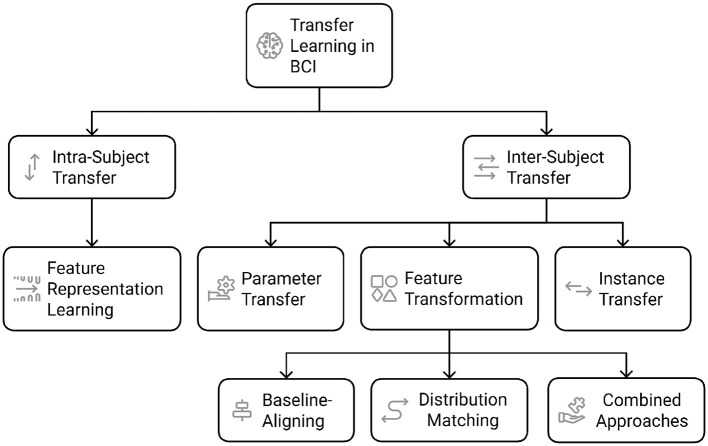
“Distribution-matching transforms features so that the distributions across users become more similar (Li et al., 2019b; Zhang et al., 2015; Rodrigues et al., 2018; Dai et al., 2019; Li et al., 2019a).”
Domain Adaptation for EEG Emotion Recognition Based on Latent Representation Similarity
Li, J., Qiu, S., Du, C., Wang, Y., & He, H. (2020) · IEEE Transactions on Cognitive and Developmental Systems · doi:10.1109/tcds.2019.2949306 · Cited by 291
Composite Common Spatial Pattern for Subject-to-Subject Transfer
Kang, H., Nam, Y., & Choi, S. (2009) · IEEE Signal Processing Letters · doi:10.1109/lsp.2009.2022557 · Cited by 265
Riemannian Procrustes Analysis: Transfer Learning for Brain–Computer Interfaces
Rodrigues, P. L. C., Jutten, C., & Congedo, M. (2019) · IEEE Transactions on Biomedical Engineering · doi:10.1109/tbme.2018.2889705 · Cited by 219 · cited 1×
“Distribution-matching transforms features so that the distributions across users become more similar (Li et al., 2019b; Zhang et al., 2015; Rodrigues et al., 2018; Dai et al., 2019; Li et al., 2019a).”
A Convolutional Recurrent Attention Model for Subject-Independent EEG Signal Analysis
Zhang, D., Yao, L., Chen, K., & Monaghan, J. (2019) · IEEE Signal Processing Letters · doi:10.1109/lsp.2019.2906824 · Cited by 211 · cited 1×
“Similarly, Zhang et al. (2019a) and Jeon et al. (2021) used deep learning to extract consistent patterns across users.”
Manifold Embedded Knowledge Transfer for Brain-Computer Interfaces
Zhang, W., & Wu, D. (2020) · IEEE Transactions on Neural Systems and Rehabilitation Engineering · doi:10.1109/tnsre.2020.2985996 · Cited by 183 · cited 1×
“Some studies combine both strategies for better results (Zhang and Wu, 2020).”
Brain Computer Interfaces for Improving the Quality of Life of Older Adults and Elderly Patients
Belkacem, A. N., Jamil, N., Palmer, J. A., Ouhbi, S., & Chen, C. (2020) · Frontiers in Neuroscience · doi:10.3389/fnins.2020.00692 · Cited by 171
Self-citationAssessing inter individual differences with task related functional neuroimaging
Lebreton, M., Bavard, S., Daunizeau, J., & Palminteri, S. (2019) · Nature Human Behaviour · doi:10.1038/s41562-019-0681-8 · Cited by 160
Jamil, N., Belkacem, A. N., Ouhbi, S., & Lakas, A. (2021) · Sensors · doi:10.3390/s21144754 · Cited by 122 · cited 1×
“These systems have great promise for applications in neurorehabilitation, assistive technologies for individuals with disabilities, and cognitive monitoring tasks such as attention tracking and emotion detection (Belkacem et al., 2020; Jamil et al., 2021).”
Self-citationMutual Information-Driven Subject-Invariant and Class-Relevant Deep Representation Learning in BCI
Jeon, E., Ko, W., Yoon, J. S., & Suk, H. (2021) · IEEE Transactions on Neural Networks and Learning Systems · doi:10.1109/tnnls.2021.3100583 · Cited by 120 · cited 1×
“Similarly, Zhang et al. (2019a) and Jeon et al. (2021) used deep learning to extract consistent patterns across users.”
A subject transfer framework for EEG classification
Tu, W., & Sun, S. (2011) · Neurocomputing · doi:10.1016/j.neucom.2011.10.024 · Cited by 118
Wei, C.-S., Lin, Y.-P., Wang, Y.-T., Lin, C.-T., & Jung, T.-P. (2018) · NeuroImage · doi:10.1016/j.neuroimage.2018.03.032 · Cited by 115
Electroencephalography (EEG)‐Based Brain–Computer Interfaces
Lotte, F., Bougrain, L., & Clerc, M. (2015) · Wiley Encyclopedia of Electrical and Electronics Engineering · doi:10.1002/047134608x.w8278 · Cited by 98 · cited 1×
“A brain-computer interface (BCI) provides an immediate interface between the human brain and an external machine, mapping brain signals reflecting user intentions or cognitive states (Lotte et al., 2015).”
Learning Invariant Representations From EEG via Adversarial Inference
Ozdenizci, O., Wang, Y., Koike-Akino, T., & Erdogmus, D. (2020) · IEEE Access · doi:10.1109/access.2020.2971600 · Cited by 95 · cited 1×
“Özdenizci et al. (2020) applied convolutional neural networks and adversarial training to learn subject-invariant features.”
Shahbakhti, M., Beiramvand, M., Nazari, M., Broniec, A., Augustyniak, P., Rodrigues, A. S., Wierzchoń, M., & Marozas, V. (2021) · IEEE Transactions on Neural Systems and Rehabilitation Engineering · doi:10.1109/tnsre.2021.3054733 · Cited by 83
Belkacem, A. N., Jamil, N., Khalid, S., & Alnajjar, F. (2023) · Frontiers in Human Neuroscience · doi:10.3389/fnhum.2023.1085173 · Cited by 80
Self-citationA subject-independent brain-computer interface based on smoothed, second-order baselining
Reuderink, B., Farquhar, J., Poel, M., & Nijholt, A. (2011) · 2011 Annual International Conference of the IEEE Engineering in Medicine and Biology Society · doi:10.1109/iembs.2011.6091139 · Cited by 54 · cited 1×
“Baseline-aligning removes individual-specific baselines to make the data more uniform (Reuderink et al., 2011; Zanini et al., 2017; He and Wu, 2019).”
Gutiérrez-Martínez, J., Mercado-Gutierrez, J. A., Carvajal-Gámez, B. E., Rosas‐Trigueros, J. L., & Contreras-Martinez, A. E. (2021) · Frontiers in Human Neuroscience · doi:10.3389/fnhum.2021.772837 · Cited by 42
Individual Similarity Guided Transfer Modeling for EEG-based Emotion Recognition
Zhang, X., Liang, W., Ding, T., Pan, J., Shen, J. G., Huang, X., & Gao, J. (2019) · IEEE International Conference on Bioinformatics and Biomedicine (BIBM) · doi:10.1109/bibm47256.2019.8982972 · Cited by 37 · cited 1×
“This weighting is often based on the distance between their data distributions (Dagois et al., 2018; Zhang et al., 2019b).”
Transfer Components Between Subjects for EEG-based Driving Fatigue Detection
Zhang, Y., Zheng, W., & Lu, B. (2015) · Lecture notes in computer science · doi:10.1007/978-3-319-26561-2_8 · Cited by 35 · cited 1×
“Distribution-matching transforms features so that the distributions across users become more similar (Li et al., 2019b; Zhang et al., 2015; Rodrigues et al., 2018; Dai et al., 2019; Li et al., 2019a).”
Domain Transfer Multiple Kernel Boosting for Classification of EEG Motor Imagery Signals
Dai, M., Wang, S., Zheng, D., Na, R., & Zhang, S. (2019) · IEEE Access · doi:10.1109/access.2019.2908851 · Cited by 35
Low dimensional subject representation based transfer learning in eeg decoding
Jeng, P.-Y., Wei, C.-S., Jung, T.-P., & Wang, L.-C. (2021) · IEEE Journal of Biomedical and Health Informatics · doi:10.1109/jbhi.2020.3025865 · Cited by 35 · cited 1×
“This variability makes it difficult to develop models that can perform well for any individual without requiring time-consuming and lengthy calibration sessions for each individual (Jeng et al., 2020).”
Revisiting Euclidean alignment for transfer learning in EEG-based brain–computer interfaces
Wu, D. (2025) · Journal of Neural Engineering · doi:10.1088/1741-2552/addd49 · Cited by 26 · cited 1×
“A recent review (Wu, 2025) further consolidates these developments and expands the scope of alignment to MEG, intracranial EEG, and cross-modality applications.”
Reichert, C., Tellez Ceja, I. F., Sweeney-Reed, C. M., Heinze, H.-J., Hinrichs, H., & Dürschmid, S. (2020) · Frontiers in Neuroscience · doi:10.3389/fnins.2020.591777 · Cited by 23 · cited 5×
“…Analysis, RPA), direct Euclidean transformation, and statistical feature alignment (CORAL), to understand their relative strengths, weaknesses, and optimal application within the context of EEG-BCIs, particularly for tasks like attention decoding (Reichert et al., 2020; Chugh and Aggarwal, 2024).”
InfluentialEffect of Stimulus Size in a Visual ERP-Based BCI under RSVP
Fernández-Rodríguez, Á., Darves‐Bornoz, A., Velasco-Álvarez, F., & Ron-Angevín, R. (2022) · Sensors · doi:10.3390/s22239505 · Cited by 20
Transfer Learning for a Multimodal Hybrid EEG-fTCD Brain–Computer Interface
Dagois, E., Khalaf, A. F., Sejdić, E., & Akçakaya, M. (2018) · IEEE Sensors Letters · doi:10.1109/lsens.2018.2879466 · Cited by 18
Mellot, A., Collas, A., Rodrigues, P. L. C., Engemann, D., & Gramfort, A. (2023) · Imaging Neuroscience · doi:10.1162/imag_a_00040 · Cited by 16
Improving the performance of a gaze independent P300-BCI by using the expectancy wave
Xu, W., Gao, P., He, F., & Qi, H. (2022) · Journal of Neural Engineering · doi:10.1088/1741-2552/ac60c8 · Cited by 12
Spatial localization in target detection based on decoding N2pc component
Wang, Y., Luo, Z., Zhao, S., Xie, L., Xu, M., Ming, D., & Yin, E. (2021) · Journal of Neuroscience Methods · doi:10.1016/j.jneumeth.2021.109440 · Cited by 11
EOG acquisition system based on ATmega AVR microcontroller
Abdel-Samei, A.-G. A., Shaaban, A.-S., Brisha, A. M., El‐Samie, F. E. A., & Ali, A. S. (2023) · Journal of Ambient Intelligence and Humanized Computing · doi:10.1007/s12652-023-04622-9 · Cited by 11
Subject Selection on a Riemannian Manifold for Unsupervised Cross-subject Seizure DetectionPreprint
Bolagh, S. N. G., & Clifford, G. D. (2017) · arXiv (Cornell University) · doi:10.48550/arxiv.1712.00465 · Cited by 11
RSVP-based BCI for inconspicuous targets: detection, localization, and modulation of attention
Zhou, Q., Zhang, Q., Wang, B., Yang, Y., Yuan, Z., Li, S., Zhao, Y., Zhu, Y., Gao, Z., Zhou, J., et al. (2024) · Journal of Neural Engineering · doi:10.1088/1741-2552/ad658e · Cited by 9
A One-Step Physiological Status Assessment Method Fusing Subject-Variant Information
An, Y., Chen, S., & Zhang, X. (2022) · IEEE Transactions on Automation Science and Engineering · doi:10.1109/tase.2022.3183589 · Cited by 8
Kæseler, R. L., Farina, D., Bentsen, B., Obál, I., Vinge, L., Dremstrup, K., Jochumsen, M., & Struijk, L. N. S. A. (2023) · doi:10.36227/techrxiv.21975476.v1 · Cited by 6
A toolbox for decoding BCI commands based on event-related potentials
Reichert, C., Sweeney‐Reed, C. M., Hinrichs, H., & Dürschmid, S. (2024) · Frontiers in Human Neuroscience · doi:10.3389/fnhum.2024.1358809 · Cited by 6
EEG-Based Decoding of Selective Visual Attention in Superimposed Videos
Yao, Y., Swaef, W. D., Geirnaert, S., & Bertrand, A. (2025) · IEEE Journal of Biomedical and Health Informatics · doi:10.1109/jbhi.2025.3580261 · Cited by 6
Reichert, C., Dürschmid, S., Sweeney‐Reed, C. M., & Hinrichs, H. (2022) · Complexity in Engineering (COMPENG) · doi:10.1109/compeng50184.2022.9905445 · Cited by 5
Ron-Angevín, R., Fernández-Rodríguez, Á., Velasco-Álvarez, F., Lespinet‐Najib, V., & André, J. (2024) · Sensors · doi:10.3390/s24113315 · Cited by 5
van de Wauw, C., Riecke, L., Goebel, R., Kaas, A. L., & Sorger, B. (2023) · NeuroImage · doi:10.1016/j.neuroimage.2023.120172 · Cited by 3
Chugh, N., & Aggarwal, S. (2024) · Clinical EEG and Neuroscience · doi:10.1177/15500594241229187 · Cited by 3
Vishwanath, M., Cao, S., Dutt, N., Rahmani, A. M., Lim, M. M., & Cao, H. (2025) · Biomedical Signal Processing and Control · doi:10.1016/j.bspc.2025.107948 · Cited by 3 · cited 1×
“Transfer EA (Vishwanath et al., 2025) enables inter-dataset and cross-species transfer, demonstrating improved classification between human and mouse EEG. Covariance-based harmonization frameworks (Mellot et al., 2023) decompose alignment into re-centering, re-scaling, and rotation, highlighting…”
Decoding Visual Covert Attention Shift from EEG for Use in BCI
Aggarwal, S., Chugh, N., & Balyan, A. (2022) · Lecture notes in networks and systems · doi:10.1007/978-981-16-5987-4_87 · Cited by 2
Paul, A., Pal, S., & Mitra, M. (2024) · Journal of Data Science and Intelligent Systems · doi:10.47852/bonviewjdsis42022757 · Cited by 1
Altan, G., & Inat, G. (2021) · Journal of Intelligent Systems with Applications · doi:10.64799/joiswa.v4.i2.10 · Cited by 1
Kæseler, R. L., Farina, D., Bentsen, B., Obál, I., Vinge, L., Dremstrup, K., Jochumsen, M., & Struijk, L. N. S. A. (2023) · doi:10.36227/techrxiv.21975476 · Cited by 1
EEG-based Decoding of Selective Visual Attention in Superimposed Videos
Yao, Y., Swaef, W. D., Geirnaert, S., et al. (2024) · arXiv · doi:10.48550/arxiv.2409.12562
Research works printed but not linked: 2
- Alamgir, 2010, “Multitask learning for brain-computer interfaces,”, 17
- Honzík V. Ph.D. thesis Use of spiking neural networks 2021
Cited by
Falsifiable substitution tests reveal task-structured neural evidence for auditory attentionPreprint
Ding, Y. (2026) · bioRxiv (Cold Spring Harbor Laboratory) · doi:10.64898/2026.08.03.742580
Metadata
- Authors
- Ahmed, S. G., Ambali Parambil, M. M., Damseh, R., Bouktif, S., Alnajjar, F., & Belkacem, A. N.
- Affiliations
- United Arab Emirates University (AE)
- Department of Computer Science and Software Engineering, College of Information Technology, United Arab Emirates University
- Corresponding author
- Alnajjar, Fady
- Venue
- Frontiers in Systems Neuroscience
- Publisher
- Frontiers Media SA
- Published
- 2026-06-11
- Volume
- 20
- Pages
- 1840121-1840121
- ISSN
- 1662-5137 (ISSN-L)
- PMC
- PMC13294087
- OpenAlex
- W7164296090
- Cited by
- 2
- References
- 51
- Citations by year
- 2026: 2
- FWCI
- 8.24
- Type
- journal article
- Language
- en
- Open access
- gold
- doi.org
- Licence
- Locations
- Frontiers in Systems Neuroscience (publishedVersion, cc-by)
- PubMed Central (publishedVersion, cc-by)
- PubMed (publishedVersion)
- DOAJ (DOAJ: Directory of Open Access Journals) (submittedVersion, cc-by-sa)
- Funders
- United Arab Emirates University
- Topics
- Life Sciences › Neuroscience › Cognitive Neuroscience › EEG and Brain-Computer Interfaces
- Physical Sciences › Computer Science › Human-Computer Interaction › Gaze Tracking and Assistive Technology
- Physical Sciences › Computer Science › Artificial Intelligence › Emotion and Mood Recognition
- Keywords
- EEG-based brain-computer interface, cross-subject transfer learning, data alignment, coral, leave-one-subject-out cross-validation, regularization parameter optimization, subject-specific calibration, interindividual variability
About these checks
Registry, retraction, Cites and statistics results are computed, not judged, with one exception: a printed reference that no index lists is read once by a model before it counts as a citation error. Claims are extracted by a model and kept only when their quote appears verbatim in the text; each cited source is then checked, with a model’s help, for whether it says what the claim relies on. Those verdicts can be wrong — read the claim’s quote and the cited source before relying on one.
The claim verdicts this report counts are experimental: their accuracy is not yet measured.
A language model drew the claims from the paper on 2026-10-10, under version 3 of the claim definition (model deepseek-v4.1-flash, prompt extract-v3).
A second model labelled each claim on 2026-10-10 (model jev-1.13-20260917, definition revision gold-guideline-v0.2).
Cited sources are checked with a language model’s help (gpt-6-sol).
Statistics and arithmetic are recomputed, not judged.
Confidence bands are shown only for fields calibrated on our annotated test set. None is calibrated yet, so no band is shown.
What counts as a claim ›How we measure confidence ›How we check this ›
Are you an author, or do you see a problem with this page? Request a review
Data sources
Bibliographic data: Semantic Scholar, OpenAlex, Crossref.
Contains information from the Semantic Scholar Academic Graph Datasets, made available under the ODC Attribution License (ODC-BY 1.0).
Semantic Scholar’s data is described in: Kinney, R., et al. (2023). The Semantic Scholar Open Data Platform. arXiv:2301.10140.
