

Pycnogenol® French maritime pine bark extract in randomized, double-blind, placebo-controlled human clinical studies
Open accessThe DOI matches its Crossref record; 77 of the 77 references it cites were found in a registry or an index.
Abstract
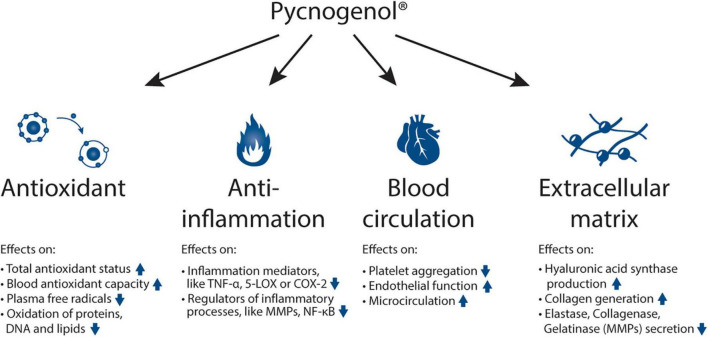
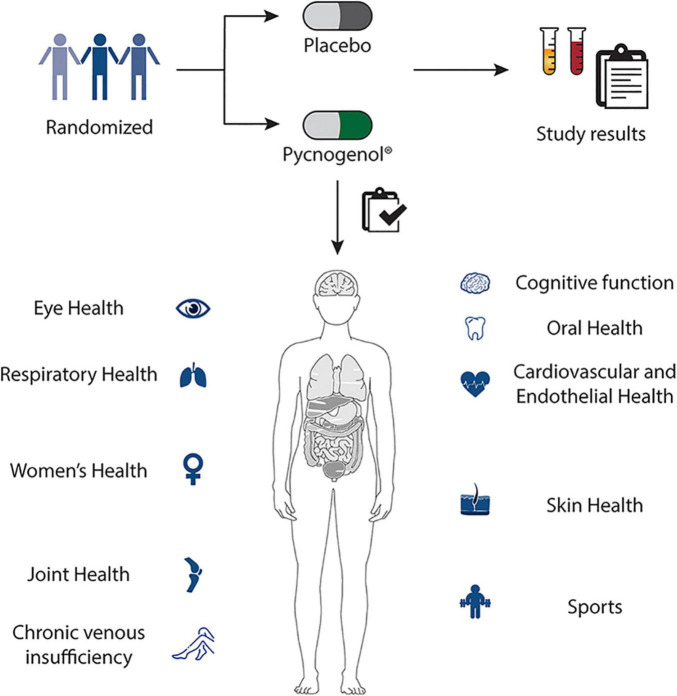
Pycnogenol® French maritime pine bark extract is a well-known and thoroughly studied patented extract from the bark of Pinus pinaster Ait. ssp. Atlantica. In 39 randomized double-blind, placebo-controlled (RDP) human clinical trials including 2,009 subjects, Pycnogenol® French maritime pine bark extract supplementation for two weeks to six months has been shown to beneficially affect cardiovascular health, chronic venous insufficiency, cognition, joint health, skin health, eye health, women’s health, respiratory health and allergies, oral health and sports performance. The mechanisms of action that can explain the respective effects on different conditions in the human body are discussed as well. As investigated in several in vitro, in vivo and in clinical studies, Pycnogenol® French maritime pine bark extract showed antioxidative effects, anti-inflammatory abilities, beneficial effects on endothelial function and reinforcing effects on the extracellular matrix. The present review aims to give a comprehensive overview of currently available “gold standard” RDP trials of Pycnogenol®’s benefits across various health domains compared to placebo. In addition, some of the processes on which the presented effects of Pycnogenol® French maritime pine bark extract are based will be elucidated and discussed. This broad overview of RDP studies on Pycnogenol® in different health domains can be used as a basis for further research on applications and mechanisms of this unique French maritime pine bark extract.
Overview
The claims and statistics of this paper haven’t been checked yet.
Free: it reads the open-access text and checks the first 5 claims that cite a source we can check. Create a free account to check every claim.
Integrity signals
Registry
Cites
Statistics
Figures
Verification
Claims the paper makes
The claims and statistics of this paper haven’t been checked yet.
Free: it reads the open-access text and checks the first 5 claims that cite a source we can check. Create a free account to check every claim.
Claims other papers make about this one
Each is checked against this paper’s own text: does it say what the citing paper says it does?
The check wasn’t confident either way, so it gives no verdict — never disputed.
In the citing paper
“In summary, citrus flavonoids may improve glycemic control, increase GLP-1 secretion, lower inflammation, and support weight management, making them potential adjunctive candidates to GLP-1RAs [117,118,347], though no clinical studies have directly evaluated their combined use.”
From Nutritional Approaches to Enhance GLP-1 Analogue Therapy in Obesity: A Narrative Review (2025) · cites this paper as [347]
Experimental — accuracy not yet measuredIn the citing paper
“Animal studies also show citrus flavonoids reduce weight gain and adiposity by activating AMPK and upregulating adipocyte thermogenesis [346,347], suggesting weightmodulating effects.”
From Nutritional Approaches to Enhance GLP-1 Analogue Therapy in Obesity: A Narrative Review (2025) · cites this paper as [347]
In the citing paper
“In summary, citrus flavonoids may improve glycemic control, increase GLP-1 secretion, lower inflammation, and support weight management, making them potential adjunctive candidates to GLP-1RAs [117,118,347], though no clinical studies have directly evaluated their combined use.”
From Nutritional Approaches to Enhance GLP-1 Analogue Therapy in Obesity: A Narrative Review (2025) · cites this paper as [347]
Self-check
Percentages, sums and reported differences re-computed from the paper’s own numbers.
The self-check needs the paper’s full text.
Citations
Cites
Cheung, N., Mitchell, P., & Wong, T. Y. (2010) · The Lancet · doi:10.1016/s0140-6736(09)62124-3 · Cited by 3,288
Understanding Asthma Phenotypes, Endotypes, and Mechanisms of Disease
Kuruvilla, M. E., Lee, F. E.-H., & Lee, G. B. (2019) · Clinical Reviews in Allergy & Immunology · doi:10.1007/s12016-018-8712-1 · Cited by 1,228
Epidemiology of Asthma in Children and Adults
Dharmage, S. C., Perret, J. L., & Custovic, A. (2019) · Frontiers in Pediatrics · doi:10.3389/fped.2019.00246 · Cited by 1,200 · cited 1×
“With almost 300 million people affected, asthma is one of the most common respiratory diseases worldwide (77).”
BackgroundOxidative stress in brain agingImplications for therapeutics of neurodegenerative diseases
FLOYD, R., & HENSLEY, K. (2002) · Neurobiology of Aging · doi:10.1016/s0197-4580(02)00019-2 · Cited by 830 · cited 1×
“Impairment in memory skills has 10.3389/fnut.2024.1389374 been found to be associated with increased age and oxidative stress (68), explaining Pycnogenol R (cid:13) ’s effects on cognitive function.”
BackgroundInfluentialEndothelial Dysfunction and Hypertension
Konukoglu, D., & Uzun, H. (2016) · Advances in Experimental Medicine and Biology · doi:10.1007/5584_2016_90 · Cited by 594
Rohdewald, P. (2002) · Int. Journal of Clinical Pharmacology and Therapeutics · doi:10.5414/cpp40158 · Cited by 481
Self-citationKawamura, T., & Muraoka, I. (2018) · Antioxidants · doi:10.3390/antiox7090119 · Cited by 307
Inflammatory Markers in Dysmenorrhea and Therapeutic Options
Barcikowska, Z., Rajkowska-Labon, E., Grzybowska, M. E., Hansdorfer-Korzon, R., & Zorena, K. (2020) · International Journal of Environmental Research and Public Health · doi:10.3390/ijerph17041191 · Cited by 269
Endothelium and Its Alterations in Cardiovascular Diseases: Life Style Intervention
Favero, G., Paganelli, C., Buffoli, B., Rodella, L. F., & Rezzani, R. (2014) · BioMed Research International · doi:10.1155/2014/801896 · Cited by 252 · cited 1×
“…human clinical RDP studies (9, 11, 12, 20–22 As the endothelium—the inner lining of blood vessels—is actively involved in many physiological functions, like controlling blood pressure, blood clotting and signaling during inflammation, endothelial function is crucial for cardiovascular health (62).”
BackgroundDiagnosis and management of ADHD in children.
Felt, B. T., Biermann, B., Christner, J. G., Kochhar, P., & Harrison, R. V. (2014) · PubMed · Cited by 222
Research works printed but not linked: 6
- 5. Oliff H. Scientific and clinical monograph for Pycnogenol. Austin, TX: American Botanical Council; (2019). p. 1–46.
- 7. The United States Pharmacopeia. USP monograph. Maritime pine extract. (Vol. 39). North Bethesda, MD: The United States Pharmacopeia; (2016). p. 6748–9.
- 31. Wang S, Tan D, Zhao Y, Gao G, Gao X, Hu L. The effect of Pycnogenol® on the microcirculation, platelet function and ischaemic myocardium in patients with coronary artery diseases. Eur Bull Drug Res. (1999) 7:19–25.
- 47. Kohama T, Negami M. Effect of low-dose French maritime pine bark extract on climacteric syndrome in 170 perimenopausal women. J Reprod Med. (2013) 58:39–46.
- 53. Pavlovic P. Improved Endurance By Use Of Antioxidants. Eur Bull Drug Res. (1999) 7:26–9.
- 70. World Health Organization. Osteoarthritis. Geneva: World Health Organization; (2023).
Cited by
Tienaho, J., Liimatainen, J., Myllymäki, L., Kaipanen, K., Tagliavento, L., Ruuttunen, K., Rudolfsson, M., Karonen, M., Marjomäki, V., Hagerman, A. E., et al. (2024) · Separation and Purification Technology · doi:10.1016/j.seppur.2024.130925 · Cited by 23
Supriyadi, D., Damayanti, D., Veigel, S., Hansmann, C., & Gindl‐Altmutter, W. (2025) · Materials Today Sustainability · doi:10.1016/j.mtsust.2025.101074 · Cited by 33
Chen, L., Li, Z., & Fan, Y. (2025) · Frontiers in Cellular and Infection Microbiology · doi:10.3389/fcimb.2025.1601888 · Cited by 16
Nutritional Approaches to Enhance GLP-1 Analogue Therapy in Obesity: A Narrative Review
Dias, D. D., Vasconcelos, A. R., Souza, A. C. R., Menezes, C. D., Silva, I. S. T. E., & Name, J. J. (2025) · Obesities · doi:10.3390/obesities5040088 · Cited by 8
“French maritime pine bark extract, derived from Pinus pinaster and rich in procyanidin, is a well-researched botanical with multiple clinically demonstrated benefits, including for metabolic, cardiovascular, and cognitive health [344].”
Dunlop, K., Dillon, G., Crowley, R. K., Phillips, C., Twomey, P. J., & McAuliffe, F. M. (2025) · Nutrition & Metabolism · doi:10.1186/s12986-025-00908-1 · Cited by 10
“Due to the age of the participants, the small sample size, and the fact use of the supplement was completely voluntary, results were considered equivocal [49].”
Metadata
- Authors
- Weichmann, F., & Rohdewald, P.
- Affiliations
- Horphag Research (Switzerland) (CH)
- University of Münster (DE)
- Corresponding author
- Weichmann, Franziska
- ORCID
- Weichmann, Franziska
- Venue
- Frontiers in Nutrition
- Publisher
- Frontiers Media SA
- Published
- 2024-05-02
- Volume
- 11
- Pages
- 1389374-1389374
- ISSN
- 2296-861X (ISSN-L)
- PMC
- PMC11096518
- OpenAlex
- W4396590316
- Cited by
- 38
- References
- 77
- Citations by year
- 2026: 17 · 2025: 19 · 2024: 2
- FWCI
- 1.45
- Type
- journal article
- Language
- en
- Open access
- gold
- doi.org
- Licence
- Locations
- Frontiers in Nutrition (publishedVersion, cc-by)
- PubMed Central (publishedVersion, cc-by)
- PubMed (publishedVersion)
- DOAJ (DOAJ: Directory of Open Access Journals) (submittedVersion, cc-by-sa)
- Topics
- Health Sciences › Medicine › Biochemistry (medical) › Phytochemicals and Antioxidant Activities
- Health Sciences › Medicine › Complementary and alternative medicine › Ginkgo biloba and Cashew Applications
- Life Sciences › Agricultural and Biological Sciences › Plant Science › Natural Compound Pharmacology Studies
- Keywords
- Pycnogenol, Pinus pinaster, dietary supplementation, cardiovascular health, chronic venous insufficiency, cognition, joint health, skin health, eye health, women's health, respiratory health, allergy, oral health, athletic performance, antioxidant activity, anti-inflammatory activity, endothelial function, extracellular matrix
About these checks
Registry, retraction, Cites and statistics results are computed, not judged, with one exception: a printed reference that no index lists is read once by a model before it counts as a citation error. Claims are extracted by a model and kept only when their quote appears verbatim in the text; each cited source is then checked, with a model’s help, for whether it says what the claim relies on. Those verdicts can be wrong — read the claim’s quote and the cited source before relying on one.
Statistics and arithmetic are recomputed, not judged.
Confidence bands are shown only for fields calibrated on our annotated test set. None is calibrated yet, so no band is shown.
What counts as a claim ›How we measure confidence ›How we check this ›
Are you an author, or do you see a problem with this page? Request a review
How to cite
Cite CoChat for the checks on this page, and the paper for its own findings.
- This page
- CoChat. (2026). Citation check: Pycnogenol® French maritime pine bark extract in randomized, double-blind, placebo-controlled human clinical studies. https://app.cochat.ai/papers/10.3389/fnut.2024.1389374
- The paper
- Weichmann, F., & Rohdewald, P. (2024). Pycnogenol® French maritime pine bark extract in randomized, double-blind, placebo-controlled human clinical studies. Frontiers in Nutrition. https://doi.org/10.3389/fnut.2024.1389374
Data sources
Bibliographic data: Semantic Scholar, OpenAlex, Crossref.
Contains information from the Semantic Scholar Academic Graph Datasets, made available under the ODC Attribution License (ODC-BY 1.0).
Semantic Scholar’s data is described in: Kinney, R., et al. (2023). The Semantic Scholar Open Data Platform. arXiv:2301.10140.
