

The DOI matches its Crossref record; 9 of the 9 references it cites were found in a registry or an index.
Genetic Architectures and Cell-of-Origin in Glioblastoma
Abstract
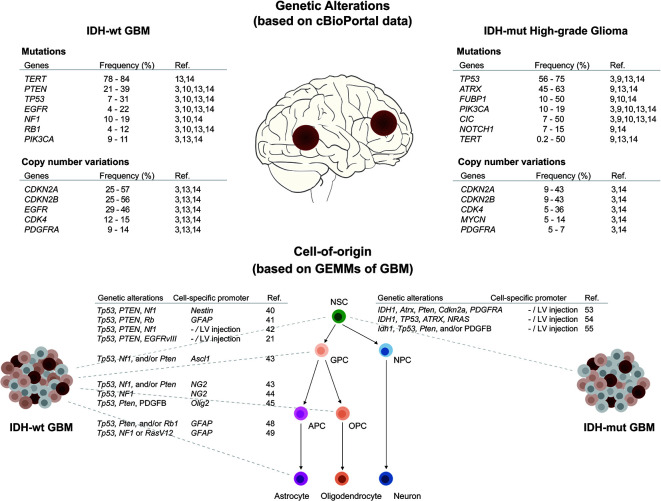
An aggressive primary brain cancer, glioblastoma (GBM) is the most common cancer of the central nervous system in adults. However, an inability to identify its cell-of-origin has been a fundamental issue hindering further understanding of the nature and pathogenesis of GBM, as well as the development of novel therapeutic targets. Researchers have hypothesized that GBM arises from an accumulation of somatic mutations in neural stem cells (NSCs) and glial precursor cells that confer selective growth advantages, resulting in uncontrolled proliferation. In this review, we outline genomic perspectives on IDH-wildtype and IDH-mutant GBMs pathogenesis and the cell-of-origin harboring GBM driver mutations proposed by various GBM animal models. Additionally, we discuss the distinct neurodevelopmental programs observed in either IDH-wildtype or IDH-mutant GBMs. Further research into the cellular origin and lineage hierarchy of GBM will help with understanding the evolution of GBMs and with developing effective targets for treating GBM cancer cells.
Overview
The claims and statistics of this paper haven’t been checked yet.
Run the check — free, no account needed. It reads the open-access text and checks the sources it cites.
Integrity signals
Registry
Cites
Statistics
Figures
Verification
Claims the paper makes
The claims and statistics of this paper haven’t been checked yet.
Run the check — free, no account needed. It reads the open-access text and checks the sources it cites.
Claims other papers make about this one
Each is checked against this paper’s own text: does it say what the citing paper says it does?
In the citing paper
“there are multiple lines of evidence that it originates from neural stem cells (NSCs), NSC-derived glial progenitors, and oligodendrocyte precursor cells.41,42,43,44”
From MiR-128-3p – a gray eminence of the human central nervous system (2024) · cites this paper as [43]
Self-check
Percentages, sums and reported differences re-computed from the paper’s own numbers.
The self-check needs the paper’s full text.
Citations
Cites
Single-cell RNA-seq highlights intratumoral heterogeneity in primary glioblastoma
Patel, A. P., Tirosh, I., Trombetta, J. J., Shalek, A. K., Gillespie, S. M., Wakimoto, H., Cahill, D. P., Nahed, B. V., Curry, W. T., Martuza, R. L., et al. (2014) · Science · doi:10.1126/science.1254257 · Cited by 5,063
The Somatic Genomic Landscape of Glioblastoma
Brennan, C. W., Verhaak, R. G. W., McKenna, A., Campos, B., Noushmehr, H., Salama, S. R., Zheng, S., Chakravarty, D., Sanborn, J. Z., Berman, S. H., et al. (2013) · Cell · doi:10.1016/j.cell.2013.09.034 · Cited by 5,016
A Randomized Trial of Bevacizumab for Newly Diagnosed Glioblastoma
Gilbert, M. R., Dignam, J. J., Armstrong, T. S., Wefel, J. S., Blumenthal, D. T., Vogelbaum, M. A., Colman, H., Chakravarti, A., Pugh, S., Won, M., et al. (2014) · New England Journal of Medicine · doi:10.1056/nejmoa1308573 · Cited by 2,834
The Glial Nature of Embryonic and Adult Neural Stem Cells
Kriegstein, A., & Alvarez-Buylla, A. (2009) · Annual Review of Neuroscience · doi:10.1146/annurev.neuro.051508.135600 · Cited by 2,475
Human Hippocampal Neurogenesis Persists throughout Aging
Boldrini, M., Fulmore, C. A., Tartt, A. N., Simeon, L. R., Pavlova, I., Poposka, V., Rosoklija, G. B., Stankov, A., Arango, V., Dwork, A. J., et al. (2018) · Cell Stem Cell · doi:10.1016/j.stem.2018.03.015 · Cited by 1,345
Coactivation of receptor tyrosine kinases affects the response of tumor cells to targeted therapies
Stommel, J. M., Kimmelman, A. C., Ying, H., Nabioullin, R., Ponugoti, A. H., Wiedemeyer, R., Stegh, A. H., Bradner, J. E., Ligon, K. L., Brennan, C., et al. (2007) · Science · doi:10.1126/science.1142946 · Cited by 938
Immune and genomic correlates of response to anti-PD-1 immunotherapy in glioblastoma
Zhao, J., Chen, A. X., Gartrell, R. D., Silverman, A. M., Aparicio, L., Chu, T., Bordbar, D., Shan, D., Samanamud, J., Mahajan, A., et al. (2019) · Nature Medicine · doi:10.1038/s41591-019-0349-y · Cited by 903
The transcription factor GABP selectively binds and activates the mutant TERT promoter in cancer
Bell, R. J. A., Rube, H. T., Kreig, A., Mancini, A., Fouse, S. D., Nagarajan, R. P., Choi, S., Hong, C., He, D., Pekmezci, M., et al. (2015) · Science · doi:10.1126/science.aab0015 · Cited by 566
Isocitrate dehydrogenase-1 mutations: A fundamentally new understanding of diffuse glioma?
Kloosterhof, N. K., Bralten, L. B., Dubbink, H. J., French, P. J., & van den Bent, M. J. (2011) · The Lancet Oncology · doi:10.1016/s1470-2045(10)70053-x · Cited by 222
Research works printed but not linked: 57
- Louis, 2016, The 2016 World Health Organization Classification of Tumors of the Central Nervous System: a summary, Acta Neuropathol, 131, 10.1007/s00401-016-1545-1 · DOI
- Stupp, 2005, Radiotherapy plus concomitant and adjuvant temozolomide for glioblastoma, N Engl J Med, 352, 10.1056/NEJMoa043330 · DOI · Paper page
- Cancer Genome Atlas Research, 2008, Comprehensive genomic characterization defines human glioblastoma genes and core pathways, Nature, 455, 10.1038/nature07385 · DOI · Paper page
- Nathanson, 2014, Targeted therapy resistance mediated by dynamic regulation of extrachromosomal mutant EGFR DNA, Science, 343, 10.1126/science.1241328 · DOI
- Visvader, 2011, Cells of origin in cancer, Nature, 469, 10.1038/nature09781 · DOI
- Batista, 2014, Adult neurogenesis and glial oncogenesis: when the process fails, BioMed Res Int, 2014, 10.1155/2014/438639 · DOI
- Bradshaw, 2016, Cancer Stem Cell Hierarchy in Glioblastoma Multiforme, Front Surg, 3, 10.3389/fsurg.2016.00021 · DOI
- Gimple, 2019, Glioblastoma stem cells: lessons from the tumor hierarchy in a lethal cancer, Genes Dev, 33, 591, 10.1101/gad.324301.119 · DOI · Paper page
- Parsons, 2008, An integrated genomic analysis of human glioblastoma multiforme, Science, 321, 10.1126/science.1164382 · DOI · Paper page
- Ceccarelli, 2016, Molecular Profiling Reveals Biologically Discrete Subsets and Pathways of Progression in Diffuse Glioma, Cell, 164, 10.1016/j.cell.2015.12.028 · DOI
- Korber, 2019, Evolutionary Trajectories of IDH(WT) Glioblastomas Reveal a Common Path of Early Tumorigenesis Instigated Years ahead of Initial Diagnosis, Cancer Cell, 35, 692, 10.1016/j.ccell.2019.02.007 · DOI
- Wang, 2016, Clonal evolution of glioblastoma under therapy, Nat Genet, 48, 10.1038/ng.3590 · DOI · Paper page
- Miller, 2019, Tracking tumour evolution in glioma through liquid biopsies of cerebrospinal fluid, Nature, 565, 10.1038/s41586-019-0882-3 · DOI
- Jonsson, 2019, Genomic Correlates of Disease Progression and Treatment Response in Prospectively Characterized Gliomas, Clin Cancer Res, 25, 10.1158/1078-0432.CCR-19-0032 · DOI
- Cerami, 2012, The cBio cancer genomics portal: an open platform for exploring multidimensional cancer genomics data, Cancer Discovery, 2, 10.1158/2159-8290.CD-12-0095 · DOI · Paper page
- Gao, 2013, Integrative analysis of complex cancer genomics and clinical profiles using the cBioPortal, Sci Signal, 6, pl1, 10.1126/scisignal.2004088 · DOI · Paper page
- Killela, 2013, TERT promoter mutations occur frequently in gliomas and a subset of tumors derived from cells with low rates of self-renewal, Proc Natl Acad Sci USA, 110, 10.1073/pnas.1303607110 · DOI · Paper page
- Lee, 2018, Human glioblastoma arises from subventricular zone cells with low-level driver mutations, Nature, 560, 10.1038/s41586-018-0389-3 · DOI · Paper page
- Barthel, 2018, Reconstructing the molecular life history of gliomas, Acta Neuropathol, 135, 10.1007/s00401-018-1842-y · DOI
- Nobusawa, 2009, IDH1 mutations as molecular signature and predictive factor of secondary glioblastomas, Clin Cancer Res, 15, 10.1158/1078-0432.CCR-09-0715 · DOI
- Ichimura, 2009, IDH1 mutations are present in the majority of common adult gliomas but rare in primary glioblastomas, Neuro Oncol, 11, 10.1215/15228517-2009-025 · DOI
- Yan, 2009, IDH1 and IDH2 mutations in gliomas, N Engl J Med, 360, 10.1056/NEJMoa0808710 · DOI · Paper page
- Barthel, 2019, Longitudinal molecular trajectories of diffuse glioma in adults, Nature, 576, 10.1038/s41586-019-1775-1 · DOI
- Liu, 2012, Frequent ATRX mutations and loss of expression in adult diffuse astrocytic tumors carrying IDH1/IDH2 and TP53 mutations, Acta Neuropathol, 124, 10.1007/s00401-012-1031-3 · DOI
- Jiao, 2012, CIC, FUBP1 and IDH1 mutations refine the classification of malignant gliomas, Oncotarget, 3, 10.18632/oncotarget.588 · DOI
- Verhaak, 2010, Integrated genomic analysis identifies clinically relevant subtypes of glioblastoma characterized by abnormalities in PDGFRA, IDH1, EGFR, and NF1, Cancer Cell, 17, 98, 10.1016/j.ccr.2009.12.020 · DOI · Paper page
- Wang, 2017, Tumor Evolution of Glioma-Intrinsic Gene Expression Subtypes Associates with Immunological Changes in the Microenvironment, Cancer Cell, 32, 42, 10.1016/j.ccell.2017.06.003 · DOI
- Lei, 2011, Glioblastoma models reveal the connection between adult glial progenitors and the proneural phenotype, PLoS One, 6, e20041, 10.1371/journal.pone.0020041 · DOI
- Sanai, 2004, Unique astrocyte ribbon in adult human brain contains neural stem cells but lacks chain migration, Nature, 427, 10.1038/nature02301 · DOI
- Tomasetti, 2017, Stem cell divisions, somatic mutations, cancer etiology, and cancer prevention, Science, 355, 10.1126/science.aaf9011 · DOI
- Chen, 2012, Malignant glioma: lessons from genomics, mouse models, and stem cells, Cell, 149, 36, 10.1016/j.cell.2012.03.009 · DOI
- Zong, 2015, Cell of origin for malignant gliomas and its implication in therapeutic development, Cold Spring Harb Perspect Biol, 7, a020610, 10.1101/cshperspect.a020610 · DOI
- Alcantara Llaguno, 2016, Cell of origin of glioma: biological and clinical implications, Br J Cancer, 115, 10.1038/bjc.2016.354 · DOI
- Alcantara Llaguno, 2009, Malignant astrocytomas originate from neural stem/progenitor cells in a somatic tumor suppressor mouse model, Cancer Cell, 15, 45, 10.1016/j.ccr.2008.12.006 · DOI · Paper page
- Jacques, 2010, Combinations of genetic mutations in the adult neural stem cell compartment determine brain tumour phenotypes, EMBO J, 29, 10.1038/emboj.2009.327 · DOI · Paper page
- Zuckermann, 2015, Somatic CRISPR/Cas9-mediated tumour suppressor disruption enables versatile brain tumour modelling, Nat Commun, 6, 7391, 10.1038/ncomms8391 · DOI · Paper page
- Alcantara Llaguno, 2015, Adult Lineage-Restricted CNS Progenitors Specify Distinct Glioblastoma Subtypes, Cancer Cell, 28, 10.1016/j.ccell.2015.09.007 · DOI
- Galvao, 2014, Transformation of quiescent adult oligodendrocyte precursor cells into malignant glioma through a multistep reactivation process, Proc Natl Acad Sci USA, 111, 10.1073/pnas.1414389111 · DOI
- Liu, 2011, Mosaic analysis with double markers reveals tumor cell of origin in glioma, Cell, 146, 10.1016/j.cell.2011.06.014 · DOI
- Lu, 2016, Olig2-Dependent Reciprocal Shift in PDGF and EGF Receptor Signaling Regulates Tumor Phenotype and Mitotic Growth in Malignant Glioma, Cancer Cell, 29, 10.1016/j.ccell.2016.03.027 · DOI
- Alcantara Llaguno, 2019, Cell-of-origin susceptibility to glioblastoma formation declines with neural lineage restriction, Nat Neurosci, 22, 10.1038/s41593-018-0333-8 · DOI
- Chow, 2011, Cooperativity within and among Pten, p53, and Rb pathways induces high-grade astrocytoma in adult brain, Cancer Cell, 19, 10.1016/j.ccr.2011.01.039 · DOI
- Friedmann-Morvinski, 2012, Dedifferentiation of neurons and astrocytes by oncogenes can induce gliomas in mice, Science, 338, 10.1126/science.1226929 · DOI
- Friedmann-Morvinski, 2014, Dedifferentiation and reprogramming: origins of cancer stem cells, EMBO Rep, 15, 10.1002/embr.201338254 · DOI
- Xiong, 2019, Cellular Reprogramming as a Therapeutic Target in Cancer, Trends Cell Biol, 29, 10.1016/j.tcb.2019.05.001 · DOI
- Bardella, 2016, Expression of Idh1(R132H) in the Murine Subventricular Zone Stem Cell Niche Recapitulates Features of Early Gliomagenesis, Cancer Cell, 30, 10.1016/j.ccell.2016.08.017 · DOI
- Philip, 2018, Mutant IDH1 Promotes Glioma Formation In Vivo, Cell Rep, 23, 10.1016/j.celrep.2018.03.133 · DOI
- Nunez, 2019, IDH1-R132H acts as a tumor suppressor in glioma via epigenetic up-regulation of the DNA damage response, Sci Transl Med, 11, eaaq1427, 10.1126/scitranslmed.aaq1427 · DOI
- Zhang, 2019, Mutant IDH Sensitizes Gliomas to Endoplasmic Reticulum Stress and Triggers Apoptosis via miR-183-Mediated Inhibition of Semaphorin 3E, Cancer Res, 79, 4994, 10.1158/0008-5472.CAN-19-0054 · DOI
- Wang, 2020, Cell Lineage-Based Stratification for Glioblastoma, Cancer Cell, 38, 366, 10.1016/j.ccell.2020.06.003 · DOI
- Francis, 2014, EGFR variant heterogeneity in glioblastoma resolved through single-nucleus sequencing, Cancer Discovery, 4, 10.1158/2159-8290.CD-13-0879 · DOI · Paper page
- Muller, 2016, Single-cell sequencing maps gene expression to mutational phylogenies in PDGF- and EGF-driven gliomas, Mol Syst Biol, 12, 889, 10.15252/msb.20166969 · DOI
- Neftel, 2019, An Integrative Model of Cellular States, Plasticity, and Genetics for Glioblastoma, Cell, 178, 835, 10.1016/j.cell.2019.06.024 · DOI · Paper page
- Couturier, 2020, Single-cell RNA-seq reveals that glioblastoma recapitulates a normal neurodevelopmental hierarchy, Nat Commun, 11, 3406, 10.1038/s41467-020-17186-5 · DOI
- Tirosh, 2016, Single-cell RNA-seq supports a developmental hierarchy in human oligodendroglioma, Nature, 539, 10.1038/nature20123 · DOI
- Venteicher, 2017, Decoupling genetics, lineages, and microenvironment in IDH-mutant gliomas by single-cell RNA-seq, Science, 355, 10.1126/science.aai8478 · DOI
- Canoll, 2008, The interface between glial progenitors and gliomas, Acta Neuropathol, 116, 10.1007/s00401-008-0432-9 · DOI
Cited by
Sorted by citations
MiR-128-3p – a gray eminence of the human central nervous system
Kiel, K., Król, S. K., Bronisz, A., & Godlewski, J. (2024) · Molecular Therapy Nucleic Acids · doi:10.1016/j.omtn.2024.102141 · Cited by 15
Metadata
- Authors
- Kim, H. J., Park, J. W., & Lee, J. H.
- Venue
- Frontiers in Oncology
- Publisher
- Frontiers Media SA
- Published
- 2021-01-21
- Volume
- 10
- ISSN
- 2234-943X
- PMC
- PMC7859479
- Cited by
- 69
- References
- 9
- Funders
- National Research Foundation of Korea
About these checks
Registry, retraction, Cites and statistics results are computed, not judged, with one exception: a printed reference that no index lists is read once by a model before it counts as a citation error. Claims are extracted by a model and kept only when their quote appears verbatim in the text; each cited source is then checked, with a model’s help, for whether it says what the claim relies on. Those verdicts can be wrong — read the claim’s quote and the cited source before relying on one.
Statistics and arithmetic are recomputed, not judged.
Confidence bands are shown only for fields calibrated on our annotated test set. None is calibrated yet, so no band is shown.
What counts as a claim ›How we measure confidence ›How we check this ›
Are you an author, or do you see a problem with this page? Request a review
How to cite
Cite CoChat for the checks on this page, and the paper for its own findings.
- This page
- CoChat. (2026). Citation check: Genetic Architectures and Cell-of-Origin in Glioblastoma. https://app.cochat.ai/papers/10.3389/fonc.2020.615400
- The paper
- Kim, H. J., Park, J. W., & Lee, J. H. (2021). Genetic Architectures and Cell-of-Origin in Glioblastoma. Frontiers in Oncology. https://doi.org/10.3389/fonc.2020.615400
