

The DOI matches its Crossref record; 32 of the 32 references it cites were found in a registry or an index; 19 of the 24 sources its claims cite were checked for support.
Integrated cognitive behavioral intervention for functional tics (I-CBiT): case reports and treatment formulation
Open accessAbstract
Introduction: The onset of the COVID-19 pandemic saw a global surge in functional tic-like behaviors (FTLBs). FTLBs are unique from primary tic disorders. They are thought to manifest through a complex interplay between environmental and personal factors, including the stress-arousal system, and are characterized by their sudden and explosive onset. Accordingly, common interventions for tic disorders show limited efficacy in this population. We present an Integrated Cognitive Behavioral Intervention for Functional Tics (I-CBiT) that uses an urge acceptance model to manage tics and related stress and anxiety. Methods: We describe the treatment outcomes of eight young people presenting with new and sudden onset FTLBs who underwent I-CBiT, which integrates traditional behavioral tic interventions with third-wave cognitive behavioral therapies. All cases completed the three-phase intervention involving core components of psychoeducation, exposure and response prevention with urge acceptance, sensory grounding strategies, and cognitive behavioral intervention targeting the stress-arousal system. Tic severity and impairment were assessed prior to treatment and at completion. Results: All cases showed a significant reduction in tic severity post I-CBiT and an improvement in overall daily living function. These cases highlight the role of urge acceptance in managing both tic urges and the underlying stress-arousal system to bring about long-term change. Conclusion: We demonstrated the efficacy of I-CBiT for managing FTLBs. Our findings illustrate the importance of treating underlying stress and anxiety in this population and, therefore, a need for greater interaction between multidisciplinary services in managing FTLBs to comprehensively cover the varied symptom presentations linked to thoughts, emotions, bodily sensations, and stress responses. 2023 Maxwell, Zouki and Eapen.
Overview
CoChat Summary
## TL;DR
This paper presents eight case reports of young people with sudden-onset functional tic-like behaviors treated with Integrated Cognitive Behavioral Intervention for Functional Tics (I-CBiT). The authors report significant post-treatment improvements in tic severity, impairment, suppressibility, and daily functioning, and argue that targeting urge acceptance plus underlying stress-arousal processes is central.
## Key findings
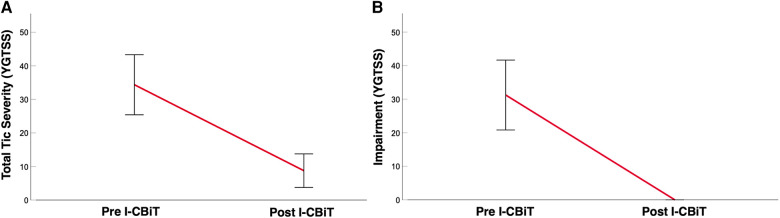
- In all 8/8 cases, tic frequency, tic suppressibility, and YGTSS scores improved after I-CBiT.
- Paired t-tests showed significant reductions in YGTSS scores: total tic severity from 35.00 (SD 10.97) to 8.50 (SD 6.37), t(7) = 5.63, p < .001; impairment from 31.25 (SD 12.46) to 0.00 (SD 0.00), t(7) = 7.09, p < .001.
- 4/8 cases were tic-free post-treatment or had only occasional mild tics once per month; 2/8 had tic-free days or weeks; the remaining 2/8 had tics every couple of hours with some tic-free days.
- 7/8 cases could suppress tics for at least one hour; all cases with reduced school attendance (n = 4) returned to school full-time.
## Methods
- Case series of 8 young people with new and sudden-onset functional tic-like behaviors presenting to the clinic between 2019 and 2023.
- Inclusion criteria required rapid symptom onset/evolution, at least 4/9 phenomenological criteria, and tic onset at >12 years old in 6/8 cases; diagnoses were confirmed by a clinical psychologist plus a neurologist, psychiatrist, or pediatrician.
- All cases received I-CBiT, a three-phase intervention integrating exposure and response prevention with urge acceptance, sensory grounding, psychoeducation, and cognitive behavioral work on stress-arousal; paired t-tests assessed pre/post YGTSS severity and impairment.
## Limitations
- The paper states the sample was all adolescent/young adult biological females, so the authors say future work should examine male patients, different age groups, and geographic locations.
- Because the data were retrospective from a tic-specific clinic, standardized measures of stress, anxiety, and somatic symptoms were not available; the authors note future larger studies should include them.
- The design is observational/case-series based, so the authors state the applicability of I-CBiT to additional FTLB presentations is not yet fully understood.
Model-written summary. Check it against the paper before relying on it.
Integrity signals
Registry
Cites
Statistics
Figures
Verification
Claims the paper makes
9 Valid · 0 Not valid · 3 Not checked · 34 Own results and interpretations
The cited sources support only part of this claim — read each source’s verdict below.
In the paper
“FTLBs are unique from primary tic disorders.”
- Also stated in: § Introduction · plain
“Although FTLBs are often difficult to discriminate from primary tics seen in persistent tic disorders such as Tourette syndrome, there are some stark epidemiological and phenomenological differences (3, 5)”
§ Integrated cognitive behavioral intervention for functional tics (I-CBiT): case reports and treatment formulation > Abstract > Introduction
What the sources say
- Supportedcites [3] Han, 2022, Rapid onset functional tic-like behaviours in children and adolescents during COVID-19: clinical features, assessment and biopsychosocial treatment approach, J Paediatr Child Health source
The Discussion (Table 2) lists common differences between functional tic disorder and Tourette syndrome, including onset, clinical features, and impact on functioning. The Results also report significant differences between the functional tic and chronic tic disorder/Tourette syndrome groups. These passages support the broad claim that functional tic-like behaviours are distinct from primary tic disorders. (LLM, conf=0.93)
- Partly supportedcites [5] Buts, 2022, Paediatric tic-like presentations during the COVID-19 pandemic, Arch Dis Child sourceExperimental — accuracy not yet measured
The Abstract describes sudden-onset functional tic-like movements in predominantly female adolescents as a presentation needing identification and management. This supports treating these presentations as distinctive, but the passages available in our copy do not compare them directly with primary tic disorders or establish that all FTLBs are unique from them. (LLM, conf=0.76)
plain- Asserted: passes — The authors put it forward as true.
- Checkable: passes — It can be checked against evidence.
- Load-bearing: passes — The paper’s conclusions depend on it.
- Based: passes — The paper gives a reason why it holds.
- Also stated in: § Introduction · plain
The cited sources support only part of this claim — read each source’s verdict below.
In the paper
“common interventions for tic disorders show limited efficacy in this population.”
- Also stated in: § Introduction · hedged
“Preliminary findings show minimal or no clinical improvement with standard pharmacological treatments (3, 4, 9).”
§ Integrated cognitive behavioral intervention for functional tics (I-CBiT): case reports and treatment formulation > Abstract > Introduction
What the sources say
- Partly supportedcites [3] Han, 2022, Rapid onset functional tic-like behaviours in children and adolescents during COVID-19: clinical features, assessment and biopsychosocial treatment approach, J Paediatr Child Health sourceExperimental — accuracy not yet measured
Table 2 in the Discussion describes functional tic disorder as refractory to dopaminergic agents, and the Discussion says these medications may not be useful. That supports limited efficacy for one conventional tic treatment, but not the broader claim about common interventions generally. The Results also state that the authors could not determine treatment responses in their cohort. (LLM, conf=0.84)
- Partly supportedcites [4] Pringsheim, 2021, Rapid onset functional tic-like behaviors in young females during the COVID-19 pandemic, Mov Disord sourceExperimental — accuracy not yet measured
The Viewpoint reports anecdotal evidence that patients with FTLBs do not respond typically to conventional tic medications. But it also predicts that cognitive behavioral therapies incorporating CBIT may succeed, so the claim is too broad if “common interventions” includes behavioral treatment. The paper does not report a systematic efficacy assessment. (LLM, conf=0.87)
- Partly supportedcites [9] Ganos, 2016, “I swear it is Tourette’s!”: on functional coprolalia and other tic-like vocalizations, Psychiatry Res sourceExperimental — accuracy not yet measured
The Results report that ten patients with functional coprolalia or other complex tic-like vocalizations received classical anti-tic medications without symptom improvement or with atypical adverse effects. This supports limited efficacy for those medications in this small case series, but not for common tic-disorder interventions generally or the broader FTLB population. (LLM, conf=0.84)
plain- Asserted: passes — The authors put it forward as true.
- Checkable: passes — It can be checked against evidence.
- Load-bearing: passes — The paper’s conclusions depend on it.
- Based: passes — The paper gives a reason why it holds.
- Also stated in: § Introduction · hedged
Every source the paper cites for this claim was checked and supports it.
In the paper
“All cases presented to our clinic between 2019 and 2023 and met criteria for FTLBs based on current guidelines (12).”
§ Integrated cognitive behavioral intervention for functional tics (I-CBiT): case reports and treatment formulation > Materials and methods > Inclusion criteria
What the sources say
- Supportedcites [12] Pringsheim, 2023, European Society for the study of Tourette syndrome 2022 criteria for clinical diagnosis of functional tic-like behaviours: international consensus from experts in tic disorders, Eur J Neurol source
Table 3 (Additional information) sets out the ESSTS 2022 clinical diagnostic criteria for functional tic-like behaviours. The citation identifies the guidelines the citing authors say they applied; it does not attribute their clinic cases to this source. (LLM, conf=0.91)
plainn = 8- Asserted: passes — The authors put it forward as true.
- Checkable: passes — It can be checked against evidence.
- Load-bearing: passes — The paper’s conclusions depend on it.
- Based: passes — The paper gives a reason why it holds.
- Supported
Every source the paper cites for this claim was checked and supports it.
In the paper
“In their case report, the authors demonstrated the utility of managing co-occurring FND symptoms (“tic attacks”) by modifying attention, worry processes, and negative beliefs related to symptom presentation using a novel cognitive behavioral therapy-based approach”
§ Integrated cognitive behavioral intervention for functional tics (I-CBiT): case reports and treatment formulation > Introduction
What the sources say
- Supportedcites [21] Robinson, 2016, Novel psychological formulation and treatment of “tic attacks” in Tourette syndrome, Front Pediatr source
Split into 2 atoms — 2 confirmed, 0 partially supported, 0 disputed, 0 misattributed, 0 unverifiable. Expand the claim to see per-atom verdicts.
boostedstates a causeSingle case- Asserted: passes — The authors put it forward as true.
- Checkable: passes — It can be checked against evidence.
- Load-bearing: passes — The paper’s conclusions depend on it.
- Based: passes — The paper gives a reason why it holds.
- Supported
A result the paper reports from its own data — it cites no other source for it, so there is none to check. The quote shows it is in the paper.
In the paper
“All cases showed a reduction in tic frequency, with four of the eight cases (1–3, 8) being tic-free post-treatment or only having occasional mild tics once per month.”
§ Integrated cognitive behavioral intervention for functional tics (I-CBiT): case reports and treatment formulation > Results
plainstates a causen = 8- Asserted: passes — The authors put it forward as true.
- Checkable: passes — It can be checked against evidence.
- Load-bearing: passes — The paper’s conclusions depend on it.
- Based: passes — The paper gives a reason why it holds.
21 more claims
Create a free account to see all 46 claims and every source verdict.
- Probably not a substantial claim. 8
- It may state two separate claims as one. 14
Statistics recomputed
Every reported test result, recomputed from its test statistic and degrees of freedom. A result shows as not adding up only once an independent check has confirmed it.
- Consistentt(7) = 5.63reported p < .001 · recomputed p < .001
“t(7) = 5.63, p < .001”
- Consistentt(7) = 7.09reported p < .001 · recomputed p < .001
“t(7) = 7.09, p < .001”
Self-check
Percentages, sums and reported differences re-computed from the paper’s own numbers.
Self-check results appear here once an independent check has confirmed them.
Citations
Cites
(1999) · Cited by 5,934
The yale global tic severity scale: initial testing of a clinician-rated scale of tic severity
LECKMAN, J. F., RIDDLE, M. A., HARDIN, M. T., ORT, S. I., SWARTZ, K. L., STEVENSON, J., & COHEN, D. J. (1989) · Journal of the American Academy of Child & Adolescent Psychiatry · doi:10.1097/00004583-198907000-00015 · Cited by 2,146
The third wave of cognitive behavioral therapy and the rise of process-based care
Hayes, S. C., & Hofmann, S. G. (2017) · World Psychiatry · doi:10.1002/wps.20442 · Cited by 613 · cited 2×
“This novel intervention draws on traditional behavioral tic interventions yet integrates third-wave cognitive behavioral therapies, highlighting the importance of a person ’ s relationship to their thoughts, emotions, and bodily sensations, including stress responses (24).”
BackgroundPremonitory sensory phenomenon in Tourette's syndrome
Kwak, C., Dat Vuong, K., & Jankovic, J. (2003) · Movement Disorders · doi:10.1002/mds.10618 · Cited by 295 · cited 1×
“Additionally, the premonitory urge preceding FTLBs typically differs, with patients often describing these sensory phenomena as whole-body pressure or a pulse of energy (9) rather than tension isolated to the speci fi c anatomical region where the tic is generated (10, 11).”
BackgroundFunctional symptoms in neurology: management
Stone, J. (2005) · Journal of Neurology, Neurosurgery & Psychiatry · doi:10.1136/jnnp.2004.061663 · Cited by 141 · cited 1×
“Further, while FTLBs share many common features with primary tic disorders, they are suggested to have unique psychological and pathophysiological underpinnings (15) and are best conceptualized using a biopsychosocial model (16, 17).”
BackgroundCOVID-19 related increase in childhood tics and tic-like attacks
Heyman, I., Liang, H., & Hedderly, T. J. (2021) · Archives of Disease in Childhood · doi:10.1136/archdischild-2021-321748 · Cited by 133
Rapid Onset Functional Tic‐Like Behaviors in Young Females During the COVID‐19 Pandemic
Pringsheim, T., Ganos, C., McGuire, J. F., Hedderly, T., Woods, D., Gilbert, D. L., Piacentini, J., Dale, R. C., & Martino, D. (2021) · Movement Disorders · doi:10.1002/mds.28778 · Cited by 133
The clinical features of psychogenic movement disorders resembling tics
Baizabal-Carvallo, J. F., & Jankovic, J. (2014) · Journal of Neurology, Neurosurgery & Psychiatry · doi:10.1136/jnnp-2013-305594 · Cited by 125
Tics and functional tic-like movements: Can we tell them apart?
Ganos, C., Martino, D., Espay, A. J., Lang, A. E., Bhatia, K. P., & Edwards, M. J. (2019) · Neurology · doi:10.1212/wnl.0000000000008372 · Cited by 124 · cited 1×
“Further, while FTLBs share many common features with primary tic disorders, they are suggested to have unique psychological and pathophysiological underpinnings (15) and are best conceptualized using a biopsychosocial model (16, 17).”
BackgroundHull, M., Parnes, M., & Jankovic, J. J. (2021) · Neurology Clinical Practice · doi:10.1212/cpj.0000000000001082 · Cited by 103
Cited by
Time is ticking for TikTok tics: A retrospective follow‐up study in the post‐COVID‐19 isolation era
Tomczak, K. K., Worhach, J., Rich, M., Ludolph, O. S., Eppling, S., Sideridis, G. D., & Katz, T. C. (2024) · Brain and Behavior · doi:10.1002/brb3.3451 · Cited by 22
“A new modified CBIT protocol that combines urge awareness drawn from CBIT, exposure response prevention, sensory grounding drawn from OT,andacceptanceofemotionsandsomaticsymptoms asdoneinCBT is now being proposed (Maxwell et al., 2023).”
MethodFunctional Tic-like Behaviors: From the COVID-19 Pandemic to the Post-Pandemic Era
Cavanna, A. E., Spini, L., Ferrari, S., Purpura, G., Riva, A., Nacinovich, R., & Seri, S. (2024) · Healthcare · doi:10.3390/healthcare12111106 · Cited by 19
“A group based in Australia implemented the Integrated Cognitive Behavioral Intervention for Functional Tics (I-CBiT), incorporating an urge acceptance model originally developed to address neurodevelopmental tics and associated stress and anxiety [69].”
BackgroundMethodEvaluation of a psychoeducation group for children presenting with functional tic-like behaviours
Duncan, M., Pearman, Z., Harrold, K., Warren, A., Evans, S., McAllister, E., Heyman, I., Shavel‐Jessop, S., Murphy, T. L., & Liang, H. (2024) · Clinical Child Psychology and Psychiatry · doi:10.1177/13591045241237829 · Cited by 11
“Further small scale case series have integrated Cognitive Behaviour Therapy with tic behavioural treatment, which resulted in signi fi cant reducition in tic severity and improvement in daily living functioning (Maxwell et al., 2023).”
Interoception and Mental Health
Khalsa, S. S., & Verdonk, C. (2024) · Springer eBooks · doi:10.1007/978-3-031-68521-7_9 · Cited by 13
Dean, S. L., & Torbey, S. (2024) · Psychiatric Clinics of North America · doi:10.1016/j.psc.2024.09.001 · Cited by 8
Metadata
- Authors
- Maxwell, A., Zouki, J.-J., & Eapen, V.
- Affiliations
- UNSW Sydney (AU)
- Deakin University (AU)
- Corresponding author
- Maxwell, Amanda
- Venue
- Frontiers in Pediatrics
- Publisher
- Frontiers Media SA
- Published
- 2023-11-16
- Volume
- 11
- Pages
- 1265123-1265123
- ISSN
- 2296-2360 (ISSN-L)
- PMC
- PMC10687404
- OpenAlex
- W4388735372
- Semantic Scholar
- 62e21a1d4a01a7a266f8f2aaa3e51d41ac587c67
- Cited by
- 18
- References
- 31
- Citations by year
- 2026: 7 · 2025: 3 · 2024: 8
- FWCI
- 5.23
- Type
- journal article
- Language
- en
- Open access
- gold
- doi.org
- Licence
- Locations
- Frontiers in Pediatrics (publishedVersion, cc-by)
- PubMed Central (publishedVersion, cc-by)
- PubMed (publishedVersion)
- DOAJ (DOAJ: Directory of Open Access Journals) (submittedVersion, cc-by-sa)
- Figshare (submittedVersion, cc-by)
- Funders
- Deakin University
- Topics
- Social Sciences › Psychology › Clinical Psychology › Obsessive-Compulsive Spectrum Disorders
- Health Sciences › Medicine › Psychiatry and Mental health › Psychosomatic Disorders and Their Treatments
- Social Sciences › Psychology › Experimental and Cognitive Psychology › Anxiety, Depression, Psychometrics, Treatment, Cognitive Processes
- Keywords
- cognitive-behavioral intervention, anxiety, exposure and response prevention, psychoeducation, COVID-19 pandemic, tic severity, adolescents, treatment formulation
About these checks
Registry, retraction, Cites and statistics results are computed, not judged, with one exception: a printed reference that no index lists is read once by a model before it counts as a citation error. Claims are extracted by a model and kept only when their quote appears verbatim in the text; each cited source is then checked, with a model’s help, for whether it says what the claim relies on. Those verdicts can be wrong — read the claim’s quote and the cited source before relying on one.
The claim verdicts this report counts are experimental: their accuracy is not yet measured.
A language model drew the claims from the paper on 2026-10-11, under version 3 of the claim definition (model deepseek-v4.1-flash, prompt extract-v3).
A second model labelled each claim on 2026-10-11 (model jev-1.13-20260917, definition revision gold-guideline-v0.2).
Cited sources are checked with a language model’s help (gpt-6-sol).
Statistics and arithmetic are recomputed, not judged.
Confidence bands are shown only for fields calibrated on our annotated test set. None is calibrated yet, so no band is shown.
What counts as a claim ›How we measure confidence ›How we check this ›
Are you an author, or do you see a problem with this page? Request a review
How to cite
Cite CoChat for the checks on this page, and the paper for its own findings.
- This page
- CoChat. (2026). Citation check: Integrated cognitive behavioral intervention for functional tics (I-CBiT): case reports and treatment formulation. https://app.cochat.ai/papers/10.3389/fped.2023.1265123
- The paper
- Maxwell, A., Zouki, J.-J., & Eapen, V. (2023). Integrated cognitive behavioral intervention for functional tics (I-CBiT): case reports and treatment formulation. Frontiers in Pediatrics. https://doi.org/10.3389/fped.2023.1265123
Data sources
Bibliographic data: Semantic Scholar, OpenAlex, Crossref.
Contains information from the Semantic Scholar Academic Graph Datasets, made available under the ODC Attribution License (ODC-BY 1.0).
Semantic Scholar’s data is described in: Kinney, R., et al. (2023). The Semantic Scholar Open Data Platform. arXiv:2301.10140.
