

The DOI matches its Crossref record; 5 of the 5 references it cites were found in a registry or an index.
Public Goods Games on Coevolving Social Network Models
Overview
The claims and statistics of this paper haven’t been checked yet.
Run the check — free, no account needed. It reads the open-access text and checks the sources it cites.
Integrity signals
Registry
Cites
Statistics
Figures
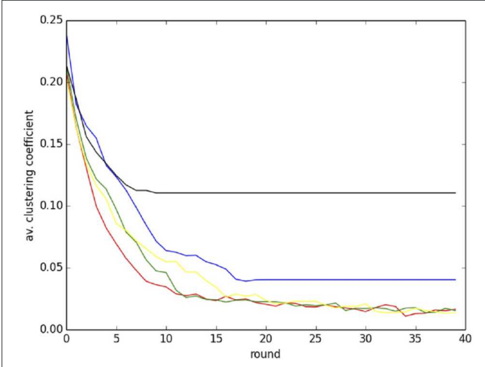
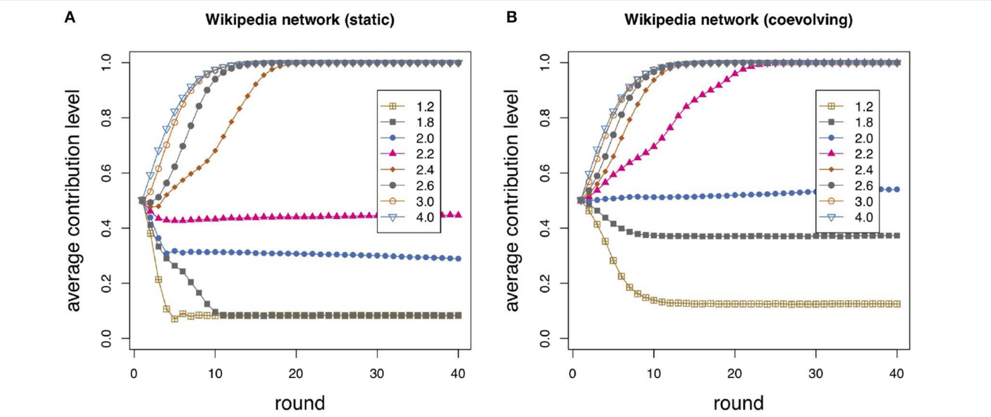
Verification
Claims the paper makes
The claims and statistics of this paper haven’t been checked yet.
Run the check — free, no account needed. It reads the open-access text and checks the sources it cites.
Claims other papers make about this one
Each is checked against this paper’s own text: does it say what the citing paper says it does?
In the citing paper
“This occurs despite opposing forces such as aversion to free riding (Fehr and G ¨ achter, 2000), altruistic and adaptive preferences, reputa tional effects, preferences for relational goods (Bruni and Smerilli, 2010; Tomassini and Antonioni, 2020).”
From Win Together or Lose Alone: Circular Economy and Hybrid Governance for Natural Resource Commons (2024) · cites this paper as Tomassini and Antonioni, 2020
In the citing paper
“Therefore, hybrid organizations need to change incentives and/or selection of agents to effectively avoid co ordination failure (Antonioni and Tommassini, 2019; Tomassini and Antonioni, 2020).”
From Win Together or Lose Alone: Circular Economy and Hybrid Governance for Natural Resource Commons (2024) · cites this paper as Tomassini and Antonioni, 2020
Self-check
Percentages, sums and reported differences re-computed from the paper’s own numbers.
The self-check needs the paper’s full text.
Citations
Cites
Cooperation and Punishment in Public Goods Experiments
Fehr, E., & Gächter, S. (2000) · American Economic Review · doi:10.1257/aer.90.4.980 · Cited by 4,547
OLSON, M. (2009) · doi:10.2307/j.ctvjsf3ts · Cited by 1,601
Sigmund, K. (2010) · doi:10.1515/9781400832255 · Cited by 570
Cooperation Prevails When Individuals Adjust Their Social Ties
Santos, F. C., Pacheco, J. M., & Lenaerts, T. (2006) · PLoS Computational Biology · doi:10.1371/journal.pcbi.0020140 · Cited by 556
Cooperation and assortativity with dynamic partner updating
Wang, J., Suri, S., & Watts, D. J. (2012) · Proceedings of the National Academy of Sciences · doi:10.1073/pnas.1120867109 · Cited by 198
Research works printed but not linked: 39
- Barrett, 2007, Why Cooperate?, 10.1093/acprof:oso/9780199211890.001.0001 · DOI
- Hardin, 1968, The tragedy of the commons, Science., 162, 1243, 10.1126/science.162.3859.1243 · DOI · Paper page
- Andreoni, 1995, Cooperation in public-goods experiments: kindness or confusion?, Am Econ Rev., 85, 891
- Fehr, 2002, Altruistic punishment in humans, Nature., 415, 137, 10.1038/415137a · DOI · Paper page
- Burton-Chellew, 2013, Prosocial preferences do not explain human cooperation in public-goods games, Proc Natl Acad Sci USA., 110, 216, 10.1073/pnas.1210960110 · DOI
- Burton-Chellew, 2016, Conditional cooperation and confusion in public-goods experiments, Proc Natl Acad Sci USA., 113, 1291, 10.1073/pnas.1509740113 · DOI
- Burton-Chellew, 2018, Payoff-based learning explains the decline in cooperation in public goods games, Proc R Soc Lond B Biol Sci., 282, 20142678, 10.1098/rspb.2014.2678 · DOI · Paper page
- Li, 2018, Punishment diminishes the benefits of network reciprocity in social dilemma experiments, Proc Natl Acad Sci USA., 115, 30, 10.1073/pnas.1707505115 · DOI
- Wang, 2018, Exploiting a cognitive bias promotes cooperation in social dilemma experiments, Nat Commun., 9, 1, 10.1038/s41467-018-05259-5 · DOI
- Antonioni, 2014, Know thy neighbor: costly information can hurt cooperation in dynamic networks, PLoS ONE., 9, e110788, 10.1371/journal.pone.0110788 · DOI
- Cuesta, 2014, Reputation drives cooperative behaviour and network formation in human groups, Sci Rep., 5, 7843, 10.1038/srep07843 · DOI
- Barcelo, 2015, Group size effect on cooperation in one-shot social dilemmas, Sci Rep., 5, 1, 10.1038/srep07937 · DOI
- Capraro, 2015, Group size effect on cooperation in one-shot social dilemmas II: curvilinear effect, PLoS ONE., 10, e0131419, 10.1371/journal.pone.0131419 · DOI
- Antonioni, 2016, Cooperation survives and cheating pays in a dynamic network structure with unreliable reputation, Sci Rep., 6, 27160, 10.1038/srep27160 · DOI
- Lozano, 2018, Cooperation on dynamic networks within an uncertain reputation environment, Sci Rep., 8, 9093, 10.1038/s41598-018-27544-5 · DOI
- Pereda, 2019, Large scale and information effects on cooperation in public good games, Sci Rep., 9, 15023, 10.1038/s41598-019-50964-w · DOI
- Santos, 2008, Social diversity promotes the emergence of cooperation in public goods games, Nature., 454, 213, 10.1038/nature06940 · DOI
- Gómez-Gardeñes, 2011, Disentangling social and group heterogeneities: public goods games on complex networks, Europhys Lett., 95, 68003, 10.1209/0295-5075/95/68003 · DOI
- Gómez-Gardeñes, 2011, Evolutionary games defined at the network mesoscale: the public goods game, Chaos., 21, 016113, 10.1063/1.3535579 · DOI
- Javarone, 2016, Conformity-driven agents support ordered phases in the spatial public goods game, Europhys Lett., 114, 38001, 10.1209/0295-5075/114/38001 · DOI
- Perc, 2013, Evolutionary dynamics of group interactions on structured populations: a review, J R Soc Interface., 10, 20120997, 10.1098/rsif.2012.0997 · DOI · Paper page
- Perc, 2017, Statistical physics of human cooperation, Phys Rep., 687, 1, 10.1016/j.physrep.2017.05.004 · DOI
- Tomassini, 2019, Computational behavioral models for public goods games on social networks, Games., 10, 35, 10.3390/g10030035 · DOI
- Eguíluz, 2005, Cooperation and the emergence of role differentiation in the dynamics of social networks, Am J Sociol., 110, 977, 10.1086/428716 · DOI
- Pestelacci, 2008, Evolution of cooperation and coordination in a dynamically networked society, J Biol Theory., 3, 139, 10.1162/biot.2008.3.2.139 · DOI
- Perc, 2010, Coevolutionary games–a mini review, Biosystems., 99, 109, 10.1016/j.biosystems.2009.10.003 · DOI
- Rand, 2011, Dynamic social networks promote cooperation in experiments with humans, Proc Natl Acad Sci USA., 108, 19193, 10.1073/pnas.1108243108 · DOI · Paper page
- Gallo, 2015, The effects of reputational and social knowledge on cooperation, Proc Natl Acad Sci USA., 112, 3647, 10.1073/pnas.1415883112 · DOI
- Antonioni, 2017, A growing social network model in geographical space, J Stat Mech., 2017, 093403, 10.1088/1742-5468/aa819c · DOI
- Newman, 2018, Networks: An Introduction, 10.1093/oso/9780198805090.001.0001 · DOI
- Pereda, 2019, Group size effects and critical mass in public goods games, Sci Rep., 9, 5503, 10.1038/s41598-019-41988-3 · DOI
- Smaldino, 2011, An institutional mechanism for assortment in an ecology of games, PLoS ONE., 6, e23019, 10.1371/journal.pone.0023019 · DOI
- Peña, 2012, Bipartite graphs as models of population structures in evolutionary multiplayer games, PLoS ONE., 7, e44514, 10.1371/journal.pone.0044514 · DOI
- Wu, 2009, Individual's expulsion to nasty environment promotes cooperation in public goods games, Europhys Lett., 88, 30011, 10.1209/0295-5075/88/30011 · DOI
- Zhang, 2011, Coevolving agent strategies and network topology for the public goods games, Eur Phys J B., 80, 217, 10.1140/epjb/e2011-10470-2 · DOI
- Zhang, 2011, Aspiration-induced reconnection in spatial public-goods game, Europhys Lett., 94, 18006, 10.1209/0295-5075/94/18006 · DOI
- Li, 2013, The coevolution of partner switching and strategy updating in non-excludable public goods game, Phys A Stat Mech Appl., 392, 4956, 10.1016/j.physa.2013.05.054 · DOI
- Li, 2015, Network topology control strategy based on spatial evolutionary public goods game, Phys A Stat Mech Appl., 432, 16, 10.1016/j.physa.2015.02.101 · DOI
- Rossi, 2015, The network data repository with interactive graph analytics and visualization, 10.1609/aaai.v29i1.9277 · DOI
Cited by
Sorted by citations
Win Together or Lose Alone: Circular Economy and Hybrid Governance for Natural Resource Commons
Becchetti, L., Bova, D. M., & Raffaele, L. (2024) · doi:10.2139/ssrn.4880178 · Cited by 16
Metadata
- Authors
- Tomassini, M., & Antonioni, A.
- Venue
- Frontiers in Physics
- Publisher
- Frontiers Media SA
- Published
- 2020-03-11
- Volume
- 8
- ISSN
- 2296-424X
- Cited by
- 21
- References
- 5
- Funders
- Ministerio de Economía, Industria y Competitividad, Gobierno de España
- Ministerio de Ciencia, Innovación y Universidades
About these checks
Registry, retraction, Cites and statistics results are computed, not judged, with one exception: a printed reference that no index lists is read once by a model before it counts as a citation error. Claims are extracted by a model and kept only when their quote appears verbatim in the text; each cited source is then checked, with a model’s help, for whether it says what the claim relies on. Those verdicts can be wrong — read the claim’s quote and the cited source before relying on one.
Statistics and arithmetic are recomputed, not judged.
Confidence bands are shown only for fields calibrated on our annotated test set. None is calibrated yet, so no band is shown.
What counts as a claim ›How we measure confidence ›How we check this ›
Are you an author, or do you see a problem with this page? Request a review
How to cite
Cite CoChat for the checks on this page, and the paper for its own findings.
- This page
- CoChat. (2026). Citation check: Public Goods Games on Coevolving Social Network Models. https://app.cochat.ai/papers/10.3389/fphy.2020.00058
- The paper
- Tomassini, M., & Antonioni, A. (2020). Public Goods Games on Coevolving Social Network Models. Frontiers in Physics. https://doi.org/10.3389/fphy.2020.00058
