

The DOI matches its Crossref record; 41 of the 41 references it cites were found in a registry or an index; none of the 42 sources its claims cite is checked for support yet.
Sex-Specific Effects of Respiratory Muscle Endurance Training on Cycling Time Trial Performance in Normoxia and Hypoxia
Open accessAbstract
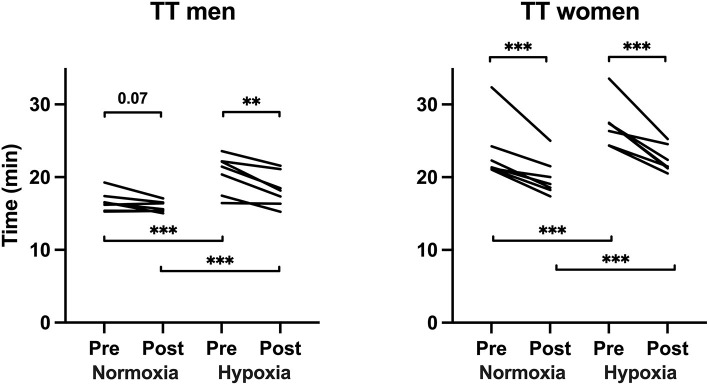
Objectives: We tested the hypotheses that respiratory muscle endurance training (RMET) improves endurance cycling performance differently in women and men and more so in hypoxia than in normoxia. Design: A prospective pre–post cross-over study with two testing conditions. Methods: Healthy and active women (seven, 24 ± 4 years, mean ± standard deviation [SD]) and men (seven, 27 ± 5 years) performed incremental cycling to determine maximum oxygen consumption (VO 2peak) and power output (W peak) and on different days two 10-km cycling time trials (TTs) in normoxia and normobaric hypoxia (FiO 2, 0.135, ~3,500 m equivalent), in a balanced randomized order. Next they performed supervised RMET in normoxia (4 weeks, 5 days/week, 30 min/day eucapnic hyperpnea at ~60% predicted maximum voluntary ventilation) followed by identical post-tests. During TTs, heart rate, ear oximetry reading, and W peak were recorded. Results: The VO 2peak and W peak values were unchanged after RMET. The TT was improved by 7 ± 6% (p < 0.001) in normoxia and 16 ± 6% (p < 0.001) in hypoxia. The difference between normoxic and hypoxic TT was smaller after RMET as compared with that before RMET (14% vs. 21%, respectively, p < 0.001). All effects were greater in women (p < 0.001). The RMET did not change the heart rate or ear oximetry reading during TTs. Conclusion: We found a greater effect of RMET on cycling TT performance in women than in men, an effect more pronounced in hypoxia. These findings are congruent with the contention of a more pronounced performance-limiting role of the respiratory system during endurance exercise in hypoxia compared with normoxia and more so in women whose respiratory system is undersized compared with that of men.
Overview
CoChat Summary
TL;DR
In a pre–post cross-over pilot, 4 weeks of supervised respiratory muscle endurance training (RMET) improved 10-km cycling time-trial performance in healthy active adults, with larger gains in hypoxia than normoxia and larger gains in women than men. VO2peak and Wpeak were unchanged.
Key findings
- RMET improved 10-km cycling TT performance by 7 ± 6% in normoxia and 16 ± 6% in hypoxia (both p < 0.001); the normoxic–hypoxic TT difference was smaller after RMET than before (14% vs. 21%, p < 0.001).
- Effects of RMET on TT performance were greater in women than in men (pre–post: p < 0.001; normoxia–hypoxia: p < 0.001).
- VO2peak and Wpeak did not change after RMET (VO2peak p = 0.115; Wpeak p = 0.959), and peak HR was unchanged.
- RMET did not change mean or final HR or ear oximetry during TTs; women had higher average hypoxic SpO2 than men (pre-RMET 85 ± 2 vs. 81 ± 3%; post-RMET 85 ± 4 vs. 80 ± 2%, p < 0.001), with no RMET effect per se.
Methods
- Prospective pre–post cross-over study with two testing conditions; 14 healthy recreationally active participants (7 women, 24 ± 4 years, 80 ± 30 min exercise/week; 7 men, 27 ± 5 years, 154 ± 47 min exercise/week).
- Participants performed incremental cycling to determine VO2peak and Wpeak, then two 10-km cycling TTs in normoxia and normobaric hypoxia (FiO2 0.135, ~3,500 m equivalent) in balanced randomized order; after 4 weeks of supervised RMET in normoxia (5 days/week, 30 min/day eucapnic hyperpnea at ~60% predicted maximum voluntary ventilation), they repeated identical post-tests.
- Analysis used repeated-measures ANOVA for TT performance with factors woman/man and normoxia/hypoxia; ANOVA or mixed-effects modeling for other analyses; Sidak post hoc; significance set at p < 0.05.
Limitations
- Stated: no sham/placebo arm, so placebo/nocebo or training effects cannot be fully excluded; authors note meta-analytic evidence that sham presence did not alter RMT effects and that unchanged VO2peak supports this.
- Stated: the study did not quantify respiratory muscle force/endurance, respiratory data during TTs, locomotor or respiratory muscle fatigue, metaboreflex/cardiovascular changes, or mechanistic explanations; sample size was small and needs replication; men were somewhat more physically active/better trained than women; no TT familiarization sessions; and the 10-km TT duration was longer in hypoxia than normoxia.
- Evident: very small sex-specific subgroups (7 women; 6 men with post-RMET CPET data because one measurement was lost) limit precision and generalizability, and baseline activity/VO2peak differences between sexes may confound the sex-specific findings.
Model-written summary. Check it against the paper before relying on it.
Integrity signals
Registry
Cites
Statistics
Figures
Verification
Claims the paper makes
0 Valid · 0 Not valid · 30 Not checked · 40 Own results and interpretations
A result the paper reports from its own data — it cites no other source for it, so there is none to check. The quote shows it is in the paper.
In the paper
“Women had higher average saturations during TTs in hypoxia than men (women pre-RMET, 85 ± 2, and post-RMET, 85 ± 4%; men pre-RMET, 81 ± 3, and post-RMET, 80 ± 2%, p < 0.001, no effect of RMET per se).”
§ Sex-Specific Effects of Respiratory Muscle Endurance Training on Cycling Time Trial Performance in Normoxia and Hypoxia > Results > Time Trial Performance
plainstates an association- Asserted: passes — The authors put it forward as true.
- Checkable: passes — It can be checked against evidence.
- Load-bearing: unclear — It is unclear whether the paper’s conclusions depend on it.
- Based: passes — The paper gives a reason why it holds.
A result the paper reports from its own data — it cites no other source for it, so there is none to check. The quote shows it is in the paper.
In the paper
“The difference between normoxic and hypoxic TT was smaller after RMET as compared with that before RMET (14% vs. 21%, respectively, p < 0.001).”
- Also stated in: § Time Trial Performance · plain
“The difference between normoxic and hypoxic TT was smaller after RMET as compared with that before RMET (14% vs. 21%, respectively, p < 0.001).”
§ Sex-Specific Effects of Respiratory Muscle Endurance Training on Cycling Time Trial Performance in Normoxia and Hypoxia > Abstract
plainstates a cause- Asserted: passes — The authors put it forward as true.
- Checkable: passes — It can be checked against evidence.
- Load-bearing: passes — The paper’s conclusions depend on it.
- Based: passes — The paper gives a reason why it holds.
- Also stated in: § Time Trial Performance · plain
A result the paper reports from its own data — it cites no other source for it, so there is none to check. The quote shows it is in the paper.
In the paper
“All effects were greater in women (p < 0.001).”
- Also stated in: § Time Trial Performance · plain
“The effects of RMET on TT performance were greater in women (pre–post: p < 0.001; normoxia–hypoxia: p < 0.001).”
- Also stated in: § Abstract · plain
“We found a greater effect of RMET on cycling TT performance in women than in men, an effect more pronounced in hypoxia.”
§ Sex-Specific Effects of Respiratory Muscle Endurance Training on Cycling Time Trial Performance in Normoxia and Hypoxia > Abstract
plainstates a cause- Asserted: passes — The authors put it forward as true.
- Checkable: passes — It can be checked against evidence.
- Load-bearing: passes — The paper’s conclusions depend on it.
- Based: passes — The paper gives a reason why it holds.
- Also stated in: § Time Trial Performance · plain
A result the paper reports from its own data — it cites no other source for it, so there is none to check. The quote shows it is in the paper.
In the paper
“The TT was improved by 7 ± 6% (p < 0.001) in normoxia and 16 ± 6% (p < 0.001) in hypoxia.”
- Also stated in: § Time Trial Performance · plain
“RMET significantly improved the TT performance more in hypoxia (by 16 ± 6%, p < 0.001) than in normoxia (by 7 ± 6%, P < 0.001)”
§ Sex-Specific Effects of Respiratory Muscle Endurance Training on Cycling Time Trial Performance in Normoxia and Hypoxia > Abstract
plainstates a cause- Asserted: passes — The authors put it forward as true.
- Checkable: passes — It can be checked against evidence.
- Load-bearing: passes — The paper’s conclusions depend on it.
- Based: passes — The paper gives a reason why it holds.
- Also stated in: § Time Trial Performance · plain
A result the paper reports from its own data — it cites no other source for it, so there is none to check. The quote shows it is in the paper.
In the paper
“The VO2peak and Wpeak values were unchanged after RMET.”
- Also stated in: § Cardiopulmonary Exercise Test · plain
“The VO2peak (p = 0.115) and Wpeak (p = 0.959) values were not changed after RMET (see Table 1).”
§ Sex-Specific Effects of Respiratory Muscle Endurance Training on Cycling Time Trial Performance in Normoxia and Hypoxia > Abstract
plain- Asserted: passes — The authors put it forward as true.
- Checkable: passes — It can be checked against evidence.
- Load-bearing: unclear — It is unclear whether the paper’s conclusions depend on it.
- Based: passes — The paper gives a reason why it holds.
- Rests on an assumption not shown here.
- Also stated in: § Cardiopulmonary Exercise Test · plain
28 more claims
Create a free account to see all 70 claims and to verify the 40 references still open.
- It may state two separate claims as one. 27
- Probably not a substantial claim. 18
Citations
Cites
Quanjer, P. H., Stanojevic, S., Cole, T. J., Baur, X., Hall, G. L., Culver, B. H., Enright, P., Hankinson, J., Ip, M., Zheng, J., et al. (2012) · European Respiratory Journal · doi:10.1183/09031936.00080312 · Cited by 6,126
Limiting factors for maximum oxygen uptake and determinants of endurance performance
BASSETT, D. R. (2000) · Medicine & Science in Sports & Exercise · doi:10.1097/00005768-200001000-00012 · Cited by 2,410
Illi, S. K., Held, U., Frank, I., & Spengler, C. M. (2012) · Sports Medicine · doi:10.1007/bf03262290 · Cited by 411
Ansdell, P., Thomas, K., Hicks, K. M., Hunter, S. K., Howatson, G., & Goodall, S. (2020) · Experimental Physiology · doi:10.1113/ep088548 · Cited by 403
Biology of VO2max: looking under the physiology lamp
Lundby, C., Montero, D., & Joyner, M. (2017) · Acta Physiologica · doi:10.1111/apha.12827 · Cited by 300
HajGhanbari, B., Yamabayashi, C., Buna, T. R., Coelho, J. D., Freedman, K. D., Morton, T. A., Palmer, S. A., Toy, M. A., Walsh, C., Sheel, A. W., et al. (2013) · Journal of Strength and Conditioning Research · doi:10.1519/jsc.0b013e318269f73f · Cited by 279
Physiological demands of running at 2-hour marathon race pace
JONES, A. M., Kirby, B. S., Clark, I. E., Rice, H. M., Fulkerson, E., Wylie, L. J., Wilkerson, D. P., Vanhatalo, A., & Wilkins, B. W. (2020) · Journal of Applied Physiology · doi:10.1152/japplphysiol.00647.2020 · Cited by 223
Respiratory Muscle Training in Healthy Individuals
Sheel, A. W. (2002) · Sports Medicine · doi:10.2165/00007256-200232090-00003 · Cited by 191
The placebo and nocebo effect on sports performance: a systematic review
Hurst, P., Schipof‐Godart, L., Szabo, A., Raglin, J., Hettinga, F., Roelands, B., Lane, A., Foad, A., Coleman, D., & Beedie, C. (2020) · European Journal of Sport Science · doi:10.1080/17461391.2019.1655098 · Cited by 124
Effects of inspiratory muscle training on exercise responses in normoxia and hypoxia
Downey, A. E., Chenoweth, L. M., Townsend, D. K., Ranum, J. D., Ferguson, C. S., & Harms, C. A. (2007) · Respiratory Physiology & Neurobiology · doi:10.1016/j.resp.2006.08.006 · Cited by 123
Sheel, A. W., Dominelli, P. B., & Molgat‐Seon, Y. (2016) · Experimental Physiology · doi:10.1113/ep085366 · Cited by 99
Shei, R. (2018) · The Journal of Strength and Conditioning Research · doi:10.1519/jsc.0000000000002730 · Cited by 97
Respiratory physiology: adaptations to high-level exercise
McKenzie, D. C. (2012) · British Journal of Sports Medicine · doi:10.1136/bjsports-2011-090824 · Cited by 85
The respiratory system as an exercise limiting factor in normal sedentary subjects
Boutellier, U., & Piwko, P. (1992) · European Journal of Applied Physiology and Occupational Physiology · doi:10.1007/bf00717952 · Cited by 82
Dempsey, J. A., La Gerche, A., & Hull, J. H. (2020) · Journal of Applied Physiology · doi:10.1152/japplphysiol.00444.2020 · Cited by 78
Effect of acute hypoxia on respiratory muscle fatigue in healthy humans
Verges, S., Bachasson, D., & Wuyam, B. (2010) · Respiratory Research · doi:10.1186/1465-9921-11-109 · Cited by 77
Karsten, M., Ribeiro, G. D. S., Esquivel, M. S., & Matte, D. L. (2018) · Physical Therapy in Sport · doi:10.1016/j.ptsp.2018.09.004 · Cited by 72
Morgan, D., Kohrt, W., Bates, B., & Skinner, J. (1987) · International Journal of Sports Medicine · doi:10.1055/s-2008-1025647 · Cited by 69
Molgat-Seon, Y., Peters, C. M., & Sheel, A. W. (2018) · Current Opinion in Physiology · doi:10.1016/j.cophys.2018.03.007 · Cited by 61
Fairbarn, M., Coutts, K., Pardy, R., & McKenzie, D. (1991) · International Journal of Sports Medicine · doi:10.1055/s-2007-1024658 · Cited by 56
Sales, A. T. D. N., Fregonezi, G. A. D. F., Ramsook, A. H., Guenette, J. A., Lima, I. N. D. F., & Reid, W. D. (2016) · Physical Therapy in Sport · doi:10.1016/j.ptsp.2015.08.001 · Cited by 52
Respiratory energetics during exercise at high altitude
Cibella, F., Cuttitta, G., Romano, S., Grassi, B., Bonsignore, G., & Milic‐Emili, J. (1999) · Journal of Applied Physiology · doi:10.1152/jappl.1999.86.6.1785 · Cited by 51
Inspiratory Muscle Training in Intermittent Sports Modalities: A Systematic Review
Lorca-Santiago, J., Sáiz, S. L. J., Pareja-Galeano, H., & Calvo, A. L. (2020) · International Journal of Environmental Research and Public Health · doi:10.3390/ijerph17124448 · Cited by 51
Geary, C. M., Welch, J. F., McDonald, M. R., Peters, C. M., Leahy, M. G., Reinhard, P. A., & Sheel, A. W. (2019) · The Journal of Physiology · doi:10.1113/jp278380 · Cited by 43
A Review on Respiratory Muscle Training Devices
Menzes, K. K. P., Nascimento, L. R., Avelino, P. R., Polese, J. C., & Teixeira‐Salmela, L. F. (2018) · Journal of Pulmonary & Respiratory Medicine · doi:10.4172/2161-105x.1000451 · Cited by 42
Effect of respiratory muscle training on maximum aerobic power in normoxia and hypoxia
Esposito, F., Limonta, E., Alberti, G., Veicsteinas, A., & Ferretti, G. (2010) · Respiratory Physiology & Neurobiology · doi:10.1016/j.resp.2010.02.004 · Cited by 37
The effects of respiratory muscle training on respiratory mechanics and energy cost
Held, H. E., & Pendergast, D. R. (2014) · Respiratory Physiology & Neurobiology · doi:10.1016/j.resp.2014.05.002 · Cited by 37
Salazar-Martínez, E., Gatterer, H., Burtscher, M., Naranjo Orellana, J., & Santalla, A. (2017) · Frontiers in Physiology · doi:10.3389/fphys.2017.00133 · Cited by 33
Factors limiting maximal O2 consumption: effects of acute changes in ventilation
Ferretti, G., & di Prampero, P. E. (1995) · Respiration Physiology · doi:10.1016/0034-5687(94)00092-e · Cited by 32
Putative role of respiratory muscle training to improve endurance performance in hypoxia: a review
Álvarez-Herms, J., Julià-Sánchez, S., Corbi, F., Odriozola-Martínez, A., & Burtscher, M. (2019) · Frontiers in Physiology · doi:10.3389/fphys.2018.01970 · Cited by 32
Segizbaeva, M. O., Timofeev, N. N., Donina, Z. A., Kur’yanovich, E. N., & Aleksandrova, N. P. (2014) · Advances in Experimental Medicine and Biology · doi:10.1007/5584_2014_20 · Cited by 27
Archiza (2020) · doi:10.1113/jp280704 · Cited by 27
Variable effects of respiratory muscle training on cycle exercise performance in men and women
Guenette, J. A., Martens, A. M., Lee, A. L., Tyler, G. D., Richards, J. C., Foster, G. E., Warburton, D. E. R., & Sheel, A. W. (2006) · Applied Physiology, Nutrition, and Metabolism · doi:10.1139/h05-016 · Cited by 24
Respiratory muscle fitness and exercise endurance in healthy humans
BOUTELLIER, U. (1998) · Medicine & Science in Sports & Exercise · doi:10.1097/00005768-199807000-00024 · Cited by 21
Respiratory muscle endurance training: effect on normoxic and hypoxic exercise performance
Keramidas, M. E., Debevec, T., Amon, M., Kounalakis, S. N., Simunic, B., & Mekjavic, I. B. (2010) · European Journal of Applied Physiology · doi:10.1007/s00421-009-1286-0 · Cited by 19
Inspiratory Muscle Training Effects on Cycling During Acute Hypoxic Exposure
Lomax, M., Massey, H. C., & House, J. R. (2017) · Aerospace Medicine and Human Performance · doi:10.3357/amhp.4780.2017 · Cited by 18
Inspiratory Muscle Training: Improvement of Exercise Performance With Acute Hypoxic Exposure
Hursh, D. G., Baranauskas, M. N., Wiggins, C. C., Bielko, S. A., Mickleborough, T. D., & Chapman, R. F. (2019) · International Journal of Sports Physiology and Performance · doi:10.1123/ijspp.2018-0483 · Cited by 14
Effects of respiratory muscle endurance training in hypoxia on running performance
KATAYAMA, K., GOTO, K., OHYA, T., IWAMOTO, E., TAKAO, K., KASAI, N., SUMI, D., MORI, H., ISHIDA, K., SHIMIZU, K., et al. (2019) · Medicine & Science in Sports & Exercise · doi:10.1249/mss.0000000000001929 · Cited by 14
Respiratory muscle training and exercise endurance at altitude
Helfer, S., Quackenbush, J., Fletcher, M., & Pendergast, D. R. (2016) · Aerospace Medicine and Human Performance · doi:10.3357/amhp.4405.2016 · Cited by 13
Ventilation-limited exercise capacity in a 59-year-old athlete
Burtscher, M., Schocke, M., & Koch, R. (2011) · Respiratory Physiology & Neurobiology · doi:10.1016/j.resp.2010.10.003 · Cited by 7
Breathless legs? consider training your respiration
Spengler, C. M., & Boutellier, U. (2000) · Physiology · doi:10.1152/physiologyonline.2000.15.2.101 · Cited by 3
Research works printed but not linked: 1
- Kayser, 2005, Why is endurance performance decreased at high altitude?, Schweiz. Z. Med. Traumatol., 53, 54
Cited by
Women at Altitude: Sex-Related Physiological Responses to Exercise in Hypoxia
Raberin, A., Burtscher, J., Citherlet, T., Manferdelli, G., Krumm, B., Bourdillon, N., Antero, J., Rasica, L., Malatesta, D., Brocherie, F., et al. (2024) · Sports Medicine · doi:10.1007/s40279-023-01954-6 · Cited by 70
Time to Move Beyond a “One-Size Fits All” Approach to Inspiratory Muscle Training
Shei, R., Paris, H. L. R., Sogard, A. S., & Mickleborough, T. D. (2022) · Frontiers in Physiology · doi:10.3389/fphys.2021.766346 · Cited by 51
Oxygen Saturation Behavior by Pulse Oximetry in Female Athletes: Breaking Myths
Martín-Escudero, P., Cabanas, A. M., Fuentes, M. E., & Galindo-Canales, M. (2021) · Biosensors · doi:10.3390/bios11100391 · Cited by 26
Illidi, C. R., Romer, L. M., Johnson, M. A., Williams, N. C., Rossiter, H. B., Casaburi, R. H., & Tiller, N. B. (2023) · European Journal of Applied Physiology · doi:10.1007/s00421-023-05166-8 · Cited by 26
The therapeutic role of inspiratory muscle training in the management of asthma: a narrative review
Sogard, A. S., & Mickleborough, T. D. (2023) · American Journal of Physiology-Regulatory, Integrative and Comparative Physiology · doi:10.1152/ajpregu.00325.2022 · Cited by 14
Metadata
- Authors
- Chambault, J., Grand, G., & Kayser, B.
- Affiliations
- University of Lausanne (CH)
- Corresponding author
- Kayser, Bengt
- ORCID
- Kayser, Bengt
- Venue
- Frontiers in Physiology
- Publisher
- Frontiers Media SA
- Published
- 2021-08-06
- Volume
- 12
- Pages
- 700620-700620
- ISSN
- 1664-042X (ISSN-L)
- PMC
- PMC8378271
- OpenAlex
- W3191604909
- Semantic Scholar
- 855c8131b89cda6f5258bf68dc61c93c34ef35ed
- Cited by
- 12
- References
- 41
- Citations by year
- 2026: 2 · 2025: 2 · 2024: 1 · 2023: 5 · 2022: 1 · 2021: 1
- FWCI
- 1.22
- Type
- journal article
- Language
- en
- Open access
- gold
- doi.org
- Licence
- Locations
- Frontiers in Physiology (publishedVersion, cc-by)
- PubMed (publishedVersion)
- PubMed Central (publishedVersion, cc-by)
- SERVAL (Université de Lausanne) (publishedVersion, cc-by)
- IRIS (submittedVersion, cc-by)
- DOAJ (DOAJ: Directory of Open Access Journals) (submittedVersion, cc-by-sa)
- Funders
- Reuter Foundation
- Hôpitaux Universitaires de Genève
- Topics
- Health Sciences › Medicine › Physiology (medical) › High Altitude and Hypoxia
- Health Sciences › Medicine › Physiology (medical) › Cardiovascular and exercise physiology
- Health Sciences › Medicine › Orthopedics and Sports Medicine › Sports Performance and Training
- Keywords
- respiratory muscle endurance training, cycling time trial performance, sex differences, hypoxia, normobaric hypoxia, endurance cycling, VO2max, ventilatory capacity, women
About these checks
Registry, retraction, Cites and statistics results are computed, not judged, with one exception: a printed reference that no index lists is read once by a model before it counts as a citation error. Claims are extracted by a model and kept only when their quote appears verbatim in the text; each cited source is then checked, with a model’s help, for whether it says what the claim relies on. Those verdicts can be wrong — read the claim’s quote and the cited source before relying on one.
A language model drew the claims from the paper on 2026-11-13, under version 3 of the claim definition (model deepseek-v4.1-flash, prompt extract-v3).
A second model labelled each claim on 2026-11-13 (model jev-1.13-20260917, definition revision gold-guideline-v0.2).
Statistics and arithmetic are recomputed, not judged.
Confidence bands are shown only for fields calibrated on our annotated test set. None is calibrated yet, so no band is shown.
What counts as a claim ›How we measure confidence ›How we check this ›
Are you an author, or do you see a problem with this page? Request a review
Data sources
Bibliographic data: Semantic Scholar, OpenAlex, Crossref.
Contains information from the Semantic Scholar Academic Graph Datasets, made available under the ODC Attribution License (ODC-BY 1.0).
Semantic Scholar’s data is described in: Kinney, R., et al. (2023). The Semantic Scholar Open Data Platform. arXiv:2301.10140.
