

The DOI matches its Crossref record; 90 of the 90 references it cites were found in a registry or an index.
How does exercise regulate the physiological responses of post-traumatic stress disorder? The crosstalk between oxidative stress and the hypothalamic–pituitary–adrenal axis
Open accessAbstract
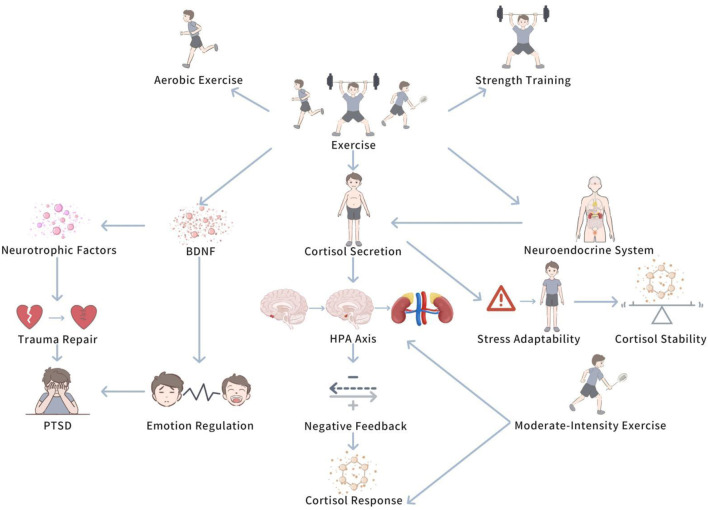
Post traumatic stress disorder (PTSD) is a severe psychological disorder cautilized by extreme traumatic events, typically accompanied by physiological mechanisms, such as oxidative stress and dysfunction of the hypothalamic-pituitary-adrenal (HPA) axis. Our review explores how exercise boosts the physiological response of PTSD patients by regulating oxidative stress and HPA axis function, and delves into the potential mechanisms and application prospects of exercise in PTSD treatment. By a review of existing literature, we mainly discussed the effects of various types of exercise, like aerobic exercise, strength training, and high-intensity interval training (HIIT), on oxidative stress markers and HPA axis function, and evaluated the efficacy and mechanism of exercise intervention in the treatment of post traumatic stress disorder. Specifically, regular exercise can enhance the antioxidant defense system, reduce levels of reactive oxygen species (ROS), restore HPA axis function, and thereby alleviate the psychological and physiological symptoms of post-traumatic stress disorder. Different types of exercise have varying influences on the regulation of oxidative stress and cortisol secretion patterns. As a multidimensional therapeutic approach, exercise can provide comprehensive therapeutic advantages by enhancing neural plasticity, promoting immune function, and improving psychological resilience. In addition, the combination of exercise with conventional treatment strategies, such as cognitive-behavioral therapy and medication has apparently optimized treatment outcomes.
Overview
The claims and statistics of this paper haven’t been checked yet.
Free: it reads the open-access text and checks the first 5 claims that cite a source we can check. Create a free account to check every claim.
Integrity signals
Registry
Cites
Statistics
Figures




Verification
Claims the paper makes
The claims and statistics of this paper haven’t been checked yet.
Free: it reads the open-access text and checks the first 5 claims that cite a source we can check. Create a free account to check every claim.
Claims other papers make about this one
Each is checked against this paper’s own text: does it say what the citing paper says it does?
The source backs part of the claim, not all of it — or backs it for a different population, condition or comparison.
In the citing paper
“Exercise may improve emotional states and stress responses by regulating the hypothalamic-pituitary-adrenal (HPA) axis and promoting the secretion of neurotransmitters such as endorphins, and it may also reduce anxiety by enhancing self-efficacy, improving sleep, and strengthening perceived control (Zhang and Kong, 2025; Ahindru et al., 2023).”
From The impact mechanism of green exercise on college students' suicidal ideation: a mediation analysis based on entrance anxiety (2026) · cites this paper as Zhang and Kong, 2025
Experimental — accuracy not yet measured
Self-check
Percentages, sums and reported differences re-computed from the paper’s own numbers.
The self-check needs the paper’s full text.
Citations
Cites
Exercise and the immune system: regulation, integration, and adaptation
Pedersen, B. K., & Hoffman-Goetz, L. (2000) · Physiological Reviews · doi:10.1152/physrev.2000.80.3.1055 · Cited by 1,710
Posttraumatic stress disorder in the world mental health surveys
Koenen, K. C., Ratanatharathorn, A., Ng, L., McLaughlin, K. A., Bromet, E. J., Stein, D. J., Karam, E. G., Meron Ruscio, A., Benjet, C., Scott, K., et al. (2017) · Psychological Medicine · doi:10.1017/s0033291717000708 · Cited by 1,453 · cited 3×
“Literature has shown that external traumatic causes, like war, natural disasters, and violent events are the major factors of PTSD (Koenen et al., 2017).”
InfluentialSleiman, S. F., Henry, J., Al-Haddad, R., El Hayek, L., Abou Haidar, E., Stringer, T., Ulja, D., Karuppagounder, S. S., Holson, E. B., Ratan, R. R., et al. (2016) · eLife · doi:10.7554/elife.15092 · Cited by 810
Paradise lost: the neurobiological and clinical consequences of child abuse and neglect
Nemeroff, C. B. (2016) · Neuron · doi:10.1016/j.neuron.2016.01.019 · Cited by 768
(2000) · PubMed · Cited by 676
Exercise and the Regulation of Immune Functions
Simpson, R. J., Kunz, H., Agha, N., & Graff, R. (2015) · Progress in Molecular Biology and Translational Science · doi:10.1016/bs.pmbts.2015.08.001 · Cited by 602
The Role of Cortisol in Chronic Stress, Neurodegenerative Diseases, and Psychological Disorders
Knezevic, E., Nenic, K., Milanovic, V., & Knezevic, N. N. (2023) · Cells · doi:10.3390/cells12232726 · Cited by 564
Exercise-induced immune system response: Anti-inflammatory status on peripheral and central organs
Scheffer, D. D. L., & Latini, A. (2020) · Biochimica et Biophysica Acta (BBA) - Molecular Basis of Disease · doi:10.1016/j.bbadis.2020.165823 · Cited by 489
A Meta-analysis of oxidative stress markers in depression
Liu, T., Zhong, S., Liao, X., Chen, J., He, T., Lai, S., & Jia, Y. (2015) · PLOS ONE · doi:10.1371/journal.pone.0138904 · Cited by 485 · cited 1×
“Research has illustrated that increased levels of oxidative stress are closely linked to anxiety and depression symptoms in PTSD patients (Liu et al., 2015).”
Brain-derived neurotrophic factor: a bridge between inflammation and neuroplasticity
Calabrese, F., Rossetti, A. C., Racagni, G., Gass, P., Riva, M. A., & Molteni, R. (2014) · Frontiers in Cellular Neuroscience · doi:10.3389/fncel.2014.00430 · Cited by 482
Cited by
Integrating Physical Activity Into Routine Psychiatric Care: A Review
Stubbs, B., Ma, R., Teychenne, M. J., Kinnafick, F., Mossaheb, N., Korman, N., Trott, M., Rosenbaum, S., Schuch, F. B., Firth, J., et al. (2026) · JAMA Psychiatry · doi:10.1001/jamapsychiatry.2026.0026 · Cited by 12
Ren, M., Kong, J., Luan, C., & Mu, Y. (2025) · Frontiers in Psychiatry · doi:10.3389/fpsyt.2025.1683058 · Cited by 6
Self-citationZhang, G., Hu, Q., & Zou, H. (2026) · Frontiers in Psychiatry · doi:10.3389/fpsyt.2026.1766980 · Cited by 7
“This bidirectional modi fi cation of the HPA axis makes the ECS an ideal pressure buffer system – both determining the necessary stress response and avoiding over-response or prolongation (71).”
la Fuente, M. D., Garrido, A., Vida, C., Manassra, R., & Giménez‐Llort, L. (2026) · Biomolecules · doi:10.3390/biom16030475 · Cited by 2
“Moreover, regular exercise training decreases oxidative stress and improves resistance to oxidative damage due to the downregulation of oxidant release because of the adaptation of antioxidant defenses, which increases their amounts and activities [40,46–48].”
Cichoń-Woźniak, J., Dziewiecka, H., Ostapiuk–Karolczuk, J., Mydłowska, M., Szymańczuk, M., & Skarpańska-Stejnborn, A. (2026) · Frontiers in Physiology · doi:10.3389/fphys.2026.1705876 · Cited by 2
Metadata
- Authors
- Zhang, T., & Kong, J.
- Affiliations
- Qufu Normal University (CN)
- Corresponding author
- Kong, Jianda
- Venue
- Frontiers in Physiology
- Publisher
- Frontiers Media SA
- Published
- 2025-09-12
- Volume
- 16
- Pages
- 1567603-1567603
- ISSN
- 1664-042X (ISSN-L)
- PMC
- PMC12466154
- OpenAlex
- W4414591944
- Cited by
- 19
- References
- 89
- Citations by year
- 2026: 18 · 2025: 1
- FWCI
- 4.18
- Type
- journal article
- Language
- en
- Open access
- gold
- doi.org
- Licence
- Locations
- Frontiers in Physiology (publishedVersion, cc-by)
- Europe PMC (PubMed Central) (publishedVersion, cc-by)
- PubMed (publishedVersion)
- PubMed Central (publishedVersion, cc-by)
- DOAJ (DOAJ: Directory of Open Access Journals) (submittedVersion, cc-by-sa)
- Topics
- Social Sciences › Psychology › Clinical Psychology › Posttraumatic Stress Disorder Research
- Life Sciences › Neuroscience › Behavioral Neuroscience › Stress Responses and Cortisol
- Health Sciences › Medicine › Public Health, Environmental and Occupational Health › Physical Activity and Health
- Keywords
- post-traumatic stress disorder, exercise intervention, oxidative stress, hypothalamic-pituitary-adrenal axis, cortisol, reactive oxygen species, antioxidant defense, aerobic exercise, resistance training, high-intensity interval training, neuroplasticity, psychological resilience, cognitive behavioral therapy
About these checks
Registry, retraction, Cites and statistics results are computed, not judged, with one exception: a printed reference that no index lists is read once by a model before it counts as a citation error. Claims are extracted by a model and kept only when their quote appears verbatim in the text; each cited source is then checked, with a model’s help, for whether it says what the claim relies on. Those verdicts can be wrong — read the claim’s quote and the cited source before relying on one.
Statistics and arithmetic are recomputed, not judged.
Confidence bands are shown only for fields calibrated on our annotated test set. None is calibrated yet, so no band is shown.
What counts as a claim ›How we measure confidence ›How we check this ›
Are you an author, or do you see a problem with this page? Request a review
How to cite
Cite CoChat for the checks on this page, and the paper for its own findings.
- This page
- CoChat. (2026). Citation check: How does exercise regulate the physiological responses of post-traumatic stress disorder? The crosstalk between oxidative stress and the hypothalamic–pituitary–adrenal axis. https://app.cochat.ai/papers/10.3389/fphys.2025.1567603
- The paper
- Zhang, T., & Kong, J. (2025). How does exercise regulate the physiological responses of post-traumatic stress disorder? The crosstalk between oxidative stress and the hypothalamic–pituitary–adrenal axis. Frontiers in Physiology. https://doi.org/10.3389/fphys.2025.1567603
Data sources
Bibliographic data: Semantic Scholar, OpenAlex, Crossref.
Contains information from the Semantic Scholar Academic Graph Datasets, made available under the ODC Attribution License (ODC-BY 1.0).
Semantic Scholar’s data is described in: Kinney, R., et al. (2023). The Semantic Scholar Open Data Platform. arXiv:2301.10140.
