

How does exercise regulate the physiological responses of post-traumatic stress disorder? The crosstalk between oxidative stress and the hypothalamic–pituitary–adrenal axis
Open accessThe DOI matches its Crossref record; 90 of the 90 references it cites were found in a registry or an index.
Abstract
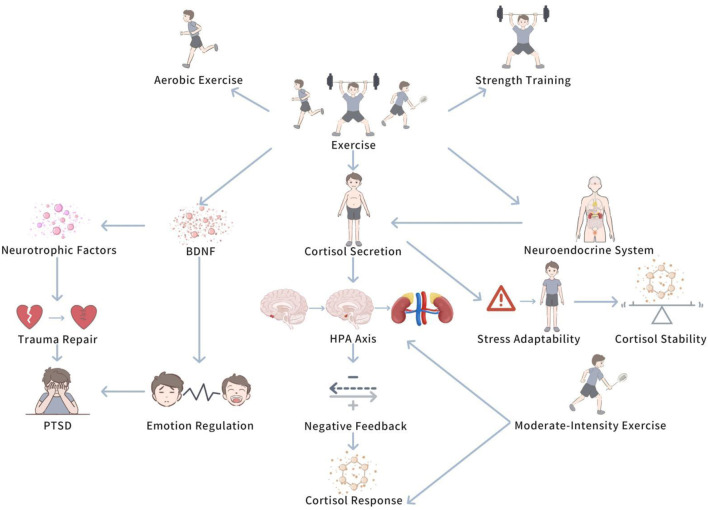
Post traumatic stress disorder (PTSD) is a severe psychological disorder cautilized by extreme traumatic events, typically accompanied by physiological mechanisms, such as oxidative stress and dysfunction of the hypothalamic-pituitary-adrenal (HPA) axis. Our review explores how exercise boosts the physiological response of PTSD patients by regulating oxidative stress and HPA axis function, and delves into the potential mechanisms and application prospects of exercise in PTSD treatment. By a review of existing literature, we mainly discussed the effects of various types of exercise, like aerobic exercise, strength training, and high-intensity interval training (HIIT), on oxidative stress markers and HPA axis function, and evaluated the efficacy and mechanism of exercise intervention in the treatment of post traumatic stress disorder. Specifically, regular exercise can enhance the antioxidant defense system, reduce levels of reactive oxygen species (ROS), restore HPA axis function, and thereby alleviate the psychological and physiological symptoms of post-traumatic stress disorder. Different types of exercise have varying influences on the regulation of oxidative stress and cortisol secretion patterns. As a multidimensional therapeutic approach, exercise can provide comprehensive therapeutic advantages by enhancing neural plasticity, promoting immune function, and improving psychological resilience. In addition, the combination of exercise with conventional treatment strategies, such as cognitive-behavioral therapy and medication has apparently optimized treatment outcomes.
Overview
The claims and statistics of this paper haven’t been checked yet.
Free: it reads the open-access text and checks the first 5 claims that cite a source we can check. Create a free account to check every claim.
Integrity signals
Registry
Cites
Statistics
Figures




Verification
Claims the paper makes
The claims and statistics of this paper haven’t been checked yet.
Free: it reads the open-access text and checks the first 5 claims that cite a source we can check. Create a free account to check every claim.
Claims other papers make about this one
Each is checked against this paper’s own text: does it say what the citing paper says it does?
The source backs part of the claim, not all of it — or backs it for a different population, condition or comparison.
In the citing paper
“Exercise may improve emotional states and stress responses by regulating the hypothalamic-pituitary-adrenal (HPA) axis and promoting the secretion of neurotransmitters such as endorphins, and it may also reduce anxiety by enhancing self-efficacy, improving sleep, and strengthening perceived control (Zhang and Kong, 2025; Ahindru et al., 2023).”
From The impact mechanism of green exercise on college students' suicidal ideation: a mediation analysis based on entrance anxiety (2026) · cites this paper as Zhang and Kong, 2025
Experimental — accuracy not yet measured
Self-check
Percentages, sums and reported differences re-computed from the paper’s own numbers.
The self-check needs the paper’s full text.
Citations
Cites
Exercise and the immune system: regulation, integration, and adaptation
Pedersen, B. K., & Hoffman-Goetz, L. (2000) · Physiological Reviews · doi:10.1152/physrev.2000.80.3.1055 · Cited by 1,710
Posttraumatic stress disorder in the world mental health surveys
Koenen, K. C., Ratanatharathorn, A., Ng, L., McLaughlin, K. A., Bromet, E. J., Stein, D. J., Karam, E. G., Meron Ruscio, A., Benjet, C., Scott, K., et al. (2017) · Psychological Medicine · doi:10.1017/s0033291717000708 · Cited by 1,453 · cited 3×
“Literature has shown that external traumatic causes, like war, natural disasters, and violent events are the major factors of PTSD (Koenen et al., 2017).”
InfluentialSleiman, S. F., Henry, J., Al-Haddad, R., El Hayek, L., Abou Haidar, E., Stringer, T., Ulja, D., Karuppagounder, S. S., Holson, E. B., Ratan, R. R., et al. (2016) · eLife · doi:10.7554/elife.15092 · Cited by 810
Paradise lost: the neurobiological and clinical consequences of child abuse and neglect
Nemeroff, C. B. (2016) · Neuron · doi:10.1016/j.neuron.2016.01.019 · Cited by 768
(2000) · PubMed · Cited by 676
Exercise and the Regulation of Immune Functions
Simpson, R. J., Kunz, H., Agha, N., & Graff, R. (2015) · Progress in Molecular Biology and Translational Science · doi:10.1016/bs.pmbts.2015.08.001 · Cited by 602
The Role of Cortisol in Chronic Stress, Neurodegenerative Diseases, and Psychological Disorders
Knezevic, E., Nenic, K., Milanovic, V., & Knezevic, N. N. (2023) · Cells · doi:10.3390/cells12232726 · Cited by 564
Exercise-induced immune system response: Anti-inflammatory status on peripheral and central organs
Scheffer, D. D. L., & Latini, A. (2020) · Biochimica et Biophysica Acta (BBA) - Molecular Basis of Disease · doi:10.1016/j.bbadis.2020.165823 · Cited by 489
A Meta-analysis of oxidative stress markers in depression
Liu, T., Zhong, S., Liao, X., Chen, J., He, T., Lai, S., & Jia, Y. (2015) · PLOS ONE · doi:10.1371/journal.pone.0138904 · Cited by 485 · cited 1×
“Research has illustrated that increased levels of oxidative stress are closely linked to anxiety and depression symptoms in PTSD patients (Liu et al., 2015).”
Brain-derived neurotrophic factor: a bridge between inflammation and neuroplasticity
Calabrese, F., Rossetti, A. C., Racagni, G., Gass, P., Riva, M. A., & Molteni, R. (2014) · Frontiers in Cellular Neuroscience · doi:10.3389/fncel.2014.00430 · Cited by 482
The stress response and the hypothalamic-pituitary-adrenal axis: from molecule to melancholia
O'CONNOR, T. M. (2000) · QJM · doi:10.1093/qjmed/93.6.323 · Cited by 396
Mitochondrial ROS regulation of proliferating cells
Diebold, L., & Chandel, N. S. (2016) · Free Radical Biology and Medicine · doi:10.1016/j.freeradbiomed.2016.04.198 · Cited by 391
Redox Mechanism of Reactive Oxygen Species in Exercise
He, F., Li, J., Liu, Z., Chuang, C.-C., Yang, W., & Zuo, L. (2016) · Frontiers in Physiology · doi:10.3389/fphys.2016.00486 · Cited by 385
James, K. A., Stromin, J. I., Steenkamp, N., & Combrinck, M. I. (2023) · Frontiers in Endocrinology · doi:10.3389/fendo.2023.1085950 · Cited by 364
Rosenbaum, S., Vancampfort, D., Steel, Z., Newby, J., Ward, P. B., & Stubbs, B. (2015) · Psychiatry Research · doi:10.1016/j.psychres.2015.10.017 · Cited by 333
Fast Feedback Inhibition of the HPA Axis by Glucocorticoids Is Mediated by Endocannabinoid Signaling
Evanson, N. K., Tasker, J. G., Hill, M. N., Hillard, C. J., & Herman, J. P. (2010) · Endocrinology · doi:10.1210/en.2010-0285 · Cited by 322
Pace, T. W. W., & Heim, C. M. (2011) · Brain, Behavior, and Immunity · doi:10.1016/j.bbi.2010.10.003 · Cited by 321
Kawamura, T., & Muraoka, I. (2018) · Antioxidants · doi:10.3390/antiox7090119 · Cited by 307 · cited 4×
“For instance, moderate aerobic exercise has been displayed to strike a balance between free radical generation and antioxidant responses, reducing oxidative damage (Kawamura and Muraoka, 2018).”
InfluentialActivation of the hypothalamic-pituitary-adrenal stress axis induces cellular oxidative stress
Spiers, J. G., Chen, H.-J. C., Sernia, C., & Lavidis, N. A. (2015) · Frontiers in Neuroscience · doi:10.3389/fnins.2014.00456 · Cited by 292
Stress and the HPA Axis: Balancing Homeostasis and Fertility.
Joseph, D., & Whirledge, S. (2017) · International journal of molecular sciences · doi:10.3390/ijms18102224 · Cited by 290 · cited 1×
“The function of the HPA axis is not limited to activating the stress response; it also involves sustaining system homeostasis by negative feedback mechanisms (Joseph and Whirledge, 2017).”
Cellular ROS and Antioxidants: Physiological and Pathological Role
Kozlov, A. V., Javadov, S., & Sommer, N. (2024) · Antioxidants · doi:10.3390/antiox13050602 · Cited by 259
Exercise, brain plasticity, and depression
Zhao, J., Jiang, W., Wang, X., Cai, Z., Liu, Z., & Liu, G. (2020) · CNS Neuroscience & Therapeutics · doi:10.1111/cns.13385 · Cited by 241
Oxidative Stress in Traumatic Brain Injury
Fesharaki-Zadeh, A. (2022) · International Journal of Molecular Sciences · doi:10.3390/ijms232113000 · Cited by 217
Functional actions of corticosteroids in the hippocampus
Joëls, M. (2008) · European Journal of Pharmacology · doi:10.1016/j.ejphar.2007.11.064 · Cited by 212 · cited 1×
“Oxidative stress is not only related to neuroinflammatory responses, but also impacts the functional regulation of stress-responsive brain regions (Joëls, 2008).”
Wilson, C. B., McLaughlin, L. D., Nair, A., Ebenezer, P. J., Dange, R., & Francis, J. (2013) · PLoS ONE · doi:10.1371/journal.pone.0076146 · Cited by 201
Exercise augmentation of exposure therapy for PTSD: rationale and pilot efficacy data
Powers, M. B., Medina, J. L., Burns, S., Kauffman, B. Y., Monfils, M., Asmundson, G. J. G., Diamond, A., McIntyre, C., & Smits, J. A. J. (2015) · Cognitive Behaviour Therapy · doi:10.1080/16506073.2015.1012740 · Cited by 194 · cited 1×
“In contrast, studies like those of Powers et al. (2015) (Powers et al., 2015) and Young-McCaughan et al. (2022) found that while exercise, such as aerobic training or exercise augmented exposure therapy, can promote PTSD symptoms in military personnel and veterans, the efficacy of combining…”
Chen, C., Nakagawa, S., An, Y., Ito, K., Kitaichi, Y., & Kusumi, I. (2017) · Frontiers in Neuroendocrinology · doi:10.1016/j.yfrne.2016.12.001 · Cited by 191
Neuroimmunological effects of physical exercise in depression
Eyre, H., & Baune, B. T. (2012) · Brain, Behavior, and Immunity · doi:10.1016/j.bbi.2011.09.015 · Cited by 187
Exercise for Brain Health: An Investigation into the Underlying Mechanisms Guided by Dose
Cabral, D. F., Rice, J., Morris, T. P., Rundek, T., Pascual‐Leone, Á., & Gomes‐Osman, J. (2019) · Neurotherapeutics · doi:10.1007/s13311-019-00749-w · Cited by 183
Effect of Different Exercise Modalities on Oxidative Stress: A Systematic Review
Thirupathi, A., Wang, M., Lin, J. K., Fekete, G., Bíró, I., Baker, J. S., & Gu, Y. (2021) · BioMed Research International · doi:10.1155/2021/1947928 · Cited by 182 · cited 2×
“Moderate-intensity aerobic exercise, obviously, like running and swimming, has been displayed to vastly boost the activity of antioxidant enzymes (Thirupathi et al., 2021a; Börzsei et al., 2024).”
The Effects and Mechanisms of Exercise on the Treatment of Depression
Xie, Y., Wu, Z., Sun, L., Zhou, L., Wang, G., Xiao, L., & Wang, H. (2021) · Frontiers in Psychiatry · doi:10.3389/fpsyt.2021.705559 · Cited by 178
Kim, T. D., Lee, S., & Yoon, S. (2020) · Antioxidants · doi:10.3390/antiox9020107 · Cited by 168
Oxidative Stress and Cognitive Decline: The Neuroprotective Role of Natural Antioxidants
Franzoni, F., Scarfò, G., Guidotti, S., Fusi, J., Асомов, М. И., & Pruneti, C. A. (2021) · Frontiers in Neuroscience · doi:10.3389/fnins.2021.729757 · Cited by 156
Exercise Intervention in PTSD: A Narrative Review and Rationale for Implementation
Hegberg, N. J., Hayes, J. P., & Hayes, S. M. (2019) · Frontiers in Psychiatry · doi:10.3389/fpsyt.2019.00133 · Cited by 154
Meng, Q., & Su, C.-H. (2024) · doi:10.20944/preprints202404.0770.v1 · Cited by 149
The homeostatic role of neuropeptide Yin immune function and its impact on mood and behaviour
Farzi, A., Reichmann, F., & Holzer, P. (2015) · Acta Physiologica · doi:10.1111/apha.12445 · Cited by 145
Dimitrov, S., Hulteng, E., & Hong, S. (2016) · Brain Behavior and Immunity · doi:10.1016/j.bbi.2016.12.017 · Cited by 142
Hypothalamic Regulation of Corticotropin-Releasing Factor under Stress and Stress Resilience
Kageyama, K., Iwasaki, Y., & Daimon, M. (2021) · International Journal of Molecular Sciences · doi:10.3390/ijms222212242 · Cited by 137
Martin, K. S., Azzolini, M., & Ruas, J. L. (2020) · American Journal of Physiology-Cell Physiology · doi:10.1152/ajpcell.00580.2019 · Cited by 136
Sriram, K., Rodriguez-Fernandez, M., & Doyle, F. J. (2012) · PLoS Computational Biology · doi:10.1371/journal.pcbi.1002379 · Cited by 134
Physical Exercise as Treatment for PTSD: A Systematic Review and Meta-Analysis
Björkman, F., & Ekblom, Ö. (2022) · Military Medicine · doi:10.1093/milmed/usab497 · Cited by 131
Exercise Training and Skeletal Muscle Antioxidant Enzymes: An Update
Powers, S. K., Goldstein, E., Schrager, M., & Ji, L. L. (2022) · Antioxidants · doi:10.3390/antiox12010039 · Cited by 131
Running from Stress: Neurobiological Mechanisms of Exercise-Induced Stress Resilience
Nowacka-Chmielewska, M. M., Grabowska, K., Grabowski, M., Meybohm, P., Burek, M., & Małecki, A. (2022) · International Journal of Molecular Sciences · doi:10.3390/ijms232113348 · Cited by 129
Meng, Q., & Su, C.-H. (2024) · Antioxidants · doi:10.3390/antiox13050573 · Cited by 120
Role of the Hypothalamic–Pituitary–Adrenal Axis in Health and Disease
DeMorrow, S. (2018) · International Journal of Molecular Sciences · doi:10.3390/ijms19040986 · Cited by 119
Lu, Y., Wiltshire, H., Baker, J. S., & Wang, Q. (2021) · Biology · doi:10.3390/biology10121272 · Cited by 117 · cited 1×
“Moreover, HIIT can remarkably enhance antioxidant status in populations without training experience (Lu et al., 2021).”
Zhu, L.-J., Liu, M.-Y., Li, H., Liu, X., Chen, C., Han, Z., Wu, H.-Y., Jing, X., Zhou, H.-H., Suh, H., et al. (2014) · PLoS ONE · doi:10.1371/journal.pone.0097689 · Cited by 114 · cited 1×
“Chronic stress states commonly trigger HPA axis dysfunction, displayed as excessive or persistently low cortisol secretion (Zhu et al., 2014).”
Marques, A., Marconcin, P., Werneck, A. O., Ferrari, G., Gouveia, É. R., Kliegel, M., Peralta, M., & Ihle, A. (2021) · Brain Sciences · doi:10.3390/brainsci11070829 · Cited by 107
Effect of Running Exercise on Oxidative Stress Biomarkers: A Systematic Review
Thirupathi, A., Pinho, R. A., Ugbolue, U. C., He, Y., Meng, Y., & Gu, Y. (2021) · Frontiers in Physiology · doi:10.3389/fphys.2020.610112 · Cited by 106
Physical activity and cortisol regulation: A meta-analysis
Moyers, S. A., & Hagger, M. S. (2023) · Biological Psychology · doi:10.1016/j.biopsycho.2023.108548 · Cited by 98 · cited 2×
“Aerobic exercise and strength training can not only boost cortisol secretion patterns, but also improve the HPA axis’s negative feedback mechanisms, thus facilitating normal cortisol cycling and preventing excessive activation of stress responses (Moyers and Hagger, 2023).”
Hypothalamus and Post-Traumatic Stress Disorder: A Review
Raise‐Abdullahi, P., Meamar, M., Vafaei, A. A., Alizadeh, M., Dadkhah, M., Shafia, S., Ghalandari-Shamami, M., Naderian, R., Samaei, A., & Rashidy‐Pour, A. (2023) · Brain Sciences · doi:10.3390/brainsci13071010 · Cited by 97 · cited 2×
“CRH is a key hormone triggering the stress response, which plays on the pituitary to stimulate the secretion of adrenocorticotropic hormone (ACTH), thus promoting the adrenal glands to secrete cortisol and initiating systemic stress responses (Raise-Abdullahi et al., 2023).”
Hormonal adaptation and the stress of exercise training: the role of glucocorticoids.
Hackney, A. C., & Walz, E. A. (2013) · PubMed · Cited by 93
Hare, B. D., Beierle, J. A., Toufexis, D. J., Hammack, S. E., & Falls, W. A. (2014) · Neuropsychopharmacology · doi:10.1038/npp.2013.329 · Cited by 85
Jaberi, S., & Fahnestock, M. L. (2023) · Biomolecules · doi:10.3390/biom13111577 · Cited by 82
Liang, J., Wang, H., Zeng, Y., Qu, Y., Liu, Q., Zhao, F., Duan, J., Jiang, Y., Li, S., Ying, J., et al. (2021) · Reviews in the Neurosciences · doi:10.1515/revneuro-2020-0099 · Cited by 81
Ferrer-Uris, B., Ramos, M. A., Busquets, A., & Angulo-Barroso, R. (2022) · AIMS Neuroscience · doi:10.3934/neuroscience.2022009 · Cited by 80
Oxidative Stress, Mitochondrial Function and Adaptation to Exercise: New Perspectives in Nutrition
Vargas-Mendoza, N., Angeles-Valencia, M., Morales-González, Á., Madrigal-Santillán, E. O., Morales-Martínez, M., Madrigal-Bujaidar, E., Álvarez-González, I., Gutiérrez-Salinas, J., Esquivel-Chirino, C., Chamorro-Cevallos, G., et al. (2021) · Life · doi:10.3390/life11111269 · Cited by 80
Wang, Z., Jiang, B., Wang, X., Li, Z., Wang, D., Xue, H., & Wang, D. (2023) · European Journal of Psychotraumatology · doi:10.1080/20008066.2023.2205667 · Cited by 79
Karanikas, E., Daskalakis, N. P., & Agorastos, A. (2021) · Brain Sciences · doi:10.3390/brainsci11060723 · Cited by 78
Pilot randomized controlled trial of exercise training for older veterans with PTSD
Hall, K. S., Morey, M. C., Bosworth, H. B., Beckham, J. C., Pebole, M. M., Sloane, R., & Pieper, C. F. (2020) · Journal of Behavioral Medicine · doi:10.1007/s10865-019-00073-w · Cited by 70
Shobeiri, P., Karimi, A., Momtazmanesh, S., Teixeira, A. L., Teunissen, C. E., van Wegen, E. E. H., Hirsch, M. A., Yekaninejad, M. S., & Rezaei, N. (2022) · PLoS ONE · doi:10.1371/journal.pone.0264557 · Cited by 69
You, Q., Yu, L., Li, G., He, H., & Lv, Y. (2022) · Frontiers in Physiology · doi:10.3389/fphys.2021.803102 · Cited by 64
Zhu, L., Li, L., Li, X.-Z., & Wang, L. (2022) · Frontiers in Psychology · doi:10.3389/fpsyg.2021.738211 · Cited by 51 · cited 1×
“Studieshavedemonstratedthatexercisecanobviously boost the negative feedback mechanisms of the HPA axis, regulating cortisol secretion (Hegberg et al., 2019a; Zhu et al., 2022).”
Lushchak, O. V., Strilbytska, O. M., Koliada, A. K., & Storey, K. B. (2023) · Frontiers in Physiology · doi:10.3389/fphys.2022.1094076 · Cited by 44
Oxidative Stress and Antioxidant Enzymes Activity after Cycling at Different Intensity and Duration
Daud, D. M. A., Ahmedy, F. B., Baharuddin, D. M. P., & Zakaria, Z. A. (2022) · Applied Sciences · doi:10.3390/app12189161 · Cited by 43
Molina‐Hidalgo, C., Stillman, C. M., Collins, A. M., Velázquez‐Díaz, D., Ripperger, H. S., Drake, J. A., Gianaros, P. J., Marsland, A. L., & Erickson, K. I. (2023) · Frontiers in Physiology · doi:10.3389/fphys.2023.1273981 · Cited by 41
van der Stouwe, E. C. D., van Busschbach, J. T., de Vries, B., Cahn, W., Aleman, A., & Pijnenborg, G. H. M. (2018) · NeuroImage: Clinical · doi:10.1016/j.nicl.2018.04.018 · Cited by 39
Trifunović, S. L., Stevanović, I. D., Milosevic, A., Ristić, N., Janjic, M. M., Bjelobaba, I. M., Savić, D. Z., Bozic, I. D., Jakovljevic, M., Tesovic, K., et al. (2021) · Frontiers in Neuroscience · doi:10.3389/fnins.2021.649485 · Cited by 36
Bacanoiu, M. V., Dănoiu, M., Rusu, L., & Marin, M. I. (2023) · Antioxidants · doi:10.3390/antiox12051008 · Cited by 35
Jadhakhan, F., Lambert, N., Middlebrook, N., Evans, D. W., & Falla, D. (2022) · Frontiers in Psychology · doi:10.3389/fpsyg.2022.943479 · Cited by 34
Zhang, Q., Yi, J., & Wu, Y. (2024) · Frontiers in Nutrition · doi:10.3389/fnut.2024.1469779 · Cited by 34 · cited 1×
“Common physiological symptoms in PTSD patients, such as poor sleep quality and increased fatigue, are closely linked to oxidative stress (Zhang et al., 2024).”
Budde, H., Akko, D. P., Ainamani, H. E., Murillo-Rodríguez, E., & Weierstall, R. (2018) · Trials · doi:10.1186/s13063-018-2753-x · Cited by 31
Potential oxidative stress related targets of mitochondria-focused therapy of PTSD
Kmita, H., Pinna, G., & Lushchak, V. I. (2023) · Frontiers in Physiology · doi:10.3389/fphys.2023.1266575 · Cited by 29
Koyuncuoğlu, T., Sevim, H., Çetrez, N., Meral, Z., Gönenç, B., Dertsiz, E. K., Akakın, D., Yüksel, M., & ÇAKIR, Ö. (2020) · Behavioural Brain Research · doi:10.1016/j.bbr.2020.112923 · Cited by 29
So, B., Park, J.-H., Jang, J.-H., Lim, W., Imdad, S., & Kang, C. (2022) · Frontiers in Physiology · doi:10.3389/fphys.2021.773539 · Cited by 27
Tempol prevents post-traumatic stress disorder induced memory impairment
Alzoubi, K. H., Rababa’h, A. M., & Yacoub, O. N. A. (2017) · Physiology & Behavior · doi:10.1016/j.physbeh.2017.12.002 · Cited by 26
Rangel, M. V. D. S., Lopes, K. G., Qin, X., & Borges, J. P. (2025) · Frontiers in Sports and Active Living · doi:10.3389/fspor.2025.1535152 · Cited by 24 · cited 1×
“These metabolic changes may help boost the thorough health status of PTSD patients, lowering the risk of chronic inflammation (Rangel et al., 2025).”
Young‐McCaughan, S., Peterson, A. L., Mintz, J., Hale, W. J., Dondanville, K. A., Borah, E. V., Blount, T. H., Blankenship, A. E., Fina, B. A., Hall‐Clark, B. N., et al. (2022) · Cognitive Behaviour Therapy · doi:10.1080/16506073.2021.2001689 · Cited by 24
The Role of Exercise-Induced Reactive Oxygen Species (ROS) Hormesis in Aging: Friend or Foe
Lesmana, R., Parameswari, C., Mandagi, G. F., Wahyudi, J. F., Permana, N. J., Radhiyanti, P. T., & Gunadi, J. W. (2022) · Cellular Physiology and Biochemistry · doi:10.33594/000000594 · Cited by 24
Diet quality and exercise in older veterans with PTSD: a pilot study
Browne, J., Morey, M. C., Beckham, J. C., Bosworth, H. B., Starr, K. N. P., Bales, C. W., McDermott, J., Sloane, R. J., Gregg, J. J., & Hall, K. S. M. (2021) · Translational Behavioral Medicine · doi:10.1093/tbm/ibab116 · Cited by 24
Manukhina, E. B., Цейликман, В. Э., Komelkova, M. V., Lapshin, M. S., Goryacheva, A. V., Kondashevskaya, М. V., Аршакович, М. В., Lazuko, S. S., Tseilikman, O. B., Sarapultsev, A., et al. (2021) · Journal of Applied Physiology · doi:10.1152/japplphysiol.00694.2019 · Cited by 24
dos Santos, J. R., Bortolanza, M., Ferrari, G. D., Lanfredi, G. P., Nascimento, G. C., Azzolini, A. E. C. S., Bel, E. A. D., Campos, A. C., Faça, V. M., Vulczak, A., et al. (2020) · Antioxidants · doi:10.3390/antiox9050445 · Cited by 21
The Neurobiological Links between Stress and Traumatic Brain Injury: A Review of Research to Date
Zheng, L., Pang, Q., Xu, H., Guo, H., Liu, R., & Wang, T. (2022) · International Journal of Molecular Sciences · doi:10.3390/ijms23179519 · Cited by 15
Maurer, A., Klein, J., Claus, J., Upadhyay, N., Henschel, L., Martin, J. A., Scheef, L., Daamen, M., Schörkmaier, T., Stirnberg, R., et al. (2022) · International Journal of Environmental Research and Public Health · doi:10.3390/ijerph19106078 · Cited by 15
Physiology mechanisms of exercise for PTSD: a narrative review
Dong, H., & Lin, Z. (2025) · Frontiers in Psychology · doi:10.3389/fpsyg.2025.1483523 · Cited by 13
Changes in immune and endocrine systems in posttraumatic stress disorder – prospective study
Vidović, A., Vilibić, M., Sabioncello, A., Gotovac, K., Rabatić, S., Folnegović-Šmalc, V., & Dekaris, D. (2009) · Acta Neuropsychiatrica · doi:10.1017/s0924270800032725 · Cited by 12
Editorial: Exercise-induced oxidative stress and the role of antioxidants in sport and exercise
Moir, H. J., Maciejczyk, M., Maciejczyk, M., Aidar, F. J., & Arazi, H. (2023) · Frontiers in Sports and Active Living · doi:10.3389/fspor.2023.1269826 · Cited by 10
Editorial: Role of mitochondria in post-traumatic stress disorder (PTSD)
Pinna, G., Kmita, H., & Lushchak, V. I. (2023) · Frontiers in Physiology · doi:10.3389/fphys.2023.1341204 · Cited by 5
Moderate-Intensity Swimming Alleviates Oxidative Injury in Ischemic Heart
Börzsei, D., Kiss, V., Nagy, A. C., Hoffmann, A., Török, S., Almási, N., Veszelka, M., Varga, C., & Szabó, R. (2024) · Applied Sciences · doi:10.3390/app14052073 · Cited by 4
Do, P., Guo, F., & Warburton, D. (2020) · Health & fitness journal of Canada · doi:10.14288/hfjc.v14i2.305 · Cited by 4
Cited by
Integrating Physical Activity Into Routine Psychiatric Care: A Review
Stubbs, B., Ma, R., Teychenne, M. J., Kinnafick, F., Mossaheb, N., Korman, N., Trott, M., Rosenbaum, S., Schuch, F. B., Firth, J., et al. (2026) · JAMA Psychiatry · doi:10.1001/jamapsychiatry.2026.0026 · Cited by 12
Ren, M., Kong, J., Luan, C., & Mu, Y. (2025) · Frontiers in Psychiatry · doi:10.3389/fpsyt.2025.1683058 · Cited by 6
Self-citationZhang, G., Hu, Q., & Zou, H. (2026) · Frontiers in Psychiatry · doi:10.3389/fpsyt.2026.1766980 · Cited by 7
“This bidirectional modi fi cation of the HPA axis makes the ECS an ideal pressure buffer system – both determining the necessary stress response and avoiding over-response or prolongation (71).”
la Fuente, M. D., Garrido, A., Vida, C., Manassra, R., & Giménez‐Llort, L. (2026) · Biomolecules · doi:10.3390/biom16030475 · Cited by 2
“Moreover, regular exercise training decreases oxidative stress and improves resistance to oxidative damage due to the downregulation of oxidant release because of the adaptation of antioxidant defenses, which increases their amounts and activities [40,46–48].”
Cichoń-Woźniak, J., Dziewiecka, H., Ostapiuk–Karolczuk, J., Mydłowska, M., Szymańczuk, M., & Skarpańska-Stejnborn, A. (2026) · Frontiers in Physiology · doi:10.3389/fphys.2026.1705876 · Cited by 2
Metadata
- Authors
- Zhang, T., & Kong, J.
- Affiliations
- Qufu Normal University (CN)
- Corresponding author
- Kong, Jianda
- Venue
- Frontiers in Physiology
- Publisher
- Frontiers Media SA
- Published
- 2025-09-12
- Volume
- 16
- Pages
- 1567603-1567603
- ISSN
- 1664-042X (ISSN-L)
- PMC
- PMC12466154
- OpenAlex
- W4414591944
- Cited by
- 19
- References
- 89
- Citations by year
- 2026: 18 · 2025: 1
- FWCI
- 4.18
- Type
- journal article
- Language
- en
- Open access
- gold
- doi.org
- Licence
- Locations
- Frontiers in Physiology (publishedVersion, cc-by)
- Europe PMC (PubMed Central) (publishedVersion, cc-by)
- PubMed (publishedVersion)
- PubMed Central (publishedVersion, cc-by)
- DOAJ (DOAJ: Directory of Open Access Journals) (submittedVersion, cc-by-sa)
- Topics
- Social Sciences › Psychology › Clinical Psychology › Posttraumatic Stress Disorder Research
- Life Sciences › Neuroscience › Behavioral Neuroscience › Stress Responses and Cortisol
- Health Sciences › Medicine › Public Health, Environmental and Occupational Health › Physical Activity and Health
- Keywords
- post-traumatic stress disorder, exercise intervention, oxidative stress, hypothalamic-pituitary-adrenal axis, cortisol, reactive oxygen species, antioxidant defense, aerobic exercise, resistance training, high-intensity interval training, neuroplasticity, psychological resilience, cognitive behavioral therapy
About these checks
Registry, retraction, Cites and statistics results are computed, not judged, with one exception: a printed reference that no index lists is read once by a model before it counts as a citation error. Claims are extracted by a model and kept only when their quote appears verbatim in the text; each cited source is then checked, with a model’s help, for whether it says what the claim relies on. Those verdicts can be wrong — read the claim’s quote and the cited source before relying on one.
Statistics and arithmetic are recomputed, not judged.
Confidence bands are shown only for fields calibrated on our annotated test set. None is calibrated yet, so no band is shown.
What counts as a claim ›How we measure confidence ›How we check this ›
Are you an author, or do you see a problem with this page? Request a review
Data sources
Bibliographic data: Semantic Scholar, OpenAlex, Crossref.
Contains information from the Semantic Scholar Academic Graph Datasets, made available under the ODC Attribution License (ODC-BY 1.0).
Semantic Scholar’s data is described in: Kinney, R., et al. (2023). The Semantic Scholar Open Data Platform. arXiv:2301.10140.
