

The DOI matches its Crossref record; 81 of the 83 references it cites were found in a registry or an index.
Visual Surround Suppression in Schizophrenia
Open accessAbstract
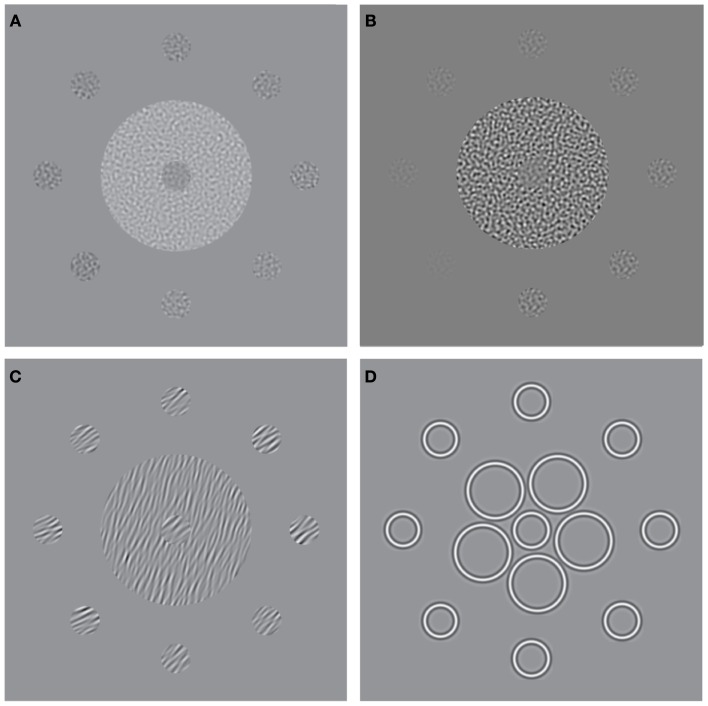
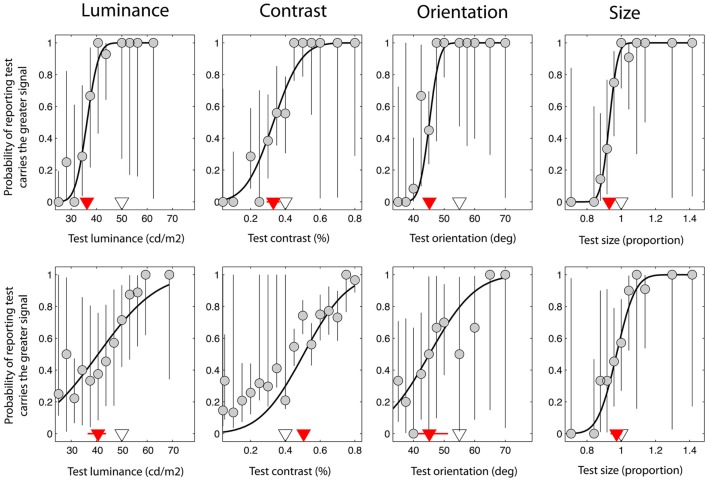
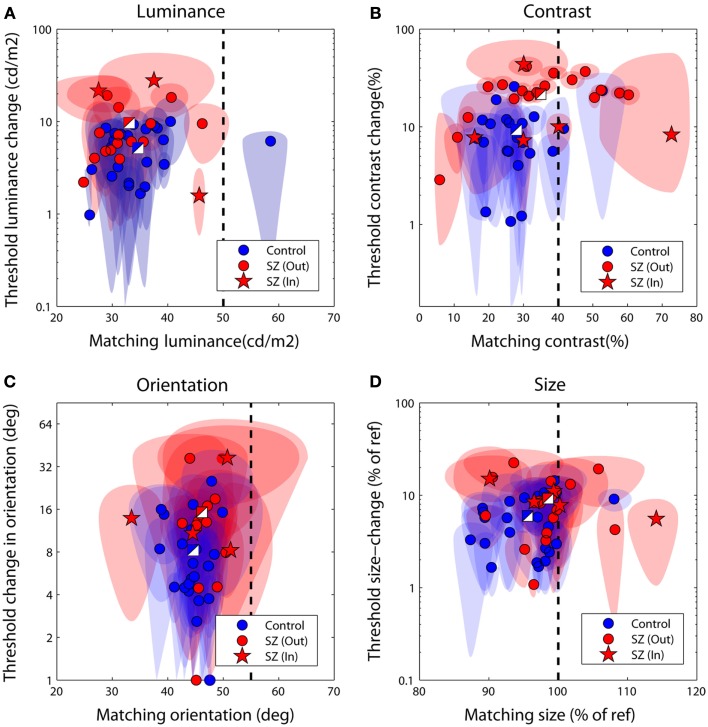
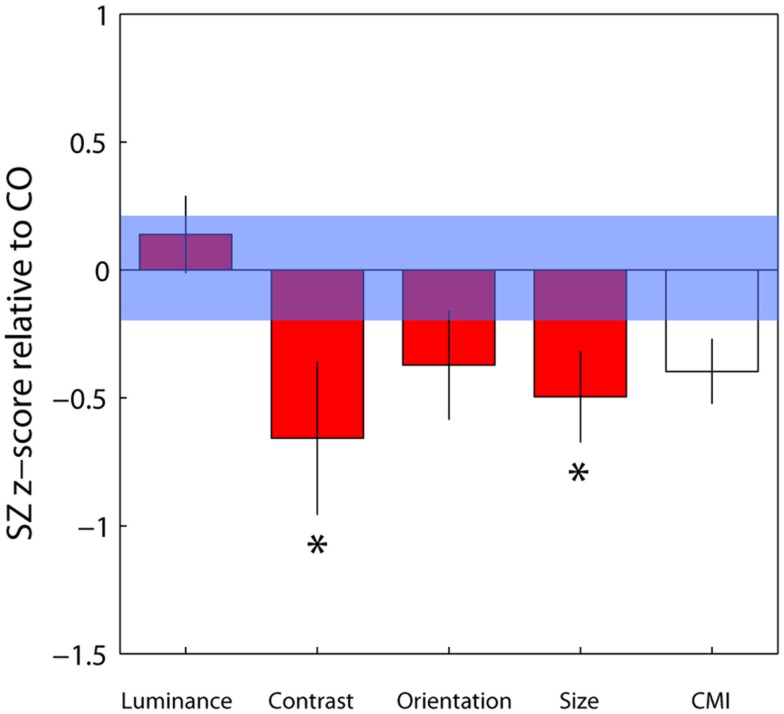
Compared to unaffected observers patients with schizophrenia (SZ) show characteristic differences in visual perception, including a reduced susceptibility to the influence of context on judgments of contrast - a manifestation of weaker surround suppression (SS). To examine the generality of this phenomenon we measured the ability of 24 individuals with SZ to judge the luminance, contrast, orientation, and size of targets embedded in contextual surrounds that would typically influence the target's appearance. Individuals with SZ demonstrated weaker SS compared to matched controls for stimuli defined by contrast or size, but not for those defined by luminance or orientation. As perceived luminance is thought to be regulated at the earliest stages of visual processing our findings are consistent with a suppression deficit that is predominantly cortical in origin. In addition, we propose that preserved orientation SS in SZ may reflect the sparing of broadly tuned mechanisms of suppression. We attempt to reconcile these data with findings from previous studies.
Overview
The claims and statistics of this paper haven’t been checked yet.
Run the check — free, no account needed. It reads the open-access text and checks the sources it cites.
Integrity signals
Registry
Cites
Statistics
Figures
Verification
Claims the paper makes
The claims and statistics of this paper haven’t been checked yet.
Run the check — free, no account needed. It reads the open-access text and checks the sources it cites.
Claims other papers make about this one
Each is checked against this paper’s own text: does it say what the citing paper says it does?
The source backs part of the claim, not all of it — or backs it for a different population, condition or comparison.
In the citing paper
“Thus, these authors hypothesized that the pre-cortical stages of the visual system, in which luminance is supposed to be processed, were spared, thereby contradicting Norton's conclusions.”
From What visual illusions teach us about schizophrenia (2014) · cites this paper as Tibber et al., 2013
Experimental — accuracy not yet measuredIn the citing paper
“Our findings are therefore not at odds with decreased susceptibility to some visual illusions in schizophrenic patients (37,38,40,41).”
From Shift toward prior knowledge confers a perceptual advantage in early psychosis and psychosis-prone healthy individuals (2015) · cites this paper as [38]
In the citing paper
“This previous effect is most likely related to well-established schizophrenic deficits in early and midlevel vision that affect perceptual organization, context processing and integration (37,38,(48)(49)(50)(51)(52)(53) rather than to top-down influences from high-level visual cognition as in the current study.”
From Shift toward prior knowledge confers a perceptual advantage in early psychosis and psychosis-prone healthy individuals (2015) · cites this paper as [38]
In the citing paper
“Yang et al. (2012) and Tibber et al. (2013) found that luminance context processing was similar, whereas the strength of the illusions was inferior in patients for the other psychophysical parameters (e.g., contrast, orientation, size or motion).”
From What visual illusions teach us about schizophrenia (2014) · cites this paper as Tibber et al., 2013
In the citing paper
“Some authors have argued, in line with the findings that stem from the study of VIs, that the impairment of gain control is a robust and significant property of visual processing in schizophrenia, and may even consider it a core feature of the disorder (Robol et al., 2013; Tibber et al., 2013).”
From What visual illusions teach us about schizophrenia (2014) · cites this paper as Tibber et al., 2013
In the citing paper
“While some authors found no or only weak relationships between VIs and psychopathology (Koethe et al., 2006, 2009; Tibber et al., 2013; Yang et al., 2013)”
From What visual illusions teach us about schizophrenia (2014) · cites this paper as Tibber et al., 2013
Self-check
Percentages, sums and reported differences re-computed from the paper’s own numbers.
The self-check needs the paper’s full text.
Citations
Cites
Brainard, D. H. (1997) · Spatial Vision · doi:10.1163/156856897x00357 · Cited by 20,012
The VideoToolbox software for visual psychophysics: transforming numbers into movies
Pelli, D. G. (1997) · Spatial Vision · doi:10.1163/156856897x00366 · Cited by 11,110
The Dopamine Hypothesis of Schizophrenia: Version III--The Final Common Pathway
Howes, O. D., & Kapur, S. (2009) · Schizophrenia Bulletin · doi:10.1093/schbul/sbp006 · Cited by 2,693
Chlorpromazine Equivalent Doses for the Newer Atypical Antipsychotics
Woods, S. W. (2003) · The Journal of Clinical Psychiatry · doi:10.4088/jcp.v64n0607 · Cited by 2,056
Normalization as a canonical neural computation
Carandini, M., & Heeger, D. J. (2012) · Nature Reviews Neuroscience · doi:10.1038/nrn3136 · Cited by 1,906
Normalization of cell responses in cat striate cortex
Heeger, D. J. (1992) · Visual Neuroscience · doi:10.1017/s0952523800009640 · Cited by 1,835
Context, cortex, and dopamine: A connectionist approach to behavior and biology in schizophrenia.
Cohen, J. D., & Servan‐Schreiber, D. (1992) · Psychological Review · doi:10.1037/0033-295x.99.1.45 · Cited by 1,513
Ceramide-orchestrated signalling in cancer cells
Morad, S. A. F., & Cabot, M. C. (2012) · Nature reviews. Cancer · doi:10.1038/nrc3398 · Cited by 1,032
The Maudsley Prescribing Guidelines in Psychiatry
Taylor, D. M., Barnes, T. R. E., & Young, A. H. (2021) · Wiley eBooks · doi:10.1002/9781119870203 · Cited by 995
Chapter 9 Visual adaptation and retinal gain controls
Shapley, R. M., & Enroth‐Cugell, C. (1984) · Progress in Retinal Research · doi:10.1016/0278-4327(84)90011-7 · Cited by 888
Cited by
Sorted by citations
Robertson, C. E., & Baron-Cohen, S. (2017) · Nature Reviews Neuroscience · doi:10.1038/nrn.2017.112 · Cited by 1,157
With or without you: predictive coding and Bayesian inference in the brain
Aitchison, L., & Lengyel, M. (2017) · Current Opinion in Neurobiology · doi:10.1016/j.conb.2017.08.010 · Cited by 308
Teufel, C., Subramaniam, N., Dobler, V., Perez, J., Finnemann, J., Mehta, P. R., Goodyer, I. M., & Fletcher, P. C. (2015) · Proceedings of the National Academy of Sciences · doi:10.1073/pnas.1503916112 · Cited by 308
Silverstein, S. M., & Rosen, R. B. (2015) · Schizophrenia Research Cognition · doi:10.1016/j.scog.2015.03.004 · Cited by 189
What visual illusions teach us about schizophrenia
Notredame, C.-E., Pins, D., Deneve, S., & Jardri, R. (2014) · Frontiers in Integrative Neuroscience · doi:10.3389/fnint.2014.00063 · Cited by 177
Metadata
- Authors
- Tibber, M. S., Anderson, E. J., Bobin, T., Antonova, E., Seabright, A., Wright, B., Carlin, P., Shergill, S. S., & Dakin, S. C.
- Affiliations
- National Institute for Health and Care Research (GB)
- NIHR Moorfields Biomedical Research Centre (GB)
- King's College London (GB)
- University College London (GB)
- Corresponding author
- Tibber, Marc S.
- Venue
- Frontiers in Psychology
- Publisher
- Frontiers Media SA
- Published
- 2013
- Volume
- 4
- Pages
- 88-88
- ISSN
- 1664-1078 (ISSN-L)
- PMC
- PMC3584288
- OpenAlex
- W2129294405
- Cited by
- 116
- References
- 83
- Citations by year
- 2026: 7 · 2025: 7 · 2024: 11 · 2023: 11 · 2022: 6 · 2021: 6 · 2020: 8 · 2019: 7 · 2018: 8 · 2017: 11 · 2016: 8 · 2015: 13 · 2014: 6 · 2013: 7
- FWCI
- 6.22
- Type
- journal article
- Language
- en
- Update notices
- corrigendum (2019-08-22)
- Open access
- gold
- doi.org
- Licence
- cc-by
- Locations
- Frontiers in Psychology (publishedVersion, cc-by)
- Europe PMC (PubMed Central) (publishedVersion, cc-by)
- PubMed Central (publishedVersion, cc-by)
- PubMed (publishedVersion)
- Repository@Hull (Worktribe) (University of Hull) (submittedVersion, cc-by)
- DOAJ (DOAJ: Directory of Open Access Journals) (submittedVersion)
- UCL Discovery (University College London) (submittedVersion)
- Research Portal (King's College London) (submittedVersion, cc-by)
- ResearchSpace (University of Auckland) (submittedVersion, cc-by)
- Brunel University Research Archive (BURA) (Brunel University London) (submittedVersion)
- Funders
- Wellcome Trust
- Topics
- Life Sciences › Neuroscience › Cognitive Neuroscience › Visual perception and processing mechanisms
- Health Sciences › Medicine › Psychiatry and Mental health › Schizophrenia research and treatment
- Life Sciences › Neuroscience › Cognitive Neuroscience › Hallucinations in medical conditions
- Keywords
- schizophrenia, surround suppression, visual perception, contrast perception, luminance perception, orientation perception, size perception
About these checks
Registry, retraction, Cites and statistics results are computed, not judged, with one exception: a printed reference that no index lists is read once by a model before it counts as a citation error. Claims are extracted by a model and kept only when their quote appears verbatim in the text; each cited source is then checked, with a model’s help, for whether it says what the claim relies on. Those verdicts can be wrong — read the claim’s quote and the cited source before relying on one.
Statistics and arithmetic are recomputed, not judged.
Confidence bands are shown only for fields calibrated on our annotated test set. None is calibrated yet, so no band is shown.
What counts as a claim ›How we measure confidence ›How we check this ›
Are you an author, or do you see a problem with this page? Request a review
