

A Nap But Not Rest or Activity Consolidates Language Learning
Open accessThe DOI matches its Crossref record; 50 of the 50 references it cites were found in a registry or an index; none of the 31 sources its claims cite is checked for support yet.
Abstract
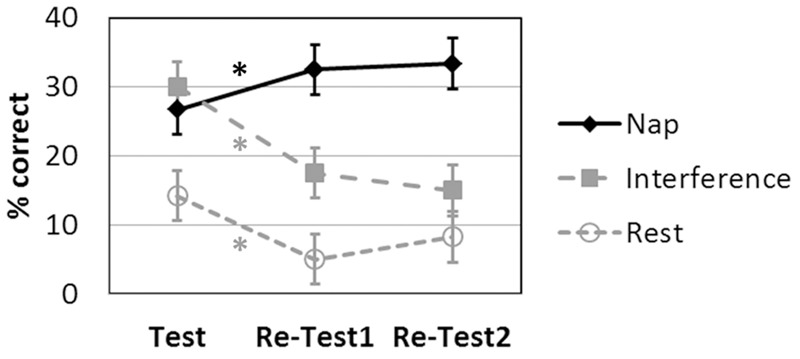
Recent evidence suggests that a period of sleep after a motor learning task is a relevant factor for memory consolidation. However, it is yet open whether this also holds true for language-related learning. Therefore, the present study compared the short- and long-term effects of a daytime nap, rest, or an activity task after vocabulary learning on learning outcome. Thirty healthy subjects were divided into three treatment groups. Each group received a pseudo-word learning task in which pictures of monsters were associated with unique pseudo-word names. At the end of the learning block a first test was administered. Then, one group went for a 90-min nap, one for a waking rest period, and one for a resting session with interfering activity at the end during which a new set of monster names was to be learned. After this block, all groups performed a first re-test of the names that they initially learned. On the morning of the following day, a second re-test was administered to all groups. The nap group showed significant improvement from test to re-test and a stable performance onto the second re-test. In contrast, the rest and the interference groups showed decline in performance from test to re-test, with persistently low performance at re-test 2. The 3 (GROUP) × 3 (TIME) ANOVA revealed a significant interaction, indicating that the type of activity (nap/rest/interfering action) after initial learning actually had an influence on the memory outcome. These data are discussed with respect to translation to clinical settings with suggestions for improvement of intervention outcome after speech-language therapy if it is followed by a nap rather than interfering activity.
Overview
CoChat Summary
TL;DR
A daytime nap after pseudo-word learning improved recall in healthy older adults, whereas rest or interfering activity led to decline. The 3×3 ANOVA showed a significant intervention × time interaction.
Key findings
- Nap group improved from Test to Re-Test1 [t(9) = −3.280, p = 0.010] and Test to Re-Test2 [t(9) = −3.207, p = 0.011], with no difference between Re-Test1 and Re-Test2 [t(9) = −0.557, p = 0.591].
- Rest group declined from Test to Re-Test1 [t(9) = 3.973, p = 0.003]; other contrasts were not significant after correction [Re-Test1 to Re-Test2: p = 0.037; Test to Re-Test2: p = 0.066].
- Interference group declined from Test to Re-Test1 [t(9) = 5.582, p < 0.001] and Test to Re-Test2 [t(9) = 5.014, p = 0.001], with no difference between Re-Test1 and Re-Test2 [t(9) = 1.152, p = 0.279].
- The 3×3 ANOVA showed significant main effects of INTERVENTION [F(2,27) = 10.147, p = 0.001] and TIME [F(2,54) = 10.473, p < 0.001], and a significant INTERVENTION × TIME interaction [F(4,54) = 15.374, p < 0.001]. With initial performance as covariate, INTERVENTION [F(2,26) = 23.000, p < 0.001] and the interaction [F(4,52) = 16.029, p < 0.001] remained significant, while TIME disappeared [F(2,52) = 0.241, p = 0.787].
Methods
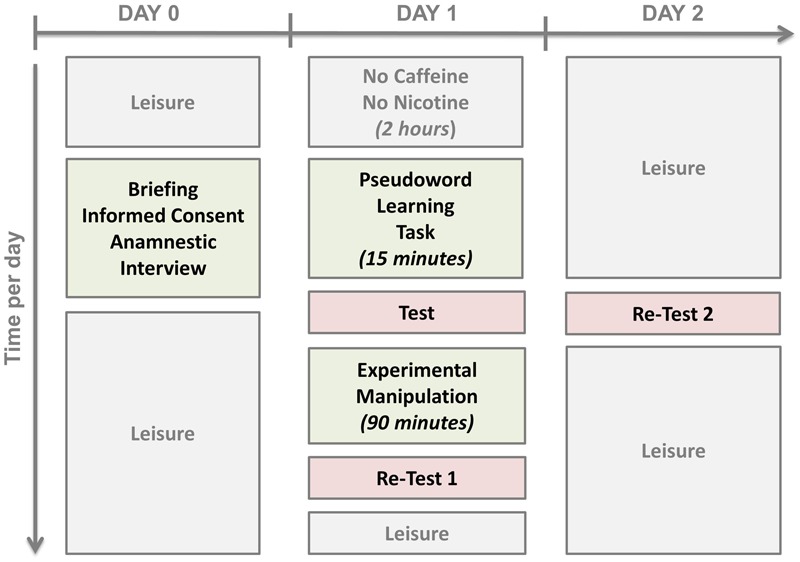
- Thirty healthy elderly volunteers aged 50–75, monolingual German speakers, were divided into three groups of n = 10: 90-min nap, 90-min waking rest with non-verbal activities, or rest plus a 10-min interfering pseudo-word learning task at the end.
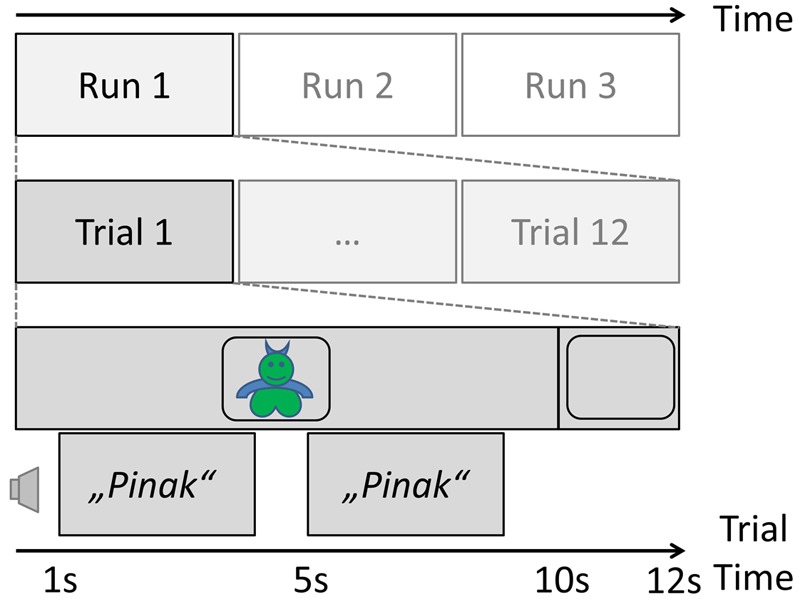
- The learning task paired 24 monster images with 1- to 3-syllable German pseudo-word names; set A was learned in three runs, each monster shown for 10 s with a 2-s inter-stimulus interval and its name presented twice. Tests occurred after initial learning, after the intervention (Re-Test1), and the next day (Re-Test2).
- Analysis used SPSS 20: a 3×3 ANOVA with INTERVENTION (Nap/Rest/Interference) and TIME (Test/Re-Test1/Re-Test2), planned pairwise t-tests with Bonferroni correction, an ANCOVA with initial test performance as covariate, and exploratory correlations.
Limitations
- The paper states the sample size of n = 30 is not large; higher power might better distinguish consolidating effects from nocturnal sleep.
- The paper notes the Rest group had lower initial performance than both other groups (one-way ANOVA F(2,27) = 5.407, p = 0.011; post hoc Interference vs Rest p = 0.004, Nap vs Rest p = 0.020), and suggests higher performers might consolidate better; no cross-over design was used.
- The paper states no polysomnographic examination was conducted; the discussion notes the Interference group had a 10-min longer Test-to-Re-Test1 interval due to the additional interference task, and electrophysiological/neuroimaging models were not part of the study.
Model-written summary. Check it against the paper before relying on it.
Integrity signals
Registry
Cites
Statistics
Figures
Verification
Claims the paper makes
0 Valid · 0 Not valid · 17 Not checked · 33 Own results and interpretations
A result the paper reports from its own data — it cites no other source for it, so there is none to check. The quote shows it is in the paper.
In the paper
“All other effects were not significant at a corrected level [Re-Test1 to Re-Test2: t(9) = -2.449; p = 0.037 two-tailed; Test to Re-Test2: t(9) = 2.090; p = 0.066 two-tailed].”
§ A Nap But Not Rest or Activity Consolidates Language Learning > Results > Planned Contrasts for the Rest Condition
plain- Asserted: passes — The authors put it forward as true.
- Checkable: passes — It can be checked against evidence.
- Load-bearing: passes — The paper’s conclusions depend on it.
- Based: passes — The paper gives a reason why it holds.
A result the paper reports from its own data — it cites no other source for it, so there is none to check. The quote shows it is in the paper.
In the paper
“The 3 × 3 ANOVA revealed significant main effects of INTERVENTION [F(2,27) = 10.147; p = 0.001] and TIME [F(2,54) = 10.473; p < 0.001] and a significant INTERVENTION × TIME interaction [F(4,54) = 15.374; p < 0.001].”
§ A Nap But Not Rest or Activity Consolidates Language Learning > Results > Comparison of Intervention Effects between Groups
plainstates an association- Asserted: passes — The authors put it forward as true.
- Checkable: passes — It can be checked against evidence.
- Load-bearing: passes — The paper’s conclusions depend on it.
- Based: passes — The paper gives a reason why it holds.
A result the paper reports from its own data — it cites no other source for it, so there is none to check. The quote shows it is in the paper.
In the paper
“The post hoc two-tailed dependent-sample t-tests for the Rest group revealed a significant decrease in language learning from Test to Re-Test1 [t(9) = 3.973; p = 0.003 two-tailed].”
§ A Nap But Not Rest or Activity Consolidates Language Learning > Results > Planned Contrasts for the Rest Condition
plainstates a cause- Asserted: passes — The authors put it forward as true.
- Checkable: passes — It can be checked against evidence.
- Load-bearing: passes — The paper’s conclusions depend on it.
- Based: passes — The paper gives a reason why it holds.
A result the paper reports from its own data — it cites no other source for it, so there is none to check. The quote shows it is in the paper.
In the paper
“The post hoc two-tailed dependent-sample t-tests for the Interference group revealed a significant decrease in language learning from Test to Re-Test1 [t(9) = 5.582; p < 0.001] and from Test to Re-Test2 [t(9) = 5.014; p = 0.001].”
§ A Nap But Not Rest or Activity Consolidates Language Learning > Results > Planned Contrasts for the Interference Condition
plainstates a cause- Asserted: passes — The authors put it forward as true.
- Checkable: passes — It can be checked against evidence.
- Load-bearing: passes — The paper’s conclusions depend on it.
- Based: passes — The paper gives a reason why it holds.
A result the paper reports from its own data — it cites no other source for it, so there is none to check. The quote shows it is in the paper.
In the paper
“The post hoc two-tailed dependent-sample t-tests for the Nap group revealed a significant increase in language learning from Test to Re-Test1 [t(9) = -3.280; p = 0.010] and from Test to Re-Test2 [t(9) = -3.207; p = 0.011].”
§ A Nap But Not Rest or Activity Consolidates Language Learning > Results > Planned Contrasts for the Nap Condition
plainstates a cause- Asserted: passes — The authors put it forward as true.
- Checkable: passes — It can be checked against evidence.
- Load-bearing: passes — The paper’s conclusions depend on it.
- Based: passes — The paper gives a reason why it holds.
22 more claims
Create a free account to see all 50 claims and to verify the 28 references still open.
- Probably not a substantial claim. 18
- It may state two separate claims as one. 7
- The quote only partly states this claim. 1
Claims other papers make about this one
Each is checked against this paper’s own text: does it say what the citing paper says it does?
In the citing paper
“The exceptions were Heim et al. (2017) and Gerbier et al. (2019) who included older adult participants (range 50-80 years).”
From The effect of sleep on novel word learning in healthy adults: a systematic review and meta-analysis (2021) · cites this paper as Heim et al., 2017
In the citing paper
“The sample size of each study experiment varied from 30 participants (Heim et al., 2017), up to 111 participants (Schapiro et al., 2017), with a total of 1,396 participants across all of the experiments (704 in sleep groups and 692 in wake groups) included in the meta-analysis.”
From The effect of sleep on novel word learning in healthy adults: a systematic review and meta-analysis (2021) · cites this paper as Heim et al., 2017
In the citing paper
“The majority of studies involved just one sleep and one wake group for comparison; however, some studies involved multiple sleep and/or wake groups (Havas et al., 2018;Heim et al., 2017;Himmer et al., 2017;Kroneisen & Kuepper-Tetzel, 2021;Mazza et al., 2016;McGregor et al., 2013;Schapiro et al., 2017;Schoen & Badia, 1984).”
From The effect of sleep on novel word learning in healthy adults: a systematic review and meta-analysis (2021) · cites this paper as Heim et al., 2017
Statistics recomputed
Every reported test result, recomputed from its test statistic and degrees of freedom. A result shows as not adding up only once an independent check has confirmed it.
- ConsistentF(2, 27) = 10.147reported p = .001 · recomputed p < .001
“F(2,27) = 10.147, p = .001”
- ConsistentF(2, 54) = 10.473reported p < .001 · recomputed p < .001
“F(2,54) = 10.473, p < .001”
- ConsistentF(4, 54) = 15.374reported p < .001 · recomputed p < .001
“F(4,54) = 15.374, p < .001”
- Consistentt(9) = -3.28reported p = .01 · recomputed p = .010
“t(9) = -3.280, p = .010”
- Consistentt(9) = -3.207reported p = .011 · recomputed p = .011
“t(9) = -3.207, p = .011”
11 more recomputed tests
Create a free account to see every test the Stats check recomputed.
Self-check
Percentages, sums and reported differences re-computed from the paper’s own numbers.
Self-check results appear here once an independent check has confirmed them.
Citations
Cites
A New Method for Measuring Daytime Sleepiness: The Epworth Sleepiness Scale
Johns, M. W. (1991) · Sleep · doi:10.1093/sleep/14.6.540 · Cited by 17,364
Memory - A century of consolidation
McGaugh, J. L. (2000) · Science · doi:10.1126/science.287.5451.248 · Cited by 4,250
Diekelmann, S., & Born, J. (2010) · Nature Reviews Neuroscience · doi:10.1038/nrn2762 · Cited by 3,760
Rasch, B., & Born, J. (2013) · Physiological Reviews · doi:10.1152/physrev.00032.2012 · Cited by 2,783 · cited 1×
“…as word association learning depends more on phases with sleep spindles (Philal and Born, 1997; for a recent review of the electrophysiological account of sleep-induced memory consolidation, which will not be part of the present paper, cf., e.g., Chatburn et al., 2014; or Rasch and Born, 2013).”
BackgroundStructure and function of declarative and nondeclarative memory systems
Squire, L. R., & Zola, S. M. (1996) · Proceedings of the National Academy of Sciences · doi:10.1073/pnas.93.24.13515 · Cited by 1,327 · cited 1×
“…often tested with motor sequences) and declarative (explicit, verbally expressible; intentional; factual) types of learning and memory (e.g., Squire and Zola, 1996).2 Procedural learning (e.g., finger tapping sequences) relies more on phases of rapid eye movement (REM) sleep while…”
BackgroundSleep loss, learning capacity and academic performance
CURCIO, G., FERRARA, M., & DEGENNARO, L. (2006) · Sleep Medicine Reviews · doi:10.1016/j.smrv.2005.11.001 · Cited by 1,310 · cited 1×
“Next, a 3 × 3 ANOVA with factors INTERVENTION (Nap/Rest/Interference) and TIME (Test/Re-Test1/Re-Test2) 4It appears that REM sleep deprivation affects learning more than slow-wave sleep deprivation (for a review see Curcio et al., 2006).”
MethodEffects of early and late nocturnal sleep on declarative and procedural memory
Plihal, W., & Born, J. (1997) · Journal of Cognitive Neuroscience · doi:10.1162/jocn.1997.9.4.534 · Cited by 1,026
Dobkin, B. H. (2005) · New England Journal of Medicine · doi:10.1056/nejmcp043511 · Cited by 910
Functional Stages in the Formation of Human Long-Term Motor Memory
Shadmehr, R., & Brashers-Krug, T. (1997) · The Journal of Neuroscience · doi:10.1523/jneurosci.17-01-00409.1997 · Cited by 706
Declarative memory consolidation: mechanisms acting during human sleep
Gais, S., & Born, J. (2004) · Learning & Memory · doi:10.1101/lm.80504 · Cited by 536
Research works printed but not linked: 1
- Rechtschaffen A. Kales A. (1968). A Manual of Standardized Terminology, Techniques and Scoring System for Sleep Stages of Human Subjects, NIH Publication No. 204. Washington, DC: US Government Printing Office.
Cited by
The sleep benefit in episodic memory: An integrative review and a meta-analysis.
Berres, S., & Erdfelder, E. (2021) · Psychological Bulletin · doi:10.1037/bul0000350 · Cited by 74
The Effect of Sleep on Children's Word Retention and Generalization
Axelsson, E. L., Williams, S. E., & Horst, J. S. (2016) · Frontiers in Psychology · doi:10.3389/fpsyg.2016.01192 · Cited by 49
The effect of sleep on novel word learning in healthy adults: a systematic review and meta-analysis
Schimke, E. A. E., Angwin, A. J., Cheng, B. B. Y., & Copland, D. A. (2021) · Psychonomic Bulletin & Review · doi:10.3758/s13423-021-01980-3 · Cited by 41
Benefits and risks of napping in older adults: A systematic review
Souabni, M., Souabni, M. J., Hammouda, O., Romdhani, M., Trabelsi, K., Ammar, A., & Driss, T. (2022) · Frontiers in Aging Neuroscience · doi:10.3389/fnagi.2022.1000707 · Cited by 37
The role of daytime napping in declarative memory performance: a systematic review
Farhadian, N., Khazaie, H., Nami, M., & Khazaie, S. (2021) · Sleep Medicine · doi:10.1016/j.sleep.2021.05.019 · Cited by 28
Metadata
- Authors
- Heim, S., Klann, J., Schattka, K. I., Bauhoff, S., Borcherding, G., Nosbüsch, N., Struth, L., Binkofski, F. C., & Werner, C. J.
- Affiliations
- Forschungszentrum Jülich (DE)
- SRH Hochschule für Gesundheit Gera (DE)
- RWTH Aachen University (DE)
- Corresponding author
- Heim, Stefan
- Venue
- Frontiers in Psychology
- Publisher
- Frontiers Media SA
- Published
- 2017-05-16
- Volume
- 8
- Pages
- 665-665
- ISSN
- 1664-1078 (ISSN-L)
- PMC
- PMC5432759
- OpenAlex
- W2611540853
- Cited by
- 20
- References
- 50
- Citations by year
- 2025: 5 · 2024: 1 · 2023: 2 · 2022: 5 · 2021: 3 · 2020: 3
- FWCI
- 0.37
- Type
- journal article
- Language
- en
- Open access
- gold
- doi.org
- Licence
- cc-by
- Locations
- Frontiers in Psychology (publishedVersion, cc-by)
- RWTH Publications (RWTH Aachen) (publishedVersion, cc-by)
- Europe PMC (PubMed Central) (publishedVersion, cc-by)
- PubMed Central (publishedVersion, cc-by)
- PubMed (publishedVersion)
- DOAJ (DOAJ: Directory of Open Access Journals) (submittedVersion)
- RWTH Publications (RWTH Aachen)
- Funders
- European Commission
- Bundesministerium für Forschung, Technologie und Raumfahrt (01EW1203)
- Topics
- Life Sciences › Neuroscience › Cognitive Neuroscience › Sleep and Wakefulness Research
- Life Sciences › Neuroscience › Cognitive Neuroscience › Memory Processes and Influences
- Life Sciences › Neuroscience › Cognitive Neuroscience › Neurobiology of Language and Bilingualism
- Keywords
- daytime napping, memory consolidation, vocabulary acquisition, rest periods, language learning, speech therapy, long-term retention
About these checks
Registry, retraction, Cites and statistics results are computed, not judged, with one exception: a printed reference that no index lists is read once by a model before it counts as a citation error. Claims are extracted by a model and kept only when their quote appears verbatim in the text; each cited source is then checked, with a model’s help, for whether it says what the claim relies on. Those verdicts can be wrong — read the claim’s quote and the cited source before relying on one.
A language model drew the claims from the paper on 2026-11-24, under version 3 of the claim definition (model deepseek-v4.1-flash, prompt extract-v3).
A second model labelled each claim on 2026-11-24 (model jev-1.13-20260917, definition revision gold-guideline-v0.2).
Statistics and arithmetic are recomputed, not judged.
Confidence bands are shown only for fields calibrated on our annotated test set. None is calibrated yet, so no band is shown.
What counts as a claim ›How we measure confidence ›How we check this ›
Are you an author, or do you see a problem with this page? Request a review
Data sources
Bibliographic data: Semantic Scholar, OpenAlex, Crossref.
Contains information from the Semantic Scholar Academic Graph Datasets, made available under the ODC Attribution License (ODC-BY 1.0).
Semantic Scholar’s data is described in: Kinney, R., et al. (2023). The Semantic Scholar Open Data Platform. arXiv:2301.10140.
