

The DOI matches its Crossref record; 39 of the 39 references it cites were found in a registry or an index.
Moral Judgement in Early Bilinguals: Language Dominance Influences Responses to Moral Dilemmas
Abstract
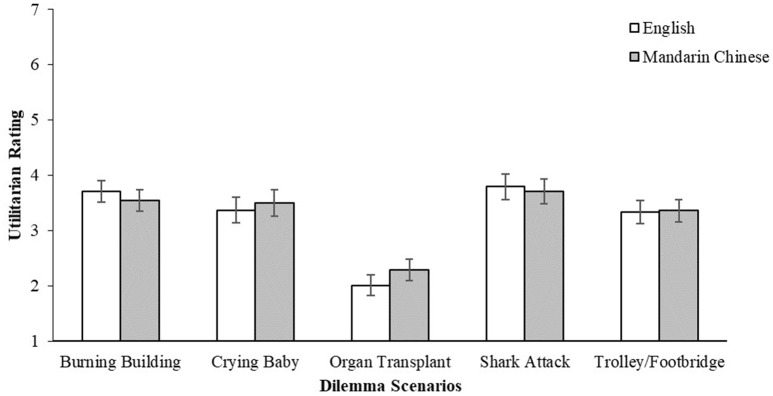
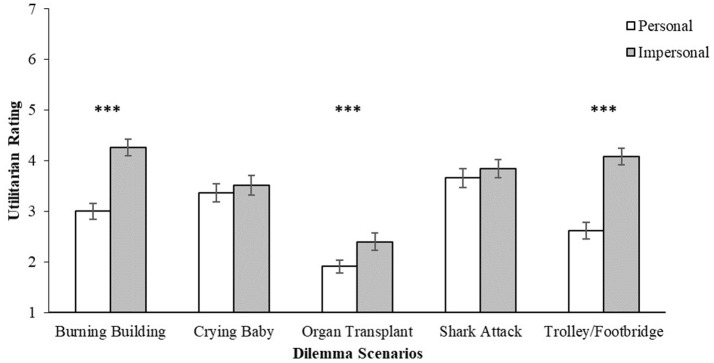
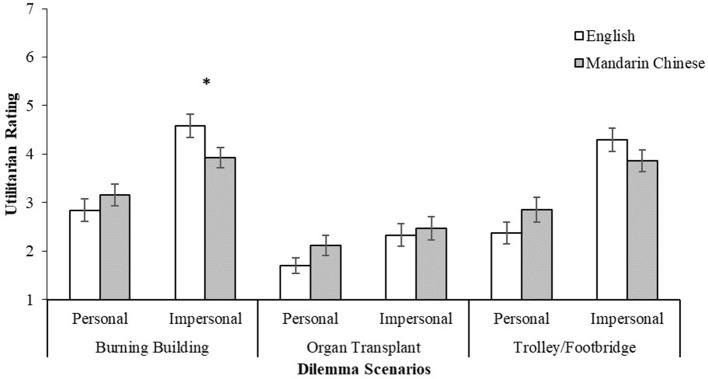
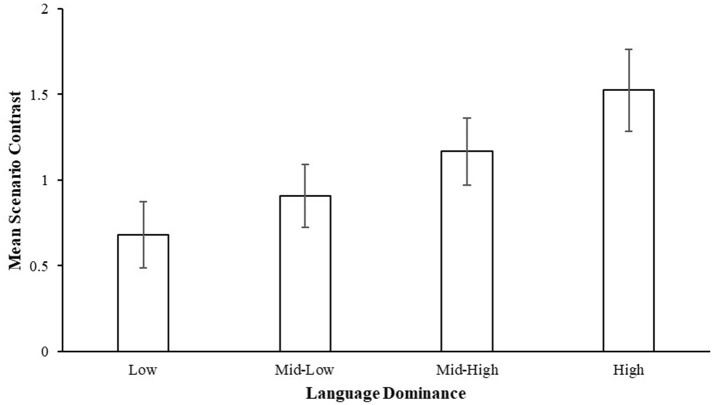
The Foreign-Language effect (FLe) on morality describes how late bilinguals make different decisions on moral judgements, when presented in either their native or foreign language. However the relevance of this phenomenon to early bilinguals, where a language's "nativeness" is less distinct, is unknown. This study aims to verify the effect of early bilinguals' languages on their moral decisions and examine how language experience may influence these decisions. Eighty-six early English-Chinese bilinguals were asked to perform a moral dilemmas task consisting of personal and impersonal dilemmas, in either English or Mandarin Chinese. Information on language experience factors were also collected from the participants. Findings suggest that early bilinguals do show evidence of a language effect on their moral decisions, which is dependent on how dominant they are in the language. Particularly, the more dominant participants were in their tested language, the larger the difference between their personal and impersonal dilemma response choice. In light of these findings, the study discusses the need to re-examine how we conceptualize the FLe phenomenon and its implications on bilinguals' moral judgement. It also addresses the importance of treating bilingualism as multidimensional, rather than a unitary variable.
Overview
The claims and statistics of this paper haven’t been checked yet.
Run the check — free, no account needed. It reads the open-access text and checks the sources it cites.
Integrity signals
Registry
Cites
Statistics
Figures
Verification
Claims the paper makes
The claims and statistics of this paper haven’t been checked yet.
Run the check — free, no account needed. It reads the open-access text and checks the sources it cites.
Claims other papers make about this one
Each is checked against this paper’s own text: does it say what the citing paper says it does?
The cited source doesn’t support the claim as written.
In the citing paper
“Therefore, language dominance as measured by the Bilingual Language Profile was significantly correlated to a higher emotional response.”
From What Heritage Bilinguals Tell Us about the Language of Emotion (2022) · cites this paper as Wong and Ng (2018)
Checked by a reasoning model — may be wrong.
Experimental — accuracy not yet measuredIn the citing paper
“Language dominance as calculated by the Bilingual Language Profile, operationalized as a multidimensional construct, was found to modulate a few of the emotion-memory effects in the data consistent with past studies reporting significant effects of language dominance using the same questionnaire (Wong and Ng 2018; but see Ferré et al. 2010).”
From What Heritage Bilinguals Tell Us about the Language of Emotion (2022) · cites this paper as Wong and Ng 2018
Self-check
Percentages, sums and reported differences re-computed from the paper’s own numbers.
The self-check needs the paper’s full text.
Citations
Cites
An fMRI Investigation of Emotional Engagement in Moral Judgment
Greene, J. D., Sommerville, R. B., Nystrom, L. E., Darley, J. M., & Cohen, J. D. (2001) · Science · doi:10.1126/science.1062872 · Cited by 4,561
Individual differences in reasoning: Implications for the rationality debate?
Stanovich, K. E., & West, R. F. (2000) · Behavioral and Brain Sciences · doi:10.1017/s0140525x00003435 · Cited by 2,762
Mauss, I. B., & Robinson, M. D. (2009) · Cognition and Emotion · doi:10.1080/02699930802204677 · Cited by 2,078
The Handbook of Child Language
(1996) · Wiley eBooks · doi:10.1111/b.9780631203124.1996.x · Cited by 1,488
Killing, Letting Die, and the Trolley Problem
Thomson, J. J., & The Hegeler Institute (1976) · Monist · doi:10.5840/monist197659224 · Cited by 1,341
How People Make Decisions That Involve Risk: A Dual-Processes Approach
Reyna, V. F. (2004) · Current Directions in Psychological Science · doi:10.1111/j.0963-7214.2004.00275.x · Cited by 636
Pushing moral buttons: The interaction between personal force and intention in moral judgment
Greene, J. D., Cushman, F. A., Stewart, L. E., Lowenberg, K., Nystrom, L. E., & Cohen, J. D. (2009) · Cognition · doi:10.1016/j.cognition.2009.02.001 · Cited by 633
The Foreign-Language Effect: Thinking in a Foreign Tongue Reduces Decision Biases
Keysar, B., Hayakawa, S. L., & An, S. G. (2012) · Psychological Science · doi:10.1177/0956797611432178 · Cited by 626
Your Morals Depend on Language
Costa, A., Foucart, A., Hayakawa, S., Aparici, M., Apesteguia, J., Heafner, J., & Keysar, B. (2014) · PLoS ONE · doi:10.1371/journal.pone.0094842 · Cited by 505
Bartels, D. M., & Pizarro, D. A. (2011) · Cognition · doi:10.1016/j.cognition.2011.05.010 · Cited by 486
10. When is a First Language More Emotional? Psychophysiological Evidence from Bilingual Speakers
Harris, C. L., Gleason, J. B., & Ayçiçeǧi, A. (2006) · Bilingual Minds · doi:10.21832/9781853598746-012 · Cited by 308
The Bilingual Mind: And What it Tells Us about Language and Thought
Pavlenko, A. (2014) · Cambridge University Press eBooks · doi:10.1017/cbo9781139021456 · Cited by 300
“Piensa” twice: On the foreign language effect in decision making
Costa, A., Foucart, A., Arnon, I., Aparici, M., & Apesteguia, J. (2014) · Cognition · doi:10.1016/j.cognition.2013.11.010 · Cited by 294
Emotionality differences between a native and foreign language: theoretical implications
Caldwell‐Harris, C. L. (2014) · Frontiers in Psychology · doi:10.3389/fpsyg.2014.01055 · Cited by 274
Thinking More or Feeling Less? Explaining the Foreign-Language Effect on Moral Judgment
Hayakawa, S. L., Tannenbaum, D., Costa, A., Corey, J. D., & Keysar, B. (2017) · Psychological Science · doi:10.1177/0956797617720944 · Cited by 258
One Individual, Two Identities: Frame Switching among Biculturals
Luna, D., Ringberg, T., & Peracchio, L. A. (2008) · Journal of Consumer Research · doi:10.1086/586914 · Cited by 255
Swann, W. B., Gómez, Á., Dovidio, J. F., Hart, S., & Jetten, J. (2010) · Psychological Science · doi:10.1177/0956797610376656 · Cited by 248
The motivated use of moral principles
Uhlmann, E. L., Pizarro, D. A., Tannenbaum, D., & Ditto, P. H. (2009) · Judgment and Decision Making · doi:10.1017/s1930297500004022 · Cited by 213
How foreign language shapes moral judgment
Geipel, J., Hadjichristidis, C., & Surian, L. (2015) · Journal of Experimental Social Psychology · doi:10.1016/j.jesp.2015.02.001 · Cited by 203
The Foreign Language Effect on Moral Judgment: The Role of Emotions and Norms
Geipel, J., Hadjichristidis, C., & Surian, L. (2015) · PLoS ONE · doi:10.1371/journal.pone.0131529 · Cited by 192
Moral judgment reloaded: a moral dilemma validation study
Christensen, J. F., Flexas, A., Calabrese, M., Gut, N. K., & Gomila, A. (2014) · Frontiers in Psychology · doi:10.3389/fpsyg.2014.00607 · Cited by 177
The Preference for Indirect Harm
Royzman, E. B., & Baron, J. (2002) · Social Justice Research · doi:10.1023/a:1019923923537 · Cited by 172
The Moral Foreign-Language Effect
Perez, H. C., McFarlane, S., & Weissglass, C. (2015) · Philosophical Psychology · doi:10.1080/09515089.2014.993063 · Cited by 172
Using a Foreign Language Changes Our Choices
Hayakawa, S. L., Costa, A., Foucart, A., & Keysar, B. (2016) · Trends in Cognitive Sciences · doi:10.1016/j.tics.2016.08.004 · Cited by 168
Degner, J., DOYCHEVA, C., & Wentura, D. (2011) · Bilingualism Language and Cognition · doi:10.1017/s1366728911000095 · Cited by 152
Foreign language affects the contribution of intentions and outcomes to moral judgment
Geipel, J., Hadjichristidis, C., & Surian, L. (2016) · Cognition · doi:10.1016/j.cognition.2016.05.010 · Cited by 151
On Language Processing Shaping Decision Making
Costa, A., Vives, M., & Corey, J. D. (2017) · Current Directions in Psychological Science · doi:10.1177/0963721416680263 · Cited by 138
Multilinguals' perceptions of feeling different when switching languages
Dewaele, J.-M., & Nakano, S. (2013) · Journal of Multilingual and Multicultural Development · doi:10.1080/01434632.2012.712133 · Cited by 136
Emotionality in free recall: Language specificity in bilingual memory
Anooshian, L. J., & Hertel, P. T. (1994) · Cognition & Emotion · doi:10.1080/02699939408408956 · Cited by 129
Our moral choices are foreign to us.
Corey, J. D., Hayakawa, S. L., Foucart, A., Aparici, M., Botella, J., Costa, A., & Keysar, B. (2017) · Journal of Experimental Psychology Learning Memory and Cognition · doi:10.1037/xlm0000356 · Cited by 112
Bilingualism: An Advanced Resource Book
Ng, B. C., & Wigglesworth, G. (2007) · Cited by 101
Self-citationBlinded by taboo words in L1 but not L2.
Colbeck, K. L., & Bowers, J. S. (2012) · Emotion · doi:10.1037/a0026387 · Cited by 84
Pletti, C., Lotto, L., Buodo, G., & Sarlo, M. (2016) · British Journal of Psychology · doi:10.1111/bjop.12205 · Cited by 83
Emotion Word Processing: Effects of Word Type and Valence in Spanish–English Bilinguals
Kazanas, S. A., & Altarriba, J. (2015) · Journal of Psycholinguistic Research · doi:10.1007/s10936-015-9357-3 · Cited by 82
Morality and Cultural Differences
Cook, J. W. (1999) · doi:10.1093/oso/9780195126792.001.0001 · Cited by 75
1. ‘The Making of an American’: Negotiation of Identities at the Turn of the Twentieth Century
Pavlenko, A. (2004) · Multilingual Matters eBooks · doi:10.21832/9781853596483-004 · Cited by 74
Language use as a carrier of social identity
Tong, Y., Hong, Y., Lee, S.-L., & Chiu, C. (1999) · International Journal of Intercultural Relations · doi:10.1016/s0147-1767(98)00039-x · Cited by 73
Chan, Y., Gu, X., Ng, J. C. K., & Tse, C. (2016) · Asian Journal Of Social Psychology · doi:10.1111/ajsp.12123 · Cited by 55
Kusev, P., van Schaik, P., Alzahrani, S., Lonigro, S., & Purser, H. (2016) · Psychonomic Bulletin & Review · doi:10.3758/s13423-016-1029-2 · Cited by 31
Research works printed but not linked: 5
- Birdsong, 2012, Bilingual Language Profile: An Easy-to-Use Instrument to Assess Bilingualism.
- De Houwer, 1995, Bilingual language acquisition, 219
- McLaughlin, 1984, Second Language Acquisition in Childhood. Vol 2: Pre-School Children, 2nd Edn
- Norton, 2000, Investment, acculturation, and language loss, 443
- Schneider, 2002, E-Prime: User's Guide
Cited by
What Heritage Bilinguals Tell Us about the Language of Emotion
Vargas Fuentes, N. A., Kroll, J. F., & Torres, J. (2022) · Languages · doi:10.3390/languages7020144 · Cited by 5
Metadata
- Authors
- Wong, G., & Ng, B. C.
- Venue
- Frontiers in Psychology
- Publisher
- Frontiers Media SA
- Published
- 2018-06-28
- Volume
- 9
- ISSN
- 1664-1078
- PMC
- PMC6032433
- Cited by
- 31
- References
- 39
- Funders
- Nanyang Technological University (RG159/14)
About these checks
Registry, retraction, Cites and statistics results are computed, not judged, with one exception: a printed reference that no index lists is read once by a model before it counts as a citation error. Claims are extracted by a model and kept only when their quote appears verbatim in the text; each cited source is then checked, with a model’s help, for whether it says what the claim relies on. Those verdicts can be wrong — read the claim’s quote and the cited source before relying on one.
Statistics and arithmetic are recomputed, not judged.
Confidence bands are shown only for fields calibrated on our annotated test set. None is calibrated yet, so no band is shown.
What counts as a claim ›How we measure confidence ›How we check this ›
Are you an author, or do you see a problem with this page? Request a review
Data sources
Bibliographic data: Semantic Scholar, OpenAlex, Crossref.
Contains information from the Semantic Scholar Academic Graph Datasets, made available under the ODC Attribution License (ODC-BY 1.0).
Semantic Scholar’s data is described in: Kinney, R., et al. (2023). The Semantic Scholar Open Data Platform. arXiv:2301.10140.
