

The DOI matches its Crossref record; 52 of the 52 references it cites were found in a registry or an index.
The Efficacy of Metacognitive Therapy: A Systematic Review and Meta-Analysis
Open accessAbstract
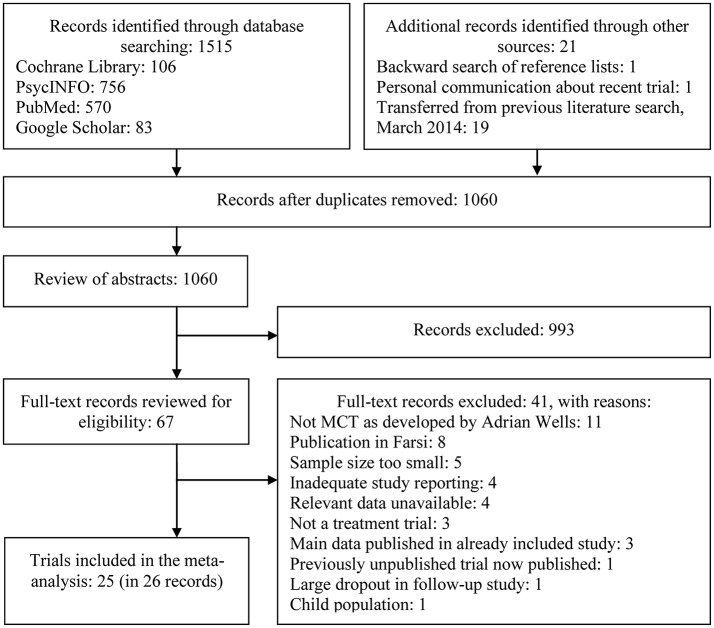
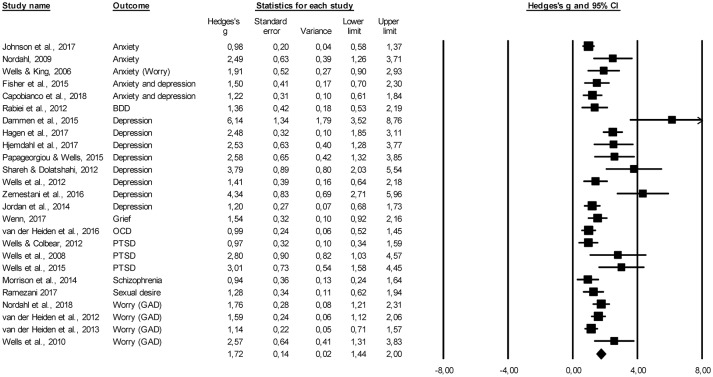
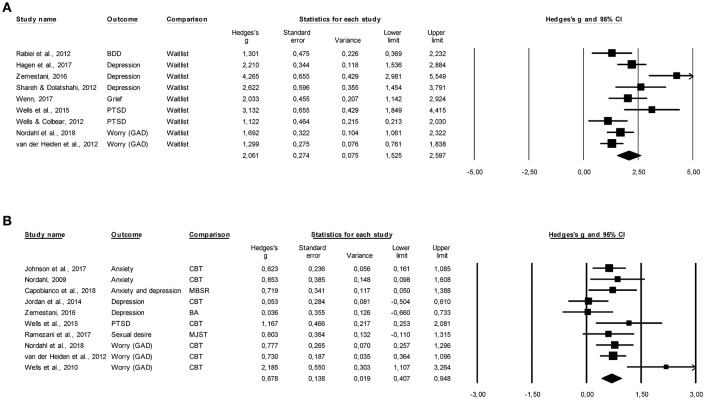
Background Metacognitive therapy (MCT) continues to gain increased ground as a treatment for psychological complaints. During the last years, several clinical trials on the efficacy of MCT have been published. The aim of the current study was to provide an updated meta-analytic review of the effect of MCT for psychological complaints. Methods We conducted a systematic search of trials on MCT for young and adult patients with psychological complaints published until January 2018, using PsycINFO, PubMed, the Cochrane Library, and Google Scholar. Trials with a minimum of 10 participants in the MCT condition were included. Results A total of 25 studies that examined a variety of psychological complaints met our inclusion criteria, of which 15 were randomized controlled trials. We identified only one trial that was conducted with children and adolescents. In trials with adult patients, large uncontrolled effect size estimates from pre- to posttreatment and follow-up suggest that MCT is effective at reducing symptoms of the targeted primary complaint, anxiety, depression, and dysfunctional metacognitions. The comparison with waitlist control conditions also resulted in a large effect (Hedges’ g = 2.06). The comparison of MCT to cognitive and behavioral interventions at posttreatment and at follow-up showed pooled effect sizes (Hedges’ g) of 0.69 and 0.37 at posttreatment (k = 8) and follow-up (k = 7), respectively. Conclusions Our findings indicate that MCT is an effective treatment for a range of psychological complaints. To date, strongest evidence exists for anxiety and depression. Current results suggest that MCT may be superior to other psychotherapies, including cognitive behavioral interventions. However, more trials with larger number of participants are needed in order to draw firm conclusions.
Overview
The claims and statistics of this paper haven’t been checked yet.
Run the check — free, no account needed. It reads the open-access text and checks the sources it cites.
Integrity signals
Registry
Cites
Statistics
Figures
Verification
Claims the paper makes
The claims and statistics of this paper haven’t been checked yet.
Run the check — free, no account needed. It reads the open-access text and checks the sources it cites.
Claims other papers make about this one
Each is checked against this paper’s own text: does it say what the citing paper says it does?
The cited source says what the claim attributes to it.
In the citing paper
“Several clinical trials indicate that MCT is an effective treatment over a range of disorders, including GAD [22].”
From Psychological interventions for generalized anxiety disorder: Effects and predictors in a naturalistic outpatient setting (2023) · cites this paper as [22]
The cited source says what the claim attributes to it.
In the citing paper
“MCT is an effective treatment, especially for anxiety and depression (25).”
From Metacognitive Short-Term Intervention in Patients With Mental Disorders Following Cardiovascular Events (2022) · cites this paper as [25]
The cited source says what the claim attributes to it.
In the citing paper
“As of yet, there is evidence from several meta-analyses and RCTs in favor of face-to-face MCT (18, 19).”
Self-check
Percentages, sums and reported differences re-computed from the paper’s own numbers.
The self-check needs the paper’s full text.
Citations
Cites
Preferred Reporting Items for Systematic Reviews and Meta-Analyses: the PRISMA statement
Moher, D., Liberati, A., Tetzlaff, J., Altman, D. G., & for the PRISMA Group (2009) · BMJ · doi:10.1136/bmj.b2535 · Cited by 83,823
Preferred Reporting Items for Systematic Reviews and Meta-Analyses: The PRISMA Statement
Moher, D., Liberati, A., Tetzlaff, J., Altman, D. G., & The PRISMA Group (2009) · PLoS Medicine · doi:10.1371/journal.pmed.1000097 · Cited by 64,042
Measuring inconsistency in meta-analyses
Higgins, J. P. T., Thompson, S. G., Deeks, J. J., & Altman, D. G. (2003) · BMJ · doi:10.1136/bmj.327.7414.557 · Cited by 63,139
An inventory for measuring depression
BECK, A. T. (1961) · Archives of General Psychiatry · doi:10.1001/archpsyc.1961.01710120031004 · Cited by 38,032
The Cochrane Collaboration's tool for assessing risk of bias in randomised trials
Higgins, J. P. T., Altman, D. G., Gotzsche, P. C., Juni, P., Moher, D., Oxman, A. D., Savovic, J., Schulz, K. F., Weeks, L., Sterne, J. A. C., et al. (2011) · BMJ · doi:10.1136/bmj.d5928 · Cited by 33,817
Dermyshi, E., Wang, Y., Yan, C., Hong, W., Qiu, G., Gong, X., & Zhang, T. (2017) · Neonatology · doi:10.1159/000454668 · Cited by 24,586
Wang, G., Ma, R., Qiao, G., Wada, K., Aizawa, Y., & Satoh, T. (2015) · Integrative Medicine International · doi:10.1159/000368408 · Cited by 18,762
An inventory for measuring clinical anxiety: Psychometric properties.
Beck, A. T., Epstein, N., Brown, G., & Steer, R. A. (1988) · Journal of Consulting and Clinical Psychology · doi:10.1037/0022-006x.56.6.893 · Cited by 14,407
Borenstein, M., Hedges, L. V., Higgins, J. P. T., & Rothstein, H. R. (2009) · doi:10.1002/9780470743386 · Cited by 14,225
Duval, S., & Tweedie, R. (2000) · Biometrics · doi:10.1111/j.0006-341x.2000.00455.x · Cited by 14,099
Sterne, J. A. C., Sutton, A. J., Ioannidis, J. P. A., Terrin, N., Jones, D. R., Lau, J., Carpenter, J., Rucker, G., Harbord, R. M., Schmid, C. H., et al. (2011) · BMJ · doi:10.1136/bmj.d4002 · Cited by 7,709
Beck, A. T., Steer, R. A., & Brown, G. (2011) · PsycTESTS Dataset · doi:10.1037/t00742-000 · Cited by 7,535
Selective Cortical Undercutting As a Means of Modifying and Studying Frontal Lobe Function in Man
Scoville, W. B. (1949) · Journal of neurosurgery · doi:10.3171/jns.1949.6.1.0065 · Cited by 7,374
Morris, S. B., & DeShon, R. P. (2002) · Psychological Methods · doi:10.1037/1082-989x.7.1.105 · Cited by 2,502
A short form of the metacognitions questionnaire: properties of the MCQ-30
Wells, A., & Cartwright-Hatton, S. (2004) · Behaviour Research and Therapy · doi:10.1016/s0005-7967(03)00147-5 · Cited by 1,396 · cited 1×
“With respect to measures of metacognition, the Metacognitions Questionnaire(-30) (Cartwright-Hatton and Wells, 1997; Wells and Cartwright-Hatton, 2004), the Positive Beliefs about Rumination Scale (Papageorgiou and Wells, 2001) and the Negative Beliefs about Rumination Scale (Papageorgiou et al.”
MethodMetacognitive therapy for anxiety and depression
Veeraraghavan, V. (2009) · Anxiety, Stress & Coping · doi:10.1080/10615800902833770 · Cited by 1,165
Modelling cognition in emotional disorder: the S-REF model
Wells, A., & Matthews, G. (1996) · Behaviour Research and Therapy · doi:10.1016/s0005-7967(96)00050-2 · Cited by 1,067
Beliefs about Worry and Intrusions: The Meta-Cognitions Questionnaire and its Correlates
Cartwright-Hatton, S., & Wells, A. (1997) · Journal of Anxiety Disorders · doi:10.1016/s0887-6185(97)00011-x · Cited by 977
Fu, R., Gartlehner, G., Grant, M., Shamliyan, T., Sedrakyan, A., Wilt, T. J., Griffith, L., Oremus, M., Raina, P., Ismaila, A., et al. (2011) · Journal of Clinical Epidemiology · doi:10.1016/j.jclinepi.2010.08.010 · Cited by 730
Adrian Wells, A. (1990) · Behavior Therapy · doi:10.1016/s0005-7894(05)80330-2 · Cited by 326
Papageorgiou, C., & Adrian Wells, A. (2001) · Behavior Therapy · doi:10.1016/s0005-7894(01)80041-1 · Cited by 318
Attention and emotion: a clinical perspective
Eysenck, M. W. (1995) · Personality and Individual Differences · doi:10.1016/0191-8869(95)90043-8 · Cited by 301
Dysfunctional metacognition across psychopathologies: a meta-analytic review
Sun, X., Zhu, C., & So, S. H. W. (2017) · European Psychiatry · doi:10.1016/j.eurpsy.2017.05.029 · Cited by 267
THE EFFICACY OF METACOGNITIVE THERAPY FOR ANXIETY AND DEPRESSION: A META-ANALYTIC REVIEW
Normann, N., van Emmerik, A., & Nexhmedin Morina, B. (2014) · Depression and Anxiety · doi:10.1002/da.22273 · Cited by 266
Self-citationvan der Heiden, C., Muris, P., & van der Molen, H. T. (2012) · Behaviour Research and Therapy · doi:10.1016/j.brat.2011.12.005 · Cited by 265 · cited 2×
“…2012 Unclear Unclear High Low Unclear Low Ramezani et al., 2017 Low Unclear Low Unclear Unclear Low Shareh and Dolatshahi, 2012 Unclear Unclear Low High Unclear Low van der Heiden et al., 2012 Low Unclear Low Low Unclear Low van der Heiden et al., 2013 – – Low Low Unclear Low van der Heiden et…”
BackgroundMetacognitive therapy for generalized anxiety disorder: An open trial
Wells, A., & King, P. (2006) · Journal of Behavior Therapy and Experimental Psychiatry · doi:10.1016/j.jbtep.2005.07.002 · Cited by 254
Wells, A., Welford, M., King, P., Papageorgiou, C., Wisely, J., & Mendel, E. (2010) · Behaviour Research and Therapy · doi:10.1016/j.brat.2009.11.013 · Cited by 195
Metacognitive therapy in treatment-resistant depression: A platform trial
Wells, A., Fisher, P., Myers, S., Wheatley, J., Patel, T., & Brewin, C. R. (2012) · Behaviour Research and Therapy · doi:10.1016/j.brat.2012.02.004 · Cited by 145
Nordahl, H. M., Borkovec, T. D., Hagen, R., Kennair, L. E. O., Hjemdal, O., Solem, S., Hansen, B., Haseth, S., & Wells, A. (2018) · BJPsych Open · doi:10.1192/bjo.2018.54 · Cited by 102
Treating posttraumatic stress disorder with metacognitive therapy: a preliminary controlled trial.
Wells, A., & Colbear, J. S. (2012) · Journal of Clinical Psychology · doi:10.1002/jclp.20871 · Cited by 93
Rabiei, M., Mulkens, S., Kalantari, M., Molavi, H., & Bahrami, F. (2012) · Journal of Behavior Therapy and Experimental Psychiatry · doi:10.1016/j.jbtep.2011.09.013 · Cited by 83
Morrison, A. P., Pyle, M., Chapman, N., French, P., Parker, S. K., & Wells, A. (2014) · Journal of Behavior Therapy and Experimental Psychiatry · doi:10.1016/j.jbtep.2013.11.003 · Cited by 82
Hagen, R., Hjemdal, O., Solem, S., Kennair, L. E. O., Nordahl, H. M., Fisher, P., & Adrian Wells, A. (2017) · Frontiers in Psychology · doi:10.3389/fpsyg.2017.00031 · Cited by 78
Capobianco, L., Reeves, D., Morrison, A. P., & Adrian Wells, A. (2017) · Psychiatry Research · doi:10.1016/j.psychres.2017.11.045 · Cited by 78
Wells, A., Walton, D. A., Lovell, K., & Proctor, D. (2015) · Cognitive Therapy and Research · doi:10.1007/s10608-014-9636-6 · Cited by 71
Johnson, S. U., Hoffart, A., Nordahl, H. M., & Wampold, B. E. (2017) · Journal of Anxiety Disorders · doi:10.1016/j.janxdis.2017.06.004 · Cited by 67
Chronic PTSD Treated With Metacognitive Therapy: An Open Trial
Adrian Wells, A., Welford, M., Fraser, J., King, P., Mendel, E., Wisely, J. A., Knight, A., & Rees, D. (2008) · Cognitive and Behavioral Practice · doi:10.1016/j.cbpra.2006.11.005 · Cited by 63
Esbjørn, B. H., Normann, N., Christiansen, B. M., & Reinholdt‐Dunne, M. L. (2017) · Journal of Anxiety Disorders · doi:10.1016/j.janxdis.2017.11.002 · Cited by 59
Self-citationPapageorgiou, C., & Adrian Wells, A. (2014) · Cognitive Therapy and Research · doi:10.1007/s10608-014-9632-x · Cited by 52
Metacognitive therapy for obsessive–compulsive disorder: A pilot study
van der Heiden, C., Melchior, K., Dekker, A., Damstra, M., & Deen, M. L. (2016) · Journal of Obsessive-Compulsive and Related Disorders · doi:10.1016/j.jocrd.2016.02.002 · Cited by 52
An open trial of group metacognitive therapy for depression in Norway
Dammen, T., Papageorgiou, C., & Adrian Wells, A. (2014) · Nordic Journal of Psychiatry · doi:10.3109/08039488.2014.936502 · Cited by 49
Nordahl, H. M. (2009) · International Journal of Cognitive Therapy · doi:10.1521/ijct.2009.2.2.152 · Cited by 41
Metacognitive Therapy in Major Depression: An Open Trial of Comorbid Cases
Hjemdal, O., Hagen, R., Solem, S., Nordahl, H., Kennair, L. E. O., Ryum, T., Nordahl, H. M., & Adrian Wells, A. (2016) · Cognitive and Behavioral Practice · doi:10.1016/j.cbpra.2016.06.006 · Cited by 41
Metacognitive therapy versus cognitive behavioural therapy for depression: a randomized pilot study
Jordan, J., Carter, J. D., McIntosh, V. V. W., Fernando, K., Frampton, C. M., Porter, R., Mulder, R., Lacey, C. J., & Joyce, P. R. (2014) · Australian & New Zealand Journal of Psychiatry · doi:10.1177/0004867414533015 · Cited by 38
Efficacy of metacognitive therapy in improving mental health: A meta‐analysis of single‐case studies
Rochat, L., Manolov, R., & Billieux, J. (2017) · Journal of Clinical Psychology · doi:10.1002/jclp.22567 · Cited by 37
Zemestani, M., Davoodi, I., Honarmand, M. M., Zargar, Y., & Ottaviani, C. (2016) · Journal of Mental Health · doi:10.3109/09638237.2015.1057326 · Cited by 27
The effectiveness of group metacognitive therapy for generalised anxiety disorder: a pilot study
van der Heiden, C., Melchior, K., & de Stigter, E. (2013) · Journal of Contemporary Psychotherapy · doi:10.1007/s10879-013-9235-y · Cited by 26
Fisher, P., McNicol, K., Young, B., Smith, E., & Salmon, P. (2015) · Journal of Adolescent and Young Adult Oncology · doi:10.1089/jayao.2014.0046 · Cited by 23
A Two Year Follow up Study of Group Metacognitive Therapy for Depression in Norway
Dammen, T., & Papageorgiou, C. (2016) · Journal of Depression & Anxiety · doi:10.4172/2167-1044.1000227 · Cited by 14
Efficacy of metacognitive therapy for hypoactive sexual desire disorder among Iranian couples
Ramezani, M. A., Ahmadi, K., Besharat, M., Noohi, S., & Ghaemmaghami, A. (2017) · Psychotherapy Research · doi:10.1080/10503307.2017.1301690 · Cited by 13
van der Heiden, C., & Melchior, K. (2014) · European Journal for Person Centered Healthcare · doi:10.5750/ejpch.v2i4.812 · Cited by 8
Wenn, J. A. (2017) · eSpace (Curtin University) · Cited by 3
Research works printed but not linked: 3
- 2000, Diagnostic and Statistical Manual of Mental Disorders, 4th Edn., DSM-IV-TR).
- Cohen, 1988, Statistical Power Analysis for the Behavioral Sciences, 2nd Edn
- 1992, The ICD-10 Classification of Mental and Behavioural Disorders: Diagnostic Criteria for Research
Cited by
Sorted by citations
Adrian Wells, A. (2019) · Frontiers in Psychology · doi:10.3389/fpsyg.2019.02621 · Cited by 182
Social anxiety and Internet gaming disorder: The role of motives and metacognitions
Marino, C., Canale, N., Vieno, A., Caselli, G., Scacchi, L., & Spada, M. M. (2020) · Journal of Behavioral Addictions · doi:10.1556/2006.2020.00044 · Cited by 133
Adrian Wells, A., Reeves, D., Capobianco, L., Heal, C., Davies, L. M., Heagerty, A. M., Doherty, P., & Fisher, P. (2021) · Circulation · doi:10.1161/circulationaha.120.052428 · Cited by 98
Villalobos, D., Pacios, J., & Vázquez, C. (2021) · Frontiers in Psychology · doi:10.3389/fpsyg.2021.628416 · Cited by 106
A Systematic Review of Metacognitive Beliefs in Chronic Medical Conditions
Lenzo, V., Sardella, A., Martino, G., & Quattropani, M. C. (2020) · Frontiers in Psychology · doi:10.3389/fpsyg.2019.02875 · Cited by 81
Metadata
- Authors
- Normann, N., & Morina, N.
- Affiliations
- University of Copenhagen (DK)
- Corresponding author
- Normann, Nicoline
- ORCID
- Normann, Nicoline
- Venue
- Frontiers in Psychology
- Publisher
- Frontiers Media SA
- Published
- 2018-11-14
- Volume
- 9
- Pages
- 2211-2211
- ISSN
- 1664-1078 (ISSN-L)
- PMC
- PMC6246690
- OpenAlex
- W2900534208
- Cited by
- 289
- References
- 52
- Citations by year
- 2026: 41 · 2025: 42 · 2024: 35 · 2023: 55 · 2022: 39 · 2021: 28 · 2020: 30 · 2019: 18
- FWCI
- 2.99
- Type
- journal article
- Language
- en
- Open access
- gold
- doi.org
- Locations
- Frontiers in Psychology (publishedVersion, cc-by)
- Europe PMC (PubMed Central) (publishedVersion, cc-by)
- PubMed Central (publishedVersion, cc-by)
- PubMed (publishedVersion)
- Research at the University of Copenhagen (University of Copenhagen) (publishedVersion, cc-by)
- DOAJ (DOAJ: Directory of Open Access Journals) (submittedVersion, cc-by-sa)
- Topics
- Social Sciences › Psychology › Experimental and Cognitive Psychology › Anxiety, Depression, Psychometrics, Treatment, Cognitive Processes
- Social Sciences › Psychology › Clinical Psychology › Psychotherapy Techniques and Applications
- Social Sciences › Psychology › Clinical Psychology › Psychological Treatments and Assessments
- Keywords
- metacognitive therapy, psychological complaints, anxiety, depression, psychotherapy efficacy, cognitive behavioral therapy comparison, waitlist control, treatment effect size
About these checks
Registry, retraction, Cites and statistics results are computed, not judged, with one exception: a printed reference that no index lists is read once by a model before it counts as a citation error. Claims are extracted by a model and kept only when their quote appears verbatim in the text; each cited source is then checked, with a model’s help, for whether it says what the claim relies on. Those verdicts can be wrong — read the claim’s quote and the cited source before relying on one.
Statistics and arithmetic are recomputed, not judged.
Confidence bands are shown only for fields calibrated on our annotated test set. None is calibrated yet, so no band is shown.
What counts as a claim ›How we measure confidence ›How we check this ›
Are you an author, or do you see a problem with this page? Request a review
