

The DOI matches its Crossref record; 39 of the 40 references it cites were found in a registry or an index.
How to Reduce Test Anxiety and Academic Procrastination Through Inquiry of Cognitive Appraisals: A Pilot Study Investigating the Role of Academic Self-Efficacy
Open accessAbstract
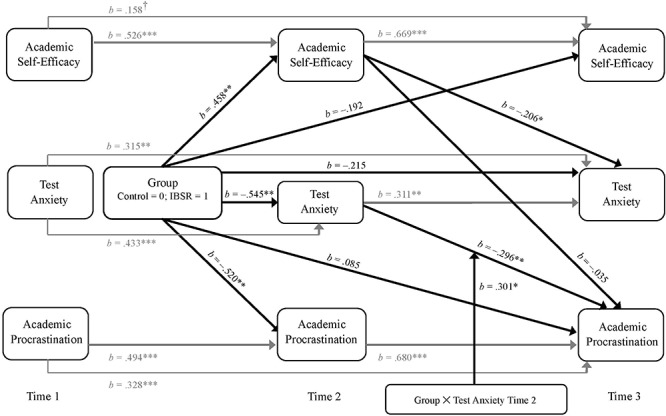
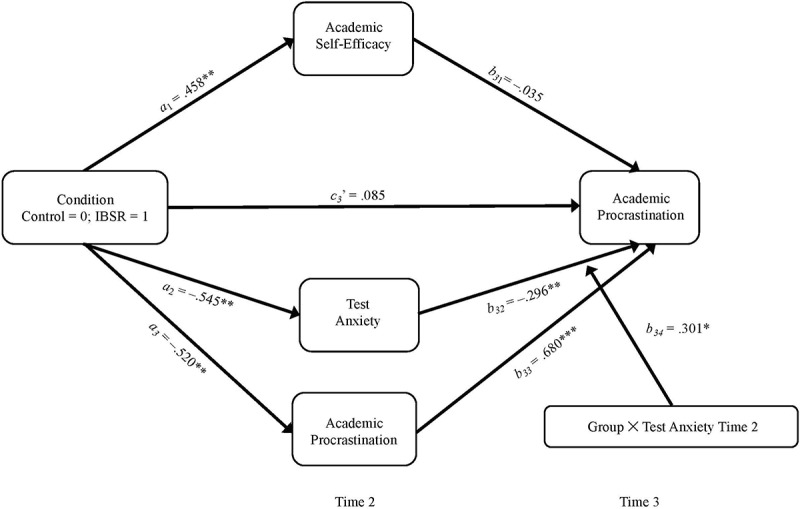
BACKGROUND AND OBJECTIVES: Test anxiety can impair learning motivation and lead to procrastination. Control-value theory of achievement emotions (Pekrun, 2006) assumes test anxiety to be a result of students' appraisals of the testing situation and its outcomes. Modification of cognitive appraisals such as low self-efficacy beliefs is thus assumed to reduce test anxiety and subsequent procrastination. In the present study, we tested the effects of an inquiry-based stress reduction (IBSR) intervention on students' academic self-efficacy, their test anxiety, and subsequent procrastination in the final stages of an academic term. DESIGN: Longitudinal quasi-randomized intervention control trial. METHODS: = 31) received the intervention after the study was completed. Dependent variables were assessed before and after the intervention as well as at the end of the term. RESULTS: Data-analyses revealed that the IBSR intervention reduced test anxiety as well as subsequent academic procrastination in comparison to the control group. The effect on test anxiety was partly due to an enhancement of self-efficacy. CONCLUSION: Our findings provide preliminary evidence that IBSR might help individuals to cope with their test anxiety and procrastination.
Overview
The claims and statistics of this paper haven’t been checked yet.
Run the check — free, no account needed. It reads the open-access text and checks the sources it cites.
Integrity signals
Registry
Cites
Statistics
Figures
Verification
Claims the paper makes
The claims and statistics of this paper haven’t been checked yet.
Run the check — free, no account needed. It reads the open-access text and checks the sources it cites.
Claims other papers make about this one
Each is checked against this paper’s own text: does it say what the citing paper says it does?
The cited source says what the claim attributes to it.
In the citing paper
“Krispenz and Dickhäuser et al. presented the effectiveness of an IBSR intervention in reducing students’ academic procrastination and test anxiety [57,58].”
From Inquiry based stress reduction (Ibsr) improves overall stuttering experience among adults who stutter: A randomized controlled trial (2021) · cites this paper as [58]
Self-check
Percentages, sums and reported differences re-computed from the paper’s own numbers.
The self-check needs the paper’s full text.
Citations
Cites
Self-efficacy: Toward a unifying theory of behavioral change
Bandura, A. (1977) · Psychological Review · doi:10.1037/0033-295x.84.2.191 · Cited by 43,925
Self-efficacy: Toward a unifying theory of behavioral change
Bandura, A. (1978) · Advances in Behaviour Research and Therapy · doi:10.1016/0146-6402(78)90002-4 · Cited by 10,586
A test of missing completely at random for multivariate data with missing values
Little, R. J. A. (1988) · Journal of the American Statistical Association · doi:10.1080/01621459.1988.10478722 · Cited by 8,963
Confirmation Bias: A Ubiquitous Phenomenon in Many Guises
Nickerson, R. S. (1998) · Review of General Psychology · doi:10.1037/1089-2680.2.2.175 · Cited by 7,267 · cited 1×
“This is done in order to help them overcome the tendency to seek or interpret evidence in ways that are biased by already existing beliefs (i.e., the confirmation bias; Nickerson, 1998).”
BackgroundIntroduction to mediation, moderation, and conditional process analysis :
Hayes, A. F., & names (2015) · Cited by 7,004
Pekrun, R. (2006) · Educational Psychology Review · doi:10.1007/s10648-006-9029-9 · Cited by 5,566 · cited 15×
“…participants of the IBSR intervention with new means for emotional coping: As test anxiety is accompanied by states of unpleasant physical arousal and worry thoughts (Pekrun, 2006), students often feel the desire to withdraw from the anxiety-causing situation (Geen, 1987; Matthews et al., 1999).”
BackgroundMethodResultInfluentialTesting moderator and mediator effects in counseling psychology research.
Frazier, P. A., Tix, A. P., & Barron, K. E. (2004) · Journal of Counseling Psychology · doi:10.1037/0022-0167.51.1.115 · Cited by 4,037
Steel, P. (2007) · Psychological bulletin · doi:10.1037/0033-2909.133.1.65 · Cited by 3,417 · cited 13×
“As expected and in line with previous studies (Van Eerde, 2003; Steel, 2007), at all three times of measurement, these correlations suggest negative associations between self-efficacy and test anxiety, positive associations between procrastination and test anxiety, as well as negative relationships…”
BackgroundMethodResultInfluentialBest practices for missing data management in counseling psychology
Schlomer, G. L., Bauman, S., & Card, N. A. (2010) · Journal of Counseling Psychology · doi:10.1037/a0018082 · Cited by 1,835
Iacobucci, D., Saldanha, N., & Deng, X. (2007) · Journal of Consumer Psychology · doi:10.1016/s1057-7408(07)70020-7 · Cited by 1,362 · cited 1×
“Firstly, there is evidence that structural equation models perform better than simple regression models when it comes to investigate causal mechanisms via mediation analyses (Iacobucci et al., 2007).”
Background
Research works printed but not linked: 6
- Geiser, 2013, Data Analysis with Mplus.
- Jerusalem, 1986, Selbstwirksamkeit (Self-efficacy), Skalen Zur Befindlichkeit und Persönlichkeit
- Kline, 2016, Principles and Practices of Structural Equation Modeling
- Muthén, 2012, Mplus User’s Guide
- Patzelt, 2014, German version of the academic procrastination state inventory (APSI-d), Compilation of Social Science Items and Scales
- Schermelleh-Engel, 2003, Evaluating the fit of structural equations models: tests of significance and descriptive goodness-of-fit measures., Methods Psychol. Res., 8, 23
Cited by
Sorted by citations
Academic Self-Efficacy and Postgraduate Procrastination: A Moderated Mediation Model
Liu, G., Cheng, G., Hu, J., Pan, Y., & Zhao, S. (2020) · Frontiers in Psychology · doi:10.3389/fpsyg.2020.01752 · Cited by 142
“Recently, one study revealed that an academic self-efficacy intervention could reduce academic procrastination (Krispenz et al., 2019).”
BackgroundTian, J., Zhao, J., Xu, J.-M., Li, Q., Sun, T., Zhao, C.-X., Gao, R., Zhu, L.-Y., Guo, H.-C., Yang, L.-B., et al. (2021) · Frontiers in Psychology · doi:10.3389/fpsyg.2021.758303 · Cited by 117
Lu, D., He, Y., & Tan, Y. (2022) · Frontiers in Psychology · doi:10.3389/fpsyg.2021.719425 · Cited by 66
“More recent metaanalyses have discussed demographic features of procrastination (Balkis and Erdinç, 2017; Krispenz et al., 2019) and focused on the relation between specific topics such as procrastination and time perspective (Sirois, 2014), academic performance (Kim and Seo, 2015; Sæle et al.”
BackgroundTest anxiety in primary school children: A 20-year systematic review and meta-analysis
Robson, D. A., Johnstone, S. J., Putwain, D. W., & Howard, S. J. (2023) · Journal of School Psychology · doi:10.1016/j.jsp.2023.02.003 · Cited by 92
Hayat, A. A., Choupani, H., & Dehsorkhi, H. F. (2021) · Journal of Education and Health Promotion · doi:10.4103/jehp.jehp_35_21 · Cited by 66
“[25,31] This hypothetical notion was substantiated by research studies indicating students suffering from low self‐efficacy beliefs undergo high test anxiety.[13,32,33]”
ResultInterventions to reduce academic procrastination: A systematic review
Salguero-Pazos, M. R., & de Cózar, S. R. (2023) · International Journal of Educational Research · doi:10.1016/j.ijer.2023.102228 · Cited by 52
“…in this line focuses on the cognitive aspects of procrastination, such as acceptance and control of thoughts and emotions, based on cognitive behavioral therapies (CBT) (Rozental et al., 2018; Ugwuanyi et al., 2020; Wang et al., 2017) Odacı, 2018; Krispenz, Gort, Schültke & Dickh ¨ auser, 2019).”
Bibliometric Analysis and Visualization of Academic Procrastination
Tao, X., Hanif, H., Ahmed, H. H., & Ebrahim, N. A. (2021) · Frontiers in Psychology · doi:10.3389/fpsyg.2021.722332 · Cited by 58
Jun, J., Wang, L.-L., Xu, J., Lin, X., Zhang, B., & Jiang, Q. (2021) · Frontiers in Psychology · doi:10.3389/fpsyg.2021.741821 · Cited by 45
Commodari, E., & Rosa, V. L. L. (2021) · Acta Psychologica · doi:10.1016/j.actpsy.2021.103413 · Cited by 34
Control-Value Theory of Achievement Emotions and Its Relevance to School Psychology
Tze, V. M. C., Parker, P. C., & Sukovieff, A. (2021) · Canadian Journal of School Psychology · doi:10.1177/08295735211053962 · Cited by 50
“Thus, Krispenz et al. (2019) reasoned that these kinds of control appraisals would induce anxiety when students believed they were not fully in control (e.g., think they cannot do well on the exam).”
Turner, M., & Hodis, F. A. (2023) · Educational Psychology Review · doi:10.1007/s10648-023-09838-x · Cited by 44
“…studies tested whether the intervention reduced academic procrastination via strengthening students’ emotion regulation skills (Schuenemann et al., 2022), whereas the other investigated whether the effects of the intervention were mediated by improvements in self-efficacy (Krispenz et al., 2019).”
InfluentialParmaksız, İ. (2022) · Psychology in the schools (Print) · doi:10.1002/pits.22765 · Cited by 24
Saxena, S., Wright, W. S., & Khalil, M. K. (2024) · BMC Medical Education · doi:10.1186/s12909-024-05494-z · Cited by 26
“Routine follow-up with students with attention to their mental health is vital in measuring whether interventions are successful [23].”
BackgroundXue, X., Wang, Y., Li, H., Gao, J., & Si, J. (2021) · Current Psychology · doi:10.1007/s12144-021-02133-4 · Cited by 31
Hidalgo-Fuentes, S., Martínez-Álvarez, I., & Sospedra-Baeza, M. J. (2021) · European Journal of Education and Psychology · doi:10.32457/ejep.v14i1.1533 · Cited by 22
Zhang, D., Mushtaque, I., & Hanif, M. W. (2024) · Acta Psychologica · doi:10.1016/j.actpsy.2024.104662 · Cited by 18
Ouyang, H., Xie, H., Wang, Y., Chen, X., Cheng, Q., Hou, B., & Zhang, P. (2026) · Acta Psychologica · doi:10.1016/j.actpsy.2026.106322 · Cited by 24
Cracking the Code of Test Anxiety: Insight, Impacts, and Implications
Vasiou, A., & Vasilaki, E. (2025) · Psychology International · doi:10.3390/psycholint7010018 · Cited by 19
“As a characteristic of a specific sistuation A third component, behavioral, includes ineffective study habits, avoidance, procras-tination, and distracting behaviors during exams, such as leg shaking or looking around (Krispenz et al., 2019; von der Embse et al., 2018; Wren & Benson, 2004).”
Gulacar, O., Marwaha, R., & Goradia, K. R. (2021) · Sustainable Chemistry and Pharmacy · doi:10.1016/j.scp.2021.100577 · Cited by 14
Feldman, O., Goldstien, E., Rolnik, B., Ganz, A. B., & Lev-Ari, S. (2021) · Journal of Clinical Medicine · doi:10.3390/jcm10102187 · Cited by 13
“presented the effectiveness of an IBSR intervention in reducing students’ academic procrastination and test anxiety [57,58].”
BackgroundRezaei, S., & Zebardast, A. (2021) · Practice in Clinical Psychology · doi:10.32598/jpcp.9.2.731.1 · Cited by 13
Riquelme, V. C., Maureira, N. C., Navarro, C. V., & Puente, C. T. (2021) · Revista Digital de Investigación en Docencia Universitaria · doi:10.19083/10.19083/ridu.2021.1284 · Cited by 32
“El perfil de alumno ansioso se caracteriza por una propensión evitativa de la tarea (Krispenz et al., 2019), el desarrollo continuo de rumiaciones (Constantin et al., 2018) y una tendencia hacia el locus de control externo (Watson, 1967).”
BackgroundDemir, S., & KARATEPE, H. K. (2025) · Behavioral Sciences · doi:10.3390/bs15111434 · Cited by 16
“…that students with high academic self-efficacy perform their academic tasks more effectively and that these students resort to academic procrastination behavior less (Kandemir, 2014; Krispenz et al., 2019; C. Li et al., 2022; Liu et al., 2020; Putra & Soetjiningsih, 2023; Svartdal et al., 2022).”
Li, D., Li, W., Lin, X., & Zhu, X. (2025) · BMC Psychology · doi:10.1186/s40359-025-02455-z · Cited by 22
“This impairment can lead to academic delays, absentee-ism, truancy, or even dropping out of school, and is a risk factor for lingering negative emotions or impaired mental health [6, 7].”
Autoeficácia e procrastinação acadêmica em estudantes do ensino superior
Fior, C. A., Sampaio, R. K. N., Reis, C. A. D. C., & Polydoro, S. A. J. (2022) · Psico · doi:10.15448/1980-8623.2022.1.38943 · Cited by 11
Calle, J. V. Q., & Cosentino, A. C. (2024) · Frontiers in Psychology · doi:10.3389/fpsyg.2024.1383154 · Cited by 15
Kim, M. S., Choi, B. K., Uhm, J., Ryu, J. M., Kang, M. K., & Park, J. (2022) · Healthcare · doi:10.3390/healthcare10020311 · Cited by 13
“As test anxiety arises from an interaction between the cognitive and value evaluations that are related to task achievement [8], students with low self-efficacy may not believe that they can achieve successful tasks, which may also result in higher test anxiety [9,10].”
BackgroundInquiry-based stress reduction: A systematic review of the empirical literature
Hook, J. N., Kim Penberthy, J., Davis, D. E., & Van Tongeren, D. R. (2021) · Journal of Clinical Psychology · doi:10.1002/jclp.23120 · Cited by 9
Hong, L., Xu, H., Zheng, J., Lin, X., Wang, L., Zhao, C., Tu, X., Zhang, J., Zhao, K., & Zhang, G. (2024) · Nature and Science of Sleep · doi:10.2147/nss.s462055 · Cited by 12
“26 However, our studies, along with some studies, found that elevated depression and anxiety symptoms, in turn, were related to subsequent increases in BP. 50”
ResultLethbridge, L. E., Marshall, A. D., & Jauch, M. (2024) · British Journal of Educational Psychology · doi:10.1111/bjep.12714 · Cited by 8
Mousavi, Z., Khazaie, H., Janatolmakan, M., Rezaeian, S., & Khatony, A. (2023) · BMC Medical Education · doi:10.1186/s12909-023-04825-w · Cited by 8
“Test anxiety is a widespread issue among students, known to have detrimental effects on their physical, psychological, and academic well-being [4, 5, 27, 28].”
BackgroundLohbeck, A., & Retelsdorf, J. (2021) · Studies In Educational Evaluation · doi:10.1016/j.stueduc.2021.101052 · Cited by 10
da Silva, P. G. N., Araújo, R. S. E., de Araújo, G. R., Alves, M. E. D. S., de Medeiros, P. C. B., da Fonsêca, P. N., & de Medeiros, É. D. (2022) · Revista Portuguesa de Investigação Comportamental e Social · doi:10.31211/rpics.2022.8.1.246 · Cited by 7
DEMİRBİLEK, N., & Ferhat, H. A. N. (2022) · Bingöl Üniversitesi Sosyal Bilimler Enstitüsü Dergisi · doi:10.29029/busbed.1165591 · Cited by 7
Yaffe, Y. (2023) · Social Psychology of Education · doi:10.1007/s11218-023-09767-1 · Cited by 11
Ansiedade cognitiva de provas e procrastinação acadêmica: um estudo com universitários do Brasil
da Silva, P. G. N., dos Santos, P. F., de Araújo, G. R., da Cunha, L. R. L., Neres, S. D. M. I., de Oliveira, L. B. S., de Medeiros, P. C. B., de Araújo, G. O., Silva, A. C. M. M., & de Medeiros, É. D. (2023) · Dedica · doi:10.30827/dreh.21.2023.28783 · Cited by 7
Liu, Q., Wen, J., Wang, N. Y., & Wang, M. (2024) · Emerging Adulthood · doi:10.1177/21676968241305653 · Cited by 9
“Academic anxiety is also prevalent among university students, potentially undermining their learning ef fi ciency (Shakir, 2014) and resulting in diminished academic performance (Krispenz et al., 2019).”
Wang, M., Mei, Y., Li, X., Li, J., Zhang, X., Zhang, Y., & Fan, X. (2025) · Nurse Education Today · doi:10.1016/j.nedt.2025.106850 · Cited by 9
Csirmaz, L., Vikor, F., Székely, A., & Kasos, K. (2023) · Journal of Rational-Emotive & Cognitive-Behavior Therapy · doi:10.1007/s10942-023-00512-3 · Cited by 7
“Besides connection with academic performance, test anxiety is also related to college dropout rates (Krispenz et al., 2019 ).”
Münscher, S. (2022) · Scientific Reports · doi:10.1038/s41598-022-18045-7 · Cited by 7
The Regulatory Role of Cognitive Reappraisal in the Effect of Neuroticism on Test Anxiety
Xu, Y., Tian, Y., & Yuan, J. (2023) · Cognitive Therapy and Research · doi:10.1007/s10608-023-10447-9 · Cited by 8
Miceli, M. D. (2023) · European Journal of Education · doi:10.1111/ejed.12595 · Cited by 5
Test Anxiety and Its Impact on Diverse Undergraduate Engineering Students During Remote Learning
Copp, D., & Headley, A. J. (2024) · 2021 ASEE Virtual Annual Conference Content Access Proceedings · doi:10.18260/1-2--37832 · Cited by 5
Samawi, F. S., Alramamna, A. A., الخطيب, ب. ع., & Alghafary, N. A. (2021) · Cypriot Journal of Educational Sciences · doi:10.18844/cjes.v16i6.6499 · Cited by 5
Test Anxiety is Reviewed By Gender
Matara, K., & Pantu, E. A. (2021) · International Conference on Law, Social Science, Economics, and Education (ICLSSEE) · doi:10.4108/eai.6-3-2021.2306190 · Cited by 3
“Each increase in academic self-efficacy could have an effect on individual test anxiety scores[37].”
BackgroundProcrastinación académica y ansiedad ante exámenes en estudiantes universitarios
Balladares, K. R. N., & Gómez, D. G. (2023) · LATAM Revista Latinoamericana de Ciencias Sociales y Humanidades · doi:10.56712/latam.v4i1.358 · Cited by 18
Sun, P., Wang, L., & Yan, L. (2025) · Frontiers in Psychology · doi:10.3389/fpsyg.2025.1496528 · Cited by 4
Loder, A. K. F. (2024) · Trends in Higher Education · doi:10.3390/higheredu3010004 · Cited by 4
Amro, M., Malak, M. Z., & Ayed, A. (2024) · Counselling and Psychotherapy Research · doi:10.1002/capr.12831 · Cited by 4
de Araújo, G. R., de Araújo, G. O., da Silva, P. G. N., Rocha, A. S., Ximenes, J. M., da Cunha, L. R. L., de Medeiros, P. C. B., & de Medeiros, É. D. (2024) · Revista Psicologia e Saúde · doi:10.20435/pssa.v16i1.2489 · Cited by 4
“Outros preditores são o perfeccionismo desadaptativo (Krispenz et al., 2019), medo do fracasso (Danne et al., 2024), falta de motivação, estresse, uso excessivo da internet e dificuldade de realizar tarefas (He, 2017).”
Wu, Z., Xue, L., Zhang, Y., Zhan, F., Li, H., Liu, R., Yang, X. J., & Chen, Z. (2025) · Frontiers in Psychology · doi:10.3389/fpsyg.2025.1713213 · Cited by 4
Weich, A., Higuchi, T., Bundschuh, R. A., Lapa, C., Serfling, S. E., Rowe, S. P., Pomper, M. G., Herrmann, K., Buck, A. K., Derlin, T., et al. (2022) · Molecular Imaging and Biology · doi:10.1007/s11307-022-01712-6 · Cited by 4
“This rather broad definition has been expanded by Zeidner defining multiple levels of test anxiety, including somatic symptoms such as palpitations or sweating, downgrading self-statements about (academic) failure, and behavioral avoidance tendencies such as procrastination [28, 29].”
BackgroundAssociations Between Cognitive Appraisals and Emotions: A Meta-Analytic ReviewPreprint
Yeo, G. C., & Ong, D. C. (2023) · doi:10.31234/osf.io/ystxc · Cited by 4
Mastrokoukou, S., Kaliris, A., & Longobardi, C. (2025) · Journal of Learning Disabilities · doi:10.1177/00222194251391831 · Cited by 3
“Anxiety is thought to impair motivation to learn, which is reflected in self-efficacy beliefs, potentially leading to procrastination (Krispenz et al., 2019).”
Abdulbaqi, J., & Uzun, G. O. (2024) · SAGE Open · doi:10.1177/21582440241296609 · Cited by 3
“The physiological effects include excessive perspiration, heart palpitations, nausea, trembling, and tense muscles (Krispenz et al., 2019).”
Faure, T., Weyers, I., Voltmer, J.-B., Westermann, J., & Voltmer, E. (2024) · BMC Medical Education · doi:10.1186/s12909-024-05640-7 · Cited by 3
“The study-specific self-efficacy (WIRKSTUD) was examined using seven items (e.g., ‘If I prepare myself sufficiently, I can achieve a good performance in the test/ friendly feedback’) [40, 41].”
MethodLi, G., Xiong, Z., & Lin, P. (2024) · Behavioral Sciences · doi:10.3390/bs14121219 · Cited by 9
“2024 , 14 , 1219 3 of 14 Short-term Mood Regulation Theory suggests that procrastination is an ineffective coping strategy for anxiety, as individuals tend to prioritize managing their emotional state over completing long-term tasks with positive outcomes, such as studying [25,26].”
Aydemir, M. (2026) · Frontiers in Psychology · doi:10.3389/fpsyg.2026.1806190 · Cited by 2
“Prior studies suggest that interventions targeting cognitive appraisals and academic self-efficacy can reduce both TA and subsequent AP, supporting the conceptual link between anxiety-driven avoidance and delayed task engagement (Krispenz et al., 2019).”
da Silva, P. G. N., Dantas, L. M. G. L., de Oliveira, T. C. F., Barbosa, A. M. G., Silva, A. C. M. M., de Azevedo, T. G., de Medeiros, É. D., & Alvarenga, M. A. S. (2025) · Revista Portuguesa de Investigação Comportamental e Social · doi:10.31211/rpics.2025.11.1.368 · Cited by 2
Interventional procrastination strategies for young adults in virtual settings: A systematic reviewPreprint
Xu, J. H., Marjia, M., Ahluwalia, K., Zada, D. K., Tavakolizaeh, N., & Dao, M. (2021) · doi:10.31234/osf.io/cgvdb · Cited by 2
Social Media Use and Test Anxiety: Exploring the Relationship
Donkoh, S., Ekuban, J. I. A., & Mensah, R. (2023) · Journal of Education and Learning · doi:10.5539/jel.v12n6p166 · Cited by 1
“Test anxiety is a multidimensional construct (Krispenz, Gort, Schültke, & Dickhäuser, 2019) associated with either the fear of or not performing satisfactorily in a test.”
朱, 婉. (2024) · Advances in Education · doi:10.12677/ae.2024.143446 · Cited by 1
Duraku, Z. H., Fetahu, D., Konjufca, J., Rrahmani, F., & Bajgora, S. (2025) · International Journal of Adolescence and Youth · doi:10.1080/02673843.2025.2495885 · Cited by 1
“These behaviours not only undermine students’ ability to study and prepare effectively but also perpetuate the cycle of anxiety and poor academic performance (Krispenz et al., 2019; Van Eerde, 2003; Zeidner, 2007).”
Beaird, E., Karaoğlu, S., Hafızoğlu, F. M., & Sen, S. (2025) · Elsevier eBooks · doi:10.1016/b978-0-44-340553-2.00018-6 · Cited by 1
Lin, L., Yu, H., Jiang, X., Ma, Y., Zixuan, L., & Tingting, L. (2025) · BMC Psychology · doi:10.1186/s40359-025-03790-x · Cited by 3
“For instance, Krispenz et al. discovered that individuals with low academic self-efficacy frequently exhibit test anxiety when confronted with exams [15].”
Exploring the Pattern of Cognitive Test Anxiety among PG Students: A Cluster Analysis
Barun Patra, B. D. (2026) · International Journal of Advanced Research in Science Communication and Technology · doi:10.48175/ijarsct-31675 · Cited by 1
Peker, A., Cengiz, S., Laranjeira, C., & Yıldırım, M. (2026) · Counselling and Psychotherapy Research · doi:10.1002/capr.70123 · Cited by 1
Team Approach to Diagnostic and Correction of Learning Problems in a Public Primary School
Plotnikova, A. V., & Glozman, J. M. (2019) · Bulletin of Kemerovo State University · doi:10.21603/2078-8975-2019-21-4-998-1004 · Cited by 1
韩, 思. (2021) · Advances in Psychology · doi:10.12677/ap.2021.115132 · Cited by 1
Lingaiah, J., & Ishak, S. N. (2024) · International Journal of Research and Review · doi:10.52403/ijrr.20240145 · Cited by 1
Impact of Inquiry-Based Stress Reduction Intervention on Pharmacy Students’ Test Anxiety
Ndungu, M., Galal, S. M., Tran, E. N., Peng, M., Chang, J., Vyas, D., Mayberry, J. K., & Chima, A. K. (2024) · Trends in Higher Education · doi:10.3390/higheredu3040069 · Cited by 1
MoodBooster - A Gamified App to Support Stress Reduction in University Students
Aigner, C., Moser, M., Wolfsberger, O. C., Baranyi, R., Hohenegger, V., & Grechenig, T. (2024) · IEEE International Conference on e-Health Networking, Applications and Services (Healthcom) · doi:10.1109/healthcom60970.2024.10880742 · Cited by 1
“The latter is based on IBSR [39].”
Psychometric properties for the General Procrastination Scale (GPS) Brazilian version
Chirinéa, G., Gonçalves, A. P., Lima, V. L. M. C., Santos, A. L. M., de Almeida, C. P., & Lodha, P. (2025) · Estudos de Psicologia (Campinas) · doi:10.1590/1982-0275202542e230051 · Cited by 1
Procrastination in Medical University Students with Different Personality Orientation
Voronova, T. A., Dubrovina, S. V., & Chepurko, Y. V. (2020) · The Education and science journal · doi:10.17853/1994-5639-2020-9-86-106 · Cited by 1
Gopakumar, G., & Mathew, P. (2022) · International Journal of Health Sciences and Research · doi:10.52403/ijhsr.20220424 · Cited by 1
“On an effective level test anxiety is associated with unpleasant feelings of agitation, insecurity and helplessness, which may evoke certain motivational consequences such as avoidance tendencies.(4) A low level of stress is necessary, but it is sometimes so complicated that it limits individual performance in test an…”
BackgroundMotivational aspects of learning activities among engineering specialties’ students
Pilishvili, T., Medvedeva, I. A., & Игоревна, Ф. М. (2020) · Perspectives of science and education · doi:10.32744/pse.2020.4.22 · Cited by 1
تحليل مسار العلاقات بين قلق فيروس کورونا والمناعة النفسية والتسويف الأکاديمي لدى طلبة الجامعة
هلال, م. ح. ع. ا. (2021) · المجلة التربوية لکلية التربية بسوهاج · doi:10.21608/edusohag.2021.198471
Capacidad predictiva de la escala de procrastinación académica en estudiantes universitarios
Maturrano, E. F. L. (2021) · REVISTA VERITAS ET SCIENTIA - UPT · doi:10.47796/ves.v10i2.567
“…destructivo, puede llevar a la reducción de la confianza en uno mismo y la somnolencia, y aumentan los comportamientos poco saludables, tabaquismo, bebida, trastornos gastrointestinales, insomnio, ansiedad y depresión, reduciendo así la calidad de vida (Steel & Gröpel, 2008; Krispenz et al., 2019).”
BackgroundInfluentialفعالية برنامج إرشادي عقلاني انفعالي لتحسين التفکير الإيجابي لخفض التسويف الأکاديمي لدى طلاب الجامعة
معوض, م. ن. (2021) · مجلة كلية التربية جامعة بنها · doi:10.21608/jfeb.2022.230542
الشهري, ع. ا. س. (2022) · المجلة التربوية لکلية التربية بسوهاج · doi:10.21608/edusohag.2022.270094
Bhatta, K. R., Shakya, S., Luitel, N. P., & Rai, B. (2023) · Journal of Psychiatrists Association of Nepal · doi:10.3126/jpan.v12i1.59418
“Further, group-based interventions effectively reduce test anxiety among school and college students (26-28) .”
BackgroundTransformative Analysis of Mental Health in Rural China: The CART Algorithm ApproachPreprint
Fu, D., He, J., & Mu, Q. (2024) · Research Square · doi:10.21203/rs.3.rs-3953360/v1
ACER’s Mathematics Anxiety and Engagement Strategy (MAES): A framework
Buckley, S., Reid, K., Pearn, C., & Sniedze-Gregory, S. (2024) · ACEReSearch Repository (Australian Council for Educational Research) · doi:10.37517/978-1-74286-736-6
Hojjati, M., & Zadhasn, Z. (2023) · KMAN Counseling and Psychology Nexus · doi:10.61838/kman.psychnexus.1.1.2
Brojerdi, K. K., Bagheri, M. M. S., & صالحی, ک. (2024) · Journal of Assessment and Research in Applied Counseling · doi:10.61838/kman.jarac.6.3.21
Salsabila, A., Rahmat, A., & Hamdiyati, Y. (2024) · JPBI (Jurnal Pendidikan Biologi Indonesia) · doi:10.22219/jpbi.v10i2.33297 · Cited by 4
Akın, E., Doğan, T., Erbiçer, E. S., Koçtürk, N., Özkanca, D. B., Işık, E. Ö. K., Öztürk, C. D., Kahraman, D., & Türkçapar, M. H. (2024) · e-Kafkas Eğitim Araştırmaları Dergisi · doi:10.30900/kafkasegt.1377702
The relationship between academic self-efficacy and academic procrastination: A meta-analysis study
ASLAN, Ö. Ş., & Terzi, R. (2026) · International Journal of Assessment Tools in Education · doi:10.21449/ijate.1790430 · Cited by 1
Eficacia de una intervención para reducir la procrastinación académica y la ansiedad de evaluación
Furlán, L. A., Pesarini, P. A., Cuevas, L. A., & Santos, G. M. (2025) · Acta Colombiana de Psicología · doi:10.14718/acp.2025.28.3 · Cited by 1
Senior High Students’ Examination Anxiety and Its Implications for Counselling
Ahenakwa, S., Kuranchie, A., & Mensah, M. K. (2025) · Advances in Social Sciences Research Journal · doi:10.14738/assrj.123.18486
Using Agent Interventions to Reduce User Procrastination Tendencies
Beaird, E., Hafızoğlu, F. M., & Sen, S. (2025) · Lecture notes in computer science · doi:10.1007/978-3-031-93930-3_12
Tatsiopoulou, P., Alvanou, A., Holeva, V., Malliora, A., Vourlgaroglou, A., Triglianou, M., Nikopoulou, V. A., Parlapani, E., & Fountoulakis, K. Ν. (2025) · Psychology and Behavioral Sciences · doi:10.11648/j.pbs.20251404.13
Asare, P. Y. (2026) · The International Journal of Management Education · doi:10.1016/j.ijme.2025.101286
Mor, S., Sela, Y., & Lev‐Ari, S. (2025) · medRxiv · doi:10.1101/2025.11.04.25339519
Saxena, S., Wright, W. S., & Khalil, M. K. (2024) · Figshare · doi:10.6084/m9.figshare.26717286
Hands, C., Limniou, M., & Stevens, C. (2025) · Trends in Higher Education · doi:10.3390/higheredu5010002
“…example, if asked about exam stress, students will often emphasise anxiety, pressure, and nervousness before the exam period; however, once the exam is completed, they may emphasise relief and feelings of accomplishment, disappointment, and/or regret depending on their perceived performance [32].”
Liu, K., & Zhou, S. (2021) · OSF Preprints (OSF Preprints)
Metadata
- Authors
- Krispenz, A., Gort, C., Schültke, L., & Dickhäuser, O.
- Affiliations
- University of Mannheim (DE)
- Corresponding author
- Krispenz, Ann
- Venue
- Frontiers in Psychology
- Publisher
- Frontiers Media SA
- Published
- 2019-08-20
- Volume
- 10
- Pages
- 1917-1917
- ISSN
- 1664-1078 (ISSN-L)
- PMC
- PMC6710437
- OpenAlex
- W2966775938
- Semantic Scholar
- 26a16b37fdc951f50d3eccc257d99ae7f313d6c8
- Cited by
- 116
- References
- 40
- Citations by year
- 2026: 16 · 2025: 24 · 2024: 25 · 2023: 13 · 2022: 10 · 2021: 24 · 2020: 3 · 2019: 1
- FWCI
- 10.91
- Type
- journal article
- Language
- en
- Open access
- gold
- doi.org
- Licence
- Locations
- Frontiers in Psychology (publishedVersion, cc-by)
- PubMed Central (publishedVersion, cc-by)
- PubMed (publishedVersion)
- MADOC (University of Mannheim) (acceptedVersion)
- BORIS (University Library Bern) (submittedVersion, cc-by)
- DOAJ (DOAJ: Directory of Open Access Journals) (submittedVersion, cc-by-sa)
- Open Access CRIS of the University of Bern
- Funders
- Universität Mannheim
- Ministerium für Wissenschaft, Forschung und Kunst Baden-Württemberg
- Topics
- Social Sciences › Psychology › Clinical Psychology › Perfectionism, Procrastination, Anxiety Studies
- Social Sciences › Psychology › Developmental and Educational Psychology › Student Stress and Coping
- Social Sciences › Psychology › Developmental and Educational Psychology › Education, Achievement, and Giftedness
- Keywords
- test anxiety, academic procrastination, academic self-efficacy, cognitive appraisal, stress reduction intervention, control-value theory of achievement emotions, coping with anxiety, students
About these checks
Registry, retraction, Cites and statistics results are computed, not judged, with one exception: a printed reference that no index lists is read once by a model before it counts as a citation error. Claims are extracted by a model and kept only when their quote appears verbatim in the text; each cited source is then checked, with a model’s help, for whether it says what the claim relies on. Those verdicts can be wrong — read the claim’s quote and the cited source before relying on one.
Statistics and arithmetic are recomputed, not judged.
Confidence bands are shown only for fields calibrated on our annotated test set. None is calibrated yet, so no band is shown.
What counts as a claim ›How we measure confidence ›How we check this ›
Are you an author, or do you see a problem with this page? Request a review
