

The DOI matches its Crossref record; 39 of the 40 references it cites were found in a registry or an index.
How to Reduce Test Anxiety and Academic Procrastination Through Inquiry of Cognitive Appraisals: A Pilot Study Investigating the Role of Academic Self-Efficacy
Open accessAbstract
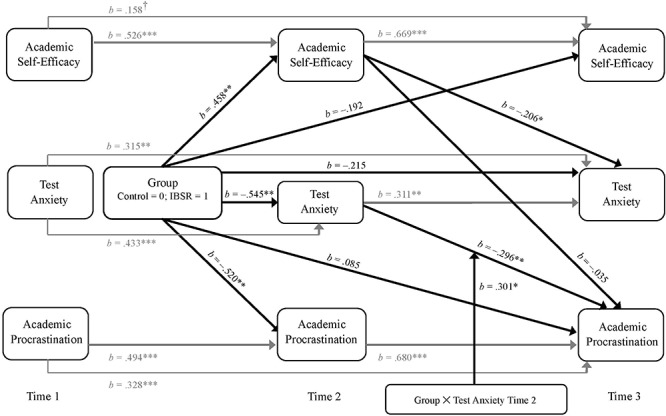
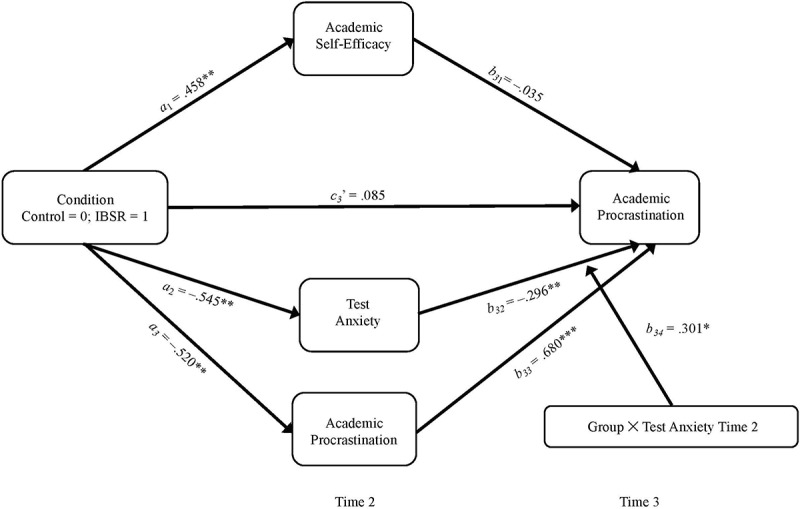
BACKGROUND AND OBJECTIVES: Test anxiety can impair learning motivation and lead to procrastination. Control-value theory of achievement emotions (Pekrun, 2006) assumes test anxiety to be a result of students' appraisals of the testing situation and its outcomes. Modification of cognitive appraisals such as low self-efficacy beliefs is thus assumed to reduce test anxiety and subsequent procrastination. In the present study, we tested the effects of an inquiry-based stress reduction (IBSR) intervention on students' academic self-efficacy, their test anxiety, and subsequent procrastination in the final stages of an academic term. DESIGN: Longitudinal quasi-randomized intervention control trial. METHODS: = 31) received the intervention after the study was completed. Dependent variables were assessed before and after the intervention as well as at the end of the term. RESULTS: Data-analyses revealed that the IBSR intervention reduced test anxiety as well as subsequent academic procrastination in comparison to the control group. The effect on test anxiety was partly due to an enhancement of self-efficacy. CONCLUSION: Our findings provide preliminary evidence that IBSR might help individuals to cope with their test anxiety and procrastination.
Overview
The claims and statistics of this paper haven’t been checked yet.
Run the check — free, no account needed. It reads the open-access text and checks the sources it cites.
Integrity signals
Registry
Cites
Statistics
Figures
Verification
Claims the paper makes
The claims and statistics of this paper haven’t been checked yet.
Run the check — free, no account needed. It reads the open-access text and checks the sources it cites.
Claims other papers make about this one
Each is checked against this paper’s own text: does it say what the citing paper says it does?
The cited source says what the claim attributes to it.
In the citing paper
“Krispenz and Dickhäuser et al. presented the effectiveness of an IBSR intervention in reducing students’ academic procrastination and test anxiety [57,58].”
From Inquiry based stress reduction (Ibsr) improves overall stuttering experience among adults who stutter: A randomized controlled trial (2021) · cites this paper as [58]
Self-check
Percentages, sums and reported differences re-computed from the paper’s own numbers.
The self-check needs the paper’s full text.
Citations
Cites
Self-efficacy: Toward a unifying theory of behavioral change
Bandura, A. (1977) · Psychological Review · doi:10.1037/0033-295x.84.2.191 · Cited by 43,925
Self-efficacy: Toward a unifying theory of behavioral change
Bandura, A. (1978) · Advances in Behaviour Research and Therapy · doi:10.1016/0146-6402(78)90002-4 · Cited by 10,586
A test of missing completely at random for multivariate data with missing values
Little, R. J. A. (1988) · Journal of the American Statistical Association · doi:10.1080/01621459.1988.10478722 · Cited by 8,963
Confirmation Bias: A Ubiquitous Phenomenon in Many Guises
Nickerson, R. S. (1998) · Review of General Psychology · doi:10.1037/1089-2680.2.2.175 · Cited by 7,267 · cited 1×
“This is done in order to help them overcome the tendency to seek or interpret evidence in ways that are biased by already existing beliefs (i.e., the confirmation bias; Nickerson, 1998).”
BackgroundIntroduction to mediation, moderation, and conditional process analysis :
Hayes, A. F., & names (2015) · Cited by 7,004
Pekrun, R. (2006) · Educational Psychology Review · doi:10.1007/s10648-006-9029-9 · Cited by 5,566 · cited 15×
“…participants of the IBSR intervention with new means for emotional coping: As test anxiety is accompanied by states of unpleasant physical arousal and worry thoughts (Pekrun, 2006), students often feel the desire to withdraw from the anxiety-causing situation (Geen, 1987; Matthews et al., 1999).”
BackgroundMethodResultInfluentialTesting moderator and mediator effects in counseling psychology research.
Frazier, P. A., Tix, A. P., & Barron, K. E. (2004) · Journal of Counseling Psychology · doi:10.1037/0022-0167.51.1.115 · Cited by 4,037
Steel, P. (2007) · Psychological bulletin · doi:10.1037/0033-2909.133.1.65 · Cited by 3,417 · cited 13×
“As expected and in line with previous studies (Van Eerde, 2003; Steel, 2007), at all three times of measurement, these correlations suggest negative associations between self-efficacy and test anxiety, positive associations between procrastination and test anxiety, as well as negative relationships…”
BackgroundMethodResultInfluentialBest practices for missing data management in counseling psychology
Schlomer, G. L., Bauman, S., & Card, N. A. (2010) · Journal of Counseling Psychology · doi:10.1037/a0018082 · Cited by 1,835
Iacobucci, D., Saldanha, N., & Deng, X. (2007) · Journal of Consumer Psychology · doi:10.1016/s1057-7408(07)70020-7 · Cited by 1,362 · cited 1×
“Firstly, there is evidence that structural equation models perform better than simple regression models when it comes to investigate causal mechanisms via mediation analyses (Iacobucci et al., 2007).”
BackgroundHighhouse, S., Doverspike, D., & Guion, R. M. (2015) · doi:10.4324/9781315690667-13 · Cited by 1,281
Tice, D. M., & Baumeister, R. F. (1997) · Psychological Science · doi:10.1111/j.1467-9280.1997.tb00460.x · Cited by 888
Van Breukelen, G. J. P. (2006) · Journal of Clinical Epidemiology · doi:10.1016/j.jclinepi.2006.02.007 · Cited by 765 · cited 7×
“With regard to procrastination interventions, recent metaanalyses (Rozental et al., 2018; Van Eerde and Klingsiek, 2018) showed that cognitive-behavioral therapy may help students showing high rates of procrastination.”
MethodInfluentialCognitive‐Experiential Self‐Theory of Personality
Epstein, S. J. (2003) · Wiley eBooks · doi:10.1002/0471264385.wei0507 · Cited by 664 · cited 3×
“Rather, dual-process models such as cognitive-experiential selftheory (CEST; Epstein, 2003) assume that rational information processing is always – mostly preconsciously and automatically – influenced by implicit schemas learned from past experiences.”
BackgroundResultInfluentialA meta-analytically derived nomological network of procrastination.
van Eerde, W. (2003) · Personality and Individual Differences · doi:10.1016/s0191-8869(02)00358-6 · Cited by 629 · cited 10×
“As expected and in line with previous studies (Van Eerde, 2003; Steel, 2007), at all three times of measurement, these correlations suggest negative associations between self-efficacy and test anxiety, positive associations between procrastination and test anxiety, as well as negative relationships…”
BackgroundResultInfluentialLongitudinal Structural Equation Modeling
Newsom, J. T. (2015) · doi:10.4324/9781315871318 · Cited by 446 · cited 1×
“…account for the longitudinal design, we first included respective first order autoregressive paths for all three dependent variables and additionally second order autoregressive paths for the dependent variables between measures at time 1 and time 3 as suggested by Geiser (2013) and Newson (2015).”
MethodProcrastination in college students: the role of self-efficacy and anxiety.
Haycock, L. A., McCarthy, P., & Skay, C. L. (1998) · Journal of Counseling & Development · doi:10.1002/j.1556-6676.1998.tb02548.x · Cited by 361 · cited 1×
“This theoretical notion is supported by empirical studies showing that students with lower self-efficacy expectations also report higher levels of test anxiety (Haycock et al., 1998; Yerdelen et al., 2016).”
ResultEffective Interventions on Test Anxiety Reduction: A Meta-Analysis
Ergene, T. (2003) · School Psychology International · doi:10.1177/01430343030243004 · Cited by 349 · cited 1×
“Further, according to Ergene (2003), up to 20% of college students are test anxious.”
BackgroundSubjective Well-Being, Test Anxiety, Academic Achievement: Testing for Reciprocal Effects
Steinmayr, R., Crede, J., McElvany, N., & Wirthwein, L. (2016) · Frontiers in Psychology · doi:10.3389/fpsyg.2015.01994 · Cited by 318
von der Embse, N., Barterian, J., & Segool, N. (2013) · Psychology in the Schools · doi:10.1002/pits.21660 · Cited by 273
Test anxiety prevalence and gender differences in a sample of English secondary school students
Putwain, D., & Daly, A. L. (2014) · Educational Studies · doi:10.1080/03055698.2014.953914 · Cited by 263
Overcoming procrastination? A meta-analysis of intervention studies
van Eerde, W., & Klingsieck, K. B. (2018) · Educational Research Review · doi:10.1016/j.edurev.2018.09.002 · Cited by 257
(2005) · North American journal of psychology · Cited by 245
The control-value theory of achievement emotions : an integrative approach to emotions in education
Pekrun, R., Götz, T., Frenzel, A. C., & Perry, R. P. (2007) · KOPS (University of Konstanz) · Cited by 239
Lowe, P. A., Lee, S. W., Witteborg, K. M., Prichard, K. W., Luhr, M. E., Cullinan, C. M., Mildren, B. A., Raad, J. M., Cornelius, R. A., & Janik, M. (2008) · Journal of Psychoeducational Assessment · doi:10.1177/0734282907303760 · Cited by 200 · cited 1×
“Additionally, test anxious individuals might experience social worry thoughts as they fear to be negatively judged by teachers, parents, and others (Lowe et al., 2008).”
BackgroundThomas, C. L., Cassady, J. C., & Finch, W. H. (2017) · Journal of Psychoeducational Assessment · doi:10.1177/0734282916686004 · Cited by 154
An assessment of appraisal, anxiety, coping, and procrastination during an examination period
Lay, C. H., Edwards, J. M., Parker, J. D. A., & Endler, N. S. (1989) · European Journal of Personality · doi:10.1002/per.2410030305 · Cited by 126 · cited 3×
“This notion is further supported by empirical results which show students to experience higher levels of anxiety before exams when they had delayed studying earlier in the semester (Lay et al., 1989).”
ResultGoals, Emotions, and Emotion Regulation: Perspectives of the Control-Value Theory
Pekrun, R. H., & Stephens, E. J. (2009) · Human Development · doi:10.1159/000242349 · Cited by 115
Self-generated persuasion: Effects of the target and direction of arguments.
Briñol, P., McCaslin, M. J., & Petty, R. E. (2012) · Journal of Personality and Social Psychology · doi:10.1037/a0027231 · Cited by 114 · cited 1×
“This approach can be assumed to be effective as the new-found arguments are self-created and this way more convincing (Briñol et al., 2012).”
BackgroundYerdelen, S., McCaffrey, A., & Klassen, R. M. (2016) · Educational Sciences Theory & Practice · doi:10.12738/estp.2016.1.0108 · Cited by 88
Loving What Is: Four Questions That Can Change Your Life
Katie, B., & Mitchell, S. (2002) · Medical Entomology and Zoology · Cited by 72
Targeting Procrastination Using Psychological Treatments: A Systematic Review and Meta-Analysis
Rozental, A., Bennett, S., Forsström, D., Ebert, D. D., Shafran, R., Andersson, G., & Carlbring, P. (2018) · Frontiers in Psychology · doi:10.3389/fpsyg.2018.01588 · Cited by 70
Test anxiety and behavioral avoidance
Geen, R. G. (1987) · Journal of Research in Personality · doi:10.1016/0092-6566(87)90034-1 · Cited by 42 · cited 3×
“…participants of the IBSR intervention with new means for emotional coping: As test anxiety is accompanied by states of unpleasant physical arousal and worry thoughts (Pekrun, 2006), students often feel the desire to withdraw from the anxiety-causing situation (Geen, 1987; Matthews et al., 1999).”
BackgroundMethodSmernoff, E., Mitnik, I., Kolodner, K., & Lev-ari, S. (2015) · EXPLORE · doi:10.1016/j.explore.2014.10.003 · Cited by 22
Krispenz, A., & Dickhäuser, O. (2018) · Frontiers in Psychology · doi:10.3389/fpsyg.2018.00201 · Cited by 21 · cited 2×
“For the first time, they show that IBSR is potent not only in reducing test anxiety (Krispenz and Dickhäuser, 2018), but also in enhancing academic self-efficacy and reducing academic procrastination.”
BackgroundResultEffects of “The Work” Meditation on Psychopathologic Symptoms: A Pilot Study
Leufke, R., Zilcha-Mano, S., Feld, A., & Lev-ari, S. (2013) · Alternative and Complementary Therapies · doi:10.1089/act.2013.19303 · Cited by 19
Rational Emotive Behavior Therapy
Ellis, A. (2002) · Elsevier eBooks · doi:10.1016/b0-12-343010-0/00177-x · Cited by 19
Validierung des STAI-SKD zur Messung von Zustandsangst in echten Prüfungssituationen
Bertrams, A., & Englert, C. (2013) · Psychologie in Erziehung und Unterricht · doi:10.2378/peu2013.art09d · Cited by 8 · cited 1×
“Test anxiety was assessed with the German short version of the state scale of the State-Trait Anxiety Inventory (STAISKD; Bertrams and Englert, 2013).”
MethodA metacognitive model and therapy for generalized anxiety disorder
Wells, A. (1999) · Clinical Psychology & Psychotherapy · doi:10.1002/(sici)1099-0879(199905)6:2
Research works printed but not linked: 6
- Geiser, 2013, Data Analysis with Mplus.
- Jerusalem, 1986, Selbstwirksamkeit (Self-efficacy), Skalen Zur Befindlichkeit und Persönlichkeit
- Kline, 2016, Principles and Practices of Structural Equation Modeling
- Muthén, 2012, Mplus User’s Guide
- Patzelt, 2014, German version of the academic procrastination state inventory (APSI-d), Compilation of Social Science Items and Scales
- Schermelleh-Engel, 2003, Evaluating the fit of structural equations models: tests of significance and descriptive goodness-of-fit measures., Methods Psychol. Res., 8, 23
Cited by
Sorted by citations
Academic Self-Efficacy and Postgraduate Procrastination: A Moderated Mediation Model
Liu, G., Cheng, G., Hu, J., Pan, Y., & Zhao, S. (2020) · Frontiers in Psychology · doi:10.3389/fpsyg.2020.01752 · Cited by 142
“Recently, one study revealed that an academic self-efficacy intervention could reduce academic procrastination (Krispenz et al., 2019).”
BackgroundTian, J., Zhao, J., Xu, J.-M., Li, Q., Sun, T., Zhao, C.-X., Gao, R., Zhu, L.-Y., Guo, H.-C., Yang, L.-B., et al. (2021) · Frontiers in Psychology · doi:10.3389/fpsyg.2021.758303 · Cited by 117
Lu, D., He, Y., & Tan, Y. (2022) · Frontiers in Psychology · doi:10.3389/fpsyg.2021.719425 · Cited by 66
“More recent metaanalyses have discussed demographic features of procrastination (Balkis and Erdinç, 2017; Krispenz et al., 2019) and focused on the relation between specific topics such as procrastination and time perspective (Sirois, 2014), academic performance (Kim and Seo, 2015; Sæle et al.”
BackgroundTest anxiety in primary school children: A 20-year systematic review and meta-analysis
Robson, D. A., Johnstone, S. J., Putwain, D. W., & Howard, S. J. (2023) · Journal of School Psychology · doi:10.1016/j.jsp.2023.02.003 · Cited by 92
Hayat, A. A., Choupani, H., & Dehsorkhi, H. F. (2021) · Journal of Education and Health Promotion · doi:10.4103/jehp.jehp_35_21 · Cited by 66
“[25,31] This hypothetical notion was substantiated by research studies indicating students suffering from low self‐efficacy beliefs undergo high test anxiety.[13,32,33]”
Result
Metadata
- Authors
- Krispenz, A., Gort, C., Schültke, L., & Dickhäuser, O.
- Affiliations
- University of Mannheim (DE)
- Corresponding author
- Krispenz, Ann
- Venue
- Frontiers in Psychology
- Publisher
- Frontiers Media SA
- Published
- 2019-08-20
- Volume
- 10
- Pages
- 1917-1917
- ISSN
- 1664-1078 (ISSN-L)
- PMC
- PMC6710437
- OpenAlex
- W2966775938
- Semantic Scholar
- 26a16b37fdc951f50d3eccc257d99ae7f313d6c8
- Cited by
- 116
- References
- 40
- Citations by year
- 2026: 16 · 2025: 24 · 2024: 25 · 2023: 13 · 2022: 10 · 2021: 24 · 2020: 3 · 2019: 1
- FWCI
- 10.91
- Type
- journal article
- Language
- en
- Open access
- gold
- doi.org
- Licence
- Locations
- Frontiers in Psychology (publishedVersion, cc-by)
- PubMed Central (publishedVersion, cc-by)
- PubMed (publishedVersion)
- MADOC (University of Mannheim) (acceptedVersion)
- BORIS (University Library Bern) (submittedVersion, cc-by)
- DOAJ (DOAJ: Directory of Open Access Journals) (submittedVersion, cc-by-sa)
- Open Access CRIS of the University of Bern
- Funders
- Universität Mannheim
- Ministerium für Wissenschaft, Forschung und Kunst Baden-Württemberg
- Topics
- Social Sciences › Psychology › Clinical Psychology › Perfectionism, Procrastination, Anxiety Studies
- Social Sciences › Psychology › Developmental and Educational Psychology › Student Stress and Coping
- Social Sciences › Psychology › Developmental and Educational Psychology › Education, Achievement, and Giftedness
- Keywords
- test anxiety, academic procrastination, academic self-efficacy, cognitive appraisal, stress reduction intervention, control-value theory of achievement emotions, coping with anxiety, students
About these checks
Registry, retraction, Cites and statistics results are computed, not judged, with one exception: a printed reference that no index lists is read once by a model before it counts as a citation error. Claims are extracted by a model and kept only when their quote appears verbatim in the text; each cited source is then checked, with a model’s help, for whether it says what the claim relies on. Those verdicts can be wrong — read the claim’s quote and the cited source before relying on one.
Statistics and arithmetic are recomputed, not judged.
Confidence bands are shown only for fields calibrated on our annotated test set. None is calibrated yet, so no band is shown.
What counts as a claim ›How we measure confidence ›How we check this ›
Are you an author, or do you see a problem with this page? Request a review
