

The DOI matches its Crossref record; 57 of the 63 references it cites were found in a registry or an index; 10 of the 81 sources its claims cite were checked for support.
Inquiry Based Stress Reduction (IBSR) Improves Overall Stuttering Experience among Adults Who Stutter: A Randomized Controlled Trial
Open accessAbstract
Stuttering is a speech disorder that can cause disturbances in the timing and flow of speech. In addition to being a communication disorder, stuttering is often accompanied by a reduction in the quality of life and has impacts on social status, mental well-being, self-acceptance, and the chances of integration into the labor market. The Inquiry Based Stress Reduction (IBSR) program, developed in the United States by Byron Katie in 1986, is the clinical application of “The Work” method (Thework.com) and represents an emerging mindfulness and cognitive-reframing method. IBSR has been demonstrated to improve mental health and well-being in adults and may alleviate psychological and psychosocial symptoms of stuttering. The purpose of this trial was to examine the effect of a 12-week IBSR intervention on the overall stuttering experience and indicators of anxiety, psychological flexibility, and well-being among adults who stutter (AWS). This study was a randomized controlled clinical trial. Participants were randomized to IBSR (n = 28) and control (n = 28) groups. Validated questionnaires of overall stuttering experience (OASES-A), anxiety (STAI), psychological flexibility (PFQ), and satisfaction with life (SWLS) were completed before, after, and one month after the intervention. An intention-to-treat approach was implemented for analysis. Our results show that participants in the IBSR intervention group exhibited a greater improvement in their overall stuttering experience as compared to the control group, as well as in general information on stuttering awareness and perception, reactions to stuttering, communication in daily situations, and quality of life. In addition, we found a greater reduction in anxiety levels and an increase in satisfaction-with-life scores in the IBSR group. These results indicate that IBSR can improve the overall stuttering experience. © 2021 by the authors. Licensee MDPI, Basel, Switzerland.
Overview
CoChat Summary
## TL;DR
This randomized controlled trial found that a 12-week Inquiry Based Stress Reduction (IBSR) workshop improved adults’ overall stuttering experience, with benefits maintained at 1 month. It also reduced trait anxiety and increased satisfaction with life, while psychological flexibility did not change significantly.
## Key findings
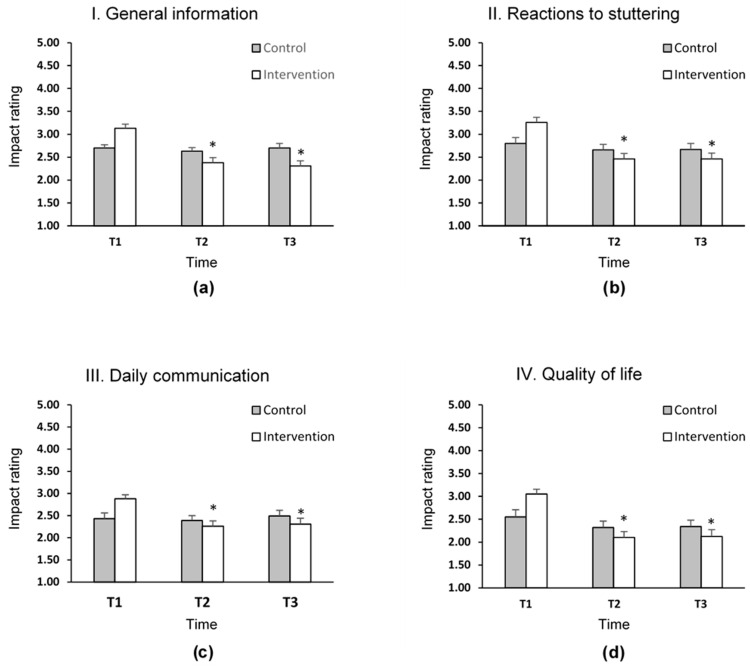
- In the intervention group, OASES-A total score dropped from 3.09 ± 0.42 at T1 to 2.30 ± 0.57 at T2 (mean difference 0.78 ± 0.09, p < 0.001) and remained lower at T3 (mean difference 0.78 ± 0.10, p < 0.001).
- The improvement covered all 4 OASES-A components: general information, reactions to stuttering, daily communication, and quality of life; the time × group interaction for OASES-A was p = 0.001.
- Trait anxiety (STAI_B) decreased from 43.11 ± 8.44 to 35.89 ± 8.09 at T2 (mean difference 7.22 ± 1.23, p < 0.001) and remained lower at T3 (mean difference 6.78, p < 0.001); the time × group interaction was p < 0.001.
- Satisfaction with life (SWLS) increased significantly in the intervention group from T1 to T2 (mean difference 3.96 ± 0.81, p < 0.001) and from T1 to T3 (mean difference 4.59 ± 0.99, p < 0.001), while psychological flexibility (PFQ) increased but not significantly.
## Methods
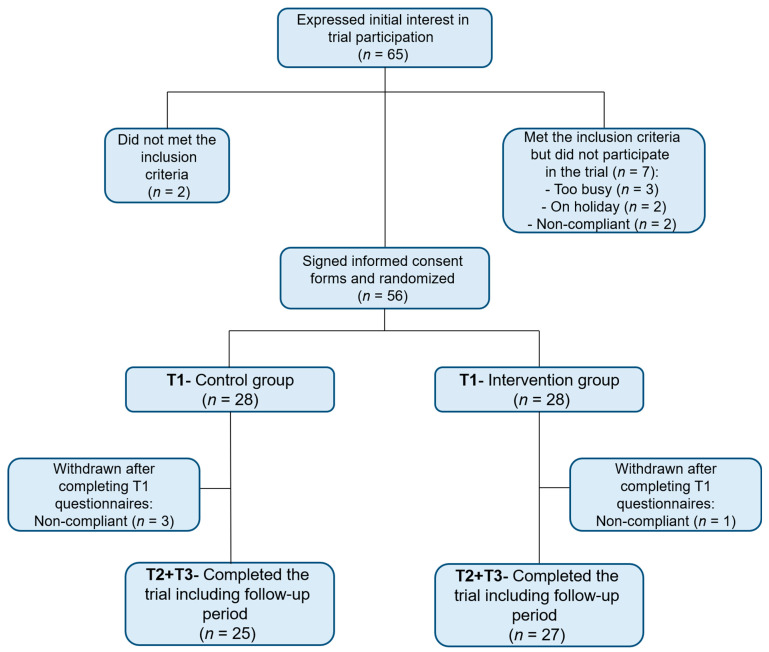
- Design: Randomized controlled clinical trial with 56 participants randomized 1:1 to IBSR intervention (n = 28) or control (n = 28); outcomes were measured at T1, T2, and T3.
- Sample: Israeli men and women adults who stutter recruited from the Israel Stuttering Association and social network ads; eligibility required age 18+, developmental or acquired stuttering, and ability to complete Hebrew instruments.
- Analysis: Intention-to-treat; Pearson correlations at baseline; two-way repeated-measures ANOVA/ANCOVA for changes over time and group × time interactions; Sidak correction for post hoc comparisons.
## Limitations
- The paper states that 80% of the sample were male, so larger female samples are needed to generalize to both genders.
- Outcomes were subjective self-reports, which may be affected by response bias; the authors note future studies should also include objective outcomes such as fluency and timing/frequency of stuttering.
- The control arm was a non-treatment control group, which is susceptible to non-specific effects such as attention and group support.
- The follow-up was only 1 month, so longer follow-up is needed to know whether gains persist long term.
Model-written summary. Check it against the paper before relying on it.
Integrity signals
Registry
Cites
Statistics
Figures


Verification
Claims the paper makes
9 Valid · 0 Not valid · 22 Not checked · 61 Own results and interpretations
The sources with a verdict support this claim; the rest weren’t checked yet, have no full text we could read, or their verdicts aren’t rated yet.
In the paper
“Other studies conducted with the IBSR intervention technique that examined its effect on anxiety in the general population reported a significant improvement in trait anxiety as part of the STAI instrument [37,56,59].”
§ Inquiry Based Stress Reduction (IBSR) Improves Overall Stuttering Experience among Adults Who Stutter: A Randomized Controlled Trial > 4. Discussion
What the sources say
- Not checked — no full text of the sourcecites [37] Smernoff, 2015, The Effects of “the Work” Meditation (Byron Katie) on Psychological Symptoms and Quality of Life-A Pilot Clinical Study, Explor. J. Sci. Heal. source
- Supportedcites [56] Krispenz, 2019, Reduction of Chronic Stress and Trait Anxiety by Inquiry of Cognitive Appraisals with the Inquiry-Based Stress Reduction (IBSR) Method, Open Psychol. source
The Trait anxiety methods section identifies the measure as the State-Trait Anxiety Inventory Form X2 (STAI-X2). The Trait anxiety results report significantly lower scores three months after IBSR training in the non-clinical intervention group, while scores in the matched control group did not change significantly. The paper describes this as preliminary evidence, which is consistent with the citing sentence’s report of a significant improvement. (LLM, conf=0.93)
- Not checked — no full text of the sourcecites [59] Smernoff, 2019, The Effects of Inquiry-Based Stress Reduction (IBSR) on Mental Health and Well-Being among a Non-Clinical Sample, Complementary Ther. Clin. Pract. source
plainstates a cause- Asserted: passes — The authors put it forward as true.
- Checkable: passes — It can be checked against evidence.
- Load-bearing: unclear — It is unclear whether the paper’s conclusions depend on it.
- Based: passes — The paper gives a reason why it holds.
Every source the paper cites for this claim was checked and supports it.
In the paper
“Thus, re-evaluation and modification of cognitive perceptions are expected to reduce stress and anxiety [56].”
§ Inquiry Based Stress Reduction (IBSR) Improves Overall Stuttering Experience among Adults Who Stutter: A Randomized Controlled Trial > 4. Discussion
What the sources say
- Supportedcites [56] Krispenz, 2019, Reduction of Chronic Stress and Trait Anxiety by Inquiry of Cognitive Appraisals with the Inquiry-Based Stress Reduction (IBSR) Method, Open Psychol. source
The Discussion states that stress and anxiety should decline when people modify the cognitive appraisals underlying stressful thoughts and beliefs. Practical Implications likewise describes changing cognitive appraisals as a way to reduce stress and anxiety. No page numbers are provided in our copy. (LLM, conf=0.94)
hedgedstates a possible cause- Asserted: passes — The authors put it forward as true.
- Checkable: passes — It can be checked against evidence.
- Load-bearing: passes — The paper’s conclusions depend on it.
- Based: passes — The paper gives a reason why it holds.
- Supported
A result the paper reports from its own data — it cites no other source for it, so there is none to check. The quote shows it is in the paper.
In the paper
“A significant positive correlation was also seen between quality of life variable (OASES-A-IV) and the state-anxiety variable (STAI_A; r = 0.442, p = 0.001).”
§ Inquiry Based Stress Reduction (IBSR) Improves Overall Stuttering Experience among Adults Who Stutter: A Randomized Controlled Trial > 3. Results > 3.4. Correlation-Analysis of the Trial Measures
plainstates an association- Asserted: passes — The authors put it forward as true.
- Checkable: passes — It can be checked against evidence.
- Load-bearing: unclear — It is unclear whether the paper’s conclusions depend on it.
- Based: passes — The paper gives a reason why it holds.
A result the paper reports from its own data — it cites no other source for it, so there is none to check. The quote shows it is in the paper.
In the paper
“The mean score for the intervention group increased significantly from T1 to T2 (mean difference of 3.96 ± 0.81, p < 0.001)”
§ Inquiry Based Stress Reduction (IBSR) Improves Overall Stuttering Experience among Adults Who Stutter: A Randomized Controlled Trial > 3. Results > 3.3. Psychological Indicators among Adults Who Stutter-Pre-Post IBSR Intervention
plainstates a cause- Asserted: passes — The authors put it forward as true.
- Checkable: passes — It can be checked against evidence.
- Load-bearing: passes — The paper’s conclusions depend on it.
- Based: passes — The paper gives a reason why it holds.
A result the paper reports from its own data — it cites no other source for it, so there is none to check. The quote shows it is in the paper.
In the paper
“we found a significant change between the OASES-A score in the intervention group over the time points in comparison to the control (time × group interaction test, p = 0.001).”
§ Inquiry Based Stress Reduction (IBSR) Improves Overall Stuttering Experience among Adults Who Stutter: A Randomized Controlled Trial > 3. Results > 3.2. Overall Stuttering Experience Pre-Post IBSR Intervention
plainstates an association- Asserted: passes — The authors put it forward as true.
- Checkable: passes — It can be checked against evidence.
- Load-bearing: passes — The paper’s conclusions depend on it.
- Based: passes — The paper gives a reason why it holds.
26 more claims
Create a free account to see all 92 claims and to verify the 1 reference still open.
- Probably not a substantial claim. 44
- It may state two separate claims as one. 32
Claims other papers make about this one
Each is checked against this paper’s own text: does it say what the citing paper says it does?
In the citing paper
“By challenging these beliefs, participants can reduce negative emotions and adopt a more balanced approach to stress, enhancing their ability to manage distressing situations.”
From Comprehensive review of chronic stress pathways and the efficacy of behavioral stress reduction programs (BSRPs) in managing diseases. (2024) · cites this paper as [267]
Citations
Cites
The satisfaction with life scale
Diener, E., Emmons, R. A., Larsen, R. J., & Griffin, S. (1985) · Journal of Personality Assessment · doi:10.1207/s15327752jpa4901_13 · Cited by 31,768 · cited 1×
“A final grade in the range of 30–35 is a very high score, indicating a person with great satisfaction who is very satisfied with his life [47,48].”
BackgroundPsychological flexibility as a fundamental aspect of health
Kashdan, T. B., & Rottenberg, J. (2010) · Clinical Psychology Review · doi:10.1016/j.cpr.2010.03.001 · Cited by 3,054
Assessing Subjective Well-Being: Progress and Opportunities
Diener, E. (1994) · Social Indicators Research · doi:10.1007/bf01207052 · Cited by 2,317 · cited 1×
“A final grade in the range of 30–35 is a very high score, indicating a person with great satisfaction who is very satisfied with his life [47,48].”
BackgroundYaruss, J. S., & Quesal, R. W. (2006) · Journal of Fluency Disorders · doi:10.1016/j.jfludis.2006.02.002 · Cited by 523 · cited 3×
“0 a severe impact rating (higher scores represent a more negative impact of stuttering) [28,43].”
BackgroundThe Impact of Stuttering on the Quality of Life in Adults Who Stutter
Craig, A., Blumgart, E., & Tran, Y. (2009) · Journal of Fluency Disorders · doi:10.1016/j.jfludis.2009.05.002 · Cited by 490 · cited 1×
“Studies have highlighted a number of particularly vulnerable areas for AWS [2,51,52].”
BackgroundVøllestad, J., Sivertsen, B., & Nielsen, G. H. (2011) · Behaviour Research and Therapy · doi:10.1016/j.brat.2011.01.007 · Cited by 361
Social anxiety disorder and stuttering: current status and future directions.
Iverach, L., & Rapee, R. M. (2014) · Journal of Fluency Disorders · doi:10.1016/j.jfludis.2013.08.003 · Cited by 337 · cited 1×
“and mental illnesses (for example, depression and strokes) and furthermore, anxiety may further exacerbate stuttering [55].”
BackgroundRobins, C. J., Keng, S., Ekblad, A. G., & Brantley, J. G. (2012) · Journal of Clinical Psychology · doi:10.1002/jclp.20857 · Cited by 332
Klompas, M., & Ross, E. (2004) · Journal of Fluency Disorders · doi:10.1016/j.jfludis.2004.10.001 · Cited by 311 · cited 1×
“In addition, stuttering is perceived by AWS, as negatively affecting their marital and family life [54].”
BackgroundThe Impact of Stuttering on Employment Opportunities and Job Performance
Klein, J. F., & Hood, S. B. (2004) · Journal of Fluency Disorders · doi:10.1016/j.jfludis.2004.08.001 · Cited by 280 · cited 2×
“In addition to communication difficulties, stuttering is also associated with a decline in the quality of life of adults who stutter (AWS) [2] and has impacts on social status [3], mental well-being [4], self-acceptance [5], and the chances of integration into the labor market [6].”
Background
Research works printed but not linked: 3
- Cheasman, C., Everard, R., and Simpson, S. (2013). Stammering Therapy from the Inside: New Perspectives on Working with Young People and Adults, J&R Press.
- Byron, K., and Stephen, M. (2002). Loving What Is: Four Questions That Can Change Your Life, Three Rivers Press.
- Spielberger, C.D., Gorsuch, R.L., and Lushene, R.E. (1970). Manual for the State-Trait Anxiety Inventory, Consulting Psychologists Press.
Cited by
Mindfulness-based positive psychology interventions: a systematic review
George, A. J., Romate, J., & Rajkumar, E. (2021) · BMC Psychology · doi:10.1186/s40359-021-00618-2 · Cited by 187
Shchaslyvyi, A. Y., Antonenko, S. V., & Telegeev, G. D. (2024) · International Journal of Environmental Research and Public Health · doi:10.3390/ijerph21081077 · Cited by 73
Laiho, A., Elovaara, H., Kaisamatti, K., Luhtalampi, K., Talaskivi, L., Pohja, S., Routamo-Jaatela, K., & Vuorio, E. (2022) · Journal of Communication Disorders · doi:10.1016/j.jcomdis.2022.106242 · Cited by 76
Dynamic human gut microbiome and immune shifts during an immersive psychosocial intervention program
Zhou, X., Ganz, A. B., Rayner, A., Cheng, T. Y., Oba, H., Rolnik, B. M., Lancaster, S. M., Lu, X., Li, Y., Johnson, J. S., et al. (2024) · Brain Behavior and Immunity · doi:10.1016/j.bbi.2024.12.027 · Cited by 13
“IBSR has been previously demonstrated to improve beliefs related to social safety and depression without the use of pharmaceutical agents (Feldman et al., 2021; Landau et al., 2021; Schnaider-Levi et al., 2020).”
Self-citationSandoval, Y., Rojas, C., Farías-Fritz, B., et al. (2025) · International Journal of Environmental Research and Public Health · doi:10.3390/ijerph22111662 · Cited by 2
“Stuttering can often lead to psychological burdens such as anxiety and depression, particularly in environments where there is a lack of awareness and acceptance [38].”
Metadata
- Authors
- Feldman, O., Goldstien, E., Rolnik, B., Ganz, A. B., & Lev-Ari, S.
- Affiliations
- Department of Health Promotion, School of Public Health, Sackler Faculty of Medicine, Tel-Aviv University, Tel-Aviv 69978, Israel
- Tel Aviv University (IL)
- Stanford University (US)
- Venue
- Journal of Clinical Medicine
- Publisher
- MDPI AG
- Published
- 2021-05-18
- Volume
- 10
- Issue
- 10
- Pages
- 2187
- ISSN
- 2077-0383 (ISSN-L)
- PMC
- PMC8158472
- OpenAlex
- W3162515339
- Cited by
- 13
- References
- 63
- Citations by year
- 2026: 1 · 2025: 4 · 2024: 4 · 2022: 3 · 2021: 1
- FWCI
- 1.36
- Type
- journal article
- Language
- en
- Open access
- gold
- doi.org
- Licence
- Locations
- Journal of Clinical Medicine (publishedVersion, cc-by)
- PubMed Central (publishedVersion, cc-by)
- PubMed (publishedVersion)
- DOAJ (DOAJ: Directory of Open Access Journals) (submittedVersion, cc-by-sa)
- Topics
- Social Sciences › Psychology › Clinical Psychology › Stuttering Research and Treatment
- Social Sciences › Psychology › Experimental and Cognitive Psychology › Anxiety, Depression, Psychometrics, Treatment, Cognitive Processes
- Social Sciences › Psychology › Clinical Psychology › Mindfulness and Compassion Interventions
- Keywords
- stuttering, adults who stutter, mindfulness, cognitive reframing, anxiety, psychological flexibility, well-being, quality of life, life satisfaction
About these checks
Registry, retraction, Cites and statistics results are computed, not judged, with one exception: a printed reference that no index lists is read once by a model before it counts as a citation error. Claims are extracted by a model and kept only when their quote appears verbatim in the text; each cited source is then checked, with a model’s help, for whether it says what the claim relies on. Those verdicts can be wrong — read the claim’s quote and the cited source before relying on one.
The claim verdicts this report counts are experimental: their accuracy is not yet measured.
A language model drew the claims from the paper on 2026-10-11, under version 3 of the claim definition (model deepseek-v4.1-flash, prompt extract-v3).
A second model labelled each claim on 2026-10-11 (model jev-1.13-20260917, definition revision gold-guideline-v0.2).
Cited sources are checked with a language model’s help (gpt-6-sol).
Statistics and arithmetic are recomputed, not judged.
Confidence bands are shown only for fields calibrated on our annotated test set. None is calibrated yet, so no band is shown.
What counts as a claim ›How we measure confidence ›How we check this ›
Are you an author, or do you see a problem with this page? Request a review
How to cite
Cite CoChat for the checks on this page, and the paper for its own findings.
- This page
- CoChat. (2026). Citation check: Inquiry Based Stress Reduction (IBSR) Improves Overall Stuttering Experience among Adults Who Stutter: A Randomized Controlled Trial. https://app.cochat.ai/papers/10.3390/jcm10102187
- The paper
- Feldman, O., Goldstien, E., Rolnik, B., Ganz, A. B., & Lev-Ari, S. (2021). Inquiry Based Stress Reduction (IBSR) Improves Overall Stuttering Experience among Adults Who Stutter: A Randomized Controlled Trial. Journal of Clinical Medicine. https://doi.org/10.3390/jcm10102187
Data sources
Bibliographic data: Semantic Scholar, OpenAlex, Crossref.
Contains information from the Semantic Scholar Academic Graph Datasets, made available under the ODC Attribution License (ODC-BY 1.0).
Semantic Scholar’s data is described in: Kinney, R., et al. (2023). The Semantic Scholar Open Data Platform. arXiv:2301.10140.
