

The DOI matches its Crossref record; 90 of the 93 references it cites were found in a registry or an index.
Technology Acceptance, Technological Self-Efficacy, and Attitude Toward Technology-Based Self-Directed Learning: Learning Motivation as a Mediator
Open accessAbstract
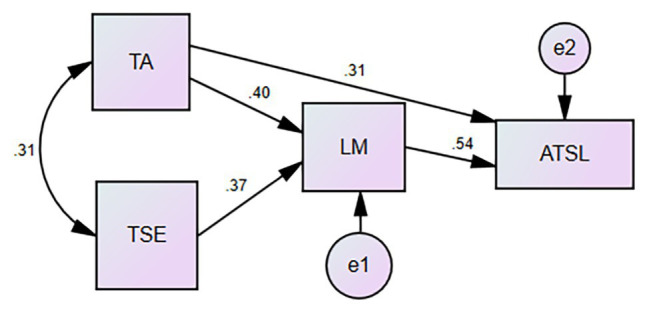
This study explored the contribution of technology acceptance and technological self-efficacy to attitude toward technology-based self-directed learning in a sample of Chinese undergraduate students. The study also inquired into whether learning motivation mediated these associations. A total of 332 undergraduate students of college English course were enrolled to participate in questionnaires regarding their technology acceptance, technological self-efficacy, attitude toward technology-based self-directed learning, and learning motivation. Results indicated that students' technology acceptance and technological self-efficacy were related to their attitude toward technology-based self-directed learning. The findings also indicated that learning motivation mediated the relations of technology acceptance, technological self-efficacy, and attitude toward technology-based self-directed learning. Specifically, students experiencing greater technology acceptance and technological self-efficacy showed higher attitude toward technology-based self-directed learning. This study highlighted the significance of learning motivation as a mediating mechanism illustrating relations between students' perception of technology environments and their attitude toward technology-based self-directed learning.
Overview
The claims and statistics of this paper haven’t been checked yet.
Run the check — free, no account needed. It reads the open-access text and checks the sources it cites.
Integrity signals
Registry
Cites
Statistics
Figures
Verification
Claims the paper makes
The claims and statistics of this paper haven’t been checked yet.
Run the check — free, no account needed. It reads the open-access text and checks the sources it cites.
Claims other papers make about this one
Each is checked against this paper’s own text: does it say what the citing paper says it does?
The source backs part of the claim, not all of it — or backs it for a different population, condition or comparison.
In the citing paper
“SE was widely acknowledged as an essential predictor of students’ technology acceptance because it influences cognitive processing, emotional stability, and perceived ability to manage new technologies [58,59].”
From Advancing Undergraduate Student Mental Healthcare of Social Anxiety Disorder: Evaluating the Acceptance of AR-Assisted Cognitive Behavioral Therapy Through TAM-Based Constructs. (2026) · cites this paper as [59]
Experimental — accuracy not yet measured
Self-check
Percentages, sums and reported differences re-computed from the paper’s own numbers.
The self-check needs the paper’s full text.
Citations
Cites
Hu, L., & Bentler, P. M. (1999) · Structural Equation Modeling A Multidisciplinary Journal · doi:10.1080/10705519909540118 · Cited by 108,788 · cited 1×
“Hu and Bentler (1999) suggested that TLI and CFI should be greater than or equal to 0.90 to indicate good suitability, and RMSEA and SRMR should be less than 0.06 and 0.08, respectively.”
BackgroundInfluentialTabachnick, B. G., & Fidell, L. S. (1983) · Cited by 79,882
Perceived usefulness, perceived ease of use, and user acceptance of information technology
Davis, F. D. (1989) · MIS Quarterly · doi:10.2307/249008 · Cited by 68,483 · cited 3×
“The TAM was first proposed by Davis (1989) on the basis of the theory of reasoned action (TRA) advanced by Fishbein and Ajzen (1975), which is used to explain the associations between the students’ technology acceptance of computer system, behavioral intention, and definite behavior of technology…”
BackgroundMethodUser Acceptance of Information Technology: Toward A Unified View1
Venkatesh, V., Morris, M. G., Davis, G. B., & Davis, F. D. (2003) · MIS Quarterly · doi:10.2307/30036540 · Cited by 45,035 · cited 2×
“Venkatesh et al. (2003) expanded the TAM with empirical research by adding such factors as social influence, cognitive structure, and experience and the factor of subjective norm that had not been adopted in the original TAM.”
Background(2013) · Cited by 44,563
Structural equation modeling in practice: A review and recommended two-step approach
Anderson, J. C., & Gerbing, D. W. (1988) · Psychological Bulletin · doi:10.1037/0033-2909.103.3.411 · Cited by 41,941 · cited 1×
“In this study, structural equation modeling was used, and a two-stage approach to data analysis was adopted (Anderson and Gerbing, 1988).”
Method(1975) · PhilPapers (PhilPapers Foundation) · Cited by 36,737
The "what" and "why" of goal pursuits: Human needs and the self-determination of behavior
Deci, E. L., & Ryan, R. M. (2000) · Psychological Inquiry · doi:10.1207/s15327965pli1104_01 · Cited by 34,210 · cited 2×
“According to Deci and Ryan (2000), intrinsic motivation helps to construct students’ experience of pleasure, enjoyment, and satisfaction, which in turn would further motivate their learning engagement (Dysvik and Kuvaas, 2013).”
BackgroundUser Acceptance of Computer Technology: A Comparison of Two Theoretical Models
Davis, F. D., Bagozzi, R. P., & Warshaw, P. R. (1989) · Management Science · doi:10.1287/mnsc.35.8.982 · Cited by 25,709 · cited 13×
“According to Teo et al. (2015, p.78), “attitude toward technology use has been examined in various models that attempt to explain individuals’ intention for technology use, including Technology Acceptance Model (TAM; Davis et al., 1989), TAM2 (Venkatesh and Davis, 2000), and Unified Theory of Acceptance and Use of Tec…”
BackgroundMethodInfluentialSelf-efficacy: the exercise of control
(1997) · Choice Reviews Online · doi:10.5860/choice.35-1826 · Cited by 24,451
Research works printed but not linked: 8
- Bandura, 1986, Social foundations of thought and action: A social cognitive theory.
- Carmines, 1981, Analyzing models with unobserved variables: analysis of covariance structures, 65
- Elliot, 2017, Achievement goals, 43
- Knowles, 1975, Self-directed learning: A guide for leaners and teachers.
- Knowles, 2015, The adult learner: The definitive classic in adult education and human resource development (Vol. 8).
- Kop, 2011, New dimension of self-directed learning in an open-networked learning environment, International Journal of Self-Directed Learning, 7, 1
- Oxford, 2009, The influence of technology on second language writing, 9
- Schunk, 2009, Self-efficacy theory, 35
Cited by
Sorted by citations
Items 201–300 of 329
Enhancing Patients' E-Health Engagement Through Artificial Intelligence
Chauhan, A. S., Gulati, C., Mathur, G., & Sankpal, S. (2024) · Advances in healthcare information systems and administration book series · doi:10.4018/979-8-3693-5468-1.ch002 · Cited by 1
Innovative Media: A Successful Approach to Improve Learning Quality
Universitas Muhammadiyah Parepare. Address Jend.Ahmad Yani KM 6 Parepare, S. S., Mustafa, S., Baharullah, B., Universitas Muhammadiyah Makassar. Address Sultan Alauddin No.259, S. S., Maming, K., Universitas Muhammadiyah Parepare. Address Jend.Ahmad Yani KM 6 Parepare, S. S., Asrinan, A., & Universitas Muhammadiyah Parepare. Address Jend.Ahmad Yani KM 6 Parepare, S. S. (2024) · International Journal of Innovative Research in Multidisciplinary Education · doi:10.58806/ijirme.2024.v3i7n11 · Cited by 1
Yang, Q., Li, X., Gu, J., Hong, J., & Hao, T. (2024) · International Journal of Technology and Design Education · doi:10.1007/s10798-024-09929-y · Cited by 1
“The exam-oriented approach may limit opportunities for creative exploration, impacting students’ TESE compared to more flexible educational systems (Pan, 2020).”
Mathur, M., & Dugan, M. T. (2025) · Journal of Education for Business · doi:10.1080/08832323.2025.2478018 · Cited by 1
“However, prior research findings indicate that despite the potential benefits, certain students may resist learning new technologies for various reasons, ultimately limiting their ability to fully leverage the learning opportunities presented (Mishra et al., 2017; Pan, 2020).”
Yan, R., & Hu, W. (2025) · Frontiers in Psychology · doi:10.3389/fpsyg.2025.1571926 · Cited by 1
“Self-efficacy can also help students maintain a positive attitude towards learning (Pan, 2020), and develop an interest and enthusiasm for digital skills as they continue to experiment and practice.”
Analyzing the Impact of Google Earth on the Learning Motivation of Elementary School Students
Fatayan, A. (2024) · ETDC Indonesian Journal of Research and Educational Review · doi:10.51574/ijrer.v3i2.1418 · Cited by 1
“Using technology like Google Earth aims to capture students' attention and inspire them to learn (Pan, 2020).”
Yundayani, A., Yuni, Y., & Alghadari, F. (2025) · Journal of language and Education · doi:10.17323/jle.2025.12439 · Cited by 1
“Besides, student attitudes towards technology-based self-learning contributed to student acceptance of technology and technical self-efficiency (Pan, 2020).”
Chou, M., & Pan, W.-C. (2025) · Language Awareness · doi:10.1080/09658416.2025.2502429 · Cited by 1
“Findings highlight that EFL students’ self-efficacy positively predicts online self-regulated learning strategies and motivation (Pan, 2020; Teng et al., 2023).”
Lim, C., Ratan, R., Pandita, S., Foxman, M., Hales, G. E., Liu, H., Lei, Y. S., & Beyea, D. (2025) · Human Behavior and Emerging Technologies · doi:10.1155/hbe2/8808655 · Cited by 1
Alsswey, A., & Malak, M. Z. (2025) · Interactive Learning Environments · doi:10.1080/10494820.2025.2559916 · Cited by 1
“It has also been suggested that technological self-efficacy significantly affects students’ behavioural tendency towards using technological tools and their opinions about the utility of technology for learning (Pan, 2022).”
The role of professional leadership and learning motivation in shaping citizenship behavior
Saifullah, S., Abbas, H., & Purwanto, A. (2025) · Social Sciences & Humanities Open · doi:10.1016/j.ssaho.2025.102105 · Cited by 4
Molina, L. F. M. (2025) · Journal of International Education in Business · doi:10.1108/jieb-05-2024-0048 · Cited by 1
Ge, X., Gordon, R., Leidl, D. M., & Bateman, S. (2025) · Simulation in Healthcare The Journal of the Society for Simulation in Healthcare · doi:10.1097/sih.0000000000000907 · Cited by 1
Xiao, Y., Wan, X., Xu, T., & Yusuf, A. (2026) · Journal of Computer Assisted Learning · doi:10.1002/jcal.70186 · Cited by 1
GenAI avatars in VR: Role of presence, health, and technological factors
Mengoni, P., Shen, D. J., Zixin, L., & Yun, P. W. P. (2026) · Computers & Education X Reality · doi:10.1016/j.cexr.2026.100141 · Cited by 1
Shi, Y., Dong, Q., Chen, J., Wu, M., Shen, J., Chen, M. F., & Xu, H. (2026) · Lecture notes in computer science · doi:10.1007/978-981-95-8420-8_24 · Cited by 2
Khairy, H. A., Salama, W., & Suliman, M. A. (2026) · Human Systems Management · doi:10.1177/01672533261439542 · Cited by 1
Zhu, J., Guan, C., Zhang, H., Wang, L., Zhang, Y., & Bian, X. (2026) · Frontiers in Medicine · doi:10.3389/fmed.2026.1817255 · Cited by 2
“In technology-enhanced learning contexts, students’attitudes may also be shaped by their perceptions of the learning environment (37).”
Armendáriz, G. F. M., & Pastrana-Villota, B. O. (2026) · Innova Science Journal · doi:10.63618/omd/isj/v4/n2/260 · Cited by 1
Factors influencing the academic use of digital technologies among Chilean pre-service teachers
León, M., Cerda, C., Salazar-Fernández, C., Usart, M., & Gisbert, M. (2026) · International Journal of Educational Technology in Higher Education · doi:10.1186/s41239-026-00595-9 · Cited by 1
“Empirical evidence identifies technological self-efficacy as a key predictor of this readiness (Pan, 2020), while technology-mediated collaborative learning enhances self-direction through reflective, peer-supported practices (Lee & Bonk, 2024).”
Tech-savviness: Predicting and measuring learning ability of novel digital platforms
DeCouto, B. S., Treacy, A., McCurdy, Z., Patterson, C. B., Johnson, M., Neubauer, C., Pollard, K., & Perera, I. (2026) · Computers in Human Behavior Reports · doi:10.1016/j.chbr.2026.101140 · Cited by 1
Developing Pre‐Service Teachers’ Digital Self‐Efficacy Through Self‐Directed Language Learning
Chen, Y., & Buckingham, L. (2026) · International Journal of Applied Linguistics · doi:10.1111/ijal.70255 · Cited by 1
Pan, L., & Chen, Q. (2026) · BMC Psychology · doi:10.1186/s40359-026-05059-3 · Cited by 2
“Similarly, Pan [47] reported that Chinese college English learners who perceived technology as easy to use were more willing to regulate their own learning.”
Ceyssens, C., Verhulst, N., & Vermeulen, M. (2026) · Journal of Business Research · doi:10.1016/j.jbusres.2026.116364 · Cited by 1
Haase, J. (2026) · AI & Society · doi:10.1007/s00146-026-03242-z · Cited by 1
“Research on technology use highlights AI literacy and attitudes as factors associated with usage intensity (Schepers and Wetzels 2007; Pan 2020).”
Alsudairi, F., Asiri, A. M., Khojah, M., Al-Somali, S. A., Bakry, D. S., Alqarni, K., & Alsaigh, M. (2026) · Journal of Intelligence · doi:10.3390/jintelligence14090220 · Cited by 1
“Students who feel competent in technology use experience enhanced intrinsic motivation and en-joyment, which subsequently fosters more positive attitudes toward technology use and higher perceptions of usefulness (Abdullah & Ward, 2016; Granić, 2022; Pan, 2020).”
Vairez, M. R., Gomez, F., Gentle-Genitty, C. S., Quiroz, J., & Manzanero, O. (2022) · Continuity in Education · doi:10.5334/cie.41 · Cited by 1
“Households with school-aged children struggled with online learning and instructional time (McElrath, 2020) as well as technological self-efficacy (Pan, 2020).”
BackgroundDitlhokwa, G. (2022) · European Journal of Interactive Multimedia and Education · doi:10.30935/ejimed/12519 · Cited by 1
“The six key items (perceived usefulness: seeking information; perceived usefulness: entrainment/recreation; perceived usefulness: building social relationships; self-efficiency influencer: MLDs; the gratification of MLDs uses; behavioral intentions of MLDs) of the hypotheses were measured based on the scale proposed b…”
BackgroundMethodInfluentialMoturi, D., Wekesa, S., & Juma, D. (2023) · International Journal of Business Management Entrepreneurship and Innovation · doi:10.35942/jbmed.v5i1.304 · Cited by 1
FinTech Loan Continuance Intention: How Far Can Self-Efficacies Go?
Danilola, S., Odeniran, A., & Otonne, A. (2022) · Springer proceedings in business and economics · doi:10.1007/978-3-031-34589-0_37 · Cited by 1
When and how does e-HRM optimize communication pace and processing time?
Aslam, M. S., & Akram, A. (2024) · Journal of economic and administrative sciences. · doi:10.1108/jeas-01-2024-0037 · Cited by 1
Quantitative Analysis of Students and Teachers Readiness for Flipped Classroom in Matriculation
Shaari, F., & Kamsin, I. F. (2024) · International Journal of Academic Research in Business and Social Sciences · doi:10.6007/ijarbss/v14-i5/21724 · Cited by 1
“According to a study conducted on postgraduate students in China, motivation acts as a mediator between technology acceptability, technology self-efficacy, and student attitudes toward technology-based self-directed learning (Pan, 2020).”
BackgroundTechnology Based Interactive Media Development
Fatayan, A., Setiani, O. I., Ghani, A. R. A., & Firdausya, B. T. W. (2024) · Advances in Social Science, Education and Humanities Research/Advances in social science, education and humanities research · doi:10.2991/978-2-38476-242-2_33 · Cited by 1
Leipold, B., & Haunschild, I. M. S. (2024) · Springer eBooks · doi:10.1007/978-3-658-44612-3_13 · Cited by 1
James, D., Utapao, K., Suvanno, S., Nunez, G. M., & Senariddhikrai, P. (2024) · Open Education Studies · doi:10.1515/edu-2024-0028 · Cited by 1
Nepal, R. M., Khadka, B. K., Guragain, S., & Ghimire, J. (2024) · Frontiers in Education · doi:10.3389/feduc.2024.1356279 · Cited by 3
Cerna, L. (2024) · Journal of interdisciplinary perspectives · doi:10.69569/jip.2024.0411 · Cited by 1
Examining Factors Influencing Online Adult Learners’ Satisfaction with Blended Synchronous Learning
Shu, F., Lu, G., Wang, Q., Tu, F., Li, H., & Zhao, C. (2024) · Education and Information Technologies · doi:10.1007/s10639-024-13265-y · Cited by 1
“Zhu et al. ( 2020 ) showed that in blended learning environments, technology acceptance positively affected students’ self-regulated learning, while Pan (2020 ) revealed that undergradu-ates’ technology acceptance and self-efficacy were linked to their attitudes toward technology-based…”
Keahlian Komputer dan Kendali Lokus Mahasiswa dalam Penerimaan Teknologi Informasi
Rusli, R., & Zawawi, Z. (2023) · Indonesian Journal of Sustainability Policy and Technology. · doi:10.61656/ijospat.v1i1.154 · Cited by 1
“Keahlian komputer, yang mencakup pengetahuan dan keterampilan teknis dalam mengoperasikan perangkat lunak dan hardware komputer, telah dikenal sebagai salah satu prediktor utama penerimaan teknologi informasi (Antonietti et al., 2022; Pan, 2020; Park et al., 2022).”
BackgroundFactors Influencing Military Instructor Technology Self-Efficacy
Frank, G. D. (2023) · doi:10.18122/td.2165.boisestate · Cited by 1
Optimism in action: Future confidence fuels digital literacy development in China’s rural students.Preprint
Li, L., Wang, Q., Ng, Y.-L., & Zhong, B. (2025) · Research Square · doi:10.21203/rs.3.rs-6122977/v1 · Cited by 1
Zhou, Z., Zhou, Y., Ouyang, B., Man, S. S., & Chan, A. H. S. (2026) · Healthcare · doi:10.3390/healthcare14131978
“SE was widely acknowledged as an essential predictor of students’ technology acceptance because it influences cognitive processing, emotional stability, and perceived ability to manage new technologies [58,59].”
Wulandari, D. A., & Widjaja, Y. (2022) · Syntax Literate Jurnal Ilmiah Indonesia · doi:10.36418/syntax-literate.v7i1.5897
Fortuna, K. L., Brooks, J., Myers, A., Sivakumar, B., & Lebby, S. R. (2022) · Psychiatric Quarterly · doi:10.1007/s11126-022-09984-5
Identifying User Preferences of Data Handling Using Assisting Technologies
Offermann, J., Wilkowska, W., & Ziefle, M. (2022) · International Conference on PErvasive Technologies Related to Assistive Environments (PETRA) · doi:10.1145/3529190.3529196
“Although these factors have previously been shown individually to be possible influencing factors for technology acceptance in different contexts [26, 27], their collaborative impact and the strength of the effects related to acceptance and the evaluation of a general collection of health-related…”
BackgroundYundayani, A., Alghadari, F., Ardiasih, L. S., & Sutrisno, B. (2022) · Journal of Higher Education Theory and Practice · doi:10.33423/jhetp.v22i13.5515
Assessment of the Building Situation Tool Adoption Among Firefighters
Sever, F. (2023) · International Journal of Technology and Human Interaction · doi:10.4018/ijthi.317749
Alanazi, A., Li, A., & Soh, B. (2023) · International Journal of ADVANCED AND APPLIED SCIENCES · doi:10.21833/ijaas.2023.04.016
Using Vicarious Learning Feedback Videos as Self-directed Learning Resources in a LMOOC Context
Zhang, H., & Wei, W. (2023) · Lecture notes in computer science · doi:10.1007/978-3-031-33023-0_38
Karawani, M., & Preece, A. S. D. (2023) · IIUM Journal of Educational Studies · doi:10.31436/ijes.v11i1.479
Exploratory Factor Analysis: Validity and Reliability of Technology Self-Efficacy Instrument
Mustafa, F. S. N., Razali, F. B., & Puad, M. H. M. (2023) · International Journal of Academic Research in Progressive Education and Development · doi:10.6007/ijarped/v12-i3/18030
“On the other hand, the self-efficacy theory places a strong emphasis on teachers’ perceptions of their own skills to complete a particular task (Pan, 2020).”
Islam, M. A., Sifat, M. B., & Mridu, F. R. (2022) · International Conference on Industrial & Mechanical Engineering and Operations Management (IMEOM) · doi:10.46254/bd05.20220050
Lee, N. A. A., Halim, M. A. A., Zulkifli, F. A., & Yulian, R. (2023) · International Journal of Academic Research in Progressive Education and Development · doi:10.6007/ijarped/v12-i4/19551
“These positive intentions could be attributed to the website's ease of use, as previous research has shown that perceived usefulness and ease of use are key factors that influence students' behavioral intention to use technology for learning purposes (Pan, 2020; Tan, 2019).”
BackgroundMethodResultInfluentialSeraji, F., & Gizgapan, E. (2023) · Quarterly Journal of Research and Planning in Higher Education · doi:10.61838/irphe.29.1.6
Salsabila, S. S., Rahmatullah, B., & ‘Aziz, H. (2023) · AL-ATHFAL JURNAL PENDIDIKAN ANAK · doi:10.14421/al-athfal.2023.92-06
“High self-efficacy in teachers can improve their ability to use technology effectively (Gomez et al., 2022; Pan, 2020), encourage experimentation and innovation in learning(Barton & Dexter, 2019; Gale et al., 2021; Gomez et al., 2022).”
BackgroundThe Mediating Effect of Trust on Consumers’ Purchase Decision in Mobile Social Commerce
(2023) · Borneo Journal of Social Sciences and Humanities · doi:10.35370/bjssh.2023.5.2-02 · Cited by 1
“According to Pan (2020), an individual’s thoughts and opinions on accepting new technology are shaped by their level of self-efficacy.”
BackgroundDominguez, H., & Shekhar, P. (2024) · ASEE Middle Atlantic Section Spring Conference · doi:10.18260/1-2--40080
Yulian, R. (2024) · International Journal of Information and Education Technology · doi:10.18178/ijiet.2024.14.2.2054
Srivastava, R., Chennelleri, H. U., Gupta, B., Abidi, N., Ramakrishna, Y., & Agarwal, R. (2024) · International Conference on Cyber Resilience (ICCR) · doi:10.1109/iccr61006.2024.10533122
“It's an overall affective evaluation, representing a psychological tendency towards favor or disfavor[34], [35], [36].”
BackgroundMatusitz, J., & Dacas, J. (2024) · Signals and communication technology · doi:10.1007/978-3-031-63485-7_7
Moraka, T., Ntsala, M., & Dikotla, M. A. (2024) · South African Journal of Libraries and Information Science · doi:10.7553/90-1-2289
Impact of Mobile Coding Apps on Student Autonomous Learning in Tertiary Education: A Case Study
Malimata, C. A., Miranda, J. P. P., Mababa, J. C., Canlas, J. D., Hernandez, H. E., Yambao, J. A., & Pelayo, E. L. B. (2024) · International Conference on Computer Science and Technologies in Education (CSTE) · doi:10.1109/cste62025.2024.00009
“Other studies have also emphasizes the importance of technology acceptance and technological self-efficacy in shaping the attitudes of the students toward technology-based autonomous learning [43] – [47].”
BackgroundAmin, R., Hossain, M. A., & Eni, L. N. (2024) · SSRN Electronic Journal · doi:10.2139/ssrn.4978170
Voices Regarding Online Assessment: Students’ Perceptions, Challenges and Proposed Solutions
Aydoğdu, Ç., & Kaplan, Y. Ü. (2024) · Anemon Muş Alparslan Üniversitesi Sosyal Bilimler Dergisi · doi:10.18506/anemon.1446039
The use of Google Earth on the learning motivation students in elementary school
Fatayan, A., Ghani, A. R. A., Naredi, H., Mimin, Ninawati, Nurafni, Kowiyah, K., Andi, & Khayitov, S. (2024) · AIP conference proceedings · doi:10.1063/5.0246820
Exploring the factors influencing the adoption of business intelligence in Malaysia’s service sector
Sivanathan, B. D. J., Sulaiman, A. B., Zakaria, N. B., & Foo, S. M. (2024) · Journal of Infrastructure Policy and Development · doi:10.24294/jipd4971
Ding, Y., Liu, C.-W., & Tu, C. C. (2025) · Journal of Adult and Continuing Education · doi:10.1177/14779714241310137
“Pan (2020) emphasized the importance of learning motivation as a mediating variable, explaining that the better students perceive the technological environment, the higher their learning motivation will be, which in turn enhances their self-directed learning attitude and leads to a more enjoyable…”
Alqahtani, M. A. (2025) · International Journal of Innovative Research and Scientific Studies · doi:10.53894/ijirss.v8i1.4094 · Cited by 1
Weerasingha, R., & Peiris, M. D. P. (2025) · SSRN Electronic Journal · doi:10.2139/ssrn.5070427
Fagforskjeller i bruken av digitale verktøy i norsk høyere utdanning
Besche, T. D., Fidjeland, A. K., & Wiborg, V. S. (2025) · Uniped · doi:10.18261/uniped.48.1.3
“…studier hvor det blir fremhevet at suksess i bruken av digital teknologi henger sammen med mestringstro og trening (Mercader & Gairín, 2020; Pan, 2020), og en gryende oppfatning om at dagens studentgenerasjoner ikke bør forstås som digital natives som kan forventes å mestre slike verktøy…”
Zhou, M. M., León, V. O. V., & Poggi-Parodi, C. (2025) · Smart innovation, systems and technologies · doi:10.1007/978-981-96-0426-5_32
Language Teaching in the Age of AI
Chniete, I., Kaddouri, M., Mhamdi, K., Marhraoui, M., & Khaldi, M. (2025) · Advances in computational intelligence and robotics book series · doi:10.4018/979-8-3693-7260-9.ch008
Han, Z., & Li, Q. (2025) · Lecture notes in computer science · doi:10.1007/978-3-031-93746-0_12
Learners' Intention to Adopt Virtual Experiences in Higher Education
Sinha, D., Sinha, S., Phutela, N., & Goyal, S. (2025) · Advances in computational intelligence and robotics book series · doi:10.4018/979-8-3693-8915-7.ch014
Chung, B.-C., & Bing, W. (2025) · SAGE Open · doi:10.1177/21582440251357161
“This belief not only enhances motivation and persistence but also builds resilience, which is essential in sports (Pan, 2020).”
Perspectives on Technology Use in Social Work: Scale Development and Validation
Williams, J. M., & Lee, E. (2025) · Research on Social Work Practice · doi:10.1177/10497315251362758 · Cited by 1
“Research has shown that targeted training and support can signi fi cantly increase technology self-ef fi cacy among professionals, which leads to better service delivery outcomes (Pan, 2020).”
Kahsay, H., Berhie, G., & Cecchetti, A. A. (2025) · Science Technology & Public Policy · doi:10.11648/j.stpp.20250902.11
Zeng, Y., Zhang, Y., & Gerong, R. (2025) · Research Square · doi:10.21203/rs.3.rs-7578150/v1
Lyu, T., & Sun, Z. (2025) · International Conference on Distance Education and Learning (ICDEL) · doi:10.1109/icdel65868.2025.11193520
“Recognizing this, Pan (2020) encompass motivational factors, creating a more comprehensive framework for comprehending technology adoption in the context of learning [13].”
Effectiveness of AI Blended Learning for Developing Student Self-Directed Learning
Ben, S., Sang, Y., & Ali, M. B. B. (2025) · International Symposium on Artificial Intelligence for Education (ISAIE) · doi:10.1145/3775073.3775179
“Extended TAM versions include self-efficacy, personal innovativeness, and task–technology fit (TTF) for better prediction [ 9 ],[ 10 ] .”
Integrating a Customized AI Chatbot in Database Design and Programming Course
Mithun, S., & Sankaranarayanan, R. (2025) · IEEE Frontiers in Education Conference (FIE) · doi:10.1109/fie63693.2025.11328169
“Furthermore, external variables such as system quality and user experience can influence technology acceptance [26].”
Cruz, A. (2026) · JPAIR Multidisciplinary Research · doi:10.7719/jpair.v63i1.975
Yang, H., Norman, H., Nasir, M. K. M., Xu, N., Lin, X., & Zhang, W. (2026) · Computer Science Education · doi:10.1080/08993408.2026.2618832
XR-powered ESP for IoT: Evaluating student perceptions across vocational learner backgrounds
Ahmad, Y., Pamungkas, K. N. P., Kustini, S., & Dhiyaussalam (2026) · Computers & Education X Reality · doi:10.1016/j.cexr.2026.100136 · Cited by 4
Afza, A., Susanti, D., Nursyahra, N., Devegi, M., Supriatno, B., Riandi, R., & Meriko, L. (2026) · AMPLITUDO Journal of Science & Technology Innovation · doi:10.56566/amplitudo.v5i1.508
“This indicates that while AR and VR technologies provide significant promise, individual student characteristics, such as their preparedness to embrace new technologies, substantially affect their motivation levels (Huang et al., 2021; Pan, 2020).”
Exploring factors determining students’ online homework adoption with an extended UTAUT2 model
Chen, L., Shen, Y., & Wong, S. L. (2026) · The Journal of Educational Research · doi:10.1080/00220671.2026.2637582
Aposika, F., & Frimpong, C. N. (2026) · Discover Education · doi:10.1007/s44217-026-01338-8
“The absence of strong predictors of satisfaction suggests that future research should explore alternative constructs such as digital self-efficacy and intrinsic motivation, which influence engagement and perception in virtual learning [44, 55].”
Kong, C., & Sheng, F. (2026) · International Journal of Sport and Exercise Psychology · doi:10.1080/1612197x.2025.2600981
Bardon, A. G., Orlin, T. J. P., Jorgio, R. M., Avelino, E. J., Cajetas, R. J., Aliviado, R. M., & Tubera, F. J. D. (2026) · Psychology and Education A Multidisciplinary Journal · doi:10.70838/pemj.540708
Lau, A., & Borchert, M. (2026) · Behaviour and Information Technology · doi:10.1080/0144929x.2026.2651113
Shimray, S. R., Kaba, A., Tiwari, S., & Bharti, P. (2026) · Open Information Science · doi:10.1515/opis-2025-0032 · Cited by 1
“Past studies discovered that undergraduates ’ technological self-e ffi cacy signi fi cantly in fl uences their attitudes concerning adopting new technologies (Pan 2020).”
Akeren, İ., & Yeti̇şensoy, O. (2026) · e-Kafkas Eğitim Araştırmaları Dergisi · doi:10.30900/kafkasegt.1751929
Dou, D., Huang, B., Chen, Q., Zhou, X., & Wang, C. (2026) · Frontiers in Psychology · doi:10.3389/fpsyg.2026.1811374 · Cited by 1
“…contexts, convenience and low operational burden may affect users’ willingness to adopt a system more directly, particularly because users can more easily disengage from technologies when usage becomes effortful, confusing, or disruptive (Pan, 2020; Angosto et al., 2023; Harris and Rogers, 2025).”
McGann, L. H., Jakes, R. S., Wajda, D. A., & Tyler, D. J. (2025) · IEEE Conference on Telepresence · doi:10.1109/telepresence66096.2025.11521434
What Factors' Gen Z Acceptance of AI Learning as Powered Study Assistants
Tianto, B., Loka, G. B., Christianto, N. B., & Sari, R. (2026) · International Conference on Current Research in Artificial Intelligence and Data Science (ICCRAIDS) · doi:10.1109/iccraids67816.2026.11519751
“…It is assumed that this intention, which is influenced by their perceptions of utility, ease and trust [14], will directly translate into the active deployment of the technology for academic purpose [41], since measuring actual utilization is the gold standard for post-implementation success [33].”
Abhijith, P. S., Joseph, K. A., & Joseph, M. (2026) · International Review of Economics · doi:10.1007/s12232-026-00537-x
“There are many studies suggesting that technology acceptance and self-efficacy are positively related to attitude towards it and social influence (Akinwale and Kyari 2020; Erdem 2015; Pan 2020; Patil et al. 2020).”
Lu, J., Li, W., Mo, Y., & Ge, M. (2026) · Behavioral Sciences · doi:10.3390/bs16060902
Metadata
- Authors
- Pan, X.
- Affiliations
- Zhejiang Normal University (CN)
- Corresponding author
- Pan, Xiaoquan
- ORCID
- Pan, Xiaoquan
- Venue
- Frontiers in Psychology
- Publisher
- Frontiers Media SA
- Published
- 2020-10-27
- Volume
- 11
- Pages
- 564294-564294
- ISSN
- 1664-1078 (ISSN-L)
- PMC
- PMC7653185
- OpenAlex
- W3097042973
- Cited by
- 329
- References
- 93
- Citations by year
- 2026: 67 · 2025: 99 · 2024: 76 · 2023: 42 · 2022: 39 · 2021: 6
- FWCI
- 21.57
- Type
- journal article
- Language
- en
- Open access
- gold
- doi.org
- Licence
- Locations
- Frontiers in Psychology (publishedVersion, cc-by)
- PubMed Central (publishedVersion, cc-by)
- PubMed (publishedVersion)
- DOAJ (DOAJ: Directory of Open Access Journals) (submittedVersion, cc-by-sa)
- Funders
- Ministry of Education of the People's Republic of China
- Topics
- Social Sciences › Decision Sciences › Information Systems and Management › Technology Adoption and User Behaviour
- Social Sciences › Gender Studies › Gender and Technology in Education
- Social Sciences › Education › Online and Blended Learning
- Keywords
- technology acceptance, technology self-efficacy, student motivation, mediation, self-directed learning, undergraduate students, college English, Chinese students
About these checks
Registry, retraction, Cites and statistics results are computed, not judged, with one exception: a printed reference that no index lists is read once by a model before it counts as a citation error. Claims are extracted by a model and kept only when their quote appears verbatim in the text; each cited source is then checked, with a model’s help, for whether it says what the claim relies on. Those verdicts can be wrong — read the claim’s quote and the cited source before relying on one.
Statistics and arithmetic are recomputed, not judged.
Confidence bands are shown only for fields calibrated on our annotated test set. None is calibrated yet, so no band is shown.
What counts as a claim ›How we measure confidence ›How we check this ›
Are you an author, or do you see a problem with this page? Request a review
