

The DOI matches its Crossref record; 90 of the 93 references it cites were found in a registry or an index.
Technology Acceptance, Technological Self-Efficacy, and Attitude Toward Technology-Based Self-Directed Learning: Learning Motivation as a Mediator
Open accessAbstract
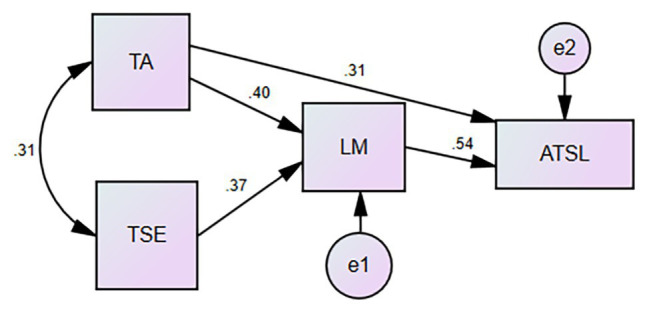
This study explored the contribution of technology acceptance and technological self-efficacy to attitude toward technology-based self-directed learning in a sample of Chinese undergraduate students. The study also inquired into whether learning motivation mediated these associations. A total of 332 undergraduate students of college English course were enrolled to participate in questionnaires regarding their technology acceptance, technological self-efficacy, attitude toward technology-based self-directed learning, and learning motivation. Results indicated that students' technology acceptance and technological self-efficacy were related to their attitude toward technology-based self-directed learning. The findings also indicated that learning motivation mediated the relations of technology acceptance, technological self-efficacy, and attitude toward technology-based self-directed learning. Specifically, students experiencing greater technology acceptance and technological self-efficacy showed higher attitude toward technology-based self-directed learning. This study highlighted the significance of learning motivation as a mediating mechanism illustrating relations between students' perception of technology environments and their attitude toward technology-based self-directed learning.
Overview
The claims and statistics of this paper haven’t been checked yet.
Run the check — free, no account needed. It reads the open-access text and checks the sources it cites.
Integrity signals
Registry
Cites
Statistics
Figures
Verification
Claims the paper makes
The claims and statistics of this paper haven’t been checked yet.
Run the check — free, no account needed. It reads the open-access text and checks the sources it cites.
Claims other papers make about this one
Each is checked against this paper’s own text: does it say what the citing paper says it does?
The source backs part of the claim, not all of it — or backs it for a different population, condition or comparison.
In the citing paper
“SE was widely acknowledged as an essential predictor of students’ technology acceptance because it influences cognitive processing, emotional stability, and perceived ability to manage new technologies [58,59].”
From Advancing Undergraduate Student Mental Healthcare of Social Anxiety Disorder: Evaluating the Acceptance of AR-Assisted Cognitive Behavioral Therapy Through TAM-Based Constructs. (2026) · cites this paper as [59]
Experimental — accuracy not yet measured
Self-check
Percentages, sums and reported differences re-computed from the paper’s own numbers.
The self-check needs the paper’s full text.
Citations
Cites
Hu, L., & Bentler, P. M. (1999) · Structural Equation Modeling A Multidisciplinary Journal · doi:10.1080/10705519909540118 · Cited by 108,788 · cited 1×
“Hu and Bentler (1999) suggested that TLI and CFI should be greater than or equal to 0.90 to indicate good suitability, and RMSEA and SRMR should be less than 0.06 and 0.08, respectively.”
BackgroundInfluentialTabachnick, B. G., & Fidell, L. S. (1983) · Cited by 79,882
Perceived usefulness, perceived ease of use, and user acceptance of information technology
Davis, F. D. (1989) · MIS Quarterly · doi:10.2307/249008 · Cited by 68,483 · cited 3×
“The TAM was first proposed by Davis (1989) on the basis of the theory of reasoned action (TRA) advanced by Fishbein and Ajzen (1975), which is used to explain the associations between the students’ technology acceptance of computer system, behavioral intention, and definite behavior of technology…”
BackgroundMethodUser Acceptance of Information Technology: Toward A Unified View1
Venkatesh, V., Morris, M. G., Davis, G. B., & Davis, F. D. (2003) · MIS Quarterly · doi:10.2307/30036540 · Cited by 45,035 · cited 2×
“Venkatesh et al. (2003) expanded the TAM with empirical research by adding such factors as social influence, cognitive structure, and experience and the factor of subjective norm that had not been adopted in the original TAM.”
Background(2013) · Cited by 44,563
Structural equation modeling in practice: A review and recommended two-step approach
Anderson, J. C., & Gerbing, D. W. (1988) · Psychological Bulletin · doi:10.1037/0033-2909.103.3.411 · Cited by 41,941 · cited 1×
“In this study, structural equation modeling was used, and a two-stage approach to data analysis was adopted (Anderson and Gerbing, 1988).”
Method(1975) · PhilPapers (PhilPapers Foundation) · Cited by 36,737
The "what" and "why" of goal pursuits: Human needs and the self-determination of behavior
Deci, E. L., & Ryan, R. M. (2000) · Psychological Inquiry · doi:10.1207/s15327965pli1104_01 · Cited by 34,210 · cited 2×
“According to Deci and Ryan (2000), intrinsic motivation helps to construct students’ experience of pleasure, enjoyment, and satisfaction, which in turn would further motivate their learning engagement (Dysvik and Kuvaas, 2013).”
BackgroundUser Acceptance of Computer Technology: A Comparison of Two Theoretical Models
Davis, F. D., Bagozzi, R. P., & Warshaw, P. R. (1989) · Management Science · doi:10.1287/mnsc.35.8.982 · Cited by 25,709 · cited 13×
“According to Teo et al. (2015, p.78), “attitude toward technology use has been examined in various models that attempt to explain individuals’ intention for technology use, including Technology Acceptance Model (TAM; Davis et al., 1989), TAM2 (Venkatesh and Davis, 2000), and Unified Theory of Acceptance and Use of Tec…”
BackgroundMethodInfluentialSelf-efficacy: the exercise of control
(1997) · Choice Reviews Online · doi:10.5860/choice.35-1826 · Cited by 24,451
A Theoretical Extension of the Technology Acceptance Model: Four Longitudinal Field Studies
Venkatesh, V., & Davis, F. D. (2000) · Management Science · doi:10.1287/mnsc.46.2.186.11926 · Cited by 23,066 · cited 2×
“According to Teo et al. (2015, p.78), “attitude toward technology use has been examined in various models that attempt to explain individuals’ intention for technology use, including Technology Acceptance Model (TAM; Davis et al., 1989), TAM2 (Venkatesh and Davis, 2000), and Unified Theory of Acceptance and Use of Tec…”
MethodPerceived Behavioral Control, Self‐Efficacy, Locus of Control, and the Theory of Planned Behavior 1
Ajzen, I. (2002) · Journal of Applied Social Psychology · doi:10.1111/j.1559-1816.2002.tb00236.x · Cited by 7,629 · cited 1×
“Additionally, Ajzen (2002) decomposed the constructs of perceived behavioral control into two components: controllability and learning motivation.”
Computer Self-Efficacy: Development of a Measure and Initial Test
Compeau, D. R., & Higgins, C. A. (1995) · MIS Quarterly · doi:10.2307/249688 · Cited by 6,553 · cited 1×
“The questionnaire of attitude toward technology-based self-directed learning was adapted from Compeau and Higgins (1995) and Saadé and Galloway (2005).”
MethodA Model of the Antecedents of Perceived Ease of Use: Development and Test
Venkatesh, V., & Davis, F. D. (1996) · Decision Sciences · doi:10.1111/j.1540-5915.1996.tb00860.x · Cited by 4,068 · cited 3×
“…of controllability essentially resembles technological self-efficacy, with both used as a proxy of individuals’ control beliefs in technology use (Venkatesh and Davis,1996), whereas learning motivation means the individual’s judgment of the ability to attain designated types of performance…”
BackgroundHandbook of Motivation at School
Wentzel, K. R., & Wigfield, A. (2009) · Routledge eBooks · doi:10.4324/9780203879498 · Cited by 2,521
A Theory of Cultural Value Orientations: Explication and Applications
Schwartz, S. (2006) · Comparative Sociology · doi:10.1163/156913306778667357 · Cited by 2,150 · cited 1×
“To enhance the literature in the Asian countries, including China, which are characterized by different social and political ideology (Schwartz, 2006), a sample of Chinese undergraduate students was recruited to participate in the study, aiming to explore the specific relations between the…”
BackgroundScherer, R., Siddiq, F., & Tondeur, J. (2019) · Computers & Education · doi:10.1016/j.compedu.2018.09.009 · Cited by 1,923
Self-Directed Learning: Toward a Comprehensive Model
Garrison, D. R. (1997) · Adult Education Quarterly · doi:10.1177/074171369704800103 · Cited by 1,578 · cited 2×
“For instance, Garrison (1997, p. 18) considered self-directed learning as “an approach where learners are motivated to assume personal responsibility and collaborative control of the cognitive (self-monitoring) and contextual (self-management) processes in constructing and confirming meaningful and…”
BackgroundSocial Measurement: Current Issues
Bohrnstedt, G. W., & Borgatta, E. F. (1981) · Medical Entomology and Zoology · Cited by 1,394
The Hierarchical Model of Approach-Avoidance Motivation
Elliot, A. J. (2006) · Motivation and Emotion · doi:10.1007/s11031-006-9028-7 · Cited by 1,385 · cited 1×
“…also reported higher levels of attitude toward technology-based self-directed learning, indicating that learning motivation could be considered as an important antecedent for attitude toward technology-based self-directed learning (Elliot, 2006; Schunk and Pajares, 2009; Elliot and Hulleman, 2017).”
BackgroundUnderstanding Technology Adoption: Theory and Future Directions for Informal Learning
Straub, E. T. (2009) · Review of Educational Research · doi:10.3102/0034654308325896 · Cited by 1,286 · cited 1×
“…to execute courses of actions to achieve intended outcome (Compeau and Higgins, 1995), is argued to have a significant positive influence on technology acceptance and use (Straub, 2009), and has been used as a proxy of individuals’ control beliefs in technology use (Venkatesh and Davis, 1996).”
BackgroundFirst year students' experiences with technology: Are they really digital natives?
Kennedy, G. E., Judd, T. S., Churchward, A., Gray, K. M., & Krause, K.-L. D. (2008) · Australasian Journal of Educational Technology · doi:10.14742/ajet.1233 · Cited by 1,120
Determining Uses and Gratifications for the Internet
Stafford, T. F., Stafford, M. R., & Schkade, L. L. (2004) · Decision Sciences · doi:10.1111/j.00117315.2004.02524.x · Cited by 1,010 · cited 1×
“Intrinsically motivated students in technology-based self-directed learning not only seek external technology-enhanced resources but also develop idiosyncratic cognitive intention (Stafford et al., 2004).”
BackgroundModelling technology acceptance in education: A study of pre-service teachers
Teo, T. (2009) · Computers & Education · doi:10.1016/j.compedu.2008.08.006 · Cited by 1,009 · cited 5×
“Although previous studies highlighted the links of related variables of students’ technology acceptance (Teo, 2009; Lai, 2013), the other generating constructs (e.g., learning motivation) that may affect these associations have not been revealed.”
BackgroundMethodResultInfluentialMcLoughlin, C., & Lee, M. J. W. (2010) · Australasian Journal of Educational Technology · doi:10.14742/ajet.1100 · Cited by 921 · cited 2×
“…use (Kennedy et al., 2008), perceived usefulness of technology (Goodyear and Ellis, 2008; Teo, 2011), perception of the utility of technological resources (Clark et al., 2009), and the scaffolding available in supporting the technology-enhanced learning experience (McLoughlin and Lee, 2010).”
BackgroundFactors influencing teachers’ intention to use technology: Model development and test
Teo, T. (2011) · Computers & Education · doi:10.1016/j.compedu.2011.06.008 · Cited by 914 · cited 5×
“Using this theory and analysis method, later in the educational landscape, there were studies that verified and explained the intention of students’ technology use (Teo, 2011) and the research of students’ independent use of technology for language learning (Lai, 2013), etc.”
BackgroundMethodResultInfluential(2017) · Cited by 871
Surveying instructor and learner attitudes toward e-learning
Liaw, S.-S., Huang, H., & Chen, G. (2006) · Computers & Education · doi:10.1016/j.compedu.2006.01.001 · Cited by 824 · cited 1×
“…language learning environment, learners’ perception and acceptance of emerging technologies are important factors that affect their effective learning (McLoughlin and Lee, 2010; Huang and Liaw, 2018) and also one of the core factors that affect self-directed learning (Liaw et al., 2007).”
BackgroundSocial supports from teachers and peers as predictors of academic and social motivation
Wentzel, K. R., Battle, A. A., Russell, S. L., & Looney, L. (2010) · Contemporary Educational Psychology · doi:10.1016/j.cedpsych.2010.03.002 · Cited by 823 · cited 1×
“Specifically, students perceiving the convenience and availability in their interactive learning process report higher motivation, engagement, and persistence in learning (Wentzel et al., 2010; Tas, 2016).”
BackgroundGUILLOTEAUX, M. J., & DÖRNYEI, Z. (2008) · TESOL Quarterly · doi:10.1002/j.1545-7249.2008.tb00207.x · Cited by 678 · cited 1×
“In this study, the motivation factors described in Guilloteaux and Dörnyei (2008) and Kormos and Csizer (2014) were used, some of which were revised and developed in combination with the actual situation.”
MethodLiaw, S.-S., & Huang, H.-M. (2013) · Computers & Education · doi:10.1016/j.compedu.2012.07.015 · Cited by 571 · cited 1×
“Liaw and Huang (2013) conducted a relatively successful theoretical innovation by integrating TAM and self-regulated learning theory, revealing the structural relationship between learners’ perceived usefulness, satisfaction, and self-regulated learning.”
BackgroundA Conceptual Model for Understanding Self-Directed Learning in Online Environments.
Song, L., & Hill, J. R. (2007) · Cited by 475
Joo, Y. J., So, H.-J., & Kim, N. H. (2018) · Computers & Education · doi:10.1016/j.compedu.2018.01.003 · Cited by 420 · cited 1×
“Previous studies have discussed learners’ acceptance of different types of technology, such as mobile technology (Pindeh et al., 2016; Nikou and Economides, 2017), computer-based communication technology (Park et al., 2014), social media (Hsieh et al., 2017), and MOOCS courses (Joo et al., 2018).”
BackgroundSelf-regulated out-of-class language learning with technology
Lai, C., & Gu, M. M. (2011) · Computer Assisted Language Learning · doi:10.1080/09588221.2011.568417 · Cited by 399 · cited 2×
“Nevertheless, some researchers identified that learners’ active use of technology for language learning does not necessarily guarantee satisfactory outcomes (Lai and Gu, 2011) and does not really reflect a sound understanding of their effective use (Oxford, 2009; Kennedy and Miceli, 2010).”
BackgroundMobile-based assessment: Investigating the factors that influence behavioral intention to use
Nikou, S. A., & Economides, A. A. (2017) · Computers & Education · doi:10.1016/j.compedu.2017.02.005 · Cited by 388 · cited 1×
“Previous studies have discussed learners’ acceptance of different types of technology, such as mobile technology (Pindeh et al., 2016; Nikou and Economides, 2017), computer-based communication technology (Park et al., 2014), social media (Hsieh et al., 2017), and MOOCS courses (Joo et al., 2018).”
BackgroundÇelik, V., & Yeşilyurt, E. (2012) · Computers & Education · doi:10.1016/j.compedu.2012.06.008 · Cited by 356 · cited 1×
“Researchers have verified a significant positive influence of technological self-efficacy on technology acceptance and utilization (Celik and Yesilyurt, 2013) and regarded technological self-efficacy as a proxy of individuals’ control beliefs in technology use (Venkatesh and Davis, 1996).”
BackgroundKormos, J., & Csizér, K. (2013) · TESOL Quarterly · doi:10.1002/tesq.129 · Cited by 354 · cited 1×
“In this study, the motivation factors described in Guilloteaux and Dörnyei (2008) and Kormos and Csizer (2014) were used, some of which were revised and developed in combination with the actual situation.”
MethodBenson, P., & Reinders, H. (2011) · Palgrave Macmillan UK eBooks · doi:10.1057/9780230306790 · Cited by 305
Teo, T. P. (2008) · Interactive Learning Environments · doi:10.1080/10494820802231327 · Cited by 299 · cited 1×
“In the TAM (Davis et al., 1989), individuals’ attitude toward using technology (Teo, 2010, 2012; Jan and Contreras, 2011) was significantly predicted by perceived usefulness and ease of use of technology, which was in turn hypothesized to affect their behavioral intention to use technology and…”
BackgroundInvestigating Determinants of Software Developers' Intentions to Follow Methodologies
Hardgrave, B. C., Davis, F. D., & Riemenschneider, C. K. (2003) · Journal of Management Information Systems · doi:10.1080/07421222.2003.11045751 · Cited by 280 · cited 1×
“%) demonstrated by this questionnaire survey highlighted the issue of educational compatibility, as previous studies have established compatibility as an important predictor of information system acceptance (Hardgrave et al., 2003; Liao and Lu, 2008).”
Understanding learner agency as a complex dynamic system
Mercer, S. (2011) · System · doi:10.1016/j.system.2011.08.001 · Cited by 280 · cited 1×
“Mercer (2011) considered self-directed language learning behavior to be contingent on “a learner’s sense of agency involving their belief systems, and the control parameters of motivation, affect, metacognitive/ self-regulatory skills, as well as actual abilities and the affordances, actual and…”
BackgroundSelf-directed learning and distance education
Moore, M. (1986) · DOAJ (DOAJ: Directory of Open Access Journals) · Cited by 256
What factors predict undergraduate students' use of technology for learning? A case from Hong Kong
Lai, C., Wang, Q., & Lei, J. (2012) · Computers & Education · doi:10.1016/j.compedu.2012.03.006 · Cited by 256 · cited 2×
“Few previous studies exploring the relation between technology climate and students’ perceived attitude toward technology-based self-directed learning have been conducted in samples of students from Asian countries, especially China (e.g., Teo, 2009; Lai et al., 2012).”
BackgroundHuang, H., & Liaw, S.-S. (2018) · The International Review of Research in Open and Distributed Learning · doi:10.19173/irrodl.v19i1.2503 · Cited by 240 · cited 1×
“…language learning environment, learners’ perception and acceptance of emerging technologies are important factors that affect their effective learning (McLoughlin and Lee, 2010; Huang and Liaw, 2018) and also one of the core factors that affect self-directed learning (Liaw et al., 2007).”
BackgroundBeyond Web 2.0: mapping the technology landscapes of young learners
Clark, W., Logan, K., Luckin, R., Mee, A., & Oliver, M. (2009) · Journal of Computer Assisted Learning · doi:10.1111/j.1365-2729.2008.00305.x · Cited by 238 · cited 1×
“…use (Kennedy et al., 2008), perceived usefulness of technology (Goodyear and Ellis, 2008; Teo, 2011), perception of the utility of technological resources (Clark et al., 2009), and the scaffolding available in supporting the technology-enhanced learning experience (McLoughlin and Lee, 2010).”
BackgroundLiao, H.-L., & Lu, H. (2008) · Computers & Education · doi:10.1016/j.compedu.2007.11.006 · Cited by 235
Teo, T. P. (2010) · Interactive Learning Environments · doi:10.1080/10494821003714632 · Cited by 235 · cited 1×
“In the TAM (Davis et al., 1989), individuals’ attitude toward using technology (Teo, 2010, 2012; Jan and Contreras, 2011) was significantly predicted by perceived usefulness and ease of use of technology, which was in turn hypothesized to affect their behavioral intention to use technology and…”
BackgroundPerry, N. E., & Winne, P. H. (2006) · Educational Psychology Review · doi:10.1007/s10648-006-9014-3 · Cited by 226 · cited 1×
“Technology-based self-directed learning, as an activity and event for learners to undertake their own learning responsibilities (Perry and Winne, 2006), not only entails the accessibility of technology but more importantly the acceleration of learning motivation.”
BackgroundPark, N., Rhoads, M., Hou, J., & Lee, K. M. (2014) · Computers in Human Behavior · doi:10.1016/j.chb.2014.05.048 · Cited by 225 · cited 1×
“Previous studies have discussed learners’ acceptance of different types of technology, such as mobile technology (Pindeh et al., 2016; Nikou and Economides, 2017), computer-based communication technology (Park et al., 2014), social media (Hsieh et al., 2017), and MOOCS courses (Joo et al., 2018).”
BackgroundStudents' self-regulation for interaction with others in online learning environments
Cho, M.-H., & Kim, B. J. (2012) · The Internet and Higher Education · doi:10.1016/j.iheduc.2012.11.001 · Cited by 221 · cited 1×
“Related studies also explored the relationship between learners’ technology acceptance and other variables, such as the relationship between technology acceptance and research constructs such as self-regulated learning, self-efficacy, and learning anxiety (Cho and Kim, 2013; Lai, 2013).”
BackgroundPerse, E. M., & Courtright, J. A. (1993) · Human Communication Research · doi:10.1111/j.1468-2958.1993.tb00310.x · Cited by 210 · cited 1×
“The analysis of variance conducted to examine the mean differences between male and female in their decision to utilize technology for self-directed learning showed no significant gender differences, which is consistent with the previous study from Perse and Courtright (1993).”
ResultLevel of intrinsic motivation of distance education students in e‐learning environments
Fırat, M., Kılınç, H., & Yüzer, T. V. (2017) · Journal of Computer Assisted Learning · doi:10.1111/jcal.12214 · Cited by 207
Dysvik, A., & Kuvaas, B. (2012) · British Journal of Social Psychology · doi:10.1111/j.2044-8309.2011.02090.x · Cited by 178 · cited 2×
“According to Deci and Ryan (2000), intrinsic motivation helps to construct students’ experience of pleasure, enjoyment, and satisfaction, which in turn would further motivate their learning engagement (Dysvik and Kuvaas, 2013).”
BackgroundKeengwe, J. (2007) · Journal of Information Technology Education Research · doi:10.28945/208 · Cited by 170
An empirical analysis of the antecedents of web-based learning continuance
Chiu, C., Sun, S., Sun, P., & Ju, T. (2006) · Computers & Education · doi:10.1016/j.compedu.2006.01.010 · Cited by 168 · cited 1×
“Chiu et al. (2007) analyzed the antecedents of web-based learning continuance, finding that students’ technology-based learning intention was mediated through their satisfaction with technology use for learning.”
BackgroundTeo, T. P., & van Schaik, P. (2011) · International Journal of Human-Computer Interaction · doi:10.1080/10447318.2011.581892 · Cited by 167 · cited 6×
“In the TAM (Davis et al., 1989), individuals’ attitude toward using technology (Teo, 2010, 2012; Jan and Contreras, 2011) was significantly predicted by perceived usefulness and ease of use of technology, which was in turn hypothesized to affect their behavioral intention to use technology and…”
BackgroundMethodInfluentialIfinedo, P. (2016) · Computers in Human Behavior · doi:10.1016/j.chb.2016.12.049 · Cited by 167 · cited 1×
“Based on TAM and motivational and social-cognitive frameworks, Ifinedo (2017) identified that students’ intrinsic motivation and attitudes toward blog use significantly determined students’ intention to continuously utilize blogs for learning.”
BackgroundJeno, L. M., Adachi, P. J. C., Grytnes, J., Vandvik, V., & Deci, E. L. (2018) · British Journal of Educational Technology · doi:10.1111/bjet.12657 · Cited by 166 · cited 1×
“SDT concentrates largely on how environments support or thwart people’s basic psychological needs for autonomy, competence, and relatedness (Jeno et al., 2019).”
BackgroundLai, C., Shum, M. S. K., & Tian, Y. (2014) · Computer Assisted Language Learning · doi:10.1080/09588221.2014.889714 · Cited by 165 · cited 1×
“…that perceived support from technology use is particularly relevant for students’ learning motivation and their attitude toward technology-based self-directed learning probably because they are confronted with the increasing technological modernity of the educational landscape (Lai et al., 2016).”
BackgroundTechnology acceptance among pre-service teachers: Does gender matter?
Teo, T. P., Fan, X., & Du, J. (2015) · Australasian Journal of Educational Technology · doi:10.14742/ajet.1672 · Cited by 164 · cited 1×
“According to Teo et al. (2015, p.78), “attitude toward technology use has been examined in various models that attempt to explain individuals’ intention for technology use, including Technology Acceptance Model (TAM; Davis et al., 1989), TAM2 (Venkatesh and Davis, 2000), and Unified Theory of…”
BackgroundTechnological acceptance of LINE in flipped EFL oral training
Hsieh, J. C., Huang, Y., & Wu, W. V. (2016) · Computers in Human Behavior · doi:10.1016/j.chb.2016.12.066 · Cited by 154 · cited 2×
“As such, in the educational field, technology acceptance is considered as a prerequisite for learners to adopt information technology to promote learning (Hsieh et al., 2017).”
BackgroundTechnology acceptance model for the use of information technology in universities
Jan, A. U., & Contreras, V. (2010) · Computers in Human Behavior · doi:10.1016/j.chb.2010.11.009 · Cited by 152 · cited 1×
“In the TAM (Davis et al., 1989), individuals’ attitude toward using technology (Teo, 2010, 2012; Jan and Contreras, 2011) was significantly predicted by perceived usefulness and ease of use of technology, which was in turn hypothesized to affect their behavioral intention to use technology and…”
BackgroundThe impact of online use of English on motivation to learn
Lamb, M., & Arisandy, F. E. (2019) · Computer Assisted Language Learning · doi:10.1080/09588221.2018.1545670 · Cited by 135 · cited 1×
“As a major psychological concept, motivation is widely believed to be an important factor contributing to students’ acquisition outcomes of second or foreign language (Lamb and Arisandy, 2019).”
BackgroundAdult learners' intention to adopt mobile learning: A motivational perspective
Hashim, K. F., Tan, F. B., & Rashid, A. (2014) · British Journal of Educational Technology · doi:10.1111/bjet.12148 · Cited by 134
Taş, Y. (2016) · European Journal of Psychology of Education · doi:10.1007/s10212-016-0303-z · Cited by 133 · cited 1×
“Specifically, students perceiving the convenience and availability in their interactive learning process report higher motivation, engagement, and persistence in learning (Wentzel et al., 2010; Tas, 2016).”
BackgroundA Framework for Developing Self-Directed Technology Use for Language Learning
Lai, C. (2013) · Language learning & technology · doi:10.64152/10125/44326 · Cited by 132 · cited 6×
“Using this theory and analysis method, later in the educational landscape, there were studies that verified and explained the intention of students’ technology use (Teo, 2011) and the research of students’ independent use of technology for language learning (Lai, 2013), etc.”
BackgroundMethodResultInfluentialKennedy, C., & Miceli, T. (2010) · Language learning & technology · doi:10.64152/10125/44201 · Cited by 117 · cited 2×
“Researchers have found that undergraduate students do adopt technology for learning (Inozu et al., 2010), but their use of technologies often lacks sufficient effectiveness (Kennedy and Miceli, 2010).”
BackgroundAR videos as scaffolding to foster students’ learning achievements and motivation in EFL learning
Chen, C. (2020) · British Journal of Educational Technology · doi:10.1111/bjet.12902 · Cited by 116 · cited 1×
“These findings confirmed that external technology environment is a critical element for triggering students’ learning motivation (Chen, 2020).”
BackgroundThe psychology of effective learning and teaching
(2006) · Choice Reviews Online · doi:10.5860/choice.44-1657 · Cited by 111 · cited 2×
“Learning Motivation as a Mediator Between the Technology Acceptance and Technological Self-Efficacy and Attitude Toward Technology-Based Self-Directed Learning Learning motivation is the sum of the incentives that positively force the choice of a specific behavior or purpose (Jarvis, 2005).”
BackgroundUniversity students’ approaches to learning: rethinking the place of technology
Goodyear, P., & Ellis, R. A. (2008) · Distance Education · doi:10.1080/01587910802154947 · Cited by 107 · cited 1×
“…students’ utilization of technology for learning, including competency in technology use (Kennedy et al., 2008), perceived usefulness of technology (Goodyear and Ellis, 2008; Teo, 2011), perception of the utility of technological resources (Clark et al., 2009), and the scaffolding available in…”
BackgroundLearner Autonomy and New Learning Environments
Reinders, H., & White, C. (2011) · Language learning & technology · doi:10.64152/10125/44254 · Cited by 93 · cited 3×
“Thereby, it is indispensable that language learners are equipped with the competence to engage in technology-based self-directed learning (Benson and Reinders, 2011; Reinders and Darasawang, 2012).”
BackgroundModeling Key Drivers of E-Learning Satisfaction among Student Teachers
Teo, T., & Wong, S. L. (2013) · Journal of Educational Computing Research · doi:10.2190/ec.48.1.d · Cited by 77 · cited 1×
“Previous studies (e.g., Teo, 2011; Teo and Wong, 2013) highlighted that students’ beliefs on the utility of technology influenced attitude toward technology use.”
An Investigation of Students' Attitudes and Motivations Toward Online Learning
Knowles, E., & Kerkman, D. D. (2007) · InSight A Journal of Scholarly Teaching · doi:10.46504/02200708kn · Cited by 76
Exploring how student motivation relates to acceptance and participation in MOOCs
Romero‐Frías, E., Montaño, J. L. A., & del Barrio‐García, S. (2020) · Interactive Learning Environments · doi:10.1080/10494820.2020.1799020 · Cited by 65
User Acceptance on Mobile Apps as an Effective Medium to Learn Kadazandusun Language
Pindeh, N., Sukı, N. M., & Sukı, N. M. (2016) · Procedia Economics and Finance · doi:10.1016/s2212-5671(16)30139-3 · Cited by 59 · cited 1×
“Previous studies have discussed learners’ acceptance of different types of technology, such as mobile technology (Pindeh et al., 2016; Nikou and Economides, 2017), computer-based communication technology (Park et al., 2014), social media (Hsieh et al., 2017), and MOOCS courses (Joo et al., 2018).”
BackgroundHandbook of Distance Education
(2003) · Routledge eBooks · doi:10.4324/9781410607294 · Cited by 56
Gan, Z. (2020) · Frontiers in Psychology · doi:10.3389/fpsyg.2020.00496 · Cited by 56 · cited 1×
“…perspective, individual motivation is defined as the degree of autonomy that individuals display during learning activity, and it falls into two major motivational orientations: (1) self-determined forms of intrinsic motivation; and (2) controlled forms of extrinsic motivation (Gan, 2020, p. 3).””
BackgroundA "Uses and Gratification Expectancy Model" to Predict Students' "Perceived e-Learning Experience"
Mondi, M., Woods, P., & Rafi, A. (2008) · Siti Hasmah Digital Library-MMU Institutiona Repository (Multimedia University) · Cited by 55
Rotgans, J. I., & Schmidt, H. G. (2012) · International journal on teaching and learning in higher education · Cited by 50
An integrated framework for theories of individual attitudes toward technology
Tate, M., Evermann, J., & Gable, G. G. (2015) · Information & Management · doi:10.1016/j.im.2015.06.005 · Cited by 48 · cited 1×
“As such, Tate et al. (2015) posed the concern that current theories are deficient in constructs that could better annotate students’ behavioral intention on technology use from the perspective of attitude.”
BackgroundThe nature of language learning experiences beyond the classroom and its learning outcomes
Julide, Inozu, Sehnaz, Sahinkarakas, Hülya, & Yumru (2010) · Acta Scientiarum Naturalium Universitatis Sunyatseni · Cited by 43
Kim, D., Lee, I., & Park, J. (2019) · British Journal of Educational Technology · doi:10.1111/bjet.12746 · Cited by 41 · cited 1×
“In the pace of network communication technology, the research on self-directed learning in open educational resource repositories via the use of information technology and the Internet (such as MOOCs and online courses) has also received great concern (Kim et al., 2019).”
BackgroundSecond Language Teaching and Learning in the Net Generation.
Oxford, R., & Oxford, J. T. (2009) · Cited by 40
The nature of language learning experiences beyond the classroom and its learning outcomes
İnözü, J., Şahinkarakaş, Ş., & Yumru, H. (2010) · Cited by 31
Greener, S. (2020) · Interactive Learning Environments · doi:10.1080/10494820.2020.1712105 · Cited by 27
Hubbard, P. L., & Romeo, K. (2012) · Cambridge University Press eBooks · doi:10.1017/cbo9781139060981.003 · Cited by 22 · cited 1×
“…such as computer literacy, technological facilitating conditions, have been viewed as a prerequisite for learners’ effective use of technology (Hubbard and Romeo, 2012); on the other hand, learners’ willingness to engage in technology use for self-directed learning has been highlighted ((Kop…”
BackgroundReinders, H., & Darasawang, P. (2012) · Cambridge University Press eBooks · doi:10.1017/cbo9781139060981.004 · Cited by 21 · cited 1×
“Thereby, it is indispensable that language learners are equipped with the competence to engage in technology-based selfdirected learning (Benson and Reinders, 2011; Reinders and Darasawang, 2012).”
BackgroundEffects of Computer Self Efficacy on the Use and Adoption of Online Social Networking
Mew, L., & Money, W. H. (2010) · International Journal of Virtual Communities and Social Networking · doi:10.4018/jvcsn.2010010102 · Cited by 19 · cited 2×
“…students’ technological learning motivation is reflected in their mastery and familiarity of technical skills, as is consistent with the study from Mew and Honey (2010), which indicated that technological learning motivation significantly influences students’ intention to use online learning…”
BackgroundResultGonzales, R. D. (2011) · SSRN Electronic Journal · doi:10.2139/ssrn.2746285 · Cited by 15 · cited 1×
“Significantly, related studies have conformed to the positive and strong associations between intrinsic motivation and extrinsic motivation (Gonzales, 2011).”
BackgroundVanderStouwe, C. (2013) · Language in Society · doi:10.1017/s0047404513000390 · Cited by 6
Research works printed but not linked: 8
- Bandura, 1986, Social foundations of thought and action: A social cognitive theory.
- Carmines, 1981, Analyzing models with unobserved variables: analysis of covariance structures, 65
- Elliot, 2017, Achievement goals, 43
- Knowles, 1975, Self-directed learning: A guide for leaners and teachers.
- Knowles, 2015, The adult learner: The definitive classic in adult education and human resource development (Vol. 8).
- Kop, 2011, New dimension of self-directed learning in an open-networked learning environment, International Journal of Self-Directed Learning, 7, 1
- Oxford, 2009, The influence of technology on second language writing, 9
- Schunk, 2009, Self-efficacy theory, 35
Cited by
Sorted by citations
Li, K. (2023) · Sustainability · doi:10.3390/su15065221 · Cited by 157
Al-Adwan, A., Yaseen, H., AlSoud, A., Abousweilem, F., & Al-rahmi, W. (2021) · Education and Information Technologies : Official Journal of the IFIP technical committee on Education · doi:10.1007/s10639-021-10758-y · Cited by 136
“It represents learners’ ownership and responsibility for their learning as it reflects their personal autonomy in handling and controlling their learning objectives (Pan, 2020).”
BackgroundChen, D., Liu, W., & Liu, X. (2024) · Acta Psychologica · doi:10.1016/j.actpsy.2024.104442 · Cited by 173
Liu, Y., Li, Y., Song, K., & Chu, F. (2024) · International Journal of Hospitality Management · doi:10.1016/j.ijhm.2024.103875 · Cited by 143
Shata, A., & Hartley, K. (2025) · International Journal of Educational Technology in Higher Education · doi:10.1186/s41239-025-00511-7 · Cited by 127
“For example, perceived ease of use was associated with self-efficacy in undergraduate students engaged in technol-ogy-supported self-directed learning (Pan, 2020).”
Metadata
- Authors
- Pan, X.
- Affiliations
- Zhejiang Normal University (CN)
- Corresponding author
- Pan, Xiaoquan
- ORCID
- Pan, Xiaoquan
- Venue
- Frontiers in Psychology
- Publisher
- Frontiers Media SA
- Published
- 2020-10-27
- Volume
- 11
- Pages
- 564294-564294
- ISSN
- 1664-1078 (ISSN-L)
- PMC
- PMC7653185
- OpenAlex
- W3097042973
- Cited by
- 329
- References
- 93
- Citations by year
- 2026: 67 · 2025: 99 · 2024: 76 · 2023: 42 · 2022: 39 · 2021: 6
- FWCI
- 21.57
- Type
- journal article
- Language
- en
- Open access
- gold
- doi.org
- Licence
- Locations
- Frontiers in Psychology (publishedVersion, cc-by)
- PubMed Central (publishedVersion, cc-by)
- PubMed (publishedVersion)
- DOAJ (DOAJ: Directory of Open Access Journals) (submittedVersion, cc-by-sa)
- Funders
- Ministry of Education of the People's Republic of China
- Topics
- Social Sciences › Decision Sciences › Information Systems and Management › Technology Adoption and User Behaviour
- Social Sciences › Gender Studies › Gender and Technology in Education
- Social Sciences › Education › Online and Blended Learning
- Keywords
- technology acceptance, technology self-efficacy, student motivation, mediation, self-directed learning, undergraduate students, college English, Chinese students
About these checks
Registry, retraction, Cites and statistics results are computed, not judged, with one exception: a printed reference that no index lists is read once by a model before it counts as a citation error. Claims are extracted by a model and kept only when their quote appears verbatim in the text; each cited source is then checked, with a model’s help, for whether it says what the claim relies on. Those verdicts can be wrong — read the claim’s quote and the cited source before relying on one.
Statistics and arithmetic are recomputed, not judged.
Confidence bands are shown only for fields calibrated on our annotated test set. None is calibrated yet, so no band is shown.
What counts as a claim ›How we measure confidence ›How we check this ›
Are you an author, or do you see a problem with this page? Request a review
