

The DOI matches its Crossref record; 90 of the 93 references it cites were found in a registry or an index.
Technology Acceptance, Technological Self-Efficacy, and Attitude Toward Technology-Based Self-Directed Learning: Learning Motivation as a Mediator
Open accessAbstract
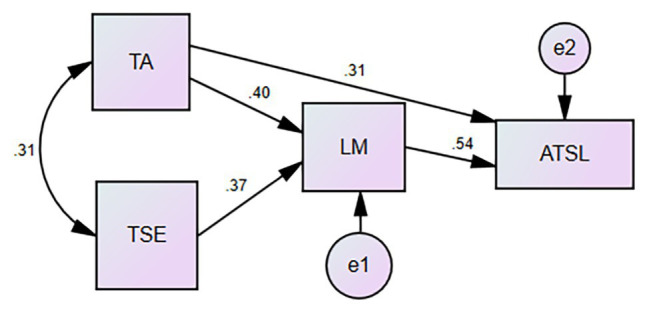
This study explored the contribution of technology acceptance and technological self-efficacy to attitude toward technology-based self-directed learning in a sample of Chinese undergraduate students. The study also inquired into whether learning motivation mediated these associations. A total of 332 undergraduate students of college English course were enrolled to participate in questionnaires regarding their technology acceptance, technological self-efficacy, attitude toward technology-based self-directed learning, and learning motivation. Results indicated that students' technology acceptance and technological self-efficacy were related to their attitude toward technology-based self-directed learning. The findings also indicated that learning motivation mediated the relations of technology acceptance, technological self-efficacy, and attitude toward technology-based self-directed learning. Specifically, students experiencing greater technology acceptance and technological self-efficacy showed higher attitude toward technology-based self-directed learning. This study highlighted the significance of learning motivation as a mediating mechanism illustrating relations between students' perception of technology environments and their attitude toward technology-based self-directed learning.
Overview
The claims and statistics of this paper haven’t been checked yet.
Run the check — free, no account needed. It reads the open-access text and checks the sources it cites.
Integrity signals
Registry
Cites
Statistics
Figures
Verification
Claims the paper makes
The claims and statistics of this paper haven’t been checked yet.
Run the check — free, no account needed. It reads the open-access text and checks the sources it cites.
Claims other papers make about this one
Each is checked against this paper’s own text: does it say what the citing paper says it does?
The source backs part of the claim, not all of it — or backs it for a different population, condition or comparison.
In the citing paper
“SE was widely acknowledged as an essential predictor of students’ technology acceptance because it influences cognitive processing, emotional stability, and perceived ability to manage new technologies [58,59].”
From Advancing Undergraduate Student Mental Healthcare of Social Anxiety Disorder: Evaluating the Acceptance of AR-Assisted Cognitive Behavioral Therapy Through TAM-Based Constructs. (2026) · cites this paper as [59]
Experimental — accuracy not yet measured
Self-check
Percentages, sums and reported differences re-computed from the paper’s own numbers.
The self-check needs the paper’s full text.
Citations
Cites
Hu, L., & Bentler, P. M. (1999) · Structural Equation Modeling A Multidisciplinary Journal · doi:10.1080/10705519909540118 · Cited by 108,788 · cited 1×
“Hu and Bentler (1999) suggested that TLI and CFI should be greater than or equal to 0.90 to indicate good suitability, and RMSEA and SRMR should be less than 0.06 and 0.08, respectively.”
BackgroundInfluentialTabachnick, B. G., & Fidell, L. S. (1983) · Cited by 79,882
Perceived usefulness, perceived ease of use, and user acceptance of information technology
Davis, F. D. (1989) · MIS Quarterly · doi:10.2307/249008 · Cited by 68,483 · cited 3×
“The TAM was first proposed by Davis (1989) on the basis of the theory of reasoned action (TRA) advanced by Fishbein and Ajzen (1975), which is used to explain the associations between the students’ technology acceptance of computer system, behavioral intention, and definite behavior of technology…”
BackgroundMethodUser Acceptance of Information Technology: Toward A Unified View1
Venkatesh, V., Morris, M. G., Davis, G. B., & Davis, F. D. (2003) · MIS Quarterly · doi:10.2307/30036540 · Cited by 45,035 · cited 2×
“Venkatesh et al. (2003) expanded the TAM with empirical research by adding such factors as social influence, cognitive structure, and experience and the factor of subjective norm that had not been adopted in the original TAM.”
Background(2013) · Cited by 44,563
Structural equation modeling in practice: A review and recommended two-step approach
Anderson, J. C., & Gerbing, D. W. (1988) · Psychological Bulletin · doi:10.1037/0033-2909.103.3.411 · Cited by 41,941 · cited 1×
“In this study, structural equation modeling was used, and a two-stage approach to data analysis was adopted (Anderson and Gerbing, 1988).”
Method(1975) · PhilPapers (PhilPapers Foundation) · Cited by 36,737
The "what" and "why" of goal pursuits: Human needs and the self-determination of behavior
Deci, E. L., & Ryan, R. M. (2000) · Psychological Inquiry · doi:10.1207/s15327965pli1104_01 · Cited by 34,210 · cited 2×
“According to Deci and Ryan (2000), intrinsic motivation helps to construct students’ experience of pleasure, enjoyment, and satisfaction, which in turn would further motivate their learning engagement (Dysvik and Kuvaas, 2013).”
BackgroundUser Acceptance of Computer Technology: A Comparison of Two Theoretical Models
Davis, F. D., Bagozzi, R. P., & Warshaw, P. R. (1989) · Management Science · doi:10.1287/mnsc.35.8.982 · Cited by 25,709 · cited 13×
“According to Teo et al. (2015, p.78), “attitude toward technology use has been examined in various models that attempt to explain individuals’ intention for technology use, including Technology Acceptance Model (TAM; Davis et al., 1989), TAM2 (Venkatesh and Davis, 2000), and Unified Theory of Acceptance and Use of Tec…”
BackgroundMethodInfluentialSelf-efficacy: the exercise of control
(1997) · Choice Reviews Online · doi:10.5860/choice.35-1826 · Cited by 24,451
Research works printed but not linked: 8
- Bandura, 1986, Social foundations of thought and action: A social cognitive theory.
- Carmines, 1981, Analyzing models with unobserved variables: analysis of covariance structures, 65
- Elliot, 2017, Achievement goals, 43
- Knowles, 1975, Self-directed learning: A guide for leaners and teachers.
- Knowles, 2015, The adult learner: The definitive classic in adult education and human resource development (Vol. 8).
- Kop, 2011, New dimension of self-directed learning in an open-networked learning environment, International Journal of Self-Directed Learning, 7, 1
- Oxford, 2009, The influence of technology on second language writing, 9
- Schunk, 2009, Self-efficacy theory, 35
Cited by
Sorted by citations
Li, K. (2023) · Sustainability · doi:10.3390/su15065221 · Cited by 157
Al-Adwan, A., Yaseen, H., AlSoud, A., Abousweilem, F., & Al-rahmi, W. (2021) · Education and Information Technologies : Official Journal of the IFIP technical committee on Education · doi:10.1007/s10639-021-10758-y · Cited by 136
“It represents learners’ ownership and responsibility for their learning as it reflects their personal autonomy in handling and controlling their learning objectives (Pan, 2020).”
BackgroundChen, D., Liu, W., & Liu, X. (2024) · Acta Psychologica · doi:10.1016/j.actpsy.2024.104442 · Cited by 173
Liu, Y., Li, Y., Song, K., & Chu, F. (2024) · International Journal of Hospitality Management · doi:10.1016/j.ijhm.2024.103875 · Cited by 143
Shata, A., & Hartley, K. (2025) · International Journal of Educational Technology in Higher Education · doi:10.1186/s41239-025-00511-7 · Cited by 127
“For example, perceived ease of use was associated with self-efficacy in undergraduate students engaged in technol-ogy-supported self-directed learning (Pan, 2020).”
Mustofa, R. H., Kuncoro, T. G., Atmono, D., Hermawan, H. D., & Sukirman, S. (2025) · Computers and Education Artificial Intelligence · doi:10.1016/j.caeai.2025.100379 · Cited by 187
Falebita, O. S., & Kok, P. J. (2024) · Journal for STEM Education Research · doi:10.1007/s41979-024-00132-1 · Cited by 154
“Studies have proven the presence of an interaction between attitude toward technology and the adoption of AI, which was mostly found to be positive (Adelana et al., 2024; Ayanwale & Ndlovu, 2024; Cai et al., 2017; Kwak et al., 2022; Obenza et al., 2024; Pan, 2020).”
InfluentialWang, Q., Gao, Y., & Wang, X. (2024) · International Journal of Human-Computer Interaction · doi:10.1080/10447318.2024.2400403 · Cited by 117
“In contrast, students with high technology or online self-efficacy beliefs show more self-regulated learning strategies, motivation, confidence, engagement, and satisfaction (Pan, 2020; Namaziandost & C¸akmak, 2020).”
A Systematic Review of Machine-Translation-Assisted Language Learning for Sustainable Education
Deng, X., & Yu, Z. (2022) · Sustainability · doi:10.3390/su14137598 · Cited by 145
“Students recognizing the benefits of greater technology use possessed a higher level of learning motivation, thus facilitating students’ technology-based self-directed learning [26].”
BackgroundEşiyok, E., Gökçearslan, Ş., & Küçükergi̇n, K. G. (2024) · International Journal of Human-Computer Interaction · doi:10.1080/10447318.2024.2303557 · Cited by 122
“The technology acceptance level and technological self-efficacy among students are also related to their attitudes toward SDLT (Pan, 2020).”
Fu-hai, A., Xi, L., & Yu, J. (2023) · Education and Information Technologies · doi:10.1007/s10639-023-11959-3 · Cited by 144
“The present results echo previous studies documenting technology acceptance, technological self-efficacy, and self-regulated learning (Pan, 2020).”
Álvarez-Risco, A., Del-Aguila-Arcentales, S., Rosen, M. A., & Yáñez, J. A. (2022) · Journal of Open Innovation Technology Market and Complexity · doi:10.3390/joitmc8030142 · Cited by 100
“In one model, self-efficacy is influenced by a person’s specific abilities, other individual factors, and environmental factors [68,69].”
BackgroundWu, D., Zhang, S., Ma, Z., Yue, G. X.-G., & Dong, R. K. (2024) · Systems · doi:10.3390/systems12090332 · Cited by 127
Chou, C.-M., Shen, T.-C., Shen, T.-C., & Shen, C.-H. (2022) · Education and Information Technologies · doi:10.1007/s10639-021-10866-9 · Cited by 118
“From the viewpoint of self-directed learning theory, students should have the self-ability of "ICT skills" and "ICT cognition", manifested in the self-assessment of AI information technology, transformation of learning needs and goals, selection of efficient strategies, and the ability to collect and evaluate (Loeng,…”
BackgroundPeng, M. Y., Xu, Y., & Xu, C. (2022) · Heliyon · doi:10.1016/j.heliyon.2023.e13302 · Cited by 81
Jiang, M. Y., Jong, M. S., Lau, W. W. F., Meng, Y.-L., Chai, C. S., & Chen, M. (2021) · Frontiers in Psychology · doi:10.3389/fpsyg.2021.671615 · Cited by 76
“…computer-and internet-related ability to carry out specific tasks and it has been concluded in many reviews and empirical studies that ICT self-efficacy plays an integral role in a computer-mediated learning environment (e.g., Moos and Azevedo, 2009; Kumar et al., 2020; Pan, 2020; Zheng and Li, 2020).”
BackgroundEducational UTAUT-based virtual reality acceptance scale: a validity and reliability study
Üstün, A. B., Yılmaz, F. G. K., & Yılmaz, R. (2022) · Virtual Reality · doi:10.1007/s10055-022-00717-4 · Cited by 76
“The rule of thumb that a factor load should be at least 0.30 in the relevant factor was followed in order for each item to be kept on the scale (Pallant 2005).”
InfluentialCamacho-Sánchez, R., Rillo-Albert, A., & Burgués, P. L. (2022) · Applied Sciences · doi:10.3390/app122111214 · Cited by 102
Artificial intelligence tools utilized in nursing education: incidence and associated factors
Jallad, S. T., Alsaqer, K., Albadareen, B. I., & Al-maghaireh, D. (2024) · Nurse Education Today · doi:10.1016/j.nedt.2024.106355 · Cited by 58
Chen, M., Jeronen, E. K., & Wang, A. (2021) · International Journal of Environmental Research and Public Health · doi:10.3390/ijerph18158217 · Cited by 57
Wagiran, W., Suharjana, S., Nurtanto, M., & Mutohhari, F. (2022) · Heliyon · doi:10.1016/j.heliyon.2022.e11160 · Cited by 86
“Research from (de Barba et al., 2016; Pan, 2020; Wang et al., 2021) reports that motivation plays a signi fi cant role in mediating the indirect effect of digital technology capabilities and supporting equipment on e-learning readiness.”
Pan, X. (2022) · Frontiers in Psychology · doi:10.3389/fpsyg.2022.1000069 · Cited by 74
Self-citationHuang, L., & Zhao, Y. (2025) · Frontiers in Psychology · doi:10.3389/fpsyg.2025.1669247 · Cited by 55
“Moreover, faculty members’ level of technology acceptance may moderate the extent to which AI literacy supports psychological need fulfillment (Pan, 2020).”
Al‐Hattami, H. M. (2025) · The International Journal of Management Education · doi:10.1016/j.ijme.2025.101131 · Cited by 77
Zhao, Z., An, Q., & Liu, J. (2025) · Frontiers in Psychology · doi:10.3389/fpsyg.2025.1619391 · Cited by 77
“Pan (2020) demonstrated that college students who were more confident in using tech were more open to trying AI tools, Liwanag and Galicia (2023) emphasized AI’s role in promoting self-directed learning, and Masry-Herzallah and Watted (2024) highlighted the positive effect of AI on engaging with…”
Ndebele, C., & Mbodila, M. (2022) · Education Sciences · doi:10.3390/educsci12010054 · Cited by 61
Fu-hai, A., Xi, L., Yu, J., & Zhang, M. (2022) · Sustainability · doi:10.3390/su141610390 · Cited by 55
Kang, S., Choi, Y., & Kim, B. (2024) · Social Sciences · doi:10.3390/socsci13090475 · Cited by 58
“Furthermore, personalized services significantly improve user experience and satisfaction because they are tailored to users’ individual needs and preferences (Pan 2020; Schmid and Dowling 2020; Kabalisa and Altmann 2021).”
Wang, S., Sun, Z., Wang, H., Yang, D., & Zhang, H. (2025) · The International Journal of Management Education · doi:10.1016/j.ijme.2025.101184 · Cited by 57
Pan, X., & Chen, W. (2021) · Frontiers in Psychology · doi:10.3389/fpsyg.2021.751017 · Cited by 58
“Online learning, E-learning, M-learning and other informal technological learning approaches provide students with more chances to explore selfdirected learning ways (King and He, 2006; Zandi et al., 2014; Hsu, 2016; Huang et al., 2020; Pan, 2020).”
BackgroundSelf-citationBarz, N., Benick, M., Dörrenbächer‐Ulrich, L., & Perels, F. (2024) · Discover Education · doi:10.1007/s44217-024-00195-7 · Cited by 105
The Mediating Effect of AI Trust on AI Self-Efficacy and Attitude Toward AI of College Students
Obenza, B. N., Baguio, J. S. I. E., Bardago, K. M. W., Granado, L. B., Loreco, K. C. A., Matugas, L. P., Talaboc, D. J., Zayas, R. K. D. D., Caballo, J. H. S., & Caangay, R. B. R. (2023) · International Journal of Metaverse · doi:10.54536/ijm.v2i1.2286 · Cited by 49
“In the interim, Pan (2020) .”
Ogegbo, A. A., Penn, M., Ramnarain, U. D., Pila, O. K., Westhuizen, C. V. D., Mdlalose, N., Moser, I., Hlosta, M., & Bergamin, P. B. (2024) · Education and Information Technologies · doi:10.1007/s10639-024-12664-5 · Cited by 35
“Studies have highlighted the role of technological self-efficacy, anxiety and attitude on the acceptance and actual usage of systems (Pan, 2020; Schlebusch, 2018).”
Qi, J., Liu, J., & Xu, Y. (2025) · Behavioral Sciences · doi:10.3390/bs15030328 · Cited by 45
“Past studies have revealed that self‑directed learning ability is posi‑ tively associated with students’ usage behaviors of digital technologies, including GenAI tools (Esiyok et al., 2024; Gokcearslan, 2017; Pan, 2020).”
Mekheimer, M. (2025) · Humanities and Social Sciences Communications · doi:10.1057/s41599-025-04947-0 · Cited by 49
“However, unlike some previous research (e.g. Pan 2020), our study suggests that the direct in fl uence of intrinsic motivation on satisfaction is less pronounced than that of technological self-ef fi cacy and the contextual factors shaping online learning environments.”
InfluentialLiu, Q., Tian, Q., Li, X., & Tan, H. (2026) · Frontiers in Psychology · doi:10.3389/fpsyg.2025.1690238 · Cited by 43
“Prior AI related studies on enterprise management concentrated on analyzing from one employee view, such as the AI adoption (Pan, 2020; Bakir et al., 2025) or AI awareness (Kong et al., 2024; Wang et al., 2022) on employee behavior from the perspective of individual employees.”
Al-khresheh, M. H., & Alkursheh, T. (2024) · Humanities and Social Sciences Communications · doi:10.1057/s41599-024-02783-2 · Cited by 55
Aldosari, A. M., Alramthi, S. M., & Eid, H. F. (2022) · Frontiers in Psychology · doi:10.3389/fpsyg.2022.994403 · Cited by 45
“Technological self-efficacy is the conviction that one can successfully use technology to fulfill a learning task (Pan, 2020).”
BackgroundImjai, N., Nui-Suk, C., Usman, B., Somwethee, P., & Aujirapongpan, S. (2024) · International Journal of Information Management Data Insights · doi:10.1016/j.jjimei.2024.100301 · Cited by 42
Wang, Y., & Wang, H. (2024) · Frontiers in Psychology · doi:10.3389/fpsyg.2024.1477470 · Cited by 37
“This finding is consistent with the other works (Pan, 2020; Zaineldeen et al., 2020), which indicate that attitudes toward technology, while influential, are often overshadowed by more immediate contextual factors such as usability and perceived usefulness.”
Sukkamart, A., Pimdee, P., Leekitchwatana, P., Kongpiboon, W., & Kantathanawat, T. (2023) · Frontiers in Psychology · doi:10.3389/fpsyg.2023.1211594 · Cited by 27
“Table 5 details the correlation coefficient analysis results of the six latent variables (Pan, 2020).”
BackgroundImpact of technology self-efficacy on online learning effectiveness during the COVID-19 pandemic
Rahman, M. K., Bhuiyan, M. A., Hossain, M. M., & Sifa, R. (2023) · Kybernetes · doi:10.1108/k-07-2022-1049 · Cited by 39
Zhu, Y., Xu, Y., Wang, X., Yan, S., & Zhao, L. (2022) · Frontiers in Psychology · doi:10.3389/fpsyg.2022.765832 · Cited by 26
“Regarding technology-based behavior, a number of meta-analyses have found that there is a good correlation between perceived behavioral control and the usefulness of certain technologies (Pan, 2020), which means that self-efficacy of technology is related to its usefulness.”
BackgroundWill Teacher-AI Collaboration Enhance Teaching Engagement?
Ding, L.-J., Li, J., & Hui, B.-H. (2025) · Behavioral Sciences · doi:10.3390/bs15070866 · Cited by 33
“Conversely, low technological self-efficacy may lead to avoidance of technology and decreased participation (Li et al., 2025b; Pan, 2020).”
Hameed, I., Mubarik, M. S., Khan, K., & Waris, I. (2022) · Human Behavior and Emerging Technologies · doi:10.1155/2022/4904686 · Cited by 24
“This tendency can be high for a few individuals and for some it is low [38].”
BackgroundNinghardjanti, P., Umam, M. C., Subarno, A., Winarno, W., Langgi, N. R., & Widodo, J. (2025) · Frontiers in Education · doi:10.3389/feduc.2025.1719625 · Cited by 50
Tian, Y., & Chan, T. J. (2024) · SAGE Open · doi:10.1177/21582440241292525 · Cited by 47
“Patil et al. (2020) assessed the association between behavioral intention and the actual use of mobile payments and demonstrated that behavioral intention drives the actual usage of users.”
InfluentialFactors influencing international students’ adoption of generative artificial intelligence
Ittefaq, M., Zain, A., Arif, R., Taufiq, A., Khan, M. L., & Seo, H. (2025) · Journal of International Students · doi:10.32674/fnwdpn48 · Cited by 29
Zhou, Y., Zhang, D., Guan, X., Pan, Q., Deng, S., & Yu, M. (2022) · BMC Medical Education · doi:10.1186/s12909-022-03189-x · Cited by 22
Ibrahim, H. B., Zin, M. L. M., Aman‐Ullah, A., & Ghazi, M. R. M. (2023) · Kybernetes · doi:10.1108/k-01-2023-0018 · Cited by 22
Li, B., Wang, C., Bonk, C. J., & Kou, X. (2024) · TechTrends · doi:10.1007/s11528-024-00960-3 · Cited by 29
“Previous studies have emphasized the importance of learning motivation as a mechanism that illustrates the relationship between students’ perception of technology environments and their attitude toward technology-based SDL (Pan, 2020).”
Jallad, S. T., Natsheh, I., Helo, L. A., Ibdah, D. M., Salah, A., Muhsen, R., Shehadeh, Y., & Froukh, N. (2024) · BMC Nursing · doi:10.1186/s12912-024-02254-8 · Cited by 21
“Furthermore, students’ technological learning motivation is reflected in their mastery and familiarity with technical skills, thus significantly influencing their intention to use VR applications [71].”
BackgroundSun, L., & Zhou, L. (2024) · Education and Information Technologies · doi:10.1007/s10639-024-13236-3 · Cited by 30
“In the field of education, they are particularly important as they directly influence students’ willingness and effectiveness in using technology-assisted learning (Pan, 2020).”
Jacobs, C., Johnson, H., Tan, N., Brownlie, K., Joiner, R., & Thompson, T. (2025) · JMIR Medical Education · doi:10.2196/70766 · Cited by 20
“Learning motivation can be seen as a mediator between technological acceptance and self-efficacy on the task [35, 36].”
The STEAM learning performance and sustainable inquiry behavior of college students in China
Nong, L., Liao, C., Ye, J., Wei, C., Zhao, C., & Nong, W. (2022) · Frontiers in Psychology · doi:10.3389/fpsyg.2022.975515 · Cited by 20
“In addition, students’ self-efficacy is related to the PU and PEOU of technology (Pan, 2020), through which learners can feel that technology is more useful and easier to use (Nur and Joviando, 2021).”
BackgroundConsumer’s acceptance of retail service robots: mediating role of pleasure and arousal
Alam, S., Abdullah, S., Kokash, H. A., Ahmed, S., & Omar, N. A. (2024) · Journal of Decision System · doi:10.1080/12460125.2024.2318527 · Cited by 20
Alhur, M., Caamaño-Alegre, J., & Reyes-Santías, F. (2024) · Digital Health · doi:10.1177/20552076241272567 · Cited by 27
Cui, Z., Song, Y., & Du, X. (2024) · Frontiers in Psychology · doi:10.3389/fpsyg.2024.1458899 · Cited by 32
“This notion aligns with findings from Pan (2020), who noted that individuals with a predisposition for physical activity tend to engage more with technological tools designed to enhance their workouts.”
ResultGong, Y., Xu, C., Luo, S., & Lin, J. (2025) · Scientific Reports · doi:10.1038/s41598-025-03298-9 · Cited by 32
“Studies on students’ technological intentions have found a strong correlation between SE and SN 54,55 .”
Yoo, N., & Jang, S. H. (2023) · Digital Health · doi:10.1177/20552076231171503 · Cited by 22
Wiprayoga, P., & Widagda, K. I. G. N. J. A. (2023) · Russian Journal of Agricultural and Socio-Economic Sciences · doi:10.18551/rjoas.2023-08.06 · Cited by 24
Sense of belonging and grit in e-learning portal usage in higher education
Devisakti, A., & Ramayah, T. (2021) · Interactive Learning Environments · doi:10.1080/10494820.2021.1983611 · Cited by 18
“Past research showed that learners have a positive attitude positively correlated with technology usage (Pan, 2020; Tatli et al., 2019).”
BackgroundResultEducational Technology in the Post-Pandemic Era: Current Progress, Potential, and Challenges
Zhang, Z., & Wasie, S. (2023) · International Conference on Education Technology and Computer · doi:10.1145/3629296.3629303 · Cited by 27
“On the students’ side, technology can enhance students’ self-directed learning abilities [52].”
BackgroundPlaying to learn: developing self-directed learning skills through serious games
Pacheco-Velazquez, E. A., Rodés, V., Glasserman‐Morales, L. D., & Carlos-Arroyo, M. (2024) · Journal of International Education in Business · doi:10.1108/jieb-08-2023-0054 · Cited by 17
Yao, Y., Wang, X., & Sun, K. (2025) · PLoS ONE · doi:10.1371/journal.pone.0314306 · Cited by 28
“If the learning or operating process of a new technology is easy, they will perceive the AI image generator as a practical and valuable tool because they can easily use its various functions during use, thus increasing their perception of the software’s usefulness [45].”
Zhu, Y., & Siquan, X. (2025) · European Journal of Education · doi:10.1111/ejed.70160 · Cited by 23
Liwanag, M. F., & Galicia, L. S. (2023) · Technium Social Sciences Journal · doi:10.47577/tssj.v44i1.8980 · Cited by 16
“Furthermore, the study of Pan (2020) also proves that students experiencing greater technology acceptance and technological self-efficacy showed higher attitudes toward technology-based self-directed learning.”
BackgroundZhang, Y. (2025) · Acta Psychologica · doi:10.1016/j.actpsy.2025.105452 · Cited by 47
Generative AI in Self-Directed Learning: a thematic scoping review
Roe, J., & Perkins, M. (2025) · Interactive Learning Environments · doi:10.1080/10494820.2025.2603431 · Cited by 57
Pan, X. (2022) · Frontiers in Psychology · doi:10.3389/fpsyg.2022.1028264 · Cited by 20
“…use and self-regulation (Pintrich and Schunk, 2002; Zusho et al., 2003) and that learning motivation functioned as a mediating mechanism illustrating relations between students’ perception of technology environments and their attitude toward technology-based self-directed learning (Pan, 2020).”
BackgroundSelf-citationPurnomo, E. N., Ali Imron, A. M., Wiyono, B. B., Sobri, A. Y., & Dami, Z. A. (2023) · Pegem Journal of Education and Instruction · doi:10.47750/pegegog.13.04.23 · Cited by 24
“According to the self-efficacy theory, a person’s perception of their ability to carry out particular activities impacts their emotional reactions and behavior (Pan, 2020).”
InfluentialChughtai, M. S., & Khalid, Y. (2022) · Journal of Innovative Research in Management Sciences · doi:10.62270/jirms.vi.24 · Cited by 17
Factors determining the use of e-learning and teaching satisfaction
Cazan, A., & Maican, C. I. (2022) · Comunicar · doi:10.3916/c74-2023-07 · Cited by 33
“…de los antecedentes más importantes del uso de las plataformas de e-learning y de la satisfacción de utilizarlas, © COMUNICAR, 74 (2023-1); e-ISSN: 1988-3293; OnlineFirst DOI: 10.3916/C74-2023-07 siendo los efectos directos de la autoeficacia positivos y significativos (Pan, 2020), apoyando la H1.”
BackgroundInfluentialPang, X., Zou, J., Zhang, X., Li, Y., Zhang, H., Wang, F., Zhang, Y., & Chen, X. (2025) · BMC Medical Education · doi:10.1186/s12909-025-07826-z · Cited by 18
Modeling Student Acceptance of AI Technologies in Higher Education: A Hybrid SEM–ANN Approach
Saflor, C. S. (2025) · Future Internet · doi:10.3390/fi17120581 · Cited by 13
“This aligns with the “risk–benefit acceptability” model, which highlights that risk evaluations are influenced not only by personal beliefs but also by how risks and benefits are framed and communicated within one’s social environment [17].”
Wang, X., Chen, X., Wu, X., Lu, J. W., Xu, B., & Wang, H. (2023) · Sustainability · doi:10.3390/su151612454 · Cited by 12
Liu, J., Liu, Z., Wang, C., Li, X.-Y., & Xu, Y. (2023) · Current Psychology · doi:10.1007/s12144-023-05136-5 · Cited by 19
“Pan (2020) used structural equations to demonstrate the positive effect of technical self-efficacy on motivation among undergraduate English students.”
Fan, Q., Hoang, M.-N., DuBose, L., Ory, M. G., Vennatt, J., Salha, D., Lee, S., & Falohun, T. (2024) · JMIR Aging · doi:10.2196/55132 · Cited by 12
“In addition, an individual’s adoption of a technological intervention is greatly influenced by their perception of technology self-efficacy, which is defined as an individual’s confidence in applying a technology to perform a task [20-23].”
BackgroundOsman, Z., Mohamad, R. K., & Kasbun, N. (2024) · International Journal of Academic Research in Business and Social Sciences · doi:10.6007/ijarbss/v14-i7/22004 · Cited by 15
Xu, J., Huang, S., Wu, C., Ren, Y., Li, Q., Cai, J., Wang, C., & Jiang, P. (2024) · Heliyon · doi:10.1016/j.heliyon.2024.e36698 · Cited by 12
“Previous studies have emphasized that independent learners should be motivated to learn, have clear goals, and be able to learn independently and continuously [21-23].”
BackgroundNurlaela, N., Irfan, A. M., Rahman, M. H., Putra, K. P., Mahmud, A., & Setialaksana, W. (2025) · Education and Information Technologies · doi:10.1007/s10639-025-13465-0 · Cited by 12
“These findings align with previous research, highlighting the importance of engaging in self-directed learning environments in fostering positive attitudes toward new technologies (An et al., 2022; Mentz & Van Zyl, 2016; Pan, 2020).”
Pirzado, F. A., Ahmed, A., Alipour, M. A., & Terashima‐Marín, H. (2025) · Journal of Computers in Education · doi:10.1007/s40692-025-00375-w · Cited by 19
“In educational environments, it might be understood as the inclination of students or learners to utilize or not use an application or specialized technology, depending on the degree to which they believe it would improve their study performance (Pan, 2020 ; Alfadda & Mahdi, 2021).”
Abhijith, P. S., & Antony Joseph, K. (2023) · International Journal of E-Business Research · doi:10.4018/ijebr.316146 · Cited by 11
Medici, G., Grote, G., Igic, I., & Hirschi, A. (2023) · European Journal of Work and Organizational Psychology · doi:10.1080/1359432x.2023.2197215 · Cited by 17
“So far, the influence of TSE has been explored for the use of technology in higher education and online classes (Huffman et al., 2013; Pan, 2020; Warden et al., 2020), and in healthcare (Rahman et al., 2016).”
BackgroundAl-Hammouri, Q., Ghaith, M. M., Abueita, J. D., Ababneh, E., Altaher, A. M., Al-Gasawneh, J. A., & Mansour, A. M. H. (2022) · Journal of Southwest Jiaotong University · doi:10.35741/issn.0258-2724.57.5.48 · Cited by 11
Zhu, W., Jusoh, N. H. M., Alan, R., Latip, M., & Saad, J. M. (2025) · Behavioral Sciences · doi:10.3390/bs15030306 · Cited by 17
ZHANG, Y. (. (2025) · Journal of Information Technology Education Research · doi:10.28945/5502 · Cited by 13
“Past studies have shown that when a technology is easy to use, users are more likely to perceive it as useful, which in turn enhances their overall attitudes toward adoption (Ashraf et al., 2014; Pan, 2020; Yao et al., 2024).”
Addai, P. (2025) · International Journal of Public Leadership · doi:10.1108/ijpl-04-2025-0073 · Cited by 10
Oluyinka, S. A., & Cusipag, M. N. (2021) · Acta Informatica Pragensia · doi:10.18267/j.aip.154 · Cited by 10
Lin, Y.-T., & Wang, T.-C. (2022) · Education Sciences · doi:10.3390/educsci12110764 · Cited by 10
Ferizaj, D., Perotti, L., Dahms, R., & Steinert, A. (2023) · Zeitschrift für Gerontologie und Geriatrie · doi:10.1007/s00391-023-02225-9 · Cited by 10
Hoong, Y., & Rezania, D. (2024) · Computers & Security · doi:10.1016/j.cose.2024.103852 · Cited by 9
Wang, W., & Wang, W. (2025) · Journal of Computer Assisted Learning · doi:10.1111/jcal.70075 · Cited by 12
Erol, M., Canbeldek Erol, M., Erol, A., & Gök Çolak, F. (2025) · European Journal of Education · doi:10.1111/ejed.70332 · Cited by 10
Demir, K. (2024) · Sustainability · doi:10.3390/su16156444 · Cited by 14
Seniors’ attitudes and intention toward IoT enabled healthcare devices in emerging economies
Malarvizhi, C. A., Mamun, A. A., Reza, M. N. H., & Yang, M. (2025) · Scientific Reports · doi:10.1038/s41598-025-97507-0 · Cited by 8
“As expected, we found that individuals’ attitudes toward IoT-enabled healthcare devices significantly affect their intention to use them (H 7 ), which is consistent with earlier studies conducted by Svenningsson, Höst 61 and Pan 62 .”
Gibreel, O., Karataş, K., & Arpacı, İ. (2026) · Scientific Reports · doi:10.1038/s41598-026-46335-x · Cited by 16
Ermilinda, L., Handarkho, Y. D., & Emanuel, A. W. R. (2024) · Procedia Computer Science · doi:10.1016/j.procs.2024.03.098 · Cited by 8
Büyük, U., & Çetingüney, H. (2025) · Batı anadolu eğitim bilimleri dergisi · doi:10.51460/baebd.1602705 · Cited by 7
Younas, M., El‐Dakhs, D. A. S., & Jiang, Y. (2025) · Scientific Reports · doi:10.1038/s41598-025-28433-4 · Cited by 15
Metadata
- Authors
- Pan, X.
- Affiliations
- Zhejiang Normal University (CN)
- Corresponding author
- Pan, Xiaoquan
- ORCID
- Pan, Xiaoquan
- Venue
- Frontiers in Psychology
- Publisher
- Frontiers Media SA
- Published
- 2020-10-27
- Volume
- 11
- Pages
- 564294-564294
- ISSN
- 1664-1078 (ISSN-L)
- PMC
- PMC7653185
- OpenAlex
- W3097042973
- Cited by
- 329
- References
- 93
- Citations by year
- 2026: 67 · 2025: 99 · 2024: 76 · 2023: 42 · 2022: 39 · 2021: 6
- FWCI
- 21.57
- Type
- journal article
- Language
- en
- Open access
- gold
- doi.org
- Licence
- Locations
- Frontiers in Psychology (publishedVersion, cc-by)
- PubMed Central (publishedVersion, cc-by)
- PubMed (publishedVersion)
- DOAJ (DOAJ: Directory of Open Access Journals) (submittedVersion, cc-by-sa)
- Funders
- Ministry of Education of the People's Republic of China
- Topics
- Social Sciences › Decision Sciences › Information Systems and Management › Technology Adoption and User Behaviour
- Social Sciences › Gender Studies › Gender and Technology in Education
- Social Sciences › Education › Online and Blended Learning
- Keywords
- technology acceptance, technology self-efficacy, student motivation, mediation, self-directed learning, undergraduate students, college English, Chinese students
About these checks
Registry, retraction, Cites and statistics results are computed, not judged, with one exception: a printed reference that no index lists is read once by a model before it counts as a citation error. Claims are extracted by a model and kept only when their quote appears verbatim in the text; each cited source is then checked, with a model’s help, for whether it says what the claim relies on. Those verdicts can be wrong — read the claim’s quote and the cited source before relying on one.
Statistics and arithmetic are recomputed, not judged.
Confidence bands are shown only for fields calibrated on our annotated test set. None is calibrated yet, so no band is shown.
What counts as a claim ›How we measure confidence ›How we check this ›
Are you an author, or do you see a problem with this page? Request a review
