

The DOI matches its Crossref record; 83 of the 86 references it cites were found in a registry or an index, and 3 are not checked yet.
Intrinsic Rewards and Employee's Performance With the Mediating Mechanism of Employee's Motivation
Open accessAbstract
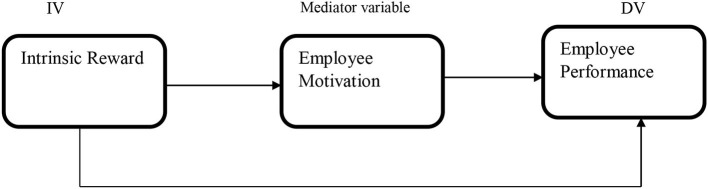
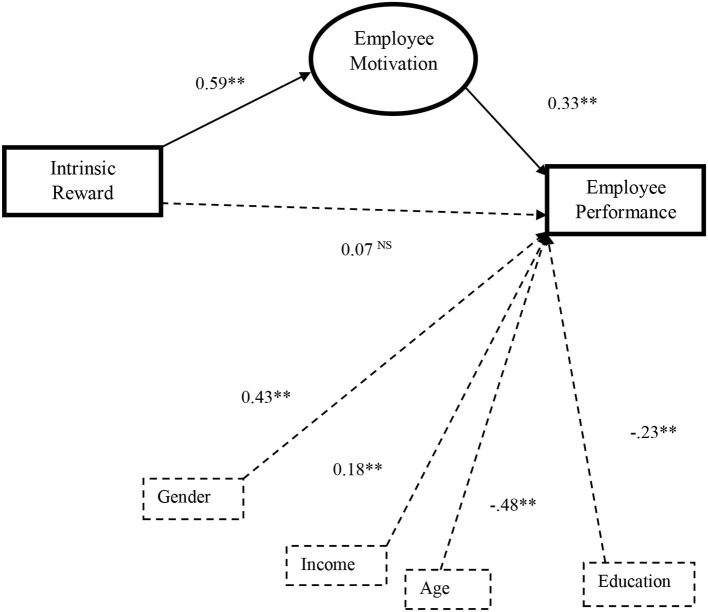
The prime goal of this study is to analyze the impact of intrinsic rewards on the performance of an employee. It also focuses on the role of motivation of the employee as an intervening factor. To achieve this objective, data have been collected through the questionnaire method from small and medium enterprises of Pakistan. A total of 400 questionnaires were distributed to the target population, and 300 were received. To test the hypotheses, the confirmatory factor analysis and the structural equation modeling have been used. The main results of the study have shown a positive and significant impact of intrinsic rewards on the performance of the employee. Specifically, the study reveals that the motivation of an employee significantly mediates the association between intrinsic rewards and the performance of the employee. In the light of the findings, implications are outlined.
Overview
The claims and statistics of this paper haven’t been checked yet.
Run the check — free, no account needed. It reads the open-access text and checks the sources it cites.
Integrity signals
Registry
Cites
Statistics
Figures
Verification
Claims the paper makes
The claims and statistics of this paper haven’t been checked yet.
Run the check — free, no account needed. It reads the open-access text and checks the sources it cites.
Claims other papers make about this one
Each is checked against this paper’s own text: does it say what the citing paper says it does?
The source backs part of the claim, not all of it — or backs it for a different population, condition or comparison.
In the citing paper
“Others are more highly influenced by extrinsic rewards, and others are more influenced by intrinsic rewards like appreciation and recognition (Katabalo & Mwita, 2024;Manzoor et al., 2021).”
From Rewards and Employee Performance in Government Agencies: Evidence from Kampala Capital City Authority (KCCA), Uganda (2026) · cites this paper as Manzoor et al., 2021
Experimental — accuracy not yet measuredThe source backs part of the claim, not all of it — or backs it for a different population, condition or comparison.
In the citing paper
“Employees are likely to show greater commitment, effort, and performance when they feel that the rewards are fair and meaningful (Manzoor et al., 2021).”
From Rewards and Employee Performance in Government Agencies: Evidence from Kampala Capital City Authority (KCCA), Uganda (2026) · cites this paper as Manzoor et al., 2021
Experimental — accuracy not yet measuredThe source backs part of the claim, not all of it — or backs it for a different population, condition or comparison.
In the citing paper
“Employees in East Africa vary with their responses to reward structure in three contexts; institutional, depending on the individual preference, and performance of the quality of implementation.”
From Rewards and Employee Performance in Government Agencies: Evidence from Kampala Capital City Authority (KCCA), Uganda (2026) · cites this paper as Manzoor et al., 2021
Experimental — accuracy not yet measuredThe cited source says what the claim attributes to it.
In the citing paper
“This elicits a positive emotional reaction and works to motivate them to continue to improve as well as make lasting behavioral changes when needed (Ryan and Deci, 2020; Manzoor et al, 2021).”
From Evaluation and Enhancement of Existing Intervention Programs for Juvenile Delinquency (2023) · cites this paper as Manzoor et al, 2021
Self-check
Percentages, sums and reported differences re-computed from the paper’s own numbers.
The self-check needs the paper’s full text.
Citations
Cites
Baron, R. M., & Kenny, D. A. (1986) · Journal of Personality and Social Psychology · doi:10.1037/0022-3514.51.6.1173 · Cited by 91,532
Preacher, K. J., & Hayes, A. F. (2008) · Behavior Research Methods · doi:10.3758/brm.40.3.879 · Cited by 34,117
On the Evaluation of Structural Equation Models
Bagozzi, R. P., & Yi, Y. (1988) · Journal of the Academy of Marketing Science · doi:10.1007/bf02723327 · Cited by 26,163
Significance tests and goodness of fit in the analysis of covariance structures.
Bentler, P. M., & Bonett, D. G. (1980) · Psychological Bulletin · doi:10.1037/0033-2909.88.3.588 · Cited by 20,015
Structural equation models with unobservable variables and measurement error: Algebra and statistics
Fornell, C., & Larcker, D. F. (1981) · Journal of Marketing Research · doi:10.1177/002224378101800313 · Cited by 13,287
Self‐determination theory and work motivation
Gagné, M., & Deci, E. L. (2005) · Journal of Organizational Behavior · doi:10.1002/job.322 · Cited by 7,757
Williams, L. J., & Anderson, S. E. (1991) · Journal of Management · doi:10.1177/014920639101700305 · Cited by 6,380
Ryan, R. M., & Deci, E. L. (2020) · Contemporary Educational Psychology · doi:10.1016/j.cedpsych.2020.101860 · Cited by 6,037
Harrison, A. J., Robinson, C., Ashenfelter, O., & Layard, R. (1989) · Canadian Journal of Economics/Revue canadienne d économique · doi:10.2307/135687 · Cited by 3,321
Haslwanter, T. (2016) · Statisctics and computing/Statistics and computing · doi:10.1007/978-3-319-28316-6_12 · Cited by 3,094
Research works printed but not linked: 2
- Herzberg, 1959, The Motivation to Work., 195
- Kushnir, 2010, A universal definition of small enterprise: a procrustean bed for SMEs, The World Bank
Cited by
Sorted by citations
Pan, C., Abbas, J., Otero, S. Á., Khan, H., & Cai, C. (2022) · Journal of Cleaner Production · doi:10.1016/j.jclepro.2022.132878 · Cited by 193
Factors Influencing Motivation and Work Engagement of Healthcare Professionals
Karaferis, D. C., Aletras, V. H., Raikou, M., & Niakas, D. A. (2022) · Materia Socio Medica · doi:10.5455/msm.2022.34.216-224 · Cited by 104
Alkandi, I. G., Khan, M. A., Fallatah, M., Alabdulhadi, A., Alanizan, S., & Alharbi, J. A. (2023) · Sustainability · doi:10.3390/su15043415 · Cited by 72
Ali, H. R., Yin, J., Manzoor, F., & An, M. (2023) · Frontiers in Psychology · doi:10.3389/fpsyg.2022.1100448 · Cited by 39
Self-citationHanu, C., & Khumalo, N. B. (2023) · Current Psychology · doi:10.1007/s12144-023-05138-3 · Cited by 38
Metadata
- Authors
- Manzoor, F., Wei, L., & Asif, M.
- Affiliations
- Zhejiang University (CN)
- Corresponding author
- Wei, Longbao
- Venue
- Frontiers in Psychology
- Publisher
- Frontiers Media SA
- Published
- 2021-07-15
- Volume
- 12
- Pages
- 563070-563070
- ISSN
- 1664-1078 (ISSN-L)
- PMC
- PMC8319625
- OpenAlex
- W3187017376
- Cited by
- 191
- References
- 86
- Citations by year
- 2026: 31 · 2025: 34 · 2024: 32 · 2023: 72 · 2022: 18 · 2021: 4
- FWCI
- 58.81
- Type
- journal article
- Language
- en
- Open access
- gold
- doi.org
- Licence
- Locations
- Frontiers in Psychology (publishedVersion, cc-by)
- PubMed Central (publishedVersion, cc-by)
- PubMed (publishedVersion)
- DOAJ (DOAJ: Directory of Open Access Journals) (submittedVersion, cc-by-sa)
- Funders
- Zhejiang University
- Topics
- Social Sciences › Business, Management and Accounting › Organizational Behavior and Human Resource Management › Employee Performance and Management
- Social Sciences › Business, Management and Accounting › Organizational Behavior and Human Resource Management › Employee Performance and Motivation
- Social Sciences › Business, Management and Accounting › Organizational Behavior and Human Resource Management › Job Satisfaction and Organizational Behavior
- Keywords
- intrinsic rewards, employee performance, employee motivation, mediating effect, small and medium-sized enterprises, human resource management
About these checks
Registry, retraction, Cites and statistics results are computed, not judged, with one exception: a printed reference that no index lists is read once by a model before it counts as a citation error. Claims are extracted by a model and kept only when their quote appears verbatim in the text; each cited source is then checked, with a model’s help, for whether it says what the claim relies on. Those verdicts can be wrong — read the claim’s quote and the cited source before relying on one.
Statistics and arithmetic are recomputed, not judged.
Confidence bands are shown only for fields calibrated on our annotated test set. None is calibrated yet, so no band is shown.
What counts as a claim ›How we measure confidence ›How we check this ›
Are you an author, or do you see a problem with this page? Request a review
