

The DOI matches its Crossref record; 84 of the 85 references it cites were found in a registry or an index, and 1 are not checked yet.
Effects of Self-Compassion Training on Work-Related Well-Being: A Systematic Review
Open accessAbstract
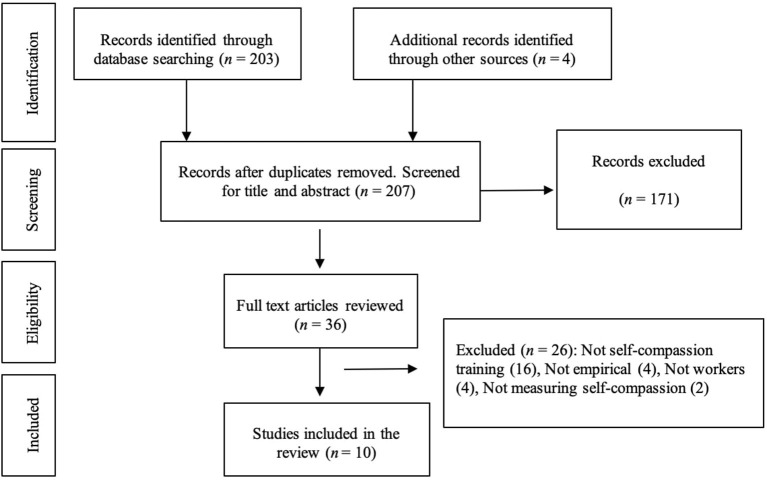
Self-compassion, sharing some commonalities with positive psychology 2.0 approaches, is associated with better mental health outcomes in diverse populations, including workers. Due to the COVID-19 pandemic, there is heightened awareness of the importance of self-care for fostering mental health at work. However, evidence regarding the applications of self-compassion interventions in work-related contexts has not been systematically reviewed to date. Therefore, this systematic review aimed to synthesize and evaluate the utility of self-compassion interventions targeting work-related well-being, as well as assess the methodological quality of relevant studies. Eligible articles were identified from research databases including ProQuest, PsycINFO, Science Direct, and Google Scholar. The quality of non-randomized trials and randomized controlled trials was assessed using the Newcastle-Ottawa Scale and the Quality Assessment Table, respectively. The literature search yielded 3,387 titles from which ten studies met the inclusion criteria. All ten studies reported promising effects of self-compassion training for work-related well-being. The methodological quality of these studies was medium. All ten studies recruited workers in a caring field and were mostly conducted in Western countries. The Self-Compassion Scale or its short-form was used in almost all instances. Findings indicate that self-compassion training can improve self-compassion and other work-related well-being outcomes in working populations. However, in general, there is need for greater methodological quality in work-related self-compassion intervention studies to advance understanding regarding the applications and limitations of this technique in work contexts. Furthermore, future studies should focus on a broader range of employee groups, including non-caring professions as well as individuals working in non-Western countries.
Overview
The claims and statistics of this paper haven’t been checked yet.
Run the check — free, no account needed. It reads the open-access text and checks the sources it cites.
Integrity signals
Registry
Cites
Statistics
Figures
Verification
Claims the paper makes
The claims and statistics of this paper haven’t been checked yet.
Run the check — free, no account needed. It reads the open-access text and checks the sources it cites.
Claims other papers make about this one
Each is checked against this paper’s own text: does it say what the citing paper says it does?
The check wasn’t confident either way, so it gives no verdict — never disputed.
In the citing paper
“This is a common aspect in MBIs [58]”
From Pilot study of an online brief mindfulness-based intervention to improve the well-being of managers and reduce their stress at work. (2024) · cites this paper as [58]
Experimental — accuracy not yet measured
Self-check
Percentages, sums and reported differences re-computed from the paper’s own numbers.
The self-check needs the paper’s full text.
Citations
Cites
Preferred Reporting Items for Systematic Reviews and Meta-Analyses: the PRISMA statement
Moher, D., Liberati, A., Tetzlaff, J., Altman, D. G., & for the PRISMA Group (2009) · BMJ · doi:10.1136/bmj.b2535 · Cited by 83,823
Preferred Reporting Items for Systematic Reviews and Meta-Analyses: The PRISMA Statement
Moher, D., Liberati, A., Tetzlaff, J., Altman, D. G., & The PRISMA Group (2009) · PLoS Medicine · doi:10.1371/journal.pmed.1000097 · Cited by 64,042
Wang, G., Ma, R., Qiao, G., Wada, K., Aizawa, Y., & Satoh, T. (2015) · Integrative Medicine International · doi:10.1159/000368408 · Cited by 18,762
Mindfulness: A proposed operational definition.
Bishop, S. R., Lau, M., Shapiro, S., Carlson, L., Anderson, N. D., Carmody, J., Segal, Z. V., Abbey, S., Speca, M., Velting, D., et al. (2004) · Clinical Psychology: Science and Practice · doi:10.1093/clipsy.bph077 · Cited by 7,234
The Development and Validation of a Scale to Measure Self-Compassion
NEFF, K. D. (2003) · Self and Identity · doi:10.1080/15298860309027 · Cited by 6,436
Self-Compassion: An Alternative Conceptualization of a Healthy Attitude Toward Oneself
NEFF, K. (2003) · Self and Identity · doi:10.1080/15298860309032 · Cited by 5,440 · cited 3×
“Self-compassion is understood to facilitate the process of being open to one’s personal failures, inadequacies, and suffering (Neff, 2003a).”
BackgroundConstruction and factorial validation of a short form of the Self-Compassion Scale
Raes, F., Pommier, E., Neff, K. D., & Van Gucht, D. (2011) · Clinical Psychology & Psychotherapy · doi:10.1002/cpp.702 · Cited by 2,997 · cited 2×
“The remaining four studies used the Self-Compassion Scale-Short Form (SCS-SF; Raes et al., 2011; Rao and Kemper, 2017; Scarlet et al., 2017; Suyi et al., 2017; Maratos et al., 2019), and one study used the Five-Facets Mindfulness Questionnaire (FFMQ; Cebolla et al.”
MethodCompassion: an evolutionary analysis and empirical review
Goetz, J. L., Keltner, D., & Simon-Thomas, E. (2010) · Psychological Bulletin · doi:10.1037/a0018807 · Cited by 2,200 · cited 1×
“Self-compassion is related to, but distinct from, compassion, which refers more to being sensitive to suffering in others, while strongly wishing to relieve that suffering (Goetz et al., 2010; Shonin et al., 2017).”
BackgroundThe SAGE handbook of organizational research methods
Buchanan, D., & Bryman, A. E. (2009) · Cited by 2,123
(2009) · Cited by 2,062
Research works printed but not linked: 4
- Hoofstede, 2010, Cultures and Organizations: Software of the Mind (3rd ed.)
- 2010, Report from Policy Committee for Mental Health at Work [Shokuba niokeru mental health taisakukentoukai houkokusho]
- Wong, 2012, From logotherapy to meaning-centered counseling and therapy, 619
- Wong, Made for Resilience and Happiness: Effective Coping With COVID-19 According to Viktor E. Frankl and Paul T. P. Wong
Cited by
Sorted by citations
Chan, X. W., Shang, S., Brough, P. A., Wilkinson, A. J., & Lu, C. (2022) · Asia Pacific Journal of Human Resources · doi:10.1111/1744-7941.12355 · Cited by 142
Self‐compassion in organizations: A review and future research agenda
Dodson, S. J., & Heng, Y. T. (2021) · Journal of Organizational Behavior · doi:10.1002/job.2556 · Cited by 112
Kotera, Y., Maxwell-Jones, R., Edwards, A., & Knutton, N. (2021) · International Journal of Environmental Research and Public Health · doi:10.3390/ijerph18105308 · Cited by 112
“Self-compassion interventions have begun to be utilised actively in healthcare, and the promising effects have been reported [65].”
BackgroundSelf-citationRushforth, A., Durk, M., Rothwell-Blake, G. A. A., Kirkman, A., Ng, F., & Kotera, Y. (2023) · International Journal of Environmental Research and Public Health · doi:10.3390/ijerph20126109 · Cited by 69
“Self-compassion as an intervention approach was shown to be primitive yet promising [43].”
BackgroundSelf-citationZhang, L. J., & Fathi, J. (2024) · System · doi:10.1016/j.system.2024.103433 · Cited by 61
Wouters-Soomers, L., Ruysseveldt, J. V., Bos, A. E. R., & Jacobs, N. (2022) · Frontiers in Psychology · doi:10.3389/fpsyg.2022.920908 · Cited by 40
Derakhshan, A., & MacIntyre, P. D. (2025) · System · doi:10.1016/j.system.2025.103928 · Cited by 31
Kotera, Y., Maybury, S., Liu, G., Colman, R. D., Lieu, J., & Dosedlová, J. (2022) · Healthcare · doi:10.3390/healthcare10112135 · Cited by 38
Self-citationJoneghani, R. B. N., Joneghani, R. B. N., Dustmohammadloo, H., Bouzari, P., Ebrahimi, P., & Fekete‐Farkas, M. (2023) · Healthcare · doi:10.3390/healthcare11131884 · Cited by 51
“Self-compassion is one of the newest approaches as a topic of empirical interest among researchers [7,10], and it has appeared as a structure concerned with employee mental health and well-being in both organizations and hospitals [11–16].”
BackgroundResultInfluentialCaldarelli, G., Pizzini, B., Cosenza, M., & Troncone, A. (2024) · Psychiatry Research · doi:10.1016/j.psychres.2024.116208 · Cited by 38
“In line with previous research (Brown et al., 2022; Grassini, 2022; Kotera and Van Gordon, 2021), the review used the NOS for cohort studies to appraise studies using a pre (cid:0) /post-intervention design.”
MethodCurley, K., Colman, R., Rushforth, A., & Kotera, Y. (2023) · Youth · doi:10.3390/youth3010017 · Cited by 27
“Considering that ASD is present worldwide, it would be helpful to include ASD articles in other languages [61].”
BackgroundSelf-citationMaratos, F. A., Wood, W., Cahill, R., Hernández, Y. A. T., Matos, M., & Gilbert, P. (2024) · Mindfulness · doi:10.1007/s12671-024-02303-y · Cited by 25
“…reducing depression, anxiety and stress, and increasing compassion, mindfulness and prosocial behaviour (Kirby et al., 2017; Kirby & Gilbert, 2017; Kotera & Van Gordon, 2021), our first aim was to develop and deliver a child-friendly schools-based CMT intervention, grounded on an already accepted…”
Beyond empathy training for practitioners: Cultivating empathic healthcare systems and leadership
Howick, J., de Zulueta, P., & Gray, M. (2024) · Journal of Evaluation in Clinical Practice · doi:10.1111/jep.13970 · Cited by 25
Andersson, C., Mellner, C., Lilliengren, P., Einhorn, S., Bergsten, K. L., Stenström, E., & Osika, W. (2022) · Frontiers in Psychology · doi:10.3389/fpsyg.2021.748140 · Cited by 32
Kotera, Y., Aledeh, M., Barnes, K., Rushforth, A., Adam, H., & Riswani, R. (2022) · Healthcare · doi:10.3390/healthcare10102092 · Cited by 51
“In sum, intrinsic motivation, self-compassion and resilience are wellbeing constructs, associated with good mental health in many populations [40].”
BackgroundSelf-citationMental Health of Japanese Workers: Amotivation Mediates Self-Compassion on Mental Health Problems
Kotera, Y., Asano, K., Kotera, H., Ohshima, R., & Rushforth, A. (2022) · International Journal of Environmental Research and Public Health · doi:10.3390/ijerph191710497 · Cited by 25
“Likewise, a systematic review synthesizing the evidence for the organizational application of self-compassion reported that self-compassion helped reduce workplace mental distress [29].”
BackgroundSelf-citationKotera, Y., Jackson, J. E., Kirkman, A., Edwards, A., Colman, R. D., Underhill, A., Jackson, J. G., Baker, D., & Ozaki, A. (2023) · International Journal of Mental Health and Addiction · doi:10.1007/s11469-023-01018-w · Cited by 30
“Self-compassion has been receiving increasing attention in research and practice, as it has been identified as a protective factor for mental health (Kotera & Van Gordon, 2021).”
Self-citationThe Effects of Zentangle ® on Affective Well-Being Among Adults: A Pilot Randomized Controlled Trial
Chung, S.-K., Ho, F. Y., & Chan, H. C.-Y. (2022) · American Journal of Occupational Therapy · doi:10.5014/ajot.2022.049113 · Cited by 16
Wu, Q., Qi, T., Wei, J., & Shaw, A. (2023) · BMC Psychology · doi:10.1186/s40359-023-01384-z · Cited by 23
“…symptoms, integrated interventions can encourage detachment from work (e.g., boundary management and engagement in recovery activities) and self-compassion (e.g., mindful self-compassion training) and combine these to reduce the emotional strain and distress that result from work stress [61, 62].”
BackgroundCurley, K., & Kotera, Y. (2023) · Healthcare · doi:10.3390/healthcare11081199 · Cited by 15
“A process where one is actively being kind and caring to one’s self, resulting in an expansion of the soothing system and reduction in suffering and sense of threat [24].”
BackgroundSelf-citationKotera, Y., Tsuda‐McCaie, F., Edwards, A., Bhandari, D., & Maughan, G. (2021) · International Journal of Environmental Research and Public Health · doi:10.3390/ijerph18158187 · Cited by 19
“Understanding the relationship between self-compassion and other constructs is important in developing varied approaches for cultivating self-compassion, as self-compassion interventions remain to be further developed [13].”
BackgroundSelf-citationThe influence of doomscrolling on mental health: a scoping review
Sharpe, A., Tyndall, I. T., Poulus, D., Obine, E. A. C., & Sharpe, B. T. (2026) · Mental Health and Digital Technologies · doi:10.1108/mhdt-10-2025-0068 · Cited by 25
Super, A., Yarker, J., Lewis, R., Keightley, S., Summers, D., & Munir, F. (2024) · International Journal of Environmental Research and Public Health · doi:10.3390/ijerph21101346 · Cited by 19
“Recent systematic reviews suggest that self-compassion interventions delivered in the workplace show promise [39–41].”
BackgroundSelf-Compassion during COVID-19 in Non-WEIRD Countries: A Narrative Review
Kotera, Y., Kirkman, A., Beaumont, J., Komorowska, M. A., Such, E., Kaneda, Y., & Rushforth, A. (2023) · Healthcare · doi:10.3390/healthcare11142016 · Cited by 14
“As a pre-COVID systematic review on self-compassion reported, selfcompassion research in non-WEIRD countries is scarce [68].”
BackgroundSelf-citationLifespan perspective on self-compassion: Insights from age-groups and gender comparisons
Tavares, L., Xavier, A., Vagos, P., Castilho, P., Cunha, M. I. V. A., & Pinto‐Gouveia, J. (2024) · Applied Developmental Science · doi:10.1080/10888691.2024.2432864 · Cited by 18
“The benefits of fostering self-compassion have been found in different settings (e.g., work-related well-being, Kotera & Van Gordon, 2021; mental health professionals, Crego et al., 2022) and in relation to diverse mental health conditions (e.g., suicidal thoughts and behaviors and non-suicidal…”
Mediation of Self-Compassion on Pathways from Stress to Psychopathologies among Japanese Workers
Kotera, Y., Young, H., Maybury, S., & Aledeh, M. (2022) · International Journal of Environmental Research and Public Health · doi:10.3390/ijerph191912423 · Cited by 17
“A systematic review identified a negative association between work-related stress and self-compassion: employees who are kind towards themselves in difficult situations tend to feel less stress from work [49].”
BackgroundSelf-citationSuggesting self-compassion training in schools to stop cyberbullying: a narrative review
Aledeh, M., Sokan‐Adeaga, A. A., Adam, H., Aledeh, S., & Kotera, Y. (2024) · Discover Psychology · doi:10.1007/s44202-023-00110-5 · Cited by 12
“Additionally, a recent study suggests self-compassion training to be effective on work-related well-being across diverse cultures [89].”
Self-citationRavina-Ripoll, R., & Ramírez, R. R. (2023) · Humanities and Social Sciences Communications · doi:10.1057/s41599-023-01937-y · Cited by 12
Self-compassion, mental health shame and work motivation in German and Japanese employees
Kotera, Y., Mayer, C., & Vanderheiden, E. (2022) · International Review of Psychiatry · doi:10.1080/09540261.2022.2148829 · Cited by 13
“Self-compassion, as a form of self-love, is associated with many positive outcomes including better mental health and ethical judgement (Kotera, Conway, et al., 2019; Kotera & Van Gordon, 2021; Zessin et al., 2015).”
BackgroundSelf-citationCompassion in Healthcare: A Narrative Review of Cross-Cultural Perspectives
Poudel, D. B., Aledeh, M., Parveen, N., Ishfaq, M., Golbourn, L.-M., Ali, Y., Lazzari, C. G., & Kotera, Y. (2025) · Journal of Healthcare Leadership · doi:10.2147/jhl.s555896 · Cited by 11
“7,37,56 Rushforth et al (2023) reviewed evidence for self-compassion interventions reducing secondary traumatic stress, though they noted a lack of high-quality studies especially outside Western contexts.”
Self-citationUneno, Y., Kotera, Y., Fujisawa, D., Kataoka, Y., Kosugi, K., Murata, N., Kessoku, T., Ozaki, A., Miyatake, H., & Muto, M. (2022) · BMJ Open · doi:10.1136/bmjopen-2022-067187 · Cited by 13
Self-citationBrophy, K., Emery, M., MacDonald, C., Côté, C. I., & Körner, A. (2024) · PLoS ONE · doi:10.1371/journal.pone.0305776 · Cited by 10
Thomsen, H. S., Jørgensen, B. E., Schøtz, J. K., Bech, L. M., & Grønkjær, L. L. (2024) · BMC Nursing · doi:10.1186/s12912-024-01888-y · Cited by 10
“In many of these studies, the effect of self-compassion is measured before and after an intervention using specific self-compassion questionnaires addressing for example burnout, mindfulness, and well-being [27].”
BackgroundFatemi, J., Vagharseyyedin, S. A., & Askari-Noghani, A. (2024) · Issues in Mental Health Nursing · doi:10.1080/01612840.2024.2371942 · Cited by 10
“Furthermore, Kotera and Van Goedon (2021) conducted a systematic review of the benefits of self-compassion interventions on work-related well-being, concluding that the effects of self-compassion training on work-related well-being are promising (Kotera & Van Gordon, 2021).”
InfluentialKotera, Y., Asano, K., Jones, J., Colman, R. D., Taylor, E., Aledeh, M., Barnes, K., Golbourn, L.-M., & Kishimoto, K. (2023) · Mental Health Religion & Culture · doi:10.1080/13674676.2023.2230908 · Cited by 10
“Moreover, many healthcare professionals in Japan reported that Japanese culture also devalues self-care as that may be viewed as selfish (Kotera, 2018; Kotera, Ozaki, et al., 2022).”
Self-citationThe Link between Mindfulness and Self-Compassion: A Meta-Analysis
Schutte, N. S., & Malouff, J. M. (2025) · International Journal of Applied Positive Psychology · doi:10.1007/s41042-025-00228-y · Cited by 15
“For example, studies have found that mindfulness training leads to decreased negative emotions (Spinelli et al., 2019) and that self-compassion training leads to increased well-being (Kotera & Gordon, 2021).”
PITCH: Designing Agentic Conversational Support for Planning and Self-reflection
Abbas, A., Wohn, C., Hu, D., Rho, E. H. R., & Lee, S. W. (2025) · ACM Conference on Conversational User Interfaces (CUI) · doi:10.1145/3719160.3736634 · Cited by 11
Qualitative Investigation into Pre- and Post-Natal Experience of Parents of Triplets
Kotera, Y., Kaluževičiūtė, G., & Viliardos, L. (2021) · Journal of Child and Family Studies · doi:10.1007/s10826-021-02200-1 · Cited by 9
Self-citationTran, T. P., Vo, A. N., An, N. H., & Nguyen, T. M. (2023) · Journal of Rational-Emotive & Cognitive-Behavior Therapy · doi:10.1007/s10942-023-00509-y · Cited by 9
“Additionally, several Asian countries appear to have a different perspective on SC, which should be examined further (Kotera & van Gordon, 2021).”
Liu, C., Lin, L.-J., Zhang, K., & Chiou, W. (2025) · Behavioral Sciences · doi:10.3390/bs15070909 · Cited by 15
“Prior research suggests that mindfulness-based interventions, including LKM, may contribute to stress reduction and increased job satisfaction by promoting emotional regulation and resilience (Kotera & Van Gordon, 2021).”
HARMANCI, H., & Akdeniz, S. (2022) · Psychological Reports · doi:10.1177/00332941221149173 · Cited by 10
Mandliya, A., & Pandey, J. (2023) · Frontiers in Psychology · doi:10.3389/fpsyg.2023.1142309 · Cited by 7
Supporting early childhood teacher well-being through the practice of mindful self-compassion
O’Hara-Gregan, J. (2023) · Australasian Journal of Early Childhood · doi:10.1177/18369391231202833 · Cited by 6
“Kotera and Van Gordon (2021) in a systematic review of self-compassion interventions in work-related contexts found that self-compassion training can improve self-compassion and other work-related well-being outcomes in working populations.”
BackgroundKurosawa, T., Adachi, K., & Takizawa, R. (2024) · JMIR Research Protocols · doi:10.2196/53541 · Cited by 9
“However, only a few randomized controlled trials (RCTs) have shown that self-compassion is effective in improving work-related outcomes; thus, a body of methodologically robust evidence is needed [18].”
BackgroundInfluentialAsensio-Martínez, Á., Adame, L., Aguilar-Latorre, A., Millán, B., Domínguez-García, M., & Magallón-Botaya, R. (2024) · International Journal of Occupational Safety and Ergonomics · doi:10.1080/10803548.2024.2358676 · Cited by 5
“The results are supported by the systematic review carried out by Kotera and Van Gordon [58] which confirmed how training practices in self-compassion increase work-related well-being, in the education, health and service sectors.”
Wang, H., He, G., Wang, E., Wang, Y., Wang, Z., Zheng, M. Q., Zhu, Y., & Kong, F. (2024) · Applied Psychology Health and Well-Being · doi:10.1111/aphw.12593 · Cited by 5
Hui, Z., Wang, C., Sun, J., Han, W., Wang, T., Li, J., Fan, Y., Wu, W., Sun, N., Zhang, Z., et al. (2024) · BMC Public Health · doi:10.1186/s12889-024-20293-3 · Cited by 7
“SC serves as a self-attitude and stress moderator that helps individuals adapt and cope with stress [29, 38], positively influencing well-being outcomes at work [58].”
BackgroundHuang, P., Lin, Z., Wang, B., & Du, Z. (2025) · Frontiers in Psychology · doi:10.3389/fpsyg.2025.1510987 · Cited by 15
Caring for the Carer – Self-Compassion in the Health Professions
Pavlova, A., & Consedine, N. S. (2023) · Mindfulness in behavioral health · doi:10.1007/978-3-031-22348-8_14 · Cited by 5
Yang, Y., Chang, H., Guo, S., Gao, X. L., Wang, L., & Ma, A. (2024) · Frontiers in Public Health · doi:10.3389/fpubh.2024.1420384 · Cited by 5
The Role of Compassion during the Shift to Online Teaching for Language Teacher Wellbeing
Mairitsch, A., Babić, S., Mercer, S., Sulis, G., & Shin, S. K. (2023) · Theory and Practice of Second Language Acquisition · doi:10.31261/tapsla.13123 · Cited by 11
The Prevalence and Benefits of Self-Compassion Among Professional Caregivers
Lathren, C., Efird, L., Reed, D., Zimmerman, S. I., Perreira, K. M., Bluth, K., & Sloane, P. D. (2024) · Journal of the American Medical Directors Association · doi:10.1016/j.jamda.2024.105099 · Cited by 4
Self-compassion interventions for nursing students: A scoping review
Inuwa, A., & Esmaeilzadeh, S. (2025) · Nurse Education in Practice · doi:10.1016/j.nepr.2025.104556 · Cited by 5
Understanding emotional and health indicators underlying the burnout risk of healthcare workers
Güveyi, E., Elvin, G., Kennedy, A., Kurt, Z., Sice, P. V., Patel, P., Dubruel, A., & Heckels, D. (2025) · PLoS ONE · doi:10.1371/journal.pone.0302604 · Cited by 7
From theory to practice: a participatory HR-led training programme for employee wellbeing
Shekhar, A., Saurombe, M. D., & Joseph, R. M. (2025) · Frontiers in Organizational Psychology · doi:10.3389/forgp.2025.1624518 · Cited by 9
Healy, K. L., Payne, K., & Kirby, J. N. (2024) · Australian Journal of Management · doi:10.1177/03128962241270860 · Cited by 8
“…suggesting that self-compassion training may improve work-related wellbeing, including with school-based employees (Maratos et al., 2019); it also addresses some of the methodological limitations of previous research by using a randomised design (Dodson and Heng, 2020; Kotera and Van Gordon, 2021).”
Aledeh, M., Sokan‐Adeaga, A. A., Adam, H., Aledeh, S., & Kotera, Y. (2025) · Journal of Psychosocial Rehabilitation and Mental Health · doi:10.1007/s40737-024-00447-7 · Cited by 5
“Studies show that self-compassion training can enhance mental resilience and improve self-compassion and other work-related well-being outcomes in diverse communities (S. Aledeh et al., 2024; Kotera & van Gordon, 2021; Pandey et al., 2021; Tiwari et al., 2020).”
Self-citationBailey, A., Kooij, D. T. A. M., de Reuver, R. S. M., & Kupper, N. H. M. (2026) · Stress and Health · doi:10.1002/smi.70163 · Cited by 3
“For instance, mindfulness‐ or self‐compassion‐based interventions could help cognitively reframe job demands and manage stress (Hilton et al. 2019; Kotera and Van Gordon 2021).”
Writing to your past-self can make you feel better
Sugimori, E., Yamaguchi, M., & Kusumi, T. (2024) · Frontiers in Psychology · doi:10.3389/fpsyg.2024.1327595 · Cited by 3
“A lot of research has shown the positive impact of self-compassion interventions on mental health and well-being, as reviewed in Kotera and Van Gordon (2021).”
BackgroundMacleod, E., Curll, S. L., Walker, I. A., Cruwys, T., Greenwood, L., Reynolds, J., Lane, J., Galati, C., Christensen, B. K., & Calear, A. L. (2025) · International Journal of Disaster Risk Reduction · doi:10.1016/j.ijdrr.2025.105195 · Cited by 5
Brophy, K., Emery, M., MacDonald, C., Bigelow, A., Ernst, J., Graser, J., Lyons, N., & Körner, A. (2025) · Mindfulness · doi:10.1007/s12671-025-02545-4 · Cited by 5
“…self-compassion has been associated with lower levels of psychopathology (Mac-Beth & Gumley, 2012; Pinto-Gouveia et al., 2014), enhanced well-being (Kotera & Van Gordon, 2021; Zessin et al., 2015), and related to attachment style in terms of developing the capacity for caring motives (Brophy et…”
Kaneda, Y., Hori, A., Kotera, Y., Wada, M., Sawano, T., Kanemoto, Y., Kurokawa, T., Tsubokura, M., Tanimoto, T. E., Ejiri, T., et al. (2022) · Clinical Case Reports · doi:10.1002/ccr3.6680 · Cited by 3
Self-citationEditorial: Compassion: from neuroscience to new horizons and innovative, inclusive research agendas
Waddington, K., Manley, J., Edginton, T. L., & Kanov, J. M. (2023) · Frontiers in Psychology · doi:10.3389/fpsyg.2023.1324381 · Cited by 3
Kishimoto, K., Asano, K., Colman, R. D., Kameo, Y., Aledeh, M., Barnes, K., & Kotera, Y. (2024) · Mental Health Religion & Culture · doi:10.1080/13674676.2024.2313462 · Cited by 2
“For example, compassion research has been attracting attention in mental health research globally, including in Japan (Asano et al., 2020; Kotera & Van Gordon, 2021; Kotera, Asano, et al., 2022).”
Self-citationWeerasekara, N., & Kariyapperuma, S. K. (2025) · Social Responsibility Journal · doi:10.1108/srj-03-2025-0209 · Cited by 2
Rammou, A., Allan, S. M., Dean-Tozer, M., & Baker, J. (2025) · PLoS ONE · doi:10.1371/journal.pone.0333582 · Cited by 2
Chan, M. S., & Halim, H. A. (2025) · Cogent Psychology · doi:10.1080/23311908.2025.2580034 · Cited by 3
Cross-cultural perspectives on mental health shame among male workers
Kotera, Y., Jackson, J. E., Aledeh, M., Edwards, A., Veasey, C. M., Barnes, K., Komorowska, M. A., Adam, H., & Kirkman, A. (2023) · Journal of Men s Health · doi:10.22514/jomh.2023.018 · Cited by 6
Self-citationBreast Cancer Understanding Among University Students: A Rapid Review of Cross-country Comparisons
Colman, R. D., Kirkman, A., Jackson, J. E., Golbourn, L.-M., Ozaki, A., & Kotera, Y. (2023) · Archives of Breast Cancer · doi:10.32768/abc.2023102114-123 · Cited by 2
Self-citationTavares, L., Vagos, P., Cunha, M. I. V. A., & Xavier, A. (2024) · Mindfulness · doi:10.1007/s12671-024-02441-3 · Cited by 2
“Moreover, the literature has demonstrated the benefits of fostering self-compassion in different settings (e.g., work-related well-being, Kotera & Van Gordon, 2021; mental health professionals, Crego et al., 2022) and in relation to specific mental health conditions (e.g., suicidal thoughts and…”
Work-related well-being in early career: A role of self-compassion
Krejčová, K., Krejčí, I., Chýlová, H., Rymešová, P., & Michálek, P. (2024) · Heliyon · doi:10.1016/j.heliyon.2024.e41377 · Cited by 2
Self-Compassion and Spiritual Well-Being Among Employees in Educational Institutions
Tandukar, R., Shah, N. K., & Adhikari, B. (2024) · Interdisciplinary Journal of Innovation in Nepalese Academia · doi:10.3126/idjina.v3i2.73213 · Cited by 2
Communication in dentistry: application of Neuro-Linguistic Programming to reduce patients’ anxiety
Adams, L., Martínez-Rives, N. L., Edwards, A., Komorowska, M. A., & Kotera, Y. (2023) · International Journal of Spa and Wellness · doi:10.1080/24721735.2023.2204545 · Cited by 2
“Certain behaviours were found to improve the patient’s perception of empathy: recognising the patient’s non-verbal cues of emotions, eye contact, kind tone of voice, and sitting as opposed to standing over the patient during a consultation (Kotera & Van Gordon, 2021).”
BackgroundSelf-citationWork Well-Being During COVID-19: A Survey of Canadian Early Childhood Education and Care Managers
Bigras, N., Fortin, G., Lemay, L., Robert-Mazaye, C., Charron, A., & Duval, S. (2022) · Educating the young child · doi:10.1007/978-3-030-96977-6_8 · Cited by 2
Self-Compassion and Personal Resources in Workers during the Pandemic: A Multidisciplinary View
Palermo, S., Grandi, A., Martoni, M., Giannandrea, A., Sist, L., Zito, M., Russo, V., & Colombo, L. (2022) · IntechOpen eBooks · doi:10.5772/intechopen.108278 · Cited by 1
Yeshua, M., & Zohar, A. H. (2023) · Counselling and Psychotherapy Research · doi:10.1002/capr.12676 · Cited by 1
Promoting Workplace Mental Health for Hospital Social Workers Using Compassionate Mind Training
Tay, P. L., Kerk, E. L., Lau, M. M., & Goh, S. N. (2024) · OBM Integrative and Complementary Medicine · doi:10.21926/obm.icm.2404064 · Cited by 1
Effects on psychological well-being of a self-compassion training program in student nurses
Carmona-Gutiérrez, A., Fernández, M. D. R., Ortega‐Galán, Á. M., Henríquez, D., & Castillo-Mansilla, D. (2025) · Teaching and learning in nursing · doi:10.1016/j.teln.2025.04.026 · Cited by 1
Voyer, C., Corbière, M., Villotti, P., Stamate, A. N., & Sauvé, G. (2025) · Contemporary Clinical Trials · doi:10.1016/j.cct.2025.107997 · Cited by 1
Mann, A., Fainstad, T. L., Sullivan, I., Ritz, E. M., SooHoo, J. R., Mechaber, H. F., & Shah, A. N. (2025) · PLoS ONE · doi:10.1371/journal.pone.0328546 · Cited by 6
“[45–47] We also found a statistically significant, though modest improvement in flourishing.”
Kotera, Y., Wilkes, J., & Colman, R. D. (2025) · Cambridge University Press eBooks · doi:10.1017/9781009407427.013 · Cited by 1
Self-citationTakahashi, E., Fukuda, R., Takahashi, T., & Katsuragawa, T. (2025) · PLoS ONE · doi:10.1371/journal.pone.0334753 · Cited by 1
“This finding aligns with a meta-analysis that demonstrated a link between self-compassion and well-being [16].”
InfluentialValidation of the Workplace Compassion Scale for the Portuguese Population
Martins, F. J., Bártolo, A., Palmeira, L., & Matos, M. (2025) · Psychological Test Adaptation and Development · doi:10.1027/2698-1866/a000113 · Cited by 1
Using mobile apps to improve mental health (literature review)
Грибкова, И. В. (2025) · Health Care of the Russian Federation · doi:10.47470/0044-197x-2025-69-6-561-566 · Cited by 1
Lazzari, C. G., Crawford, P., & Kotera, Y. (2026) · Frontiers in Public Health · doi:10.3389/fpubh.2025.1704798 · Cited by 4
Self-citationThe Impact of Compassion in Multicultural, Multifaith Communities, and Workplace Environments
Lazzari, C. G., & Kotera, Y. (2026) · Advances in mental health and addiction · doi:10.1007/978-3-032-12438-8_2 · Cited by 1
Self-citationDeylampasha, M., Jafari, H., Ahmadzadeh-Zeidi, M. J., Nia, H. S., & Shafipour, V. (2026) · BMC Nursing · doi:10.1186/s12912-026-04747-0 · Cited by 1
“Evidence shows that self-kindness strengthens overall self-compassion, life satisfaction, and resilience, providing an emotional safe space, reducing guilt or inadequacy, and supporting nurses’ professional quality of life and performance [49, 50].”
Niazi, M., Sefat, F. F. M., & Meshgi, S. (2022) · Journal of Health and Care · doi:10.52547/jhc.23.4.289 · Cited by 2
Ueki, S., Kaneda, Y., Ozaki, A., Kotera, Y., Tanimoto, T. E., Omoto, Y., Kurosaki, K., Yamazaki, H., Yoshida, T., Mizoue, N., et al. (2024) · SN Comprehensive Clinical Medicine · doi:10.1007/s42399-024-01722-1 · Cited by 1
“Still, mental health issues are significant concerns, and self-administered mental health interventions, such as mindfulness practices and self-compassion techniques, could prove beneficial in maintaining optimal psychological well-being [26, 27].”
Self-citationA Commentary on Thomas et al. (2024): Band-Aids on Bullet Wounds
Beekman, E. M., & Adiasto, K. (2025) · Group & Organization Management · doi:10.1177/10596011241312452 · Cited by 1
“This heterogeneity suggests that the effects of mental health offerings are likely to differ across contexts, such as work characteristics (Tarro et al., 2020), industry sector (Kotera & Van Gordon, 2021), or employee cultural background (Kotera et al., 2020).”
Designing Microlearning Programmes for Centennials Taste
Fabiani, M., & Pastore, P. (2023) · Community Notebook People Education and Welfare in the Society 5 0 · doi:10.61007/qdc.2023.2.133 · Cited by 1
Charitidou, A. (2024) · PsyArXiv (OSF Preprints) · doi:10.31234/osf.io/vd9bc · Cited by 2
Self-compassion is linked to positive affect and buffers declines in self-esteem in low performersPreprint
Weis, J. F., Krach, S., Paulus, F. M., & Stolz, D. S. (2025) · bioRxiv (Cold Spring Harbor Laboratory) · doi:10.1101/2025.11.11.687618 · Cited by 1
الشفقة بالذات القائمة على المعرفة كمدخل لخفض إعاقة الذات الأكادیمیة والتسویف الأكادیمی لطلاب الجامعة
منتصر, غ. ع. ا. ع. ا. (2023) · المجلة المصرية للدراسات النفسية · doi:10.21608/ejcj.2023.295077
Peña-Muñante, G. S. (2023) · APUNTES DE PSICOLOGÍA · doi:10.55414/ap.v41i2.1540
Well-Being at Work and Sustainability in Public Services: Brazilian University Case
Borges, R. R., Dinis, M. A. P., & Barros, N. A. (2023) · Implementing the UN sustainable development goals - regional perspectives · doi:10.1007/978-3-030-91188-1_10-1
Well-Being at Work and Sustainability in Public Services: Brazilian University Case
Borges, R. R., Dinis, M. A. P., & Barros, N. A. (2023) · Implementing the UN sustainable development goals - regional perspectives · doi:10.1007/978-3-031-16017-2_10
المكاوي, م. ر. إ., & السعود, ش. م. ا. أ. (2023) · مجلة كلية التربية جامعة بنها · doi:10.21608/jfeb.2023.241562.1770
Grundlagen des Selbstmitgefühls
Jansen, P. (2023) · Springer eBooks · doi:10.1007/978-3-662-67840-4_2
Metadata
- Authors
- Kotera, Y., & Van Gordon, W.
- Affiliations
- University of Derby (GB)
- Corresponding author
- Kotera, Yasuhiro
- ORCID
- Kotera, Yasuhiro
- Venue
- Frontiers in Psychology
- Publisher
- Frontiers Media SA
- Published
- 2021-04-23
- Volume
- 12
- Pages
- 630798-630798
- ISSN
- 1664-1078 (ISSN-L)
- PMC
- PMC8102699
- OpenAlex
- W3159166417
- Cited by
- 127
- References
- 84
- Citations by year
- 2026: 22 · 2025: 27 · 2024: 30 · 2023: 27 · 2022: 17 · 2021: 4
- FWCI
- 2.59
- Type
- journal article
- Language
- en
- Open access
- gold
- doi.org
- Licence
- Locations
- Frontiers in Psychology (publishedVersion, cc-by)
- PubMed Central (publishedVersion, cc-by)
- PubMed (publishedVersion)
- University of Derby Online Research Archive. (University of Derby) (submittedVersion, cc-by)
- DOAJ (DOAJ: Directory of Open Access Journals) (submittedVersion, cc-by-sa)
- Topics
- Social Sciences › Psychology › Clinical Psychology › Mindfulness and Compassion Interventions
- Social Sciences › Psychology › Social Psychology › Psychological Well-being and Life Satisfaction
- Health Sciences › Medicine › Public Health, Environmental and Occupational Health › Workplace Health and Well-being
- Keywords
- self-compassion training, work-related well-being, employee mental health, self-compassion interventions, positive psychology interventions, caring professions, Self-Compassion Scale
About these checks
Registry, retraction, Cites and statistics results are computed, not judged, with one exception: a printed reference that no index lists is read once by a model before it counts as a citation error. Claims are extracted by a model and kept only when their quote appears verbatim in the text; each cited source is then checked, with a model’s help, for whether it says what the claim relies on. Those verdicts can be wrong — read the claim’s quote and the cited source before relying on one.
Statistics and arithmetic are recomputed, not judged.
Confidence bands are shown only for fields calibrated on our annotated test set. None is calibrated yet, so no band is shown.
What counts as a claim ›How we measure confidence ›How we check this ›
Are you an author, or do you see a problem with this page? Request a review
