

The DOI matches its Crossref record; 84 of the 85 references it cites were found in a registry or an index, and 1 are not checked yet.
Effects of Self-Compassion Training on Work-Related Well-Being: A Systematic Review
Open accessAbstract
Self-compassion, sharing some commonalities with positive psychology 2.0 approaches, is associated with better mental health outcomes in diverse populations, including workers. Due to the COVID-19 pandemic, there is heightened awareness of the importance of self-care for fostering mental health at work. However, evidence regarding the applications of self-compassion interventions in work-related contexts has not been systematically reviewed to date. Therefore, this systematic review aimed to synthesize and evaluate the utility of self-compassion interventions targeting work-related well-being, as well as assess the methodological quality of relevant studies. Eligible articles were identified from research databases including ProQuest, PsycINFO, Science Direct, and Google Scholar. The quality of non-randomized trials and randomized controlled trials was assessed using the Newcastle-Ottawa Scale and the Quality Assessment Table, respectively. The literature search yielded 3,387 titles from which ten studies met the inclusion criteria. All ten studies reported promising effects of self-compassion training for work-related well-being. The methodological quality of these studies was medium. All ten studies recruited workers in a caring field and were mostly conducted in Western countries. The Self-Compassion Scale or its short-form was used in almost all instances. Findings indicate that self-compassion training can improve self-compassion and other work-related well-being outcomes in working populations. However, in general, there is need for greater methodological quality in work-related self-compassion intervention studies to advance understanding regarding the applications and limitations of this technique in work contexts. Furthermore, future studies should focus on a broader range of employee groups, including non-caring professions as well as individuals working in non-Western countries.
Overview
The claims and statistics of this paper haven’t been checked yet.
Run the check — free, no account needed. It reads the open-access text and checks the sources it cites.
Integrity signals
Registry
Cites
Statistics
Figures
Verification
Claims the paper makes
The claims and statistics of this paper haven’t been checked yet.
Run the check — free, no account needed. It reads the open-access text and checks the sources it cites.
Claims other papers make about this one
Each is checked against this paper’s own text: does it say what the citing paper says it does?
The check wasn’t confident either way, so it gives no verdict — never disputed.
In the citing paper
“This is a common aspect in MBIs [58]”
From Pilot study of an online brief mindfulness-based intervention to improve the well-being of managers and reduce their stress at work. (2024) · cites this paper as [58]
Experimental — accuracy not yet measured
Self-check
Percentages, sums and reported differences re-computed from the paper’s own numbers.
The self-check needs the paper’s full text.
Citations
Cites
Preferred Reporting Items for Systematic Reviews and Meta-Analyses: the PRISMA statement
Moher, D., Liberati, A., Tetzlaff, J., Altman, D. G., & for the PRISMA Group (2009) · BMJ · doi:10.1136/bmj.b2535 · Cited by 83,823
Preferred Reporting Items for Systematic Reviews and Meta-Analyses: The PRISMA Statement
Moher, D., Liberati, A., Tetzlaff, J., Altman, D. G., & The PRISMA Group (2009) · PLoS Medicine · doi:10.1371/journal.pmed.1000097 · Cited by 64,042
Wang, G., Ma, R., Qiao, G., Wada, K., Aizawa, Y., & Satoh, T. (2015) · Integrative Medicine International · doi:10.1159/000368408 · Cited by 18,762
Mindfulness: A proposed operational definition.
Bishop, S. R., Lau, M., Shapiro, S., Carlson, L., Anderson, N. D., Carmody, J., Segal, Z. V., Abbey, S., Speca, M., Velting, D., et al. (2004) · Clinical Psychology: Science and Practice · doi:10.1093/clipsy.bph077 · Cited by 7,234
The Development and Validation of a Scale to Measure Self-Compassion
NEFF, K. D. (2003) · Self and Identity · doi:10.1080/15298860309027 · Cited by 6,436
Self-Compassion: An Alternative Conceptualization of a Healthy Attitude Toward Oneself
NEFF, K. (2003) · Self and Identity · doi:10.1080/15298860309032 · Cited by 5,440 · cited 3×
“Self-compassion is understood to facilitate the process of being open to one’s personal failures, inadequacies, and suffering (Neff, 2003a).”
BackgroundConstruction and factorial validation of a short form of the Self-Compassion Scale
Raes, F., Pommier, E., Neff, K. D., & Van Gucht, D. (2011) · Clinical Psychology & Psychotherapy · doi:10.1002/cpp.702 · Cited by 2,997 · cited 2×
“The remaining four studies used the Self-Compassion Scale-Short Form (SCS-SF; Raes et al., 2011; Rao and Kemper, 2017; Scarlet et al., 2017; Suyi et al., 2017; Maratos et al., 2019), and one study used the Five-Facets Mindfulness Questionnaire (FFMQ; Cebolla et al.”
MethodCompassion: an evolutionary analysis and empirical review
Goetz, J. L., Keltner, D., & Simon-Thomas, E. (2010) · Psychological Bulletin · doi:10.1037/a0018807 · Cited by 2,200 · cited 1×
“Self-compassion is related to, but distinct from, compassion, which refers more to being sensitive to suffering in others, while strongly wishing to relieve that suffering (Goetz et al., 2010; Shonin et al., 2017).”
BackgroundThe SAGE handbook of organizational research methods
Buchanan, D., & Bryman, A. E. (2009) · Cited by 2,123
(2009) · Cited by 2,062
(2003) · Choice Reviews Online · doi:10.5860/choice.40-4918 · Cited by 2,016
Mindfulness-based stress reduction for health care professionals: results from a randomized trial
Shapiro, S. L., Astin, J. A., Bishop, S. R., & Cordova, M. (2005) · International Journal of Stress Management · doi:10.1037/1072-5245.12.2.164 · Cited by 1,323
Self‐Compassion Versus Global Self‐Esteem: Two Different Ways of Relating to Oneself
Neff, K. D., & Vonk, R. (2008) · Journal of Personality · doi:10.1111/j.1467-6494.2008.00537.x · Cited by 1,258 · cited 1×
“This self-care competency includes open-hearted awareness of all aspects of oneself, leading to more resilience and stability during difficult times (Neff and Vonk, 2009).”
BackgroundPositive psychology 2.0: Towards a balanced interactive model of the good life.
Wong, P. T. P. (2011) · Canadian Psychology/Psychologie canadienne · doi:10.1037/a0022511 · Cited by 870
Self-Compassion: Conceptualizations, Correlates, & Interventions
Barnard, L. K., & Curry, J. F. (2011) · Review of General Psychology · doi:10.1037/a0025754 · Cited by 835
Roeser, R. W., Schonert-Reichl, K. A., Jha, A., Cullen, M., Wallace, L., Wilensky, R., Oberle, E., Thomson, K., Taylor, C., & Harrison, J. (2013) · Journal of Educational Psychology · doi:10.1037/a0032093 · Cited by 795 · cited 1×
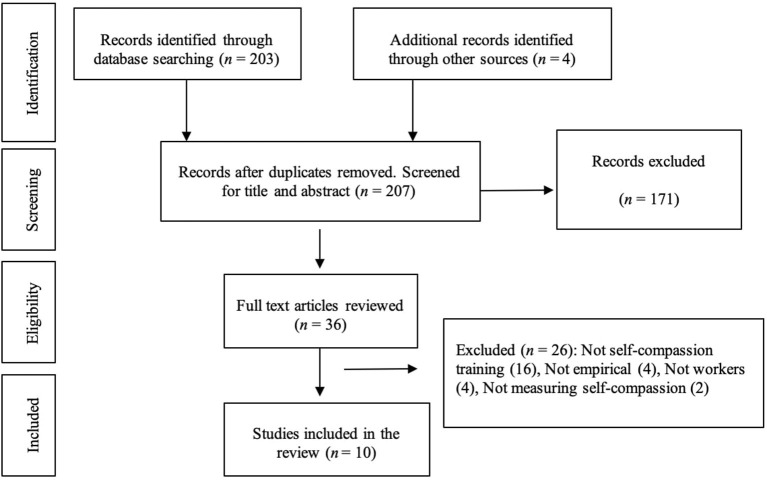
“Search Results The initial comprehensive literature search identified a total of 207 papers, including four papers (Shapiro et al., 2005; Frank et al., 2013; Roeser et al., 2013; Beshai et al., 2016) identified via manual searches of previous self-compassion reviews (Raab, 2014; Mills et al.”
BackgroundThe Human Quest for Meaning : Theories, Research, and Applications
Wong, P. T. P. (2012) · Cited by 680
Doing A Systematic Review: A Student’s Guide
Boland, A., Cherry, M. G., Dickson, R., & Carden, J. (2020) · International Coaching Psychology Review · doi:10.53841/bpsicpr.2020.15.2.119 · Cited by 642
Exploring self compassion and empathy in the context of mindfulness-based stress reduction (MBSR)
Birnie, K., Speca, M., & Carlson, L. E. (2010) · Stress and Health · doi:10.1002/smi.1305 · Cited by 600
The development of compassionate engagement and action scales for self and others
Gilbert, P., Catarino, F., Duarte, C., Matos, M., Kolts, R., Stubbs, J., Ceresatto, L., Duarte, J., Pinto-Gouveia, J., & Basran, J. (2017) · Journal of Compassionate Health Care · doi:10.1186/s40639-017-0033-3 · Cited by 527
Hollis-Walker, L., & Colosimo, K. (2011) · Personality and Individual Differences · doi:10.1016/j.paid.2010.09.033 · Cited by 498
Effects of Mindfulness-Based Stress Reduction on employees’ mental health: A systematic review
Janssen, M., Heerkens, Y., Kuijer, W., van der Heijden, B., & Engels, J. (2018) · PLOS ONE · doi:10.1371/journal.pone.0191332 · Cited by 415
(2009) · Cited by 407
Raab, K. (2014) · Journal of Health Care Chaplaincy · doi:10.1080/08854726.2014.913876 · Cited by 395 · cited 2×
“, 2016) identified via manual searches of previous self-compassion reviews (Raab, 2014; Mills et al., 2017; Janssen et al., 2018).”
BackgroundMethodA Reconsideration of the Self-Compassion Scale’s Total Score: Self-Compassion versus Self-Criticism
López, A., Sanderman, R., Smink, A., Zhang, Y., van Sonderen, E., Ranchor, A., & Schroevers, M. J. (2015) · PLOS ONE · doi:10.1371/journal.pone.0132940 · Cited by 380
Alkema, K., Linton, J. M., & Davies, R. S. (2008) · Journal of Social Work in End-of-Life & Palliative Care · doi:10.1080/15524250802353934 · Cited by 359
Promoting Self–Compassionate Attitudes Toward Eating Among Restrictive and Guilty Eaters
Adams, C. E., & Leary, M. R. (2007) · Journal of Social and Clinical Psychology · doi:10.1521/jscp.2007.26.10.1120 · Cited by 353
COVID-19 and employees’ mental health: stressors, moderators and agenda for organizational actions
Hamouche, S. (2020) · Emerald Open Research · doi:10.35241/emeraldopenres.13550.1 · Cited by 316 · cited 2×
“, pandemic related information overload), quarantine and reduction of social contact, stigma, and job insecurity (Hamouche, 2020).”
BackgroundDelaney, M. C. (2018) · PLoS ONE · doi:10.1371/journal.pone.0207261 · Cited by 292 · cited 27×
“…in eight studies worked in healthcare fields including doctors, nurses, social workers, human service professionals, and disability support workers (Pidgeon et al., 2014; Rao and Kemper, 2017; Sansó et al., 2017, 2019; Scarlet et al., 2017; Suyi et al., 2017; Delaney, 2018; Smith et al., 2019).”
BackgroundMethodInfluentialShonin, E., Van Gordon, W., Compare, A., Zangeneh, M., & Griffiths, M. D. (2015) · Mindfulness · doi:10.1007/s12671-014-0368-1 · Cited by 268 · cited 1×
“…for oneself, whereas Buddhism emphasizes happiness for others, particularly in the context of the core Buddhist teaching on the four immeasurable attitudes of (i) loving-kindness, (ii) compassion, (iii) appreciative joy, and (iv) equanimity for all beings (Peng and Shen, 2012; Shonin et al., 2015).”
BackgroundCallahan, J. L. (2010) · Human Resource Development Review · doi:10.1177/1534484310371492 · Cited by 265 · cited 1×
“The literature search focusing on where, when, who, how, what, and why (Callahan, 2010).”
BackgroundCebolla, A., García-Palacios, A., Soler, J., Guillen, V., Baños, R., & Botella, C. (2012) · The European Journal of Psychiatry · doi:10.4321/s0213-61632012000200005 · Cited by 263
The emerging role of Buddhism in clinical psychology: Toward effective integration.
Shonin, E., Gordon, W. V., & Griffiths, M. D. (2014) · Psychology of Religion and Spirituality · doi:10.1037/a0035859 · Cited by 253 · cited 1×
“However, the extent to which self-compassion reflects an entirely Buddhist-derived construct is currently unclear (Shonin et al., 2014).”
BackgroundPauley, G., & McPherson, S. (2009) · Psychology and Psychotherapy Theory Research and Practice · doi:10.1348/147608309x471000 · Cited by 241 · cited 1×
“Thus, selfcompassion is understood to be a good predictor of well-being at work because work-related well-being outcomes are impacted by self-kindness as part of adaptive soothing system functioning (Pauley and McPherson, 2010).”
BackgroundIndividual differences in self-esteem: A review and theoretical integration
Leary, M. R., & MacDonald, G. (2003) · Cited by 238
Eriksson, T., Germundsjö, L., Åström, E., & Rönnlund, M. (2018) · Frontiers in Psychology · doi:10.3389/fpsyg.2018.02340 · Cited by 225 · cited 2×
“, 2017), reduced burnout (Eriksson et al., 2018), and enhanced resilience (Delaney, 2018).”
BackgroundSasaki, N., Kuroda, R., Tsuno, K., & Kawakami, N. (2020) · Journal of Occupational Health · doi:10.1002/1348-9585.12134 · Cited by 217 · cited 1×
“Conversely, organizational COVID-19 mental health preventative measures are positively associated with job performance and psychological well-being (Sasaki et al., 2020).”
BackgroundMindfulness, Eating Behaviours, and Obesity: A Review and Reflection on Current Findings
Mantzios, M., & Wilson, J. C. (2015) · Current Obesity Reports · doi:10.1007/s13679-014-0131-x · Cited by 210
Frank, J. L., Reibel, D., Broderick, P., Cantrell, T., & Metz, S. (2015) · Mindfulness · doi:10.1007/s12671-013-0246-2 · Cited by 197 · cited 1×
“Search Results The initial comprehensive literature search identified a total of 207 papers, including four papers (Shapiro et al., 2005; Frank et al., 2013; Roeser et al., 2013; Beshai et al., 2016) identified via manual searches of previous self-compassion reviews (Raab, 2014; Mills et al.”
BackgroundGuides for reading and interpreting systematic reviews: I. Getting started.
Klassen, T. P., Jadad, A. R., & Moher, D. (1998) · PubMed · Cited by 170
Teaching the Mindful Self-Compassion Program: A Guide for Professionals
Miles, C. (2021) · Forensic Update · doi:10.53841/bpsfu.2021.1.136.113 · Cited by 142 · cited 2×
“…focus on self-compassion was excluded (e.g., resilience training that increased self-compassion; Kinman and Grant, 2017), however studies integrating mindfulness or other techniques as part of self-compassion training were included (e.g., the Mindful Self-Compassion Program; Germer and Neff, 2019).”
BackgroundBeshai, S., McAlpine, L., Weare, K., & Kuyken, W. (2016) · Mindfulness · doi:10.1007/s12671-015-0436-1 · Cited by 141
Existential positive psychology and integrative meaning therapy
Wong, P. T. P. (2020) · International Review of Psychiatry · doi:10.1080/09540261.2020.1814703 · Cited by 132
Dev, V., Fernando, A. T., Lim, A. G., & Consedine, N. S. (2018) · International Journal of Nursing Studies · doi:10.1016/j.ijnurstu.2018.02.003 · Cited by 127 · cited 2×
“, 2017), job satisfaction (Abaci and Arda, 2013), and burnout and barriers to compassion (Dev et al., 2018).”
BackgroundMontero‐Marín, J., Kuyken, W., Crane, C., Gu, J., Baer, R. A., Al-Awamleh, A. A., Akutsu, S., Araya-Véliz, C., Ghorbani, N., Chen, Z. J., et al. (2018) · Frontiers in Psychology · doi:10.3389/fpsyg.2018.02638 · Cited by 121 · cited 2×
“However, self-compassion can be perceived differently between cultures (Montero-Marin et al., 2018).”
BackgroundPidgeon, A. M., Ford, L., & Klaassen, F. (2013) · Psychology Health & Medicine · doi:10.1080/13548506.2013.806815 · Cited by 111 · cited 12×
“Four studies used a combination of mindfulness and self-compassion training (Pidgeon et al., 2014; Beshai et al., 2016; Suyi et al., 2017; Delaney, 2018).”
BackgroundMethodInfluentialThe effects of Compassion Cultivation Training (CCT) on health‐care workers
Scarlet, J., Altmeyer, N., Knier, S., & Harpin, R. E. (2017) · Clinical Psychologist · doi:10.1111/cp.12130 · Cited by 111 · cited 14×
“, 2017; Delaney, 2018), ranging from 20min (Scarlet et al., 2017) to 30min (Suyi et al.”
BackgroundMethodInfluentialRao, N., & Kemper, K. J. (2016) · Journal of Evidence-Based Complementary & Alternative Medicine · doi:10.1177/2156587216642102 · Cited by 110 · cited 9×
“, 2019), and seven studies used a within-subject pre-post design (Rao and Kemper, 2017; Sansó et al., 2017; Scarlet et al., 2017; Suyi et al., 2017; Delaney, 2018; Maratos et al., 2019; Smith et al., 2019).”
BackgroundMethodInfluentialKotera, Y., Laethem, M. V., & Ohshima, R. (2020) · Cross Cultural & Strategic Management · doi:10.1108/ccsm-02-2020-0055 · Cited by 110
Self-citationGermer, C., & Neff, K. (2019) · Handbook of Mindfulness-Based Programmes · doi:10.4324/9781315265438-28 · Cited by 103
Mahon, M. A., Mee, L., Brett, D., & Dowling, M. (2017) · Journal of research in nursing · doi:10.1177/1744987117721596 · Cited by 93
Evaluation of a Compassionate Mind Training Intervention with School Teachers and Support Staff
Maratos, F. A., Montague, J., Ashra, H., Welford, M., Wood, W., Barnes, C. R., Sheffield, D., & Gilbert, P. (2019) · Mindfulness · doi:10.1007/s12671-019-01185-9 · Cited by 89
Reizer, A. (2019) · Frontiers in Psychology · doi:10.3389/fpsyg.2019.01148 · Cited by 81 · cited 1×
“Self-compassion is also negatively associated with anxious and avoidant attachments, and positively associated with work performance, organizational prosocial behaviors and employment retention (Reizer, 2019).”
BackgroundKotera, Y., Green, P., & Sheffield, D. (2019) · Journal of Work and Organizational Psychology · doi:10.5093/jwop2019a15 · Cited by 78
Self-citationNeurolinguistic programming: a systematic review of the effects on health outcomes
Sturt, J. A., Ali, S., Robertson, W., Metcalfe, D., Grove, A., Bourne, C., & Bridle, C. (2012) · British Journal of General Practice · doi:10.3399/bjgp12x658287 · Cited by 75
Brooker, J., Julian, J., Webber, L., Chan, J., Shawyer, F., & Meadows, G. (2013) · Mindfulness · doi:10.1007/s12671-012-0112-7 · Cited by 72
Kotera, Y., & Sheffield, D. (2020) · SN Comprehensive Clinical Medicine · doi:10.1007/s42399-020-00309-w · Cited by 68
Self-citationWhat is Existential Positive Psychology
Wong, P. T. P. (2011) · Cited by 67
Suyi, Y., Meredith, P., & Khan, A. (2017) · EXPLORE · doi:10.1016/j.explore.2017.06.001 · Cited by 67 · cited 12×
“Risk of Bias The risk of bias in the nine non-randomized studies was mostly deemed to bemedium, indicated by a rating of 3-4 stars (medium: Rao and Kemper, 2017; Sansó et al., 2017; Scarlet et al., 2017; Suyi et al., 2017; Delaney, 2018; Maratos et al., 2019; Smith et al., 2019).”
BackgroundMethodResultInfluentialBrown, T. J., Pilkington, G., Bagust, A., Boland, A., Oyee, J., Smith, C. T., Blundell, M., Lai, M., Saborido, C. M., Greenhalgh, J., et al. (2013) · Health Technology Assessment · doi:10.3310/hta17310 · Cited by 64
Building Resilience in Early-Career Social Workers: Evaluating a Multi-Modal Intervention
Kinman, G., & Grant, L. (2016) · The British Journal of Social Work · doi:10.1093/bjsw/bcw164 · Cited by 62 · cited 1×
“…journal in English language *training that did not focus on self-compassion was excluded (e.g., resilience training that increased self-compassion; Kinman and Grant, 2017), however studies integrating mindfulness or other techniques as part of self-compassion training were included (e.g., the…”
BackgroundMental Health Attitudes, Self-Criticism, Compassion and Role Identity among UK Social Work Students
Kotera, Y., Green, P., & Sheffield, D. (2018) · The British Journal of Social Work · doi:10.1093/bjsw/bcy072 · Cited by 61
Self-citationGubbins, C., & Rousseau, D. M. (2015) · Human Resource Development Quarterly · doi:10.1002/hrdq.21214 · Cited by 59 · cited 1×
“More methodologically robust randomized controlled trials of self-compassion studies in worker populations are thus needed to address these issues, which has been identified as a need underlying research of this nature within contemporary organizational psychology (Gubbins and Rousseau, 2015).”
BackgroundWong, P. (2017) · The Humanistic Psychologist · doi:10.1037/hum0000062 · Cited by 59
Horan, K. A., & Taylor, M. B. (2018) · Journal of Contextual Behavioral Science · doi:10.1016/j.jcbs.2018.02.003 · Cited by 57
Kotera, Y., Sheffield, D., & Gordon, W. V. (2018) · Human Resource Development Quarterly · doi:10.1002/hrdq.21334 · Cited by 56
Self-citationPalliative care professionals' care and compassion for self and others: a narrative review
Mills, J., Wand, T., & Fraser, J. (2017) · International Journal of Palliative Nursing · doi:10.12968/ijpn.2017.23.5.219 · Cited by 52
Rojon, C., McDowall, A., & Saunders, M. N. K. (2011) · Journal of Personnel Psychology · doi:10.1027/1866-5888/a000041 · Cited by 51 · cited 2×
“Literature Search After consulting a subject librarian (Rojon et al., 2011), the following electronic research databases were used to conduct a comprehensive literature search: ProQuest, PsycINFO, Science Direct, and Google Scholar via EBSCO.”
MethodBrown, T. J., Pilkington, G., Boland, A., Oyee, J., Smith, C. T., Dundar, Y., Richards, E., Yang, R., & Dickson, R. (2013) · Health Technology Assessment · doi:10.3310/hta17060 · Cited by 48
Relationship between Self-compassion and Job Satisfaction in White Collar Workers
Abacı, R., & Arda, D. (2013) · Procedia - Social and Behavioral Sciences · doi:10.1016/j.sbspro.2013.12.255 · Cited by 41
Development and validation of a sympathy scale.
Uchida, Y., & Kitayama, S. (2001) · The Japanese journal of psychology · doi:10.4992/jjpsy.72.275 · Cited by 41
Mental Health and Work: Netherlands
OECD (2014) · Mental health and work · doi:10.1787/9789264223301-en · Cited by 38
Japanese managers’ experiences of neuro-linguistic programming: a qualitative investigation
Kotera, Y., & Gordon, W. V. (2019) · The Journal of Mental Health Training Education and Practice · doi:10.1108/jmhtep-06-2018-0033 · Cited by 34
Self-citationSystematic review: complementary therapies and employee well-being
Ravalier, J. M., Wegrzynek, P., & Lawton, S. (2016) · Occupational Medicine · doi:10.1093/occmed/kqw047 · Cited by 31 · cited 1×
“The selection of such terms was informed by prior systematic reviews evaluating psychological interventions in the workplace (e.g., Ravalier et al., 2016; Kotera et al., 2019a).”
MethodCultivating Emotional Balance in Professional Caregivers: a Pilot Intervention
Sansó, N., Galiana, L., Cebolla, A., Oliver, A., Benito, E., & Ekman, E. (2017) · Mindfulness · doi:10.1007/s12671-017-0707-0 · Cited by 27 · cited 6×
“Risk of Bias The risk of bias in the nine non-randomized studies was mostly deemed to bemedium, indicated by a rating of 3-4 stars (medium: Rao and Kemper, 2017; Sansó et al., 2017; Scarlet et al., 2017; Suyi et al., 2017; Delaney, 2018; Maratos et al., 2019; Smith et al., 2019).”
BackgroundInfluentialHenshall, L., Alexander, T., Molyneux, P., Gardiner, E., & McLellan, A. (2017) · Clinical Psychology & Psychotherapy · doi:10.1002/cpp.2157 · Cited by 27 · cited 1×
“, 2016), perceived organizational compassion and threat (Henshall et al., 2018), compassion for others (Mills et al.”
BackgroundDifferential Effects of Two Contemplative Practice-based Programs for Health Care Professionals
Sansó, N., Galiana, L., González, B., Sarmentero, J., Reynes, M., Oliver, A., & Garcı́a-Toro, M. (2019) · Psychosocial Intervention · doi:10.5093/pi2019a12 · Cited by 27 · cited 8×
“, 2014), two used non-equivalent groups design (Beshai et al., 2016; Sansó et al., 2019), and seven studies used a within-subject pre-post design (Rao and Kemper, 2017; Sansó et al.”
BackgroundMethodInfluentialBoiger, M., Vanderheiden, E., & Mayer, C.-H. (2017) · Springer eBooks · doi:10.1007/978-3-319-53100-7 · Cited by 19
Guides for Reading and Interpreting Systematic Reviews
Klassen, T. P., Jadad, A. R., & Moher, D. (1998) · Archives of Pediatrics and Adolescent Medicine · doi:10.1001/archpedi.152.7.700 · Cited by 16
The Analysis of Self-Compassion and Self-Construal in the Compassion-Contemplation of Buddhism
Yan-qin, P., & Jian-Dan, S. H. E. N. (2013) · Advances in Psychological Science · doi:10.3724/sp.j.1042.2012.01479 · Cited by 11
Wagner, L. K., Schindler, S., & Reinhard, M. (2017) · Frontiers in Psychology · doi:10.3389/fpsyg.2017.01353 · Cited by 11 · cited 1×
“This cultural characteristic is thought to arise as a result of positive attitudes toward challenges in learning, whereby self-compassion is deemed to temper the need for instant gratification or short-term reward (Wagner et al., 2017).”
BackgroundCan compassion help cure health-related disorders?
Shonin, E., Gordon, W. V., García‐Campayo, J., & Griffiths, M. D. (2017) · British Journal of General Practice · doi:10.3399/bjgp17x690329 · Cited by 10
Wang, C. (2020) · Educational Philosophy and Theory · doi:10.1080/00131857.2020.1777852 · Cited by 5 · cited 1×
“Consequently, it could be argued that the self-emphasis aspect of self-compassion runs antithetical to Buddhism’s focus on others and on dismantling self-oriented schemas (e.g., no-self realization; Wang, 2020).”
BackgroundSimões, D., Simões, S. C. C., Espírito‐Santo, H., Simões, D., Marques, M., & Lemos, L. (2016) · European Psychiatry · doi:10.1016/j.eurpsy.2016.01.1924 · Cited by 2 · cited 1×
“In work contexts, self-compassion is associated with improvements in (for example) healthy self-care behaviors (Horan and Taylor, 2018), optimism and organizational integrity (Simões et al., 2016), perceived organizational compassion and threat (Henshall et al.”
BackgroundSmith, K., Dandil, Y., Baillie, C., & Tchanturia, K. (2019) · Brain Sciences · doi:10.3390/brainsci9100247 · Cited by 1 · cited 17×
“…in eight studies worked in healthcare fields including doctors, nurses, social workers, human service professionals, and disability support workers (Pidgeon et al., 2014; Rao and Kemper, 2017; Sansó et al., 2017, 2019; Scarlet et al., 2017; Suyi et al., 2017; Delaney, 2018; Smith et al., 2019).”
BackgroundMethodInfluential
Research works printed but not linked: 4
- Hoofstede, 2010, Cultures and Organizations: Software of the Mind (3rd ed.)
- 2010, Report from Policy Committee for Mental Health at Work [Shokuba niokeru mental health taisakukentoukai houkokusho]
- Wong, 2012, From logotherapy to meaning-centered counseling and therapy, 619
- Wong, Made for Resilience and Happiness: Effective Coping With COVID-19 According to Viktor E. Frankl and Paul T. P. Wong
Cited by
Sorted by citations
Chan, X. W., Shang, S., Brough, P. A., Wilkinson, A. J., & Lu, C. (2022) · Asia Pacific Journal of Human Resources · doi:10.1111/1744-7941.12355 · Cited by 142
Self‐compassion in organizations: A review and future research agenda
Dodson, S. J., & Heng, Y. T. (2021) · Journal of Organizational Behavior · doi:10.1002/job.2556 · Cited by 112
Kotera, Y., Maxwell-Jones, R., Edwards, A., & Knutton, N. (2021) · International Journal of Environmental Research and Public Health · doi:10.3390/ijerph18105308 · Cited by 112
“Self-compassion interventions have begun to be utilised actively in healthcare, and the promising effects have been reported [65].”
BackgroundSelf-citationRushforth, A., Durk, M., Rothwell-Blake, G. A. A., Kirkman, A., Ng, F., & Kotera, Y. (2023) · International Journal of Environmental Research and Public Health · doi:10.3390/ijerph20126109 · Cited by 69
“Self-compassion as an intervention approach was shown to be primitive yet promising [43].”
BackgroundSelf-citationZhang, L. J., & Fathi, J. (2024) · System · doi:10.1016/j.system.2024.103433 · Cited by 61
Metadata
- Authors
- Kotera, Y., & Van Gordon, W.
- Affiliations
- University of Derby (GB)
- Corresponding author
- Kotera, Yasuhiro
- ORCID
- Kotera, Yasuhiro
- Venue
- Frontiers in Psychology
- Publisher
- Frontiers Media SA
- Published
- 2021-04-23
- Volume
- 12
- Pages
- 630798-630798
- ISSN
- 1664-1078 (ISSN-L)
- PMC
- PMC8102699
- OpenAlex
- W3159166417
- Cited by
- 127
- References
- 84
- Citations by year
- 2026: 22 · 2025: 27 · 2024: 30 · 2023: 27 · 2022: 17 · 2021: 4
- FWCI
- 2.59
- Type
- journal article
- Language
- en
- Open access
- gold
- doi.org
- Licence
- Locations
- Frontiers in Psychology (publishedVersion, cc-by)
- PubMed Central (publishedVersion, cc-by)
- PubMed (publishedVersion)
- University of Derby Online Research Archive. (University of Derby) (submittedVersion, cc-by)
- DOAJ (DOAJ: Directory of Open Access Journals) (submittedVersion, cc-by-sa)
- Topics
- Social Sciences › Psychology › Clinical Psychology › Mindfulness and Compassion Interventions
- Social Sciences › Psychology › Social Psychology › Psychological Well-being and Life Satisfaction
- Health Sciences › Medicine › Public Health, Environmental and Occupational Health › Workplace Health and Well-being
- Keywords
- self-compassion training, work-related well-being, employee mental health, self-compassion interventions, positive psychology interventions, caring professions, Self-Compassion Scale
About these checks
Registry, retraction, Cites and statistics results are computed, not judged, with one exception: a printed reference that no index lists is read once by a model before it counts as a citation error. Claims are extracted by a model and kept only when their quote appears verbatim in the text; each cited source is then checked, with a model’s help, for whether it says what the claim relies on. Those verdicts can be wrong — read the claim’s quote and the cited source before relying on one.
Statistics and arithmetic are recomputed, not judged.
Confidence bands are shown only for fields calibrated on our annotated test set. None is calibrated yet, so no band is shown.
What counts as a claim ›How we measure confidence ›How we check this ›
Are you an author, or do you see a problem with this page? Request a review
