

The Psychology of Resistance to Change: The Antidotal Effect of Organizational Justice, Support and Leader-Member Exchange
Open accessThe DOI matches its Crossref record; 103 of the 105 references it cites were found in a registry or an index, and 1 are not checked yet; none of the 52 sources its claims cite is checked for support yet.
Abstract
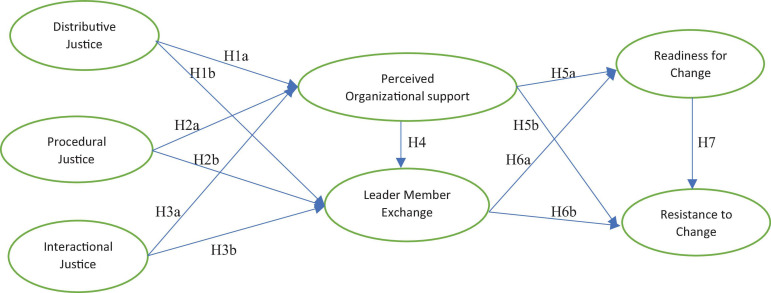
In today’s business environment, the survival and sustenance of any organization depend upon its ability to introduce a successful change. However, in implementing a change, one of the biggest problems an organization faces is resistance from its employees. The current paper addresses this problem by examining the role of organizational justice dimensions in coping with the resistance to change through the intervening role of perceived organizational support (POS), leader-member exchange (LMX), and readiness for change (RFC) in a sequential framework. Data of 372 employees have been collected from the banking industry of Pakistan. The results obtained through the Partial Least Squares- Structural Equation Modeling (PLS-SEM) approach using SmartPLS suggest that distributive justice, procedural justice, and interactional justice play a critical role in lowering the resistance to change through POS, LMX, and RFC, contributing significantly to the theory and practice. Furthermore, this study also discusses recommendations for future research and limitations associated with this research work.
Checked 2026-11-24 · 1 reference not checked yet
Overview
CoChat Summary
TL;DR
This study tests a sequential mediation model in which organizational justice dimensions reduce resistance to change through perceived organizational support (POS), leader-member exchange (LMX), and readiness for change (RFC) among 372 bank employees in Pakistan. PLS-SEM results support most direct and indirect paths, with distributive and procedural justice reaching resistance to change through POS→LMX→RFC, while the interactional justice→POS→LMX→RFC→RTC path is not supported.
Key findings
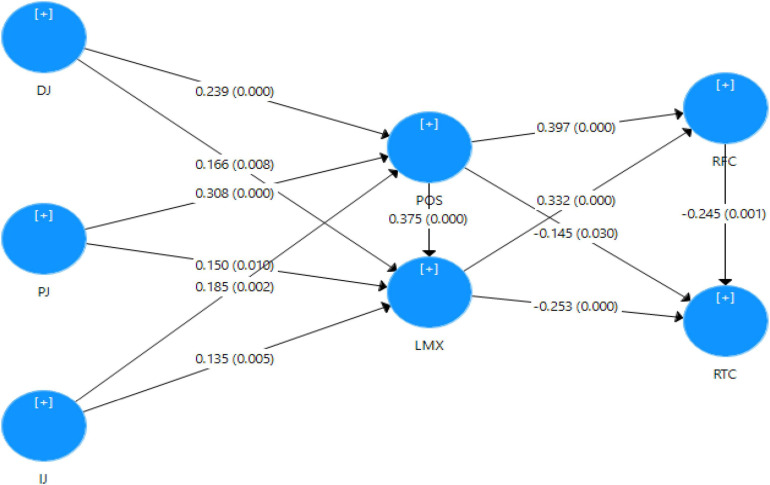
- Distributive, procedural, and interactional justice positively affected POS (β = 0.239, 0.308, 0.185) and LMX (β = 0.166, 0.150, 0.135); POS positively affected LMX (β = 0.375).
- POS and LMX positively affected RFC (β = 0.397; β = 0.332) and negatively affected RTC (β = −0.145; β = −0.253); RFC negatively affected RTC (β = −0.245).
- POS and LMX sequentially mediated the relationships from justice dimensions to RFC and RTC (H8a–H8f supported); POS→LMX→RFC→RTC was supported (β = −0.030, p = 0.020).
- DJ and PJ reached RTC through POS→LMX→RFC (β = −0.007, p = 0.041; β = −0.009, p = 0.032), but IJ→POS→LMX→RFC→RTC was not supported (β = −0.006, p = 0.074); H9a and H9b were also not supported.
Methods
- Cross-sectional survey of 372 lower and middle managers from the five largest private commercial banks in Pakistan; 1,200 questionnaires were distributed across 600 branches, 410 were returned (34.16% response rate), and 38 were discarded.
- Measures used seven-point Likert scales: Niehoff and Moorman’s organizational justice scale (5 distributive, 6 procedural, 9 interactional items), LMX-7, an 8-item POS scale, a 9-item RFC scale, and an 18-item RTC scale.
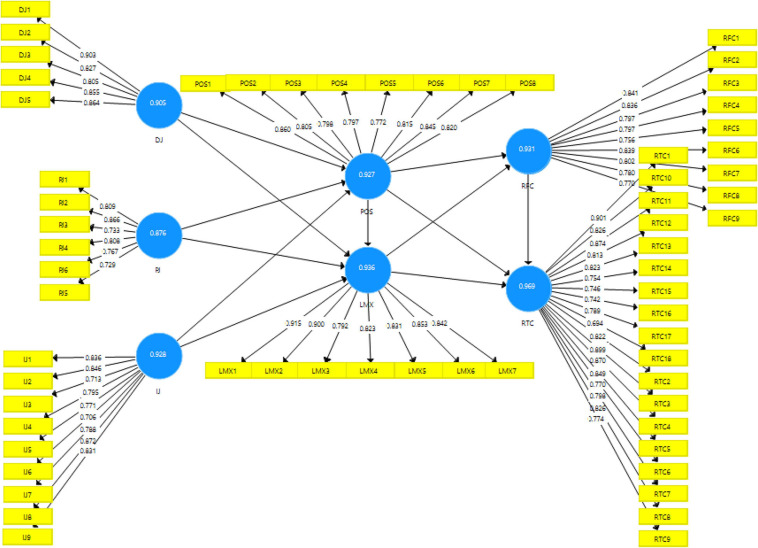
- Analysis used PLS-SEM via SmartPLS 3.2.6, including measurement model assessment (Cronbach’s alpha, CR, AVE, discriminant validity), structural model testing, and Hayes process bootstrapping for mediation; common method variance was assessed with Harman’s single-factor test (29% variance) and CFA with/without a common latent factor.
Limitations
- Stated: the cross-sectional design limits cause-and-effect conclusions; data came only from the banking industry; future research should use longitudinal data, manufacturing sectors, and other mediators such as organizational identification and organizational citizenship behavior.
- Evident: the sample is predominantly male (341/372, 91.67%) and lower management (323/372, 86.83%), drawn from Punjab province, which may limit generalizability.
- Evident: all variables were self-reported, though the authors report ex-ante and ex-post remedies for common method variance.
Model-written summary. Check it against the paper before relying on it.
Integrity signals
Registry
Cites
Statistics
Figures
Verification
Claims the paper makes
0 Valid · 2 Not valid · 39 Not checked · 71 Own results and interpretations
A result the paper reports from its own data — it cites no other source for it, so there is none to check. The quote shows it is in the paper.
In the paper
“So, it turns out that the RFC is an effective predictor of lowering the resistance to change.”
- Also stated in: § Structural Model · boosted
“In the end, H7 has also been supported (β = 0.245, p < 0.001), representing that RFC has a significant negative impact on RTC.”
- Also stated in: § Structural Model · plain
“H7 | RFC - > RTC | −0.245 | 3.430 | 0.001 | Supported”
§ The Psychology of Resistance to Change: The Antidotal Effect of Organizational Justice, Support and Leader-Member Exchange > Background and Hypotheses Development > Readiness for Change and Resistance to Change
boostedstates a cause- Asserted: passes — The authors put it forward as true.
- Checkable: passes — It can be checked against evidence.
- Load-bearing: passes — The paper’s conclusions depend on it.
- Based: passes — The paper gives a reason why it holds.
- Also stated in: § Structural Model · boosted
A result the paper reports from its own data — it cites no other source for it, so there is none to check. The quote shows it is in the paper.
In the paper
“The results obtained through the Partial Least Squares- Structural Equation Modeling (PLS-SEM) approach using SmartPLS suggest that distributive justice, procedural justice, and interactional justice play a critical role in lowering the resistance to change through POS, LMX, and RFC”
§ The Psychology of Resistance to Change: The Antidotal Effect of Organizational Justice, Support and Leader-Member Exchange > Abstract
hedgedstates a cause- Asserted: passes — The authors put it forward as true.
- Checkable: passes — It can be checked against evidence.
- Load-bearing: passes — The paper’s conclusions depend on it.
- Based: passes — The paper gives a reason why it holds.
A result the paper reports from its own data — it cites no other source for it, so there is none to check. The quote shows it is in the paper.
In the paper
“H4 | POS - > LMX | 0.375 | 4.335 | 0.000 | Supported”
§ The Psychology of Resistance to Change: The Antidotal Effect of Organizational Justice, Support and Leader-Member Exchange > Methodology > Structural Model
plainstates a cause- Asserted: passes — The authors put it forward as true.
- Checkable: passes — It can be checked against evidence.
- Load-bearing: passes — The paper’s conclusions depend on it.
- Based: passes — The paper gives a reason why it holds.
A result the paper reports from its own data — it cites no other source for it, so there is none to check. The quote shows it is in the paper.
In the paper
“H9e | PJ - > POS - > RFC - > RTC | −0.030 | 2.581 | 0.010 | Supported”
§ The Psychology of Resistance to Change: The Antidotal Effect of Organizational Justice, Support and Leader-Member Exchange > Methodology > Structural Model
plainstates a cause- Asserted: passes — The authors put it forward as true.
- Checkable: passes — It can be checked against evidence.
- Load-bearing: passes — The paper’s conclusions depend on it.
- Based: passes — The paper gives a reason why it holds.
- Rests on an assumption not shown here.
A result the paper reports from its own data — it cites no other source for it, so there is none to check. The quote shows it is in the paper.
In the paper
“H11b | PJ - > POS - > LMX - > RFC - > RTC | −0.009 | 2.145 | 0.032 | Supported”
§ The Psychology of Resistance to Change: The Antidotal Effect of Organizational Justice, Support and Leader-Member Exchange > Methodology > Structural Model
plainstates a cause- Asserted: passes — The authors put it forward as true.
- Checkable: passes — It can be checked against evidence.
- Load-bearing: passes — The paper’s conclusions depend on it.
- Based: passes — The paper gives a reason why it holds.
- Rests on an assumption not shown here.
62 more claims
Create a free account to see all 112 claims and to verify the 45 references still open.
- It may state two separate claims as one. 24
- Probably not a substantial claim. 26
Self-check
Percentages, sums and reported differences re-computed from the paper’s own numbers.
Each contradiction between two passages listed here was confirmed by an independent check.
Rated minor: it would not touch a result — a value no result rests on, a p-value that stays on the same side of the significance level, or a conflict that is clerical, resolved elsewhere in the paper, or outside its own findings.
In the paper
§ The Psychology of Resistance to Change: The Antidotal Effect of Organizational Justice, Support and Leader-Member Exchange > Methodology > Sample and Procedure
“The dominant group of respondents was lower management with ages between 31 and 40 years and experience of more than 10 years.”
§ The Psychology of Resistance to Change: The Antidotal Effect of Organizational Justice, Support and Leader-Member Exchange > Methodology > Sample and Procedure
“| Less than or equal to 10 years | 259 | 69.62 | 69.62 |”
Rated minor: it would not touch a result — a value no result rests on, a p-value that stays on the same side of the significance level, or a conflict that is clerical, resolved elsewhere in the paper, or outside its own findings.
In the paper
§ The Psychology of Resistance to Change: The Antidotal Effect of Organizational Justice, Support and Leader-Member Exchange > Methodology > Structural Model
“Similarly, LMX is significantly influenced by DJ (β = 0.166, p < 0.006), PJ (β = 0.150, p < 0.008), and IJ (β = 0.135, p < 0.007), which support hypotheses H2a, H2b, and H3c, respectively.”
§ The Psychology of Resistance to Change: The Antidotal Effect of Organizational Justice, Support and Leader-Member Exchange > Methodology > Structural Model
“| H1b | DJ - > LMX | 0.166 | 2.750 | 0.006 | Supported |”
Rated minor: it would not touch a result — a value no result rests on, a p-value that stays on the same side of the significance level, or a conflict that is clerical, resolved elsewhere in the paper, or outside its own findings.
In the paper
§ The Psychology of Resistance to Change: The Antidotal Effect of Organizational Justice, Support and Leader-Member Exchange > Methodology > Structural Model
“H7 has also been supported (β = 0.245, p < 0.001), representing that RFC has a significant negative impact on RTC.”
§ The Psychology of Resistance to Change: The Antidotal Effect of Organizational Justice, Support and Leader-Member Exchange > Methodology > Structural Model
“| H7 | RFC - > RTC | −0.245 | 3.430 | 0.001 | Supported |”
Rated minor: it would not touch a result — a value no result rests on, a p-value that stays on the same side of the significance level, or a conflict that is clerical, resolved elsewhere in the paper, or outside its own findings.
In the paper
§ The Psychology of Resistance to Change: The Antidotal Effect of Organizational Justice, Support and Leader-Member Exchange > Methodology > The Measurement Model (Confirmatory Factor Analysis)
“The values of loadings and AVE were above the threshold levels of 0.7 and 0.5, respectively”
§ The Psychology of Resistance to Change: The Antidotal Effect of Organizational Justice, Support and Leader-Member Exchange > Methodology > The Measurement Model (Confirmatory Factor Analysis)
“| RTC | 0.969 | 0.972 | 0.658 | 0.901–0.694 | 2.13–4.21 |”
Citations
Cites
Evaluating Structural Equation Models with Unobservable Variables and Measurement Error
Fornell, C., & Larcker, D. F. (1981) · Journal of Marketing Research · doi:10.2307/3151312 · Cited by 109,314
Evaluating structural equation models with unobservable variables and measurement error
Fornell, C., & Larcker, D. F. (1981) · Journal of Marketing Research · doi:10.1177/002224378101800104 · Cited by 109,190
Podsakoff, P. M., MacKenzie, S. B., Lee, J.-Y., & Podsakoff, N. P. (2003) · Journal of Applied Psychology · doi:10.1037/0021-9010.88.5.879 · Cited by 82,194
Sources of method bias in social science research and recommendations on how to control it
Podsakoff, P. M., MacKenzie, S. B., & Podsakoff, N. P. (2012) · Annual Review of Psychology · doi:10.1146/annurev-psych-120710-100452 · Cited by 15,744
Exchange and Power in Social Life.
Bierstedt, R., & Blau, P. M. (1965) · American Sociological Review · doi:10.2307/2091154 · Cited by 13,624
Adams, J. S. (1965) · Advances in Experimental Social Psychology · doi:10.1016/s0065-2601(08)60108-2 · Cited by 10,818 · cited 1×
“Among dimensions of organizational justice, distributive justice derives its roots from equity theory (Adams, 1965), and refers to an employee’s perception of the distribution of organizational rewards and outcomes (Niehoff and Moorman, 1993).”
BackgroundPerceived organizational support.
Eisenberger, R., Huntington, R., Hutchison, S., & Sowa, D. (1986) · Journal of Applied Psychology · doi:10.1037/0021-9010.71.3.500 · Cited by 10,023
Perceived organizational support: a review of the literature.
Rhoades, L., & Eisenberger, R. (2002) · Journal of Applied Psychology · doi:10.1037/0021-9010.87.4.698 · Cited by 7,592
Mathieu, J. E., & Zajac, D. M. (1990) · Psychological Bulletin · doi:10.1037//0033-2909.108.2.171 · Cited by 6,449
Structural Equation Modeling and Regression: Guidelines for Research Practice
Gefen, D., Straub, D., & Boudreau, M.-C. (2000) · Communications of the Association for Information Systems · doi:10.17705/1cais.00407 · Cited by 6,416
Research works printed but not linked: 6
- Ciliana F. Mansoer W. (2008). Pengaruh kepuasan kerja, keterlibatan kerja, stress kerja, dan komitmen organisasi terhadap kesiapan untuk berubah pada karyawan PT Bank Y. J. Psikol. Sos. 14 151– 164.
- Fasolo P. M. (1995). “Procedural justice and perceived organizational support: hypothesized effects on job performance,” in Organizational Politics, Justice, and Support: Managing Social Climate at Work, eds Cropanzano R. Kacmar K. M. (Westport, CT: Quorum Press), 185– 195.
- Meaney M. Pung C. (2008). McKinsey global results: creating organizational transformations. McKinsey Q. 7 1– 7.
- Robbins D. L. Galperin B. L. (2010). Constructive deviance: striving toward organizational change in healthcare. J. Manag. Mark. Res. 5, 1– 11.
- Robins S. P. Judge T. A. Vohra N. (2011). Organization Behaviour, India Person Education. Inc.
- Shore L. M. Shore T. H. (1995). “Perceived organizational support and organizational justice,” in Cropanzano R. Kacmar M. (eds) Organizational Politics, Justice and Support: Managing the Social Climate of the Workplace, Westport, CT: Quorum. Vol. 149: 164
Cited by
Integrating Artificial Intelligence into Public Administration: Challenges and Vulnerabilities
Vatamanu, A. F., & Tofan, M. (2025) · Administrative Sciences · doi:10.3390/admsci15040149 · Cited by 198
Li, C., Ashraf, S. F., Amin, S., & Safdar, M. N. (2023) · SAGE Open · doi:10.1177/21582440231217731 · Cited by 90
DIGITAL TRANSFORMATION IN BANKING: A REVIEW OF NIGERIA'S JOURNEY TO ECONOMIC PROSPERITY
Lottu, O. A., Abdul, A. A., Daraojimba, D. O., Alabi, A. M., John-Ladega, A. A., & Daraojimba, C. (2023) · International Journal of Advanced Economics · doi:10.51594/ijae.v5i8.572 · Cited by 79
The ‘side effects’ of digitalization: A study on role overload and job burnout of employees
Zhang, Q., Dai, W., Chen, J., Gu, Y., & Zhao, Y. (2025) · PLoS ONE · doi:10.1371/journal.pone.0322112 · Cited by 60
Khan, M., Mahmood, A., & Shoaib, M. (2022) · Sustainability · doi:10.3390/su141711055 · Cited by 54
Self-citationEthical Considerations in Organizational Conflict
Hyatt, J., & Gruenglas, J. (2023) · IntechOpen eBooks · doi:10.5772/intechopen.1002645 · Cited by 53
Rahman, M. H., Ahmad, A., & Sawal, M. Z. H. M. (2024) · Information Development · doi:10.1177/02666669241257196 · Cited by 41
Mahroof, J., Rafi, A., & Ahmad, A. (2025) · Technology in Society · doi:10.1016/j.techsoc.2025.102964 · Cited by 40
When colleague got recognized: Third-party’s reaction to witnessing employee recognition
Yang, T., & Xia, J. (2023) · Frontiers in Psychology · doi:10.3389/fpsyg.2023.968782 · Cited by 40
Bunnag, T. (2023) · International Journal of Energy Economics and Policy · doi:10.32479/ijeep.14088 · Cited by 37
Assessing The Impact of Financial Service Digitalization on SME Businesses In Lagos, Nigeria
Olatunji, F., Sajuyigbe, A. S., Rahmon, T. A., Oke, O. D., Babalola, O. A., & Adebayo, W. (2025) · Journal of Entrepreneur & Business · doi:10.24123/jeb.v6i1.7212 · Cited by 31
Kabanda, M. (2025) · EIKI Journal of Effective Teaching Methods · doi:10.59652/jetm.v3i1.404 · Cited by 29
Al-Jundi, S. A., الجنابي, ه. ع. ا., Salam, M. A., Bajaba, S. M., & Ullah, S. (2022) · Frontiers in Psychology · doi:10.3389/fpsyg.2021.831014 · Cited by 29
The Quantum Technology Open Master: widening access to the quantum industry
Goorney, S., Sarantinou, M., & Sherson, J. F. (2024) · EPJ Quantum Technology · doi:10.1140/epjqt/s40507-024-00217-1 · Cited by 24
Koh, W. Q., Hoel, V., Casey, D., & Toomey, E. C. (2022) · Journal of the American Medical Directors Association · doi:10.1016/j.jamda.2022.09.010 · Cited by 24
Aldabbas, H., Elamın, A. M., & Ahmed, A. Z. E. (2025) · Cogent Business & Management · doi:10.1080/23311975.2025.2514807 · Cited by 24
OVERCOMING RESISTANCE TO INNOVATION: STRATEGIES AND CHANGE MANAGEMENT
Xue, Z., Nasir, N. S. M., Yanping, C., Weifeng, W., & Cao, Y. (2024) · Journal of Business Innovation · Cited by 24
Shekoni, O., Iversen, S. A., Jiménez-Díaz, G., Aune, A., Ubuane, P. O., Imam, Z. O., & André, B. (2024) · SAGE Open Medicine · doi:10.1177/20503121231224568 · Cited by 22
Data-Driven Agility: Assessing Agile Culture transformation in a technology organisation
Uwasomba, C. F., Deshpande, A., Sharp, H., Gregory, P., Willis, R., Barroca, L., Uwadi, M., & Taylor, K. (2025) · Information and Software Technology · doi:10.1016/j.infsof.2025.107729 · Cited by 22
Integrating Lean Management and Circular Economy for Sustainable Dentistry
Αντωνιάδου, Μ. (2024) · Sustainability · doi:10.3390/su162210047 · Cited by 19
Jiang, B., Kumar, T., Rehman, N., Hameed, R., Kızıloğlu, M., & Israr, A. (2022) · Frontiers in Psychology · doi:10.3389/fpsyg.2022.834041 · Cited by 19
Self-citationHidayat, R., Patras, Y. E., Marini, A., Sarifah, I., & Nurjannah, N. (2023) · JMKSP (Jurnal Manajemen Kepemimpinan dan Supervisi Pendidikan) · doi:10.31851/jmksp.v8i1.9080 · Cited by 19
Salama, W., Khairy, H. A., Badwy, H. E., Almaaitah, R. A., Mohammed, S. A., & Elsokkary, H. H. K. A. (2024) · Environment and Social Psychology · doi:10.59429/esp.v9i11.3251 · Cited by 16
Reimer, M., Haensse, L., & Lin‐Hi, N. (2024) · Journal of Organizational Change Management · doi:10.1108/jocm-03-2024-0125 · Cited by 15
Braßler, M. (2025) · Discover Sustainability · doi:10.1007/s43621-025-02078-9 · Cited by 14
Bakir, B., & Tyas, A. A. W. P. (2024) · Jurnal Minfo Polgan · doi:10.33395/jmp.v13i1.13689 · Cited by 12
Colombo, L., Maran, D. A., & Grandi, A. (2023) · Frontiers in Psychology · doi:10.3389/fpsyg.2023.1122763 · Cited by 11
Bapayeva, S. T., Tarman, B., Kassymzhanova, A. A., Hananyan, A., & Kudaibergenova, S. K. (2024) · Humanities and Social Sciences Communications · doi:10.1057/s41599-024-04079-x · Cited by 11
Dumbi, K. S., & Indrasari, S. Y. (2024) · REID (Research and Evaluation in Education) · doi:10.21831/reid.v10i2.72081 · Cited by 11
Impact of organizational justice dimensions on social exchange theory constructs: a literature
Schierholt, M. I., de Souza, K. F. R., de Queiroz, R. G., & Gimenes, R. M. T. (2023) · Revista de Gestão e Secretariado (Management and Administrative Professional Review) · doi:10.7769/gesec.v14i12.2878 · Cited by 11
Susantinah, N., Jusman, I. A., & Ardi, M. (2023) · Journal of Contemporary Administration and Management (ADMAN) · doi:10.61100/adman.v1i3.88 · Cited by 11
Workplace Strategies to Reduce Burnout in Veterinary Nurses and Technicians: A Delphi Study
Chapman, A. J., Bennett, P. C., & Rohlf, V. (2025) · Animals · doi:10.3390/ani15091257 · Cited by 10
Intrapreneurial Factors Influencing Organizational Citizenship Behaviour in Mobile Brigade Corps
Hidayat, S., Meria, L., Purwohedi, U., Safariningsih, R. T. H., Kosasih, F. G., & Budiarti, S. (2026) · Aptisi Transactions On Technopreneurship (ATT) · doi:10.34306/att.v8i1.611 · Cited by 10
The Role of Education in Fostering Entrepreneurial Mindset
Virk, N. K., & Gambhir, J. (2024) · Advances in business strategy and competitive advantage book series · doi:10.4018/979-8-3693-5426-1.ch002 · Cited by 10
Quality mindset: applying implicit theories to quality management
Manzani, Y. E. (2025) · International Journal of Quality & Reliability Management · doi:10.1108/ijqrm-05-2025-0153 · Cited by 9
Trust in management, change resistance and work engagement on startup employees in Indonesia
Aziza, D. F., & Nadia, F. N. D. (2023) · Jurnal Ilmiah Psikologi Terapan · doi:10.22219/jipt.v11i2.26074 · Cited by 9
Digital health for environmentally sustainable cancer screening
Benedetto, V., Mainardi, V., Pennucci, F., Damone, A., Ciuti, G., & Nuti, S. (2025) · npj Digital Medicine · doi:10.1038/s41746-025-01561-x · Cited by 9
Tan‐Lim, C. S. C., Javelosa, M. A. U., Sanchez, J. T., Dans, L. F., Rey, M. P., Elepaño, A. G., Mesa, R. Y. H. D., & Dans, A. L. (2024) · BMJ Open Quality · doi:10.1136/bmjoq-2024-002788 · Cited by 9
Artisanal fishers and seaweed farmers’ engagement in Blue Economy in Zanzibar
Mwanyoka, I. R., Said, M. K., Peter, K. H., & Kaswamila, A. (2025) · Marine Policy · doi:10.1016/j.marpol.2025.106587 · Cited by 9
Nazaria, R., Wijaya, I. M. S., Pranudia, A. D., Dzulhiba, Wirawan, D., Male, H. D. C., & Veranita, M. (2024) · RADINKA JOURNAL OF SCIENCE AND SYSTEMATIC LITERATURE REVIEW · doi:10.56778/rjslr.v2i1.246 · Cited by 9
Suyuthi, N. F., Amaliah, A., & Linggi, T. (2025) · Journal Development Manecos · doi:10.71435/604109 · Cited by 9
Resistance to Change in the Romanian Educational System: Challenges and Opportunities
Dârjan, I. (2024) · Journal of Educational Sciences · doi:10.35923/jes.2024.1.10 · Cited by 9
Yap, C. Y. L., Daniel, C., Cheng, L., Oliffe, J. L., & Gerdtz, M. F. (2024) · International Journal of Nursing Studies · doi:10.1016/j.ijnurstu.2024.104719 · Cited by 7
Luna, A. M. D., & Encio, H. A. (2023) · European Journal of Business Management and Research · doi:10.24018/ejbmr.2023.8.4.2060 · Cited by 7
Asniwati, A., & Ramadhan, A. N. J. (2025) · Economics and Digital Business Review · doi:10.37531/ecotal.v6i1.2235 · Cited by 7
Neuroleadership and Its Role in Educational Settings: A Review of Current Practices
Antonopoulou, H. (2024) · Technium Education and Humanities · doi:10.47577/teh.v10i.11976 · Cited by 6
Faller, N. L. (2025) · Environment and Social Psychology · doi:10.59429/esp.v9i12.3300 · Cited by 6
Crafting a Winning Workplace Culture: Understanding Organizational Dynamics Using AI Tools
Ghannam, Y. P. (2024) · Advances in business information systems and analytics book series · doi:10.4018/979-8-3693-6447-5.ch002 · Cited by 6
Hossain, M. N., Hidayat-ur-Rehman, I., Bao, Y., & Hoque, M. R. (2026) · Journal of Manufacturing Technology Management · doi:10.1108/jmtm-08-2025-0824 · Cited by 5
Mehmood, S. (2024) · Journal of Digitovation and Information System · doi:10.54433/jdiis.2024100044 · Cited by 5
Gender Disparity Index in European Former Communist States: Assessing the Influence of EU Membership
Pîrju, I. S., Panaitescu, M. C., Șorcaru, S.-L., Marinescu, L. M., & Popa, D. A. T. (2024) · Administrative Sciences · doi:10.3390/admsci14040073 · Cited by 5
ANALYSIS OF SUPPORTING FACTORS ON READINESS FOR CHANGE AT PT PLN (PERSERO) SUMATERA BARAT
Prakoso, R., Rivai, H. A., & Lukito, H. (2022) · Jurnal Mantik · doi:10.35335/mantik.v6i2.2507 · Cited by 5
Rijanti, T., Yunianto, A., Priyono, B. S., Prabowo, R. E., & Sudiyatno, B. (2023) · Problems and Perspectives in Management · doi:10.21511/ppm.22(1).2024.07 · Cited by 5
The Impact of Work Culture and Understanding Capabilities on Change Success
Soliz, C. (2025) · Open Journal of Business and Management · doi:10.4236/ojbm.2025.131034 · Cited by 4
Nguyen, L., Lee, A., Hastie, M. J., & Hagn, E. E. (2023) · Anesthesia & Analgesia · doi:10.1213/ane.0000000000006658 · Cited by 4
The experiences of counselors caring for children and adolescents with problematic smartphone use
Joung, J., Oh, E., & Lee, E. J. (2023) · Scientific Reports · doi:10.1038/s41598-023-39494-8 · Cited by 4
Building a nomological network for creative learning transfer focusing on leadership development
Kim, J., Beyerlein, M., Wang, J., & Han, S. J. (2023) · Leadership & Organization Development Journal · doi:10.1108/lodj-01-2023-0019 · Cited by 4
The effect of LMX on performance: Cyberloafing and commitment as serial mediators
Ülbeği, İ. D., & İplik, E. (2025) · South African Journal of Business Management · doi:10.4102/sajbm.v56i1.5243 · Cited by 4
Ye, J., & Morris, G. R. (2025) · Advances in higher education and professional development book series · doi:10.4018/979-8-3693-9102-0.ch005 · Cited by 4
Lecardeur, L. (2022) · Journal de gestion et d économie médicales · doi:10.54695/jdds.040.0203.116135 · Cited by 4
Framing Potential Influences of Digital Transformation of Manufacturing SMEs
Zürn, S., & Joe, M. (2024) · Open Journal of Business and Management · doi:10.4236/ojbm.2024.125182 · Cited by 3
Lindig, A., Mannagottera, L., Hahlweg, P., Sigl, H., Klimesch, A., Zeh, S., Kriston, L., & Scholl, I. (2024) · Health Expectations · doi:10.1111/hex.14030 · Cited by 3
Herrmann, S., Giesel-Gerstmeier, J., Demuth, A., & Fenske, D. (2024) · Journal of Multidisciplinary Healthcare · doi:10.2147/jmdh.s446896 · Cited by 3
Tatlı, H. S., Eyitmiş, A. M., & Zümrüt, M. Z. (2025) · Organizacija · doi:10.2478/orga-2025-0017 · Cited by 3
Gumede, L., Hazell, L. J., & Lewis, S. (2024) · Journal of medical imaging and radiation sciences · doi:10.1016/j.jmir.2024.101795 · Cited by 3
Ahmadzai, Z. (2023) · Journal Social Civilecial · doi:10.71435/610484 · Cited by 3
Principals’ Use of Leadership Metaphors in Three Urban Junior High Schools in Taiwan
Whang, N.-Y. (2024) · Urban Education · doi:10.1177/00420859241279448 · Cited by 3
Work-Related Stress and Uncertainty Amid Change: Can Workplace Coaching Make a Difference?Preprint
Ebrahimi, M. (2023) · doi:10.33774/coe-2023-zxnkt-v3 · Cited by 3
Noh, K. B. (2026) · Asia Pacific Journal of Human Resources · doi:10.1111/1744-7941.70062 · Cited by 3
Effective Talent Retention Strategies Employed by Information Technology Managers in Ghana
Nyame, I. M. (2024) · ScholarWorks (Walden University) · Cited by 3
Terapan Ilmu PembelajaranPreprint
Wijayanto, A. (2023) · OSF Preprints (OSF Preprints) · doi:10.31219/osf.io/a3wq6 · Cited by 2
The New Normal: The Challenges and Opportunities of Freelancing and Remote Work for HR Departments
Chabani, Z., Sergio, R. P., & Hoffman, E. P. (2023) · Studies in systems, decision and control · doi:10.1007/978-3-031-39158-3_79 · Cited by 2
Navigating the Future: Industry 4.0 Adoption in Accounting Through the TOE Framework.
Oluka, A. (2025) · International Journal of Applied Research in Business and Management · doi:10.51137/wrp.ijarbm.2025.aont.45738 · Cited by 2
Ahmed, A. Z. E., Elamın, A. M., & Aldabbas, H. (2025) · Journal of Posthumanism · doi:10.63332/joph.v5i5.1826 · Cited by 2
Data Science for Quality Management
Vaghela, D. A., Chaudhari, A. Z., Balar, P. C., Kumar, A., Solanki, H., & Chavda, V. P. (2025) · Wiley eBooks · doi:10.1002/9781394287383.ch8 · Cited by 2
Code Red: Fighting Fires, Racism, and Policies in Emergency Safety Services
Wright, J. E., Cox, C., & Pham, V. (2026) · Review of Public Personnel Administration · doi:10.1177/0734371x251411200 · Cited by 2
Ebrahimi, M. (2025) · International Journal of Management Thinking · doi:10.56868/ijmt.v3i1.90 · Cited by 2
Authentic leadership in law enforcement: Narratives of transformation
Ginete, R. R., & Caballero, N. (2025) · Industry and Academic Research Review · doi:10.53378/iarr.185 · Cited by 2
Strategies to Recruit Workers With Critical Skills in Canadian Small Automotive Repairs Businesses
Hyman, J. T. (2024) · ScholarWorks (Walden University) · Cited by 2
Data Challenges in Sports Organizations
Schwizer, D., & Burch, M. (2025) · Management for professionals · doi:10.1007/978-3-032-10993-4_3 · Cited by 2
Rasheed, A., Atta, N., & Sohail, T. (2024) · International Journal of Studies in Psychology · doi:10.38140/ijspsy.v4i2.1162 · Cited by 2
Lubis, S. (. A., Mustanir, A. (. )., Nonci, N. (., S, M. N. (., Nur, M. (., D, H. D. (., Jabbar, A. (., Irwan, I. (., Sundari, S. K. (., Sellang, K. (., et al. (2024) · Neliti · Cited by 2
Dirgantara, M. I., Sulastiana, M., & Yanuarti, N. (2025) · IDEA Jurnal Psikologi · doi:10.32492/idea.v9i2.92013 · Cited by 2
YAN, B. (2024) · Durham e-Theses (Durham University) · Cited by 2
Kirsten, M. (2025) · SA Journal of Human Resource Management · doi:10.4102/sajhrm.v23i0.3213 · Cited by 2
Botelho, É. D. A. (2022) · RIUnB Institutional Repository (University of Brasília) · doi:10.26512/2022.10.t.44969 · Cited by 2
Abozenadah, H. (2024) · Dublin City University Open Access Institutional Repository (Dublin City University) · Cited by 2
Wangang, S. N. (2024) · International Journal of Innovative Science and Research Technology (IJISRT) · doi:10.38124/ijisrt/ijisrt24jul1919 · Cited by 2
Amin, M. U., & Zaman, S. U. (2025) · Physical Education Health and Social Sciences · doi:10.63163/jpehss.v3i1.199 · Cited by 2
Investigating Employee Resistance and Strategies for Transformation on New Ideas at Workplace
Harun, W. M. A. W., Maideen, M. B. H., & Rahuman, S. A. H. (2025) · International Journal of Academic Research in Business and Social Sciences · doi:10.6007/ijarbss/v15-i12/27133 · Cited by 2
Pedagogues' subjective perception of the education digitalization problems
Lenkov, S. L., Rubtsova, N. E., & Efremova, G. I. (2022) · Yaroslavl Pedagogical Bulletin · doi:10.20323/1813-145x-2022-2-125-126-139 · Cited by 2
Li, L., & Erorita, S. M. (2025) · Innovative Organizational Design · doi:10.63808/iod.v1i2.180 · Cited by 2
Jaran, F. Z., & Ali, A. J. (2025) · International Journal of Academic Research in Economics and Management Sciences · doi:10.6007/ijarems/v14-i3/26565 · Cited by 2
Organizational Learning, Change Management and Performance of Governmental Agencies in Nigeria
Omokhuale, C. O. P. S., & Omokhuale, P. S. (2026) · JOURNAL OF BUSINESS AND AFRICAN ECONOMY · doi:10.56201/jbae.vol.11.no1.2025.pg88.101 · Cited by 2
Shekoni, O., & Iversen, S. A. (2022) · NVA (Nasjonalt vitenarkiv) · Cited by 2
Amoako, F., & Asuamah, S. Y. (2023) · RePEc: Research Papers in Economics · Cited by 2
Ade-Ojo, G. O., & Duckworth, V. (2024) · International Journal of Lifelong Education · doi:10.1080/02601370.2024.2365797 · Cited by 1
Kilawe, F. (2024) · African Journal of Empirical Research · doi:10.51867/ajernet.5.3.76 · Cited by 1
Trad, A. T. (2024) · Practice, progress, and proficiency in sustainability · doi:10.4018/979-8-3693-2827-9.ch005 · Cited by 1
Metadata
- Authors
- Rehman, N., Mahmood, A., Ibtasam, M., Murtaza, S. A., Iqbal, N., & Molnár, E.
- Affiliations
- University of Lahore (PK)
- Namal University (PK)
- University of Engineering and Technology Lahore (PK)
- University of Debrecen (HU)
- University of the Punjab (PK)
- Corresponding author
- Mahmood, Asif
- Venue
- Frontiers in Psychology
- Publisher
- Frontiers Media SA
- Published
- 2021-08-02
- Volume
- 12
- Pages
- 678952-678952
- ISSN
- 1664-1078 (ISSN-L)
- PMC
- PMC8365138
- OpenAlex
- W3188539019
- Semantic Scholar
- c471a2163a890c2aca6a486644cb48a8ca9675c1
- Cited by
- 232
- References
- 104
- Citations by year
- 2026: 57 · 2025: 68 · 2024: 62 · 2023: 31 · 2022: 12 · 2021: 2
- FWCI
- 18.70
- Type
- journal article
- Language
- en
- Open access
- gold
- doi.org
- Licence
- Locations
- Frontiers in Psychology (publishedVersion, cc-by)
- PubMed Central (publishedVersion, cc-by)
- PubMed (publishedVersion)
- University of Debrecen Electronic Archive (University of Debrecen) (submittedVersion, cc-by)
- DOAJ (DOAJ: Directory of Open Access Journals) (submittedVersion)
- Greater South Information System
- Topics
- Social Sciences › Business, Management and Accounting › Organizational Behavior and Human Resource Management › Organizational Change and Leadership
- Social Sciences › Business, Management and Accounting › Organizational Behavior and Human Resource Management › Job Satisfaction and Organizational Behavior
- Social Sciences › Business, Management and Accounting › Organizational Behavior and Human Resource Management › Organizational Management and Change
- Keywords
- resistance to change, organizational justice, perceived organizational support, leader-member exchange, readiness to change, distributive justice, procedural justice, interactional justice, organizational change, bank employees
About these checks
Registry, retraction, Cites and statistics results are computed, not judged, with one exception: a printed reference that no index lists is read once by a model before it counts as a citation error. Claims are extracted by a model and kept only when their quote appears verbatim in the text; each cited source is then checked, with a model’s help, for whether it says what the claim relies on. Those verdicts can be wrong — read the claim’s quote and the cited source before relying on one.
A language model drew the claims from the paper on 2026-11-24, under version 3 of the claim definition (model deepseek-v4.1-flash, prompt extract-v3).
A second model labelled each claim on 2026-11-24 (model jev-1.13-20260917, definition revision gold-guideline-v0.2).
Statistics and arithmetic are recomputed, not judged.
Confidence bands are shown only for fields calibrated on our annotated test set. None is calibrated yet, so no band is shown.
What counts as a claim ›How we measure confidence ›How we check this ›
Are you an author, or do you see a problem with this page? Request a review
Data sources
Bibliographic data: Semantic Scholar, OpenAlex, Crossref.
Contains information from the Semantic Scholar Academic Graph Datasets, made available under the ODC Attribution License (ODC-BY 1.0).
Semantic Scholar’s data is described in: Kinney, R., et al. (2023). The Semantic Scholar Open Data Platform. arXiv:2301.10140.
