

The Psychology of Resistance to Change: The Antidotal Effect of Organizational Justice, Support and Leader-Member Exchange
Open accessThe DOI matches its Crossref record; 103 of the 105 references it cites were found in a registry or an index, and 1 are not checked yet; none of the 52 sources its claims cite is checked for support yet.
Abstract
In today’s business environment, the survival and sustenance of any organization depend upon its ability to introduce a successful change. However, in implementing a change, one of the biggest problems an organization faces is resistance from its employees. The current paper addresses this problem by examining the role of organizational justice dimensions in coping with the resistance to change through the intervening role of perceived organizational support (POS), leader-member exchange (LMX), and readiness for change (RFC) in a sequential framework. Data of 372 employees have been collected from the banking industry of Pakistan. The results obtained through the Partial Least Squares- Structural Equation Modeling (PLS-SEM) approach using SmartPLS suggest that distributive justice, procedural justice, and interactional justice play a critical role in lowering the resistance to change through POS, LMX, and RFC, contributing significantly to the theory and practice. Furthermore, this study also discusses recommendations for future research and limitations associated with this research work.
Checked 2026-11-24 · 1 reference not checked yet
Overview
CoChat Summary
TL;DR
This study tests a sequential mediation model in which organizational justice dimensions reduce resistance to change through perceived organizational support (POS), leader-member exchange (LMX), and readiness for change (RFC) among 372 bank employees in Pakistan. PLS-SEM results support most direct and indirect paths, with distributive and procedural justice reaching resistance to change through POS→LMX→RFC, while the interactional justice→POS→LMX→RFC→RTC path is not supported.
Key findings
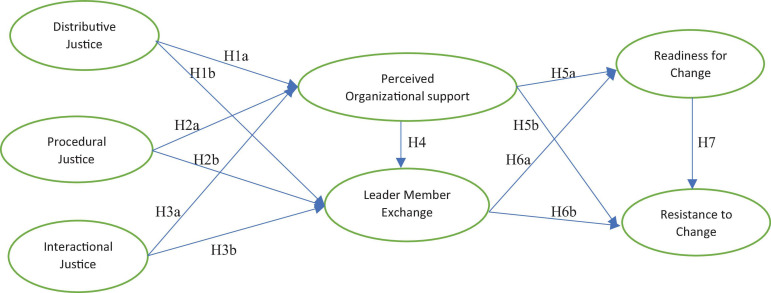
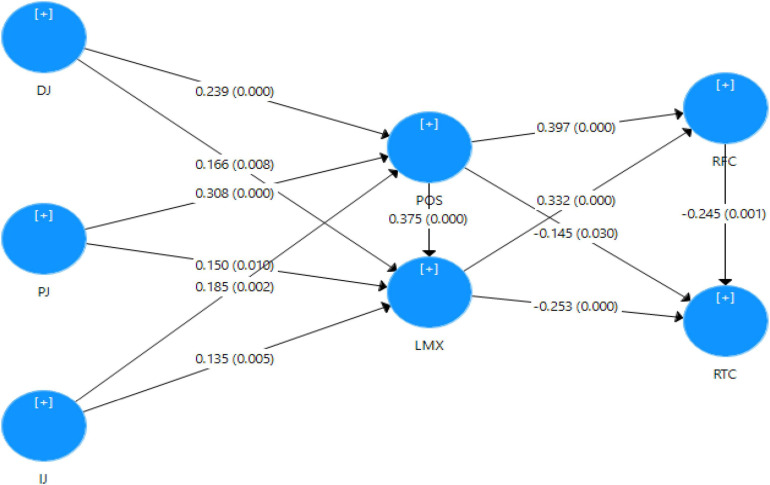
- Distributive, procedural, and interactional justice positively affected POS (β = 0.239, 0.308, 0.185) and LMX (β = 0.166, 0.150, 0.135); POS positively affected LMX (β = 0.375).
- POS and LMX positively affected RFC (β = 0.397; β = 0.332) and negatively affected RTC (β = −0.145; β = −0.253); RFC negatively affected RTC (β = −0.245).
- POS and LMX sequentially mediated the relationships from justice dimensions to RFC and RTC (H8a–H8f supported); POS→LMX→RFC→RTC was supported (β = −0.030, p = 0.020).
- DJ and PJ reached RTC through POS→LMX→RFC (β = −0.007, p = 0.041; β = −0.009, p = 0.032), but IJ→POS→LMX→RFC→RTC was not supported (β = −0.006, p = 0.074); H9a and H9b were also not supported.
Methods
- Cross-sectional survey of 372 lower and middle managers from the five largest private commercial banks in Pakistan; 1,200 questionnaires were distributed across 600 branches, 410 were returned (34.16% response rate), and 38 were discarded.
- Measures used seven-point Likert scales: Niehoff and Moorman’s organizational justice scale (5 distributive, 6 procedural, 9 interactional items), LMX-7, an 8-item POS scale, a 9-item RFC scale, and an 18-item RTC scale.
- Analysis used PLS-SEM via SmartPLS 3.2.6, including measurement model assessment (Cronbach’s alpha, CR, AVE, discriminant validity), structural model testing, and Hayes process bootstrapping for mediation; common method variance was assessed with Harman’s single-factor test (29% variance) and CFA with/without a common latent factor.
Limitations
- Stated: the cross-sectional design limits cause-and-effect conclusions; data came only from the banking industry; future research should use longitudinal data, manufacturing sectors, and other mediators such as organizational identification and organizational citizenship behavior.
- Evident: the sample is predominantly male (341/372, 91.67%) and lower management (323/372, 86.83%), drawn from Punjab province, which may limit generalizability.
- Evident: all variables were self-reported, though the authors report ex-ante and ex-post remedies for common method variance.
Model-written summary. Check it against the paper before relying on it.
Integrity signals
Registry
Cites
Statistics
Figures
Verification
Claims the paper makes
0 Valid · 2 Not valid · 39 Not checked · 71 Own results and interpretations
A result the paper reports from its own data — it cites no other source for it, so there is none to check. The quote shows it is in the paper.
In the paper
“So, it turns out that the RFC is an effective predictor of lowering the resistance to change.”
- Also stated in: § Structural Model · boosted
“In the end, H7 has also been supported (β = 0.245, p < 0.001), representing that RFC has a significant negative impact on RTC.”
- Also stated in: § Structural Model · plain
“H7 | RFC - > RTC | −0.245 | 3.430 | 0.001 | Supported”
§ The Psychology of Resistance to Change: The Antidotal Effect of Organizational Justice, Support and Leader-Member Exchange > Background and Hypotheses Development > Readiness for Change and Resistance to Change
boostedstates a cause- Asserted: passes — The authors put it forward as true.
- Checkable: passes — It can be checked against evidence.
- Load-bearing: passes — The paper’s conclusions depend on it.
- Based: passes — The paper gives a reason why it holds.
- Also stated in: § Structural Model · boosted
A result the paper reports from its own data — it cites no other source for it, so there is none to check. The quote shows it is in the paper.
In the paper
“The results obtained through the Partial Least Squares- Structural Equation Modeling (PLS-SEM) approach using SmartPLS suggest that distributive justice, procedural justice, and interactional justice play a critical role in lowering the resistance to change through POS, LMX, and RFC”
§ The Psychology of Resistance to Change: The Antidotal Effect of Organizational Justice, Support and Leader-Member Exchange > Abstract
hedgedstates a cause- Asserted: passes — The authors put it forward as true.
- Checkable: passes — It can be checked against evidence.
- Load-bearing: passes — The paper’s conclusions depend on it.
- Based: passes — The paper gives a reason why it holds.
A result the paper reports from its own data — it cites no other source for it, so there is none to check. The quote shows it is in the paper.
In the paper
“H4 | POS - > LMX | 0.375 | 4.335 | 0.000 | Supported”
§ The Psychology of Resistance to Change: The Antidotal Effect of Organizational Justice, Support and Leader-Member Exchange > Methodology > Structural Model
plainstates a cause- Asserted: passes — The authors put it forward as true.
- Checkable: passes — It can be checked against evidence.
- Load-bearing: passes — The paper’s conclusions depend on it.
- Based: passes — The paper gives a reason why it holds.
A result the paper reports from its own data — it cites no other source for it, so there is none to check. The quote shows it is in the paper.
In the paper
“H9e | PJ - > POS - > RFC - > RTC | −0.030 | 2.581 | 0.010 | Supported”
§ The Psychology of Resistance to Change: The Antidotal Effect of Organizational Justice, Support and Leader-Member Exchange > Methodology > Structural Model
plainstates a cause- Asserted: passes — The authors put it forward as true.
- Checkable: passes — It can be checked against evidence.
- Load-bearing: passes — The paper’s conclusions depend on it.
- Based: passes — The paper gives a reason why it holds.
- Rests on an assumption not shown here.
A result the paper reports from its own data — it cites no other source for it, so there is none to check. The quote shows it is in the paper.
In the paper
“H11b | PJ - > POS - > LMX - > RFC - > RTC | −0.009 | 2.145 | 0.032 | Supported”
§ The Psychology of Resistance to Change: The Antidotal Effect of Organizational Justice, Support and Leader-Member Exchange > Methodology > Structural Model
plainstates a cause- Asserted: passes — The authors put it forward as true.
- Checkable: passes — It can be checked against evidence.
- Load-bearing: passes — The paper’s conclusions depend on it.
- Based: passes — The paper gives a reason why it holds.
- Rests on an assumption not shown here.
62 more claims
Create a free account to see all 112 claims and to verify the 45 references still open.
- It may state two separate claims as one. 24
- Probably not a substantial claim. 26
Self-check
Percentages, sums and reported differences re-computed from the paper’s own numbers.
Each contradiction between two passages listed here was confirmed by an independent check.
Rated minor: it would not touch a result — a value no result rests on, a p-value that stays on the same side of the significance level, or a conflict that is clerical, resolved elsewhere in the paper, or outside its own findings.
In the paper
§ The Psychology of Resistance to Change: The Antidotal Effect of Organizational Justice, Support and Leader-Member Exchange > Methodology > Sample and Procedure
“The dominant group of respondents was lower management with ages between 31 and 40 years and experience of more than 10 years.”
§ The Psychology of Resistance to Change: The Antidotal Effect of Organizational Justice, Support and Leader-Member Exchange > Methodology > Sample and Procedure
“| Less than or equal to 10 years | 259 | 69.62 | 69.62 |”
Rated minor: it would not touch a result — a value no result rests on, a p-value that stays on the same side of the significance level, or a conflict that is clerical, resolved elsewhere in the paper, or outside its own findings.
In the paper
§ The Psychology of Resistance to Change: The Antidotal Effect of Organizational Justice, Support and Leader-Member Exchange > Methodology > Structural Model
“Similarly, LMX is significantly influenced by DJ (β = 0.166, p < 0.006), PJ (β = 0.150, p < 0.008), and IJ (β = 0.135, p < 0.007), which support hypotheses H2a, H2b, and H3c, respectively.”
§ The Psychology of Resistance to Change: The Antidotal Effect of Organizational Justice, Support and Leader-Member Exchange > Methodology > Structural Model
“| H1b | DJ - > LMX | 0.166 | 2.750 | 0.006 | Supported |”
Rated minor: it would not touch a result — a value no result rests on, a p-value that stays on the same side of the significance level, or a conflict that is clerical, resolved elsewhere in the paper, or outside its own findings.
In the paper
§ The Psychology of Resistance to Change: The Antidotal Effect of Organizational Justice, Support and Leader-Member Exchange > Methodology > Structural Model
“H7 has also been supported (β = 0.245, p < 0.001), representing that RFC has a significant negative impact on RTC.”
§ The Psychology of Resistance to Change: The Antidotal Effect of Organizational Justice, Support and Leader-Member Exchange > Methodology > Structural Model
“| H7 | RFC - > RTC | −0.245 | 3.430 | 0.001 | Supported |”
Rated minor: it would not touch a result — a value no result rests on, a p-value that stays on the same side of the significance level, or a conflict that is clerical, resolved elsewhere in the paper, or outside its own findings.
In the paper
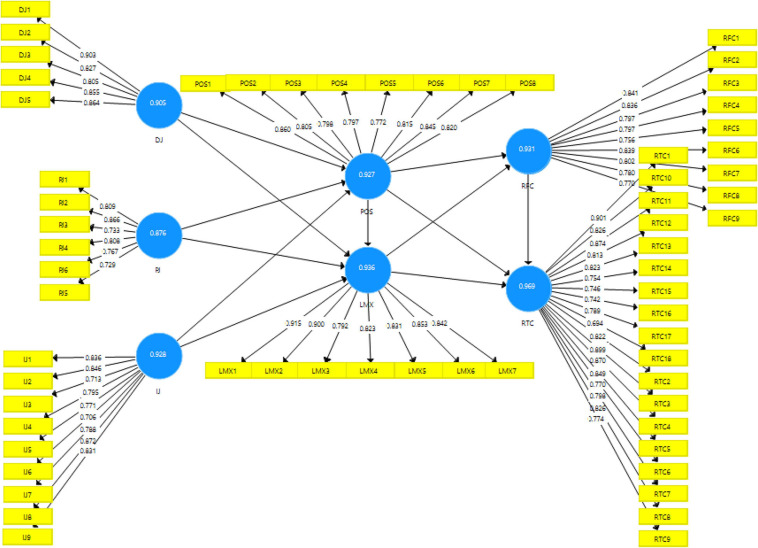
§ The Psychology of Resistance to Change: The Antidotal Effect of Organizational Justice, Support and Leader-Member Exchange > Methodology > The Measurement Model (Confirmatory Factor Analysis)
“The values of loadings and AVE were above the threshold levels of 0.7 and 0.5, respectively”
§ The Psychology of Resistance to Change: The Antidotal Effect of Organizational Justice, Support and Leader-Member Exchange > Methodology > The Measurement Model (Confirmatory Factor Analysis)
“| RTC | 0.969 | 0.972 | 0.658 | 0.901–0.694 | 2.13–4.21 |”
Citations
Cites
Evaluating Structural Equation Models with Unobservable Variables and Measurement Error
Fornell, C., & Larcker, D. F. (1981) · Journal of Marketing Research · doi:10.2307/3151312 · Cited by 109,314
Evaluating structural equation models with unobservable variables and measurement error
Fornell, C., & Larcker, D. F. (1981) · Journal of Marketing Research · doi:10.1177/002224378101800104 · Cited by 109,190
Podsakoff, P. M., MacKenzie, S. B., Lee, J.-Y., & Podsakoff, N. P. (2003) · Journal of Applied Psychology · doi:10.1037/0021-9010.88.5.879 · Cited by 82,194
Sources of method bias in social science research and recommendations on how to control it
Podsakoff, P. M., MacKenzie, S. B., & Podsakoff, N. P. (2012) · Annual Review of Psychology · doi:10.1146/annurev-psych-120710-100452 · Cited by 15,744
Exchange and Power in Social Life.
Bierstedt, R., & Blau, P. M. (1965) · American Sociological Review · doi:10.2307/2091154 · Cited by 13,624
Adams, J. S. (1965) · Advances in Experimental Social Psychology · doi:10.1016/s0065-2601(08)60108-2 · Cited by 10,818 · cited 1×
“Among dimensions of organizational justice, distributive justice derives its roots from equity theory (Adams, 1965), and refers to an employee’s perception of the distribution of organizational rewards and outcomes (Niehoff and Moorman, 1993).”
BackgroundPerceived organizational support.
Eisenberger, R., Huntington, R., Hutchison, S., & Sowa, D. (1986) · Journal of Applied Psychology · doi:10.1037/0021-9010.71.3.500 · Cited by 10,023
Perceived organizational support: a review of the literature.
Rhoades, L., & Eisenberger, R. (2002) · Journal of Applied Psychology · doi:10.1037/0021-9010.87.4.698 · Cited by 7,592
Mathieu, J. E., & Zajac, D. M. (1990) · Psychological Bulletin · doi:10.1037//0033-2909.108.2.171 · Cited by 6,449
Structural Equation Modeling and Regression: Guidelines for Research Practice
Gefen, D., Straub, D., & Boudreau, M.-C. (2000) · Communications of the Association for Information Systems · doi:10.17705/1cais.00407 · Cited by 6,416
Research works printed but not linked: 6
- Ciliana F. Mansoer W. (2008). Pengaruh kepuasan kerja, keterlibatan kerja, stress kerja, dan komitmen organisasi terhadap kesiapan untuk berubah pada karyawan PT Bank Y. J. Psikol. Sos. 14 151– 164.
- Fasolo P. M. (1995). “Procedural justice and perceived organizational support: hypothesized effects on job performance,” in Organizational Politics, Justice, and Support: Managing Social Climate at Work, eds Cropanzano R. Kacmar K. M. (Westport, CT: Quorum Press), 185– 195.
- Meaney M. Pung C. (2008). McKinsey global results: creating organizational transformations. McKinsey Q. 7 1– 7.
- Robbins D. L. Galperin B. L. (2010). Constructive deviance: striving toward organizational change in healthcare. J. Manag. Mark. Res. 5, 1– 11.
- Robins S. P. Judge T. A. Vohra N. (2011). Organization Behaviour, India Person Education. Inc.
- Shore L. M. Shore T. H. (1995). “Perceived organizational support and organizational justice,” in Cropanzano R. Kacmar M. (eds) Organizational Politics, Justice and Support: Managing the Social Climate of the Workplace, Westport, CT: Quorum. Vol. 149: 164
Cited by
Items 201–228 of 228
AL-HASANAT, R. A. S. J., & Al-Soud, R. S. (2025) · Jordanian Educational Journal · doi:10.46515/jaes.v11i2.2045
Organizational Transformation in Bahrain Context
Mutlaq, L. M. R., & Alkhatib, A. J. (2025) · Scholars Journal of Economics Business and Management · doi:10.36347/sjebm.2025.v12i08.001
Khumalo, W. S. (2025) · DUT Open Scholar (Durban University of Technology) · doi:10.51415/10321/6262
СУБЪЕКТИВНОЕ ВОСПРИЯТИЕ ПЕДАГОГАМИ ПРОБЛЕМ ЦИФРОВИЗАЦИИ ОБРАЗОВАНИЯ
Леонидович, Л. С., Евгеньевна, Р. Н., & Ивановна, Е. Г. (n.d.) · CyberLeninK (CyberLeninka)
INTEGRATING CULTURALLY SUSTAINING PEDAGOGY TO DISRUPT OPPRESSIVE PRACTICE
Baruta, T. (2022) · Scholarship@Western (Western University)
Abebe, Y. (2022) · NVA (Nasjonalt vitenarkiv)
Navigate Change: The Path to Effective Implementation
Benjaminsson, M., Engholm, A., & Mellbin, E. (2024) · DiVA - University of Borås (Högskolan i Borås)
Yhteisten työskentelytapojen vaikutus ohjelmistokehityksen läpimenoaikoihin
Holm, P. (2023) · Aaltodoc (Aalto University)
Human Capital Architecture and Its Role in Sustaining Strategic Innovation
Kuspriyono, T. (2026) · Brilliant International Journal Of Management And Tourism · doi:10.55606/bijmt.v6i2.6934
Resistencia al cambio en el desempeño laboral de una institución estatal de Lima, 2024
Palacios, J. A. M. R. (2025) · LA Referencia (Red Federada de Repositorios Institucionales de Publicaciones Científicas)
Bukhari, A., & Nawaz, S. (2025) · iRASD Journal of Management · doi:10.52131/irasd-jom.2025.v7i4.3117
Enhancing Development through Occupational Therapy: Staff and Family Education for Overall Wellness
Whitehead, H. L. (2026) · bepress Legal Repository
Clinical audit of wait times for the emergency room patient: report and reflection
Williams, N., & O'Byrne, L. (2026) · The Veterinary Nurse · doi:10.12968/vetn.2026.0010
Staying Alive to the Possibilities of Becoming: Designing for Hope in Uncertain Futures
Vink, J., Romm, J., Ihler, H. M., & Romm, K. L. (2026) · DIID · doi:10.30682/diid8826c
Prasetyono, D. W., Endarti, E. W., & Prihatini, T. (2026) · SEMANGGI Jurnal Pengabdian kepada Masyarakat · doi:10.38156/sjpm.v5i1.511
Arechua, M. F. B., Anchundia, N. J. P., & Pisco, S. M. H. (2026) · Ibero Ciencias - Revista Científica y Académica · doi:10.63371/ic.v5.n2.a1289
Peran Change Readiness dalam Menurunkan Resistensi terhadap Perubahan Organisasi: Tinjauan Literatur
Riani, S., Samsir, S., & Sasmita, J. (2026) · RIGGS Journal of Artificial Intelligence and Digital Business · doi:10.31004/riggs.v5i2.10890
Syafruddin, D., Komari, N., & Daud, I. (2026) · International Journal of Scientific Multidisciplinary Research · doi:10.55927/ijsmr.v4i8.143
Dismantling the Architecture of Silence: A Dialogic Approach to Co-Creating an Equitable Polytechnic
Nyamekye, I. (2026) · Scholarship@Western (Western University)
Salsabila, M. H., Musadieq, M. A., & Ruhana, I. (2025) · AL-BANJARI Jurnal Ilmiah Ilmu-ilmu Keislaman
Modal Psikologis Positif, Kesiapan Perubahan, Dan Resistensi Perubahan Di Lembaga XYZ Padang
Sari, W. I., & Anggraini, F. (2026) · ProBisnis Jurnal Manajemen
Fachrizal, E., & Soetjipto, B. W. (2026) · Perbanas International Seminar on Economics, Business, Management, Accounting and IT
How AI Is Disrupting Traditional Banks: Perceptions of the Younger Generation
Rukkhaphun, W. (2025) · Journal of Modern Management SHINAWATRA UNIVERSITY
Amatullah, A. A., & Hurriyati, D. (2026) · PAEDAGOGY Jurnal Ilmu Pendidikan dan Psikologi · doi:10.51878/paedagogy.v6i4.16461
Lifelong and Modular Education for Archival Professionals
Novák, M., & Tojnko, N. K. (2026) · Atlanti · doi:10.33700/2670-451x.36.2.147-185(2026
علّام, ع. م., & جابر, أ. ق. (2026) · Awraq Thaqafya · doi:10.67928/6805
Qin, X., Schneider, R. J., Li, Y., & Vajari, M. A. (2024) · ROSA P
Lee, S. Y., Ann, L. C., & Hilmi, M. F. (2026) · Advances in computational intelligence and robotics book series · doi:10.4018/979-8-3373-9139-7.ch006
Metadata
- Authors
- Rehman, N., Mahmood, A., Ibtasam, M., Murtaza, S. A., Iqbal, N., & Molnár, E.
- Affiliations
- University of Lahore (PK)
- Namal University (PK)
- University of Engineering and Technology Lahore (PK)
- University of Debrecen (HU)
- University of the Punjab (PK)
- Corresponding author
- Mahmood, Asif
- Venue
- Frontiers in Psychology
- Publisher
- Frontiers Media SA
- Published
- 2021-08-02
- Volume
- 12
- Pages
- 678952-678952
- ISSN
- 1664-1078 (ISSN-L)
- PMC
- PMC8365138
- OpenAlex
- W3188539019
- Semantic Scholar
- c471a2163a890c2aca6a486644cb48a8ca9675c1
- Cited by
- 232
- References
- 104
- Citations by year
- 2026: 57 · 2025: 68 · 2024: 62 · 2023: 31 · 2022: 12 · 2021: 2
- FWCI
- 18.70
- Type
- journal article
- Language
- en
- Open access
- gold
- doi.org
- Licence
- Locations
- Frontiers in Psychology (publishedVersion, cc-by)
- PubMed Central (publishedVersion, cc-by)
- PubMed (publishedVersion)
- University of Debrecen Electronic Archive (University of Debrecen) (submittedVersion, cc-by)
- DOAJ (DOAJ: Directory of Open Access Journals) (submittedVersion)
- Greater South Information System
- Topics
- Social Sciences › Business, Management and Accounting › Organizational Behavior and Human Resource Management › Organizational Change and Leadership
- Social Sciences › Business, Management and Accounting › Organizational Behavior and Human Resource Management › Job Satisfaction and Organizational Behavior
- Social Sciences › Business, Management and Accounting › Organizational Behavior and Human Resource Management › Organizational Management and Change
- Keywords
- resistance to change, organizational justice, perceived organizational support, leader-member exchange, readiness to change, distributive justice, procedural justice, interactional justice, organizational change, bank employees
About these checks
Registry, retraction, Cites and statistics results are computed, not judged, with one exception: a printed reference that no index lists is read once by a model before it counts as a citation error. Claims are extracted by a model and kept only when their quote appears verbatim in the text; each cited source is then checked, with a model’s help, for whether it says what the claim relies on. Those verdicts can be wrong — read the claim’s quote and the cited source before relying on one.
A language model drew the claims from the paper on 2026-11-24, under version 3 of the claim definition (model deepseek-v4.1-flash, prompt extract-v3).
A second model labelled each claim on 2026-11-24 (model jev-1.13-20260917, definition revision gold-guideline-v0.2).
Statistics and arithmetic are recomputed, not judged.
Confidence bands are shown only for fields calibrated on our annotated test set. None is calibrated yet, so no band is shown.
What counts as a claim ›How we measure confidence ›How we check this ›
Are you an author, or do you see a problem with this page? Request a review
Data sources
Bibliographic data: Semantic Scholar, OpenAlex, Crossref.
Contains information from the Semantic Scholar Academic Graph Datasets, made available under the ODC Attribution License (ODC-BY 1.0).
Semantic Scholar’s data is described in: Kinney, R., et al. (2023). The Semantic Scholar Open Data Platform. arXiv:2301.10140.
