

The DOI matches its Crossref record; 105 of the 107 references it cites were found in a registry or an index.
Examining the effectiveness of gamification as a tool promoting teaching and learning in educational settings: a meta-analysis
Open accessAbstract
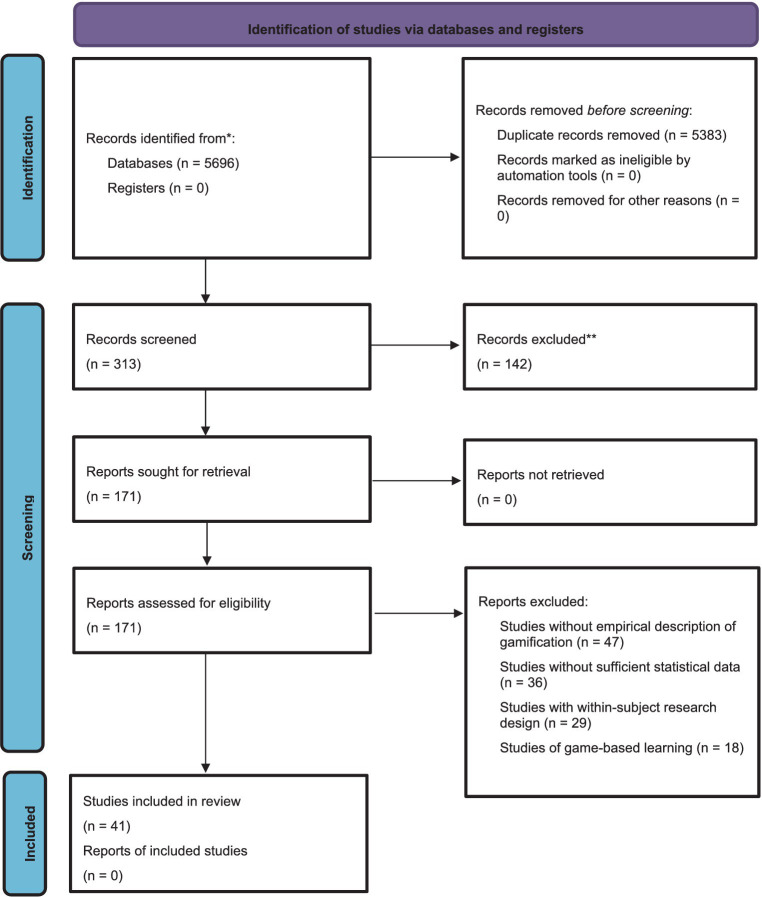
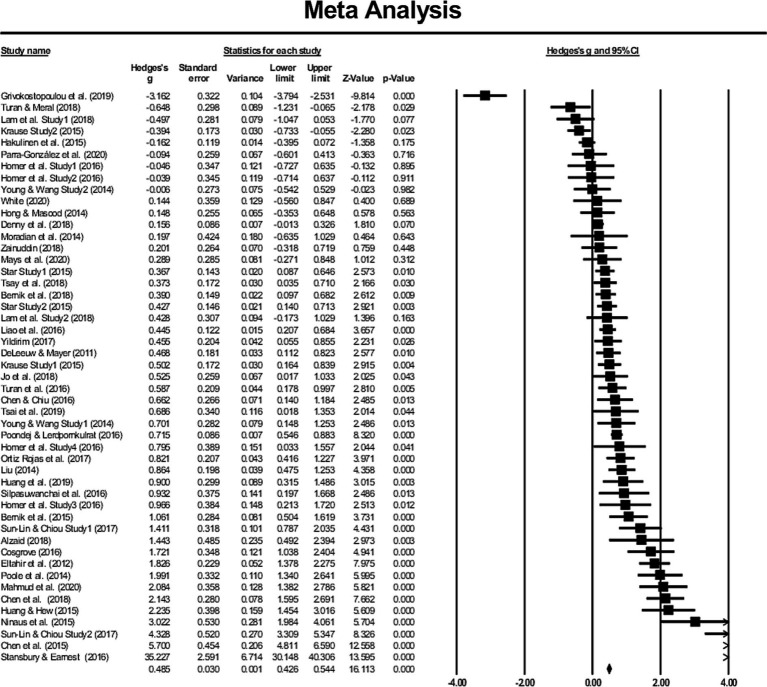
The integration of gamification into educational settings has gained recognition for its potential to boost student motivation, engagement, interest, and learning outcomes. Despite its popularity, research on gamification has produced mixed results regarding student learning outcomes. This meta-analysis aims to synthesize the existing empirical evidence on the effectiveness of gamification as a tool for promoting teaching and learning in educational settings. Forty-one studies with 49 independent samples involving more than 5,071 participants were included in our analysis. Results from random effects models showed an overall significant large effect size ( g = 0.822 [0.567 to 1.078]). The research performed the moderator analysis to scrutinize the effects of a number of factors on the relationship between gamification and student learning outcomes. The study uncovered significant moderating effects for user type, educational discipline, design principles for educational gamification, duration of “gameful” experience, and learning environment. However, measurement of student outcomes and publication type did not appear to have any significant moderating effect. Those findings hold important implications for improving and implementing gamification to promote teaching and learning in future research.
Overview
The claims and statistics of this paper haven’t been checked yet.
Run the check — free, no account needed. It reads the open-access text and checks the sources it cites.
Integrity signals
Registry
Cites
Statistics
Figures
Verification
Claims the paper makes
The claims and statistics of this paper haven’t been checked yet.
Run the check — free, no account needed. It reads the open-access text and checks the sources it cites.
Claims other papers make about this one
Each is checked against this paper’s own text: does it say what the citing paper says it does?
The source backs part of the claim, not all of it — or backs it for a different population, condition or comparison.
In the citing paper
“Educational video games may also complement traditional, less-engaging forms of instruction, while providing adolescents opportunities to learn and practice vital skills [50].”
From Health Benefits of Video Games in Adolescents and Young Adults (2026) · cites this paper as [50]
Experimental — accuracy not yet measuredThe source backs part of the claim, not all of it — or backs it for a different population, condition or comparison.
In the citing paper
“Gamified learning platforms represent a new way to democratize learning and education by boosting student motivation, engagement, interest, and learning outcomes [50].”
From Health Benefits of Video Games in Adolescents and Young Adults (2026) · cites this paper as [50]
Experimental — accuracy not yet measured
Self-check
Percentages, sums and reported differences re-computed from the paper’s own numbers.
The self-check needs the paper’s full text.
Citations
Cites
The PRISMA 2020 statement: An updated guideline for reporting systematic reviews
Page, M. J., McKenzie, J. E., Bossuyt, P. M., Boutron, I., Hoffmann, T. C., Mulrow, C. D., Shamseer, L., Tetzlaff, J. M., Akl, E. A., Brennan, S. E., et al. (2021) · BMJ · doi:10.1136/bmj.n71 · Cited by 108,283
Duval, S., & Tweedie, R. (2000) · Biometrics · doi:10.1111/j.0006-341x.2000.00455.x · Cited by 14,099
Borenstein, M., Hedges, L. V., Higgins, J. P. T., & Rothstein, H. R. (2021) · doi:10.1002/9781119558378 · Cited by 9,799
(2000) · Cited by 9,198
Cohen, J. (1992) · Psychological Bulletin · doi:10.1037//0033-2909.112.1.155 · Cited by 8,771
Problem-Based Learning: What and How Do Students Learn?
Hmelo‐Silver, C. E. (2004) · Educational Psychology Review · doi:10.1023/b:edpr.0000034022.16470.f3 · Cited by 5,552
Funnel plots for detecting bias in meta-analysis
Sterne, J. A. C., & Egger, M. (2001) · Journal of Clinical Epidemiology · doi:10.1016/s0895-4356(01)00377-8 · Cited by 3,779
Kapp, K. M. (2012) · Cited by 3,753
Play and Its Role in the Mental Development of the Child
Vygotsky, L. (1967) · Soviet Psychology · doi:10.2753/rpo1061-040505036 · Cited by 2,757
Specious reward: A behavioral theory of impulsiveness and impulse control.
Ainslie, G. (1975) · Psychological Bulletin · doi:10.1037/h0076860 · Cited by 2,708
Research works printed but not linked: 4
- Borenstein, 2005, Comprehensive meta-analysis (computer program) version 2
- Caponetto, 2014, Gamification and education: a literature review
- Jacobs, 2013, Gamification: a framework for the workplace
- Marczewski, 2013, Gamification: A simple introduction
Cited by
Sorted by citations
Zeng, J., Sun, D., Looi, C., & Fan, A. C. W. (2024) · British Journal of Educational Technology · doi:10.1111/bjet.13471 · Cited by 241
Dong, L., Tang, X., & Wang, X. (2025) · Computers and Education Artificial Intelligence · doi:10.1016/j.caeai.2025.100400 · Cited by 116
How gamification boosts learning in STEM higher education: a mixed methods study
Ortiz-Rojas, M., Chiluiza, K., Valcke, M., & Bolanos-Mendoza, C. (2025) · International Journal of STEM Education · doi:10.1186/s40594-024-00521-3 · Cited by 71
Coelho, F., Rando, B., Aparício, D., Ribeiro, P. C. P. S. V., Gonçalves, D. J. V., & Abreu, A. M. (2025) · Journal of Computers in Education · doi:10.1007/s40692-025-00366-x · Cited by 88
Enhancing EFL/ESL instruction through gamification: a comprehensive review of empirical evidence
Chan, S., & Lo, N. (2024) · Frontiers in Education · doi:10.3389/feduc.2024.1395155 · Cited by 123
Metadata
- Authors
- Li, M., Ma, S., & Shi, Y.
- Affiliations
- Guangdong University of Foreign Studies (CN)
- Peking University (CN)
- Corresponding author
- Ma, Siyu
- Shi, Yuyang
- Venue
- Frontiers in Psychology
- Publisher
- Frontiers Media SA
- Published
- 2023-10-09
- Volume
- 14
- Pages
- 1253549-1253549
- ISSN
- 1664-1078 (ISSN-L)
- PMC
- PMC10591086
- OpenAlex
- W4387454440
- Semantic Scholar
- 47a35e0c351194f41452f75bb40a5b69dad915ba
- Cited by
- 439
- References
- 107
- Citations by year
- 2026: 279 · 2025: 121 · 2024: 36 · 2023: 3
- FWCI
- 19.25
- Type
- journal article
- Language
- en
- Open access
- gold
- doi.org
- Licence
- Locations
- Frontiers in Psychology (publishedVersion, cc-by)
- PubMed Central (publishedVersion, cc-by)
- PubMed (publishedVersion)
- DOAJ (DOAJ: Directory of Open Access Journals) (submittedVersion, cc-by-sa)
- Topics
- Social Sciences › Psychology › Developmental and Educational Psychology › Educational Games and Gamification
- Social Sciences › Sociology and Political Science › Digital Games and Media
- Physical Sciences › Computer Science › Computer Science Applications › Online Learning and Analytics
- Keywords
- gamification, educational gamification, learning outcomes, student motivation, student engagement, gameful experience, educational design principles, learning environment, moderating effect
About these checks
Registry, retraction, Cites and statistics results are computed, not judged, with one exception: a printed reference that no index lists is read once by a model before it counts as a citation error. Claims are extracted by a model and kept only when their quote appears verbatim in the text; each cited source is then checked, with a model’s help, for whether it says what the claim relies on. Those verdicts can be wrong — read the claim’s quote and the cited source before relying on one.
Statistics and arithmetic are recomputed, not judged.
Confidence bands are shown only for fields calibrated on our annotated test set. None is calibrated yet, so no band is shown.
What counts as a claim ›How we measure confidence ›How we check this ›
Are you an author, or do you see a problem with this page? Request a review
