

The DOI matches its Crossref record; 105 of the 107 references it cites were found in a registry or an index.
Examining the effectiveness of gamification as a tool promoting teaching and learning in educational settings: a meta-analysis
Open accessAbstract
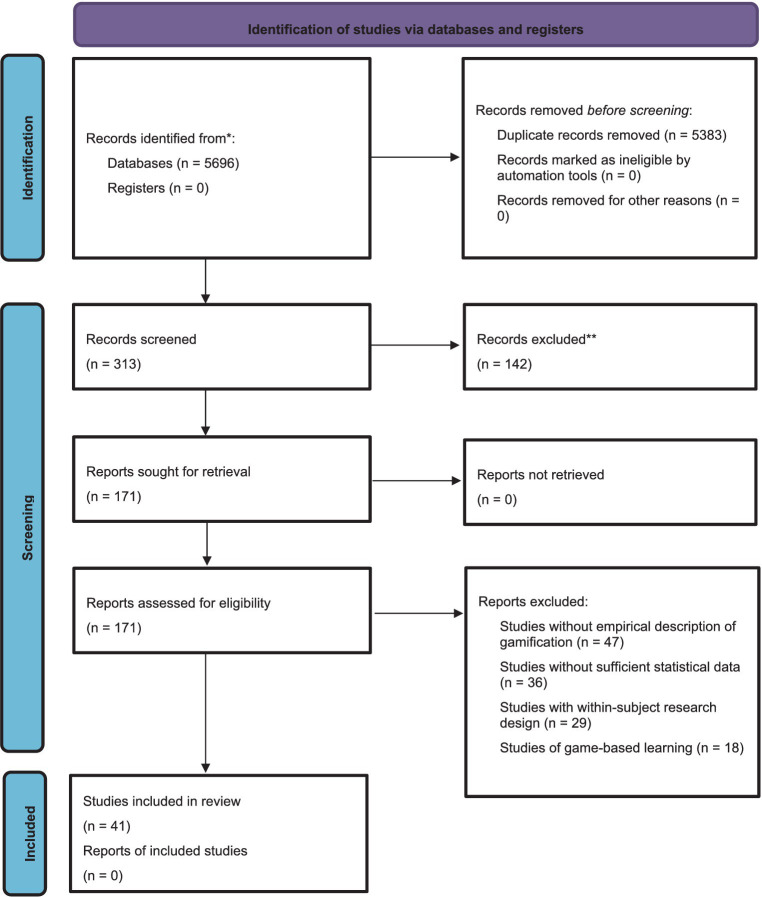
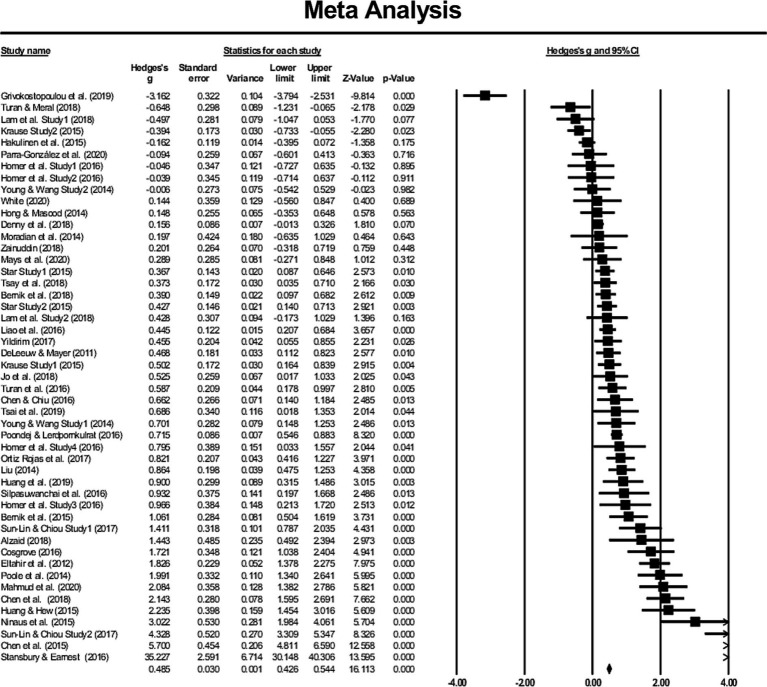
The integration of gamification into educational settings has gained recognition for its potential to boost student motivation, engagement, interest, and learning outcomes. Despite its popularity, research on gamification has produced mixed results regarding student learning outcomes. This meta-analysis aims to synthesize the existing empirical evidence on the effectiveness of gamification as a tool for promoting teaching and learning in educational settings. Forty-one studies with 49 independent samples involving more than 5,071 participants were included in our analysis. Results from random effects models showed an overall significant large effect size ( g = 0.822 [0.567 to 1.078]). The research performed the moderator analysis to scrutinize the effects of a number of factors on the relationship between gamification and student learning outcomes. The study uncovered significant moderating effects for user type, educational discipline, design principles for educational gamification, duration of “gameful” experience, and learning environment. However, measurement of student outcomes and publication type did not appear to have any significant moderating effect. Those findings hold important implications for improving and implementing gamification to promote teaching and learning in future research.
Overview
The claims and statistics of this paper haven’t been checked yet.
Run the check — free, no account needed. It reads the open-access text and checks the sources it cites.
Integrity signals
Registry
Cites
Statistics
Figures
Verification
Claims the paper makes
The claims and statistics of this paper haven’t been checked yet.
Run the check — free, no account needed. It reads the open-access text and checks the sources it cites.
Claims other papers make about this one
Each is checked against this paper’s own text: does it say what the citing paper says it does?
The source backs part of the claim, not all of it — or backs it for a different population, condition or comparison.
In the citing paper
“Educational video games may also complement traditional, less-engaging forms of instruction, while providing adolescents opportunities to learn and practice vital skills [50].”
From Health Benefits of Video Games in Adolescents and Young Adults (2026) · cites this paper as [50]
Experimental — accuracy not yet measuredThe source backs part of the claim, not all of it — or backs it for a different population, condition or comparison.
In the citing paper
“Gamified learning platforms represent a new way to democratize learning and education by boosting student motivation, engagement, interest, and learning outcomes [50].”
From Health Benefits of Video Games in Adolescents and Young Adults (2026) · cites this paper as [50]
Experimental — accuracy not yet measured
Self-check
Percentages, sums and reported differences re-computed from the paper’s own numbers.
The self-check needs the paper’s full text.
Citations
Cites
The PRISMA 2020 statement: An updated guideline for reporting systematic reviews
Page, M. J., McKenzie, J. E., Bossuyt, P. M., Boutron, I., Hoffmann, T. C., Mulrow, C. D., Shamseer, L., Tetzlaff, J. M., Akl, E. A., Brennan, S. E., et al. (2021) · BMJ · doi:10.1136/bmj.n71 · Cited by 108,283
Duval, S., & Tweedie, R. (2000) · Biometrics · doi:10.1111/j.0006-341x.2000.00455.x · Cited by 14,099
Borenstein, M., Hedges, L. V., Higgins, J. P. T., & Rothstein, H. R. (2021) · doi:10.1002/9781119558378 · Cited by 9,799
(2000) · Cited by 9,198
Cohen, J. (1992) · Psychological Bulletin · doi:10.1037//0033-2909.112.1.155 · Cited by 8,771
Problem-Based Learning: What and How Do Students Learn?
Hmelo‐Silver, C. E. (2004) · Educational Psychology Review · doi:10.1023/b:edpr.0000034022.16470.f3 · Cited by 5,552
Funnel plots for detecting bias in meta-analysis
Sterne, J. A. C., & Egger, M. (2001) · Journal of Clinical Epidemiology · doi:10.1016/s0895-4356(01)00377-8 · Cited by 3,779
Kapp, K. M. (2012) · Cited by 3,753
Play and Its Role in the Mental Development of the Child
Vygotsky, L. (1967) · Soviet Psychology · doi:10.2753/rpo1061-040505036 · Cited by 2,757
Specious reward: A behavioral theory of impulsiveness and impulse control.
Ainslie, G. (1975) · Psychological Bulletin · doi:10.1037/h0076860 · Cited by 2,708
The gamification of learning: a meta-analysis
Sailer, M., & Homner, L. (2020) · Educational Psychology Review · doi:10.1007/s10648-019-09498-w · Cited by 2,594 · cited 4×
“This effect size is much higher than that reported in prior research (0.40– 0.60) (Bai et al., 2020; Huang et al., 2020; Sailer and Homner, 2020), providing strong evidence to support the use of gamification as an instructional approach in educational contexts.”
BackgroundResultInfluentialGamification in theory and action: a survey
Seaborn, K., & Fels, D. I. (2015) · International Journal of Human-Computer Studies · doi:10.1016/j.ijhcs.2014.09.006 · Cited by 2,515 · cited 2×
“In recent years, there has been a notable increase in studies exploring gamification in educational contexts (Seaborn and Fels, 2015).”
Background(2012) · Swinburne figshare (Swinburne University of Technology) · Cited by 2,354
The Rise of Motivational Information Systems: A Review of Gamification Research
Koivisto, J., & Hamari, J. (2017) · International Journal of Information Management · doi:10.1016/j.ijinfomgt.2018.10.013 · Cited by 2,229
Gamifying learning experiences: Practical implications and outcomes
Domínguez‐Díaz, A., Saenz-de-Navarrete, J., de‐Marcos, L., Sanz, L. F., Pagés, C., & Martínez-Herráiz, J.-J. (2013) · Computers & Education · doi:10.1016/j.compedu.2012.12.020 · Cited by 2,189
Gamifying education: what is known, what is believed and what remains uncertain: a critical review
Dichev, C., & Dicheva, D. (2017) · International Journal of Educational Technology in Higher Education · doi:10.1186/s41239-017-0042-5 · Cited by 2,112 · cited 1×
“Academic performance, motivation, and engagement are frequently utilized outcome measures in gamification research (Dichev and Dicheva, 2017; Zainuddin et al., 2020; Rivera and Garden, 2021).”
BackgroundSailer, M., Hense, J. U., Mayr, S. K., & Mandl, H. (2017) · Computers in Human Behavior · doi:10.1016/j.chb.2016.12.033 · Cited by 2,064
AGE DIFFERENCES IN TECHNOLOGY ADOPTION DECISIONS: IMPLICATIONS FOR A CHANGING WORK FORCE
MORRIS, M. G., & VENKATESH, V. (2000) · Personnel Psychology · doi:10.1111/j.1744-6570.2000.tb00206.x · Cited by 1,723
Experimental methods: Between-subject and within-subject design
Charness, G., Gneezy, U., & Kuhn, M. A. (2012) · Journal of Economic Behavior & Organization · doi:10.1016/j.jebo.2011.08.009 · Cited by 1,469
From Game Design Elements to Gamefulness: Defining “Gamification”
Deterding, S., Dixon, D., Khaled, R., & Nacke, L. E. (2011) · IT University Of Copenhagen (IT University of Copenhagen) · Cited by 1,341
Investigating the determinants and age and gender differences in the acceptance of mobile learning
Wang, Y., Wu, M., & Wang, H. (2008) · British Journal of Educational Technology · doi:10.1111/j.1467-8535.2007.00809.x · Cited by 1,308
The impact of gamification on learning and instruction: A systematic review of empirical evidence
Zainuddin, Z., Chu, S. K. W., Shujahat, M., & Perera, C. J. (2020) · Educational Research Review · doi:10.1016/j.edurev.2020.100326 · Cited by 1,276
Gamification for health and wellbeing: A systematic review of the literature
Johnson, D., Deterding, S., Kuhn, K.-A., Staneva, A., Stoyanov, S., & Hides, L. (2016) · Internet Interventions · doi:10.1016/j.invent.2016.10.002 · Cited by 1,237
A test of self‐determination theory in school physical education
Standage, M., Duda, J. L., & Ntoumanis, N. (2005) · British Journal of Educational Psychology · doi:10.1348/000709904x22359 · Cited by 1,205
Gamified learning in higher education: A systematic review of the literature
Subhash, S., & Cudney, E. A. (2018) · Computers in Human Behavior · doi:10.1016/j.chb.2018.05.028 · Cited by 1,043
Bai, S., Hew, K. F., & Huang, B. (2020) · Educational Research Review · doi:10.1016/j.edurev.2020.100322 · Cited by 994 · cited 2×
“This effect size is much higher than that reported in prior research (0.40– 0.60) (Bai et al., 2020; Huang et al., 2020; Sailer and Homner, 2020), providing strong evidence to support the use of gamification as an instructional approach in educational contexts.”
BackgroundResultInfluentialDeveloping a Theory of Gamified Learning: Linking Serious Games and Gamification of Learning
Landers, R. N. (2014) · Simulation & Gaming · doi:10.1177/1046878114563660 · Cited by 918
The effect of gamification on motivation and engagement
Alsawaier, R. S. (2018) · The International Journal of Information and Learning Technology · doi:10.1108/ijilt-02-2017-0009 · Cited by 887
Gamification and student motivation
Buckley, P. G., & Doyle, E. (2014) · Interactive Learning Environments · doi:10.1080/10494820.2014.964263 · Cited by 883
Between Level Up and Game Over: A Systematic Literature Review of Gamification in Education
Manzano-León, A., Camacho-Lazarraga, P., Guerrero, M. A., Guerrero-Puerta, L., Aguilar-Parra, J. M., Trigueros, R., & Alias, A. (2021) · Sustainability · doi:10.3390/su13042247 · Cited by 512
Huang, B., Hew, K. F., & Lo, C. K. (2019) · Interactive Learning Environments · doi:10.1080/10494820.2018.1495653 · Cited by 406
Students' learning performance and perceived motivation in gamified flipped-class instruction
Zainuddin, Z. (2018) · Computers & Education · doi:10.1016/j.compedu.2018.07.003 · Cited by 324
Enhancing student learning experience with technology-mediated gamification: An empirical study
Tsay, C. H., Kofinas, A., & Luo, J. (2018) · Computers & Education · doi:10.1016/j.compedu.2018.01.009 · Cited by 323
Yildirim, I. (2017) · The Internet and Higher Education · doi:10.1016/j.iheduc.2017.02.002 · Cited by 320 · cited 1×
“Gamification has found widespread application in Li et al. 10.3389/fpsyg.2023.1253549 Frontiers in Psychology 02 frontiersin.org various domains (Caponetto et al., 2014), including business (Moradian et al., 2014), math (Yıldırım, 2017), and science (Chen et al., 2018).”
BackgroundInfluentialRachels, J. R., & Rockinson‐Szapkiw, A. J. (2017) · Computer Assisted Language Learning · doi:10.1080/09588221.2017.1382536 · Cited by 316
Gamification for student engagement: a framework
Rivera, E. S., & Garden, C. L. P. (2021) · Journal of Further and Higher Education · doi:10.1080/0309877x.2021.1875201 · Cited by 306
Kiryakova, G., Angelova, N., & Yordanova, L. (2017) · IGI Global eBooks · doi:10.4018/978-1-5225-5198-0 · Cited by 306
The Gamification Toolkit: Dynamics, Mechanics, and Components for the Win
Werbach, K. D., & Hunter, D. (2015) · Swinburne figshare (Swinburne University of Technology) · Cited by 280
Groening, C., & Binnewies, C. (2019) · Computers in Human Behavior · doi:10.1016/j.chb.2019.02.026 · Cited by 249
Empirical Study on the Effect of Achievement Badges in TRAKLA2 Online Learning Environment
Hakulinen, L., Auvinen, T., & Korhonen, A. (2013) · doi:10.1109/latice.2013.34 · Cited by 228
Gamification and Education: Achievements, Cognitive Loads, and Views of Students
Turan, Z., Avinc, Z., Kara, K., & Göktaş, Y. (2016) · International Journal of Emerging Technologies in Learning (iJET) · doi:10.3991/ijet.v11i07.5455 · Cited by 226
Eltahir, M. E., Alsalhi, N. R., Al-Qatawneh, S. S., Alqudah, H., & Jaradat, M. (2021) · Education and Information Technologies · doi:10.1007/s10639-020-10396-w · Cited by 219
The effects of player type on performance: A gamification case study
Lopez, C. E., & Tucker, C. S. (2018) · Computers in Human Behavior · doi:10.1016/j.chb.2018.10.005 · Cited by 213
Gamifying an ICT course: Influences on engagement and academic performance
Çakıroğlu, Ü., Başıbüyük, B., Güler, M., Atabay, M., & Memiş, B. Y. (2016) · Computers in Human Behavior · doi:10.1016/j.chb.2016.12.018 · Cited by 204
Effects of Gamification on Behavioral Change in Education: A Meta-Analysis
Kim, J.-H., & Castelli, D. M. (2021) · International Journal of Environmental Research and Public Health · doi:10.3390/ijerph18073550 · Cited by 203
Gamification: The effect on student motivation and performance at the post-secondary level
Lister, M. (2015) · Issues and Trends in Educational Technology · doi:10.2458/azu_itet_v3i2_lister · Cited by 202
González, M. E. P., López-Belmonte, J., Robles, A. S., & Cabrera, A. F. (2020) · Sustainability · doi:10.3390/su12020602 · Cited by 196
Empirical Support for a Causal Relationship Between Gamification and Learning Outcomes
Denny, P., McDonald, F., Empson, R., Kelly, P., & Petersen, A. (2018) · Proceedings of the 2018 CHI Conference on Human Factors in Computing Systems · doi:10.1145/3173574.3173885 · Cited by 135
Krause, M., Mogalle, M., Pohl, H., & Williams, J. J. (2015) · ACM Conference on Learning @ Scale (L@S) · doi:10.1145/2724660.2724665 · Cited by 131
Effects of Game-Based Learning on Students’ Achievement in Science: A Meta-Analysis
Lei, H., Chiu, M. M., Wang, D., Wang, C., & Xie, T. (2022) · Journal of Educational Computing Research · doi:10.1177/07356331211064543 · Cited by 126
Segura-Robles, A., Cabrera, A. F., González, M. E. P., & López-Belmonte, J. (2020) · Frontiers in Psychology · doi:10.3389/fpsyg.2020.01103 · Cited by 123
Examining the Impact of a Gamified Entrepreneurship Education Framework in Higher Education
Grivokostopoulou, F., Kovas, K., & Perikos, I. (2019) · Sustainability · doi:10.3390/su11205623 · Cited by 122
Chen, C.-H., & Chiu, C. (2016) · Computers & Education · doi:10.1016/j.compedu.2016.09.007 · Cited by 117
Chen, C., Liu, G., & Hwang, G. (2015) · British Journal of Educational Technology · doi:10.1111/bjet.12270 · Cited by 99
Chen, C. (2018) · Online Learning · doi:10.24059/olj.v22i3.1466 · Cited by 98
Teaching Presence in Online Gamified Education for Sustainability Learning
Mahmud, S. N. D., Husnin, H. B., & Soh, T. M. T. (2020) · Sustainability · doi:10.3390/su12093801 · Cited by 98
Lai, J. W. M., & Bower, M. (2020) · Journal of Computer Assisted Learning · doi:10.1111/jcal.12412 · Cited by 92
The Game Embedded CALL System to Facilitate English Vocabulary Acquisition and Pronunciation
Young, S. S., & Wang, Y. H. (2014) · Educational Technology & Society · Cited by 87
Game elements improve performance in a working memory training task
Ninaus, M., Pereira, G., Stefitz, R., Prada, R., Paiva, A., Neuper, C., & Wood, G. (2015) · International Journal of Serious Games · doi:10.17083/ijsg.v2i1.60 · Cited by 86
Racey, M., O'Brien, C., Douglas, S., Marquez, O., Hendrie, G. A., & Newton, G. S. (2016) · Journal of School Health · doi:10.1111/josh.12396 · Cited by 83
Ritzhaupt, A. D., Huang, R., Sommer, M., Zhu, J., Stephen, A., Valle, N., Hampton, J. D., & Li, J. (2021) · Educational Technology Research and Development · doi:10.1007/s11423-021-10036-1 · Cited by 83
The development of gamified learning activities to increase student engagement in learning
Poondej, C., & Lerdpornkulrat, T. (2016) · Australian educational computing · Cited by 80
Navarro-Mateos, C., López, I. J. P., & Femia, P. (2021) · Retos · doi:10.47197/retos.v42i0.87384 · Cited by 80
Jo, J., Jun, H., & Lim, H. (2018) · Computer Applications in Engineering Education · doi:10.1002/cae.21992 · Cited by 79
Meaningful Gamification in an Industrial/Organizational Psychology Course
Stansbury, J. A., & Earnest, D. R. (2016) · Teaching of Psychology · doi:10.1177/0098628316677645 · Cited by 78
TURAN, Z., & MERAL, E. (2018) · Informatics in Education · doi:10.15388/infedu.2018.07 · Cited by 78
Developing a Comprehensive Engagement Framework of Gamification for Reflective Learning
Silpasuwanchai, C., Ma, X., Shigemasu, H., & Ren, X. (2016) · Designing Interactive Systems Conference · doi:10.1145/2901790.2901836 · Cited by 68
Exploring EFL learners’ perspectives on using Kahoot as a game-based student response system
Ebadi, S., Rasouli, R., & Mohamadi, M. M. (2021) · Interactive Learning Environments · doi:10.1080/10494820.2021.1881798 · Cited by 68
The effect of physical activity and motivation on function in ankylosing spondylitis: A cohort study
Brophy, S. T., Cooksey, R., Davies, H. A., Dennis, M., Zhou, S., & Siebert, S. (2013) · Seminars in Arthritis and Rheumatism · doi:10.1016/j.semarthrit.2012.09.007 · Cited by 67
The effect of pedagogical GAME model on students' PISA scientific competencies
Tsai, C., Lin, H., & Liu, S. (2019) · Journal of Computer Assisted Learning · doi:10.1111/jcal.12406 · Cited by 64
Homer, R., Hew, K. F., & Tan, C. Y. (2018) · The HKU Scholars Hub (University of Hong Kong) · Cited by 61
Huang, B., & Hew, K. (2015) · International Conference on Computers in Education · Cited by 60
Beemer, L. R., Ajibewa, T. A., DellaVecchia, G. P., & Hasson, R. E. (2019) · International Journal of Environmental Research and Public Health · doi:10.3390/ijerph16214082 · Cited by 57
Ortíz-Rojas, M., Chiluiza, K., & Valcke, M. (2017) · Ghent University Academic Bibliography (Ghent University) · Cited by 55
Digital games pre-schoolers play: parental mediation and examination of educational content
Gözüm, A. İ. C., & Kandır, A. (2021) · Education and Information Technologies · doi:10.1007/s10639-020-10382-2 · Cited by 55
Sandusky, S. (2015) · UA Campus Repository (The University of Arizona) · Cited by 52
Gamification framework model, based on social engagement in e-learning 2.0
Wongso, O., Rosmansyah, Y., & Bandung, Y. (2014) · doi:10.1109/time-e.2014.7011583 · Cited by 50
Wijaya, T. T., Cao, Y., Bernard, M., Rahmadi, I. F., Lavicza, Z., & Surjono, H. D. (2022) · Frontiers in Psychology · doi:10.3389/fpsyg.2022.952549 · Cited by 49
Problem-based learning and management development – Empirical and theoretical considerations
Carriger, M. S. (2015) · The International Journal of Management Education · doi:10.1016/j.ijme.2015.07.003 · Cited by 46
Cognitive consequences of making computer-based learning activities more game-like
DeLeeuw, K. E., & Mayer, R. E. (2011) · Computers in Human Behavior · doi:10.1016/j.chb.2011.05.008 · Cited by 41
Liu, T.-Y. (2014) · Interactive Learning Environments · doi:10.1080/10494820.2014.917109 · Cited by 40
Models of Instructional Design in Gamification: A Systematic Review of the Literature
González-Fernández, A., Revuelta-Domínguez, F.-I., & Fernández-Sánchez, M. R. (2022) · Education Sciences · doi:10.3390/educsci12010044 · Cited by 37
Twenty years of research on gamified advertising: a systematic overview of theories and variables
van Berlo, Z. M. C., van Reijmersdal, E. A., & Waiguny, M. K. J. (2022) · International Journal of Advertising · doi:10.1080/02650487.2022.2143098 · Cited by 37
Effects Of Gamification On Lower Secondary School Students' Motivation And Engagement
Hong, G. Y., & Masood, M. (2014) · Zenodo (CERN European Organization for Nuclear Research) · doi:10.5281/zenodo.1096961 · Cited by 36
The effects of participation, performance, and interest in a game‐based writing environment
Liao, C. C. Y., Chang, W., & Chan, T.-W. (2018) · Journal of Computer Assisted Learning · doi:10.1111/jcal.12233 · Cited by 34
Bernik, A., Bubaš, G., & Radošević, D. (2018) · International Convention on Information and Communication Technology, Electronics and Microelectronics · doi:10.23919/mipro.2018.8400149 · Cited by 34
Get Your Head in the Game: Using Gamification in Business Education to Connect with Generation Y
Poole, S. M., Kemp, E., Williams, K. H., & Patterson, L. (2014) · USF Scholarship Repository (University of San Francisco) · Cited by 33
Homework and primary-school students’ academic achievement in Latin America
Murillo, F. J., & Martínez-Garrido, C. (2014) · International Review of Education · doi:10.1007/s11159-014-9440-2 · Cited by 32
Student perceptions of the impact of online discussion forum participation on learning outcomes
Jahnke, J. (2010) · Journal of Learning Design · doi:10.5204/jld.v3i2.48 · Cited by 29
FRAGGLE: A FRamework for AGile Gamification of Learning Experiences
Mora, A., Zaharias, P., González, C. S. G., & Arnedo-Moreno, J. (2016) · Lecture notes in computer science · doi:10.1007/978-3-319-40216-1_57 · Cited by 29
(2015) · International Conference on Information Systems · Cited by 25
Papadakis, S., Gözüm, A. İ. C., Kalogiannakis, M., & Kandır, A. (2022) · Lecture notes in educational technology · doi:10.1007/978-981-19-0568-1_23 · Cited by 24
The Impact of Gamification in Educational Settings on Student Learning Outcomes: A Meta-Analysis
Huang, R. (2021) · American Educational Research Association Annual Meeting (AERA) · doi:10.3102/1686773 · Cited by 22
Gamification of collaborative idea generation and convergence
Moradian, A., Nasir, M., Lyons, K. A., Leung, R., & Sim, S. E. (2014) · CHI Conference Extended Abstracts on Human Factors in Computing Systems (CHI EA) · doi:10.1145/2559206.2581253 · Cited by 21
Mays, B. R., Yeh, H., & Chen, N. (2020) · The Asia-Pacific Education Researcher · doi:10.1007/s40299-020-00506-0 · Cited by 18
Using Gamification in Education: A Systematic Literature Review.
Inocêncio, F. D. C. (2018) · Journal of the Association for Information Systems · Cited by 17
A Pilot Study of the Influence of Gamification on the Effectiveness of an e-Learning Course
Bernik, A., & Bubaš, G. (2015) · Cited by 15
Developing a parental mediation scale of digital games for children
Gözüm, A. İ. C., & Kandır, A. (2020) · International Journal of Curriculum and Instruction · Cited by 15
Sun-Lin, H. Z., & Chiou, G. (2017) · Eurasia Journal of Mathematics Science and Technology Education · doi:10.12973/eurasia.2017.01244a · Cited by 14
Gamification and Its Application in the Social Environment
Cordero-Brito, S., & Mena, J. (2020) · Journal of Information Technology Research · doi:10.4018/jitr.2020070104 · Cited by 12
Coping with Loss and Grief through On-Line Support Groups.
Gary, J. M., & Remolino, L. (2000) · Cited by 7
Alzaid, F. (2018) · doi:10.82308/12259 · Cited by 6
Anim, N. A. H. M., Suffarruddin, S. H., Najib, N. M., & Sabarudin, N. A. (2023) · The Journal of Muamalat and Islamic Finance Research · doi:10.33102/jmifr.475 · Cited by 5
Improving Students’ Argumentative Writing and Oral Proficiencies
Hew, K. F., & Cheung, W. S. (2014) · Springer briefs in education · doi:10.1007/978-981-287-089-6_5 · Cited by 2
Avoiding eSolation in Online Education
Manner, J. C. (2003) · Society for Information Technology & Teacher Education International Conference · Cited by 2
Research works printed but not linked: 4
- Borenstein, 2005, Comprehensive meta-analysis (computer program) version 2
- Caponetto, 2014, Gamification and education: a literature review
- Jacobs, 2013, Gamification: a framework for the workplace
- Marczewski, 2013, Gamification: A simple introduction
Cited by
Sorted by citations
Zeng, J., Sun, D., Looi, C., & Fan, A. C. W. (2024) · British Journal of Educational Technology · doi:10.1111/bjet.13471 · Cited by 241
Dong, L., Tang, X., & Wang, X. (2025) · Computers and Education Artificial Intelligence · doi:10.1016/j.caeai.2025.100400 · Cited by 116
How gamification boosts learning in STEM higher education: a mixed methods study
Ortiz-Rojas, M., Chiluiza, K., Valcke, M., & Bolanos-Mendoza, C. (2025) · International Journal of STEM Education · doi:10.1186/s40594-024-00521-3 · Cited by 71
Coelho, F., Rando, B., Aparício, D., Ribeiro, P. C. P. S. V., Gonçalves, D. J. V., & Abreu, A. M. (2025) · Journal of Computers in Education · doi:10.1007/s40692-025-00366-x · Cited by 88
Enhancing EFL/ESL instruction through gamification: a comprehensive review of empirical evidence
Chan, S., & Lo, N. (2024) · Frontiers in Education · doi:10.3389/feduc.2024.1395155 · Cited by 123
Metadata
- Authors
- Li, M., Ma, S., & Shi, Y.
- Affiliations
- Guangdong University of Foreign Studies (CN)
- Peking University (CN)
- Corresponding author
- Ma, Siyu
- Shi, Yuyang
- Venue
- Frontiers in Psychology
- Publisher
- Frontiers Media SA
- Published
- 2023-10-09
- Volume
- 14
- Pages
- 1253549-1253549
- ISSN
- 1664-1078 (ISSN-L)
- PMC
- PMC10591086
- OpenAlex
- W4387454440
- Semantic Scholar
- 47a35e0c351194f41452f75bb40a5b69dad915ba
- Cited by
- 439
- References
- 107
- Citations by year
- 2026: 279 · 2025: 121 · 2024: 36 · 2023: 3
- FWCI
- 19.25
- Type
- journal article
- Language
- en
- Open access
- gold
- doi.org
- Licence
- Locations
- Frontiers in Psychology (publishedVersion, cc-by)
- PubMed Central (publishedVersion, cc-by)
- PubMed (publishedVersion)
- DOAJ (DOAJ: Directory of Open Access Journals) (submittedVersion, cc-by-sa)
- Topics
- Social Sciences › Psychology › Developmental and Educational Psychology › Educational Games and Gamification
- Social Sciences › Sociology and Political Science › Digital Games and Media
- Physical Sciences › Computer Science › Computer Science Applications › Online Learning and Analytics
- Keywords
- gamification, educational gamification, learning outcomes, student motivation, student engagement, gameful experience, educational design principles, learning environment, moderating effect
About these checks
Registry, retraction, Cites and statistics results are computed, not judged, with one exception: a printed reference that no index lists is read once by a model before it counts as a citation error. Claims are extracted by a model and kept only when their quote appears verbatim in the text; each cited source is then checked, with a model’s help, for whether it says what the claim relies on. Those verdicts can be wrong — read the claim’s quote and the cited source before relying on one.
Statistics and arithmetic are recomputed, not judged.
Confidence bands are shown only for fields calibrated on our annotated test set. None is calibrated yet, so no band is shown.
What counts as a claim ›How we measure confidence ›How we check this ›
Are you an author, or do you see a problem with this page? Request a review
