

The effect of short-form video addiction on undergraduates' academic procrastination: a moderated mediation model
Open accessThe DOI matches its Crossref record; 67 of the 72 references it cites were found in a registry or an index; 10 of the 33 sources its claims cite were checked for support.
Abstract
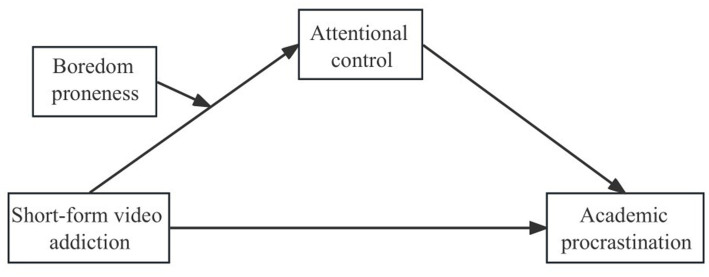
Background: Short-form videos have become one of the most popular ways for people to entertain and relax. However, the intense interest in short-form videos has given rise to short-video addiction, which poses risks to both physical and mental health of individuals. Undergraduates are one of the important users for short-form videos, and the influence of short-form video addiction calls for more attention. This study aimed to investigate the association between short-form video addiction and academic procrastination among undergraduates, exploring the role of executive functions (i.e., attentional control) and personality traits (i.e., boredom proneness) in the association. Methods: Using stratified random cluster sampling method, the data of 1,047 college students were used in the study. All variables were measured by empirical instruments, and all instruments were highly reliable. Mediation and moderation analysis was conducted using Model 4 and 7 in PROCESS macro powered by SPSS. Results: Results revealed that short-form video addiction not only directly impacted academic procrastination but also placed indirect effect on academic procrastination through attentional control. Furthermore, the mediating effect of attentional control was contingent upon individuals' boredom proneness. Higher levels of boredom proneness weakened the impact of short-form video addiction on attentional control. Conclusion: The findings expand our knowledge of the negative effects of short-form video addiction and the underlying mechanisms, providing implications for mitigating undergraduates' academic procrastination.
Overview
CoChat Summary
TL;DR
This study found that short-form video addiction was positively associated with academic procrastination among Chinese undergraduates, with attentional control partially mediating the link. Boredom proneness moderated the path from short-form video addiction to attentional control, weakening that negative association at higher boredom proneness.
Key findings
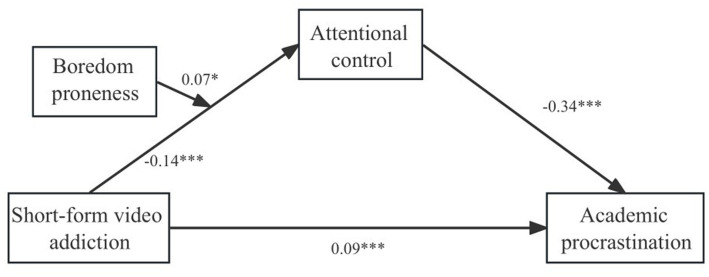
- Short-form video addiction significantly positively predicted academic procrastination (β = 0.17, p < 0.001) and significantly negatively predicted attentional control (β = −0.23, p < 0.001).
- Attentional control partially mediated the relationship: when both predictors were included, short-form video addiction still positively predicted academic procrastination (β = 0.09, p < 0.001), while attentional control negatively predicted it (β = −0.34, p < 0.001).
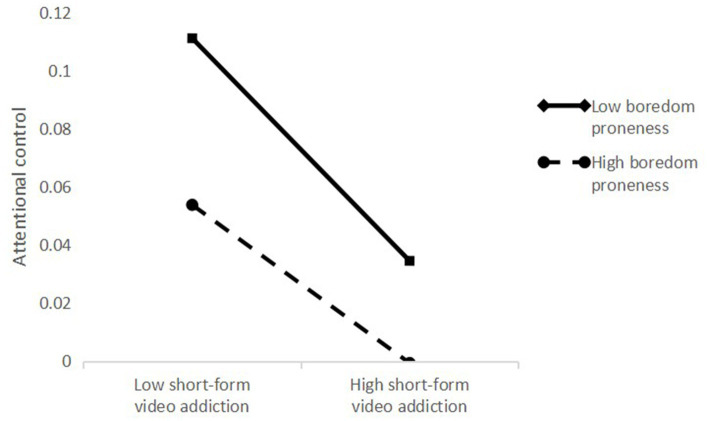
- Boredom proneness moderated the short-form video addiction–attentional control link: the interaction was significant (β = 0.07, p < 0.05), and simple slopes indicated the effect of short-form video addiction on attentional control was stronger for students with lower boredom proneness.
- Correlations showed short-form video addiction was negatively correlated with attentional control (r = −0.23, p < 0.001) and positively correlated with boredom proneness (r = 0.34, p < 0.001) and academic procrastination (r = 0.17, p < 0.001).
Methods
- Stratified random cluster sampling was used; 1,176 questionnaires were distributed to grades 1–3 from seven universities in central China, yielding 1,047 valid questionnaires (89.03% effective recovery). Participants were 17–25 years old (Mage = 20.08, SD = 1.34); 593 boys and 454 girls.
- Measures included the Short-Form Video Addiction Scale, Attentional Control Scale, Boredom Proneness Scale for College Students, and Academic Procrastination Scale; reported Cronbach’s alphas ranged from 0.770 to 0.891.
- Analyses used SPSS 20.0 for descriptive statistics and Pearson correlations, and PROCESS macro Models 4 and 7 for mediation and moderation, with standardized variables and bias-corrected bootstrapping using 5,000 resamples and 95% confidence intervals.
Limitations
- The paper states that cross-sectional data prevent establishing causal relationships and exploring bidirectional effects between short-form video addiction and academic procrastination; it also states the study assumed a linear relationship between short-form video addiction and attentional control.
- The paper states the sample may not represent the college student population because it was based on convenience sampling, and it included only college students, so effects may differ for teenagers or other age groups.
- Evident from the text: all variables were measured by self-report questionnaires, and the study tested common method bias but did not use behavioral or objective measures of attentional control or procrastination.
Model-written summary. Check it against the paper before relying on it.
Integrity signals
Registry
Cites
Statistics
Figures
Verification
Claims the paper makes
9 Valid · 0 Not valid · 18 Not checked · 47 Own results and interpretations
The cited sources support only part of this claim — read each source’s verdict below.
In the paper
“short-form video addiction has been shown to be positively associated with various mental health problems, such as symptoms of depression, anxiety, and stress (Sabir et al., 2020).”
§ The effect of short-form video addiction on undergraduates’ academic procrastination: a moderated mediation model > Introduction > Short-form video addiction and academic procrastination
What the sources say
- Partly supportedcites Sabir et al., 2020 matched to “TikTok addictions and its disorders among youth of Pakistan” (2020) sourceExperimental — accuracy not yet measured
The Correlation section reports a positive association between social media use and a general disorder measure among 190 students. The Problem Statement links TikTok addiction to depression, but the cited paper does not establish a positive association specifically between short-form video addiction and symptoms of depression, anxiety, and stress; anxiety and stress are not reported in the passages found. (LLM, conf=0.86)
boostedstates an association- Asserted: passes — The authors put it forward as true.
- Checkable: passes — It can be checked against evidence.
- Load-bearing: passes — The paper’s conclusions depend on it.
- Based: passes — The paper gives a reason why it holds.
- Partly supported
The sources with a verdict support this claim; the rest weren’t checked yet, have no full text we could read, or their verdicts aren’t rated yet.
In the paper
“Attentional control, a cognitive function that regulates the allocation of attention, is significantly linked to executive control (Derryberry and Reed, 2002; Hopfinger and Slotnick, 2020).”
§ The effect of short-form video addiction on undergraduates’ academic procrastination: a moderated mediation model > Introduction > The mediating role of attentional control
What the sources say
- Not checked — no full text of the sourcecites Derryberry and Reed, 2002 matched to “Anxiety-related attentional biases and their regulation by attentional control.” (2002) source
- Supportedcites Hopfinger and Slotnick, 2020 matched to “Attentional control and executive function” (2020) source
The Introduction describes interacting influences of attention and executive control on perception and action. It also reports a significant increase in connectivity between attentional-control and executive-control networks under an implied-social-presence manipulation, supporting the claimed link in that context. The supplied passages have no page numbers. (LLM, conf=0.86)
plainstates an association- Asserted: passes — The authors put it forward as true.
- Checkable: passes — It can be checked against evidence.
- Load-bearing: unclear — It is unclear whether the paper’s conclusions depend on it.
- Based: passes — The paper gives a reason why it holds.
Every source the paper cites for this claim was checked and supports it.
In the paper
“Continuous academic procrastination not only hinders students’ academic achievement (Bytamar et al., 2020), but also prevents them from effectively regulating emotions and experiencing fulfillment (Balkis, 2013).”
§ The effect of short-form video addiction on undergraduates’ academic procrastination: a moderated mediation model > Introduction
What the sources say
- Supportedcites Bytamar et al., 2020 matched to “Emotion regulation difficulties and academic procrastination” (2020) source
The Introduction says academic procrastination is associated with major dysfunction in academic performance and describes frequent procrastination as a source of problems for students. The Discussion adds that procrastination can prevent people from achieving long-term goals. Together, these passages support the cited claim that persistent academic procrastination hinders achievement. (LLM, conf=0.88)
plainstates a cause- Asserted: passes — The authors put it forward as true.
- Checkable: passes — It can be checked against evidence.
- Load-bearing: unclear — It is unclear whether the paper’s conclusions depend on it.
- Based: passes — The paper gives a reason why it holds.
- Supported
The cited sources support only part of this claim — read each source’s verdict below.
In the paper
“According to the Interaction of Person-Affect-Cognition-Execution (I-PACE) model, internet addiction has compensatory effect when faced with the threat to relationship and the need for self-existence (Williams, 2009; Brand et al., 2019).”
§ The effect of short-form video addiction on undergraduates’ academic procrastination: a moderated mediation model > Discussion > The moderating effect of boredom proneness
What the sources say
- Not matchedcites Williams, 2009
An author–year citation the paper’s reference list doesn’t settle. We don’t search these by name.
- Partly supportedcites Brand et al., 2019 matched to “The Interaction of Person-Affect-Cognition-Execution (I-PACE) model for addictive behaviors: Update, generalization to addictive behaviors beyond internet-use disorders, and specification of the process character of addictive behaviors” (2019) sourceExperimental — accuracy not yet measured
Section 2.2 (pp. 2, 4) describes compensation associated with addictive behaviors, including internet-use behaviors, and relief from negative moods. It does not specifically link that compensation to threatened relationships or a need for self-existence. (LLM, conf=0.86)
plainstates a cause- Asserted: passes — The authors put it forward as true.
- Checkable: passes — It can be checked against evidence.
- Load-bearing: passes — The paper’s conclusions depend on it.
- Based: passes — The paper gives a reason why it holds.
- Not matched
The cited sources support only part of this claim — read each source’s verdict below.
In the paper
“Since short-form videos are short in duration, watching short-form videos may create a false perception of time (Krivonogova et al., 2022).”
§ The effect of short-form video addiction on undergraduates’ academic procrastination: a moderated mediation model > Implications and limitations
What the sources say
- Partly supportedcites Krivonogova et al., 2022 matched to “Time estimation or autonomic heart rate regulation: which mechanism is more sensitive in the development of internet addiction in adolescents?” (2022) sourceExperimental — accuracy not yet measured
The Discussion (page not available) links addictive behaviour with misperception of time, and reports underestimation of time among adolescents at risk of internet addiction. It does not examine short-form videos or show that their short duration causes a false perception of time. (LLM, conf=0.86)
hedgedstates a possible cause- Asserted: passes — The authors put it forward as true.
- Checkable: passes — It can be checked against evidence.
- Load-bearing: unclear — It is unclear whether the paper’s conclusions depend on it.
- Based: passes — The paper gives a reason why it holds.
- Partly supported
45 more claims
Create a free account to see all 74 claims and to verify the 2 references still open.
- Probably not a substantial claim. 15
- It may state two separate claims as one. 13
Claims other papers make about this one
Each is checked against this paper’s own text: does it say what the citing paper says it does?
The source backs part of the claim, not all of it — or backs it for a different population, condition or comparison.
In the citing paper
“In summary, while existing short video addiction scales have been adapted from other addiction behavior scales, they exhibit notable limitations in reliability and validity, particularly when applied to the unique context of short video addiction.”
From Short video addiction scale for middle school students: development and initial validation (2025) · cites this paper as [14]
Experimental — accuracy not yet measuredThe source backs part of the claim, not all of it — or backs it for a different population, condition or comparison.
In the citing paper
“procrastination is, in part, an attention-regulation problem rather than solely a motivational or time-management failure”
From Algorithmic short-video music consumption and academic related functions: a three-wave longitudinal study of university students (2026) · cites this paper as Xie et al., 2023
Experimental — accuracy not yet measuredThe source backs part of the claim, not all of it — or backs it for a different population, condition or comparison.
In the citing paper
“Research shows that such rapid reward structures, including short TikTok videos or Instagram reels, can significantly reduce attention control over time [14].”
From The Impact of Social Media & Technology on Child and Adolescent Mental Health (2025) · cites this paper as [14]
Experimental — accuracy not yet measuredThe source backs part of the claim, not all of it — or backs it for a different population, condition or comparison.
In the citing paper
“These environments are intended to provide rapid rewards, promoting impulsive behavior and making it more difficult to concentrate on tasks that demand sustained attention [14].”
From The Impact of Social Media & Technology on Child and Adolescent Mental Health (2025) · cites this paper as [14]
Experimental — accuracy not yet measuredThe cited source says what the claim attributes to it.
In the citing paper
“When attentional control is weaker, the threshold for switching away from demanding academic work toward immediately rewarding stimuli is lowered, and the likelihood of voluntary delay is correspondingly increased”
From Algorithmic short-video music consumption and academic related functions: a three-wave longitudinal study of university students (2026) · cites this paper as Xie et al., 2023
1 more claim about this paper
Create a free account to see every claim other papers make about this one.
Self-check
Percentages, sums and reported differences re-computed from the paper’s own numbers.
Each contradiction between two passages listed here was confirmed by an independent check.
Rated major: it would touch a result — a value a result rests on, reported and recomputed p-values on opposite sides of the significance level, two passages that conflict with no sign which is right, or a cited work retracted before this paper was published.
In the paper
§ The effect of short-form video addiction on undergraduates’ academic procrastination: a moderated mediation model > Methods > Participants and procedure
“Stratified random cluster sampling method was used to determine the survey sample.”
§ The effect of short-form video addiction on undergraduates’ academic procrastination: a moderated mediation model > Implications and limitations
“our sample was based on convenience sampling (Iiker et al., 2015).”
Citations
Cites
Fredrickson, B. L. (2001) · American Psychologist · doi:10.1037//0003-066x.56.3.218 · Cited by 18,025 · cited 1×
“According to the broaden-and-build theory of positive emotions, positive emotions can enhance cognitive resources and improve attentional performance (Fredrickson, 2001).”
BackgroundComparison of convenience sampling and purposive sampling
Etikan, I. (2016) · American Journal of Theoretical and Applied Statistics · doi:10.11648/j.ajtas.20160501.11 · Cited by 11,412 · cited 1×
“Furthermore, the study sample might not be representative of the college student population, as our sample was based on convenience sampling (Iiker et al., 2015).”
BackgroundInternet Addiction: The Emergence of a New Clinical Disorder
YOUNG, K. S. (1998) · CyberPsychology & Behavior · doi:10.1089/cpb.1998.1.237 · Cited by 5,513 · cited 1×
“As a result, boredom proneness might serve as a protecting factor for the deleterious effect of monotony and long-term sensory deprivation on executive functions caused by short-form video addiction (Kimberly, 1998; Das et al., 2016; Li and Jia, 2022).”
BackgroundSteel, P. (2007) · Psychological bulletin · doi:10.1037/0033-2909.133.1.65 · Cited by 3,417 · cited 2×
“According to the temporal motivation theory, people tend to prefer tasks that offer quicker rewards when time is limited, and postpone those with more distant rewards (Steel, 2007).”
BackgroundStatistical mediation analysis with a multicategorical independent variable
Hayes, A. F., & Preacher, K. J. (2014) · British Journal of Mathematical and Statistical Psychology · doi:10.1111/bmsp.12028 · Cited by 3,403
Brand, M., Wegmann, E., Stark, R., Müller, A., Wölfling, K., Robbins, T. W., & Potenza, M. N. (2019) · Neuroscience & Biobehavioral Reviews · doi:10.1016/j.neubiorev.2019.06.032 · Cited by 2,126
Cognitive control in media multitaskers
Ophir, E., Nass, C., & Wagner, A. D. (2009) · Proceedings of the National Academy of Sciences · doi:10.1073/pnas.0903620106 · Cited by 1,810 · cited 1×
“In comparison to television, short-form videos are inherently as arousing with faster pace of information exchange (Ophir et al., 2009; Moisala et al., 2016; Peng et al., 2018), which could result in higher degrees of dysfunction in attentional control.”
BackgroundAcademic procrastination: Frequency and cognitive-behavioral correlates.
Solomon, L. J., & Rothblum, E. D. (1984) · Journal of Counseling Psychology · doi:10.1037/0022-0167.31.4.503 · Cited by 1,788 · cited 1×
“Academic procrastination was measured by the Academic Procrastination Scale (APS) developed by Solomon and Rothblum (1984), which includes 18 items (e.g., Do you procrastinate on this task?).”
MethodAnxiety-related attentional biases and their regulation by attentional control.
Derryberry, D., & Reed, M. A. (2002) · Journal of Abnormal Psychology · doi:10.1037/0021-843x.111.2.225 · Cited by 1,729
Boredom proneness--the development and correlates of a new scale
Farmer, R., & Sundberg, N. D. (1986) · Journal of Personality Assessment · doi:10.1207/s15327752jpa5001_2 · Cited by 986
Research works printed but not linked: 2
- Shihua H. Ling L. D. Wei Z. Dong Ping L. Hai Rong Z. Cheng Ken H. (2010). Preliminary development of a boredom tendency questionnaire for college students. Psychol. Dev. Educ. 26, 308– 314.
- Williams K. D. (2009). 0stracism: a temporal need-threat model.
Cited by
Ye, J., Zheng, J., Nong, W., & Yang, X. (2025) · International Journal of Mental Health Promotion · doi:10.32604/ijmhp.2025.059929 · Cited by 75
“Apps with autoplay features encourage prolonged usage unless manually stopped, resulting in extended viewing periods [11].”
InfluentialThe Impact of Social Media & Technology on Child and Adolescent Mental Health
Masri-zada, T., Martirosyan, S., Abdou, A., Barbar, R., Kades, S., Makki, H., Haley, G., & K Agrawal, D. (2025) · Journal of Psychiatry and Psychiatric Disorders · doi:10.26502/jppd.2572-519x0242 · Cited by 45
Roberts, J. A., & David, M. E. (2025) · Cyberpsychology Behavior and Social Networking · doi:10.1089/cyber.2024.0338 · Cited by 73
“38 (p2) An additional contribution of the present study is its examination of the tech affordances offered by each respective SFV platform and their relationship with social media engagement and potential addiction.”
Li, G., Geng, Y., & Wu, T. (2024) · Frontiers in Psychology · doi:10.3389/fpsyg.2024.1428813 · Cited by 68
“In the limited existing literature in this field, researchers have primarily explored the influence of short video addiction on factors such as learning motivation (Ye et al., 2022), achievement motivation (Nong et al., 2023), and academic procrastination (Xie et al., 2023).”
BackgroundDekker, C. A., Baumgartner, S. E., & Sumter, S. R. (2025) · Telematics and Informatics · doi:10.1016/j.tele.2025.102300 · Cited by 65
Yu, Z., Zhu, X., & Li, Y. (2024) · BMC Public Health · doi:10.1186/s12889-024-19191-5 · Cited by 27
“Such problematic behavior not only leads to severe sleep issues [6, 37], affects emotional stability [27, 42], but also has adverse effects on their academic performance [39].”
BackgroundInfluentialMao, M., & Liao, F. (2025) · Scientific Reports · doi:10.1038/s41598-025-09656-x · Cited by 33
Ye, J., Cui, Y., Wang, L., & Ye, J.-N. (2024) · International Journal of Mental Health Promotion · doi:10.32604/ijmhp.2024.055814 · Cited by 32
Short video addiction scale for middle school students: development and initial validation
Ye, J., Wang, W., Huang, D., Ma, S., Chen, S., Dong, W., & Zhao, X. (2025) · Scientific Reports · doi:10.1038/s41598-025-92138-x · Cited by 20
“As short video consumption increases, it seems to exacerbate academic stress and contribute to feelings of burnout, which is particularly troubling for middle school students facing both cognitive and emotional changes as well as rising academic demands 14,20 .”
InfluentialAlruwaili, R. F. (2025) · Acta Psychologica · doi:10.1016/j.actpsy.2025.105674 · Cited by 40
Al-leimon, O., Pan, W., Jaber, A.-R., Al-leimon, A., Jaber, A. R., Aljahalin, M., & Dardas, L. A. (2025) · Healthcare · doi:10.3390/healthcare13030252 · Cited by 43
“The scale’s use has been supported among youth [38].”
Yan, C., Liu, Y., Xiao, T., & Zhang, T. (2026) · The Journal of Genetic Psychology · doi:10.1080/00221325.2026.2625059 · Cited by 23
Does Leisure Boredom Predict Short Video Addiction in Adolescents?
Baltacı, Ö., & Açar, I. (2025) · Psychiatric Quarterly · doi:10.1007/s11126-025-10172-4 · Cited by 17
Liu, C., Li, H., Shangguan, Q., Zeng, Y., Wang, P., Zong, Z., Jin, W., & Wang, Q. (2025) · NeuroImage · doi:10.1016/j.neuroimage.2025.121605 · Cited by 13
Yang, Z., Li, H., Yin, M., Zhang, M., Li, Z., Huang, L., Zhang, X., & González, M. D. M. C. (2025) · BMC Public Health · doi:10.1186/s12889-025-21879-1 · Cited by 10
“Some researchers suggested that students using short videos have poorer academic performance [8, 46].”
Otto, T. (2025) · Computers & Education · doi:10.1016/j.compedu.2025.105330 · Cited by 20
Mona, A. E., Roshith, V., Peter, R., Roy, P., Hassan, A., Devika, M., & Trishala, M. (2026) · International Journal of Adolescence and Youth · doi:10.1080/02673843.2026.2623337 · Cited by 22
Association Between Short-Form Video Use and Mental Health: Systematic Review and Meta-Analysis
Tang, D., Zhang, X., Gou, P., Feng, J., Hu, R., & Sum, R. K. W. (2026) · Journal of Medical Internet Research · doi:10.2196/82503 · Cited by 18
Li, Y., Yang, L., Lin, S., Huang, M., Wu, T., Lin, J., & Chen, J. (2025) · Journal of Research on Adolescence · doi:10.1111/jora.70098 · Cited by 17
Peng, J., Quan, Z., Yan, C., Dong, J., Chen, Z., & Liu, P. (2025) · Scientific Reports · doi:10.1038/s41598-025-24472-z · Cited by 10
Chen, B., Huang, L., & Xu, R. (2025) · International Journal of Human-Computer Interaction · doi:10.1080/10447318.2025.2484414 · Cited by 11
“…effects, such as reduced creative self-efficacy (Lin et al., 2023), lower levels of motivation and well-being, impaired academic performance among adolescents (Zhu et al., 2022), decreased user attention (Chen et al., 2022), and the promotion of procrastination behaviors (Xie et al., 2023).”
Tian, L., Xu, W., Cui, M., & Dai, H. (2025) · BMC Nursing · doi:10.1186/s12912-025-03325-0 · Cited by 10
Huang, P., Chen, C., Chen, I., Chen, J.-K., Pramukti, I., Yu, R.-L., Chen, J., Huang, C. H., Wang, X., Pakpour, A. H., et al. (2025) · Cyberpsychology Behavior and Social Networking · doi:10.1177/21522715251378312 · Cited by 12
“50,51 While short-form videos are more prevalent on platforms in Mainland China, and videos on YouTube have an average length ranging from 7 to 15 minutes, 52 the YAS may not be able to assess individuals ’ addiction to short-form videos.”
Rahayu, F. S., Wulandari, K., Christianto, S., Marcelino, A. J., & Haryanto, I. (2025) · International Seminar on Intelligent Technology and Its Applications · doi:10.1109/isitia66279.2025.11137476 · Cited by 6
“This surge in popularity, however, is accompanied by a growing body of research that investigates the potential downsides of excessive short video use, particularly its correlation with decreased attention spans, academic procrastination, and overall well-being [5].”
InfluentialIndonesian Validation of the YouTube Addiction Scale Among Young Adults
Ruckwongpatr, K., Nurmala, I., Muthmainnah, M., Salim, L. A., Nadia, A., Devi, Y. P., Hsieh, G.-J., Lin, Y.-C., Pramukti, I., Chen, C., et al. (2025) · Psychiatry Investigation · doi:10.30773/pi.2025.0081 · Cited by 6
“20,21 The widespread use of mobile devices has further enhanced YouTube’s accessibility, as evidenced by the substantial proportion of viewership occurring on smartphones and tablets, enabling users to seamlessly incorporate the platform into their daily lives.”
Peng, B., Zhu, X., Han, T., Zhao, S., Zheng, J., & Jia, F. (2025) · BMC Psychology · doi:10.1186/s40359-025-03710-z · Cited by 7
“Despite being aware of negative impacts such as reduced academic performance, social isolation, and sleep deprivation, individuals find it challenging to regulate or reduce their screen time [8].”
TikTok Usage Effects on Attention to News Reading: An Eye-Tracking Study
Cole, B., Santana, A. D., Hu, X., & Hopp, T. (2025) · Journal of Broadcasting & Electronic Media · doi:10.1080/08838151.2025.2509747 · Cited by 8
“Recent studies have shown, for example, that social media usage is associated with shorter attention span and poorer concentration (Y. Chen et al., 2023; Nikkelen et al., 2014; J. Xie et al., 2023).”
Jia, D. Y., & Wang, Y. (2025) · Cyberpsychology Behavior and Social Networking · doi:10.1177/21522715251404199 · Cited by 11
“13,48 A recent study on college students found a positive association between academic procrastination and two facets of SFV addiction: loss of control (diminished self-regulation on SFV usage) and inef fi ciency (reduced productivity after SFV consumption).”
Wang, D., & Wang, Z. (2026) · Frontiers in Psychology · doi:10.3389/fpsyg.2026.1794730 · Cited by 11
“As procrastination accumulates over time, students experience growing pressure to find quick solutions (Li et al., 2020; Xie J. et al., 2023; Yang and Chen, 2025).”
Short videos, big impact: WHO and TikTok join forces
Daramola, I., Ezeagu, C. N., Aderinto, N., Olatunji, G. D., & Kokori, E. (2025) · Discover Public Health · doi:10.1186/s12982-025-00777-2 · Cited by 4
The Prosumption Flywheel: How Short‐Video Platforms Reduce the Digital Production Divide
Singh, A., Gupta, A., Karanasios, S., Sharma, D., & Singh, J. B. (2025) · Information Systems Journal · doi:10.1111/isj.12604 · Cited by 6
Zhang, Y. L., & Chao, M. (2025) · Addiction Research & Theory · doi:10.1080/16066359.2025.2517630 · Cited by 7
“The addiction to short-form videos may lead to academic procrastination and inattention in study, thereby affecting their academic performance (Kuo et al. 2018; Xie et al. 2023).”
Self-citationLuo-sheng, A., Xu, X.-P., Li, H., & Liu, Q. (2025) · Behavioral Sciences · doi:10.3390/bs15101396 · Cited by 9
“…use poses serious threats to users’ physical and mental health, such as sleep disturbance (Yu et al., 2024), attention deficit (Chen et al., 2023), academic procrastination (J. Xie et al., 2023), depression (Zhu et al., 2024), and suicidal ideation and self-injurious behaviors (Yu et al., 2024).”
Self-citationEffect of Short-Form Videos on Student Attention
Mahmoudi, M., Taghiyareh, F., & Arian, K. (2024) · International Symposium on Telecommunications · doi:10.1109/ist64061.2024.10843554 · Cited by 10
Curious Shorts: Curiosity-Driven Exploration and Learning on Short-Form Video Platforms
Tan, F. F.-Y., Ram, A., Messerschmidt, M. A., Dissanayake, H. A., & Nanayakkara, S. C. (2025) · CHI Conference on Human Factors in Computing Systems · doi:10.1145/3706598.3713951 · Cited by 6
“This is especially relevant for counteracting the negative effects that SFVs can have on these cognitive dimensions, where fast-paced formats are shown to impair attention spans and memory retention [20, 61, 62].”
Vidani, J. (2024) · SSRN Electronic Journal · doi:10.2139/ssrn.4889423 · Cited by 3
Zhao, Z., Liu, H., Feng, Y., Chang, F., & Tang, B. (2025) · Computers in Human Behavior Reports · doi:10.1016/j.chbr.2025.100755 · Cited by 6
Singh, P., Kumari, D., & Sahu, D. (2025) · Social Science Computer Review · doi:10.1177/08944393251405480 · Cited by 4
Wang, Y., Chong, Y., Men, R., Li, F., Pan, H., & Xu, X. (2026) · Frontiers in Psychiatry · doi:10.3389/fpsyt.2025.1653871 · Cited by 2
Self-citationTsolaki, E., Παναούρα, Ρ., Pericleous, S., & Charalambides, M. (2026) · Education Sciences · doi:10.3390/educsci16010148 · Cited by 2
“As Xie et al. (2023) and Zhang et al. (2023) observe, university students increasingly rely on such resources when seeking clarification on mathematical concepts that are not fully resolved during formal instruction.”
Li, Y., Lin, S., Li, S., Li, X., Cui, J., Qiu, Z., Cui, X., & Chen, J. (2026) · Current Psychology · doi:10.1007/s12144-025-08825-5 · Cited by 2
“In 2022, China had nearly 193 mil - lion underage internet users, with 54.1% reporting regularly life, such as academic procrastination (Xie et al., 2023), low well-being (Mu et al., 2022; Ye et al., 2022) and sleep disturbance (Hu et al., 2021).”
InfluentialChen, Y., Xu, C., Hu, J., & Ye, J.-H. (2026) · Frontiers in Psychiatry · doi:10.3389/fpsyt.2026.1761069 · Cited by 6
“Addictive behaviors will encroach upon the continuous cognitive input required for learning, thereby triggering learning procrastination and inef fi ciency, and intensifying students ’ sense of powerlessness (7).”
Lail, S. A., & Ahmead, M. (2026) · BMC Psychology · doi:10.1186/s40359-026-04324-9 · Cited by 2
From attachment anxiety to short video addiction: the roles of attentional control and alexithymia
Su, H., Luo, D., Wang, H., Xiaodong, L., & He, Y. (2026) · Frontiers in Psychology · doi:10.3389/fpsyg.2026.1764536 · Cited by 3
Xiong, G., Liu, J., Huang, C., Zhang, Y., Wenqing, L. I., & Li, X. (2026) · Computers in Human Behavior · doi:10.1016/j.chb.2026.109023 · Cited by 6
Self-citationEbster, M., Lauerer, M., Nagel, E., & Schmidt, S. (2026) · European Child & Adolescent Psychiatry · doi:10.1007/s00787-026-03083-7 · Cited by 5
The Influence of Information Cocoon Effect on the Spread of Feminism: Taking Douyin as an Example
Zhu, Y. (2025) · Lecture Notes in Education Psychology and Public Media · doi:10.54254/2753-7048/2024.20616 · Cited by 2
Chen, B., Chao, G., Qian, C., Liu, X., & Zhang, C. (2025) · Journal of Affective Disorders · doi:10.1016/j.jad.2025.119415 · Cited by 2
Saving the Generations to Come from the Short Videos
Hoffman, K. (2024) · Science Insights · doi:10.15354/si.24.co180 · Cited by 1
HUBUNGAN DURASI TIKTOK DAN RENTANG PERHATIAN PADA PENGGUNA AKTIF DI USIA DEWASA MUDA
CHRISTIAN, D., & Budiarto, Y. (2024) · PAEDAGOGY Jurnal Ilmu Pendidikan dan Psikologi · doi:10.51878/paedagogy.v4i4.3804 · Cited by 6
Instagram Reels Addiction and Academic Procrastination Among Young Pakistani Adults
Khawar, H., Batul, W., Saleem, A., Shafiq, S., Shakeel, R., Khan, M. A., & Sindhu, Z. M. (2025) · Journal of Asian Development Studies · doi:10.62345/jads.2025.14.2.21 · Cited by 3
Naz, I., Murryam, L., & Kausar, N. (2025) · Advance Social Science Archive Journal · doi:10.55966/assaj.2025.4.1.040 · Cited by 2
Ayo, E. B., Tamayo, J. D., Tegio, R. G., & Sakay, L. E. (2025) · International Journal of Multidisciplinary Applied Business and Education Research · doi:10.11594/ijmaber.06.09.05 · Cited by 2
Yu Qing, W. U., Zhang, M. X., Huang, J., & Wu, A. M. S. (2025) · Humanities and Social Sciences Communications · doi:10.1057/s41599-025-05965-8 · Cited by 3
“…make them highly interactive and accurately identify content that matches the user ’ s interests (Qin et al. 2022; Tian et al. 2023), short-form video use is particularly attractive to those prone to boredom and seeking sensational excitement, and are thus vulnerable to SVA (Xie et al. 2023).”
Kurtça, T. T. (2026) · Current Psychology · doi:10.1007/s12144-025-08543-y · Cited by 4
“To maximize engagement, many platforms also employ auto-play features that seamlessly present new content without user input (Xie et al., 2023).”
Zhao, W., Zhang, W., Ma, S., Zhang, Y., Nan, Y., Li, X., Duan, C., Gao, S., Zhou, Y., & Zhang, Y. (2026) · Healthcare · doi:10.3390/healthcare14050559 · Cited by 2
“Furthermore, prolonged and frequent viewing of short videos has been shown to be closely associated with inattention (IA) [16,17].”
Self-citationJiang, Z., Kang, T., & Wu, H. (2026) · BMC Psychiatry · doi:10.1186/s12888-026-08024-x · Cited by 3
“And its project may not be able to accurately capture the core characteristics of the short-video platforms [16, 56].”
Shi, Y., Hui, X., Li, G., & Zhang, Y. (2026) · Scientific Reports · doi:10.1038/s41598-026-45914-2 · Cited by 2
“As a key psychological resource, resilience is typically associated with higher levels of emotion regulation, self-monitoring, and executive control, thereby supporting self-regulatory processes 19,20,60,61 .”
Self-citationQuality of ovarian cancer videos on TikTok, Rednote, and WeChat: A public health perspective
Zhou, X., Hao, Y., Wang, C., Han, S., Sun, X., Lin, Y., & Wang, X. (2026) · Digital Health · doi:10.1177/20552076261444155 · Cited by 1
Sha, P., & Gu, Y. (2026) · Frontiers in Psychology · doi:10.3389/fpsyg.2026.1835206 · Cited by 1
“In the contemporary era of digital proliferation, short video platforms are profoundly altering the information reception patterns and cognitive habits of the youth demographic (Xu et al., 2023).”
Jesudason, D., Braithwaite, H., Nitschke, H., Goh, R., Allison, S. C., Woon, L. S., Looi, J. C., & Bastiampillai, T. J. (2026) · Australasian Psychiatry · doi:10.1177/10398562261465237 · Cited by 2
Hui, X., Wang, Y., Cheng, W., & Shi, Y. (2026) · Frontiers in Psychology · doi:10.3389/fpsyg.2026.1889736 · Cited by 1
Sun, Y., Luo, Y., & Chen, H. (2025) · IEEE Access · doi:10.1109/access.2025.3555297 · Cited by 1
“They have become a primary means for people to express emotions, tell stories, and document their daily lives [2].”
Tarannum, T., Moniea, H. M., Sarah, M. K., & Miah, M. K. (2025) · Education and Information Technologies · doi:10.1007/s10639-025-13502-y · Cited by 1
“Excessive use of Instagram to watch short videos can lead to poor academic results since it creates a desire to spend more time online (Masrom et al., 2023) and affects protracted learning through attentional control (Xie et al., 2023).”
Vidani, J. (2024) · SSRN Electronic Journal · doi:10.2139/ssrn.4889495 · Cited by 8
Katsiroumpa, A., Konstantakopoulou, O., Moisoglou, I., Galani, O., Tsiachri, M., & Galanis, P. (2025) · Research Square · doi:10.21203/rs.3.rs-8307019/v1 · Cited by 2
Apomediation in the Age of TikTok: Reframing Health Literacy for Adolescents and Young Adults
Kaur, J., Raza, M., Saleem, M., Khan, A., Shah, B., & Khawar, F. (2026) · Journal of Primary Care & Community Health · doi:10.1177/21501319261454632 · Cited by 1
“18,19 These dynamics highlight the need to adapt health literacy frameworks for AYA populations.”
Dong, J., Zhang, H., Zhao, J., & Yuan, R. (2026) · Frontiers in Psychology · doi:10.3389/fpsyg.2026.1907189
“…finding that better attentional control predicted lower subsequent academic procrastination supports the view that procrastination is, in part, an attention-regulation problem rather than solely a motivational or time-management failure (Steel, 2007; Steel and Klingsieck, 2016; Xie et al., 2023).”
InfluentialThe Influence of Short-Form Content Platforms on Gen Z’s Dating Perceptions and Behaviors
Siddhartha, S., & Darbari, A. (2025) · doi:10.38124/ijisrt/25mar1065
Scientific Mapping and Network Analysis of Scholarly Works on Short Videos in Education
Astaño, J. L. (2025) · JOURNAL OF DIGITAL LEARNING AND DISTANCE EDUCATION · doi:10.56778/jdlde.v3i11.471 · Cited by 1
“Additionally, Xie et al. (2023) examined the drawbacks of short video usage through mediation and moderation analysis.”
Huang, D.-Z., Ismail, R., Yeoh, K. K., & Ahmad, A. (2025) · Frontiers in Psychology · doi:10.3389/fpsyg.2025.1588162 · Cited by 1
Q.S AL-‘ASHR PERSPEKTIF TEORI DOUBLE MOVEMENT FALZUR RAHMAN
Hazmi, M. H. M. (2025) · Jurnal Studi Qur an dan Tafsir · doi:10.59005/jsqt.v4i1.672 · Cited by 1
Does increased use of short-form video content increase attention problems?
Phipps, G., & Honeycutt, J. D. (2025) · Evidence-Based Practice · doi:10.1097/ebp.0000000000002493
Mapping the psychological landscape of short video consumption: A bibliometric analysis
Jha, M., & Sharma, P. (2025) · Social Sciences & Humanities Open · doi:10.1016/j.ssaho.2025.102312 · Cited by 1
Dinç, Z. F., & Saraç, L. (2026) · Osmangazi Journal of Educational Research · doi:10.59409/ojer.1757808
Sui, M., & Hawkins, I. (2026) · Media Psychology · doi:10.1080/15213269.2026.2614630 · Cited by 2
Go, S., Jung, B. M., Bae, Y., et al. (2025) · Journal of the East Asian Society of Dietary Life · doi:10.17495/easdl.2025.12.35.6.597
A Qualitative Study of Learning Continuance through Short-Form Videos among College Students
Arlind, J., & Princes, E. (2025) · International Conference on Information Technology and Digital Applications (ICITDA) · doi:10.1109/icitda68167.2025.11332546
“However, despite the potential to learn through them, short-form videos pose several challenges such as addiction, which can cause higher academic procrastination in students [9].”
Joseph, N., Mallya, A., Rashid, F., Raj, A., Yadav, N., & Garg, A. (2026) · Medical Journal of Dr D Y Patil Vidyapeeth · doi:10.4103/mjdrdypu.mjdrdypu_165_25
Li, L., & Jia, C. X. (2026) · Humanities and Social Sciences Communications · doi:10.1057/s41599-026-07133-y
“Several studies have used self-reported measures to identify addictive patterns (e.g., Xie et al., 2023), yet the question of how to de fi ne SVU addiction duration remains open.”
Wang, Z., Zhu, Z.-N., Tan, X.-J., Zhu, J., Zhang, D.-W., Li, G., & Wu, W. (2026) · International Journal of Mental Health and Addiction · doi:10.1007/s11469-026-01656-w
Feng, X., Fang, X., Xia, Y., & Liu, X. (2026) · Current Psychology · doi:10.1007/s12144-025-08888-4
“…problems, such as depression, loneliness, and anxiety (Mu et al., 2022); (ii) physical problems, such as potential chronic diseases, reduced physical fitness, and poor vision (Liu et al., 2021a); (iii) poor academic performance, such as academic burnout and procrastination (Xie et al., 2023).”
Substitute-Space Embeddings for Label-Free Syntax: Unsupervised AI for POS Discovery
Razdan, V. (2026) · International Conference on Innovative Practices in Technology and Management (ICIPTM) · doi:10.1109/iciptm69057.2026.11465825 · Cited by 3
Ameen, S. (2026) · Indian Journal of Psychiatry · doi:10.4103/indianjpsychiatry_349_26 · Cited by 1
“[2,3] Moreover, during online presentations, the speaker must compete with multiple tabs, notifications, and other distractions for the viewer’s attention.”
Zhao, Z., Cui, Z., & Sun, H. (2026) · BMC Psychology · doi:10.1186/s40359-026-04699-9
“Procrastination and physical activity are also linked to short-video addiction [15, 16].”
Mohammed, B. A., Allampally, S., Sadanandam, P., Jharbade, M., & Samayam, S. (2026) · Cureus · doi:10.7759/cureus.108156
“Similarly, Xie et al. observed that SFV use contributed to academic procrastination, mediated by poor emotion regulation and low self-control [5].”
Zhang, Z.-H., Chong, Z., Sheng, R., & Xu, W. (2026) · Current Psychology · doi:10.1007/s12144-026-09574-9
“However, as use becomes increasingly excessive and difficult to regulate, it may gradu - ally interfere with sleep, academic engagement (Xie et al., 2023 ), and offline social interaction (Yue et al., 2024), thereby increasing the likelihood of psychological distress.”
Yu, L., & Yan, M. (2026) · Current Psychology · doi:10.1007/s12144-026-09529-0
Sun, W., Ge, R., Liu, Y., & Zhang, Y. (2026) · BMC Psychology · doi:10.1186/s40359-026-04909-4
“Previous studies have confirmed that short video addiction can impact various academic-related factors, such as learning motivation, achievement motivation, and academic procrastination [6, 71, 72], particularly in terms of motivation and performance.”
Self-citationMariappan, L., & Hariharan, K. (2026) · Entertainment Computing · doi:10.1016/j.entcom.2026.101160 · Cited by 1
Li, X., Chen, P., Tang, W., & Lei, P. (2026) · Frontiers in Psychology · doi:10.3389/fpsyg.2026.1846754
“While prior research has primarily examined its relationships with academic procrastination (Xie et al., 2023), sleep quality (Zhao and Kou, 2024), and learning motivation (Ye et al., 2022), the current study extends this work to psychological resilience—a broader adaptive capacity with…”
Sun, X., & Xu, J. (2026) · The Journal of Psychology · doi:10.1080/00223980.2026.2688113 · Cited by 1
Ateş, F. B., & Kurt, İ. E. (2026) · Okul Psikolojik Danışmanlığı Dergisi · doi:10.58433/opdd.1890709
Short video addiction, self-control, and mind-wandering: a two-wave time-lagged mediation study
Altundağ, Y. (2026) · Current Psychology · doi:10.1007/s12144-026-09742-x
“Current research predominantly offers correlational results based on cross-sectional data, which provide only a concurrent snapshot of these relationships (Xie et al., 2023).”
Deng, Y., & Ye, A. (2026) · Frontiers in Human Dynamics · doi:10.3389/fhumd.2026.1872842
Yan, Z., & Zhang, W. (2026) · Frontiers in Psychology · doi:10.3389/fpsyg.2026.1890073
Liu, R., Xu, Y., Zhang, M., Li, Y., Wang, X., & Huang, C. (2026) · medRxiv · doi:10.64898/2026.07.14.26358040
Metadata
- Authors
- Xie, J., Xu, X., Zhang, Y., Tan, Y., Wu, D., Shi, M., & Huang, H.
- Affiliations
- China University of Geosciences (CN)
- Central China Normal University (CN)
- Beijing Normal University (CN)
- Dalian Naval Academy (CN)
- Corresponding author
- Huang, Hai
- Venue
- Frontiers in Psychology
- Publisher
- Frontiers Media SA
- Published
- 2023-12-15
- Volume
- 14
- Pages
- 1298361-1298361
- ISSN
- 1664-1078 (ISSN-L)
- PMC
- PMC10756502
- OpenAlex
- W4389819713
- Cited by
- 125
- References
- 72
- Citations by year
- 2026: 70 · 2025: 46 · 2024: 9
- FWCI
- 36.30
- Type
- journal article
- Language
- en
- Open access
- gold
- doi.org
- Licence
- Locations
- Frontiers in Psychology (publishedVersion, cc-by)
- PubMed Central (publishedVersion, cc-by)
- PubMed (publishedVersion)
- DOAJ (DOAJ: Directory of Open Access Journals) (submittedVersion, cc-by-sa)
- Topics
- Social Sciences › Psychology › Clinical Psychology › Perfectionism, Procrastination, Anxiety Studies
- Social Sciences › Sociology and Political Science › Impact of Technology on Adolescents
- Social Sciences › Business, Management and Accounting › Organizational Behavior and Human Resource Management › Cyberloafing and Workplace Behavior
- Keywords
- short-form video addiction, academic procrastination, undergraduate students, executive function, attentional control, boredom proneness, personality traits, moderated mediation, university students
About these checks
Registry, retraction, Cites and statistics results are computed, not judged, with one exception: a printed reference that no index lists is read once by a model before it counts as a citation error. Claims are extracted by a model and kept only when their quote appears verbatim in the text; each cited source is then checked, with a model’s help, for whether it says what the claim relies on. Those verdicts can be wrong — read the claim’s quote and the cited source before relying on one.
The claim verdicts this report counts are experimental: their accuracy is not yet measured.
A language model drew the claims from the paper on 2026-10-10, under version 3 of the claim definition (model deepseek-v4.1-flash, prompt extract-v3).
A second model labelled each claim on 2026-10-10 (model jev-1.13-20260917, definition revision gold-guideline-v0.2).
Cited sources are checked with a language model’s help (gpt-6-sol).
Statistics and arithmetic are recomputed, not judged.
Confidence bands are shown only for fields calibrated on our annotated test set. None is calibrated yet, so no band is shown.
What counts as a claim ›How we measure confidence ›How we check this ›
Are you an author, or do you see a problem with this page? Request a review
Data sources
Bibliographic data: Semantic Scholar, OpenAlex, Crossref.
Contains information from the Semantic Scholar Academic Graph Datasets, made available under the ODC Attribution License (ODC-BY 1.0).
Semantic Scholar’s data is described in: Kinney, R., et al. (2023). The Semantic Scholar Open Data Platform. arXiv:2301.10140.
