

The DOI matches its Crossref record; 8 of the 8 references it cites were found in a registry or an index.
Information literacy in the digital age: information sources, evaluation strategies, and perceived teaching competences of pre-service teachers
Abstract
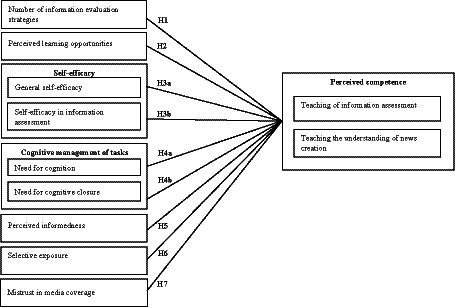
Introduction: Information literacy has become indispensable in navigating today’s fast-paced media environment, with teachers playing a pivotal role in fostering reflective and critical digital citizenship. Positioned as future gatekeepers, pre-service teachers are the key to teaching media skills and especially information literacy to future generations of pupils. Given the particular challenges facing educators today compared to previous generations, it is important to determine whether the next generation of teachers feel adequately prepared and perceive themselves as competent to pass on these skills to their future pupils. However, previous research has highlighted deficiencies in formal learning opportunities at universities, underscoring the need for further investigation into pre-service teachers’ information acquisition, evaluation practices as well as their perceived relevance to teaching, and person-related factors associated with their perceived competence in teaching information literacy. Method: An online questionnaire was presented to participants, employing a mixed-method approach. We qualitatively examined the sources of information used by pre-service teachers and the evaluation strategies they employ, while quantitatively analyzing relationships between pre-service teachers’ person-related factors and their perceived teaching competence. Participants assessed their perceived teaching competence, perceived learning opportunities, self-efficacy (general and related to information assessment), perceived informedness, selective exposure, need for cognition, need for cognitive closure, and mistrust in media coverage. Results: Data from 371 participants revealed digital media dominance in information acquisition over traditional sources, albeit with a prevalence of surface-level evaluation strategies over reflective approaches. Two distinct dimensions of perceived competence in teaching information literacy emerged: one focusing on information assessment while the other centers on the understanding of news creation processes. Perceived competence in teaching information literacy was significantly associated with self-efficacy in information assessment, perceived informedness, selective exposure to information as well as perceived learning opportunities focusing on information evaluation. Moreover, pre-service teachers employing diverse information evaluation strategies demonstrated a heightened sense of perceived competence in teaching information assessment. Discussion: Our results provide valuable insights into the multifaceted nature of pre-service teachers’ perceived competence in teaching information literacy. Theoretical implications for future research as well as practical implications for teacher education and the structure of future curricula are discussed.
Overview
The claims and statistics of this paper haven’t been checked yet.
Run the check — free, no account needed. It reads the open-access text and checks the sources it cites.
Integrity signals
Registry
Cites
Statistics
Figures
Verification
Claims the paper makes
The claims and statistics of this paper haven’t been checked yet.
Run the check — free, no account needed. It reads the open-access text and checks the sources it cites.
Claims other papers make about this one
Each is checked against this paper’s own text: does it say what the citing paper says it does?
The source backs part of the claim, not all of it — or backs it for a different population, condition or comparison.
In the citing paper
“A growing body of performance-based research demonstrates that many university students struggle to evaluate online information effectively, particularly when confronted with conflicting claims or persuasive but unreliable content (Kops et al., 2025; Lan and Tung, 2024; Trixa and Kaspar, 2024).”
From Information competence and critical thinking in digital environments evidence from university students in Kazakhstan (2026) · cites this paper as Trixa and Kaspar, 2024
Experimental — accuracy not yet measured
Self-check
Percentages, sums and reported differences re-computed from the paper’s own numbers.
The self-check needs the paper’s full text.
Citations
Cites
Cacioppo, J. T., Petty, R. E., Feinstein, J. A., & Jarvis, W. B. G. (1996) · Psychological Bulletin · doi:10.1037/0033-2909.119.2.197 · Cited by 2,517 · cited 1×
“NFC is a person’s propensity to seek out and enjoy activities that require demanding and strained thought and problem-solving (Cacioppo et al., 1996).”
BackgroundMotivated closing of the mind: “Seizing” and “freezing”
Kruglanski, A. W., & Webster, D. M. (1996) · Psychological Review · doi:10.1037/0033-295x.103.2.263 · Cited by 2,379 · cited 1×
“NFCC refers to an individual’s desire to simplify complex information and avoid ambiguity (Kruglanski, 1990; Webster and Kruglanski, 1994; Kruglanski and Webster, 1996).”
BackgroundTeachers’ Mathematical Knowledge, Cognitive Activation in the Classroom, and Student Progress
Baumert, J., Kunter, M., Blum, W., Brunner, M., Voss, T., Jordan, A., Klusmann, U., Krauss, S., Neubrand, M., & Tsai, Y.-M. (2010) · American Educational Research Journal · doi:10.3102/0002831209345157 · Cited by 2,100
Social and Heuristic Approaches to Credibility Evaluation Online
Metzger, M. J., Flanagin, A. J., & Medders, R. B. (2010) · Journal of Communication · doi:10.1111/j.1460-2466.2010.01488.x · Cited by 1,394
From digital literacy to digital competence: the teacher digital competency (TDC) framework
Falloon, G. (2020) · Educational Technology Research and Development · doi:10.1007/s11423-020-09767-4 · Cited by 1,372 · cited 3×
“Previous research has extensively explored (pre-service) teachers’ understanding of and skills in digital literacy (see, e.g., Bates et al., 2017; Ghomi and Redecker, 2019; Lázaro-Cantabrana et al., 2019; Falloon, 2020; Maher, 2020).”
BackgroundInfluentialTeachers’ self-efficacy, personality, and teaching effectiveness: A meta-analysis
Klassen, R. M., & Tze, V. M. C. (2014) · Educational Research Review · doi:10.1016/j.edurev.2014.06.001 · Cited by 1,221 · cited 2×
“For example, self-efficacy beliefs can be developed through training or via professional development settings (Klassen and Tze, 2014).”
BackgroundFighting misinformation on social media using crowdsourced judgments of news source quality
Pennycook, G., & Rand, D. G. (2019) · Proceedings of the National Academy of Sciences · doi:10.1073/pnas.1806781116 · Cited by 947
Siddiq, F., Hatlevik, O. E., Olsen, R. V., Throndsen, I., & Scherer, R. (2016) · Educational Research Review · doi:10.1016/j.edurev.2016.05.002 · Cited by 269
Research works printed but not linked: 95
- Asselin, 2003, Whither they go: an analysis of the inclusion of school library programs and Services in the Preparation of pre-service teachers in Canadian universities, Behav. Soc. Sci. Libr., 22, 19, 10.1300/J103v22n01_03 · DOI
- 2004, Australian and New Zealand information literacy framework: Principles, standards and practice
- Aydın, 2013, Examining the effects of pre-service teachers’ personality traits on their teaching competencies, Int. Online J. Educ. Sci., 5, 575
- Bandura, 1997, Self-efficacy: the exercise of control
- Bardin, 2018, The effect of information quality evaluation on selective exposure in informational cognitive dissonance: the role of information novelty, Int. Rev. Soc. Psychol., 31, 21, 10.5334/irsp.173 · DOI
- Beierlein, 2013, Kurzskala zur Erfassung allgemeiner Selbstwirksamkeitserwartungen (ASKU), Methoden Daten Analysen, 7, 251, 10.12758/mda.2013.014 · DOI
- Bless, 1994, Need for cognition: Eine Skala zur Erfassung von engagement und Freude bei Denkaufgaben: need for cognition: a scale measuring engagement and happiness in cognitive tasks, Z. Sozialpsychol., 25, 147
- Blömeke, 2010, TEDS-M 2008
- Botturi, 2022, Screencasting information literacy. Insights in pre-service teachers’ conception of online search, J. Media Literacy Educ., 14, 94, 10.23860/JMLE-2022-14-3-8 · DOI
- Bransford, 2000, How people learn. Brain, mind, experience, and school: Expanded edition
- Brownlee, 2008, Developing relational epistemology through relational pedagogy, 405, 10.1007/978-1-4020-6596-5_19 · DOI
- Cacioppo, 1982, The need for cognition, J. Pers. Soc. Psychol., 42, 116, 10.1037/0022-3514.42.1.116 · DOI · Paper page
- Cacioppo, 1983, Effects of need for cognition on message evaluation, recall and persuasion, J. Pers. Soc. Psychol., 45, 805, 10.1037/0022-3514.45.4.805 · DOI
- Camaj, 2019, From selective exposure to selective information processing: a motivated reasoning approach, Media Commun., 7, 8, 10.17645/mac.v7i3.2289 · DOI
- Clayton, 2020, Real solutions for fake news? Measuring the effectiveness of general warnings and fact-check tags in reducing belief in false stories on social media, Polit. Behav., 42, 1073, 10.1007/s11109-019-09533-0 · DOI · Paper page
- Cohen, 1960, A coefficient of agreement for nominal scales, Educ. Psychol. Meas., 20, 37, 10.1177/001316446002000104 · DOI · Paper page
- Cook, 1982, Criticism and influence analysis in regression, Sociol. Methodol., 13, 313, 10.2307/270724 · DOI
- Dahlqvist, 2021, Information-seeking behaviours of teacher students: a systematic review of quantitative methods literature, Educ. Inf., 37, 259, 10.3233/EFI-200400 · DOI
- DeBacker, 2009, The influence of need for closure on learning and teaching, Educ. Psychol. Rev., 21, 303, 10.1007/s10648-009-9111-1 · DOI
- Djafarova, 2017, Exploring the credibility of online celebrities’ Instagram profiles in influencing the purchase decisions of young female users, Comput. Hum. Behav., 68, 1, 10.1016/j.chb.2016.11.009 · DOI
- Dreger, 2014, Ökonometrische Eingleichungsmodelle, 19, 10.1007/978-3-8349-3828-2_2 · DOI
- Dubois, 2018, The echo chamber is overstated: the moderating effect of political interest and diverse media, Inf. Commun. Soc., 21, 729, 10.1080/1369118X.2018.1428656 · DOI · Paper page
- Durodolu, 2020, Information literacy, self-concept and metacognitive ability of teacher-librarians at the University of Zululand, Libr. Philos. Pract., 1673
- Elias, 2002, Utilizing need for cognition and perceived self-efficacy to predict academic Performance1, J. Appl. Soc. Psychol., 32, 1687, 10.1111/j.1559-1816.2002.tb02770.x · DOI
- Feist, 2012, Predicting interest in and attitudes toward science from personality and need for cognition, Personal. Individ. Differ., 52, 771, 10.1016/j.paid.2012.01.005 · DOI
- Festinger, 1957, A theory of cognitive dissonance, 10.1515/9781503620766 · DOI · Paper page
- Garrett, 2013, Selective exposure: new methods and new directions, Commun. Methods Meas., 7, 247, 10.1080/19312458.2013.835796 · DOI
- Gärtner, 2020, Need for cognitive closure, tolerance for ambiguity, and perfectionism in medical school applicants, BMC Med. Educ., 20, 132, 10.1186/s12909-020-02043-2 · DOI
- Gil de Zúñiga, 2019, News finds me perception and democracy: effects on political knowledge, political interest, and voting, New Media Soc., 21, 1253, 10.1177/1461444818817548 · DOI
- Gil de Zúñiga, 2017, Effects of the news-finds-me perception in communication: social media use implications for news seeking and learning about politics, J. Comput.-Mediat. Commun., 22, 105, 10.1111/jcc4.12185 · DOI
- Gutiérrez-Martín, 2022, ICT and media competencies of teachers. Convergence towards an integrated MIL-ICT model, Comunicar, 30, 21, 10.3916/C70-2022-02 · DOI
- Hart, 2009, Feeling validated versus being correct: a meta-analysis of selective exposure to information, Psychol. Bull., 135, 555, 10.1037/a0015701 · DOI · Paper page
- Hatlevik, 2018, Examining the relationship between teachers’ ICT self-efficacy for educational purposes, collegial collaboration, lack of facilitation and the use of ICT in teaching practice, Front. Psychol., 9, 935, 10.3389/fpsyg.2018.00935 · DOI
- Haugtvedt, 1992, Personality and persuasion: need for cognition moderates the persistence and resistance of attitude changes, J. Pers. Soc. Psychol., 63, 308, 10.1037/0022-3514.63.2.308 · DOI
- Hayes, 2007, Using heteroskedasticity-consistent standard error estimators in OLS regression: an introduction and software implementation, Behav. Res. Methods, 39, 709, 10.3758/BF03192961 · DOI
- Hoss, 2021, Forced remote learning during the COVID-19 pandemic in Germany: a mixed-methods study on students’ positive and negative expectations, Front. Psychol., 12, 642616, 10.3389/fpsyg.2021.642616 · DOI
- Hoss, 2022, German university students’ perspective on remote learning during the COVID-19 pandemic: a quantitative survey study with implications for future educational interventions, Front. Psychol., 13, 734160, 10.3389/fpsyg.2022.734160 · DOI
- Jäger-Biela, 2020, Lerngelegenheiten zum Erwerb von digitalisierungsbezogenen Medienkompetenzen: Analysen des Studienangebots und des Nutzungsverhaltens von Lehramtsstudierenden am Fallbeispiel der Universität zu Köln, 66
- Jones-Jang, 2019, Does media literacy help identification of fake news? Information literacy helps, but other literacies Don’t, Am. Behav. Sci., 65, 371, 10.1177/0002764219869406 · DOI · Paper page
- Kaspar, 2023, Online learning during the Covid-19 pandemic: how university students’ perceptions, engagement, and performance are related to their personal characteristics, Curr. Psychol., 1, 10.1007/s12144-023-04403-9 · DOI
- Kaspar, 2010, Die Effektivität formativer Evaluation bei der Entwicklung gebrauchs- tauglicher Software–eine Fallstudie, Zeitschrift Arbeits Organisationspsychol., 54, 29, 10.1026/0932-4089/a000003 · DOI
- Kaspar, 2014, The experience of new sensorimotor contingencies by sensory augmentation, Conscious. Cogn., 28, 47, 10.1016/j.concog.2014.06.006 · DOI
- Kaspar, 2021, Information seeking behavior on Facebook: the role of censorship endorsement and personality, Curr. Psychol., 40, 3848, 10.1007/s12144-019-00316-8 · DOI
- Kaye, 2012, Blogs as a source of democratic deliberation, 10.4018/978-1-60960-744-9.ch001 · DOI
- Knobloch-Westerwick, 2015, Political online information searching in Germany and the United States: confirmation Bias, source credibility, and attitude impacts: political online information search in Germany and United States, J. Commun., 65, 489, 10.1111/jcom.12154 · DOI
- König, 2018, Pädagogisches Wissen versus fachdidaktisches Wissen?, Z. Erzieh., 21, 1, 10.1007/s11618-017-0765-z · DOI
- Kovalik, 2011, Information literacy, collaboration, and teacher education, Commun. Inf. Lit., 4, 145, 10.15760/comminfolit.2011.4.2.94 · DOI
- Kramer, 2020, Classroom videos or transcripts? A quasi-experimental study to assess the effects of media-based learning on pre-service teachers’ situation-specific skills of classroom management, Int. J. Educ. Res., 103, 101624, 10.1016/j.ijer.2020.101624 · DOI
- Kruglanski, 1990, Lay epistemic theory in social-cognitive psychology, Psychol. Inq., 1, 181, 10.1207/s15327965pli0103_1 · DOI
- Kunina-Habenicht, 2013, Die Bedeutung der Lerngelegenheiten im Lehramtsstudium und deren individuelle Nutzung für den Aufbau des bildungswissenschaftlichen Wissens, Zeitschrift Pädagogik, 59, 1, 10.25656/01:11924 · DOI
- Lázaro-Cantabrana, 2019, Assessing teacher digital competence: the construction of an instrument for measuring the knowledge of pre-service teachers, J. New Approaches Educ. Res., 8, 73, 10.7821/naer.2019.1.370 · DOI
- Lin, 2008, A study of pre-service teachers’ attitudes about computers and mathematics teaching: the impact of web-based instruction, Int. J. Technol. Math. Educ., 15, 45
- Lord, 1979, Biased assimilation and attitude polarization: the effects of prior theories on subsequently considered evidence, J. Pers. Soc. Psychol., 37, 2098, 10.1037/0022-3514.37.11.2098 · DOI · Paper page
- Lou, 2019, Influencer marketing: how message value and credibility affect consumer Trust of Branded Content on social media, J. Interact. Advert., 19, 58, 10.1080/15252019.2018.1533501 · DOI · Paper page
- Lowry, 2013, A picture is worth a thousand words: source credibility theory applied to logo and website design for heightened credibility and consumer trust, Int. J. Hum. Comput. Interact., 30, 63, 10.1080/10447318.2013.839899 · DOI
- Maher, 2020, Pre-service Teachers' digital competencies to support school Students' digital literacies, 29, 10.4018/978-1-7998-1461-0.ch002 · DOI
- Mayring, 2015, Qualitative Inhaltsanalyse
- McNeill, 2018, “My friend posted it and that’s good enough for me!”: source perception in online information sharing, J. Am. Folk., 131, 493, 10.5406/jamerfolk.131.522.0493 · DOI
- Mihailidis, 2017, Spreadable spectacle in digital culture: civic expression, fake news, and the role of media literacies in “post-fact” society, Am. Behav. Sci., 61, 441, 10.1177/0002764217701217 · DOI
- Min, 2018, Selective exposure and political polarization of public opinion on the presidential impeachment in South Korea: Facebook vs. kakaotalk, Korea Observer, 49, 137, 10.29152/KOIKS.2018.49.1.137 · DOI
- O’Hara, 2009, Need for cognition and conscientiousness as predictors of political interest and voting strategy, J. Appl. Soc. Psychol., 39, 1397, 10.1111/j.1559-1816.2009.00487.x · DOI
- Onyekachi, 2020, A comparison of principal component analysis, maximum likelihood and the principal Axis in factor analysis, Am. J. Mathemat. Statistic., 10, 44, 10.5923/j.ajms.20201002.03 · DOI
- Pariser, 2011, The filter bubble: What the internet is hiding from you
- Peciuliauskiene, 2022, Exploring the roles of information search and information evaluation literacy and pre-service teachers' ICT self-efficacy in teaching, Int. J. Educ. Technol. High. Educ., 19, 33, 10.1186/s41239-022-00339-5 · DOI
- Pérez Rodríguez, 2019, Media competence in Spanish secondary school students. Assessing instrumental and critical thinking skills in digital contexts, Educ. Sci., 19, 33, 10.12738/estp.2019.3.003 · DOI
- Pérez-Escoda, 2021, Fake news reaching young people on social networks: distrust challenging media literacy, Publica, 9, 24, 10.3390/publications9020024 · DOI
- Peterson, 2011, Technology confidence, competence and problem solving strategies: differences within online and face-to-face formats, J. Dist. Educ., 25
- Poole, 1971, The assumptions of the linear regression model, Trans. Inst. Br. Geogr., 52, 145, 10.2307/621706 · DOI
- Robitaille, 1980, Intention, implementation, realisation: the impact of curriculum reform in mathematics, J. Curric. Stud., 12, 299, 10.1080/0022027800120403 · DOI
- Rohlfs, 2011, Ein neuer Bildungsbegriff? Zur Unterscheidung formaler, non-formaler und informeller Bildung: Konturen des aktuellen Bildungsdiskurses, 33
- Rott, 2021, Epistemological beliefs and critical thinking in pre-service teacher education, 10.1007/978-3-658-33539-7_5 · DOI
- Rüth, 2022, Teaching with digital games: how intentions to adopt digital game-based learning are related to personal characteristics of pre-service teachers, Br. J. Educ. Technol., 53, 1412, 10.1111/bjet.13201 · DOI
- Sanches, 2018, Required skills for teachers: information literacy at the top, 634, 10.1007/978-3-319-74334-9_65 · DOI
- Schlink, 2007, Kurz und gut: Eine deutsche Kurzskala zur Erfassung des Bedürfnisses nach kognitiver Geschlossenheit, Z. Sozialpsychol., 38, 153, 10.1024/0044-3514.38.3.153 · DOI
- Schwarzer, 1999, Skalen zur Erfassung von Lehrer- und Schülermerkmalen. Dokumentation der psychometrischen Verfahren im Rahmen der Wissenschaftlichen Begleitung des Modellversuchs Selbstwirksame Schulen
- Schwarzer, 2002, Das Konzept der Selbstwirksamkeit, Zeitschrift Pädagogik, 44, 28, 10.25656/01:7863 · DOI
- Shannon, 2019, Teachers and information literacy: understandings and perceptions of the concept, J. Inform. Liter., 13, 41, 10.11645/13.2.2642 · DOI
- Siddiq, 2017, Learning in digital networks – ICT literacy: a novel assessment of students’ 21st century skills, Comput. Educ., 109, 11, 10.1016/j.compedu.2017.01.014 · DOI
- Sindermann, 2021, The evaluation of fake and true news: on the role of intelligence, personality, interpersonal trust, ideological attitudes, and news consumption, Heliyon, 7, e06503, 10.1016/j.heliyon.2021.e06503 · DOI
- Skaalvik, 2007, Dimensions of teacher self-efficacy and relations with strain factors, perceived collective teacher efficacy, and teacher burnout, J. Educ. Psychol., 99, 611, 10.1037/0022-0663.99.3.611 · DOI · Paper page
- Sunstein, 2007, Republic.com 2.0
- Tachtsoglou, 2018, Der Einfluss von Lerngelegenheiten in der Lehrerausbildung auf das pädagogische Wissen angehender Englischlehrkräfte, J. Educ. Res. Online, 10, 3, 10.25656/01:16131 · DOI
- Tanas, 2020, The importance of teachers’ need for cognition in their use of Technology in Mathematics Instruction, Front. Psychol., 11, 259, 10.3389/fpsyg.2020.00259 · DOI
- Thompson, 1992, A partial test distribution for cosines among factors across samples, 81
- Thompson, 1996, Factor analytic evidence for the construct validity of scores: a historical overview and some guidelines, Educ. Psychol. Meas., 56, 197, 10.1177/0013164496056002001 · DOI
- Trixa, 2020, Press Start: Digitale Spiele im Unterricht, Grundschule, 5, 53
- Valtonen, 2019, Media literacy education in the age of machine learning. Journal of media literacy, J. Media Literacy Educ., 11, 20, 10.23860/JMLE-2019-11-2-2 · DOI
- Voss, 2013, Mathematics teachers’ beliefs, 249
- Watson, 2018, Die Nutzung institutioneller Lerngelegenheiten und die Entwicklung bildungswissenschaftlichen Wissens angehender Lehrkräfte, Z. Erzieh., 21, 565, 10.1007/s11618-017-0794-7 · DOI
- Webster, 1994, Individual differences in need for cognitive closure, J. Pers. Soc. Psychol., 67, 1049, 10.1037//0022-3514.67.6.1049 · DOI · Paper page
- Wronska, 2019, Person-task fit: emotional consequences of performing divergent versus convergent thinking tasks depend on need for cognitive closure, Personal. Individ. Differ., 142, 172, 10.1016/j.paid.2018.09.018 · DOI
- Wu, 2022, Factors associated with teachers’ competence to develop students’ information literacy: a multilevel approach, Comput. Educ., 176, 104360, 10.1016/j.compedu.2021.104360 · DOI
- Zimmermann, 2022, Pre-service teachers’ search strategies when sourcing educational information on the internet, Front. Educ., 7, 976346, 10.3389/feduc.2022.976346 · DOI
- Zimmermann, 2023, Political news on Instagram: influencer versus traditional magazine and the role of their expertise in consumers’ credibility perceptions and news engagement, Front. Psychol., 14, 1257994, 10.3389/fpsyg.2023.1257994 · DOI
- Zimmermann, 2022, Influencers on YouTube: a quantitative study on young people’s use and perception of videos about political and societal topics, Curr. Psychol., 41, 6808, 10.1007/s12144-020-01164-7 · DOI
Cited by
Sorted by citations
School Library Professionals’ Perceptions of Students’ Digital Information Literacy
Merga, M. K., & Mat Roni, S. (2025) · Journal of Library Administration · doi:10.1080/01930826.2025.2475701 · Cited by 13
“…of this common SLP skill, while needing further research, may be underestimated, given that “one of the biggest barriers teachers face, is a lack of competence and confidence in DIL, which often results in their reluctance to incorporate or teach new content” (Trixa & Kaspar, 2024, p. 4).”
Yrymbayeva, N., Yermekova, M., Tezekova, O., Issatayeva, B., Zhubandykova, A., & Tuxanbayev, A. (2026) · Frontiers in Education · doi:10.3389/feduc.2026.1809360 · Cited by 2
Metadata
- Authors
- Trixa, J., & Kaspar, K.
- Venue
- Frontiers in Psychology
- Publisher
- Frontiers Media SA
- Published
- 2024-03-15
- Volume
- 15
- ISSN
- 1664-1078
- PMC
- PMC10978670
- Cited by
- 49
- References
- 8
About these checks
Registry, retraction, Cites and statistics results are computed, not judged, with one exception: a printed reference that no index lists is read once by a model before it counts as a citation error. Claims are extracted by a model and kept only when their quote appears verbatim in the text; each cited source is then checked, with a model’s help, for whether it says what the claim relies on. Those verdicts can be wrong — read the claim’s quote and the cited source before relying on one.
Statistics and arithmetic are recomputed, not judged.
Confidence bands are shown only for fields calibrated on our annotated test set. None is calibrated yet, so no band is shown.
What counts as a claim ›How we measure confidence ›How we check this ›
Are you an author, or do you see a problem with this page? Request a review
How to cite
Cite CoChat for the checks on this page, and the paper for its own findings.
- This page
- CoChat. (2026). Citation check: Information literacy in the digital age: information sources, evaluation strategies, and perceived teaching competences of pre-service teachers. https://app.cochat.ai/papers/10.3389/fpsyg.2024.1336436
- The paper
- Trixa, J., & Kaspar, K. (2024). Information literacy in the digital age: information sources, evaluation strategies, and perceived teaching competences of pre-service teachers. Frontiers in Psychology. https://doi.org/10.3389/fpsyg.2024.1336436
