

The DOI matches its Crossref record; 66 of the 66 references it cites were found in a registry or an index.
Autistic Symptoms in Schizophrenia Spectrum Disorders: A Systematic Review and Meta-Analysis
Open accessAbstract
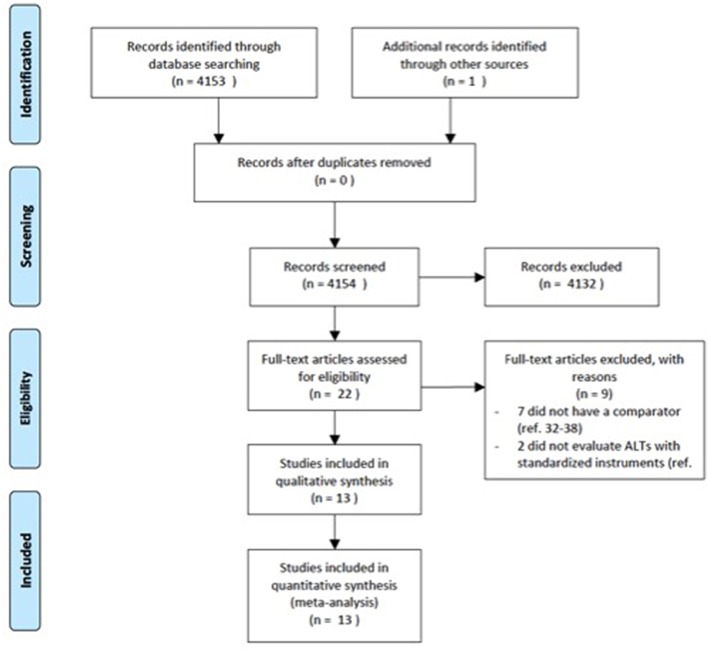
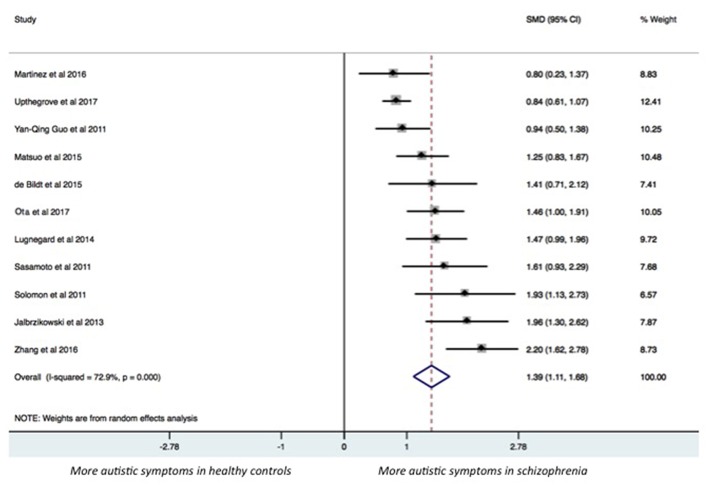
BACKGROUND: Recent studies have examined the association between autism spectrum disorder and schizophrenia spectrum disorders, describing a number of cognitive features common to both conditions (e.g., weak central coherence, difficulties in set-shifting, impairment in theory of mind). Several studies have reported high levels of autistic symptoms in population with schizophrenia spectrum disorders. Our study systematically reviews and quantitatively synthetizes the current evidence on the presence of autistic symptoms in individuals with schizophrenia spectrum disorders. METHODS: A comprehensive literature search of the PubMed/MEDLINE, Cochrane Library, CINHAL, and Embase databases was performed from the date of their inceptions until March 2018. The primary outcome measure was the Autism Spectrum Quotient (AQ). As secondary outcome measures, we analysed the AQ subscales. Data were extracted and analyzed by using a conservative model and expressed by standardized mean difference (SMD). RESULTS: Thirteen studies comprising a total of 1958 individuals were included in the analysis. Results showed that individuals with schizophrenia spectrum disorders have higher levels of autistic symptoms compared to healthy controls [SMD: 1.39, 95% confidence interval (CI): 1.11 to 1.68] and lower levels of autistic symptoms compared to individuals with autism (SMD: -1.27, 95% CI: -1.77 to -0.76). CONCLUSIONS: Current findings support that individuals with schizophrenia spectrum disorders have higher autistic symptoms than healthy controls. Therefore, further studies are needed in order to shed light on the association between these two conditions.
Overview
The claims and statistics of this paper haven’t been checked yet.
Run the check — free, no account needed. It reads the open-access text and checks the sources it cites.
Integrity signals
Registry
Cites
Statistics
Figures
Verification
Claims the paper makes
The claims and statistics of this paper haven’t been checked yet.
Run the check — free, no account needed. It reads the open-access text and checks the sources it cites.
Claims other papers make about this one
Each is checked against this paper’s own text: does it say what the citing paper says it does?
In the citing paper
“ASD shares many overlaps with schizophrenia, not just on a clinical scale, but also with similar PV-IN abnormalities [39].”
From Parvalbumin interneuron vulnerability and brain disorders (2021) · cites this paper as [39]
Self-check
Percentages, sums and reported differences re-computed from the paper’s own numbers.
The self-check needs the paper’s full text.
Citations
Cites
Preferred Reporting Items for Systematic Reviews and Meta-Analyses: the PRISMA statement
Moher, D., Liberati, A., Tetzlaff, J., Altman, D. G., & for the PRISMA Group (2009) · BMJ · doi:10.1136/bmj.b2535 · Cited by 83,823
Measuring inconsistency in meta-analyses
Higgins, J. P. T., Thompson, S. G., Deeks, J. J., & Altman, D. G. (2003) · BMJ · doi:10.1136/bmj.327.7414.557 · Cited by 63,139
Preferred Reporting Items for Systematic Reviews and Meta-Analyses: The PRISMA Statement
Moher, D., Liberati, A., Tetzlaff, J., & Altman, D. G. (2009) · Journal of Clinical Epidemiology · doi:10.1016/j.jclinepi.2009.06.005 · Cited by 19,575
(2014) · Medical Entomology and Zoology · Cited by 17,633
Baron-Cohen, S., Wheelwright, S., Skinner, R., Martin, J., & Clubley, E. (2001) · Journal of Autism and Developmental Disorders · doi:10.1023/a:1005653411471 · Cited by 6,450 · cited 1×
“The AQ is a 50item questionnaire consisting of five different areas: social skill, attention switching, attention to detail, communication, and imagination (47).”
BackgroundComorbid psychiatric disorders in children with autism: interview development and rates of disorders
Leyfer, O. T., Folstein, S. E., Bacalman, S., Davis, N. O., Dinh, E., Morgan, J., Tager-Flusberg, H., & Lainhart, J. E. (2006) · Journal of Autism and Developmental Disorders · doi:10.1007/s10803-006-0123-0 · Cited by 1,637
Shared molecular neuropathology across major psychiatric disorders parallels polygenic overlap
Gandal, M. J., Haney, J. R., Parikshak, N. N., Leppa, V., Ramaswami, G., Hartl, C., Schork, A. J., Appadurai, V., Buil, A., Werge, T. M., et al. (2018) · Science · doi:10.1126/science.aad6469 · Cited by 1,095
Constantino, J. N. (2013) · Encyclopedia of Autism Spectrum Disorders · doi:10.1007/978-1-4419-1698-3_296 · Cited by 908
Ehlers, S., Gillberg, C., & Wing, L. (1999) · Journal of Autism and Developmental Disorders · doi:10.1023/a:1023040610384 · Cited by 854
Theory of mind impairment in schizophrenia: meta-analysis
Bora, E., Yucel, M., & Pantelis, C. (2009) · Schizophrenia Research · doi:10.1016/j.schres.2008.12.020 · Cited by 797
Research works printed but not linked: 3
- 2013, Diagnostic and Statistical Manual of Mental Disorders-5
- Lord, 2012, Autism Diagnostic Observation Schedule, Second Edition (ADOS-2) Manual (Part II): Toddler Module
- Lord, 2012, Autism Diagnostic Observation Schedule, Second Edition (ADOS-2) Manual (Part I): Modules 1-4
Cited by
Sorted by citations
Parvalbumin interneuron vulnerability and brain disorders
Ruden, J. B., Dugan, L. L., & Konradi, C. (2021) · Neuropsychopharmacology · doi:10.1038/s41386-020-0778-9 · Cited by 194
The schizophrenia syndrome, circa 2024: What we know and how that informs its nature
Tandon, R., Nasrallah, H. A., Akbarian, S., Carpenter, W. T., DeLisi, L. E., Gäebel, W., Green, M. F., Gur, R. E., Heckers, S., Kane, J. M., et al. (2023) · Schizophrenia Research · doi:10.1016/j.schres.2023.11.015 · Cited by 205
Tromp, A., Mowry, B. J., & Giacomotto, J. (2020) · Molecular Psychiatry · doi:10.1038/s41380-020-00944-8 · Cited by 100
Eissa, N., Sadeq, A. S., Sasse, A., & Sadek, B. S. (2020) · Frontiers in Pharmacology · doi:10.3389/fphar.2020.00886 · Cited by 99
Recognizing Psychosis in Autism Spectrum Disorder
Ribolsi, M., Nastro, F. F., Pelle, M., Medici, C., Sacchetto, S., Lisi, G., Riccioni, A., Siracusano, M., Mazzone, L., & Lorenzo, G. D. (2022) · Frontiers in Psychiatry · doi:10.3389/fpsyt.2022.768586 · Cited by 70
Self-citation
Metadata
- Authors
- De Crescenzo, F., Postorino, V., Siracusano, M., Riccioni, A., Armando, M., Curatolo, P., & Mazzone, L.
- Affiliations
- Mental Health Center of Denver (US)
- University of Rome Tor Vergata (IT)
- University of Geneva (CH)
- Corresponding author
- Mazzone, Luigi
- ORCID
- Venue
- Frontiers in Psychiatry
- Publisher
- Frontiers Media SA
- Published
- 2019-02-21
- Volume
- 10
- Pages
- 78-78
- ISSN
- 1664-0640 (ISSN-L)
- PMC
- PMC6393379
- OpenAlex
- W2912969681
- Cited by
- 143
- References
- 66
- Citations by year
- 2026: 19 · 2025: 16 · 2024: 17 · 2023: 12 · 2022: 18 · 2021: 40 · 2020: 18 · 2019: 3
- FWCI
- 3.32
- Type
- journal article
- Language
- en
- Open access
- gold
- doi.org
- Licence
- Locations
- Frontiers in Psychiatry (publishedVersion, cc-by)
- Europe PMC (PubMed Central) (publishedVersion, cc-by)
- PubMed Central (publishedVersion, cc-by)
- PubMed (publishedVersion)
- Cineca Institutional Research Information System (Tor Vergata University) (submittedVersion, other-oa)
- DOAJ (DOAJ: Directory of Open Access Journals) (submittedVersion, cc-by-sa)
- SERVAL (Université de Lausanne) (submittedVersion)
- Topics
- Health Sciences › Medicine › Psychiatry and Mental health › Schizophrenia research and treatment
- Life Sciences › Neuroscience › Cognitive Neuroscience › Autism Spectrum Disorder Research
- Social Sciences › Arts and Humanities › Philosophy › Mental Health and Psychiatry
- Keywords
- autism symptoms, schizophrenia spectrum disorders, autism spectrum disorder, Autism Spectrum Quotient, weak central coherence, set-shifting, theory of mind, comorbidities
About these checks
Registry, retraction, Cites and statistics results are computed, not judged, with one exception: a printed reference that no index lists is read once by a model before it counts as a citation error. Claims are extracted by a model and kept only when their quote appears verbatim in the text; each cited source is then checked, with a model’s help, for whether it says what the claim relies on. Those verdicts can be wrong — read the claim’s quote and the cited source before relying on one.
Statistics and arithmetic are recomputed, not judged.
Confidence bands are shown only for fields calibrated on our annotated test set. None is calibrated yet, so no band is shown.
What counts as a claim ›How we measure confidence ›How we check this ›
Are you an author, or do you see a problem with this page? Request a review
