

Online support seeking, co-rumination, and mental health in adolescent girls
Open accessThe DOI matches its Crossref record; 56 of the 56 references it cites were found in a registry or an index.
Abstract
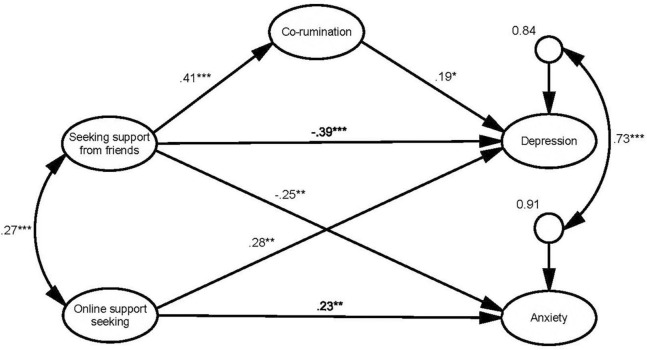
Introduction: Adolescents frequently use informal support seeking to cope with stress and worries. Past research in face-to-face contexts has shown that the relationship between informal support seeking and mental health is influenced by the specific strategy used and the mode through which support is sought. To date, little research has considered the relationship between support seeking online and adolescent mental health. Methods: In this study, structural equation modeling (SEM) examined the mediating role of co-rumination in the relationships between seeking support from friends or online and two measures of mental health: depression and anxiety. Participants were 186 adolescent girls, drawn from four independent girls’ schools in Sydney, Australia. Four brief vignettes described common social stressors and participants rated their likelihood of seeking support from close friends and from informal online sources. Co-rumination was measured using a short form of the Co-rumination Questionnaire and depression and anxiety were measured with the youth version of the Depression, Anxiety, and Stress Scale-Youth (DASS-Y). Results: Different patterns of findings were found for support seeking from close friends and support seeking online. First, support seeking from friends was related to lower levels of depression and anxiety while seeking support online was related to higher levels depression and anxiety. Second, co-rumination suppressed the relationship between seeking support from friends and depression, but not online support seeking and depression or anxiety. Discussion: These findings suggest that co-rumination reduces the benefits of seeking support from friends but is unrelated to online support seeking. The findings also confirm the problematic nature of online support seeking for adolescent girls’ mental health, particularly in response to social stressors.
Overview
The claims and statistics of this paper haven’t been checked yet.
Free: it reads the open-access text and checks the first 5 claims that cite a source we can check. Create a free account to check every claim.
Integrity signals
Registry
Cites
Statistics
Figures
Verification
Claims the paper makes
The claims and statistics of this paper haven’t been checked yet.
Free: it reads the open-access text and checks the first 5 claims that cite a source we can check. Create a free account to check every claim.
Claims other papers make about this one
Each is checked against this paper’s own text: does it say what the citing paper says it does?
The cited source says what the claim attributes to it.
In the citing paper
“The finding of a female-specific mediation through distrust supports existing evidence that adolescent girls, who tend to show greater empathic concern and place a higher value on symmetrical reciprocity [73, 74], may be particularly susceptible to relationship-based stressors [75] in online contexts, where they often go for support [76].”
From Adolescent social media use and psychiatric outcomes: a longitudinal mediation analysis via interpersonal distrust, sleep, and self-image. (2026) · cites this paper as [76]
Self-check
Percentages, sums and reported differences re-computed from the paper’s own numbers.
The self-check needs the paper’s full text.
Citations
Cites
Hu, L., & Bentler, P. M. (1999) · Structural Equation Modeling A Multidisciplinary Journal · doi:10.1080/10705519909540118 · Cited by 108,788
Principles and Practice of Structural Equation Modeling
Tabri, N., & Elliott, C. M. (2012) · Canadian Graduate Journal of Sociology and Criminology · doi:10.15353/cgjsc-rcessc.v1i1.25 · Cited by 38,891
Lovibond, P. F., & Lovibond, S. H. (1995) · Behaviour Research and Therapy · doi:10.1016/0005-7967(94)00075-u · Cited by 14,523 · cited 7×
“Mean imputation is the recommended method of dealing with missing values in the DASS (47).”
MethodInfluentialNolen-Hoeksema, S., Wisco, B. E., & Lyubomirsky, S. (2008) · Perspectives on Psychological Science · doi:10.1111/j.1745-6924.2008.00088.x · Cited by 5,172 · cited 1×
“Perceived stressors cause individuals to reach out to others for support in managing their emotions, with specific conversational characteristics determining whether the discussion includes more productive forms of shared problem solving and emotional support or a repetitive and non-productive dwelling on the challeng…”
BackgroundEquivalence of the Mediation, Confounding and Suppression Effect
MacKinnon, D. P., Krull, J. L., & Lockwood, C. M. (2000) · Prevention Science · doi:10.1023/a:1026595011371 · Cited by 4,188 · cited 1×
“Specifically, we found an inconsistent mediation (suppression) effect (51), as seeking support from friends was positively related to co-rumination (β = 0.”
BackgroundSalk, R. H., Hyde, J. S., & Abramson, L. Y. (2017) · Psychological Bulletin · doi:10.1037/bul0000102 · Cited by 2,622
Compas, B. E., Jaser, S. S., Bettis, A. H., Watson, K. H., Gruhn, M. A., Dunbar, J. P., Williams, E., & Thigpen, J. C. (2017) · Psychological Bulletin · doi:10.1037/bul0000110 · Cited by 1,555
Co–Rumination in the Friendships of Girls and Boys
Rose, A. J. (2002) · Child Development · doi:10.1111/1467-8624.00509 · Cited by 1,172 · cited 6×
“Co-rumination was measured using a short form of the Co-rumination Questionnaire and depression and anxiety were measured with the youth version of the Depression, Anxiety, and Stress Scale-Youth (DASS-Y).”
BackgroundMethodInfluentialMeta-Analysis of the Relationships Between Social Support and Well-Being in Children and Adolescents
Chu, P. S., Saucier, D. A., & Hafner, E. (2010) · Journal of Social and Clinical Psychology · doi:10.1521/jscp.2010.29.6.624 · Cited by 962 · cited 1×
“(13) reported a weak association between support seeking and wellbeing outcomes, Heerde and Hemphill (12) and Compas et al.”
BackgroundNesi, J., Choukas-Bradley, S., & Prinstein, M. J. (2018) · Clinical Child and Family Psychology Review · doi:10.1007/s10567-018-0261-x · Cited by 712 · cited 2×
“Explanations for this include poorer quality support provision due to reduced social cues (16–18), overly negative or critical feedback in response to support seeking attempts (19), and increased availability of friends resulting in problematic support seeking behaviors such as co-rumination (20).”
Background
Research works printed but not linked: 1
- Muthén LK Muthén BO. MPlus. Version 8.8. [software]. Los Angeles, CA: Muthén & Muthén (2022).
Cited by
Jiang, J., Chen, J., Lin, Z., Tang, X., & Hu, Z. (2024) · Frontiers in Psychology · doi:10.3389/fpsyg.2024.1466426 · Cited by 25
Dong, K., Qi, H., & Zhao, G. (2025) · Journal of Youth and Adolescence · doi:10.1007/s10964-025-02140-9 · Cited by 18
Vuijk, P., Bul, K., Buil, J. M., Rauws, M., Curie, K., Amesz, C., Weerheijm, R., & Riper, H. M. (2024) · Trials · doi:10.1186/s13063-023-07885-x · Cited by 14
“For instance, Mackenzie and colleagues [30] demonstrated that co-rumination suppressed the beneficial effect of seeking support from friends.”
BackgroundTsomokos, D. I. (2026) · Social Psychiatry and Psychiatric Epidemiology · doi:10.1007/s00127-025-02999-w · Cited by 5
Hu, J., Isak, G., Yalikun, S., Lu, X., & Ren, Z. (2024) · Personality and Individual Differences · doi:10.1016/j.paid.2024.112717 · Cited by 7
Co-rumination and depression: A systematic review and future directions
Badawi, J. C., & Ingram, R. E. (2025) · Journal of Social and Clinical Psychology · doi:10.1521/jscp.2025.44.1.002 · Cited by 5
Ho, T. T. Q., Nguyen, B. T. N., & Pham, T. T. H. (2025) · Psychiatric Quarterly · doi:10.1007/s11126-025-10186-y · Cited by 6
“However, online social support can also have adverse effects, including reduced self-esteem [52], increased risk of internet addiction [70], and exacerbated symptoms of depression and anxiety [51, 53 ].”
Jiang, J., Yao, C., & Song, X. (2024) · Frontiers in Public Health · doi:10.3389/fpubh.2024.1320146 · Cited by 3
Raeymaecker, K. D., Bastin, M., Baetens, I., Bijttebier, P., & Heel, M. V. (2025) · Cognitive Therapy and Research · doi:10.1007/s10608-025-10599-w · Cited by 1
“This, in turn, opens the door to (accidental) harshness and misunderstandings (Mackenzie et al., 2023; Winstone et al., 2021).”
Intimate disclosure in online‐only friendships predicts adolescents' depressive symptoms
Kilic, Z., Maheux, A. J., Nesi, J. L., Silk, J. S., & Choukas‐Bradley, S. (2026) · Journal of Research on Adolescence · doi:10.1111/jora.70144 · Cited by 3
“Indeed, support-seeking online could be one mechanism by which teens engage in excessive amounts of intimate disclosure with OOFs; online support-seeking has previously been linked to higher levels of depressive symptoms (Mackenzie et al., 2023).”
Influence of human and organizational factors on security perception
Larena-Luengo, A., Martínez-Herráiz, J.-J., Ferrer-Oliva, M., & Medina, J. (2026) · International Journal of Information Security · doi:10.1007/s10207-026-01277-3 · Cited by 4
“Overall, the model provides empirical support for an integrated perspective that connects human, relational, and organizational dimensions in explaining how organizations develop resilience and security awareness.”
Navarrete, F. C., Hernández-Mosqueira, C., Contreras-Díaz, G., del‐Cuerpo, I., Jerez‐Mayorga, D., Herrera-Valenzuela, T., Guzmán-Muñoz, E., Hernández-Martínez, J., Valdés-Badilla, P. A., Núñez-Espinosa, C. A., et al. (2026) · Children · doi:10.3390/children13060825 · Cited by 1
“Psychosocially, adolescent girls tend to engage in more ruminative coping and interpersonal stress processing, while also facing greater sociocultural pressures related to body image, academic achievement, and social relationships, all of which compound emotional strain [57].”
Luo, Z., Wang, S., Xia, W., Guo, D., Ren, C., & Li, T. (2025) · Current Psychology · doi:10.1007/s12144-025-08057-7 · Cited by 1
Vuijk, P., Bul, K., Buil, J. M., Rauws, M., Curie, K., Amesz, C., Weerheijm, R., & Riper, H. M. (2023) · Research Square · doi:10.21203/rs.3.rs-3265929/v1 · Cited by 1
Brimmel, N., Kurten, S., Eggermont, S., & Bijttebier, P. (2025) · Mass Communication & Society · doi:10.1080/15205436.2025.2469742 · Cited by 1
“However, the greater negative mood may also indicate that adolescents engaged in co-rumination when they discussed these negative experiences or emotions with friends (Mackenzie et al., 2023).”
Societal pressure to be happy, co-rumination and psychological distress in emerging adults
Murdock, K. K., & Whiting, W. L. (2026) · Current Psychology · doi:10.1007/s12144-025-08683-1 · Cited by 1
“Yet other studies have tested hypothetical models of co-rumination with females only (Mackenzie et al., 2023; Stone et al., 2022).”
Li, Y., Wang, X. N., Lin, C.-Y., Liao, X.-L., Jiang, X.-Y., Griffiths, M. D., Chen, I., & Malas, O. (2026) · Current Psychology · doi:10.1007/s12144-025-08738-3
“Also, it has been applied to samples of young Australians (Mackenzie et al., 2023), Afghans (Neyazi et al., 2024), and Mexicans (Rayas et al., 2023).”
Romano, S., Esposito, D., Iorio, G. D., Panvino, F., Altomonte, B., Calderoni, D., Conte, G., Casini, M. P., & Terrinoni, A. (2026) · Psychiatry International · doi:10.3390/psychiatryint7030125
“While such material may provide emotional validation or informal coping, it also exposes adolescents to unfiltered or misleading information that may reinforce maladaptive cognitions, especially among those with heightened emotional sensitivity [33,45].”
Wang, Z., Xie, Z., & Lifen, Z. (2026) · Child & Family Social Work · doi:10.1111/cfs.70269
Fox, J. K., Irshad, G., Matsuzaka, S., & Grapin, S. L. (2026) · Journal of College Student Mental Health · doi:10.1080/28367138.2026.2727405
Gendered networks of psychological adaptation under prolonged war
Hamama, L., Hamama‐Raz, Y., & Sarid, O. (2026) · Frontiers in Public Health · doi:10.3389/fpubh.2026.1920728
Chen, F., Yan, X., Ding, X., Li, J., Pan, S., Feng, L., Zhang, X., Wu, Y., Sun, H., & Xu, H. (2026) · Frontiers in Public Health · doi:10.3389/fpubh.2026.1950568
Läßle, R. (2026) · Kinder- und Jugendmedizin · doi:10.1055/a-2884-4373
Wang, M., Dou, Y., Yan, M., & 唐静 (2026) · Archives of Psychiatric Nursing · doi:10.1016/j.apnu.2026.152256
Metadata
- Authors
- Mackenzie, E., McMaugh, A., Van Bergen, P., & Parada, R. H.
- Affiliations
- Western Sydney University (AU)
- Macquarie University (AU)
- Corresponding author
- Mackenzie, Erin
- Venue
- Frontiers in Psychiatry
- Publisher
- Frontiers Media SA
- Published
- 2023-03-07
- Volume
- 14
- Pages
- 1040636-1040636
- ISSN
- 1664-0640 (ISSN-L)
- PMC
- PMC10027699
- OpenAlex
- W4323364248
- Cited by
- 24
- References
- 56
- Citations by year
- 2026: 12 · 2025: 7 · 2024: 4 · 2023: 1
- FWCI
- 10.31
- Type
- journal article
- Language
- en
- Open access
- gold
- doi.org
- Licence
- Locations
- Frontiers in Psychiatry (publishedVersion, cc-by)
- PubMed Central (publishedVersion, cc-by)
- PubMed (publishedVersion)
- Research Online (University of Wollongong) (submittedVersion)
- DOAJ (DOAJ: Directory of Open Access Journals) (submittedVersion, cc-by-sa)
- Figshare (submittedVersion)
- Funders
- Macquarie University
- Topics
- Social Sciences › Sociology and Political Science › Impact of Technology on Adolescents
- Social Sciences › Psychology › Clinical Psychology › Child and Adolescent Psychosocial and Emotional Development
- Social Sciences › Psychology › Social Psychology › Mental Health via Writing
- Keywords
- co-rumination, adolescent girls, adolescent mental health, depression, anxiety, social stressors, friends, mediation, girls' schools
About these checks
Registry, retraction, Cites and statistics results are computed, not judged, with one exception: a printed reference that no index lists is read once by a model before it counts as a citation error. Claims are extracted by a model and kept only when their quote appears verbatim in the text; each cited source is then checked, with a model’s help, for whether it says what the claim relies on. Those verdicts can be wrong — read the claim’s quote and the cited source before relying on one.
Statistics and arithmetic are recomputed, not judged.
Confidence bands are shown only for fields calibrated on our annotated test set. None is calibrated yet, so no band is shown.
What counts as a claim ›How we measure confidence ›How we check this ›
Are you an author, or do you see a problem with this page? Request a review
Data sources
Bibliographic data: Semantic Scholar, OpenAlex, Crossref.
Contains information from the Semantic Scholar Academic Graph Datasets, made available under the ODC Attribution License (ODC-BY 1.0).
Semantic Scholar’s data is described in: Kinney, R., et al. (2023). The Semantic Scholar Open Data Platform. arXiv:2301.10140.
