

The DOI matches its Crossref record; 77 of the 77 references it cites were found in a registry or an index; 76 of the 104 sources its claims cite were checked for support.
Predictive coding and neurocomputational psychiatry: a mechanistic framework for understanding mental disorders
Open accessAbstract
Predictive coding offers a powerful computational framework for understanding brain function and psychiatric disorders at a mechanistic level. This perspective synthesizes advances in computational psychiatry, proposing that mental disorders can be conceptualized as specific alterations in the brain's predictive inference machinery. We first outline the theoretical foundations of predictive coding, including Bayesian inference, free-energy minimization, and neural population dynamics, illustrating how these abstract computational principles map onto specific neural circuits and biophysical mechanisms. We then argue that diverse psychiatric conditions can be understood within this unified framework. Taken together, these links between theory, generative models and empirical data suggest a route by which predictive coding might be rendered a testable, modifiable, falsifiable construct within biological psychiatry. Beyond offering conceptual clarity, this framework has significant clinical implications, including the development of mechanistic biomarkers, personalized treatment approaches based on computational phenotypes, and novel therapeutic interventions targeting specific inferential abnormalities. By grounding psychiatric symptoms in aberrant predictive processes implemented in neural circuitry, this approach promises a more mechanistic understanding of mental disorders and a path toward more targeted, effective interventions.
Overview
CoChat Summary
## TL;DR
This review argues that predictive coding provides a mechanistic framework for psychiatry by linking symptoms to abnormalities in Bayesian inference, precision-weighting, and circuit-level prediction error processing. It presents schizophrenia, autism, depression, OCD, anxiety, and bipolar disorder as different patterns of inferential dysfunction and suggests implications for biomarkers, personalized treatment, and novel interventions.
## Key findings
- Predictive coding is framed as a brain-inference model in which top-down predictions and bottom-up prediction errors are updated to minimize surprise/free energy; the paper links this to neural circuitry, mean-field models, and biophysical models such as Hodgkin–Huxley.
- The paper proposes disorder-specific computational interpretations:
- schizophrenia: aberrant precision-weighting of priors and prediction errors, with evidence including reduced mismatch negativity and diminished feedback connectivity in DCM studies;
- autism: weak priors / low-precision priors leading to sensory overweighting and hypersensitivity;
- depression: maladaptive attractor states and failure to update from positive evidence;
- OCD: overactive error signals and excessive precision on prediction errors;
- anxiety disorders: exaggerated uncertainty and threat predictions;
- bipolar disorder: instability of precision and network dynamics across manic and depressive states.
- For schizophrenia, the paper reports a DCM study in which patients had “markedly reduced backward connectivity from frontal cortex to visual cortex” and failed to increase this top-down connectivity when stimuli became predictable.
- The paper argues that predictive coding may support mechanistic biomarkers, personalized treatment selection, and interventions such as DBS, closed-loop stimulation, biofeedback, exposure therapy, cognitive restructuring, and pharmacological re-tuning of neuromodulatory gain.
## Methods
- Not an empirical study; this is a theoretical/review paper synthesizing predictive coding, Bayesian inference, free-energy minimization, and computational psychiatry.
- The paper draws on prior empirical literature, including M/EEG, fMRI, DCM, and neurochemical findings, but it does not report a new sample or new data collection.
- The main analysis is conceptual and integrative: it maps predictive-coding quantities (predictions, prediction errors, precision) onto psychiatric symptoms and cited circuit-level evidence.
## Limitations
- The paper states that several limitations remain: integrating computational insights into clinical taxonomies is difficult, comorbidity complicates diagnosis, and current biomarkers grounded in predictive coding (e.g. mismatch negativity) have not yet shown sufficient specificity or reliability for clinical translation.
- It also states that many predictive-coding quantities overlap with other frameworks such as reinforcement learning, Bayesian decision theory, and control-theoretic models, limiting the discriminative power of predictive coding unless it makes distinct empirical predictions.
- Evident from the text: the paper is largely a conceptual synthesis rather than a direct test of its claims, so many disorder mappings are presented as hypotheses or interpretations rather than newly demonstrated findings.
Model-written summary. Check it against the paper before relying on it.
Integrity signals
Registry
Cites
Statistics
Figures

Verification
Claims the paper makes
54 Valid · 17 Not valid · 22 Not checked · 116 Own results and interpretations
At least one cited source doesn’t support this claim or points to a different paper, and none confirmed it — see the verdicts below.
In the paper
“depressed individuals show blunted neural responses to unexpected rewards (a kind of reduced reward prediction error signalling) (52).”
§ Predictive coding and neurocomputational psychiatry: a mechanistic framework for understanding mental disorders > Predictive coding and psychiatric disorders > Depression: maladaptive attractor states and failure to update
What the sources say
- Disputedcites [52] Rutledge, 2017, Association of neural and emotional impacts of reward prediction errors with major depression, JAMA Psychiatry sourceExperimental — accuracy not yet measured
The Results (Probabilistic Reward Task) report intact reward prediction error signals in depressed participants, with no significant difference from controls. The Discussion likewise says the study found no evidence of impaired reward-related neural processes in its nonlearning task. Although the Introduction notes earlier reports of reduced responses to rewards, this paper's own findings contradict the attributed claim about reduced prediction error signalling. (LLM, conf=0.93)
Checked by a reasoning model — may be wrong.
plainstates an association- Asserted: passes — The authors put it forward as true.
- Checkable: passes — It can be checked against evidence.
- Load-bearing: passes — The paper’s conclusions depend on it.
- Based: passes — The paper gives a reason why it holds.
- Disputed
The cited sources support only part of this claim — read each source’s verdict below.
In the paper
“Among various modelling approaches, predictive coding has emerged as a compelling unifying theory for brain function (7, 8).”
§ Predictive coding and neurocomputational psychiatry: a mechanistic framework for understanding mental disorders > Introduction Traditional psychiatry has long relied on symptom-based classifications of mental illness, with limited insight into underlying brain mechanisms. Computational psychiatry offers a new paradigm (1–5): by integrating mathematical models with neurobiology, it seeks to explain psychiatric phenomena in terms of aberrant brain computations (6). Among various modelling approaches, predictive coding has emerged as a compelling unifying theory for brain function (7, 8). In essence, predictive coding treats the brain as an inference machine that continually generates and updates predictions about sensory inputs via hierarchical message passing. Closely related, but conceptually distinct (9), is the Free Energy Principle and its formulation in terms of active inference, which extend predictive coding from perceptual inference to action and policy selection (10). In this article we focus primarily on predictive coding as an algorithmic and neurobiological account of hierarchical inference, while drawing on active inference where it clarifies the role of behaviour, policy selection, and intervention. This family of frameworks provides a normative (Bayesian) account of perception and action, in which the brain seeks to minimise surprise or “free energy” by aligning its internal model with the outside world (11). Crucially, this perspective offers a plausible account of neuronal computation in cortical circuits: hierarchical networks of neurons are thought to exchange top-down predictions and bottom-up prediction errors to achieve efficient information processing. At the same time, predictive coding provides a principled way to think about mental illness. Many psychiatric symptoms can be interpreted as errors of inference - that is, failures in the predictive coding machinery (12). For example, hallucinations and delusions in psychosis may result from placing too much weight on prior beliefs (or not enough on sensory evidence) - a computationally precise deficit that could serve as a quantitative biomarker for psychosis subtypes. Conversely, autistic perception may stem from overly weak prior expectations leading to sensory overload, representing a fundamentally different computational phenotype. This review will examine how major psychiatric conditions can be framed in terms of aberrant predictive coding, linking computational deviations to clinical phenomena. Finally, predictive coding is especially attractive because it maps onto neural circuits. The abstract variables of predictive models (predictions, prediction errors, precision weights) can be associated with specific neuron populations and connections in cortical microcircuits. These concrete mappings mean that predictive coding hypotheses are testable with neurobiological data (11). Using neural mass models and Dynamic Causal Modelling (DCM), researchers can design generative models of brain activity and compare them to recordings (M/EEG, fMRI) to quantify these computational parameters in individual patients, moving toward personalized computational phenotyping in psychiatry. Since DCM was first introduced in 2003 (13), the models themselves are being refined, expanded and tested.
What the sources say
- Partly supportedcites [7] Friston, 2005, A theory of cortical responses, Philos Trans R Soc B sourceExperimental — accuracy not yet measured
The paper’s “Predictive coding and Bayes” section calls predictive coding a strategy with compelling Bayesian underpinnings. Its account brings together cortical architecture, perceptual learning, and several physiological responses, but it does not establish predictive coding as a unifying theory for brain function generally; its scope is cortical responses and perceptual inference. (LLM, conf=0.82)
- Supportedcites [8] Clark, 2013, Whatever next? predictive brains, situated agents, and the future of cognitive science, Behav Brain Sci source
Clark describes hierarchical predictive processing as an “attractive, unifying perspective” on brain capacities (section 1.1, p. 3). He also calls its unifying principles for neural function its “greatest value” (section 5.1, p. 20), supporting the citing sentence’s characterization. (LLM, conf=0.91)
boosted- Asserted: passes — The authors put it forward as true.
- Checkable: unclear — It is unclear whether it could be checked against evidence.
- Load-bearing: passes — The paper’s conclusions depend on it.
- Based: passes — The paper gives a reason why it holds.
- Partly supported
Every source the paper cites for this claim was checked and supports it.
In the paper
“These concrete mappings mean that predictive coding hypotheses are testable with neurobiological data (11).”
§ Predictive coding and neurocomputational psychiatry: a mechanistic framework for understanding mental disorders > Introduction Traditional psychiatry has long relied on symptom-based classifications of mental illness, with limited insight into underlying brain mechanisms. Computational psychiatry offers a new paradigm (1–5): by integrating mathematical models with neurobiology, it seeks to explain psychiatric phenomena in terms of aberrant brain computations (6). Among various modelling approaches, predictive coding has emerged as a compelling unifying theory for brain function (7, 8). In essence, predictive coding treats the brain as an inference machine that continually generates and updates predictions about sensory inputs via hierarchical message passing. Closely related, but conceptually distinct (9), is the Free Energy Principle and its formulation in terms of active inference, which extend predictive coding from perceptual inference to action and policy selection (10). In this article we focus primarily on predictive coding as an algorithmic and neurobiological account of hierarchical inference, while drawing on active inference where it clarifies the role of behaviour, policy selection, and intervention. This family of frameworks provides a normative (Bayesian) account of perception and action, in which the brain seeks to minimise surprise or “free energy” by aligning its internal model with the outside world (11). Crucially, this perspective offers a plausible account of neuronal computation in cortical circuits: hierarchical networks of neurons are thought to exchange top-down predictions and bottom-up prediction errors to achieve efficient information processing. At the same time, predictive coding provides a principled way to think about mental illness. Many psychiatric symptoms can be interpreted as errors of inference - that is, failures in the predictive coding machinery (12). For example, hallucinations and delusions in psychosis may result from placing too much weight on prior beliefs (or not enough on sensory evidence) - a computationally precise deficit that could serve as a quantitative biomarker for psychosis subtypes. Conversely, autistic perception may stem from overly weak prior expectations leading to sensory overload, representing a fundamentally different computational phenotype. This review will examine how major psychiatric conditions can be framed in terms of aberrant predictive coding, linking computational deviations to clinical phenomena. Finally, predictive coding is especially attractive because it maps onto neural circuits. The abstract variables of predictive models (predictions, prediction errors, precision weights) can be associated with specific neuron populations and connections in cortical microcircuits. These concrete mappings mean that predictive coding hypotheses are testable with neurobiological data (11). Using neural mass models and Dynamic Causal Modelling (DCM), researchers can design generative models of brain activity and compare them to recordings (M/EEG, fMRI) to quantify these computational parameters in individual patients, moving toward personalized computational phenotyping in psychiatry. Since DCM was first introduced in 2003 (13), the models themselves are being refined, expanded and tested.
What the sources say
- Supportedcites [11] Friston, 2007, Free-energy and the brain, Synthese source
In “Long-latency evoked responses” (page not provided), the paper says a prediction from predictive coding can be tested with functional MRI data and describes a study that did so. “Hierarchical dynamic models in the brain” also links predicted neural activity to EEG signals measurable non-invasively. (LLM, conf=0.93)
plainstates an association- Asserted: passes — The authors put it forward as true.
- Checkable: passes — It can be checked against evidence.
- Load-bearing: passes — The paper’s conclusions depend on it.
- Based: passes — The paper gives a reason why it holds.
- Supported
Every source the paper cites for this claim was checked and supports it.
In the paper
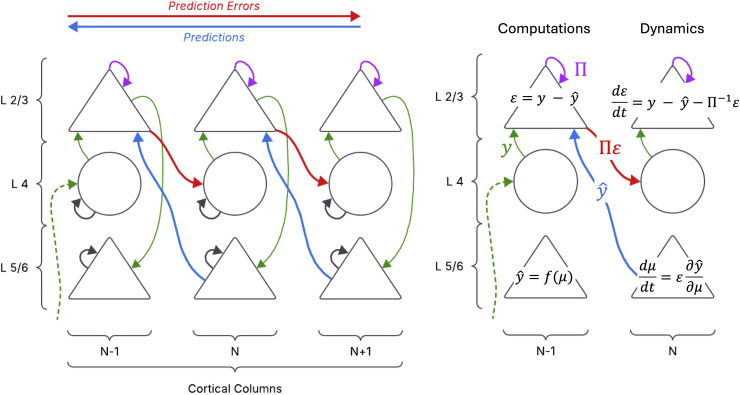
“hierarchical networks of neurons are thought to exchange top-down predictions and bottom-up prediction errors to achieve efficient information processing.”
§ Predictive coding and neurocomputational psychiatry: a mechanistic framework for understanding mental disorders > Introduction Traditional psychiatry has long relied on symptom-based classifications of mental illness, with limited insight into underlying brain mechanisms. Computational psychiatry offers a new paradigm (1–5): by integrating mathematical models with neurobiology, it seeks to explain psychiatric phenomena in terms of aberrant brain computations (6). Among various modelling approaches, predictive coding has emerged as a compelling unifying theory for brain function (7, 8). In essence, predictive coding treats the brain as an inference machine that continually generates and updates predictions about sensory inputs via hierarchical message passing. Closely related, but conceptually distinct (9), is the Free Energy Principle and its formulation in terms of active inference, which extend predictive coding from perceptual inference to action and policy selection (10). In this article we focus primarily on predictive coding as an algorithmic and neurobiological account of hierarchical inference, while drawing on active inference where it clarifies the role of behaviour, policy selection, and intervention. This family of frameworks provides a normative (Bayesian) account of perception and action, in which the brain seeks to minimise surprise or “free energy” by aligning its internal model with the outside world (11). Crucially, this perspective offers a plausible account of neuronal computation in cortical circuits: hierarchical networks of neurons are thought to exchange top-down predictions and bottom-up prediction errors to achieve efficient information processing. At the same time, predictive coding provides a principled way to think about mental illness. Many psychiatric symptoms can be interpreted as errors of inference - that is, failures in the predictive coding machinery (12). For example, hallucinations and delusions in psychosis may result from placing too much weight on prior beliefs (or not enough on sensory evidence) - a computationally precise deficit that could serve as a quantitative biomarker for psychosis subtypes. Conversely, autistic perception may stem from overly weak prior expectations leading to sensory overload, representing a fundamentally different computational phenotype. This review will examine how major psychiatric conditions can be framed in terms of aberrant predictive coding, linking computational deviations to clinical phenomena. Finally, predictive coding is especially attractive because it maps onto neural circuits. The abstract variables of predictive models (predictions, prediction errors, precision weights) can be associated with specific neuron populations and connections in cortical microcircuits. These concrete mappings mean that predictive coding hypotheses are testable with neurobiological data (11). Using neural mass models and Dynamic Causal Modelling (DCM), researchers can design generative models of brain activity and compare them to recordings (M/EEG, fMRI) to quantify these computational parameters in individual patients, moving toward personalized computational phenotyping in psychiatry. Since DCM was first introduced in 2003 (13), the models themselves are being refined, expanded and tested.
What the sources say
- Supportedcites [11] Friston, 2007, Free-energy and the brain, Synthese source
In “Hierarchical dynamic models in the brain,” the paper describes top-down predictions conveyed by backward connections and bottom-up prediction errors conveyed forward. It says these recurrent interactions suppress prediction error and minimise free energy throughout the hierarchy, supporting the claim’s description of efficient information processing. (LLM, conf=0.91)
hedgedstates a cause- Asserted: passes — The authors put it forward as true.
- Checkable: passes — It can be checked against evidence.
- Load-bearing: passes — The paper’s conclusions depend on it.
- Based: passes — The paper gives a reason why it holds.
- Supported
The cited sources support only part of this claim — read each source’s verdict below.
In the paper
“Many psychiatric symptoms can be interpreted as errors of inference - that is, failures in the predictive coding machinery (12).”
§ Predictive coding and neurocomputational psychiatry: a mechanistic framework for understanding mental disorders > Introduction Traditional psychiatry has long relied on symptom-based classifications of mental illness, with limited insight into underlying brain mechanisms. Computational psychiatry offers a new paradigm (1–5): by integrating mathematical models with neurobiology, it seeks to explain psychiatric phenomena in terms of aberrant brain computations (6). Among various modelling approaches, predictive coding has emerged as a compelling unifying theory for brain function (7, 8). In essence, predictive coding treats the brain as an inference machine that continually generates and updates predictions about sensory inputs via hierarchical message passing. Closely related, but conceptually distinct (9), is the Free Energy Principle and its formulation in terms of active inference, which extend predictive coding from perceptual inference to action and policy selection (10). In this article we focus primarily on predictive coding as an algorithmic and neurobiological account of hierarchical inference, while drawing on active inference where it clarifies the role of behaviour, policy selection, and intervention. This family of frameworks provides a normative (Bayesian) account of perception and action, in which the brain seeks to minimise surprise or “free energy” by aligning its internal model with the outside world (11). Crucially, this perspective offers a plausible account of neuronal computation in cortical circuits: hierarchical networks of neurons are thought to exchange top-down predictions and bottom-up prediction errors to achieve efficient information processing. At the same time, predictive coding provides a principled way to think about mental illness. Many psychiatric symptoms can be interpreted as errors of inference - that is, failures in the predictive coding machinery (12). For example, hallucinations and delusions in psychosis may result from placing too much weight on prior beliefs (or not enough on sensory evidence) - a computationally precise deficit that could serve as a quantitative biomarker for psychosis subtypes. Conversely, autistic perception may stem from overly weak prior expectations leading to sensory overload, representing a fundamentally different computational phenotype. This review will examine how major psychiatric conditions can be framed in terms of aberrant predictive coding, linking computational deviations to clinical phenomena. Finally, predictive coding is especially attractive because it maps onto neural circuits. The abstract variables of predictive models (predictions, prediction errors, precision weights) can be associated with specific neuron populations and connections in cortical microcircuits. These concrete mappings mean that predictive coding hypotheses are testable with neurobiological data (11). Using neural mass models and Dynamic Causal Modelling (DCM), researchers can design generative models of brain activity and compare them to recordings (M/EEG, fMRI) to quantify these computational parameters in individual patients, moving toward personalized computational phenotyping in psychiatry. Since DCM was first introduced in 2003 (13), the models themselves are being refined, expanded and tested.
What the sources say
- Partly supportedcites [12] Sterzer, 2018, The predictive coding account of psychosis, Biol Psychiatry sourceExperimental — accuracy not yet measured
In “A Predictive Coding Account of Psychosis,” the paper presents predictive coding as a plausible explanation for multiple psychotic symptoms, including delusions, hallucinations, and passivity phenomena. Its abstract links psychosis to maladaptive inference. The claim broadens this account to psychiatric symptoms generally, which these passages do not support. (LLM, conf=0.86)
plainstates a possible cause- Asserted: passes — The authors put it forward as true.
- Checkable: passes — It can be checked against evidence.
- Load-bearing: passes — The paper’s conclusions depend on it.
- Based: passes — The paper gives a reason why it holds.
- Partly supported
105 more claims · 40 with their cited sources checked
Create a free account to see all 209 claims and to verify the 1 reference still open.
- It may state two separate claims as one. 58
- Probably not a substantial claim. 49
Self-check
Percentages, sums and reported differences re-computed from the paper’s own numbers.
Each contradiction between two passages listed here was confirmed by an independent check.
Rated minor: it would not touch a result — a value no result rests on, a p-value that stays on the same side of the significance level, or a conflict that is clerical, resolved elsewhere in the paper, or outside its own findings.
In the paper
§ Predictive coding and neurocomputational psychiatry: a mechanistic framework for understanding mental disorders > Predictive coding and psychiatric disorders > Depression: maladaptive attractor states and failure to update
“Unlike the positive symptoms of schizophrenia (with its overweighted priors) or autism (with its under-weighted priors), depression may represent a different type of predictive coding dysfunction-one characterized by normal weighting but impaired updating dynamics.”
§ Predictive coding and neurocomputational psychiatry: a mechanistic framework for understanding mental disorders > Predictive coding and psychiatric disorders > Depression: maladaptive attractor states and failure to update
“At the cognitive level, the negative schema described in cognitive therapy can be recast as a prior with excessive precision that resists updating.”
Rated minor: it would not touch a result — a value no result rests on, a p-value that stays on the same side of the significance level, or a conflict that is clerical, resolved elsewhere in the paper, or outside its own findings.
In the paper
§ Predictive coding and neurocomputational psychiatry: a mechanistic framework for understanding mental disorders > Predictive coding and psychiatric disorders > Schizophrenia: aberrant precision-weighting of priors
“In schizophrenia, this balance appears to be disrupted: individuals may place too much weight on internally generated predictions (priors) and not enough on external sensory input (2).”
§ Predictive coding and neurocomputational psychiatry: a mechanistic framework for understanding mental disorders > Predictive coding and psychiatric disorders > Schizophrenia: aberrant precision-weighting of priors
“In computational simulations, reducing the “precision of priors relative to sensory evidence” indeed produces hallucination-like phenomena.”
Citations
Cites
Hodgkin, A. L., & Huxley, A. F. (1952) · The Journal of Physiology · doi:10.1113/jphysiol.1952.sp004764 · Cited by 23,191
The free-energy principle: a unified brain theory?
Friston, K. (2010) · Nature Reviews Neuroscience · doi:10.1038/nrn2787 · Cited by 8,120
Whatever next? Predictive brains, situated agents, and the future of cognitive science
Clark, A. (2013) · Behavioral and Brain Sciences · doi:10.1017/s0140525x12000477 · Cited by 5,924 · cited 12×
“Equation 7 describes how internal beliefs m ) are updated based on prediction errors ( e = y − ^ y ) and the sensitivity of predicted input ^ y to those beliefs.”
InfluentialRao, R. P. N., & Ballard, D. H. (1999) · Nature Neuroscience · doi:10.1038/4580 · Cited by 5,483
Friston, K. J., Harrison, L., & Penny, W. (2003) · NeuroImage · doi:10.1016/s1053-8119(03)00202-7 · Cited by 4,583 · cited 3×
“M/EEG), we can infer which physiological parameters ( P ) are altered in illness (for example, synaptic gain or connectivity) and thereby gain mechanistic insight (13).”
InfluentialA theory of cortical responses.
Friston, K. (2005) · Philosophical Transactions of the Royal Society B: Biological Sciences · doi:10.1098/rstb.2005.1622 · Cited by 4,578
Etkin, A., & Wager, T. D. (2007) · American Journal of Psychiatry · doi:10.1176/appi.ajp.2007.07030504 · Cited by 3,391
The weak coherence account: detail-focused cognitive style in autism spectrum disorders
Happé, F., & Frith, U. (2006) · Journal of Autism and Developmental Disorders · doi:10.1007/s10803-005-0039-0 · Cited by 2,884
Model of autism: increased ratio of excitation/inhibition in key neural systems
Rubenstein, J. L. R., & Merzenich, M. M. (2003) · Genes, Brain and Behavior · doi:10.1034/j.1601-183x.2003.00037.x · Cited by 2,768
The Bayesian brain: The role of uncertainty in neural coding and computation
Knill, D. C., & Pouget, A. (2004) · Trends in Neurosciences · doi:10.1016/j.tins.2004.10.007 · Cited by 2,588 · cited 1×
“A central premise of predictive coding (and related theories like the Bayesian brain hypothesis) is that the brain performs some form of Bayesian inference (14).”
Research works printed but not linked: 2
- Beck, 1979, Cognitive therapy and the emotional disorders
- 2022, Diagnostic and statistical manual of mental disorders
Cited by
Corozo, J. P. M., Salazar, D. E. M., & Cevallos, I. P. V. (2026) · VitalyScience Revista Científica Multidisciplinaria · doi:10.56519/pjmetd63
Digital Biomarkers and Computational Inference in Smart Neuropsychiatric Healthcare
Mou, D. (2025) · Journal of Disease and Public Health · doi:10.71052/jdph/msho1980
Mazur, M., & Krukow, P. (2026) · Current Problems of Psychiatry · doi:10.12923/2353-8627/2025-0022
Current themes of AI in mental health: Actionable evidence and guardrails for mood and anxiety care
Paulus, M. P. (2026) · Journal of Mood and Anxiety Disorders · doi:10.1016/j.xjmad.2026.100181 · Cited by 1
“A chatbot can increase engagement without improving symptoms, a predictive model can explain variance without changing outcomes, and a mechanistic hypothesis can be conceptually attractive without being clinically validated [8 – 20].”
InfluentialZhong, J., Ci, B., & Zhang, S. (2026) · Frontiers in Psychology · doi:10.3389/fpsyg.2026.1887948
“…allostatic errors (energy) must be addressed through action-oriented predictions (efficacy); if unresolved, they compel revisions of conceptual values (meaning), interpersonal strategies (relational), and ultimately the global self-model (existential) (Barrett, 2017a,b; Shaw et al., 2026).”
Influential
Metadata
- Authors
- Shaw, A. D., Sumner, R. L., & Berndt, L. C. S.
- Affiliations
- University of Exeter (GB)
- Auckland University of Technology (NZ)
- Corresponding author
- Berndt, Lioba C. S.
- Venue
- Frontiers in Psychiatry
- Publisher
- Frontiers Media SA
- Published
- 2026-01-07
- Volume
- 16
- Pages
- 1713833-1713833
- ISSN
- 1664-0640 (ISSN-L)
- PMC
- PMC12819327
- OpenAlex
- W7118698301
- Cited by
- 9
- References
- 77
- Citations by year
- 2026: 8
- FWCI
- 33.05
- Type
- journal article
- Language
- en
- Open access
- gold
- doi.org
- Licence
- Locations
- Frontiers in Psychiatry (publishedVersion, cc-by)
- PubMed (publishedVersion)
- PubMed Central (publishedVersion, cc-by)
- Explore Bristol Research (publishedVersion, cc-by)
- Tuwhera (Auckland University of Technology) (submittedVersion, cc-by)
- Bristol Research (University of Bristol) (submittedVersion, cc-by)
- Funders
- Wellcome
- Topics
- Life Sciences › Neuroscience › Cognitive Neuroscience › Embodied and Extended Cognition
- Social Sciences › Arts and Humanities › Philosophy › Mental Health and Psychiatry
- Life Sciences › Neuroscience › Cognitive Neuroscience › Neural and Behavioral Psychology Studies
- Keywords
- predictive coding, computational psychiatry, Bayesian inference, free energy principle, neural population dynamics, mental illness, mechanistic biomarkers, computational phenotypes, personalized treatment, therapeutic interventions, neural circuits
About these checks
Registry, retraction, Cites and statistics results are computed, not judged, with one exception: a printed reference that no index lists is read once by a model before it counts as a citation error. Claims are extracted by a model and kept only when their quote appears verbatim in the text; each cited source is then checked, with a model’s help, for whether it says what the claim relies on. Those verdicts can be wrong — read the claim’s quote and the cited source before relying on one.
The claim verdicts this report counts are experimental: their accuracy is not yet measured.
A language model drew the claims from the paper on 2026-10-11, under version 3 of the claim definition (model deepseek-v4.1-flash, prompt extract-v3).
A second model labelled each claim on 2026-10-11 (model jev-1.13-20260917, definition revision gold-guideline-v0.2).
Cited sources are checked with a language model’s help (gpt-6-sol).
Statistics and arithmetic are recomputed, not judged.
Confidence bands are shown only for fields calibrated on our annotated test set. None is calibrated yet, so no band is shown.
What counts as a claim ›How we measure confidence ›How we check this ›
Are you an author, or do you see a problem with this page? Request a review
How to cite
Cite CoChat for the checks on this page, and the paper for its own findings.
- This page
- CoChat. (2026). Citation check: Predictive coding and neurocomputational psychiatry: a mechanistic framework for understanding mental disorders. https://app.cochat.ai/papers/10.3389/fpsyt.2025.1713833
- The paper
- Shaw, A. D., Sumner, R. L., & Berndt, L. C. S. (2026). Predictive coding and neurocomputational psychiatry: a mechanistic framework for understanding mental disorders. Frontiers in Psychiatry. https://doi.org/10.3389/fpsyt.2025.1713833
Data sources
Bibliographic data: Semantic Scholar, OpenAlex, Crossref.
Contains information from the Semantic Scholar Academic Graph Datasets, made available under the ODC Attribution License (ODC-BY 1.0).
Semantic Scholar’s data is described in: Kinney, R., et al. (2023). The Semantic Scholar Open Data Platform. arXiv:2301.10140.
