

Federated learning for cognitive impairment detection using speech data
Open accessThe DOI matches its Crossref record; 27 of the 28 references it cites were found in a registry or an index, and 1 are not checked yet.
Abstract
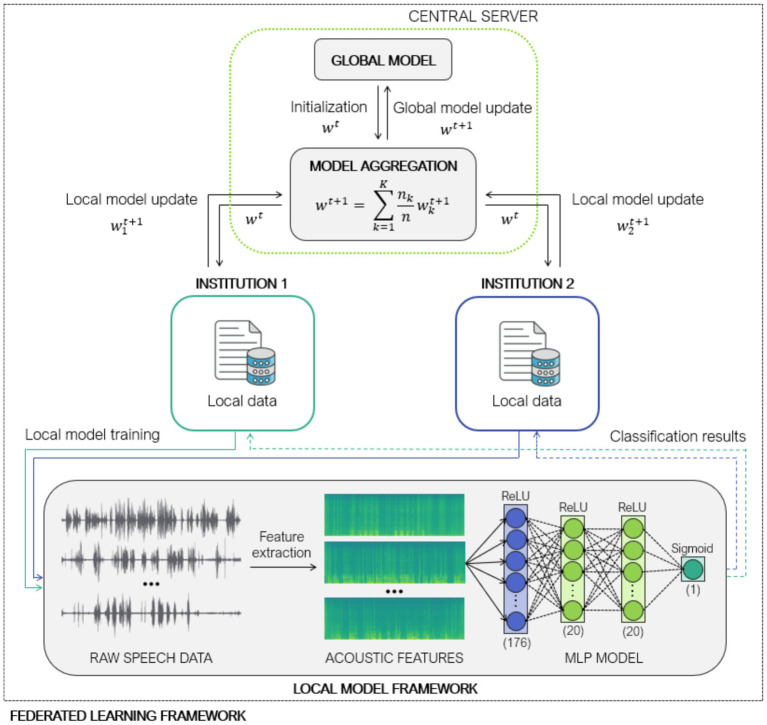
Introduction: In Alzheimer’s disease (AD) research, clinical, neuroimaging, genetic, and biomarker data are vital for advancing its understanding and treatment. However, privacy concerns and limited datasets complicate data sharing. Federated learning (FL) offers a solution by enabling collaborative research while preserving data privacy. Methods: This study analyzed data from patients assessed at the Memory Unit of the Ace Alzheimer Center Barcelona who completed a standardized digital speech protocol. Acoustic features extracted from these recordings were used to distinguish between cognitively unimpaired (CU) and cognitively impaired (CI) individuals. The aim was to evaluate how data heterogeneity impacted the FL model performance across three scenarios: (1) equal contributions and class ratios, (2) unequal contributions, and (3) imbalanced class ratios. In each scenario, the performance of local models trained using an MLP feed-forward neural network on institutional data was analyzed and compared to a global model created by aggregating these local models using Federated Averaging (FedAvg) and Iterative Data Aggregation (IDA). Results: The cohort included 2,239 participants: 221 CU individuals (mean age 66.8, 64.7% female) and 2,018 CI subjects, comprising 1,219 with mild cognitive impairment (mean age 74.3, 61.9% female) and 799 with mild AD dementia (mean age 80.8, 64.8% female). In scenarios 1 and 3, FL provided modest gains in accuracy and AUC. In scenario 2, FL markedly improved performance for the smaller dataset (balanced accuracy rising from 0.51 to 0.80) while preserving 0.86 accuracy in the larger dataset, highlighting scalability across heterogeneous conditions. Conclusion: These findings demonstrate the potential of FL to enable collaborative modeling of speech-based biomarkers for cognitive impairment detection, even under conditions of data imbalance and institutional disparity. This work highlights FL as a scalable and privacy-preserving approach for advancing digital health research in neurodegenerative diseases.
Overview
The claims and statistics of this paper haven’t been checked yet.
Free: it reads the open-access text and checks the first 5 claims that cite a source we can check. Create a free account to check every claim.
Integrity signals
Registry
Cites
Statistics
Figures
Verification
Claims the paper makes
The claims and statistics of this paper haven’t been checked yet.
Free: it reads the open-access text and checks the first 5 claims that cite a source we can check. Create a free account to check every claim.
Claims other papers make about this one
Each is checked against this paper’s own text: does it say what the citing paper says it does?
The source backs part of the claim, not all of it — or backs it for a different population, condition or comparison.
In the citing paper
“a recent study of speech-based biomarkers for cognitive impairment, which analyzed data from 2 239 participants and showed that federated learning significantly improved model performance for smaller datasets—raising balanced accuracy from 0.51 to 0.80 under class-imbalanced conditions—while maintaining robust performance (0.86 accuracy) in larger datasets (Blazquez-Folch et al., 2025).”
From Multimodal neuroimaging and AI integration in cognitive disorders: advances, challenges, and future directions for precision medicine (2026) · cites this paper as Blazquez-Folch et al., 2025
Experimental — accuracy not yet measured
Self-check
Percentages, sums and reported differences re-computed from the paper’s own numbers.
The self-check needs the paper’s full text.
Citations
Cites
McKhann, G. M., Knopman, D. S., Chertkow, H., Hyman, B. T., Jack, C. R., Kawas, C. H., Klunk, W. E., Koroshetz, W. J., Manly, J. J., Mayeux, R., et al. (2011) · Alzheimer's & Dementia · doi:10.1016/j.jalz.2011.03.005 · Cited by 18,657
Mild cognitive impairment as a diagnostic entity
Petersen, R. C. (2004) · Journal of Internal Medicine · doi:10.1111/j.1365-2796.2004.01388.x · Cited by 7,864 · cited 1×
“…CU, showing no objective cognitive or functional impairment (CDR = 0) (Jessen et al., 2014) and 2,018 participants who exhibited CI, including patients with mild cognitive impairment (MCI) ( n = 1,219, CDR = 0.5) (Petersen, 2004) and dementia due to AD ( n = 799, CDR > 0.5) (McKhann et al., 2011).”
InfluentialAdvances and Open Problems in Federated Learning
Kairouz, P., & McMahan, H. B. (2021) · Foundations and Trends in Machine Learning · doi:10.1561/2200000083 · Cited by 7,772
Jessen, F., Amariglio, R. E., van Boxtel, M., Breteler, M., Ceccaldi, M., Chételat, G., Dubois, B., Dufouil, C., Ellis, K. A., van der Flier, W. M., et al. (2014) · Alzheimer's & Dementia · doi:10.1016/j.jalz.2014.01.001 · Cited by 3,014
2024 Alzheimer's disease facts and figures
(2024) · Alzheimer's & Dementia · doi:10.1002/alz.13809 · Cited by 2,536
The Geneva Minimalistic Acoustic Parameter Set (GeMAPS) for Voice Research and Affective Computing
Eyben, F., Scherer, K. R., Schuller, B. W., Sundberg, J., Andre, E., Busso, C., Devillers, L. Y., Epps, J., Laukka, P., Narayanan, S. S., et al. (2016) · IEEE Transactions on Affective Computing · doi:10.1109/taffc.2015.2457417 · Cited by 1,818 · cited 1×
“The extracted variables corresponded to those described in the extended Geneva Minimalistic Acoustic Parameter Set (eGeMAPS) (Eyben et al., 2015), a standardized set of acoustic parameters linked to physiological voice changes, often used in neurological disease contexts (García Gutiérrez et al.,…”
Real Time Speech Enhancement in the Waveform Domain
Défossez, A., Synnaeve, G., & Adi, Y. (2020) · Interspeech 2020 · doi:10.21437/interspeech.2020-2409 · Cited by 537
Model aggregation techniques in federated learning: A comprehensive survey
Qi, P., Chiaro, D., Guzzo, A., Ianni, M., Fortino, G., & Piccialli, F. (2024) · Future Generation Computer Systems · doi:10.1016/j.future.2023.09.008 · Cited by 452 · cited 1×
“Against this backdrop, FedAvg combined with IDA offered the best balance between simplicity, robustness, and feasibility (Qi et al., 2023).”
Hardy, S., Henecka, W., Ivey-Law, H., Nock, R., Patrini, G., Smith, G., & Thorne, B. (2017) · arXiv · doi:10.48550/arxiv.1711.10677 · Cited by 431
Bucks, R. S., Singh, S., Cuerden, J. M., & Wilcock, G. K. (2000) · Aphasiology · doi:10.1080/026870300401603 · Cited by 233
Cited by
Dang, M., Liu, B., Chen, Y., & Zhang, Z. (2026) · Psychoradiology · doi:10.1093/psyrad/kkag007 · Cited by 10
Omidi, M., Bacsu, J.-D., Absher, J. R., Babaieasl, F., Kooshiar, H., Imani, S. M., Ebrahimi, N., Smith, M. L., & Rahemi, Z. (2026) · Bioengineering · doi:10.3390/bioengineering13101225
“Privacy-preserving methods like federated learning and edge computing keep data local, reducing exposure [102,103].”
Metadata
- Authors
- Blazquez-Folch, J., Limones Andrade, M., Calm, B., Auñón García, J. M., Alegret, M., Muñoz, N., Cano, A., Fernández, V., García-Gutiérrez, F., De Rojas, I., García-González, P., Olivé, C., Puerta, R., Capdevila-Bayo, M., Muñoz-Morales, Á., Bayón-Buján, P., Miguel, A., Montrreal, L., Espinosa, A., Sanz-Cartagena, P., Rosende-Roca, M., Zaldua, C., Gabirondo, P., Cantero-Fortiz, Y., Gurruchaga, M. J., Tarraga, L., Boada, M., Ruiz, A., Marquié, M., & Valero, S.
- Affiliations
- Universitat Internacional de Catalunya (ES)
- Instituto de Salud Carlos III (ES)
- Corresponding author
- Valero, Sergi
- ORCID
- Venue
- Frontiers in Artificial Intelligence
- Publisher
- Frontiers Media SA
- Published
- 2025-10-09
- Volume
- 8
- Pages
- 1662859-1662859
- ISSN
- 2624-8212 (ISSN-L)
- PMC
- PMC12548476
- OpenAlex
- W4414992495
- Cited by
- 2
- References
- 25
- Citations by year
- 2026: 2
- FWCI
- 0.80
- Type
- journal article
- Language
- en
- Open access
- gold
- doi.org
- Licence
- Locations
- Frontiers in Artificial Intelligence (publishedVersion, cc-by)
- Europe PMC (PubMed Central) (publishedVersion, cc-by)
- PubMed (publishedVersion)
- DOAJ (DOAJ: Directory of Open Access Journals) (submittedVersion, cc-by-sa)
- Funders
- European Commission (796706)
- Instituto de Salud Carlos III (AC19/00097, PI19/01301, PI22/01403, PI17/01474, PI19/00335)
- Topics
- Physical Sciences › Computer Science › Artificial Intelligence › Privacy-Preserving Technologies in Data
- Health Sciences › Medicine › Psychiatry and Mental health › Dementia and Cognitive Impairment Research
- Health Sciences › Health Professions › Speech and Hearing › Voice and Speech Disorders
- Keywords
- federated learning, cognitive impairment detection, Alzheimer's disease, acoustic features, data heterogeneity, class imbalance, FedAvg, privacy-preserving data sharing, mild cognitive impairment, mild dementia, digital health
About these checks
Registry, retraction, Cites and statistics results are computed, not judged, with one exception: a printed reference that no index lists is read once by a model before it counts as a citation error. Claims are extracted by a model and kept only when their quote appears verbatim in the text; each cited source is then checked, with a model’s help, for whether it says what the claim relies on. Those verdicts can be wrong — read the claim’s quote and the cited source before relying on one.
Statistics and arithmetic are recomputed, not judged.
Confidence bands are shown only for fields calibrated on our annotated test set. None is calibrated yet, so no band is shown.
What counts as a claim ›How we measure confidence ›How we check this ›
Are you an author, or do you see a problem with this page? Request a review
How to cite
Cite CoChat for the checks on this page, and the paper for its own findings.
- This page
- CoChat. (2026). Citation check: Federated learning for cognitive impairment detection using speech data. https://app.cochat.ai/papers/10.3389/frai.2025.1662859
- The paper
- Blazquez-Folch, J., Limones Andrade, M., Calm, B., Auñón García, J. M., Alegret, M., Muñoz, N., Cano, A., Fernández, V., García-Gutiérrez, F., De Rojas, I., García-González, P., Olivé, C., Puerta, R., Capdevila-Bayo, M., Muñoz-Morales, Á., Bayón-Buján, P., Miguel, A., Montrreal, L., Espinosa, A., . . . Valero, S. (2025). Federated learning for cognitive impairment detection using speech data. Frontiers in Artificial Intelligence. https://doi.org/10.3389/frai.2025.1662859
Data sources
Bibliographic data: Semantic Scholar, OpenAlex, Crossref.
Contains information from the Semantic Scholar Academic Graph Datasets, made available under the ODC Attribution License (ODC-BY 1.0).
Semantic Scholar’s data is described in: Kinney, R., et al. (2023). The Semantic Scholar Open Data Platform. arXiv:2301.10140.
