

The DOI matches its Crossref record; 62 of the 67 references it cites were found in a registry or an index; 22 of the 54 sources its claims cite were checked for support.
Quantum technology for development framework as a tool for science diplomacy
Open accessAbstract
The state-of-the-art quantum technologies leverage the unique principles of quantum mechanics, which include quantization, uncertainty principle, interference, entanglement and decoherence, to produce useful devices and scientific advancements not possible with classical technologies. As a result, quantum technologies, in particular, offer specific advantages that make communications networks secure and unbreakable and devices with unprecedented levels of accuracy, responsiveness, reliability, scalability and efficiency than classical emerging technologies. These capabilities can contribute significantly to addressing energy, agriculture, climate change, national security, healthcare, education and economic growth challenges. Unfortunately, these developments in these areas have not been evenly distributed between the Global North and the Global South, inadvertently creating a societal and economic gap. Closing this gap is critical to creating a more inclusive and sustainable future for all, thus delivering key sustainable goals. Therefore, to close this gap, this article proposes a quantum diplomacy framework as a means to deliver science diplomacy. Moreover, we discuss how emerging quantum technologies could profoundly impact all 17 United Nations Sustainable Development Goals. We consider this work a timely and vital intervention to prevent the gap from increasing.
Overview
CoChat Summary
## TL;DR
This paper proposes a Quantum Technology for Development (QT4D) framework to use quantum technologies as a tool for science diplomacy and to help close the technology gap between the Global North and Global South. It is a conceptual article arguing that quantum technologies could support all 17 UN Sustainable Development Goals while also enabling international collaboration.
## Key findings
- The paper argues that quantum technologies have the potential to affect all 17 SDGs and highlights specific links to SDG 1–2 and 11–15 (optimization, climate and agriculture), SDG 3 (healthcare and medicine), SDG 4 and 8 (education and upskilling), SDG 5 and 10 (bias reduction and inclusion), SDG 6 (water management), SDG 7 (energy), and SDG 3, 9, and 16 (secure communications and cyber protection).
- It states that global investment in quantum technology is about $30 billion and is expected to reach $42.4 billion by 2027.
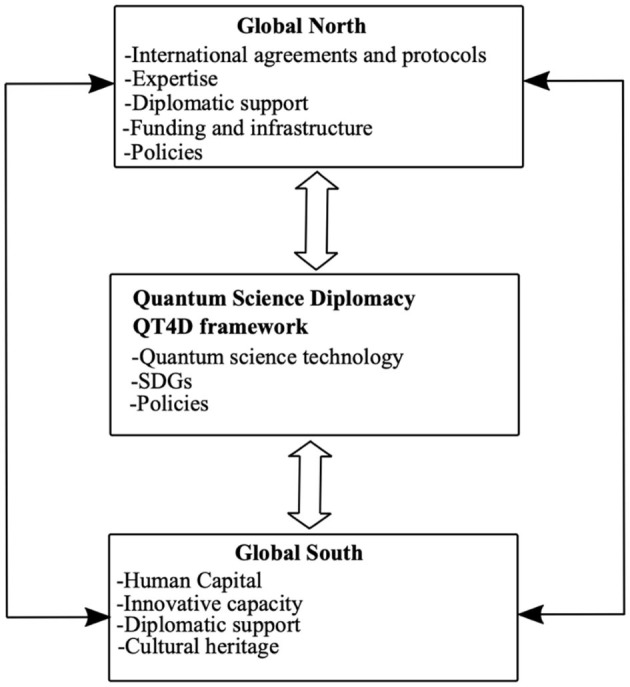
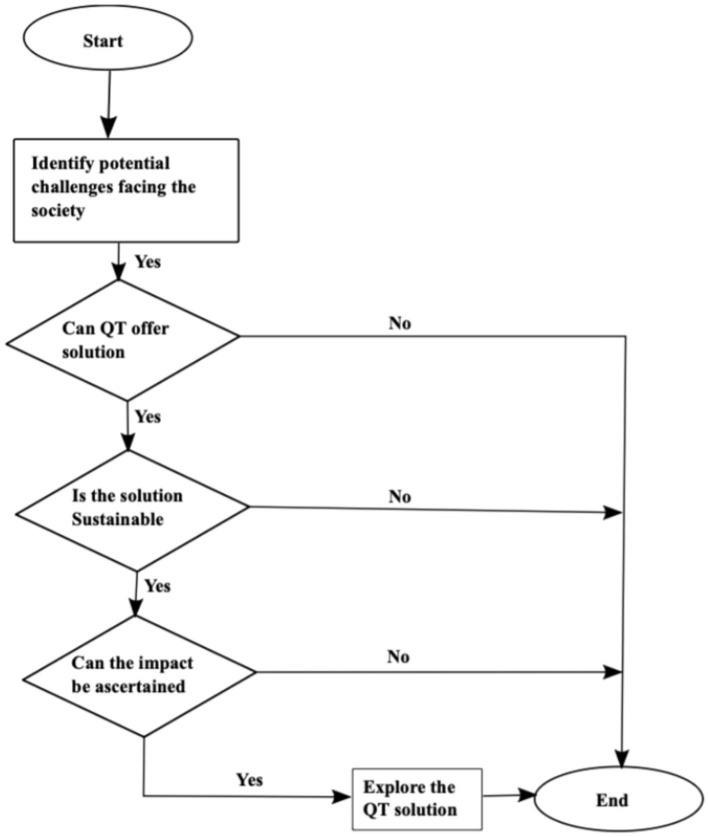
- The QT4D framework is presented as a stepwise process: identify a developmental challenge, identify a QT solution, assess sustainability, assess impact, and then form a partnership through science diplomacy.
- The paper says the framework could support improved healthcare, energy sustainability, agriculture, cybersecurity, and diplomatic confidentiality through technologies such as quantum computing, quantum sensing, and quantum cryptography.
## Methods
- Conceptual/framework paper rather than an empirical study; it proposes the QT4D framework based on a narrative synthesis of existing literature on quantum technologies, development, and science diplomacy.
- Uses examples and citations across quantum communication, computing, metrology, sensing, and quantum machine learning to map possible applications to SDGs and diplomacy.
- The paper does not report a dataset, sample, experiments, or statistical analysis; it presents a framework and discussion.
## Limitations
- The paper explicitly says the QT4D framework “still faces some inherent challenges,” including limited availability of quantum infrastructure, skilled personnel/workforce shortages, countries exploiting QTs for strategic advantage, and possible military misuse leading to an arms race.
- Evident from the text: the paper is highly theoretical/conceptual and does not provide empirical validation, case studies, or quantitative tests of the framework.
Model-written summary. Check it against the paper before relying on it.
Integrity signals
Registry
Cites
Statistics
Figures
Verification
Claims the paper makes
18 Valid · 1 Not valid · 20 Not checked · 34 Own results and interpretations
The cited sources support only part of this claim — read each source’s verdict below.
In the paper
“QTs, which encompass a wide range of scientific advancements with no classical analog, have emerged as prime examples of emerging technologies that hold a significant potential to revolutionize various fields, including science and diplomacy (Bjola, 2016; Degelsegger-Márquez, 2020).”
§ Quantum technology for development framework as a tool for science diplomacy > 2 Quantum technology: applications and potential driver to deliver science diplomacy
What the sources say
- Partly supportedcites Bjola, 2016 sourceExperimental — accuracy not yet measured
Bjola (2016) supports only the weaker, adjacent point: in 'The Quantum Challenge' (p. 2) he notes that studies have begun to 'heuristically explore the analytical gains that quantum theory may offer for studying various puzzles in psychology, finance, economics and diplomacy', and that quantum theory 'promises to offer useful cognitive guides' for digital diplomatic impact (p. 2). But the subject there is quantum theory as an analytical/heuristic framework, not quantum technologies as engineering advances 'with no classical analog'; our copy contains no discussion of quantum technologies, quantum computing/sensing, or them emerging as prime examples of transformative technologies. The same section also hedges the idea of revolutionary reach, stating quantum theory is 'arguably not the first framework that comes to mind' for diplomacy and that its reception in social sciences 'remains much more muted'. The technology-framing part of the citing sentence is therefore not attributable to this source. (LLM, conf=0.65)
- Not matchedcites Degelsegger-Márquez, 2020
Couldn’t be matched to a paper in Crossref, so it can’t be checked.
plainstates a possible cause- Asserted: passes — The authors put it forward as true.
- Checkable: passes — It can be checked against evidence.
- Load-bearing: passes — The paper’s conclusions depend on it.
- Based: passes — The paper gives a reason why it holds.
- Partly supported
The cited sources support only part of this claim — read each source’s verdict below.
In the paper
“Thus, using QML, educational institutions can analyze a vast amount of data (Ciliberto et al., 2018). This data could include student performance, attendance records, and demographic information, to identify students at risk of dropping out or struggling academically.”
§ Quantum technology for development framework as a tool for science diplomacy > 2 Quantum technology: applications and potential driver to deliver science diplomacy
What the sources say
- Partly supportedcites Ciliberto et al., 2018 sourceExperimental — accuracy not yet measured
The ‘Setting the problem’ section says quantum computation could help learning methods scale to larger datasets, but cautions that current QML methods may be limited in real settings. The paper does not establish that educational institutions can use QML to analyze their data. The citation is attached to that claim, not to the following sentence about identifying students at risk. (LLM, conf=0.86)
hedgedstates a cause- Asserted: passes — The authors put it forward as true.
- Checkable: passes — It can be checked against evidence.
- Load-bearing: unclear — It is unclear whether the paper’s conclusions depend on it.
- Based: passes — The paper gives a reason why it holds.
- Partly supported
The cited sources support only part of this claim — read each source’s verdict below.
In the paper
“Besides its security benefits, quantum cryptography also offers scalability (Pirandola et al., 2020).”
§ Quantum technology for development framework as a tool for science diplomacy > 2 Quantum technology: applications and potential driver to deliver science diplomacy
What the sources say
- Partly supportedcites Pirandola et al., 2020 sourceExperimental — accuracy not yet measured
Our copy of Pirandola et al. (2020) supports the security half of the sentence emphatically (Introduction: QKD 'offers the ultimate solution: restoring security and confidentiality by resorting to unbreakable principles of nature'), but nowhere presents scalability as a benefit that quantum cryptography offers. The closest material cuts the other way: the Introduction (p. 4) states a 'fundamental limit which restricts any point to point implementation of QKD' (secret-key capacity −log2(1−η)), with 'better long-distance scalings' only achievable if quantum repeaters and networks are developed — an open, future-dependent requirement rather than an offered advantage. Scalability does appear in a narrow, protocol-specific sense (Section on multipartite CV MDI-QKD, 'the scalable MDI network of Ref. [449]' connecting an arbitrary number N of users; star-topology MDI demos over 100 km), which is a property of particular architectures reported from other works, not a general claim attributable to this review. So the scalability attribution is not supported as stated. (LLM, conf=0.68)
plainstates a cause- Asserted: passes — The authors put it forward as true.
- Checkable: passes — It can be checked against evidence.
- Load-bearing: unclear — It is unclear whether the paper’s conclusions depend on it.
- Based: passes — The paper gives a reason why it holds.
- Partly supported
The cited sources support only part of this claim — read each source’s verdict below.
In the paper
“For example, Brazil, India, and South Africa, already have access to quantum computing (Forbes, 2021).”
§ Quantum technology for development framework as a tool for science diplomacy > 3 Quantum technology for development (QT4D) framework
What the sources say
- Partly supportedcites Forbes, 2021 sourceExperimental — accuracy not yet measured
The South African Context section says Wits provided South African universities access to a 20-qubit IBM Q computer. The International Scene section identifies active quantum programs in India and Brazil, with quantum computing among the topics covered by such programs, but does not establish that either country had access to quantum computers. (LLM, conf=0.87)
plain- Asserted: passes — The authors put it forward as true.
- Checkable: passes — It can be checked against evidence.
- Load-bearing: passes — The paper’s conclusions depend on it.
- Based: passes — The paper gives a reason why it holds.
- Partly supported
The cited sources support only part of this claim — read each source’s verdict below.
In the paper
“For instance, quantum sensors and imaging can aid in early disease detection (Matea et al., 2017; Tarasov et al., 2020).”
§ Quantum technology for development framework as a tool for science diplomacy > 3 Quantum technology for development (QT4D) framework
What the sources say
- Partly supportedcites Matea et al., 2017 sourceExperimental — accuracy not yet measured
The Sensors section describes quantum-dot detection of an ovarian-cancer biomarker, and the Imaging section describes quantum-dot imaging of tumors and biological tissue. These examples support a potential role in disease detection, but the paper does not establish that either approach enables *early* detection. (LLM, conf=0.83)
- Partly supportedcites Tarasov et al., 2020 sourceExperimental — accuracy not yet measured
The quantum-sensors discussion (section 3; page not supplied) describes their potential to detect the first defective prions in the body. The quantum-dots discussion (section 7; page not supplied) says they can visualize tumors, but describes this use for locating tumor boundaries during surgery, not for early disease detection. Thus the paper supports the sensors and imaging applications, but not the early-detection claim for imaging. (LLM, conf=0.82)
plainstates a possible cause- Asserted: passes — The authors put it forward as true.
- Checkable: passes — It can be checked against evidence.
- Load-bearing: unclear — It is unclear whether the paper’s conclusions depend on it.
- Based: passes — The paper gives a reason why it holds.
- Partly supported
9 more claims
Create a free account to see all 73 claims and to verify the 10 references still open.
- Probably not a substantial claim. 37
- It may state two separate claims as one. 40
Claims other papers make about this one
Each is checked against this paper’s own text: does it say what the citing paper says it does?
The source backs part of the claim, not all of it — or backs it for a different population, condition or comparison.
In the citing paper
“Although the physical infrastructure for quantum research remains limited in many African contexts, digital platforms offer significant opportunities to expand access to quantum education [8], [9], [81].”
From Quantum Education in Africa: Innovative Models, Collaborative Frameworks, and the Path Forward (2025) · cites this paper as [8]
Experimental — accuracy not yet measuredThe check wasn’t confident either way, so it gives no verdict — never disputed.
In the citing paper
“Although the physical infrastructure for quantum research remains limited in many African contexts, digital platforms offer significant opportunities to expand access to quantum education [8], [9], [81].”
From Quantum Education in Africa: Innovative Models, Collaborative Frameworks, and the Path Forward (2025) · cites this paper as [8]
Experimental — accuracy not yet measured
Citations
Cites
Gisin, N., Ribordy, G., Tittel, W., & Zbinden, H. (2002) · Reviews of Modern Physics · doi:10.1103/revmodphys.74.145 · Cited by 8,515
Kimble, H. J. (2008) · Nature · doi:10.1038/nature07127 · Cited by 6,023 · cited 1×
“Another technological contribution realizes that the “quantum internet”, one of QT’s primary goals (Kimble, 2008), will ensure ultra-secure telecommunications and facilitate effective communication between communities in the Global South and the Global North.”
BackgroundA Survey on Bias and Fairness in Machine Learning
Mehrabi, N., Morstatter, F., Saxena, N., Lerman, K., & Galstyan, A. (2022) · ACM Computing Surveys · doi:10.1145/3457607 · Cited by 5,812 · cited 1×
“AI models trained on historical data often exhibit inherent biases, resulting in discriminatory outcomes (Mehrabi et al., 2021).”
BackgroundDegen, C. L., Reinhard, F., & Cappellaro, P. (2017) · Reviews of Modern Physics · doi:10.1103/revmodphys.89.035002 · Cited by 4,045 · cited 2×
“Quantum sensors can detect and sense phenomena at unprecedented sensitivity levels, opening up new possibilities for surveillance and security (Degen et al., 2017).”
BackgroundMethodData-intensive applications, challenges, techniques and technologies: A survey on Big Data
Philip Chen, C. L., & Zhang, C.-Y. (2014) · Information Sciences · doi:10.1016/j.ins.2014.01.015 · Cited by 3,047
Noisy intermediate-scale quantum algorithms
Bharti, K., Cervera-Lierta, A., Kyaw, T. H., Haug, T., Alperin-Lea, S., Anand, A., Degroote, M., Heimonen, H., Kottmann, J. S., Menke, T., et al. (2022) · Reviews of Modern Physics · doi:10.1103/revmodphys.94.015004 · Cited by 2,231
Advances in quantum cryptography
Pirandola, S., Andersen, U. L., Banchi, L., Berta, M., Bunandar, D., Colbeck, R., Englund, D., Gehring, T., Lupo, C., Ottaviani, C., et al. (2020) · Advances in Optics and Photonics · doi:10.1364/aop.361502 · Cited by 2,033 · cited 1×
“Besides its security benefits, quantum cryptography also offers scalability (Pirandola et al., 2020).”
BackgroundAdvances in Quantum Cryptography
Pirandola, S., Andersen, U. L., Banchi, L., Berta, M., Bunandar, D., Colbeck, R., Englund, D., Gehring, T., Lupo, C., Ottaviani, C., et al. (2019) · White Rose Research Online (University of Leeds, The University of Sheffield, University of York) · Cited by 1,566
Steane, A. (1998) · Reports on Progress in Physics · doi:10.1088/0034-4885/61/2/002 · Cited by 1,391 · cited 1×
“SDG 1–2 and SDGs 11–15: Quantum computers use superposition and entanglement to perform complex computations more efficiently or “exponentially” faster than classical computers (Steane, 1998).”
Quantum technology: the second quantum revolution
Dowling, J. P., & Milburn, G. J. (2003) · Philosophical Transactions of the Royal Society of London. Series A: Mathematical, Physical and Engineering Sciences · doi:10.1098/rsta.2003.1227 · Cited by 1,046 · cited 2×
“Generally, QT is driven by two imperatives: practicality, which drives miniaturization, which has become a dominant trend in technological innovation, and fundamentality, where quantum mechanics provides unmatched performance over what can be achieved in classical frameworks (Dowling, 2003).”
BackgroundMethod
Research works printed but not linked: 2
- Krishnakumar, 2020, Quantum Computing and Blockchain in Business: Exploring the Applications, Challenges, and Collision of Quantum Computing and Blockchain
- 2002, Quantum Computation and Quantum Information
Cited by
Advances in artificial intelligence and machine learning for quantum communication applications
Mafu, M. (2024) · IET Quantum Communication · doi:10.1049/qtc2.12094 · Cited by 43
Self-citationLeveraging quantum science and technology for sustainable development in Africa
Mazhandu, F., & Mafu, M. (2025) · African Journal of Science Technology Innovation and Development · doi:10.1080/20421338.2025.2504259 · Cited by 9
“Quantum technologies foster global partnerships by enhancing collaborative research and ensuring the secure exchange of information within partnerships (Mafu and Senekane 2023).”
InfluentialSelf-citationLeveraging Equity and Inclusion to Demystify and Diversify Undergraduate Quantum Science Education
Mafu, M., & Mazhandu, F. (2025) · The Physics Teacher · doi:10.1119/5.0231016 · Cited by 2
Self-citationMarwala, T. (2026) · Elsevier eBooks · doi:10.1016/b978-0-443-36322-1.00022-5 · Cited by 1
Kaushal, M., Balla, K. C., & Ponnazhagan, S. (2026) · Newborn · doi:10.5005/jp-journals-11002-0157 · Cited by 1
Metadata
- Authors
- Mafu, M., & Senekane, M.
- Affiliations
- Case Western Reserve University (US)
- University of Johannesburg (ZA)
- Corresponding author
- Mafu, Mhlambululi
- Venue
- Frontiers in Research Metrics and Analytics
- Publisher
- Frontiers Media SA
- Published
- 2023-12-19
- Volume
- 8
- Pages
- 1279376-1279376
- ISSN
- 2504-0537 (ISSN-L)
- PMC
- PMC10758418
- OpenAlex
- W4389953301
- Cited by
- 13
- References
- 67
- Citations by year
- 2026: 6 · 2025: 6 · 2024: 1
- FWCI
- 12.72
- Type
- journal article
- Language
- en
- Open access
- gold
- doi.org
- Licence
- Locations
- Frontiers in Research Metrics and Analytics (publishedVersion, cc-by)
- PubMed Central (publishedVersion, cc-by)
- PubMed (publishedVersion)
- DOAJ (DOAJ: Directory of Open Access Journals) (submittedVersion, cc-by-sa)
- Topics
- Social Sciences › Political Science and International Relations › International Science and Diplomacy
- Physical Sciences › Physics and Astronomy › Atomic and Molecular Physics, and Optics › Quantum Information and Cryptography
- Social Sciences › Demography › Science, Technology, and Education in Latin America
- Keywords
- quantum technologies, science diplomacy, Sustainable Development Goals, quantum communication security, quantum computing, sustainable development
About these checks
Registry, retraction, Cites and statistics results are computed, not judged, with one exception: a printed reference that no index lists is read once by a model before it counts as a citation error. Claims are extracted by a model and kept only when their quote appears verbatim in the text; each cited source is then checked, with a model’s help, for whether it says what the claim relies on. Those verdicts can be wrong — read the claim’s quote and the cited source before relying on one.
The claim verdicts this report counts are experimental: their accuracy is not yet measured.
A language model drew the claims from the paper on 2026-10-10, under version 3 of the claim definition (model deepseek-v4.1-flash, prompt extract-v3).
A second model labelled each claim on 2026-10-10 (model jev-1.13-20260917, definition revision gold-guideline-v0.2).
Cited sources are checked with a language model’s help (qwen3.8-omni-flash and gpt-6-sol).
Statistics and arithmetic are recomputed, not judged.
Confidence bands are shown only for fields calibrated on our annotated test set. None is calibrated yet, so no band is shown.
What counts as a claim ›How we measure confidence ›How we check this ›
Are you an author, or do you see a problem with this page? Request a review
How to cite
Cite CoChat for the checks on this page, and the paper for its own findings.
- This page
- CoChat. (2026). Citation check: Quantum technology for development framework as a tool for science diplomacy. https://app.cochat.ai/papers/10.3389/frma.2023.1279376
- The paper
- Mafu, M., & Senekane, M. (2023). Quantum technology for development framework as a tool for science diplomacy. Frontiers in Research Metrics and Analytics. https://doi.org/10.3389/frma.2023.1279376
Data sources
Bibliographic data: Semantic Scholar, OpenAlex, Crossref.
Contains information from the Semantic Scholar Academic Graph Datasets, made available under the ODC Attribution License (ODC-BY 1.0).
Semantic Scholar’s data is described in: Kinney, R., et al. (2023). The Semantic Scholar Open Data Platform. arXiv:2301.10140.
