

The DOI matches its Crossref record; 80 of the 80 references it cites were found in a registry or an index.
Developmental and reproductive toxic effects of exposure to microplastics: A review of associated signaling pathways
Open accessAbstract
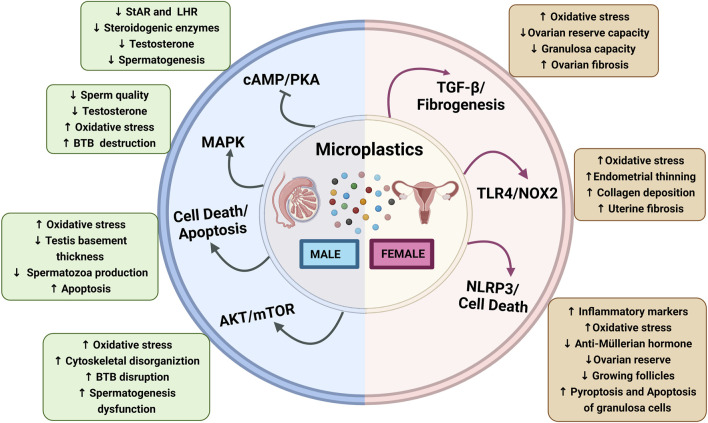
Microplastics (MPs), small pieces of plastic (∼5 mm), are released into the environment not only as a result of the decomposition of large-sized plastics but also from day-to-day use of plastic products. Chronic exposure to MPs has been attributed to harmful effects on aquatic organisms and rodents. Effects include gastrointestinal toxicity, hepatotoxicity, neurotoxicity, and reproductive and developmental toxicities. Exposure to MPs may also potentially affect human health. Herein, we reviewed the impact of MPs on male and female reproductive systems and the associated mechanisms involved in the reproductive and developmental toxicities of MPs. We performed a literature search in Google Scholar and PubMed using the following keywords: MPs and reproductive toxicity; MPs and developmental studies; MPs and infertility; MPs and aquatics; and MPs and rodents. Evidence of MPs accumulation has been reported in many organs of humans and experimental models. The harmful effects of MPs have been manifested in male and female reproductive systems of mammalian and aquatic animals, including developmental effects on gametes, embryos, and their offspring. This review describes various signaling pathways involved in MPs-associated male and female reproductive and developmental toxicities.
Overview
The claims and statistics of this paper haven’t been checked yet.
Run the check — free, no account needed. It reads the open-access text and checks the sources it cites.
Integrity signals
Registry
Cites
Statistics
Figures
Verification
Claims the paper makes
The claims and statistics of this paper haven’t been checked yet.
Run the check — free, no account needed. It reads the open-access text and checks the sources it cites.
Claims other papers make about this one
Each is checked against this paper’s own text: does it say what the citing paper says it does?
The source backs part of the claim, not all of it — or backs it for a different population, condition or comparison.
In the citing paper
“MPs can induce toxic effects on organisms, affecting normal functioning, and may cause several organ-specific toxicities, such as neuronal, digestive, reproductive, and developmental toxicity [17,18,19,20,21,22,23].”
From Is Wild Marine Biota Affected by Microplastics? (2022) · cites this paper as [21]
Experimental — accuracy not yet measured
Self-check
Percentages, sums and reported differences re-computed from the paper’s own numbers.
The self-check needs the paper’s full text.
Citations
Cites
1 retracted
Malafaia, G., de Souza, A. M., Canedo, A., Gonçalves, S., Araújo, A. P. D. C., Ribeiro, R. X., & Rocha, T. L. (2019) · The Science of The Total Environment · doi:10.1016/j.scitotenv.2019.134867 · Cited by 208
RetractedPlasticenta: First evidence of microplastics in human placenta
Ragusa, A., Svelato, A., Santacroce, C., Catalano, P., Notarstefano, V., Carnevali, O., Papa, F., Rongioletti, M. C. A., Baiocco, F., Draghi, S., et al. (2021) · Environment International · doi:10.1016/j.envint.2020.106274 · Cited by 3,474
Oyster reproduction is affected by exposure to polystyrene microplastics
Sussarellu, R., Suquet, M., Thomas, Y., Christophe Lambert, B., Fabioux, C., Arsenault-Pernet, E.-J., Goïc, N. L., Quillien, V., Mingant, C., Epelboin, Y., et al. (2016) · Proceedings of the National Academy of Sciences · doi:10.1073/pnas.1519019113 · Cited by 1,896
Detection of microplastics in human lung tissue using μFTIR spectroscopy
Jenner, L. C., Rotchell, J. M., Bennett, R. T., Cowen, M., Tentzeris, V., & Sadofsky, L. R. (2022) · Science of The Total Environment · doi:10.1016/j.scitotenv.2022.154907 · Cited by 1,536
Effect of Oxidative Stress on Male Reproduction
Agarwal, A. K., Virk, G., Ong, C. S. H., & du Plessis, S. S. (2014) · The World Journal of Men s Health · doi:10.5534/wjmh.2014.32.1.1 · Cited by 1,335
Presence of airborne microplastics in human lung tissue
Amato-Lourenço, L. F., Carvalho-Oliveira, R., Júnior, G. R., dos Santos Galvão, L., Ando, R. A., & Mauad, T. (2021) · Journal of Hazardous Materials · doi:10.1016/j.jhazmat.2021.126124 · Cited by 1,329
Cole, M., Lindeque, P., Fileman, E., Halsband, C., & Galloway, T. S. (2015) · Environmental Science & Technology · doi:10.1021/es504525u · Cited by 1,308
Plastics and microplastics in the oceans: From emerging pollutants to emerged threat
Avio, C. G., Gorbi, S., & Regoli, F. (2017) · Marine Environmental Research · doi:10.1016/j.marenvres.2016.05.012 · Cited by 1,248
Characterisation, quantity and sorptive properties of microplastics extracted from cosmetics
Napper, I. E., Bakir, A., Rowland, S. J., & Thompson, R. C. (2015) · Marine Pollution Bulletin · doi:10.1016/j.marpolbul.2015.07.029 · Cited by 1,026
Effect of microplastics in water and aquatic systems
Issac, M. N., & Kandasubramanian, B. (2021) · Environmental Science and Pollution Research · doi:10.1007/s11356-021-13184-2 · Cited by 919
Research works printed but not linked: 1
- 2011, Globally harmonized system of classification and labelling ofChemicals (GHS)
Cited by
Sorted by citations
Items 101–105 of 105
The effects of microplastics on sperm motility: an in vitro experimental study
Jain, M., Lopez, A., Jacobs, A., Jindal, S., & Davies, K. P. (2026) · F&S Science · doi:10.1016/j.xfss.2026.08.004
Gong, P., Jing, X., Han, S., Guo, J., Wang, J., Li, N., Long, H., & Yang, W. (2026) · Journal of Applied Toxicology · doi:10.1002/jat.70434
Transgenerational impacts of microplastics
Dimple, D., Ruby, R., Mundlia, P., Kumar, R., Sobti, R. C., & Giri, A. (2026) · Elsevier eBooks · doi:10.1016/b978-0-443-45635-0.00009-4
Moawad, A. M., Haytham, O., & Mahmoud, A. (2026) · Ecotoxicology · doi:10.1007/s10646-026-03146-0
Chen, Y., Ali, W., Khan, V. M., Xue, Y., Jin, H., Ma, Y., Liu, Z., & Zou, H. (2026) · Chemical Research in Toxicology · doi:10.1021/acs.chemrestox.6c00434
Metadata
- Authors
- Dubey, I., Khan, S., & Kushwaha, S.
- Affiliations
- National Institute of Pharmaceutical Education and Research (IN)
- The University of Texas MD Anderson Cancer Center (US)
- Corresponding author
- Kushwaha, Sapana
- Venue
- Frontiers in Toxicology
- Publisher
- Frontiers Media SA
- Published
- 2022-08-31
- Volume
- 4
- Pages
- 901798-901798
- ISSN
- 2673-3080 (ISSN-L)
- PMC
- PMC9471315
- OpenAlex
- W4293767673
- Cited by
- 105
- References
- 80
- Citations by year
- 2026: 25 · 2025: 35 · 2024: 31 · 2023: 12 · 2022: 2
- FWCI
- 1.14
- Type
- journal article
- Language
- en
- Open access
- gold
- doi.org
- Licence
- Locations
- Frontiers in Toxicology (publishedVersion, cc-by)
- PubMed Central (publishedVersion, cc-by)
- PubMed (publishedVersion)
- DOAJ (DOAJ: Directory of Open Access Journals) (submittedVersion, cc-by-sa)
- Topics
- Physical Sciences › Environmental Science › Pollution › Microplastics and Plastic Pollution
- Physical Sciences › Environmental Science › Health, Toxicology and Mutagenesis › Effects and risks of endocrine disrupting chemicals
- Physical Sciences › Environmental Science › Pollution › Pharmaceutical and Antibiotic Environmental Impacts
- Keywords
- microplastics, reproductive toxicity, developmental toxicity, signaling pathways, male reproductive toxicity, female reproductive toxicity, infertility, aquatic organisms, rodents, plastic exposure, human health
About these checks
Registry, retraction, Cites and statistics results are computed, not judged, with one exception: a printed reference that no index lists is read once by a model before it counts as a citation error. Claims are extracted by a model and kept only when their quote appears verbatim in the text; each cited source is then checked, with a model’s help, for whether it says what the claim relies on. Those verdicts can be wrong — read the claim’s quote and the cited source before relying on one.
Statistics and arithmetic are recomputed, not judged.
Confidence bands are shown only for fields calibrated on our annotated test set. None is calibrated yet, so no band is shown.
What counts as a claim ›How we measure confidence ›How we check this ›
Are you an author, or do you see a problem with this page? Request a review
