

The DOI matches its Crossref record; 161 of the 162 references it cites were found in a registry or an index.
Role of Selenoproteins in Redox Regulation of Signaling and the Antioxidant System: A Review
Open accessAbstract
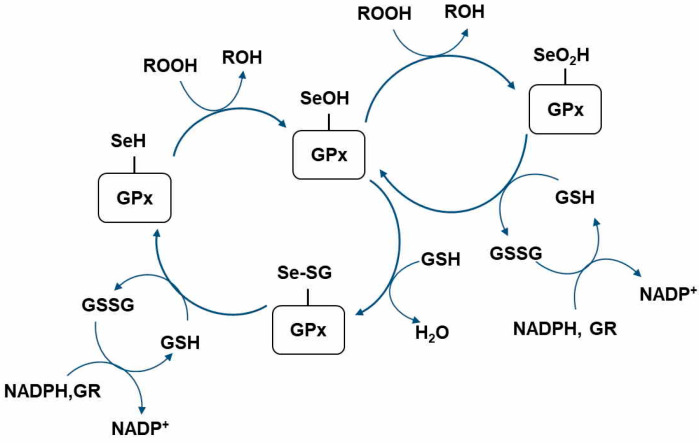
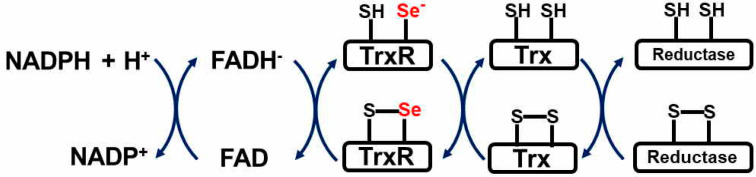
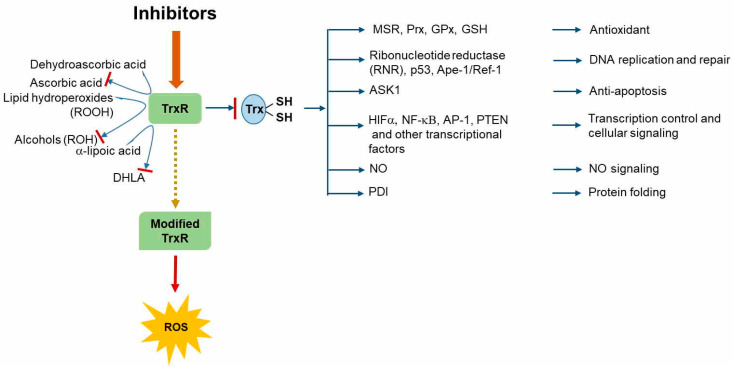
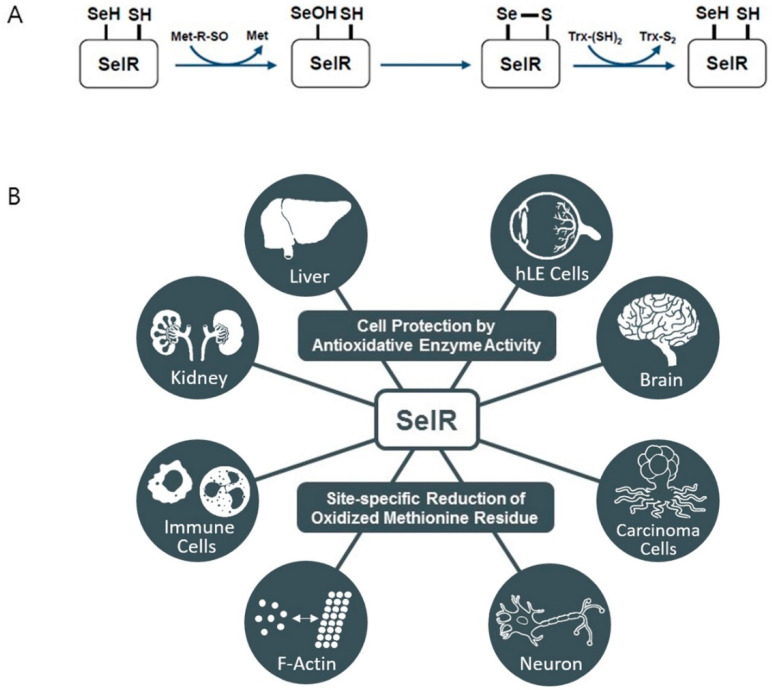
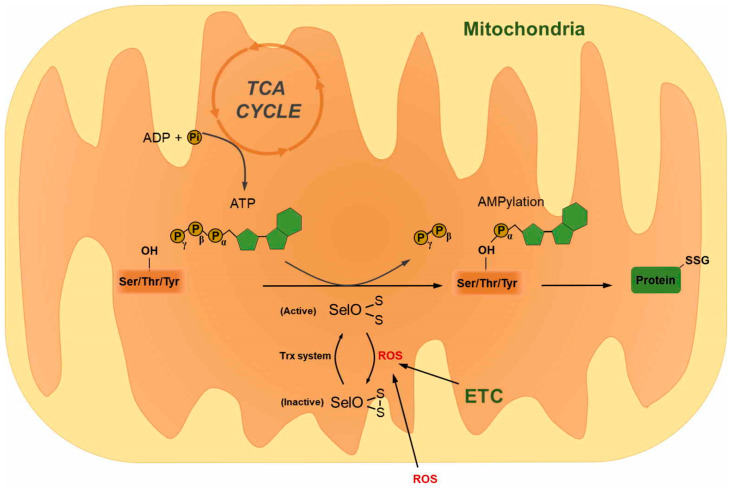
Selenium is a vital trace element present as selenocysteine (Sec) in proteins that are, thus, known as selenoproteins. Humans have 25 selenoproteins, most of which are functionally characterized as oxidoreductases, where the Sec residue plays a catalytic role in redox regulation and antioxidant activity. Glutathione peroxidase plays a pivotal role in scavenging and inactivating hydrogen and lipid peroxides, whereas thioredoxin reductase reduces oxidized thioredoxins as well as non-disulfide substrates, such as lipid hydroperoxides and hydrogen peroxide. Selenoprotein R protects the cell against oxidative damage by reducing methionine-R-sulfoxide back to methionine. Selenoprotein O regulates redox homeostasis with catalytic activity of protein AMPylation. Moreover, endoplasmic reticulum (ER) membrane selenoproteins (SelI, K, N, S, and Sel15) are involved in ER membrane stress regulation. Selenoproteins containing the CXXU motif (SelH, M, T, V, and W) are putative oxidoreductases that participate in various cellular processes depending on redox regulation. Herein, we review the recent studies on the role of selenoproteins in redox regulation and their physiological functions in humans, as well as their role in various diseases.
Overview
The claims and statistics of this paper haven’t been checked yet.
Run the check — free, no account needed. It reads the open-access text and checks the sources it cites.
Integrity signals
Registry
Cites
Statistics
Figures
Verification
Claims the paper makes
The claims and statistics of this paper haven’t been checked yet.
Run the check — free, no account needed. It reads the open-access text and checks the sources it cites.
Claims other papers make about this one
Each is checked against this paper’s own text: does it say what the citing paper says it does?
In the citing paper
“Se is an essential component of many proteins, called selenoproteins (Zhang et al. 2020).”
From Reactive Oxygen Species, Toxicity, Oxidative Stress, and Antioxidants: Chronic Diseases and Aging (2023) · cites this paper as Zhang et al. 2020
Self-check
Percentages, sums and reported differences re-computed from the paper’s own numbers.
The self-check needs the paper’s full text.
Citations
Cites
Free radicals and antioxidants in normal physiological functions and human disease
Valko, M., Leibfritz, D., Moncol, J., Cronin, M. T. D., Mazur, M., & Telser, J. (2007) · The International Journal of Biochemistry & Cell Biology · doi:10.1016/j.biocel.2006.07.001 · Cited by 14,269
Aging: a theory based on free radical and radiation chemistry
Harman, D. (1956) · Journal of Gerontology · doi:10.1093/geronj/11.3.298 · Cited by 8,567
Ferroptosis: A Regulated Cell Death Nexus Linking Metabolism, Redox Biology, and Disease
Stockwell, B. R., Friedmann Angeli, J. P., Bayir, H., Bush, A. I., Conrad, M., Dixon, S. J., Fulda, S., Gascón, S., Hatzios, S. K., Kagan, V. E., et al. (2017) · Cell · doi:10.1016/j.cell.2017.09.021 · Cited by 7,695
Free radicals, metals and antioxidants in oxidative stress-induced cancer
Valko, M., Rhodes, C. J., Moncol, J., Izakovic, M., & Mazur, M. (2006) · Chemico-Biological Interactions · doi:10.1016/j.cbi.2005.12.009 · Cited by 6,680
Nordberg, J., & Arnér, E. S. J. (2001) · Free Radical Biology and Medicine · doi:10.1016/s0891-5849(01)00724-9 · Cited by 2,720
Physiological functions of thioredoxin and thioredoxin reductase
Arnér, E. S. J., & Holmgren, A. (2000) · European Journal of Biochemistry · doi:10.1046/j.1432-1327.2000.01701.x · Cited by 2,535
Characterization of Mammalian Selenoproteomes
Kryukov, G. V., Castellano, S., Novoselov, S. V., Lobanov, A. V., Zehtab, O., Guigó, R., & Gladyshev, V. N. (2003) · Science · doi:10.1126/science.1083516 · Cited by 2,385
Oxidative stress in Parkinson's disease
Jenner, P. (2003) · Annals of Neurology · doi:10.1002/ana.10483 · Cited by 2,053
Biomarkers of Oxidative Damage in Human Disease
Dalle-Donne, I., Rossi, R., Colombo, R., Giustarini, D., & Milzani, A. (2006) · Clinical Chemistry · doi:10.1373/clinchem.2005.061408 · Cited by 1,703
Selenium Utilization by GPX4 Is Required to Prevent Hydroperoxide-Induced Ferroptosis
Ingold, I., Berndt, C., Schmitt, S., Doll, S. G., Poschmann, G., Buday, K., Roveri, A., Peng, X., Freitas, F. P., Seibt, T., et al. (2017) · Cell · doi:10.1016/j.cell.2017.11.048 · Cited by 1,701
Cited by
Sorted by citations
Reactive Oxygen Species, Toxicity, Oxidative Stress, and Antioxidants: Chronic Diseases and Aging
Jomova, K., Raptova, R., Alomar, S. Y., Alwasel, S. H., Nepovimova, E., Kuca, K., & Valko, M. (2023) · Archives of Toxicology · doi:10.1007/s00204-023-03562-9 · Cited by 2,638
Fundamentals of redox regulation in biology
Sies, H., Mailloux, R. J., & Jakob, U. (2024) · Nature Reviews Molecular Cell Biology · doi:10.1038/s41580-024-00730-2 · Cited by 561
Selenium Compounds as Novel Potential Anticancer Agents
Radomska, D., Czarnomysy, R., Radomski, D., & Bielawski, K. (2021) · International Journal of Molecular Sciences · doi:10.3390/ijms22031009 · Cited by 468
The relationship between nutrition and the immune system
Munteanu, C., & Schwartz, B. (2022) · Frontiers in Nutrition · doi:10.3389/fnut.2022.1082500 · Cited by 346
Ma, J., Li, Y., Yang, X., Liu, K., Zhang, X., Zuo, X., Ye, R., Wang, Z., Shi, R., Meng, Q., et al. (2023) · Signal Transduction and Targeted Therapy · doi:10.1038/s41392-023-01430-7 · Cited by 265
Metadata
- Authors
- Zhang, Y., Roh, Y. J., Han, S.-J., Park, I., Lee, H. M., Ok, Y. S., Lee, B. C., & Lee, S.-R.
- Affiliations
- Chonnam National University (KR)
- Korea University (KR)
- COTDE Inc. 19-3, Ugakgol-gil, Susin-myeon, Cheonan-si, Chungcheongnam-do 330-882, Korea
- Corresponding author
- Lee, Byung Cheon
- Lee, Seung-Rock
- Venue
- Antioxidants
- Publisher
- MDPI AG
- Published
- 2020-05-05
- Volume
- 9
- Issue
- 5
- Pages
- 383
- ISSN
- 2076-3921 (ISSN-L)
- PMC
- PMC7278666
- OpenAlex
- W3022351363
- Cited by
- 267
- References
- 162
- Citations by year
- 2026: 52 · 2025: 55 · 2024: 51 · 2023: 40 · 2022: 43 · 2021: 16 · 2020: 9
- FWCI
- 3.31
- Type
- journal article
- Language
- en
- Open access
- gold
- dx.doi.org
- Licence
- Locations
- Antioxidants (publishedVersion, cc-by)
- PubMed Central (publishedVersion, cc-by)
- PubMed (publishedVersion)
- DOAJ (DOAJ: Directory of Open Access Journals) (submittedVersion, cc-by-sa)
- Funders
- National Research Foundation of Korea (2018R1D1A1B06051438, 2018M3A9F3055925, 2018R1A1A1A05079386)
- Topics
- Health Sciences › Nursing › Nutrition and Dietetics › Selenium in Biological Systems
- Physical Sciences › Chemistry › Organic Chemistry › Organoselenium and organotellurium chemistry
- Life Sciences › Biochemistry, Genetics and Molecular Biology › Molecular Biology › Redox biology and oxidative stress
- Keywords
- selenoproteins, selenocysteine, redox regulation, antioxidant defense, glutathione peroxidase, thioredoxin reductase, oxidative enzymes, redox homeostasis, oxidative stress
About these checks
Registry, retraction, Cites and statistics results are computed, not judged, with one exception: a printed reference that no index lists is read once by a model before it counts as a citation error. Claims are extracted by a model and kept only when their quote appears verbatim in the text; each cited source is then checked, with a model’s help, for whether it says what the claim relies on. Those verdicts can be wrong — read the claim’s quote and the cited source before relying on one.
Statistics and arithmetic are recomputed, not judged.
Confidence bands are shown only for fields calibrated on our annotated test set. None is calibrated yet, so no band is shown.
What counts as a claim ›How we measure confidence ›How we check this ›
Are you an author, or do you see a problem with this page? Request a review
