

Evaluation of In-Package Atmospheric Dielectric Barrier Discharge Cold Plasma Treatment as an Intervention Technology for Decontaminating Bulk Ready-To-Eat Chicken Breast Cubes in Plastic Containers
Open accessThe DOI matches its Crossref record; 59 of the 60 references it cites were found in a registry or an index.
Abstract
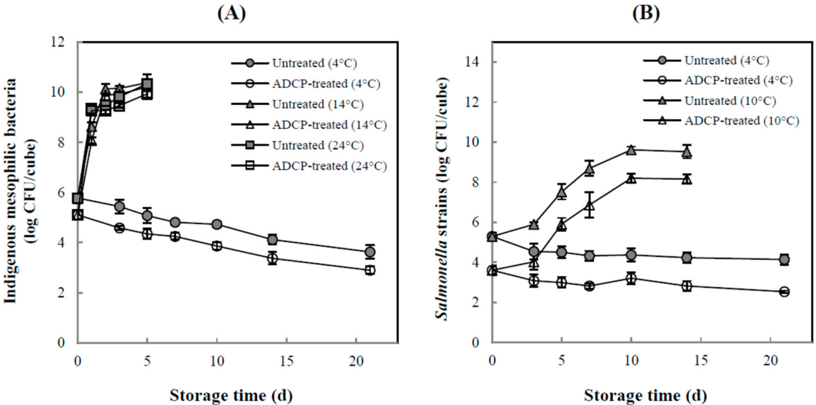
This article evaluates the effects of in-package atmospheric dielectric barrier discharge cold plasma (ADCP) treatment on microbial inactivation, nitrate and nitrite contents, oral toxicity, and storage quality of protein-coated boiled chicken breast cubes (CBCs). ADCP treatment at 24 kV for 3 min inactivated natural mesophilic aerobic bacteria, Salmonella, and Tulane virus in CBCs by 0.7 ± 0.2, 1.4 ± 0.1 log CFU/cube, and 1.1 ± 0.2 log PFU/cube, respectively. ADCP treatment did not affect the nitrite content of CBCs (p > 0.05). Furthermore, the hematological and blood biochemical parameters from toxicity tests indicated the toxicological safety of ADCP-treated CBCs. Microbial counts of natural bacteria and Salmonella in ADCP-treated CBCs were lower than the ADCP-untreated CBCs by 0.7–0.9 and 1.4–1.7 log CFU/cube, respectively, throughout post-treatment storage at 4 °C for 21 d. ADCP treatment did not alter the pH, color, total volatile basic nitrogen, lipid oxidation, and tenderness of CBCs during storage at 4 and 24 °C, and did not change the sensory properties of CBCs following a 3 d storage period at 4 °C (p > 0.05). Thus, ADCP treatment has the potential to be applied as a method to increase the microbiological safety of packaged ready-to-eat chicken products, leading to overall toxicological safety.
Overview
The claims and statistics of this paper haven’t been checked yet.
Free: it reads the open-access text and checks the first 5 claims that cite a source we can check. Create a free account to check every claim.
Integrity signals
Registry
Cites
Statistics
Figures
Verification
Claims the paper makes
The claims and statistics of this paper haven’t been checked yet.
Free: it reads the open-access text and checks the first 5 claims that cite a source we can check. Create a free account to check every claim.
Claims other papers make about this one
Each is checked against this paper’s own text: does it say what the citing paper says it does?
The source backs part of the claim, not all of it — or backs it for a different population, condition or comparison.
In the citing paper
“During storage, hermetic sealing is involved, ensuring more substantial microbial growth inactivation in the packed food.”
From Emerging Trends for Nonthermal Decontamination of Raw and Processed Meat: Ozonation, High-Hydrostatic Pressure and Cold Plasma (2022) · cites this paper as [85]
Experimental — accuracy not yet measured
Self-check
Percentages, sums and reported differences re-computed from the paper’s own numbers.
The self-check needs the paper’s full text.
Citations
Cites
Protein Oxidation in Muscle Foods: A Review
Lund, M. N., Heinonen, M., Baron, C. P., & Estévez, M. (2011) · Molecular Nutrition & Food Research · doi:10.1002/mnfr.201000453 · Cited by 1,005 · cited 1×
“ROS generated by cold plasma may react with the side chains of amino acids, causing protein oxidation and affecting tenderness [58].”
BackgroundLameire, N. H., Vanbiesen, W., & Vanholder, R. C. (2005) · The Lancet · doi:10.1016/s0140-6736(05)17831-3 · Cited by 946
A model of ductile fracture based on the nucleation and growth of voids
Le Roy, G., Embury, J. D., Edwards, G., & Ashby, M. F. (1981) · Acta Metallurgica · doi:10.1016/0001-6160(81)90185-1 · Cited by 783
The Role of Acidification for Antimicrobial Activity of Atmospheric Pressure Plasma in Liquids
Oehmigen, K., Hähnel, M., Brandenburg, R., Wilke, C., Weltmann, K. ‐., & von Woedtke, T. (2010) · Plasma Processes and Polymers · doi:10.1002/ppap.200900077 · Cited by 726 · cited 2×
“As seen in the previous investigation of nitrate and nitrite contents, nitrogen species generated during cold plasma treatment may induce the formation of nitric acid leading to a consequent decrease in pH [37].”
BackgroundMcHugh, T. H., & Krochta, J. M. (1994) · Journal of Agricultural and Food Chemistry · doi:10.1021/jf00040a001 · Cited by 688 · cited 2×
“cutting, the CBCs were coated on all sides with whey protein isolate (WPI) coating solution (BiPRO®, Davisco Foods International, Le Sueur, MN, USA), prepared according to the methods described by McHugh and Krochta [17].”
MethodMechanism of Lipid Peroxidation in Meat and Meat Products -A Review
Min, B. R., & Ahn, D. U. (2005) · Food Science and Biotechnology · Cited by 649
Effects of Cold Plasma on Food Quality: A Review
Pankaj, S., Wan, Z., & Keener, K. (2018) · Foods · doi:10.3390/foods7010004 · Cited by 556
Applications of cold plasma technology in food packaging
Pankaj, S. K., Bueno-Ferrer, C., Misra, N. N., Milosavljević, V., O'Donnell, C. P., Bourke, P., Keener, K. M., & Cullen, P. J. (2014) · Trends in Food Science & Technology · doi:10.1016/j.tifs.2013.10.009 · Cited by 530 · cited 1×
“0 min were not investigated in this study because, in food production lines, post-packaging sterilization time is mostly limited to a few minutes [27].”
BackgroundZiuzina, D., Patil, S., Cullen, P. J., Keener, K. M., & Bourke, P. (2014) · Food Microbiology · doi:10.1016/j.fm.2014.02.007 · Cited by 441 · cited 1×
“Post-treatment storage reportedly enhances the microbial inactivation efficacy of ADCP, due to cold plasma reactive species within closed containers diffusing into product tissues during storage [41].”
BackgroundPlasma Surface Modification of Biodegradable Polymers: A Review
Morent, R., De Geyter, N., Desmet, T., Dubruel, P., & Leys, C. (2011) · Plasma Processes and Polymers · doi:10.1002/ppap.201000153 · Cited by 434 · cited 1×
“, ≤10 nm, 1 μm) [45,46], it is thought that the reaction was with the WPI coating on the surface of CBCs and was not substantial to change the bulk pH.”
Background
Cited by
Cold plasma technology: Reshaping food preservation and safety
Kaur, S., Kumar, Y., Singh, V., Kaur, J., & Panesar, P. S. (2024) · Food Control · doi:10.1016/j.foodcont.2024.110537 · Cited by 98
Ranjha, M. M. A. N., Shafique, B., Aadil, R. M., Manzoor, M. F., & Cheng, J. (2023) · Trends in Food Science & Technology · doi:10.1016/j.tifs.2023.03.011 · Cited by 93
In‐package cold plasma treatment to extend the shelf life of food
Alaguthevar, R., Packialakshmi, J. S., Murugesan, B., Rhim, J., & Thiyagamoorthy, U. (2024) · Comprehensive Reviews in Food Science and Food Safety · doi:10.1111/1541-4337.13318 · Cited by 77
Abdel-Naeem, H. H. S., Ebaid, E. M. S. M., Khalel, K. H. M., Imre, K., Morar, A., Herman, V., & El-Nawawi, F. (2022) · LWT · doi:10.1016/j.lwt.2022.113739 · Cited by 68
Roobab, U., Chacha, J. S., Abida, A., Rashid, S., Muhammad Madni, G., Lorenzo, J. M., Zeng, X.-A., & Aadil, R. M. (2022) · Foods · doi:10.3390/foods11152173 · Cited by 45
“[85], within closed containers, reactive species diffused into food tissues and controlled microbial growth during storage.”
BackgroundEffect of Cold Plasma on Meat Cholesterol and Lipid Oxidation
Pérez-Andrés, J. M., Cropotova, J., Harrison, S. M., Brunton, N. P., Cullen, P. J., Rustad, T., & Tiwari, B. K. (2020) · Foods · doi:10.3390/foods9121786 · Cited by 43
“For instance, studies on pork [19] and chicken [49] investigated the impact of plasma for 12 an 21 days, respectively.”
BackgroundCold Plasma Technology in Food Packaging
Perera, K. Y., Prendeville, J., Jaiswal, A. K., & Jaiswal, S. (2022) · Coatings · doi:10.3390/coatings12121896 · Cited by 45
Rout, S., Tripathy, S., & Srivastav, P. P. (2024) · Food Bioscience · doi:10.1016/j.fbio.2024.104545 · Cited by 40
Inactivation of foodborne viruses: Opportunities for cold atmospheric plasma
Jenns, K., Sassi, H. P., Zhou, R., Cullen, P. J., Carter, D. A., & Mai‐Prochnow, A. (2022) · Trends in Food Science & Technology · doi:10.1016/j.tifs.2022.04.006 · Cited by 35
Jeon, Y. J., Lee, H., & Min, S. C. (2023) · Innovative Food Science & Emerging Technologies · doi:10.1016/j.ifset.2023.103339 · Cited by 32
Self-citationCombination of Natural Compounds With Novel Non-thermal Technologies for Poultry Products: A Review
Barroug, S., Chaple, S., & Bourke, P. (2021) · Frontiers in Nutrition · doi:10.3389/fnut.2021.628723 · Cited by 30
Lee, H. S., Kim, N., & Min, S. C. (2021) · Food Control · doi:10.1016/j.foodcont.2021.108772 · Cited by 27
Self-citationDielectric Barrier Discharge for Solid Food Applications
Figueroa-Pinochet, M. F., Castro, M. J., Tiwari, B. K., Jiménez, J. M., López, M., Cao, M.-J., & Albertos, I. (2022) · Nutrients · doi:10.3390/nu14214653 · Cited by 34
“[21] applied DBD cold plasma at 22, 23 and 24 kV power for 2, 2.”
MethodLi, R., Zhu, H., Chen, Y., Zhou, G., Li, C., & Ye, K. (2022) · LWT · doi:10.1016/j.lwt.2022.113137 · Cited by 24
Yang, X. B., Cheng, J., & Sun, D. (2023) · Food Control · doi:10.1016/j.foodcont.2023.110164 · Cited by 28
Plasma-activated water effectively decontaminates steamed rice cake
Kang, J. H., Han, J.-Y., Lee, H. S., Ryu, S., Kim, S. B., Cho, S., Kang, D., & Min, S. C. (2021) · LWT · doi:10.1016/j.lwt.2021.112838 · Cited by 25
Self-citationLee, H. S., Lee, H., Ryu, S., Eom, S., & Min, S. C. (2023) · International Journal of Food Microbiology · doi:10.1016/j.ijfoodmicro.2023.110108 · Cited by 23
Self-citationKeewan, M., Rambabu, K., Show, P. L., Tang, D. Y. Y., & BANAT, F. A. (2025) · Food Frontiers · doi:10.1002/fft2.70116 · Cited by 23
Non-thermal innovations in solid food processing: Eco-friendly alternatives to thermal methods
Khojasteh, S. K., Elmizadeh, A., Sarraf, M., & Dodange, S. (2025) · Applied Food Research · doi:10.1016/j.afres.2025.101256 · Cited by 23
Principles and Applications of Non-Thermal Technologies for Meat Decontamination
Lee, Y., & Yoon, Y. (2023) · Food Science of Animal Resources · doi:10.5851/kosfa.2023.e72 · Cited by 23
“NTP decontamination is effective on meat products (Lee et al., 2020; Moutiq et al., 2020).”
BackgroundInfluentialJeon, Y. J., Myung, G. E., & Min, S. C. (2022) · Food Packaging and Shelf Life · doi:10.1016/j.fpsl.2022.100905 · Cited by 16
Self-citationRamezan, Y., Hematabadi, H., Ramezan, M., Khani, M. R., Kamkari, A., & Tabrizi, A. N. (2022) · Food Science and Technology International · doi:10.1177/10820132221108709 · Cited by 15
Kumar, D., Yadav, G. P., Dalbhagat, C. G., & Mishra, H. N. (2022) · Journal of Food Processing and Preservation · doi:10.1111/jfpp.17010 · Cited by 16
Kang, J. H., Jeon, Y. J., & Min, S. C. (2021) · Food Science and Biotechnology · doi:10.1007/s10068-021-00978-w · Cited by 13
“ADCP achieves in-package treatment by forming plasma within a sealed package (Lee et al., 2020), thus leading to the prevention of post-processing contamination that can occur between the time of microbial inactivation and packaging as well as recontamination during packaging (Feizollahi et al.,…”
BackgroundSelf-citationBak, K. H., & Paulsen, P. (2023) · Foods · doi:10.3390/foods12173295 · Cited by 14
“5, or 3 min Sensory evaluation Decrease in flavor score immediately after ACP treatment, no difference after 3 days of storage at 4 ◦C [38]”
BackgroundKim, Y. E., Myung, G. E., Jeon, Y. J., & Min, S. C. (2024) · Food Science and Biotechnology · doi:10.1007/s10068-024-01536-w · Cited by 13
“…cold plasma (ADCP) treatment generates cold plasma between two metal electrodes with a dielectric material, generating various reactive species (e.g., electrons, ions, free radicals, reactive oxygen and nitrogen species, atoms, charged molecules, and UV photons) in the plasma (Lee et al., 2020).”
InfluentialSelf-citationCold plasma as a frontier in combating foodborne bacterial pathogens in ready-to-eat (RTE) foodstuff
Naseem, T., Zahid, U., Shahzad, A., Hassan, S. A., Abdi, G., & Aadil, R. M. (2025) · Applied Food Research · doi:10.1016/j.afres.2025.100842 · Cited by 14
Lee, E. S., Jeon, Y. J., & Min, S. C. (2021) · Foods · doi:10.3390/foods10061214 · Cited by 11
“The ADCP treatment was conducted at 24 kV, at which no direct dielectric breakdown nor any color change occurred in CS according to our preliminary study [19].”
MethodSelf-citationMatra, K., Zonklin, B., Hamkratok, S., & Pachekrepapol, U. (2025) · Discover Food · doi:10.1007/s44187-025-00320-x · Cited by 13
“Studies have shown that in-package ACP treatment of meat products successfully reduced total viable counts and pathogenic bacteria [13, 14].”
Lee, E. S., Im, S., & Min, S. C. (2023) · Food Control · doi:10.1016/j.foodcont.2023.109809 · Cited by 9
Self-citationCurrent Status of Non-Thermal Sterilization by Pet Food Raw Ingredients
Baek, U.-B., & Kim, H.-Y. (2024) · Food Science of Animal Resources · doi:10.5851/kosfa.2024.e63 · Cited by 7
Jeon, E. B., Choi, E. H., Lim, J. S., & Park, S. Y. (2025) · Poultry Science · doi:10.1016/j.psj.2025.105333 · Cited by 4
“The antimicrobial efficacy observed in this study is consistent with previous reports on cold plasma technologies, although treatment conditions such as gas type, voltage, and exposure time varied across studies (Lee et al., 2020; Moutiq et al., 2020).”
Viral inactivation of murine coronavirus via multiple gas plasma-derived reactive species
Bekeschus, S., Heuser, M., Miebach, L., Frank, M., von Woedtke, T., & Schmidt, A. (2025) · Redox Biology · doi:10.1016/j.redox.2025.103591 · Cited by 3
“Direct high-voltage atmospheric cold plasma DBD has been used to inactivate Tulane virus on chicken breast [43].”
Yoon, S., Kim, S. Y., & Min, S. C. (2025) · International Journal of Food Microbiology · doi:10.1016/j.ijfoodmicro.2025.111389 · Cited by 3
Self-citationCold Atmospheric Plasma Applications in Viral Inactivation: Systematic Review and Metanalysis
Isabelli, P., Boehm, D., Canal, C., Gherardi, M., & Laurita, R. (2026) · Plasma Chemistry and Plasma Processing · doi:10.1007/s11090-025-10611-x · Cited by 6
Agriculture and Food Processing Applications
Brust, H., Wannicke, N., & Park, G. (2023) · Topics in applied physics · doi:10.1007/978-981-19-7935-4_6 · Cited by 3
Chavan, P., Prendeville, J., Hamid, Jaiswal, S., & Jaiswal, A. K. (2024) · Elsevier eBooks · doi:10.1016/b978-0-323-90044-7.00012-4 · Cited by 3
Li, J., Chen, X., Lu, Y., Wang, X., Jin, S., Bai, Y., Wang, X., Xu, X., & Han, M. (2024) · Food Science and Human Wellness · doi:10.26599/fshw.2024.9250175 · Cited by 2
Ilchev, S. (2024) · Computation · doi:10.3390/computation12050102 · Cited by 3
“Microbiological studies may also require storing samples at predefined storage conditions, e.g., at specific temperature and humidity values, as stated in [36].”
BackgroundQuintana-Terriza, J., García, C., García‐Muñoz, P., & Rodríguez‐Chueca, J. (2025) · Water Research X · doi:10.1016/j.wroa.2025.100429 · Cited by 7
Pandey, V. K., Nath, P. C., Thapliyal, S., & Shaikh, A. M. (2026) · Ultrasonics Sonochemistry · doi:10.1016/j.ultsonch.2026.107807 · Cited by 3
“SACP is a compelling non-thermal alternative for enhancing the safety, quality retention, and shelf-life of RTE foods while maintaining customer preference for minimally processed products [126].”
Yu, J., Jung, M., Kim, J. H., & Bai, J. (2026) · Food Bioscience · doi:10.1016/j.fbio.2026.108651
Im, S., & Min, S. C. (2026) · International Journal of Food Microbiology · doi:10.1016/j.ijfoodmicro.2026.111908 · Cited by 1
Self-citationCold Plasma in Preserving Packaged Foods and Its Impact on Packaging Material
Caleb, O. J., Monyela, N. F., Yanclo, L. A., Pathare, P. B., & Belay, Z. A. (2026) · Elsevier eBooks · doi:10.1016/b978-0-443-34158-8.00071-2
Novel emerging nonthermal processing techniques for meat preservation
Wang, Y., Jiang, H., Fang, J., Fang, T., Liu, Y., Wu, T., Wang, J., & Guo, N. (2026) · Elsevier eBooks · doi:10.1016/b978-0-443-40425-2.00003-x · Cited by 1
Gil, M., Rudy, M., Duma‐Kocan, P., Stanisławczyk, R., & Dziki, D. (2026) · Molecules · doi:10.3390/molecules31203697
Metadata
- Authors
- Lee, E. S., Cheigh, C.-I., Kang, J. H., Lee, S. Y., & Min, S. C.
- Affiliations
- Seoul Women's University (KR)
- Kyungpook National University (KR)
- Corresponding author
- Min, Sea C.
- Venue
- Applied Sciences
- Publisher
- MDPI AG
- Published
- 2020-09-10
- Volume
- 10
- Issue
- 18
- Pages
- 6301
- ISSN
- 2076-3417 (ISSN-L)
- OpenAlex
- W3084954746
- Cited by
- 46
- References
- 60
- Citations by year
- 2026: 7 · 2025: 8 · 2024: 8 · 2023: 8 · 2022: 9 · 2021: 5 · 2020: 1
- FWCI
- 2.80
- Type
- journal article
- Language
- en
- Open access
- gold
- doi.org
- Licence
- Locations
- Applied Sciences (publishedVersion, cc-by)
- DOAJ (DOAJ: Directory of Open Access Journals) (submittedVersion, cc-by-sa)
- Funders
- National Research Foundation of Korea (2019R1A2B5B01069364)
- Korea Institute of Planning and Evaluation for Technology in Food, Agriculture and Forestry (318026-03)
- Topics
- Physical Sciences › Physics and Astronomy › Atomic and Molecular Physics, and Optics › Atmospheric-Pressure Plasma Applications
- Life Sciences › Biochemistry, Genetics and Molecular Biology › Biotechnology › Microbial Inactivation Methods
- Life Sciences › Agricultural and Biological Sciences › Animal Science and Zoology › Meat and Animal Product Quality
- Keywords
- non-thermal plasma, microbial inactivation, Salmonella, Tulane virus, nitrite content, oral toxicity, storage quality, meat safety, plastic packaging
About these checks
Registry, retraction, Cites and statistics results are computed, not judged, with one exception: a printed reference that no index lists is read once by a model before it counts as a citation error. Claims are extracted by a model and kept only when their quote appears verbatim in the text; each cited source is then checked, with a model’s help, for whether it says what the claim relies on. Those verdicts can be wrong — read the claim’s quote and the cited source before relying on one.
Statistics and arithmetic are recomputed, not judged.
Confidence bands are shown only for fields calibrated on our annotated test set. None is calibrated yet, so no band is shown.
What counts as a claim ›How we measure confidence ›How we check this ›
Are you an author, or do you see a problem with this page? Request a review
Data sources
Bibliographic data: Semantic Scholar, OpenAlex, Crossref.
Contains information from the Semantic Scholar Academic Graph Datasets, made available under the ODC Attribution License (ODC-BY 1.0).
Semantic Scholar’s data is described in: Kinney, R., et al. (2023). The Semantic Scholar Open Data Platform. arXiv:2301.10140.
