

Evaluation of In-Package Atmospheric Dielectric Barrier Discharge Cold Plasma Treatment as an Intervention Technology for Decontaminating Bulk Ready-To-Eat Chicken Breast Cubes in Plastic Containers
Open accessThe DOI matches its Crossref record; 59 of the 60 references it cites were found in a registry or an index.
Abstract
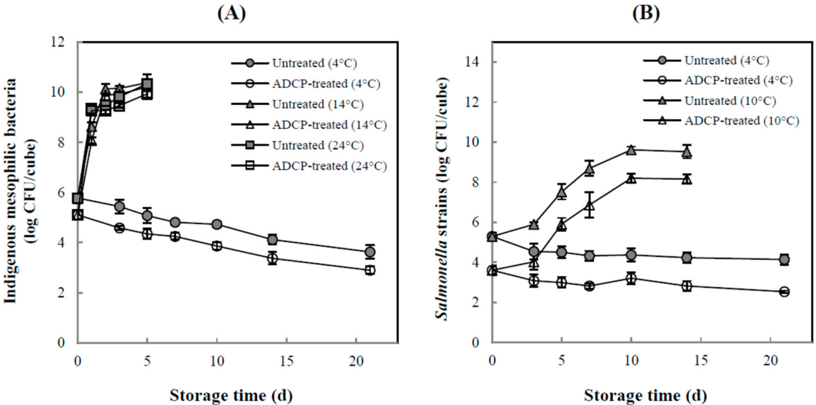
This article evaluates the effects of in-package atmospheric dielectric barrier discharge cold plasma (ADCP) treatment on microbial inactivation, nitrate and nitrite contents, oral toxicity, and storage quality of protein-coated boiled chicken breast cubes (CBCs). ADCP treatment at 24 kV for 3 min inactivated natural mesophilic aerobic bacteria, Salmonella, and Tulane virus in CBCs by 0.7 ± 0.2, 1.4 ± 0.1 log CFU/cube, and 1.1 ± 0.2 log PFU/cube, respectively. ADCP treatment did not affect the nitrite content of CBCs (p > 0.05). Furthermore, the hematological and blood biochemical parameters from toxicity tests indicated the toxicological safety of ADCP-treated CBCs. Microbial counts of natural bacteria and Salmonella in ADCP-treated CBCs were lower than the ADCP-untreated CBCs by 0.7–0.9 and 1.4–1.7 log CFU/cube, respectively, throughout post-treatment storage at 4 °C for 21 d. ADCP treatment did not alter the pH, color, total volatile basic nitrogen, lipid oxidation, and tenderness of CBCs during storage at 4 and 24 °C, and did not change the sensory properties of CBCs following a 3 d storage period at 4 °C (p > 0.05). Thus, ADCP treatment has the potential to be applied as a method to increase the microbiological safety of packaged ready-to-eat chicken products, leading to overall toxicological safety.
Overview
The claims and statistics of this paper haven’t been checked yet.
Free: it reads the open-access text and checks the first 5 claims that cite a source we can check. Create a free account to check every claim.
Integrity signals
Registry
Cites
Statistics
Figures
Verification
Claims the paper makes
The claims and statistics of this paper haven’t been checked yet.
Free: it reads the open-access text and checks the first 5 claims that cite a source we can check. Create a free account to check every claim.
Claims other papers make about this one
Each is checked against this paper’s own text: does it say what the citing paper says it does?
The source backs part of the claim, not all of it — or backs it for a different population, condition or comparison.
In the citing paper
“During storage, hermetic sealing is involved, ensuring more substantial microbial growth inactivation in the packed food.”
From Emerging Trends for Nonthermal Decontamination of Raw and Processed Meat: Ozonation, High-Hydrostatic Pressure and Cold Plasma (2022) · cites this paper as [85]
Experimental — accuracy not yet measured
Self-check
Percentages, sums and reported differences re-computed from the paper’s own numbers.
The self-check needs the paper’s full text.
Citations
Cites
Protein Oxidation in Muscle Foods: A Review
Lund, M. N., Heinonen, M., Baron, C. P., & Estévez, M. (2011) · Molecular Nutrition & Food Research · doi:10.1002/mnfr.201000453 · Cited by 1,005 · cited 1×
“ROS generated by cold plasma may react with the side chains of amino acids, causing protein oxidation and affecting tenderness [58].”
BackgroundLameire, N. H., Vanbiesen, W., & Vanholder, R. C. (2005) · The Lancet · doi:10.1016/s0140-6736(05)17831-3 · Cited by 946
A model of ductile fracture based on the nucleation and growth of voids
Le Roy, G., Embury, J. D., Edwards, G., & Ashby, M. F. (1981) · Acta Metallurgica · doi:10.1016/0001-6160(81)90185-1 · Cited by 783
The Role of Acidification for Antimicrobial Activity of Atmospheric Pressure Plasma in Liquids
Oehmigen, K., Hähnel, M., Brandenburg, R., Wilke, C., Weltmann, K. ‐., & von Woedtke, T. (2010) · Plasma Processes and Polymers · doi:10.1002/ppap.200900077 · Cited by 726 · cited 2×
“As seen in the previous investigation of nitrate and nitrite contents, nitrogen species generated during cold plasma treatment may induce the formation of nitric acid leading to a consequent decrease in pH [37].”
BackgroundMcHugh, T. H., & Krochta, J. M. (1994) · Journal of Agricultural and Food Chemistry · doi:10.1021/jf00040a001 · Cited by 688 · cited 2×
“cutting, the CBCs were coated on all sides with whey protein isolate (WPI) coating solution (BiPRO®, Davisco Foods International, Le Sueur, MN, USA), prepared according to the methods described by McHugh and Krochta [17].”
MethodMechanism of Lipid Peroxidation in Meat and Meat Products -A Review
Min, B. R., & Ahn, D. U. (2005) · Food Science and Biotechnology · Cited by 649
Effects of Cold Plasma on Food Quality: A Review
Pankaj, S., Wan, Z., & Keener, K. (2018) · Foods · doi:10.3390/foods7010004 · Cited by 556
Applications of cold plasma technology in food packaging
Pankaj, S. K., Bueno-Ferrer, C., Misra, N. N., Milosavljević, V., O'Donnell, C. P., Bourke, P., Keener, K. M., & Cullen, P. J. (2014) · Trends in Food Science & Technology · doi:10.1016/j.tifs.2013.10.009 · Cited by 530 · cited 1×
“0 min were not investigated in this study because, in food production lines, post-packaging sterilization time is mostly limited to a few minutes [27].”
BackgroundZiuzina, D., Patil, S., Cullen, P. J., Keener, K. M., & Bourke, P. (2014) · Food Microbiology · doi:10.1016/j.fm.2014.02.007 · Cited by 441 · cited 1×
“Post-treatment storage reportedly enhances the microbial inactivation efficacy of ADCP, due to cold plasma reactive species within closed containers diffusing into product tissues during storage [41].”
BackgroundPlasma Surface Modification of Biodegradable Polymers: A Review
Morent, R., De Geyter, N., Desmet, T., Dubruel, P., & Leys, C. (2011) · Plasma Processes and Polymers · doi:10.1002/ppap.201000153 · Cited by 434 · cited 1×
“, ≤10 nm, 1 μm) [45,46], it is thought that the reaction was with the WPI coating on the surface of CBCs and was not substantial to change the bulk pH.”
BackgroundThe Potential of Cold Plasma for Safe and Sustainable Food Production
Bourke, P., Ziuzina, D., Boehm, D., Cullen, P. J., & Keener, K. (2018) · Trends in Biotechnology · doi:10.1016/j.tibtech.2017.11.001 · Cited by 431 · cited 2×
“Cold plasma is an effective source of reactive oxygen and nitrogen species (RONS) [32].”
BackgroundLund, M. N., Hviid, M. S., & Skibsted, L. H. (2007) · Meat Science · doi:10.1016/j.meatsci.2006.11.003 · Cited by 262
Change Trends of Organ Weight Background Data in Sprague Dawley Rats at Different Ages
Piao, Y., Liu, Y., & Xie, X. (2013) · Journal of Toxicologic Pathology · doi:10.1293/tox.26.29 · Cited by 243 · cited 1×
“In general, weight loss in an internal organ is a sensitive index of toxicity [40].”
BackgroundKim, B., Yun, H., Jung, S., Jung, Y., Jung, H., Choe, W., & Jo, C. (2011) · Food Microbiology · doi:10.1016/j.fm.2010.07.022 · Cited by 242 · cited 1×
“However, it is likely that the number of nitrogen species generated in this study were insufficient, as several studies have reported that cold plasma treatment did not alter the pH of meat [43,44].”
BackgroundKruk, Z. A., Yun, H., Rutley, D. L., Lee, E. J., Kim, Y. J., & Jo, C. (2011) · Food Control · doi:10.1016/j.foodcont.2010.06.003 · Cited by 235 · cited 1×
“TVBN measures the total amount of amines and ammonia produced upon the decomposition of meat, and thus, acts as an indicator of meat freshness [51].”
BackgroundSelf-citationCai, J., Chen, Q., Wan, X., & Zhao, J. (2011) · Food Chemistry · doi:10.1016/j.foodchem.2010.11.098 · Cited by 228
Rød, S. K., Hansen, F., Leipold, F., & Knøchel, S. (2012) · Food Microbiology · doi:10.1016/j.fm.2011.12.018 · Cited by 222 · cited 1×
“Some studies also reported the absence of changes in the color of plasma-treated meat and meat products, such as fresh chicken breast [49], dry-cured beef [50], and processed chicken breasts [16].”
BackgroundSáyago-Ayerdi, S. G., Brenes, A., & Goñi, I. (2009) · LWT - Food Science and Technology · doi:10.1016/j.lwt.2008.12.006 · Cited by 215
Albertos, I., Martín-Diana, A. B., Cullen, P. J., Tiwari, B. K., Ojha, S. K., Bourke, P., Álvarez, C., & Rico, D. (2017) · Innovative Food Science & Emerging Technologies · doi:10.1016/j.ifset.2017.07.006 · Cited by 211
Effects of Atmospheric Pressure Plasmas on Isolated and Cellular DNA—A Review
Arjunan, K., Sharma, V., & Ptasinska, S. (2015) · International Journal of Molecular Sciences · doi:10.3390/ijms16022971 · Cited by 197
Barbanti, D., & Pasquini, M. (2005) · LWT - Food Science and Technology · doi:10.1016/j.lwt.2004.08.017 · Cited by 187 · cited 1×
“The tenderness of CBC was measured using the methods described by Barbanti and Pasquini [25].”
MethodCold Plasma in Modified Atmospheres for Post-harvest Treatment of Strawberries
Misra, N. N., Moiseev, T., Patil, S., Pankaj, S. K., Bourke, P., Mosnier, J. P., Keener, K. M., & Cullen, P. J. (2014) · Food and Bioprocess Technology · doi:10.1007/s11947-014-1356-0 · Cited by 183 · cited 1×
“Furthermore, ozone generally present in ADCP may lead to bleaching of food [48].”
BackgroundRecent Advances in the Application of Cold Plasma Technology in Foods
Sarangapani, C., Patange, A., Bourke, P., Keener, K., & Cullen, P. J. (2018) · Annual Review of Food Science and Technology · doi:10.1146/annurev-food-030117-012517 · Cited by 182 · cited 1×
“These can also enter the cells to react with proteins, lipids, and DNA, thereby non-thermally inactivating the microorganism [5,6,10,12].”
BackgroundIn-package cold plasma technologies
Misra, N. N., Yepez, X., Xu, L., & Keener, K. (2019) · Journal of Food Engineering · doi:10.1016/j.jfoodeng.2018.09.019 · Cited by 180 · cited 2×
“Among the various methods used to generate cold plasma, atmospheric dielectric barrier discharge (ADCP) has attracted the attention of the food industry, as it allows the formation of cold plasma inside plastic packages, making cold plasma treatment an in-package treatment [7,9,10].”
BackgroundMethodMoutiq, R., Misra, N. N., Mendonça, A., & Keener, K. (2020) · Meat Science · doi:10.1016/j.meatsci.2019.107942 · Cited by 176 · cited 8×
“Moutiq et al. [1] subjected fresh chicken breast samples to ADCP treatment (at 100 kV, 5 min), and reported that indigenous mesophiles and Enterobacteriaceae in the fresh chicken breast were inactivated by 1.5 log CFU/g, while shelf-life was increased by six more days [1].”
BackgroundMethodInfluentialRisk assessment of a cold argon plasma jet in respect to its mutagenicity
Wende, K., Bekeschus, S., Schmidt, A., Jatsch, L., Hasse, S., Weltmann, K. D., Masur, K., & von Woedtke, T. (2016) · Mutation Research/Genetic Toxicology and Environmental Mutagenesis · doi:10.1016/j.mrgentox.2016.02.003 · Cited by 163 · cited 1×
“reported that the application of a cold argon plasma jet to V79 cells for 3 min did not increase genotoxicity [14].”
MethodZhang, H., Xu, Z., Shen, J., Li, X., Ding, L., Ma, J., Lan, Y., Xia, W., Cheng, C., Sun, Q., et al. (2015) · Scientific Reports · doi:10.1038/srep10031 · Cited by 161 · cited 1×
“Nitrate may be produced via oxidation of nitrite, and the increase of nitrate in this study is thought to be due to nitrite oxidation induced by the reactive species generated during cold plasma treatment [35,36].”
BackgroundHsu, J., Arcot, J., & Alice Lee, N. (2009) · Food Chemistry · doi:10.1016/j.foodchem.2008.11.081 · Cited by 150 · cited 1×
“[22], high-performance liquid chromatography (HPLC, Agilent 110 series, Agilent Technologies, Santa Clara, CA, USA) was used to measure nitrate and nitrite concentrations.”
MethodWu, Y. H., Liang, Y., Wei, K., Li, W., Yao, M., Zhang, J., & Grinshpun, S. A. (2014) · Applied and Environmental Microbiology · doi:10.1128/aem.03322-14 · Cited by 148
Min, S. C., Roh, S. H., Niemira, B. A., Sites, J. E., Boyd, G., & Lacombe, A. (2016) · International Journal of Food Microbiology · doi:10.1016/j.ijfoodmicro.2016.08.025 · Cited by 145 · cited 2×
“Among the various methods used to generate cold plasma, atmospheric dielectric barrier discharge (ADCP) has attracted the attention of the food industry, as it allows the formation of cold plasma inside plastic packages, making cold plasma treatment an in-package treatment [7,9,10].”
MethodSelf-citationEffect of atmospheric pressure cold plasma (ACP) on activity and structure of alkaline phosphatase
Segat, A., Misra, N. N., Cullen, P. J., & Innocente, N. (2016) · Food and Bioproducts Processing · doi:10.1016/j.fbp.2016.01.010 · Cited by 141
Acute and subacute toxicity of ethanol extracts from Salvia przewalskii Maxim in rodents
Li, X., Luo, Y., Wang, L., Li, Y., Shi, Y., Cui, Y., & Xue, M. (2010) · Journal of Ethnopharmacology · doi:10.1016/j.jep.2010.06.012 · Cited by 124 · cited 1×
“The hematopoietic system is generally the most sensitive target of toxic substances, and thus, it is an important parameter in evaluating human and animal physiological and pathological statuses [38].”
BackgroundHow deep can plasma penetrate into a biofilm?
Xiong, Z., Du, T., Lu, X., Cao, Y., & Pan, Y. (2011) · Applied Physics Letters · doi:10.1063/1.3597622 · Cited by 123 · cited 1×
“, ≤10 nm, 1 μm) [45,46], it is thought that the reaction was with the WPI coating on the surface of CBCs and was not substantial to change the bulk pH.”
BackgroundA Review on Microbiological Decontamination of Fresh Produce with Nonthermal Plasma
Pignata, C., D'Angelo, D., Fea, E., & Gilli, G. (2017) · Journal of Applied Microbiology · doi:10.1111/jam.13412 · Cited by 121 · cited 3×
“These can destroy chemical bonds in the microbial cell membrane by collision, which erodes the cell membrane through etching [10].”
BackgroundMethodClausen, I., Jakobsen, M., Ertbjerg, P., & Madsen, N. T. (2008) · Packaging Technology and Science · doi:10.1002/pts.828 · Cited by 117 · cited 1×
“This may be due to protein decomposition caused by the proliferation of indigenous mesophilic bacteria during storage at 24 ◦C, a temperature higher than 4 ◦C [59].”
BackgroundLee, H., Yong, H. I., Kim, H., Choe, W., Yoo, S. J., Jang, E. J., & Jo, C. (2016) · Food Science and Biotechnology · doi:10.1007/s10068-016-0189-1 · Cited by 114
Nonthermal inactivation of norovirus surrogates on blueberries using atmospheric cold plasma
Lacombe, A., Niemira, B. A., Gurtler, J. B., Sites, J. E., Boyd, G., Kingsley, D. H., Li, X., & Chen, H. (2016) · Food Microbiology · doi:10.1016/j.fm.2016.10.030 · Cited by 111 · cited 2×
“5 PFU/g after atmospheric plasma jet treatment for 45 s [18].”
MethodIn-package inhibition of E. coli O157:H7 on bulk Romaine lettuce using cold plasma
Min, S. C., Roh, S. H., Niemira, B. A., Boyd, G., Sites, J. E., Uknalis, J., & Fan, X. (2017) · Food Microbiology · doi:10.1016/j.fm.2017.01.010 · Cited by 105 · cited 1×
“These can also enter the cells to react with proteins, lipids, and DNA, thereby non-thermally inactivating the microorganism [5,6,10,12].”
BackgroundSelf-citationLee, H., Kim, M. S., Lee, W., & Cho, B. (2017) · Sensors and Actuators B Chemical · doi:10.1016/j.snb.2017.12.102 · Cited by 105 · cited 1×
“The TVBN of CBC was determined using a modified version of the Conway micro-diffusion method [23].”
MethodWang, J., Zhuang, H., Hinton, A., & Zhang, J. (2016) · Food Microbiology · doi:10.1016/j.fm.2016.07.007 · Cited by 101 · cited 1×
“Some studies also reported the absence of changes in the color of plasma-treated meat and meat products, such as fresh chicken breast [49], dry-cured beef [50], and processed chicken breasts [16].”
BackgroundMin, S. C., Roh, S. H., Niemira, B. A., Boyd, G., Sites, J. E., Fan, X., Sokorai, K., & Jin, T. Z. (2018) · Food Research International · doi:10.1016/j.foodres.2018.03.033 · Cited by 97 · cited 2×
“, shaking) as those of the current study demonstrated that the effect of the treatment against Salmonella was uniform, irrespective of the positions of grape tomatoes (22 tomatoes stacked in two layers) in a plastic clamshell package [20].”
BackgroundMethodSelf-citationYang, X., Huang, J., Wu, Q., Zhang, J., Liu, S., Guo, W., Cai, S., & Yu, S. (2015) · Food Control · doi:10.1016/j.foodcont.2015.07.019 · Cited by 92
Effect of low-pressure cold plasma on surface microflora of meat and quality attributes
Ulbin‐Figlewicz, N., Brychcy, E., & Jarmoluk, A. (2013) · Journal of Food Science and Technology · doi:10.1007/s13197-013-1108-6 · Cited by 89
Yong, H. I., Lee, S. H., Kim, S. Y., Park, S., Park, J., Choe, W., & Jo, C. (2019) · Innovative Food Science & Emerging Technologies · doi:10.1016/j.ifset.2017.09.005 · Cited by 87 · cited 1×
“also reported an increase in nitrite when dielectric barrier discharge plasma treatment was applied to pork jerky [34].”
BackgroundSelf-citationLi, X., Ye, M., Neetoo, H., Golovan, S. P., & Chen, H. (2013) · International Journal of Food Microbiology · doi:10.1016/j.ijfoodmicro.2012.12.016 · Cited by 86 · cited 1×
“TV is used as a surrogate for human norovirus [9,18,19].”
MethodInactivation of a Foodborne Norovirus Outbreak Strain with Nonthermal Atmospheric Pressure Plasma
Ahlfeld, B., Li, Y., Boulaaba, A., Binder, A., Schotte, U., Zimmermann, J. L., Morfill, G. E., & Klein, G. (2015) · mBio · doi:10.1128/mbio.02300-14 · Cited by 82
Direct infusion of nitrite into meat batter by atmospheric pressure plasma treatment
Jung, S., Lee, J., Lim, Y., Choe, W., Yong, H. I., & Jo, C. (2016) · Innovative Food Science & Emerging Technologies · doi:10.1016/j.ifset.2016.11.010 · Cited by 80 · cited 1×
“reported that nitrite in meat batter increased according to the duration of atmospheric pressure plasma treatment [33].”
BackgroundPatange, A. D., Boehm, D., Giltrap, M., Lu, P. C., Cullen, P. J., & Bourke, P. (2018) · The Science of The Total Environment · doi:10.1016/j.scitotenv.2018.02.269 · Cited by 80 · cited 1×
“Nitrate may be produced via oxidation of nitrite, and the increase of nitrate in this study is thought to be due to nitrite oxidation induced by the reactive species generated during cold plasma treatment [35,36].”
BackgroundBae, S.-C., Park, S. Y., Choe, W., & Ha, S. (2015) · Food Research International · doi:10.1016/j.foodres.2015.06.039 · Cited by 76 · cited 1×
“11 log PFU/mL reductions of Murine norovirus, respectively [28].”
BackgroundChou, S. ‐., Chung, J.-C., & Hwang, D.-F. (2020) · Journal of Food and Drug Analysis · doi:10.38212/2224-6614.2702 · Cited by 63
Roh, S. H., Oh, Y., Lee, S.-Y., Kang, J., & Min, S. (2020) · LWT · doi:10.1016/j.lwt.2020.109429 · Cited by 60 · cited 4×
“5 min) did not significantly increase the lipid oxidation level of uncoated CBC, immediately following the treatment [8].”
BackgroundMethodSelf-citationOral Toxicity of Cold Plasma‐Treated Edible Films for Food Coating
Han, S., Suh, H. J., Hong, K. B., Kim, S. Y., & Min, S. C. (2016) · Journal of Food Science · doi:10.1111/1750-3841.13551 · Cited by 56 · cited 4×
“reported that, according to the toxicity tests assessing microwave cold plasma treatment of edible defatted soybean meal-based film, the clinical differences between hematological and blood biochemical parameters were not significantly different as their levels were within normal physiological ranges, although changes…”
BackgroundSelf-citationWang, J. M., Zhuang, H., Lawrence, K., & Zhang, J. H. (2018) · Journal of Applied Microbiology · doi:10.1111/jam.13637 · Cited by 54
Roh, S. H., Lee, S., Park, H. H., Lee, E. S., & Min, S. C. (2018) · International Journal of Food Microbiology · doi:10.1016/j.ijfoodmicro.2018.12.016 · Cited by 54
Self-citationDecomposition of l-Valine under Nonthermal Dielectric Barrier Discharge Plasma
Li, Y., Kojtari, A., Friedman, G., Brooks, A. D., Fridman, A., & Ji, H.-F. (2014) · The Journal of Physical Chemistry B · doi:10.1021/jp411440k · Cited by 49 · cited 1×
“The reactive species of ADCP and amino acids lead to interactions resulting in the loss of α-helix and β-sheet, causing protein denaturation [52,53].”
BackgroundPark, S. Y., & Ha, S. (2014) · Food and Bioprocess Technology · doi:10.1007/s11947-014-1452-1 · Cited by 46 · cited 1×
“Chicken breast has lower lipid content than red meat, such as beef or pork, so that it is more stable against oxidation induced by cold plasma and acts as an ideal candidate for cold plasma treatment [8,56,57].”
BackgroundMin, S. C., Roh, S. H., Boyd, G., Sites, J. E., Uknalis, J., Fan, X., & Niemira, B. A. (2016) · Journal of Food Protection · doi:10.4315/0362-028x.jfp-16-148 · Cited by 46 · cited 1×
“These can also enter the cells to react with proteins, lipids, and DNA, thereby non-thermally inactivating the microorganism [5,6,10,12].”
BackgroundSelf-citationMechanisms of volatile production from sulfur-containing amino acids by irradiation
Ahn, D. U., Lee, E. J., Feng, X., Zhang, W., Lee, J. H., Jo, C., & Nam, K. (2015) · Radiation Physics and Chemistry · doi:10.1016/j.radphyschem.2015.09.009 · Cited by 38
Self-citationKim, S. Y., Bang, I. H., & Min, S. C. (2018) · Journal of Food Engineering · doi:10.1016/j.jfoodeng.2018.08.020 · Cited by 38 · cited 1×
“[4], which forms a plasma field between two aluminum electrodes (20 × 16 cm, AL6061; Kwang-lim Co.”
BackgroundSelf-citation
Cited by
Cold plasma technology: Reshaping food preservation and safety
Kaur, S., Kumar, Y., Singh, V., Kaur, J., & Panesar, P. S. (2024) · Food Control · doi:10.1016/j.foodcont.2024.110537 · Cited by 98
Ranjha, M. M. A. N., Shafique, B., Aadil, R. M., Manzoor, M. F., & Cheng, J. (2023) · Trends in Food Science & Technology · doi:10.1016/j.tifs.2023.03.011 · Cited by 93
In‐package cold plasma treatment to extend the shelf life of food
Alaguthevar, R., Packialakshmi, J. S., Murugesan, B., Rhim, J., & Thiyagamoorthy, U. (2024) · Comprehensive Reviews in Food Science and Food Safety · doi:10.1111/1541-4337.13318 · Cited by 77
Abdel-Naeem, H. H. S., Ebaid, E. M. S. M., Khalel, K. H. M., Imre, K., Morar, A., Herman, V., & El-Nawawi, F. (2022) · LWT · doi:10.1016/j.lwt.2022.113739 · Cited by 68
Roobab, U., Chacha, J. S., Abida, A., Rashid, S., Muhammad Madni, G., Lorenzo, J. M., Zeng, X.-A., & Aadil, R. M. (2022) · Foods · doi:10.3390/foods11152173 · Cited by 45
“[85], within closed containers, reactive species diffused into food tissues and controlled microbial growth during storage.”
Background
Metadata
- Authors
- Lee, E. S., Cheigh, C.-I., Kang, J. H., Lee, S. Y., & Min, S. C.
- Affiliations
- Seoul Women's University (KR)
- Kyungpook National University (KR)
- Corresponding author
- Min, Sea C.
- Venue
- Applied Sciences
- Publisher
- MDPI AG
- Published
- 2020-09-10
- Volume
- 10
- Issue
- 18
- Pages
- 6301
- ISSN
- 2076-3417 (ISSN-L)
- OpenAlex
- W3084954746
- Cited by
- 46
- References
- 60
- Citations by year
- 2026: 7 · 2025: 8 · 2024: 8 · 2023: 8 · 2022: 9 · 2021: 5 · 2020: 1
- FWCI
- 2.80
- Type
- journal article
- Language
- en
- Open access
- gold
- doi.org
- Licence
- Locations
- Applied Sciences (publishedVersion, cc-by)
- DOAJ (DOAJ: Directory of Open Access Journals) (submittedVersion, cc-by-sa)
- Funders
- National Research Foundation of Korea (2019R1A2B5B01069364)
- Korea Institute of Planning and Evaluation for Technology in Food, Agriculture and Forestry (318026-03)
- Topics
- Physical Sciences › Physics and Astronomy › Atomic and Molecular Physics, and Optics › Atmospheric-Pressure Plasma Applications
- Life Sciences › Biochemistry, Genetics and Molecular Biology › Biotechnology › Microbial Inactivation Methods
- Life Sciences › Agricultural and Biological Sciences › Animal Science and Zoology › Meat and Animal Product Quality
- Keywords
- non-thermal plasma, microbial inactivation, Salmonella, Tulane virus, nitrite content, oral toxicity, storage quality, meat safety, plastic packaging
About these checks
Registry, retraction, Cites and statistics results are computed, not judged, with one exception: a printed reference that no index lists is read once by a model before it counts as a citation error. Claims are extracted by a model and kept only when their quote appears verbatim in the text; each cited source is then checked, with a model’s help, for whether it says what the claim relies on. Those verdicts can be wrong — read the claim’s quote and the cited source before relying on one.
Statistics and arithmetic are recomputed, not judged.
Confidence bands are shown only for fields calibrated on our annotated test set. None is calibrated yet, so no band is shown.
What counts as a claim ›How we measure confidence ›How we check this ›
Are you an author, or do you see a problem with this page? Request a review
Data sources
Bibliographic data: Semantic Scholar, OpenAlex, Crossref.
Contains information from the Semantic Scholar Academic Graph Datasets, made available under the ODC Attribution License (ODC-BY 1.0).
Semantic Scholar’s data is described in: Kinney, R., et al. (2023). The Semantic Scholar Open Data Platform. arXiv:2301.10140.
