

Face Recognition Based on Deep Learning and FPGA for Ethnicity Identification
Open accessThe DOI matches its Crossref record; 52 of the 52 references it cites were found in a registry or an index; 8 of the 16 sources its claims cite were checked for support.
Abstract
In the last decade, there has been a surge of interest in addressing complex Computer Vision (CV) problems in the field of face recognition (FR). In particular, one of the most difficult ones is based on the accurate determination of the ethnicity of mankind. In this regard, a new classification method using Machine Learning (ML) tools is proposed in this paper. Specifically, a new Deep Learning (DL) approach based on a Deep Convolutional Neural Network (DCNN) model is developed, which outperforms a reliable determination of the ethnicity of people based on their facial features. However, it is necessary to make use of specialized high-performance computing (HPC) hardware to build a workable DCNN-based FR system due to the low computation power given by the current central processing units (CPUs). Recently, the latter approach has increased the efficiency of the network in terms of power usage and execution time. Then, the usage of field-programmable gate arrays (FPGAs) was considered in this work. The performance of the new DCNN-based FR method using FPGA was compared against that using graphics processing units (GPUs). The experimental results considered an image dataset composed of 3141 photographs of citizens from three distinct countries. To our knowledge, this is the first image collection gathered specifically to address the ethnicity identification problem. Additionally, the ethnicity dataset was made publicly available as a novel contribution to this work. Finally, the experimental results proved the high performance provided by the proposed DCNN model using FPGAs, achieving an accuracy level of 96.9 percent and an F1 score of 94.6 percent while using a reasonable amount of energy and hardware resources.
Overview
CoChat Summary
TL;DR
The paper proposes a deep convolutional neural network for ethnicity identification from facial images and implements it on an FPGA DE1-SoC, comparing it with GPU execution and four pre-trained CNNs. It reports 96.9% accuracy and 94.6% F1 on a new 3,141-image dataset of Chinese, Pakistani, and Russian faces.
Key findings
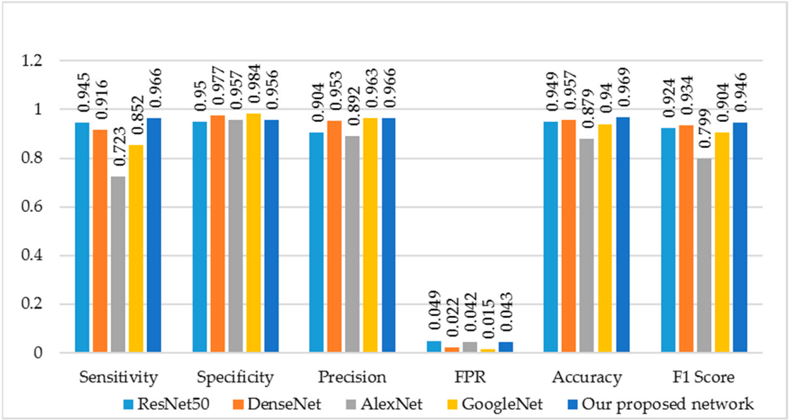
- The proposed network achieved accuracy 0.969 and F1 score 0.946, outperforming ResNet50 (0.949 accuracy, 0.924 F1), DenseNet (0.957, 0.934), AlexNet (0.879, 0.799), and GoogleNet (0.940, 0.904) in Table 2.
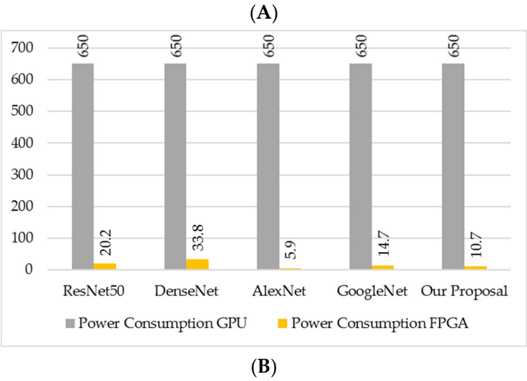
- On the FPGA DE1-SoC, the proposed network’s execution time and power consumption were reported as 2.76 s and 10.7 W, compared with 5.21 s and 650 W on GPU (Table 3).
- The new dataset contained 3,141 face photographs: 1,081 Chinese, 1,021 Pakistani, and 1,039 Russian images, split into 60% training, 10% validation, and 30% test.
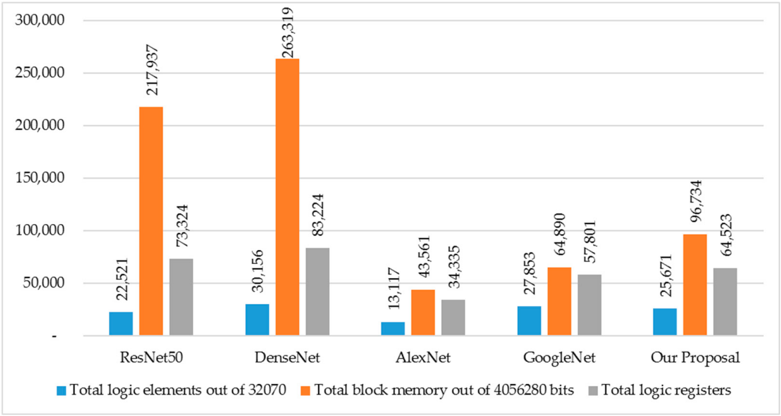
- The FPGA implementation used 25,671 total logic elements, 96,734 total block memory bits, and 64,523 total logic registers (Table 4).
Methods
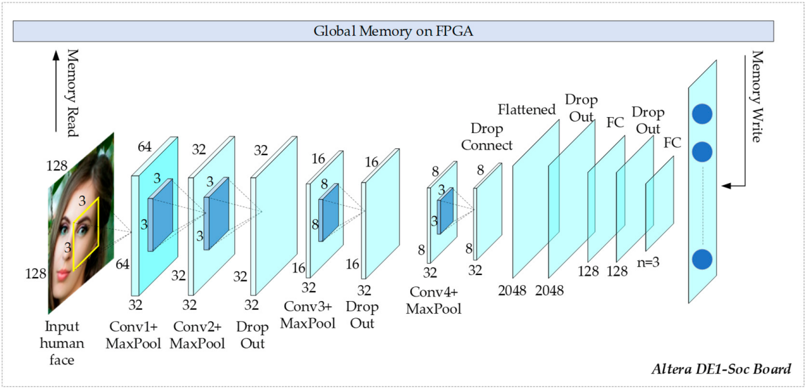
- A new DCNN proposal with twelve deep learning layers: four convolutional layers each followed by max-pooling, dropout layers, two fully connected layers, a drop-connect layer, a flattening layer, and a SoftMax output layer; input images are 128 × 128 × 3 with 3 × 3 patches and stride 1.
- The dataset was collected from three countries and compared against four pre-trained CNN models—ResNet50, DenseNet, AlexNet, and GoogleNet—with the last four layers of each frozen; training used an Intel Core i7-10750H CPU, NVIDIA GeForce RTX 2070 GPU, and 16 GB RAM.
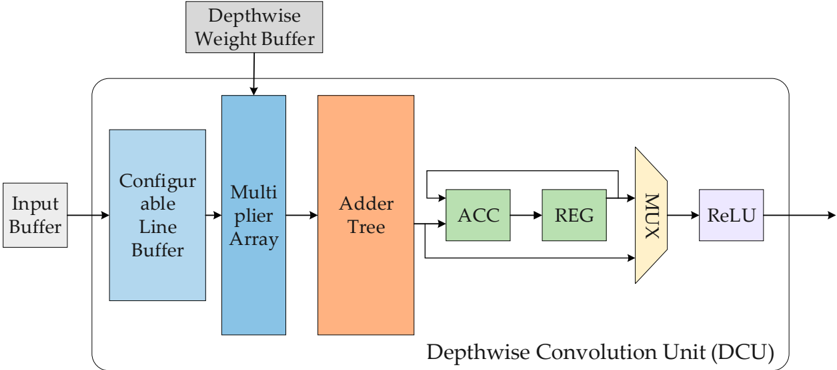
- FPGA acceleration used an FPGA DE1-SoC with a 64-computation array of 16-bit DSP; due to FPGA fabric limits, only 13 convolutional layers were employed. Evaluation included accuracy, F1, sensitivity, specificity, precision, false positive rate, execution time, power consumption, and DE1-SoC resource usage.
Limitations
- The paper states that a direct numerical comparison against all state-of-the-art methods was not feasible because several were trained and assessed on inaccessible private datasets.
- The paper states that only 13 convolutional layers were used because of the limits of FPGA fabrics on DE1-SoC.
- Evident from the text: the dataset is limited to 3,141 images from three national/ethnic groups (Chinese, Pakistani, Russian), and no cross-dataset or broader demographic validation is reported, so generalization to other ethnicities or conditions is untested.
Model-written summary. Check it against the paper before relying on it.
Integrity signals
Registry
Cites
Statistics
Figures











Verification
Claims the paper makes
7 Valid · 4 Not valid · 7 Not checked · 34 Own results and interpretations
A result the paper reports from its own data — it cites no other source for it, so there is none to check. The quote shows it is in the paper.
In the paper
“The reported results in Table 1 demonstrated the higher performance achieved by our method with an accuracy rate of 96.9 percent.”
- Also stated in: § 6. Conclusions and Future Works · plain
“The experimental results reported that our model outperformed all the methods of state-of-the-art, achieving an accuracy and F1 score value of 96.9 percent and 94.6 percent, respectively.”
§ Face Recognition Based on Deep Learning and FPGA for Ethnicity Identification > 5.3. A Preliminary Comparitive Analysis
boostedstates a cause- Asserted: passes — The authors put it forward as true.
- Checkable: passes — It can be checked against evidence.
- Load-bearing: passes — The paper’s conclusions depend on it.
- Based: passes — The paper gives a reason why it holds.
- Also stated in: § 6. Conclusions and Future Works · plain
A result the paper reports from its own data — it cites no other source for it, so there is none to check. The quote shows it is in the paper.
In the paper
“The accuracy and F1 score both reached a ratio rate of 96.9 percent and 94.6 percent, respectively.”
- Also stated in: § 6. Conclusions and Future Works · plain
“The experimental results reported that our model outperformed all the methods of state-of-the-art, achieving an accuracy and F1 score value of 96.9 percent and 94.6 percent, respectively.”
§ Face Recognition Based on Deep Learning and FPGA for Ethnicity Identification > 5.4. Comparison for the Pre-Trained CNNs
plain- Asserted: passes — The authors put it forward as true.
- Checkable: passes — It can be checked against evidence.
- Load-bearing: passes — The paper’s conclusions depend on it.
- Based: passes — The paper gives a reason why it holds.
- Also stated in: § 6. Conclusions and Future Works · plain
A result the paper reports from its own data — it cites no other source for it, so there is none to check. The quote shows it is in the paper.
In the paper
“Additionally, the ethnicity dataset was made publicly available as a novel contribution to this work.”
§ Face Recognition Based on Deep Learning and FPGA for Ethnicity Identification > Abstract
plain- Asserted: passes — The authors put it forward as true.
- Checkable: passes — It can be checked against evidence.
- Load-bearing: passes — The paper’s conclusions depend on it.
- Based: passes — The paper gives a reason why it holds.
A result the paper states — it cites no source for it, so there is none to check. The quote shows it is in the paper.
In the paper
“AlexNet offers the lowest power usage and execution time due to its basic design.”
§ Face Recognition Based on Deep Learning and FPGA for Ethnicity Identification > 5.4. Comparison for the Pre-Trained CNNs
plainstates a cause- Asserted: passes — The authors put it forward as true.
- Checkable: passes — It can be checked against evidence.
- Load-bearing: unclear — It is unclear whether the paper’s conclusions depend on it.
- Based: passes — The paper gives a reason why it holds.
A result the paper states — it cites no source for it, so there is none to check. The quote shows it is in the paper.
In the paper
“A network proposal was used to group the human face by its race, specifically from Chinese, Pakistani, and Russian citizens;”
§ Face Recognition Based on Deep Learning and FPGA for Ethnicity Identification > 1. Introduction
plainstates a cause- Asserted: passes — The authors put it forward as true.
- Checkable: passes — It can be checked against evidence.
- Load-bearing: passes — The paper’s conclusions depend on it.
- Based: passes — The paper gives a reason why it holds.
- Rests on 2 assumptions not shown here.
11 more claims
Create a free account to see all 52 claims and to verify the 3 references still open.
- It may state two separate claims as one. 19
- Probably not a substantial claim. 21
- The quote only partly states this claim. 1
Citations
Cites
Very Deep Convolutional Networks for Large-Scale Image Recognition
Simonyan, K., & Zisserman, A. (2014) · arXiv · doi:10.48550/arxiv.1409.1556 · Cited by 114,148
Fully convolutional networks for semantic segmentation
Long, J., Shelhamer, E., & Darrell, T. (2015) · 2015 IEEE Conference on Computer Vision and Pattern Recognition (CVPR) · doi:10.1109/cvpr.2015.7298965 · Cited by 38,834
Review of deep learning: concepts, CNN architectures, challenges, applications, future directions
Alzubaidi, L., Zhang, J., Humaidi, A. J., Al-Dujaili, A., Duan, Y., Al-Shamma, O., Santamaría, J., Fadhel, M. A., Al-Amidie, M., & Farhan, L. (2021) · Journal of Big Data · doi:10.1186/s40537-021-00444-8 · Cited by 7,906
Self-citationShin, H.-C., Roth, H. R., Gao, M., Lu, L., Xu, Z., Nogues, I., Yao, J., Mollura, D., & Summers, R. M. (2016) · IEEE Transactions on Medical Imaging · doi:10.1109/tmi.2016.2528162 · Cited by 5,759
Shin, H.-C., Roth, H. R., Gao, M., Lu, L., Xu, Z., Nogues, I., Yao, J.-H., Mollura, D., & Summers, R. (2016) · IEEE Transactions on Medical Imaging · doi:10.48550/arxiv.1602.03409 · Cited by 5,217
Efficient Processing of Deep Neural Networks: A Tutorial and Survey
Sze, V., Chen, Y.-H., Yang, T.-J., & Emer, J. S. (2017) · Proceedings of the IEEE · doi:10.1109/jproc.2017.2761740 · Cited by 4,215
Fully Convolutional Networks for Semantic Segmentation
Long, J., Shelhamer, E., & Darrell, T. J. (2014) · arXiv (Cornell University) · doi:10.48550/arxiv.1411.4038 · Cited by 2,489
A convolutional neural network cascade for face detection
Li, H., Lin, Z., Shen, X., Brandt, J., & Hua, G. (2015) · 2015 IEEE Conference on Computer Vision and Pattern Recognition (CVPR) · doi:10.1109/cvpr.2015.7299170 · Cited by 1,390
An improved deep learning architecture for person re-identification
Ahmed, E., Jones, M., & Marks, T. K. (2015) · 2015 IEEE Conference on Computer Vision and Pattern Recognition (CVPR) · doi:10.1109/cvpr.2015.7299016 · Cited by 1,248
Human activity recognition with smartphone sensors using deep learning neural networks
Ronao, C. A., & Cho, S.-B. (2016) · Expert Systems with Applications · doi:10.1016/j.eswa.2016.04.032 · Cited by 1,215
FINN: A Framework for Fast, Scalable Binarized Neural Network Inference
Umuroglu, Y., Fraser, N. J., Gambardella, G., Blott, M., Leong, P., Jahre, M., & Vissers, K. (2017) · Proceedings of the 2017 ACM/SIGDA International Symposium on Field-Programmable Gate Arrays · doi:10.1145/3020078.3021744 · Cited by 1,189
HCP: A Flexible CNN Framework for Multi-Label Image Classification
Wei, Y., Xia, W., Lin, M., Huang, J., Ni, B., Dong, J., Zhao, Y., & Yan, S. (2016) · IEEE Transactions on Pattern Analysis and Machine Intelligence · doi:10.1109/tpami.2015.2491929 · Cited by 784
CNN: Single-label to Multi-label
Wei, Y., Xia, W., Huang, J., Ni, B., Dong, J., Zhao, Y., & Yan, S. (2014) · arXiv · doi:10.48550/arxiv.1406.5726 · Cited by 784
An introduction to Deep Learning in Natural Language Processing: Models, techniques, and tools
Lauriola, I., Lavelli, A., & Aiolli, F. (2022) · Neurocomputing · doi:10.1016/j.neucom.2021.05.103 · Cited by 691
Deep Learning for Visual Tracking: A Comprehensive Survey
Marvasti-Zadeh, S. M., Cheng, L., Ghanei-Yakhdan, H., & Kasaei, S. (2022) · IEEE Transactions on Intelligent Transportation Systems · doi:10.1109/tits.2020.3046478 · Cited by 405
Cust, E. E., Sweeting, A. J., Ball, K., & Robertson, S. (2019) · Journal of Sports Sciences · doi:10.1080/02640414.2018.1521769 · Cited by 324
Novel Transfer Learning Approach for Medical Imaging with Limited Labeled Data
Alzubaidi, L., Al-Amidie, M., Al-Asadi, A., Humaidi, A. J., Al-Shamma, O., Fadhel, M. A., Zhang, J., Santamaría, J., & Duan, Y. (2021) · Cancers · doi:10.3390/cancers13071590 · Cited by 292
Self-citationTowards a Better Understanding of Transfer Learning for Medical Imaging: A Case Study
Alzubaidi, L., Fadhel, M. A., Al-Shamma, O., Zhang, J., Santamaría, J., Duan, Y., & R. Oleiwi, S. (2020) · Applied Sciences · doi:10.3390/app10134523 · Cited by 258
Self-citationToward Abnormal Trajectory and Event Detection in Video Surveillance
Cosar, S., Donatiello, G., Bogorny, V., Garate, C., Alvares, L. O., & Bremond, F. (2017) · IEEE Transactions on Circuits and Systems for Video Technology · doi:10.1109/tcsvt.2016.2589859 · Cited by 201
Paul, R., Hawkins, S., Balagurunathan, Y., Schabath, M., Gillies, R., Hall, L., & Goldgof, D. (2016) · Tomography · doi:10.18383/j.tom.2016.00211 · Cited by 181
Learning Race from Face: A Survey
Fu, S., He, H., & Hou, Z.-G. (2014) · IEEE Transactions on Pattern Analysis and Machine Intelligence · doi:10.1109/tpami.2014.2321570 · Cited by 178
Deep Convolutional Neural Networks for Human Activity Recognition with Smartphone Sensors
Ronao, C. A., & Cho, S.-B. (2015) · Lecture Notes in Computer Science · doi:10.1007/978-3-319-26561-2_6 · Cited by 176
Multi-channel spectrograms for speech processing applications using deep learning methods
Arias‐Vergara, T., Klumpp, P., Vásquez-Correa, J. C., Nöth, E., Orozco‐Arroyave, J. R., & Schuster, M. (2020) · Pattern Analysis and Applications · doi:10.1007/s10044-020-00921-5 · Cited by 126
A Survey of Convolutional Neural Networks on Edge with Reconfigurable Computing
Véstias, M. P. (2019) · Algorithms · doi:10.3390/a12080154 · Cited by 112
Deep neural network for halftone image classification based on sparse auto-encoder
Zhang, Y., Zhang, E., & Chen, W. (2016) · Engineering Applications of Artificial Intelligence · doi:10.1016/j.engappai.2016.01.032 · Cited by 108
Embedded Intelligence on FPGA: Survey, Applications and Challenges
Seng, K. P., Lee, P. J., & Ang, L. M. (2021) · Electronics · doi:10.3390/electronics10080895 · Cited by 105
Nasser, A. R., Hasan, A. M., Humaidi, A. J., Alkhayyat, A., Alzubaidi, L., Fadhel, M. A., Santamaría, J., & Duan, Y. (2021) · Electronics · doi:10.3390/electronics10212719 · Cited by 94
Self-citationDBCFace: Towards Pure Convolutional Neural Network Face Detection
Li, X. Y., Lai, S., & Qian, X. (2021) · IEEE Transactions on Circuits and Systems for Video Technology · doi:10.1109/tcsvt.2021.3082635 · Cited by 93
Alzubaidi, L., Duan, Y., Al-Dujaili, A. Q., Ibraheem, I. K., Alkenani, A. H., Santamaría, J., Fadhel, M. A., Al-Shamma, O., & Zhang, J. (2021) · PeerJ Computer Science · doi:10.7717/peerj-cs.715 · Cited by 73
Self-citationOn a taxonomy of facial features
Klare, B., & Jain, A. K. (2010) · 2010 Fourth IEEE International Conference on Biometrics: Theory, Applications and Systems (BTAS) · doi:10.1109/btas.2010.5634533 · Cited by 70
Robust application of new deep learning tools: an experimental study in medical imaging
Alzubaidi, L., Fadhel, M. A., Al-Shamma, O., Zhang, J., Santamaría, J., & Duan, Y. (2022) · Multimedia Tools and Applications · doi:10.1007/s11042-021-10942-9 · Cited by 68
Self-citationSmile detection in the wild with deep convolutional neural networks
Chen, J., Ou, Q., Chi, Z., & Fu, H. C. (2016) · Machine Vision and Applications · doi:10.1007/s00138-016-0817-z · Cited by 62
Race Recognition Using Deep Convolutional Neural Networks
Vo, T., Nguyen, T., & Le, C. T. (2018) · Symmetry · doi:10.3390/sym10110564 · Cited by 59
A Powerful Generative Model Using Random Weights for the Deep Image Representation
He, K., Wang, Y., & Hopcroft, J. (2016) · arXiv · doi:10.48550/arxiv.1606.04801 · Cited by 59
BlockSee: Blockchain for IoT Video Surveillance in Smart Cities
Gallo, P., Pongnumkul, S., & Quoc Nguyen, U. (2018) · 2018 IEEE International Conference on Environment and Electrical Engineering and 2018 IEEE Industrial and Commercial Power Systems Europe (EEEIC / I&CPS Europe) · doi:10.1109/eeeic.2018.8493895 · Cited by 55
Evaluating Impact of Race in Facial Recognition across Machine Learning and Deep Learning Algorithms
Coe, J., & Atay, M. (2021) · Computers · doi:10.3390/computers10090113 · Cited by 45
Efficient Processing of Deep Neural Networks: A Tutorial and SurveyPreprint
Sze, V., Chen, Y., Yang, T.-J., & Emer, J. (2017) · arXiv (Cornell University) · doi:10.48550/arxiv.1703.09039 · Cited by 45
SVAS: Surveillance Video Analysis System
Kardas, K., & Cicekli, N. K. (2017) · Expert Systems with Applications · doi:10.1016/j.eswa.2017.07.051 · Cited by 40
Regression-based methods for face alignment: A survey
Gogić, I., Ahlberg, J., & Pandzic, I. S. (2020) · Signal Processing · doi:10.1016/j.sigpro.2020.107755 · Cited by 37
An efficient three-dimensional face recognition system based random forest and geodesic curves
Nassih, B., Amine, A., Ngadi, M., Azdoud, Y., Naji, D., & Hmina, N. (2021) · Computational Geometry · doi:10.1016/j.comgeo.2021.101758 · Cited by 31
Boosting Convolutional Neural Networks Performance Based on FPGA Accelerator
Al-Shamma, O., Fadhel, M. A., Hameed, R. A., Alzubaidi, L., & Zhang, J. (2020) · Advances in Intelligent Systems and Computing · doi:10.1007/978-3-030-16657-1_47 · Cited by 27
Self-citationRecognizing Human Races through Machine Learning—A Multi-Network, Multi-Features Study
Darabant, A. S., Borza, D., & Danescu, R. (2021) · Mathematics · doi:10.3390/math9020195 · Cited by 24
Face alignment using a deep neural network with local feature learning and recurrent regression
Park, B.-H., Oh, S., & Kim, I.-J. (2017) · Expert Systems with Applications · doi:10.1016/j.eswa.2017.07.018 · Cited by 23
Identifying Ethnics of People through Face Recognition: A Deep CNN Approach
AlBdairi, A. J. A., Xiao, Z., & Alghaili, M. (2020) · Scientific Programming · doi:10.1155/2020/6385281 · Cited by 22
Self-citationConsidering Race a Problem of Transfer Learning
Khan, A., & Mahmoud, M. (2019) · 2019 IEEE Winter Applications of Computer Vision Workshops (WACVW) · doi:10.1109/wacvw.2019.00022 · Cited by 12
Comparison of hybrid convolutional neural networks models for diabetic foot ulcer classification
Alzubaidi, L., Abbood, A. A., Fadhel, M. A., Al-Shamma, O., & Zhang, J. (2021) · QUT ePrints (Queensland University of Technology) · Cited by 12
Self-citationAl-Yassin, H., Mousa, J. I., Fadhel, M. A., Al-Shamma, O., & Alzubaidi, L. (2020) · Indonesian Journal of Electrical Engineering and Computer Science · doi:10.11591/ijeecs.v18.i2.pp979-986 · Cited by 9
Self-citationUsing Stochastic Computing for Virtual Screening Acceleration
Frasser, C. F., de Benito, C., Skibinsky-Gitlin, E. S., Canals, V., Font-Rosselló, J., Roca, M., Ballester, P. J., & Rosselló, J. L. (2021) · Electronics · doi:10.3390/electronics10232981 · Cited by 3
Considering Race a Problem of Transfer LearningPreprint
Khan, A., & Mahmoud, M. (2018) · arXiv (Cornell University) · doi:10.17863/cam.38482
Cited by
Alzubaidi, L., Bai, J., Al-Sabaawi, A., Santamaría, J., Albahri, A. S., Al-dabbagh, B. S. N., Fadhel, M. A., Manoufali, M., Zhang, J., Al-Timemy, A. H., et al. (2023) · Journal of Big Data · doi:10.1186/s40537-023-00727-2 · Cited by 907
Self-citationA Novel Deep Learning Approach for Deepfake Image Detection
Raza, A., Munir, K., & Almutairi, M. (2022) · Applied Sciences · doi:10.3390/app12199820 · Cited by 220
Quantum convolutional neural network based on variational quantum circuits
Gong, L.-H., Pei, J.-J., Zhang, T.-F., & Zhou, N.-R. (2024) · Optics Communications · doi:10.1016/j.optcom.2023.129993 · Cited by 165
Zhu, X., Liu, Z., Cambria, E., Yu, X., Fan, X., Chen, H., & Wang, R. (2024) · Computer Methods and Programs in Biomedicine · doi:10.1016/j.cmpb.2024.108564 · Cited by 159
Alzubaidi, L., Al-Dulaimi, K., Salhi, A., Alammar, Z., Fadhel, M. A., Albahri, A. S., Alamoodi, A. H., Albahri, O. S., Hasan, A. F., Bai, J., et al. (2024) · Artificial Intelligence in Medicine · doi:10.1016/j.artmed.2024.102935 · Cited by 84
Self-citation
Metadata
- Authors
- AlBdairi, A. J. A., Xiao, Z., Alkhayyat, A., Humaidi, A. J., Fadhel, M. A., Taher, B. H., Alzubaidi, L., Santamaría, J., & Al-Shamma, O.
- Affiliations
- Hunan University (CN)
- Islamic University of Najaf (IQ)
- University of Technology - Iraq (IQ)
- University of Sumer (IQ)
- Queensland University of Technology (AU)
- Universidad de Jaén (ES)
- University of Information Technology and Communications (IQ)
- Corresponding author
- Alzubaidi, Laith
- Santamaría, José
- ORCID
- Venue
- Applied Sciences
- Publisher
- MDPI AG
- Published
- 2022-03-02
- Volume
- 12
- Issue
- 5
- Pages
- 2605
- ISSN
- 2076-3417 (ISSN-L)
- OpenAlex
- W4214813523
- Cited by
- 54
- References
- 45
- Citations by year
- 2026: 10 · 2025: 8 · 2024: 15 · 2023: 14 · 2022: 7
- FWCI
- 3.60
- Type
- journal article
- Language
- en
- Open access
- gold
- doi.org
- Licence
- Locations
- Applied Sciences (publishedVersion, cc-by)
- QUT ePrints (Queensland University of Technology) (submittedVersion, cc-by)
- DOAJ (DOAJ: Directory of Open Access Journals) (submittedVersion, cc-by-sa)
- Topics
- Physical Sciences › Computer Science › Computer Vision and Pattern Recognition › Face recognition and analysis
- Physical Sciences › Computer Science › Computer Vision and Pattern Recognition › Advanced Neural Network Applications
- Physical Sciences › Computer Science › Computer Vision and Pattern Recognition › Face and Expression Recognition
- Keywords
- face recognition, deep convolutional neural networks, FPGA acceleration, GPU comparison, facial features, energy efficiency, hardware resource utilization
About these checks
Registry, retraction, Cites and statistics results are computed, not judged, with one exception: a printed reference that no index lists is read once by a model before it counts as a citation error. Claims are extracted by a model and kept only when their quote appears verbatim in the text; each cited source is then checked, with a model’s help, for whether it says what the claim relies on. Those verdicts can be wrong — read the claim’s quote and the cited source before relying on one.
The claim verdicts this report counts are experimental: their accuracy is not yet measured.
A language model drew the claims from the paper on 2026-10-10, under version 3 of the claim definition (model deepseek-v4.1-flash, prompt extract-v3).
A second model labelled each claim on 2026-10-10 (model jev-1.13-20260917, definition revision gold-guideline-v0.2).
Statistics and arithmetic are recomputed, not judged.
Confidence bands are shown only for fields calibrated on our annotated test set. None is calibrated yet, so no band is shown.
What counts as a claim ›How we measure confidence ›How we check this ›
Are you an author, or do you see a problem with this page? Request a review
Data sources
Bibliographic data: Semantic Scholar, OpenAlex, Crossref.
Contains information from the Semantic Scholar Academic Graph Datasets, made available under the ODC Attribution License (ODC-BY 1.0).
Semantic Scholar’s data is described in: Kinney, R., et al. (2023). The Semantic Scholar Open Data Platform. arXiv:2301.10140.
