

The Relationship between Physical Activity, Physical Exercise, and Human Gut Microbiota in Healthy and Unhealthy Subjects: A Systematic Review
Open accessThe DOI matches its Crossref record; 104 of the 104 references it cites were found in a registry or an index.
Abstract
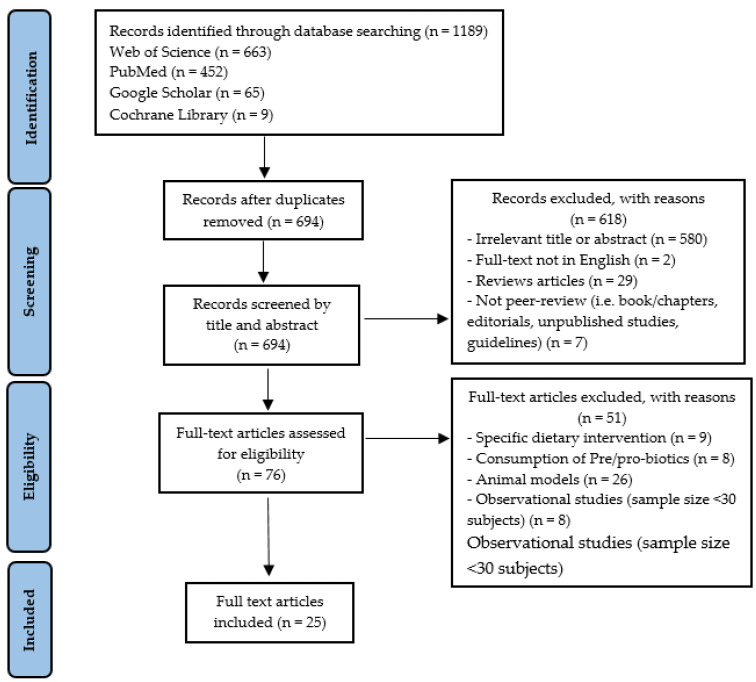
Several studies have been conducted to find at least an association between physical activity (PA)/ physical exercise (PE) and the possibility to modulate the gut microbiome (GM). However, the specific effects produced on the human GM by different types of PA/PE, different training modalities, and their age-related effects are not yet fully understood. Therefore, this systematic review aims to evaluate and summarize the current scientific evidence investigating the bi-directional relationship between PA/PE and the human GM, with a specific focus on the different types/variables of PA/PE and age-related effects, in healthy and unhealthy people. A systematic search was conducted across four databases (Web of Science, Medline (PubMed), Google Scholar, and Cochrane Library). Information was extracted using the populations, exposure, intervention, comparison, outcomes (PICOS) format. The Oxford Quality Scoring System Scale, the Risk of Bias in Non-Randomized Studies of Interventions (ROBINS-I) tool, and the JBI Critical Appraisal Checklist for Analytical Cross-Sectional Studies were used as a qualitative measure of the review. The protocol was registered in PROSPERO (code: CRD42022302725). The following data items were extracted: author, year of publication, study design, number and age of participants, type of PA/PE carried out, protocol/workload and diet assessment, duration of intervention, measurement tools used, and main outcomes. Two team authors reviewed 694 abstracts for inclusion and at the end of the screening process, only 76 full texts were analyzed. Lastly, only 25 research articles met the eligibility criteria. The synthesis of these findings suggests that GM diversity is associated with aerobic exercise contrary to resistance training; abundance of Prevotella genus seems to be correlated with training duration; no significant change in GM richness and diversity are detected when exercising according to the minimum dose recommended by the World Health Organizations; intense and prolonged PE can induce a higher abundance of pro-inflammatory bacteria; PA does not lead to significant GM α/β-diversity in elderly people (60+ years). The heterogeneity of the training parameters used in the studies, diet control, and different sequencing methods are the main confounders. Thus, this systematic review can provide an in-depth overview of the relationship between PA/PE and the human intestinal microbiota and, at the same time, provide indications from the athletic and health perspective.
Overview
The claims and statistics of this paper haven’t been checked yet.
Free: it reads the open-access text and checks the first 5 claims that cite a source we can check. Create a free account to check every claim.
Integrity signals
Registry
Cites
Statistics
Figures
Verification
Claims the paper makes
The claims and statistics of this paper haven’t been checked yet.
Free: it reads the open-access text and checks the first 5 claims that cite a source we can check. Create a free account to check every claim.
Claims other papers make about this one
Each is checked against this paper’s own text: does it say what the citing paper says it does?
The cited source says what the claim attributes to it.
In the citing paper
“it is plausible that lifestyle factors such as diet, physical activity or exposure to natural environments exert some type of regulation over probiotic effectiveness, given the well-documented effects these habits have on the microbiome [18,59,79,80].”
From Psychobiotic effects on anxiety are modulated by lifestyle behaviors: a randomized placebo-controlled trial on healthy adults (2023) · cites this paper as [79]
Self-check
Percentages, sums and reported differences re-computed from the paper’s own numbers.
The self-check needs the paper’s full text.
Citations
Cites
Preferred Reporting Items for Systematic Reviews and Meta-Analyses: the PRISMA statement
Moher, D., Liberati, A., Tetzlaff, J., Altman, D. G., & for the PRISMA Group (2009) · BMJ · doi:10.1136/bmj.b2535 · Cited by 83,823
Preferred Reporting Items for Systematic Reviews and Meta-Analyses: The PRISMA Statement
Moher, D., Liberati, A., Tetzlaff, J., & Altman, D. G. (2009) · Journal of Clinical Epidemiology · doi:10.1016/j.jclinepi.2009.06.005 · Cited by 19,575
Cryan, J. F., O'Riordan, K. J., Cowan, C. S. M., Sandhu, K. V., Bastiaanssen, T. F. S., Boehme, M., Codagnone, M. G., Cussotto, S., Fulling, C., Golubeva, A. V., et al. (2019) · Physiological Reviews · doi:10.1152/physrev.00018.2018 · Cited by 5,286 · cited 1×
“Moreover, increasing evidence shows that the complex bidirectional system of communication between the central and enteric nervous systems—named the gut–brain axis (GBA)—can be influenced by the human microbiota, which in this way acts as an emotional and behavioral modulator [9].”
BackgroundExercise and Physical Activity for Older Adults
Chodzko-Zajko, W. J., Proctor, D. N., Fiatarone Singh, M. A., Minson, C. T., Nigg, C. R., Salem, G. J., & Skinner, J. S. (2009) · Medicine & Science in Sports & Exercise · doi:10.1249/mss.0b013e3181a0c95c · Cited by 5,153
Cross-talk between Akkermansia muciniphila and intestinal epithelium controls diet-induced obesity
Everard, A., Belzer, C., Geurts, L., Ouwerkerk, J. P., Druart, C., Bindels, L. B., Guiot, Y., Derrien, M., Muccioli, G. G., Delzenne, N. M., et al. (2013) · Proceedings of the National Academy of Sciences · doi:10.1073/pnas.1219451110 · Cited by 4,511 · cited 2×
“Furthermore, abundance in the Akkermansiaceae family and genus Akkermansia has been found in athletes and the low BMI control group, which appears to be inversely correlated with obesity and associated metabolic disorders [48].”
BackgroundSokol, H., Pigneur, B., Watterlot, L., Lakhdari, O., Bermúdez-Humarán, L. G., Gratadoux, J.-J., Blugeon, S., Bridonneau, C., Furet, J.-P., Corthier, G., et al. (2008) · Proceedings of the National Academy of Sciences · doi:10.1073/pnas.0804812105 · Cited by 4,413
Parada Venegas, D., De la Fuente, M. K., Landskron, G., González, M. J., Quera, R., Dijkstra, G., Harmsen, H. J. M., Faber, K. N., & Hermoso, M. A. (2019) · Frontiers in Immunology · doi:10.3389/fimmu.2019.00277 · Cited by 3,820
The Treatment-Naive Microbiome in New-Onset Crohn’s Disease
Gevers, D., Kugathasan, S., Denson, L. A., Vázquez-Baeza, Y., Van Treuren, W., Ren, B., Schwager, E., Knights, D., Song, S. J., Yassour, M., et al. (2014) · Cell Host & Microbe · doi:10.1016/j.chom.2014.02.005 · Cited by 3,220 · cited 1×
“Athletes who engage in intense and prolonged PE show a particular composition of the microbiota, characterized by a higher abundance of bacteria involved in inflammatory processes, such as Haemophilus and Rothia genus [72], Mucispirillum [73,74], and Ruminococcus gnavus [75].”
BackgroundNewgard, C. B., An, J., Bain, J. R., Muehlbauer, M. J., Stevens, R. D., Lien, L. F., Haqq, A. M., Shah, S. H., Arlotto, M., Slentz, C. A., et al. (2009) · Cell Metabolism · doi:10.1016/j.cmet.2009.02.002 · Cited by 3,165
Human Genetics Shape the Gut Microbiome
Goodrich, J. K., Waters, J. L., Poole, A. C., Sutter, J. L., Koren, O., Blekhman, R., Beaumont, M., Van Treuren, W., Knight, R., Bell, J. T., et al. (2014) · Cell · doi:10.1016/j.cell.2014.09.053 · Cited by 3,164 · cited 1×
“[36], no changes in microbial diversity (α and β) were observed in elderly men (60+ years), only minor changes such as increased relative abundance of the genus Oscillospira, positively associated with leanness [100,101], and reduced C.”
Background
Research works printed but not linked: 1
- World Health Organization Global Recommendations on Physical Activity for Health WHO Library Cataloguing-in-Publication Data Geneva, Switzerland 2010 9789241599979 26180873
Cited by
How Diet and Physical Activity Modulate Gut Microbiota: Evidence, and Perspectives
Campaniello, D., Corbo, M. R., Sinigaglia, M., Speranza, B., Racioppo, A., Altieri, C., & Bevilacqua, A. (2022) · Nutrients · doi:10.3390/nu14122456 · Cited by 167
“production of immunoglobulins A (IgA) linked to the resistance to colonisation by specific microorganisms, (iii) increased production of SCFA, (iv) suppression of Toll-like receptor 4 (TLR4) signaling pathways, which can reduce serum lipopolysaccharides (LPS) levels; (v) release of myokines from muscle fiber cells, (v…”
BackgroundVarghese, S., Rao, S., Khattak, A., Zamir, F., & Chaari, A. (2024) · Nutrients · doi:10.3390/nu16213663 · Cited by 152
Physical activity induced alterations of gut microbiota in humans: a systematic review
Dziewiecka, H., Buttar, H. S., Kasperska, A., Ostapiuk–Karolczuk, J., Domagalska, M., Cichoń-Woźniak, J., & Skarpańska-Stejnborn, A. (2022) · BMC Sports Science Medicine and Rehabilitation · doi:10.1186/s13102-022-00513-2 · Cited by 168
“[20] excluded works without control groups, Clark et al.”
BackgroundAntioxidants and Sports Performance
Clemente‐Suárez, V. J., Bustamante-Sánchez, Á., Mielgo‐Ayuso, J., Martínez‐Guardado, I., Martín-Rodríguez, A., & Tornero-Aguilera, J. F. (2023) · Nutrients · doi:10.3390/nu15102371 · Cited by 163
You, Y., Chen, Y., Wei, M., Tang, M., Lu, Y., Zhang, Q., & Cao, Q. (2024) · Nutrients · doi:10.3390/nu16060777 · Cited by 107
“The gut–brain axis and its bidirectional communication between the gastrointestinal tract and the central nervous system would help to explain the modulation of inflammatory responses through this process [40,41].”
BackgroundEffects of exercise on gut microbiota of adults: a systematic review and meta-analysis
Min, L., Ablitip, A., Wang, R., Luciana, T., Wei, M., & Ma, X. (2024) · Nutrients · doi:10.3390/nu16071070 · Cited by 98
“…increasing production of intestinal immunoglobulin A, changes in the profile of bile acids, reducing serum lipopolysaccharide levels by suppressing Toll-like receptor 4 signaling pathways, and inducing hormetic effects of stress to stimulate beneficial adaptations of the intestinal barrier [43,44].”
BackgroundEffect of Intensity and Duration of Exercise on Gut Microbiota in Humans: A Systematic Review
Bonomini-Gnutzmann, R., Plaza‐Díaz, J., Jorquera-Aguilera, C., Rodríguez-Rodríguez, A., & Rodríguez‐Rodríguez, F. (2022) · International Journal of Environmental Research and Public Health · doi:10.3390/ijerph19159518 · Cited by 121
“However, moderate-low intensity training has also been indicated to produce limited gut microbiota changes, and higher intensity appears to be essential in provoking changes in obese and overweight subjects [50].”
BackgroundBoytar, A. N., Skinner, T. L., Wallen, R. E., Jenkins, D. G., & Nitert, M. D. (2023) · Nutrients · doi:10.3390/nu15061534 · Cited by 84
“More recent reviews have included cross-sectional studies (n = 25) [14], older adults only (n = 7) [15] or excluded those with clinical conditions and included cross-sectional studies (n = 38) [16].”
BackgroundHawley, J. A., Forster, S. C., & Giles, E. M. (2025) · Gastroenterology · doi:10.1053/j.gastro.2025.01.224 · Cited by 82
Major Depressive Disorder and Gut Microbiota: Role of Physical Exercise
de Souza, P. B., Borba, L. A., de Jesus, L. C., Valverde, A. P., Gil‐Mohapel, J., & Rodrigues, A. L. S. (2023) · International Journal of Molecular Sciences · doi:10.3390/ijms242316870 · Cited by 73
“Concerning the effects of physical exercise on the composition of the gut microbiota, several studies have consistently shown that exercise can improve microbial diversity [210,211].”
BackgroundCataldi, S., Poli, L., Şahin, F. N., Patti, A., Santacroce, L., Bianco, A., Greco, G., Ghinassi, B., Baldassarre, A. D., & Fischetti, F. (2022) · Nutrients · doi:10.3390/nu14163293 · Cited by 63
Self-citationMorales-Torres, R., Carrasco-Gubernatis, C., Grasso-Cladera, A., Cosmelli, D., Parada, F. J., & Palacios-García, I. (2023) · Nutrients · doi:10.3390/nu15071706 · Cited by 44
“As we previously hypothesized, it is plausible that lifestyle factors such as diet, physical activity or exposure to natural environments exert some type of regulation over probiotic effectiveness, given the well-documented effects these habits have on the microbiome [18,59,79,80].”
BackgroundIntestinal microbiome in normal ageing, frailty and cognition decline
Strasser, B., & Ticinesi, A. (2022) · Current Opinion in Clinical Nutrition & Metabolic Care · doi:10.1097/mco.0000000000000878 · Cited by 46
“A recent systematic review suggests that gutmicrobiota diversity is more pronounced with aerobic exercise in contrast to resistance training [72].”
BackgroundMohr, A. E., Mach, N., Pugh, J. N., Grosicki, G. J., Allen, J. M., Karl, J. P., & Whisner, C. M. (2025) · FEMS Microbiology Reviews · doi:10.1093/femsre/fuaf037 · Cited by 40
“Similarly, a growing body of research has shown that athletes and regularly active individuals harbor a more diverse GM with enhanced functional capacities than their sedentary counterparts [for in-depth reviews, see Mohr et al. ( 2020 ), Cataldi et al. ( 2022 ), and O’Brien et al. ( 2022 )].”
Yan, X., & He, B. (2025) · Frontiers in Microbiology · doi:10.3389/fmicb.2025.1695448 · Cited by 35
Linking Migraine to Gut Dysbiosis and Chronic Non-Communicable Diseases
Lauro, M. D., Guerriero, C., Cornali, K., Albanese, M., Costacurta, M., Mercuri, N. B., Daniele, N. D., & Noce, A. (2023) · Nutrients · doi:10.3390/nu15204327 · Cited by 25
“Physical activity increases the abundance of gut microbiota bacteria and improves its quality (Figure 4) [182].”
BackgroundThe relationship between the gut microbiome and resistance training: a rapid review
Wagner, A., Kapounková, K., & Struhár, I. (2024) · BMC Sports Science Medicine and Rehabilitation · doi:10.1186/s13102-023-00791-4 · Cited by 21
Hoseini, R., Rahim, H. A., Saifalddin, D. L., Kareem, D. A., & Fatah, A. M. (2025) · Journal of Translational Medicine · doi:10.1186/s12967-025-07492-1 · Cited by 23
“Moderate-intensity exercise has been shown to promote microbial diversity, strengthen intestinal barrier function, and exert anti-inflammatory effects, thereby supporting gut homeostasis [10].”
Exercise Interventions Improved Sleep Quality through Regulating Intestinal Microbiota Composition
Qiu, L., Gong, F., Wu, J., You, D., Zhao, Y., Xu, L., Cao, X., & Bao, F. (2022) · International Journal of Environmental Research and Public Health · doi:10.3390/ijerph191912385 · Cited by 25
“maintain a relatively stable level in adulthood [22,23], and low-intensity exercise may not necessarily lead to changes in the richness and diversity of the intestinal flora (alpha and/or beta diversity) [17].”
BackgroundEssential Factors for a Healthy Microbiome: A Scoping Review
Grace-Farfaglia, P., Frazier, H., & Iversen, M. D. (2022) · International Journal of Environmental Research and Public Health · doi:10.3390/ijerph19148361 · Cited by 20
“Physical activity and human gut microbiota in healthy and unhealthy subjects Observational and interventional studies 25 h ROBINS-I 8 studies scored 4–5 c Jadad Scale 4/5 studies: Moderate e JBI Critical Appraisal Checklist for Analytical Cross-Sectional Studies 12/12 Included No significant change in richness and div…”
BackgroundMethodRole of enteric dysbiosis in the development of central obesity: A review
Obayomi, O. V., Olaniran, A. F., Olawoyin, D. C., Falade, O. V., Osemwegie, O. O., & Owa, S. O. (2024) · Scientific African · doi:10.1016/j.sciaf.2024.e02204 · Cited by 22
Bianco, I., Ferrara, C., Romano, F., Loperfido, F., Sottotetti, F., Masri, D. E., Vincenti, A., Cena, H., & Giuseppe, R. D. (2024) · Biomedicines · doi:10.3390/biomedicines12112423 · Cited by 16
“For instance, a recent systematic review was conducted by Cataldi et al. [56] to explore the current scientific evidence investigating the relationship between PA/PE and gut microbiota shaping, focusing on the different types/variables of PA/PE and age-related effects, both in healthy and unhealthy…”
InfluentialGut microbiota and physical activity level: characterization from sedentary to soccer players
Petri, C., Mascherini, G., Izzicupo, P., Rosati, D., Cerboneschi, M., Smeazzetto, S., & Suarez-Arrones, L. J. (2024) · Biology of Sport · doi:10.5114/biolsport.2024.134759 · Cited by 18
“Therefore, the changes in the gut microbiota following physical exercise have yet to be definitively determined and fully understood but could depend on how the activity is practiced in terms of type, duration, intensity, and weekly frequency [16].”
BackgroundAtherosclerosis, gut microbiome, and exercise in a meta-omics perspective: a literature review
Tang, H., Huang, Y., Yuan, D., & Liu, J. (2024) · PeerJ · doi:10.7717/peerj.17185 · Cited by 15
Microbiome and physical activity
Álvarez‐Herms, J., & Odriozola, A. (2024) · Advances in genetics · doi:10.1016/bs.adgen.2024.01.002 · Cited by 13
Vandecruys, M., Smet, S. D., Beir, J. D., Renier, M., Leunis, S., Criekinge, H. V., Glorieux, G., Raes, J., Wyngaert, K. V., Nagler, E., et al. (2024) · Toxins · doi:10.3390/toxins16060242 · Cited by 10
“The World Health Organization’s minimal dose of PA, which is advised for persons aged 18 to 64, seems to cause some changes in the composition of the gut microbiome, but not significantly in terms of richness and diversity [37,38].”
BackgroundInfluentialThe Role of the Gut-Lung Axis in COVID-19 Infections and Its Modulation to Improve Clinical Outcomes
Chen, J., & Vitetta, L. (2022) · Frontiers in Bioscience-Scholar · doi:10.31083/j.fbs1403023 · Cited by 10
“Rather that intense and prolonged physical exercise can induce a higher abundance of pro-inflammatory bacteria and that physical activity does not lead to significant intestinal microbiome α / β -diversity in elderly populations (i.e., those 60+ years of age) [167].”
BackgroundInfluentialFrom Pregnancy to Breastfeeding: The Role of Maternal Exercise in Preventing Childhood Obesity
Calcaterra, V., Cena, H., Pirazzi, A., Sottotetti, F., Cordaro, E., Cavallo, C., Milanta, C., Masri, D. E., Conti, M. V., Vandoni, M., et al. (2025) · Nutrients · doi:10.3390/nu17040660 · Cited by 15
“Nonetheless, several studies have documented the positive effects of PA on gut microbiota, highlighting a rise in bacterial diversity and richness [90].”
Czerwińska‐Ledwig, O., Nowak-Zaleska, A., Żychowska, M., Meyza, K., Pałka, T., Dzidek, A., Szlachetka, A., Jurczyszyn, A. J., & Piotrowska, A. (2024) · Nutrients · doi:10.3390/nu17010061 · Cited by 9
Milia, M., Castangia, I., Corrias, F., Aroffu, M., Casula, M., Manca, M. L., Manconi, M., Bouakline, H., & Angioni, A. (2025) · Molecules · doi:10.3390/molecules30122581 · Cited by 8
Exercise as a modulator of gut microbiota for improvement of sleep quality: a narrative review
Zhao, B., Sun, J., Xiang, L., & Su, Z. (2025) · Frontiers in Neuroscience · doi:10.3389/fnins.2025.1639099 · Cited by 6
Gut Microbiome and its Role in the Development of Neurological Disorder (Schizophrenia)
Ameen, A., Akram, M. N., Farooq, S., Fatima, M., Raza, H., Naz, R., Aziz, U., Aziz, M., Tahir, S., & Hussain, A. (2023) · Pakistan Journal of Medical and Health Sciences · doi:10.53350/pjmhs2023175311 · Cited by 7
Impact of active lifestyle on the primary school children saliva microbiota composition
Mancini, A., Cerulli, C., Vitucci, D., Lasorsa, V. A., Parente, D., Credico, A. D., Orrù, S., Brustio, P. R., Lupo, C., Rainoldi, A., et al. (2023) · Frontiers in Nutrition · doi:10.3389/fnut.2023.1226891 · Cited by 4
Zheng, Y., Qu, Y., Yao, M., Li, K., Dong, Y., Xing, X., Yang, T., Guo, H., & Huang, P. (2025) · Frontiers in Microbiology · doi:10.3389/fmicb.2025.1721497 · Cited by 4
Effect of bedrest on the human gut and oral microbiome: implications for frailty
Alvaro-Fuss, M., DeClercq, V., Blodgett, J. M., Theou, O., Langille, M. G. I., & Beiko, R. G. (2026) · Experimental Gerontology · doi:10.1016/j.exger.2026.113079 · Cited by 6
Merelim, A. S., Zacca, R., Moreira‐Gonçalves, D., Costa, P., & Baptista, L. C. P. (2025) · Frontiers in Medicine · doi:10.3389/fmed.2025.1504786 · Cited by 3
“Despite these positive effects of exercise training on GM in young adults, the findings in older adults are less clear and conflicting, changes appear to be transient and reversible and to date, the effects of exercise training on GM in patients with sarcopenia remains unclear (21, 22).”
Dysfunction of the Gut Microbiome and its Onset Progression of Chronic and Mental Health Disorders
Ameen, A., Amir, A., Aziz, M. N., Irshad, A., Maryam, M., & Hayat, S. (2023) · Pakistan Journal of Medical and Health Sciences · doi:10.53350/pjmhs2023175425 · Cited by 4
Ibrahim, I., Ayariga, J. A., Xu, J., Boakai, R. K., & Ajayi, O. S. (2023) · Preprints.org · doi:10.20944/preprints202310.1337.v1 · Cited by 2
Álvarez‐Herms, J., Burtscher, M., Corbi, F., González, A., & Odriozola-Martínez, A. (2025) · Nutrients · doi:10.3390/nu17172836 · Cited by 4
“Thus, no previous studies have hypothesised on the possible bidirectional influence existing between endurance exercise and the GM-CNS axis, which modulates fatigue and unpleas-ant sensations [1,6].”
Mancini, A., Vitucci, D., Lasorsa, V. A., Lupo, C., Brustio, P. R., Capasso, M., Orrù, S., Rainoldi, A., Schena, F. F., & Buono, P. (2024) · Frontiers in Nutrition · doi:10.3389/fnut.2024.1465707 · Cited by 2
The skeleton in a physical world
Rubin, J. E., & Styner, M. (2022) · Experimental Biology and Medicine · doi:10.1177/15353702221113861 · Cited by 3
Kurinna, O. G., & Chernova, V. M. (2023) · Modern Gastroenterology · doi:10.30978/mg-2023-4-77 · Cited by 1
Peng, Z., Fuhai, F. A. N. G., Wang, Y., Chen, Y., Yang, K., Zhang, Y., Wang, W., Song, B., Zhang, W., Hou, X., et al. (2026) · Frontiers in Microbiology · doi:10.3389/fmicb.2026.1857703 · Cited by 1
“They are enriched in physically active individuals, and their abundance is positively correlated with training duration (Cataldi et al., 2022).”
Abbas, A., Weiskirchen, R., Bilal, M., Afzal, M. K., Malik, A., Akhtar, S., Khan, M., Rashid, I., Khalid, F., Akram, S., et al. (2026) · Pharmaceuticals · doi:10.3390/ph19081184 · Cited by 2
“Contemporary environmental and lifestyle factors, including the widespread consumption of ultra-processed foods [8], excessive antibiotic use [9], chronic psychological stress [10], and physical inactivity [11], have been implicated in the disruption of gut microbial homeostasis.”
МІКРОБІОТА ЛЮДЕЙ ТА ТВАРИН: ВПЛИВ ФІЗИЧНОЇ АКТИВНОСТІ ТА ДІЄТИ
Куйбіда, В., Lopatynska, V. V., & Коханець, П. (2022) · Scientia et societus · doi:10.31470/2786-6327/2022/2/108-117 · Cited by 2
Coadaptation mechanism of the gut microbiota and human organism to physical loading
Куйбіда, В., Коханець, П., & Lopatynska, V. V. (2023) · Regulatory Mechanisms in Biosystems · doi:10.15421/022332 · Cited by 5
Thomas, J., Filleron, T., Conte-Auriol, F., Laurens, C., & Pasquet, M. (2025) · BMC Cancer · doi:10.1186/s12885-025-14235-4 · Cited by 2
“Because exercise can modulate gut microbiota [41], we will study this dysbiosis in children undergoing anti-cancer treatment within our cohort using stool, saliva, and periodontal samples.”
Sports nutrology and gut microbiota: a systematic review
Diniz, L. V. L. (2023) · International Journal of Nutrology · doi:10.54448/ijn23109 · Cited by 1
Olvera-Ruiz, R., Moguel-Ancheita, R., Bazaldua, S. F., Lozoya-Morales, J. J., Ramos-Cházaro, E., Arce-Piña, L. A., Muñoz-Beltrán, L. G., Buenfil-Medina, J. C., Victoria-Nandayapa, J. R., Bautista-López, G. R., et al. (2023) · Cardiovascular and Metabolic Science · doi:10.35366/112762 · Cited by 1
Unraveling the Influence of Lifestyle Choices on Microbiota Diversity – A Comprehensive Review
Seredyński, T., Mądry, W., Mazurkiewicz, A., Kołodziej, M., Męczyńska, J., Saiuk, N., Kozicz, M. A., Wojciechowska, A., Marcicka, J., & Salasa, W. (2024) · Journal of Education Health and Sport · doi:10.12775/jehs.2024.66.012 · Cited by 1
Straume, Z., Krūmiņa, N., Elbere, I., Rozenberga, M., Blomniece, L., Erts, R., Rudzīte, D., Kloviņš, J., & Krūmiņa, A. (2024) · Proceedings of the Latvian Academy of Sciences Section B Natural Exact and Applied Sciences · doi:10.2478/prolas-2024-0037
“Marques et al . in 2022 reported that the most abundant phyla in the group using non-alcoholic beer and alcoholic beer were Firmicutes followed by Bacteroidetes and Actinobacteria (Marques et al ., 2022).”
InfluentialThe Bidirectional Role Between Gut Microbiota and Sports Performance
Gaspar, A. S. (2025) · IGI Global eBooks · doi:10.4018/979-8-3693-8699-6.ch002
Cross-Talk Between Physical Activity, Diet, Gut Microbiota and Skeletal Muscle
Zaboub, N. M., Bougherara, H., Boukhechem, S., della Malva, A., Albenzio, M., Boussena, S., Monnoye, M., Gérard, P., & Dib, A. L. (2025) · doi:10.3390/blsf2025049005
“Most of these microorganisms reside in the human gastrointestinal tract and are collectively referred to as the gut microbiota [1].”
Gasmi, M., van der Merwe, M., Hardiany, N. S., Zeb, F., Hejazi, M., & Muscella, A. (2025) · Nutrition and Health · doi:10.1177/02601060251395142
“Different forms of exercise modulate gut microbiota composition and diversity, with effects depending on the type, duration, intensity, and frequency (Cataldi et al., 2022; Ribeiro et al., 2019; Silva et al., 2022; Uchida et al., 2023).”
Shi, J., Nguyen, S. M., Yu, D., Wang, L., Liu, L., Cai, H., Wu, J., Long, J., Cai, Q., Shrubsole, M. J., et al. (2025) · Gut Microbes Reports · doi:10.1080/29933935.2025.2589861
“8,13,56 Further studies integrating metabolomics, lipidomics, intestinal transit time, and health or disease outcomes are needed to clarify the molecular and physiological mechanisms underlying our findings.”
Armah, J., Alzahid, S., Pei, Q., Cousin, L., Fanfan, D., Heldermon, C. D., & Lyon, D. (2026) · Oncoscience · doi:10.18632/oncoscience.651
Exercise reshapes gut microbiota function to enhance cancer therapy
Fang, W., Wu, Y., Yang, Z., Zheng, H., Tang, M., Xu, Y., Chen, R., Chen, L., & Ye, X. (2026) · Translational Oncology · doi:10.1016/j.tranon.2026.102772 · Cited by 1
“Aerobic endurance exercise primarily improves cardiorespiratory fitness and systemic metabolic efficiency, markedly reduces adiposity and inflammatory burden, and shows relatively consistent effects on increasing microbial diversity and activating beneficial metabolic pathways [30].”
Santarossa, S., Sitarik, A. R., Houck, F. L., Brawner, C. A., Johnson, C. C., Comstock, S. S., Lynch, S. V., van Wyk, P. M., Vundla, F., Schachtschneider, C., et al. (2026) · Frontiers in Cellular and Infection Microbiology · doi:10.3389/fcimb.2026.1747305
“In addition to these more established mechanisms, recent interest has emerged around the gut microbiome as a potentially important, but less-explored, pathway through which PA could in fl uence maternal and fetal health (Cerda et al., 2016; Campaniello et al., 2022; Cataldi et al., 2022).”
Salama, M. S. M. M., Elmasry, D. M., El-Moatasem, A. M., Zeyada, R., Abouelhassan, M. A. M., & Elnahas, N. G. M. (2026) · Advances in Rehabilitation · doi:10.2478/advrehab-2026-0005
Nowak-Misiąg, B., Pinkowicz, B., Myszor, I., Madej, M., Kubacka, M., Kocemba, L., Mroczka, G., Nycz-Jucha, S., Łobaza, P., & Rachwał, P. (2026) · International Journal of Innovative Technologies in Social Science · doi:10.31435/ijitss.2(50).2026.5217
The Impact of Diet and Physical Activity on the Human Gut Microbiota
Shang, X. (2026) · International Journal of Biology and Life Sciences · doi:10.54097/2ytefg31
“A higher intensity and duration are associated with a higher diversity in pro-inflammatory taxa [10].”
InfluentialBeneyto, R., López-Espinosa, M.-J., Francino, M. P., Vallejo-Ortega, J., Jiménez‐Hernández, N., Bustamante, M., Freire, C., González‐Palacios, S., Maître, L., Olivas-Martínez, A., et al. (2026) · medRxiv · doi:10.64898/2026.08.05.26358554
Du, Y., Wang, E., Leng, Y., Wang, Q., & Sun, J. (2026) · Cells · doi:10.3390/cells15171537
“An increased abundance of the genus Prevotella has also been reported in several previous studies investigating the relationship between physical activity and human gut microbiota [20,53].”
Merelim, A. S., dos Santos, A. P. S., Zacca, R., Moreira‐Gonçalves, D., Costa, P., & Baptista, L. C. P. (2026) · Sport Sciences for Health · doi:10.1007/s11332-026-01947-8
Ibrahim, I., Lawrence, K., Forte, O. A., Huitt, L., Naidu, N. C., Ajibola, N., Xu, J., Boakai, R. K., Akabanda, F., Owusu‐Kwarteng, J., et al. (2026) · Nutrients · doi:10.3390/nu18193168
“Diet, selected prebiotics or probiotics, and other interventions can modify community features; FMT should not be described as a general treatment for dysbiosis and is clinically established only for limited indications [26,95].”
Dietary, lifestyle, and host determinants of microbiota-host interactions
Astorga-Gaxiola, A. H., Sánchez-Magaña, L. M., León-López, L., Moreno, C. R., & Mora‐Rochín, S. (2026) · Frontiers in Microbiomes · doi:10.3389/frmbi.2026.1975060
“Thus, physical activity may modify speci fi c microbial pathways rather than induce a uniform metabolic pro fi le within an individualized host – diet – microbiota context (Campaniello et al., 2022; Cataldi et al., 2022).”
Hammou, H. A., Hakioui, I., Soulaimani, B., Nacir, O., Lairani, F. Z., Sofia, O., Krati, K., & Baz, S. E. (2026) · Bacteria · doi:10.3390/bacteria5040067
Romero, M., Mazzolani, B. C., Smaira, F. I., Sieczkowska, S. M., de Lima, A. P., Sales, G., Pinto, A. L. S., Lima, F. R., Roschel, H., Gualano, B., et al. (2026) · Lupus · doi:10.1177/09612033261496128
Metadata
- Authors
- Cataldi, S., Bonavolontà, V., Poli, L., Clemente, F. M., De Candia, M., Carvutto, R., Silva, A. F., Badicu, G., Greco, G., & Fischetti, F.
- Affiliations
- University of Bari Aldo Moro (IT)
- Department of Basic Medical Sciences, Neuroscience and Sense Organs, University of Study of Bari, 70124 Bari, Italy
- Universidade Politécnica de Viana do Castelo (PT)
- Department of Physical Education and Special Motricity, Transilvania University of Brasov, 500068 Brasov, Romania
- Corresponding author
- Greco, Gianpiero
- ORCID
- Venue
- Biology
- Publisher
- MDPI AG
- Published
- 2022-03-21
- Volume
- 11
- Issue
- 3
- Pages
- 479
- ISSN
- 2079-7737 (ISSN-L)
- PMC
- PMC8945171
- OpenAlex
- W4220715545
- Cited by
- 68
- References
- 104
- Citations by year
- 2026: 16 · 2025: 15 · 2024: 14 · 2023: 13 · 2022: 10
- FWCI
- 1.35
- Type
- journal article
- Language
- en
- Open access
- gold
- doi.org
- Licence
- Locations
- Biology (publishedVersion, cc-by)
- PubMed Central (publishedVersion, cc-by)
- PubMed (publishedVersion)
- Portuguese National Funding Agency for Science, Research and Technology (RCAAP Project by FCT) (submittedVersion, other-oa)
- CINECA IRIS Institutional Research Information System (University of Bari Aldo Moro) (submittedVersion, cc-by)
- Archivio Istituzionale della Ricerca - Università degli Studi dell Aquila (submittedVersion, cc-by)
- DOAJ (DOAJ: Directory of Open Access Journals) (submittedVersion)
- Funders
- Fundação para a Ciência e Tecnologia/ Ministério da Ciência, Tecnologia e Ensino Superior through national funds and when applicable co-funded EU funds (UIDB/50008/2020)
- Topics
- Life Sciences › Biochemistry, Genetics and Molecular Biology › Molecular Biology › Gut microbiota and health
- Health Sciences › Medicine › Public Health, Environmental and Occupational Health › Physical Activity and Health
- Life Sciences › Agricultural and Biological Sciences › Food Science › Probiotics and Fermented Foods
- Keywords
- physical activity, gut microbiota, aerobic exercise, resistance training, Prevotella, pro-inflammatory bacteria, microbiome diversity, training duration, older adults
About these checks
Registry, retraction, Cites and statistics results are computed, not judged, with one exception: a printed reference that no index lists is read once by a model before it counts as a citation error. Claims are extracted by a model and kept only when their quote appears verbatim in the text; each cited source is then checked, with a model’s help, for whether it says what the claim relies on. Those verdicts can be wrong — read the claim’s quote and the cited source before relying on one.
Statistics and arithmetic are recomputed, not judged.
Confidence bands are shown only for fields calibrated on our annotated test set. None is calibrated yet, so no band is shown.
What counts as a claim ›How we measure confidence ›How we check this ›
Are you an author, or do you see a problem with this page? Request a review
Data sources
Bibliographic data: Semantic Scholar, OpenAlex, Crossref.
Contains information from the Semantic Scholar Academic Graph Datasets, made available under the ODC Attribution License (ODC-BY 1.0).
Semantic Scholar’s data is described in: Kinney, R., et al. (2023). The Semantic Scholar Open Data Platform. arXiv:2301.10140.
