

The Relationship between Physical Activity, Physical Exercise, and Human Gut Microbiota in Healthy and Unhealthy Subjects: A Systematic Review
Open accessThe DOI matches its Crossref record; 104 of the 104 references it cites were found in a registry or an index.
Abstract
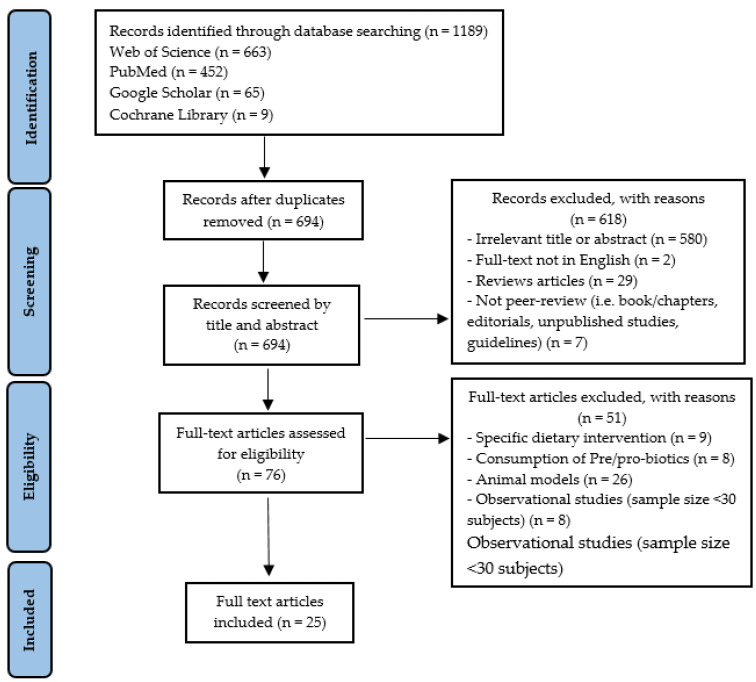
Several studies have been conducted to find at least an association between physical activity (PA)/ physical exercise (PE) and the possibility to modulate the gut microbiome (GM). However, the specific effects produced on the human GM by different types of PA/PE, different training modalities, and their age-related effects are not yet fully understood. Therefore, this systematic review aims to evaluate and summarize the current scientific evidence investigating the bi-directional relationship between PA/PE and the human GM, with a specific focus on the different types/variables of PA/PE and age-related effects, in healthy and unhealthy people. A systematic search was conducted across four databases (Web of Science, Medline (PubMed), Google Scholar, and Cochrane Library). Information was extracted using the populations, exposure, intervention, comparison, outcomes (PICOS) format. The Oxford Quality Scoring System Scale, the Risk of Bias in Non-Randomized Studies of Interventions (ROBINS-I) tool, and the JBI Critical Appraisal Checklist for Analytical Cross-Sectional Studies were used as a qualitative measure of the review. The protocol was registered in PROSPERO (code: CRD42022302725). The following data items were extracted: author, year of publication, study design, number and age of participants, type of PA/PE carried out, protocol/workload and diet assessment, duration of intervention, measurement tools used, and main outcomes. Two team authors reviewed 694 abstracts for inclusion and at the end of the screening process, only 76 full texts were analyzed. Lastly, only 25 research articles met the eligibility criteria. The synthesis of these findings suggests that GM diversity is associated with aerobic exercise contrary to resistance training; abundance of Prevotella genus seems to be correlated with training duration; no significant change in GM richness and diversity are detected when exercising according to the minimum dose recommended by the World Health Organizations; intense and prolonged PE can induce a higher abundance of pro-inflammatory bacteria; PA does not lead to significant GM α/β-diversity in elderly people (60+ years). The heterogeneity of the training parameters used in the studies, diet control, and different sequencing methods are the main confounders. Thus, this systematic review can provide an in-depth overview of the relationship between PA/PE and the human intestinal microbiota and, at the same time, provide indications from the athletic and health perspective.
Overview
The claims and statistics of this paper haven’t been checked yet.
Free: it reads the open-access text and checks the first 5 claims that cite a source we can check. Create a free account to check every claim.
Integrity signals
Registry
Cites
Statistics
Figures
Verification
Claims the paper makes
The claims and statistics of this paper haven’t been checked yet.
Free: it reads the open-access text and checks the first 5 claims that cite a source we can check. Create a free account to check every claim.
Claims other papers make about this one
Each is checked against this paper’s own text: does it say what the citing paper says it does?
The cited source says what the claim attributes to it.
In the citing paper
“it is plausible that lifestyle factors such as diet, physical activity or exposure to natural environments exert some type of regulation over probiotic effectiveness, given the well-documented effects these habits have on the microbiome [18,59,79,80].”
From Psychobiotic effects on anxiety are modulated by lifestyle behaviors: a randomized placebo-controlled trial on healthy adults (2023) · cites this paper as [79]
Self-check
Percentages, sums and reported differences re-computed from the paper’s own numbers.
The self-check needs the paper’s full text.
Citations
Cites
Preferred Reporting Items for Systematic Reviews and Meta-Analyses: the PRISMA statement
Moher, D., Liberati, A., Tetzlaff, J., Altman, D. G., & for the PRISMA Group (2009) · BMJ · doi:10.1136/bmj.b2535 · Cited by 83,823
Preferred Reporting Items for Systematic Reviews and Meta-Analyses: The PRISMA Statement
Moher, D., Liberati, A., Tetzlaff, J., & Altman, D. G. (2009) · Journal of Clinical Epidemiology · doi:10.1016/j.jclinepi.2009.06.005 · Cited by 19,575
Cryan, J. F., O'Riordan, K. J., Cowan, C. S. M., Sandhu, K. V., Bastiaanssen, T. F. S., Boehme, M., Codagnone, M. G., Cussotto, S., Fulling, C., Golubeva, A. V., et al. (2019) · Physiological Reviews · doi:10.1152/physrev.00018.2018 · Cited by 5,286 · cited 1×
“Moreover, increasing evidence shows that the complex bidirectional system of communication between the central and enteric nervous systems—named the gut–brain axis (GBA)—can be influenced by the human microbiota, which in this way acts as an emotional and behavioral modulator [9].”
BackgroundExercise and Physical Activity for Older Adults
Chodzko-Zajko, W. J., Proctor, D. N., Fiatarone Singh, M. A., Minson, C. T., Nigg, C. R., Salem, G. J., & Skinner, J. S. (2009) · Medicine & Science in Sports & Exercise · doi:10.1249/mss.0b013e3181a0c95c · Cited by 5,153
Cross-talk between Akkermansia muciniphila and intestinal epithelium controls diet-induced obesity
Everard, A., Belzer, C., Geurts, L., Ouwerkerk, J. P., Druart, C., Bindels, L. B., Guiot, Y., Derrien, M., Muccioli, G. G., Delzenne, N. M., et al. (2013) · Proceedings of the National Academy of Sciences · doi:10.1073/pnas.1219451110 · Cited by 4,511 · cited 2×
“Furthermore, abundance in the Akkermansiaceae family and genus Akkermansia has been found in athletes and the low BMI control group, which appears to be inversely correlated with obesity and associated metabolic disorders [48].”
BackgroundSokol, H., Pigneur, B., Watterlot, L., Lakhdari, O., Bermúdez-Humarán, L. G., Gratadoux, J.-J., Blugeon, S., Bridonneau, C., Furet, J.-P., Corthier, G., et al. (2008) · Proceedings of the National Academy of Sciences · doi:10.1073/pnas.0804812105 · Cited by 4,413
Parada Venegas, D., De la Fuente, M. K., Landskron, G., González, M. J., Quera, R., Dijkstra, G., Harmsen, H. J. M., Faber, K. N., & Hermoso, M. A. (2019) · Frontiers in Immunology · doi:10.3389/fimmu.2019.00277 · Cited by 3,820
The Treatment-Naive Microbiome in New-Onset Crohn’s Disease
Gevers, D., Kugathasan, S., Denson, L. A., Vázquez-Baeza, Y., Van Treuren, W., Ren, B., Schwager, E., Knights, D., Song, S. J., Yassour, M., et al. (2014) · Cell Host & Microbe · doi:10.1016/j.chom.2014.02.005 · Cited by 3,220 · cited 1×
“Athletes who engage in intense and prolonged PE show a particular composition of the microbiota, characterized by a higher abundance of bacteria involved in inflammatory processes, such as Haemophilus and Rothia genus [72], Mucispirillum [73,74], and Ruminococcus gnavus [75].”
BackgroundNewgard, C. B., An, J., Bain, J. R., Muehlbauer, M. J., Stevens, R. D., Lien, L. F., Haqq, A. M., Shah, S. H., Arlotto, M., Slentz, C. A., et al. (2009) · Cell Metabolism · doi:10.1016/j.cmet.2009.02.002 · Cited by 3,165
Human Genetics Shape the Gut Microbiome
Goodrich, J. K., Waters, J. L., Poole, A. C., Sutter, J. L., Koren, O., Blekhman, R., Beaumont, M., Van Treuren, W., Knight, R., Bell, J. T., et al. (2014) · Cell · doi:10.1016/j.cell.2014.09.053 · Cited by 3,164 · cited 1×
“[36], no changes in microbial diversity (α and β) were observed in elderly men (60+ years), only minor changes such as increased relative abundance of the genus Oscillospira, positively associated with leanness [100,101], and reduced C.”
BackgroundTurnbaugh, P. J., Bäckhed, F., Fulton, L., & Gordon, J. I. (2008) · Cell Host & Microbe · doi:10.1016/j.chom.2008.02.015 · Cited by 2,915 · cited 1×
“Abundance in the group of athletes was observed in some specific groups while at the phylum level the highest diversity was found in Firmicutes, particularly in the genus Faecalibacterium prausnitzii, producers of butyrate [54,55] and”
BackgroundMICROBIAL ECOLOGY OF THE GASTROINTESTINAL TRACT
Savage, D. C. (1977) · Annual Review of Microbiology · doi:10.1146/annurev.mi.31.100177.000543 · Cited by 2,436 · cited 1×
“The first studies on the human GM date back to about 40 years ago [10], but this remains a relatively young field of research where there are few certainties and much remains to be investigated.”
BackgroundMicrobial degradation of complex carbohydrates in the gut
Flint, H. J., Scott, K. P., Duncan, S. H., Louis, P., & Forano, E. (2012) · Gut Microbes · doi:10.4161/gmic.19897 · Cited by 2,331
Louis, P., & Flint, H. J. (2009) · FEMS Microbiology Letters · doi:10.1111/j.1574-6968.2009.01514.x · Cited by 2,179 · cited 1×
“Abundance in the group of athletes was observed in some specific groups while at the phylum level the highest diversity was found in Firmicutes, particularly in the genus Faecalibacterium prausnitzii, producers of butyrate [54,55] and”
BackgroundMachiels, K., Joossens, M., Sabino, J., De Preter, V., Arijs, I., Eeckhaut, V., Ballet, V., Claes, K., Van Immerseel, F., Verbeke, K., et al. (2014) · Gut · doi:10.1136/gutjnl-2013-304833 · Cited by 1,904 · cited 1×
“Among the most relevant in the reorganization that occurs during the transition from ACT to SED are the species Roseburia faecis and an unclassified species of Roseburia which are considered markers of good host health [64,67].”
BackgroundZhu, L., Baker, S. S., Gill, C., Liu, W., Alkhouri, R., Baker, R. D., & Gill, S. R. (2013) · Hepatology · doi:10.1002/hep.26093 · Cited by 1,708 · cited 1×
“the phylum Proteobacteria and an unidentified genus of Enterobacteriaceae associated with negative effects on host health was observed [49,50].”
BackgroundAlterations in Gut Microbiota of Patients With COVID-19 During Time of Hospitalization
Zuo, T., Zhang, F., Lui, G. C. Y., Yeoh, Y. K., Li, A. Y. L., Zhan, H., Wan, Y., Chung, A. C. K., Cheung, C. P., Chen, N., et al. (2020) · Gastroenterology · doi:10.1053/j.gastro.2020.05.048 · Cited by 1,537
Exercise and associated dietary extremes impact on gut microbial diversity
Clarke, S. F., Murphy, E. F., O'Sullivan, O., Lucey, A. J., Humphreys, M., Hogan, A., Hayes, P., O'Reilly, M., Jeffery, I. B., Wood-Martin, R., et al. (2014) · Gut · doi:10.1136/gutjnl-2013-306541 · Cited by 1,439 · cited 10×
“Several cross-sectional studies tried to evaluate the specific relationship between PA/PE and GM, one of the earliest studies done in humans [11] was conducted on professional rugby players during preseason training.”
BackgroundResultInfluentialPotential beneficial effects of butyrate in intestinal and extraintestinal diseases
Canani, R. B. (2011) · World Journal of Gastroenterology · doi:10.3748/wjg.v17.i12.1519 · Cited by 1,381
Yeoh, Y. K., Zuo, T., Lui, G. C.-Y., Zhang, F., Liu, Q., Li, A. Y., Chung, A. C., Cheung, C. P., Tso, E. Y., Fung, K. S., et al. (2021) · Gut · doi:10.1136/gutjnl-2020-323020 · Cited by 1,317
Alterations of the human gut microbiome in multiple sclerosis
Jangi, S., Gandhi, R., Cox, L. M., Li, N., von Glehn, F., Yan, R., Patel, B., Mazzola, M. A., Liu, S., Glanz, B. L., et al. (2016) · Nature Communications · doi:10.1038/ncomms12015 · Cited by 1,307 · cited 1×
“Finally, playing a key role in the transition from SED to ACT would appear to be some unclassified species of the genus Sutterella, recently associated with neurological disorders [69], conditions such as ulcerative colitis with impaired immune system function [70], as well as being identified as a typical driver in d…”
BackgroundUrsell, L. K., Metcalf, J. L., Parfrey, L. W., & Knight, R. (2012) · Nutrition Reviews · doi:10.1111/j.1753-4887.2012.00493.x · Cited by 1,255 · cited 1×
“Chronic diseases—such as obesity, metabolic syndrome, diabetes, atherosclerosis, liver dysfunction, and inflammatory bowel disease (IBD)—have been associated with alterations in the GM [8].”
BackgroundThe first 1000 cultured species of the human gastrointestinal microbiota
Rajilić-Stojanović, M., & de Vos, W. M. (2014) · FEMS Microbiology Reviews · doi:10.1111/1574-6976.12075 · Cited by 1,182
Interplay between lipids and branched-chain amino acids in development of insulin resistance
Newgard, C. B. (2012) · Cell Metabolism · doi:10.1016/j.cmet.2012.01.024 · Cited by 1,080
Estrogen–gut microbiome axis: Physiological and clinical implications
Baker, J. M., Al-Nakkash, L., & Herbst-Kralovetz, M. M. (2017) · Maturitas · doi:10.1016/j.maturitas.2017.06.025 · Cited by 993 · cited 1×
“Since hormonal set-up can affect GM composition [58], 40 premenopausal women were divided into two groups, active (ACT) and sedentary (SED).”
BackgroundThe gut microbiome: Relationships with disease and opportunities for therapy
Durack, J., & Lynch, S. V. (2019) · Journal of Experimental Medicine · doi:10.1084/jem.20180448 · Cited by 943 · cited 1×
“While this interaction has been studied extensively in diet-induced changes in the microbiota [5] and host disease processes [6,7], there has been little focus on other factors such as PA/PE.”
BackgroundMultiple sclerosis patients have a distinct gut microbiota compared to healthy controls
Chen, J., Chia, N., Kalari, K. R., Yao, J. Z., Novotna, M., Paz Soldan, M. M., Luckey, D. H., Marietta, E. V., Jeraldo, P. R., Chen, X., et al. (2016) · Scientific Reports · doi:10.1038/srep28484 · Cited by 933
Santacruz, A., Collado, M. C., García-Valdés, L., Segura, M. T., Martín-Lagos, J. A., Anjos, T., Martí-Romero, M., Lopez, R. M., Florido, J., Campoy, C., et al. (2010) · British Journal of Nutrition · doi:10.1017/s0007114510000176 · Cited by 868 · cited 1×
“Generally, bacterial species belonging to the genus Bacteroides can contribute to a reduction in metabolic dysfunction [99].”
BackgroundDisentangling Interactions in the Microbiome: A Network Perspective
Layeghifard, M., Hwang, D. M., & Guttman, D. S. (2017) · Trends in Microbiology · doi:10.1016/j.tim.2016.11.008 · Cited by 851 · cited 1×
“Within the bacterial network of ACT subjects, the Rikenellaceae and Erysipelotrichaceae families have been detected, whose role in humans, however, is still not entirely clear [11,68].”
BackgroundThe Human Microbiota in Health and Disease
Wang, B., Yao, M., Lv, L., Ling, Z., & Li, L. (2017) · Engineering · doi:10.1016/j.eng.2017.01.008 · Cited by 850 · cited 1×
“These microbes have developed a symbiotic relationship with our organism, as they are essential for our survival, and this is due to their ability to express a number of genes approximately 150 times greater than the entire human genome [2], which collectively are referred to as the microbiome.”
BackgroundGuinane, C. M., & Cotter, P. D. (2013) · Therapeutic Advances in Gastroenterology · doi:10.1177/1756283x13482996 · Cited by 846 · cited 1×
“Subjects with low aerobic fitness show a higher presence of Eubacterium rectale-Clostridium coccoides (EreC), associated with obesity and related metabolic disorders [47]; Enterobacteria; and a lower presence of Bacteroides.”
BackgroundExercise alters gut microbiota composition and function in lean and obese humans
ALLEN, J. M., MAILING, L. J., NIEMIRO, G. M., MOORE, R., COOK, M. D., WHITE, B. A., HOLSCHER, H. D., & WOODS, J. A. (2018) · Medicine & Science in Sports & Exercise · doi:10.1249/mss.0000000000001495 · Cited by 820 · cited 14×
“There appears to be also a relationship between VO2max and the Firmicutes:Bacteroidetes ratio [41], supporting what has been observed in previous studies [12,14,38] and suggesting that PE can induce favorable changes in the composition of the GM in healthy subjects.”
BackgroundResultInfluentialAlterations of the Gut Microbiota in Patients With Coronavirus Disease 2019 or H1N1 Influenza
Gu, S., Chen, Y., Wu, Z., Chen, Y., Gao, H., Lv, L., Guo, F., Zhang, X., Luo, R., Huang, C., et al. (2020) · Clinical Infectious Diseases · doi:10.1093/cid/ciaa709 · Cited by 788
Khan, I., Ullah, N., Zha, L., Bai, Y., Khan, A., Zhao, T., Che, T., & Zhang, C. (2019) · Pathogens · doi:10.3390/pathogens8030126 · Cited by 771 · cited 1×
“Athletes who engage in intense and prolonged PE show a particular composition of the microbiota, characterized by a higher abundance of bacteria involved in inflammatory processes, such as Haemophilus and Rothia genus [72], Mucispirillum [73,74], and Ruminococcus gnavus [75].”
BackgroundRoseburia Spp.: A Marker of Health?
Tamanai-Shacoori, Z., Smida, I., Bousarghin, L., Loreal, O., Meuric, V., Fong, S. B., Bonnaure-Mallet, M., & Jolivet-Gougeon, A. (2017) · Future Microbiology · doi:10.2217/fmb-2016-0130 · Cited by 746 · cited 1×
“Among the most relevant in the reorganization that occurs during the transition from ACT to SED are the species Roseburia faecis and an unclassified species of Roseburia which are considered markers of good host health [64,67].”
BackgroundMeehan, C. J., & Beiko, R. G. (2014) · Genome Biology and Evolution · doi:10.1093/gbe/evu050 · Cited by 715
A humanized gnotobiotic mouse model of host-archaeal-bacterial mutualism
Samuel, B. S., & Gordon, J. I. (2006) · Proceedings of the National Academy of Sciences · doi:10.1073/pnas.0602187103 · Cited by 674 · cited 1×
“smithii has been also detected in some professional cyclists [39], with an overproduction of genes involved in methane production, which would allow the microbial community to be more energy-efficient [51,52].”
BackgroundBarton, W., Penney, N. C., Cronin, O., Garcia-Perez, I., Molloy, M. G., Holmes, E., Shanahan, F., Cotter, P. D., & O'Sullivan, O. (2018) · Gut · doi:10.1136/gutjnl-2016-313627 · Cited by 647 · cited 7×
“works (n = 6) [11,37,39,40,43,45] investigated the effects produced on the GM following”
BackgroundMethodInfluentialEvans, C. C., LePard, K. J., Kwak, J. W., Stancukas, M. C., Laskowski, S., Dougherty, J., Moulton, L., Glawe, A., Wang, Y., Leone, V., et al. (2014) · PLoS ONE · doi:10.1371/journal.pone.0092193 · Cited by 587
Genomic and metabolic adaptations of Methanobrevibacter smithii to the human gut
Samuel, B. S., Hansen, E. E., Manchester, J. K., Coutinho, P. M., Henrissat, B., Fulton, R., Latreille, P., Kim, K., Wilson, R. K., & Gordon, J. I. (2007) · Proceedings of the National Academy of Sciences · doi:10.1073/pnas.0704189104 · Cited by 549 · cited 1×
“smithii has been also detected in some professional cyclists [39], with an overproduction of genes involved in methane production, which would allow the microbial community to be more energy-efficient [51,52].”
BackgroundIntestinal luminal nitrogen metabolism: Role of the gut microbiota and consequences for the host
Davila, A.-M., Blachier, F., Gotteland, M., Andriamihaja, M., Benetti, P.-H., Sanz, Y., & Tomé, D. (2013) · Pharmacological Research · doi:10.1016/j.phrs.2012.11.005 · Cited by 548
Mailing, L. J., Allen, J. M., Buford, T. W., Fields, C. J., & Woods, J. A. (2019) · Exercise and Sport Sciences Reviews · doi:10.1249/jes.0000000000000183 · Cited by 521 · cited 1×
“Several hypotheses are currently proposed: changes in the profile of bile acids, which may have an antimicrobial function and exert selective pressure on certain bacterial strains; suppression of TLR4 (Toll-like receptor 4) signaling pathways, which can reduce serum LPS levels; increased production of intestinal immun…”
BackgroundInfluentialDifferences in gut microbiota profile between women with active lifestyle and sedentary women
Bressa, C., Bailén-Andrino, M., Pérez-Santiago, J., González-Soltero, R., Pérez, M., Montalvo-Lominchar, M. G., Maté-Muñoz, J. L., Domínguez, R., Moreno, D., & Larrosa, M. (2017) · PLOS ONE · doi:10.1371/journal.pone.0171352 · Cited by 501 · cited 6×
“2017 [36] Cross-sectional n = 40 (F) active (ACT) (n = 19) and sedentary (SED) (n = 21) subjects, defined by WHO recommendations ACT: 30.”
BackgroundResultInfluentialSäemann, M. D., Böhmig, G. A., Österreicher, C. H., Burtscher, H., Parolini, O., Diakos, C., Stöckl, J., Hörl, W. H., & Zlabinger, G. J. (2000) · The FASEB Journal · doi:10.1096/fj.00-0359fje · Cited by 482
Estaki, M., Pither, J., Baumeister, P., Little, J. P., Gill, S. K., Ghosh, S., Ahmadi-Vand, Z., Marsden, K. R., & Gibson, D. L. (2016) · Microbiome · doi:10.1186/s40168-016-0189-7 · Cited by 476 · cited 7×
“There appears to be also a relationship between VO2max and the Firmicutes:Bacteroidetes ratio [41], supporting what has been observed in previous studies [12,14,38] and suggesting that PE can induce favorable changes in the composition of the GM in healthy subjects.”
BackgroundResultInfluentialThe Emerging Role of Branched-Chain Amino Acids in Insulin Resistance and Metabolism
Yoon, M.-S. (2016) · Nutrients · doi:10.3390/nu8070405 · Cited by 430
The aging gut microbiome and its impact on host immunity
Bosco, N., & Noti, M. (2021) · Genes & Immunity · doi:10.1038/s41435-021-00126-8 · Cited by 413
Gut Microbiome Fermentation Determines the Efficacy of Exercise for Diabetes Prevention
Liu, Y., Wang, Y., Ni, Y., Cheung, C. K. Y., Lam, K. S. L., Wang, Y., Xia, Z., Ye, D., Guo, J., Tse, M. A., et al. (2020) · Cell Metabolism · doi:10.1016/j.cmet.2019.11.001 · Cited by 405
Community characteristics of the gut microbiomes of competitive cyclists
Petersen, L. M., Bautista, E. J., Nguyen, H., Hanson, B. M., Chen, L., Lek, S. H., Sodergren, E., & Weinstock, G. M. (2017) · Microbiome · doi:10.1186/s40168-017-0320-4 · Cited by 377 · cited 7×
“works (n = 6) [11,37,39,40,43,45] investigated the effects produced on the GM following”
BackgroundMethodResultInfluentialA healthy gastrointestinal microbiome is dependent on dietary diversity
Heiman, M. L., & Greenway, F. L. (2016) · Molecular Metabolism · doi:10.1016/j.molmet.2016.02.005 · Cited by 370 · cited 1×
“Several studies [3,4] demonstrate that the gut microbiome is a mediator between many factors such as genetics, diet, exercise, and the external environment.”
BackgroundPolysaccharide degradation by the Bacteroidetes: mechanisms and nomenclature
McKee, L. S., La Rosa, S. L., Westereng, B., Eijsink, V. G., Pope, P. B., & Larsbrink, J. (2021) · Environmental Microbiology Reports · doi:10.1111/1758-2229.12980 · Cited by 369
Microbiota conservation and BMI signatures in adult monozygotic twins
Tims, S., Derom, C., Jonkers, D. M., Vlietinck, R., Saris, W. H., Kleerebezem, M., de Vos, W. M., & Zoetendal, E. G. (2013) · The ISME Journal · doi:10.1038/ismej.2012.146 · Cited by 367
Exercise Training Modulates Gut Microbiota Profile and Improves Endotoxemia
MOTIANI, K. K., COLLADO, M. C., ESKELINEN, J.-J., VIRTANEN, K. A., LÖYTTYNIEMI, E., SALMINEN, S., NUUTILA, P., KALLIOKOSKI, K. K., & HANNUKAINEN, J. C. (2020) · Medicine & Science in Sports & Exercise · doi:10.1249/mss.0000000000002112 · Cited by 333 · cited 4×
“, 2020 [26] Randomized controlled trial n = 26 (M/F) obese sedentary prediabetic/T2D, sprint interval training (n = 13) (SIT), moderate-intensity continuous training (n = 13) (MICT) 49 (±4) PE: aerobic SIT: 3×wk HIIT 30” exercise bouts (4-6) cycling (wingate protocol) 4′ recovery between bouts MICT: 40′–60′ 3×wk moder…”
BackgroundMethodInfluentialThe Microbiota and Microbiome in Aging: Potential Implications in Health and Age‐Related Diseases
Zapata, H. J., & Quagliarello, V. J. (2015) · Journal of the American Geriatrics Society · doi:10.1111/jgs.13310 · Cited by 279
West, C. E., Renz, H., Jenmalm, M. C., Kozyrskyj, A. L., Allen, K. J., Vuillermin, P., Prescott, S. L., MacKay, C., Salminen, S., Wong, G., et al. (2015) · Journal of Allergy and Clinical Immunology · doi:10.1016/j.jaci.2014.11.012 · Cited by 278 · cited 1×
“While this interaction has been studied extensively in diet-induced changes in the microbiota [5] and host disease processes [6,7], there has been little focus on other factors such as PA/PE.”
BackgroundShaw, K. A., Bertha, M., Hofmekler, T., Chopra, P., Vatanen, T., Srivatsa, A., Prince, J., Kumar, A., Sauer, C., Zwick, M. E., et al. (2016) · Genome Medicine · doi:10.1186/s13073-016-0331-y · Cited by 277 · cited 2×
“Chronic diseases—such as obesity, metabolic syndrome, diabetes, atherosclerosis, liver dysfunction, and inflammatory bowel disease (IBD)—have been associated with alterations in the GM [8].”
BackgroundDietary Fiber, Gut Microbiota, and Metabolic Regulation—Current Status in Human Randomized Trials
Myhrstad, M. C. W., Tunsjø, H., Charnock, C., & Telle-Hansen, V. H. (2020) · Nutrients · doi:10.3390/nu12030859 · Cited by 275 · cited 1×
“The amount of fiber intake was significantly higher in the ACT group than in the SED group which, in turn, consumed more processed meats, all of which may play a key role in shaping the gut microbiota [66].”
BackgroundThe effect of diet and exercise on intestinal integrity and microbial diversity in mice
Campbell, S. C., Wisniewski, P. J., Noji, M., McGuinness, L. R., Häggblom, M. M., Lightfoot, S. A., Joseph, L. B., & Kerkhof, L. J. (2016) · PLOS ONE · doi:10.1371/journal.pone.0150502 · Cited by 268 · cited 1×
“Furthermore, studies carried out first in animal samples [13], and later in humans [14], have highlighted the ability of PE to modify the composition and functionality of the microbiota independently of diet and body composition, thus in both lean and obese, as well as previously sedentary subjects.”
BackgroundVoluntary and forced exercise differentially alters the gut microbiome in C57BL/6J mice
Allen, J. M., Berg Miller, M. E., Pence, B. D., Whitlock, K., Nehra, V., Gaskins, H. R., White, B. A., Fryer, J. D., & Woods, J. A. (2015) · Journal of Applied Physiology · doi:10.1152/japplphysiol.01077.2014 · Cited by 266
Exercise influence on the microbiome–gut–brain axis
Dalton, A., Mermier, C., & Zuhl, M. (2019) · Gut Microbes · doi:10.1080/19490976.2018.1562268 · Cited by 251 · cited 1×
“Considering, moreover, the mutual influence that is established between the microbiota and the central nervous system, it is possible that PA/PE can somehow exert some effects even on that complex system previously mentioned and known as GBA; this is the conclusion reached by recent work [15] according to which the cu…”
BackgroundCerdá, B., Pérez, M., Pérez-Santiago, J. D., Tornero-Aguilera, J. F., González-Soltero, R., & Larrosa, M. (2016) · Frontiers in Physiology · doi:10.3389/fphys.2016.00051 · Cited by 247 · cited 1×
“Several hypotheses are currently proposed: changes in the profile of bile acids, which may have an antimicrobial function and exert selective pressure on certain bacterial strains; suppression of TLR4 (Toll-like receptor 4) signaling pathways, which can reduce serum LPS levels; increased production of intestinal immun…”
BackgroundInfluentialNgkelo, A., Meja, K., Yeadon, M., Adcock, I., & Kirkham, P. A. (2012) · Journal of Inflammation · doi:10.1186/1476-9255-9-1 · Cited by 238 · cited 1×
“Excessive PA/PE leads to stress that generates intestinal permeability [80], which results in the release of bacteria and products, such as lipopolysaccharides (LPS), recognized as toxic by the body, which triggers an inflammatory response [81,82].”
BackgroundMunukka, E., Ahtiainen, J. P., Puigbó, P., Jalkanen, S., Pahkala, K., Keskitalo, A., Kujala, U. M., Pietilä, S., Hollmén, M., Elo, L., et al. (2018) · Frontiers in Microbiology · doi:10.3389/fmicb.2018.02323 · Cited by 237 · cited 10×
“16S rRNA amplicon sequencing and metagenomics, in another one [32]; lastly, one study”
BackgroundMethodResultInfluentialLoy, A., Pfann, C., Steinberger, M., Hanson, B., Herp, S., Brugiroux, S., Gomes Neto, J. C., Boekschoten, M. V., Schwab, C., Urich, T., et al. (2017) · mSystems · doi:10.1128/msystems.00171-16 · Cited by 226
Quiroga, R., Nistal, E., Estébanez, B., Porras, D., Juárez-Fernández, M., Martínez-Flórez, S., García-Mediavilla, M. V., de Paz, J. A., González-Gallego, J., Sánchez-Campos, S., et al. (2020) · Experimental & Molecular Medicine · doi:10.1038/s12276-020-0459-0 · Cited by 215 · cited 10×
“…Yes Yes 5 Kern et al. (2020) [25] Yes Yes No Yes Yes 4 Motiani et al. (2020) [26] Yes Yes Yes Yes Yes 5 Liu et al. (2020) [27] Yes Yes No Yes Yes 4 Quiroga et al. (2020) [28] Yes Yes Yes Yes Yes 5 Resende et al. (2021) [29] Yes Yes Yes Yes Yes 5 Zhong et al. (2021) [30] Yes Yes Yes Yes Yes…”
BackgroundMethodResultInfluentialSutterella Species, IgA-degrading Bacteria in Ulcerative Colitis
Kaakoush, N. O. (2020) · Trends in Microbiology · doi:10.1016/j.tim.2020.02.018 · Cited by 204 · cited 1×
“Finally, playing a key role in the transition from SED to ACT would appear to be some unclassified species of the genus Sutterella, recently associated with neurological disorders [69], conditions such as ulcerative colitis with impaired immune system function [70], as well as being identified as a typical driver in d…”
BackgroundMörkl, S., Lackner, S., Müller, W., Gorkiewicz, G., Kashofer, K., Oberascher, A., Painold, A., Holl, A., Holzer, P., Meinitzer, A., et al. (2017) · International Journal of Eating Disorders · doi:10.1002/eat.22801 · Cited by 181 · cited 6×
“, 2017 [37] Cross-sectional n = 106 (F) Anorexia nervosa (AN) patients (n = 18), normal weight (NW) (n = 26), overweight (OW) (n = 22), obese (O) (n = 20) and athletes (AT) (n = 20) 24.”
BackgroundResultInfluentialMaynard, C., & Weinkove, D. (2018) · Sub-cellular biochemistry/Subcellular biochemistry · doi:10.1007/978-981-13-2835-0_12 · Cited by 177
Evolution of bacterial trp operons and their regulation
Merino, E., Jensen, R. A., & Yanofsky, C. (2008) · Current Opinion in Microbiology · doi:10.1016/j.mib.2008.02.005 · Cited by 172 · cited 1×
“coli and several bacterial taxa, such as Romboutsia, Ruminococcocaceae UCG-005, Blautia, Ruminiclostridium 9, and Clostridium phoceensis [45], which possess tryptophan synthesis machinery [53].”
BackgroundEcology and metabolism of the beneficial intestinal commensal bacterium Faecalibacterium prausnitzii
Miquel, S., Martín, R., Bridonneau, C., Robert, V., Sokol, H., Bermúdez-Humarán, L. G., Thomas, M., & Langella, P. (2014) · Gut Microbes · doi:10.4161/gmic.27651 · Cited by 170
Morita, E., Yokoyama, H., Imai, D., Takeda, R., Ota, A., Kawai, E., Hisada, T., Emoto, M., Suzuki, Y., & Okazaki, K. (2019) · Nutrients · doi:10.3390/nu11040868 · Cited by 169 · cited 7×
“, 2019 [33] Low Low Low Moderate Moderate Moderate Low Moderate”
BackgroundMethodResultInfluentialScheepers, L. E. J. M., Penders, J., Mbakwa, C. A., Thijs, C., Mommers, M., & Arts, I. C. W. (2015) · International Journal of Obesity · doi:10.1038/ijo.2014.178 · Cited by 162 · cited 1×
“the phylum Proteobacteria and an unidentified genus of Enterobacteriaceae associated with negative effects on host health was observed [49,50].”
BackgroundYücel, G., Zhao, Z., El-Battrawy, I., Lan, H., Lang, S., Li, X., Buljubasic, F., Zimmermann, W.-H., Cyganek, L., Utikal, J., et al. (2017) · Scientific Reports · doi:10.1038/s41598-017-03147-4 · Cited by 161 · cited 1×
“Excessive PA/PE leads to stress that generates intestinal permeability [80], which results in the release of bacteria and products, such as lipopolysaccharides (LPS), recognized as toxic by the body, which triggers an inflammatory response [81,82].”
BackgroundNewly Explored Faecalibacterium Diversity Is Connected to Age, Lifestyle, Geography, and Disease
De Filippis, F., Pasolli, E., & Ercolini, D. (2020) · Current Biology · doi:10.1016/j.cub.2020.09.063 · Cited by 161
Aya, V., Flórez, A., Perez, L., & Ramírez, J. D. (2021) · PLOS ONE · doi:10.1371/journal.pone.0247039 · Cited by 158 · cited 1×
“[46] focuses on this topic, considering healthy subjects aged 18–45 years.”
BackgroundInteractions between host genetics and gut microbiome in diabetes and metabolic syndrome
Ussar, S., Fujisaka, S., & Kahn, C. R. (2016) · Molecular Metabolism · doi:10.1016/j.molmet.2016.07.004 · Cited by 157 · cited 1×
“Several studies [3,4] demonstrate that the gut microbiome is a mediator between many factors such as genetics, diet, exercise, and the external environment.”
BackgroundGaike, A. H., Paul, D., Bhute, S. S., Dhotre, D. P., Pande, P., Upadhyaya, S., Reddy, Y. B. S., Sampath, R., Ghosh, D., Chandraprabha, D., et al. (2020) · mSystems · doi:10.1128/msystems.00578-19 · Cited by 156 · cited 1×
“Finally, playing a key role in the transition from SED to ACT would appear to be some unclassified species of the genus Sutterella, recently associated with neurological disorders [69], conditions such as ulcerative colitis with impaired immune system function [70], as well as being identified as a typical driver in d…”
BackgroundEffects of short‐term endurance exercise on gut microbiota in elderly men
Taniguchi, H., Tanisawa, K., Sun, X., Kubo, T., Hoshino, Y., Hosokawa, M., Takeyama, H., & Higuchi, M. (2018) · Physiological Reports · doi:10.14814/phy2.13935 · Cited by 137 · cited 6×
“Similarly [24], after 5 weeks of aerobic exercise, in agreement with Bressa et al.”
BackgroundResultInfluentialGetachew, B., Aubee, J. I., Schottenfeld, R. S., Csoka, A. B., Thompson, K. M., & Tizabi, Y. (2018) · BMC Microbiology · doi:10.1186/s12866-018-1373-7 · Cited by 134 · cited 1×
“Athletes who engage in intense and prolonged PE show a particular composition of the microbiota, characterized by a higher abundance of bacteria involved in inflammatory processes, such as Haemophilus and Rothia genus [72], Mucispirillum [73,74], and Ruminococcus gnavus [75].”
BackgroundDistinct microbiome composition and metabolome exists across subgroups of elite Irish athletes
O’Donovan, C. M., Madigan, S. M., Garcia-Perez, I., Rankin, A., O’ Sullivan, O., & Cotter, P. D. (2020) · Journal of Science and Medicine in Sport · doi:10.1016/j.jsams.2019.08.290 · Cited by 133 · cited 7×
“, 2021 [43] Cross-sectional n = 40 (M) endurance cross-country runners 35.”
BackgroundMethodInfluentialGut Microbiota Composition Is Related to Cardiorespiratory Fitness in Healthy Young Adults
Durk, R. P., Castillo, E., Márquez-Magaña, L., Grosicki, G. J., Bolter, N. D., Lee, C. M., & Bagley, J. R. (2019) · International Journal of Sport Nutrition and Exercise Metabolism · doi:10.1123/ijsnem.2018-0024 · Cited by 131 · cited 5×
“…Y Y Y Y N Y Y I Yang et al. (2017) [38] Y Y Y Y Y N Y Y I Petersen et al. (2017) [39] Y Y Y Y Y N Y Y I Barton et al. (2018) [40] Y Y Y Y N N Y Y I Durk et al. (2019) [41] Y Y Y Y N N Y Y I Langsemo et al. (2019) [42] Y Y Y Y Y N Y Y I O’Donovan et al. (2020) [43] Y Y Y Y N N Y Y I Castellanos et…”
BackgroundMethodResultInfluentialKern, T., Blond, M. B., Hansen, T. H., Rosenkilde, M., Quist, J. S., Gram, A. S., Ekstrøm, C. T., Hansen, T., & Stallknecht, B. (2020) · International Journal of Obesity · doi:10.1038/s41366-019-0440-y · Cited by 130 · cited 4×
“11) [12,14,25,26,29,34,36,38,41,42,44] regarded GM modifications following aerobic PA/PE,”
BackgroundMethodInfluentialMultiscale Evolutionary Dynamics of Host-Associated Microbiomes
Ferreiro, A., Crook, N., Gasparrini, A. J., & Dantas, G. (2018) · Cell · doi:10.1016/j.cell.2018.02.015 · Cited by 127 · cited 1×
“It is now well established that several microbial communities coexist with our organism; most of these—including bacteria, archaea, fungi, and even viruses—are hosted in the human gastrointestinal tract and, for this reason, they are generally referred to as the gut microbiota [1].”
BackgroundLee, S. A., Lim, J. Y., Kim, B.-S., Cho, S. J., Kim, N. Y., Kim, O. B., & Kim, Y. (2015) · Nutrition Research and Practice · doi:10.4162/nrp.2015.9.3.242 · Cited by 120 · cited 1×
“While this interaction has been studied extensively in diet-induced changes in the microbiota [5] and host disease processes [6,7], there has been little focus on other factors such as PA/PE.”
BackgroundReview on microbiota and effectiveness of probiotics use in older
Rondanelli, M. (2015) · World Journal of Clinical Cases · doi:10.12998/wjcc.v3.i2.156 · Cited by 115 · cited 1×
“Furthermore, when compared to young adult populations, elderly subjects show a reduction in the diversity of the microbiota, which is usually characterized by a large interindividual variability [98].”
BackgroundImpact of Different Exercise Modalities on the Human Gut Microbiome
Bycura, D., Santos, A. C., Shiffer, A., Kyman, S., Winfree, K., Sutliffe, J., Pearson, T., Sonderegger, D., Cope, E., & Caporaso, J. G. (2021) · Sports · doi:10.3390/sports9020014 · Cited by 106
Tabone, M., Bressa, C., García-Merino, J. A., Moreno-Pérez, D., Van, E. C., Castelli, F. A., Fenaille, F., & Larrosa, M. (2021) · Scientific Reports · doi:10.1038/s41598-021-82947-1 · Cited by 100 · cited 3×
“coli and several bacterial taxa, such as Romboutsia, Ruminococcocaceae UCG-005, Blautia, Ruminiclostridium 9, and Clostridium phoceensis [45], which possess tryptophan synthesis machinery [53].”
BackgroundRoberts, J., Suckling, C., Peedle, G., Murphy, J., Dawkins, T., & Roberts, M. (2016) · Nutrients · doi:10.3390/nu8110733 · Cited by 99 · cited 1×
“Excessive PA/PE leads to stress that generates intestinal permeability [80], which results in the release of bacteria and products, such as lipopolysaccharides (LPS), recognized as toxic by the body, which triggers an inflammatory response [81,82].”
BackgroundDo an Altered Gut Microbiota and an Associated Leaky Gut Affect COVID-19 Severity?
Kim, H. S. (2021) · mBio · doi:10.1128/mbio.03022-20 · Cited by 89
Cytokine response of human mononuclear cells induced by intestinal Clostridium species
Tuovinen, E., Keto, J., Nikkilä, J., Mättö, J., & Lähteenmäki, K. (2013) · Anaerobe · doi:10.1016/j.anaerobe.2012.11.002 · Cited by 75
Yang, Y., Shi, Y., Wiklund, P., Tan, X., Wu, N., Zhang, X., Tikkanen, O., Zhang, C., Munukka, E., & Cheng, S. (2017) · Nutrients · doi:10.3390/nu9080792 · Cited by 72 · cited 12×
“There appears to be also a relationship between VO2max and the Firmicutes:Bacteroidetes ratio [41], supporting what has been observed in previous studies [12,14,38] and suggesting that PE can induce favorable changes in the composition of the GM in healthy subjects.”
BackgroundMethodResultInfluentialRettedal, E. A., Cree, J. M. E., Adams, S. E., MacRae, C. L., Skidmore, P. M. L., Cameron‐Smith, D., Gant, N., Blenkiron, C., & Merry, T. L. (2020) · Experimental Physiology · doi:10.1113/ep088744 · Cited by 72 · cited 6×
“, 2020 [34] Low Low Low Low Low Low Low Low”
BackgroundInfluentialCastellanos, N., Diez, G. G., Antúnez-Almagro, C., Bailén, M., Bressa, C., González Soltero, R., Pérez, M., & Larrosa, M. (2020) · Frontiers in Microbiology · doi:10.3389/fmicb.2019.03142 · Cited by 69 · cited 5×
“, 2020 [44] Cross-sectional n = 109 (M/F) healthy subjects, active (n = 64) (ACT) and sedentary (n = 45) (SED), described by WHO recommendations ACT: 32.”
BackgroundInfluentialEffect of an 8-week Exercise Training on Gut Microbiota in Physically Inactive Older Women
Zhong, F., Wen, X., Yang, M., Lai, H.-Y., Momma, H., Cheng, L., Sun, X., Nagatomi, R., & Huang, C. (2021) · International Journal of Sports Medicine · doi:10.1055/a-1301-7011 · Cited by 66 · cited 12×
“↑ Prevotella, ↑ Verrucomicrobia, ↓ Proteobacteria abundance in the exercise group.”
BackgroundMethodResultInfluentialLangsetmo, L., Johnson, A., Demmer, R. T., Fino, N., Orwoll, E. S., Ensrud, K. E., Hoffman, A. R., Cauley, J. A., Shmagel, A., Meyer, K., et al. (2019) · The Journal of nutrition, health and aging · doi:10.1007/s12603-019-1194-x · Cited by 55 · cited 4×
“11) [12,14,25,26,29,34,36,38,41,42,44] regarded GM modifications following aerobic PA/PE,”
BackgroundInfluentialMoitinho‐Silva, L., Wegener, M., May, S., Schrinner, F., Akhtar, A., Boysen, T. J., Schaeffer, E., Hansen, C., Schmidt, T., Rühlemann, M. C., et al. (2021) · BMC Microbiology · doi:10.1186/s12866-021-02214-1 · Cited by 53 · cited 5×
“(n = 3) [31,33,35] separate interventions of resistance and aerobic exercises, lastly, further”
BackgroundMethodInfluentialThe Effects of BCAAs on Insulin Resistance in Athletes
Jian, S. H. O. U., Chen, P., & Xiao, W. (2019) · Journal of Nutritional Science and Vitaminology · doi:10.3177/jnsv.65.383 · Cited by 49
Intensive, prolonged exercise seemingly causes gut dysbiosis in female endurance runners
Morishima, S., Aoi, W., Kawamura, A., Kawase, T., Takagi, T., Naito, Y., Tsukahara, T., & Inoue, R. (2021) · Journal of Clinical Biochemistry and Nutrition · doi:10.3164/jcbn.20-131 · Cited by 48 · cited 1×
“Interestingly, a relative abundance of Faecalibacterium, a butyrateproducing bacterium usually known to be beneficial for human’s health [76–78], has been observed concomitantly with a high abundance of pro-inflammatory bacteria in female endurance runners whose abnormal gut environment can lead it to act like an oppo…”
BackgroundResende, A. S., Leite, G. S. F., & Lancha Junior, A. H. (2021) · Nutrients · doi:10.3390/nu13082839 · Cited by 44 · cited 6×
“A similar protocol was implemented through a randomized controlled trial with a 10-week moderate-intensity aerobic intervention [29].”
BackgroundMethodInfluentialHjorth, M. F., Christensen, L. H., Kjølbæk, L., Larsen, L. H., Roager, H. M., Kiilerich, P., Kristiansen, K., & Astrup, A. V. (2019) · European Journal of Clinical Nutrition · doi:10.1038/s41430-019-0466-1 · Cited by 42 · cited 1×
“Comparing lifetime elderly endurance athletes (LA) with healthy controls (CTRL) who met the American College of Sports Medicine (ACSM) recommendations on physical activity for older adults [102], no significant difference was observed in the GM diversity [103], a lower Bacteroidete:Prevotella ratio was detected in the…”
BackgroundSchlegel, P., Novotný, M., Klímová, B., & Vališ, M. (2019) · Journal of Alzheimer s Disease · doi:10.3233/jad-190460 · Cited by 41
Šoltýs, K., Lendvorský, L., Hric, I., Baranovičová, E., Penesová, A., Mikula, I., Böhmer, M., Budiš, J., Vávrová, S., Grones, J., et al. (2021) · Frontiers in Physiology · doi:10.3389/fphys.2021.670989 · Cited by 39 · cited 1×
“Comparing lifetime elderly endurance athletes (LA) with healthy controls (CTRL) who met the American College of Sports Medicine (ACSM) recommendations on physical activity for older adults [102], no significant difference was observed in the GM diversity [103], a lower Bacteroidete:Prevotella ratio was detected in the…”
BackgroundExercise improves metabolic function and alters the microbiome in rats with gestational diabetes
Mahizir, D., Briffa, J. F., Wood, J. L., Anevska, K., Hill‐Yardin, E. L., Jefferies, A. J., Gravina, S., Mazzarino, G., Franks, A. E., Moritz, K. M., et al. (2019) · The FASEB Journal · doi:10.1096/fj.201901424r · Cited by 32
Rosenkilde, M., Blond, M. B., Gram, A. S., Quist, J. S., Winther, J., Kamronn, S., Milling, D. H., Larsen, J. E., Jespersen, A. P., & Stallknecht, B. M. (2016) · Contemporary Clinical Trials · doi:10.1016/j.cct.2016.12.019 · Cited by 27 · cited 1×
“In a recent randomized controlled trial [25], using a specific training protocol called ACTIWE [90], changes in β-diversity were observed in both subjects performing intensive (VIG) or moderate-intensity (MOD) physical activity and a reduction in heterogeneity only in the VIG group.”
Method
Research works printed but not linked: 1
- World Health Organization Global Recommendations on Physical Activity for Health WHO Library Cataloguing-in-Publication Data Geneva, Switzerland 2010 9789241599979 26180873
Cited by
How Diet and Physical Activity Modulate Gut Microbiota: Evidence, and Perspectives
Campaniello, D., Corbo, M. R., Sinigaglia, M., Speranza, B., Racioppo, A., Altieri, C., & Bevilacqua, A. (2022) · Nutrients · doi:10.3390/nu14122456 · Cited by 167
“production of immunoglobulins A (IgA) linked to the resistance to colonisation by specific microorganisms, (iii) increased production of SCFA, (iv) suppression of Toll-like receptor 4 (TLR4) signaling pathways, which can reduce serum lipopolysaccharides (LPS) levels; (v) release of myokines from muscle fiber cells, (v…”
BackgroundVarghese, S., Rao, S., Khattak, A., Zamir, F., & Chaari, A. (2024) · Nutrients · doi:10.3390/nu16213663 · Cited by 152
Physical activity induced alterations of gut microbiota in humans: a systematic review
Dziewiecka, H., Buttar, H. S., Kasperska, A., Ostapiuk–Karolczuk, J., Domagalska, M., Cichoń-Woźniak, J., & Skarpańska-Stejnborn, A. (2022) · BMC Sports Science Medicine and Rehabilitation · doi:10.1186/s13102-022-00513-2 · Cited by 168
“[20] excluded works without control groups, Clark et al.”
BackgroundAntioxidants and Sports Performance
Clemente‐Suárez, V. J., Bustamante-Sánchez, Á., Mielgo‐Ayuso, J., Martínez‐Guardado, I., Martín-Rodríguez, A., & Tornero-Aguilera, J. F. (2023) · Nutrients · doi:10.3390/nu15102371 · Cited by 163
You, Y., Chen, Y., Wei, M., Tang, M., Lu, Y., Zhang, Q., & Cao, Q. (2024) · Nutrients · doi:10.3390/nu16060777 · Cited by 107
“The gut–brain axis and its bidirectional communication between the gastrointestinal tract and the central nervous system would help to explain the modulation of inflammatory responses through this process [40,41].”
Background
Metadata
- Authors
- Cataldi, S., Bonavolontà, V., Poli, L., Clemente, F. M., De Candia, M., Carvutto, R., Silva, A. F., Badicu, G., Greco, G., & Fischetti, F.
- Affiliations
- University of Bari Aldo Moro (IT)
- Department of Basic Medical Sciences, Neuroscience and Sense Organs, University of Study of Bari, 70124 Bari, Italy
- Universidade Politécnica de Viana do Castelo (PT)
- Department of Physical Education and Special Motricity, Transilvania University of Brasov, 500068 Brasov, Romania
- Corresponding author
- Greco, Gianpiero
- ORCID
- Venue
- Biology
- Publisher
- MDPI AG
- Published
- 2022-03-21
- Volume
- 11
- Issue
- 3
- Pages
- 479
- ISSN
- 2079-7737 (ISSN-L)
- PMC
- PMC8945171
- OpenAlex
- W4220715545
- Cited by
- 68
- References
- 104
- Citations by year
- 2026: 16 · 2025: 15 · 2024: 14 · 2023: 13 · 2022: 10
- FWCI
- 1.35
- Type
- journal article
- Language
- en
- Open access
- gold
- doi.org
- Licence
- Locations
- Biology (publishedVersion, cc-by)
- PubMed Central (publishedVersion, cc-by)
- PubMed (publishedVersion)
- Portuguese National Funding Agency for Science, Research and Technology (RCAAP Project by FCT) (submittedVersion, other-oa)
- CINECA IRIS Institutional Research Information System (University of Bari Aldo Moro) (submittedVersion, cc-by)
- Archivio Istituzionale della Ricerca - Università degli Studi dell Aquila (submittedVersion, cc-by)
- DOAJ (DOAJ: Directory of Open Access Journals) (submittedVersion)
- Funders
- Fundação para a Ciência e Tecnologia/ Ministério da Ciência, Tecnologia e Ensino Superior through national funds and when applicable co-funded EU funds (UIDB/50008/2020)
- Topics
- Life Sciences › Biochemistry, Genetics and Molecular Biology › Molecular Biology › Gut microbiota and health
- Health Sciences › Medicine › Public Health, Environmental and Occupational Health › Physical Activity and Health
- Life Sciences › Agricultural and Biological Sciences › Food Science › Probiotics and Fermented Foods
- Keywords
- physical activity, gut microbiota, aerobic exercise, resistance training, Prevotella, pro-inflammatory bacteria, microbiome diversity, training duration, older adults
About these checks
Registry, retraction, Cites and statistics results are computed, not judged, with one exception: a printed reference that no index lists is read once by a model before it counts as a citation error. Claims are extracted by a model and kept only when their quote appears verbatim in the text; each cited source is then checked, with a model’s help, for whether it says what the claim relies on. Those verdicts can be wrong — read the claim’s quote and the cited source before relying on one.
Statistics and arithmetic are recomputed, not judged.
Confidence bands are shown only for fields calibrated on our annotated test set. None is calibrated yet, so no band is shown.
What counts as a claim ›How we measure confidence ›How we check this ›
Are you an author, or do you see a problem with this page? Request a review
Data sources
Bibliographic data: Semantic Scholar, OpenAlex, Crossref.
Contains information from the Semantic Scholar Academic Graph Datasets, made available under the ODC Attribution License (ODC-BY 1.0).
Semantic Scholar’s data is described in: Kinney, R., et al. (2023). The Semantic Scholar Open Data Platform. arXiv:2301.10140.
