

The DOI matches its Crossref record; 213 of the 215 references it cites were found in a registry or an index.
Beyond the GFAP-Astrocyte Protein Markers in the Brain
Open accessAbstract
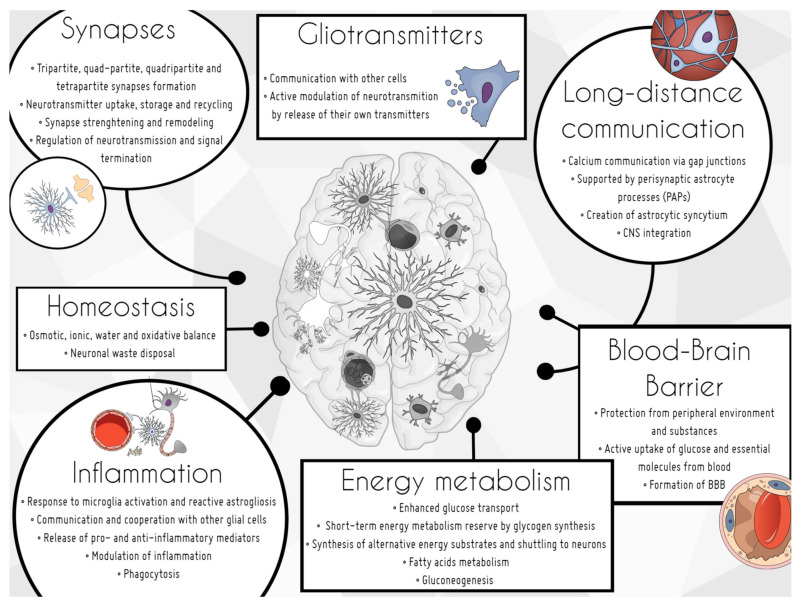
The idea of central nervous system as one-man band favoring neurons is long gone. Now we all are aware that neurons and neuroglia are team players and constant communication between those various cell types is essential to maintain functional efficiency and a quick response to danger. Here, we summarize and discuss known and new markers of astroglial multiple functions, their natural heterogeneity, cellular interactions, aging and disease-induced dysfunctions. This review is focused on newly reported facts regarding astrocytes, which are beyond the old stereotypes. We present an up-to-date list of marker proteins used to identify a broad spectrum of astroglial phenotypes related to the various physiological and pathological nervous system conditions. The aim of this review is to help choose markers that are well-tailored for specific needs of further experimental studies, precisely recognizing differential glial phenotypes, or for diagnostic purposes. We hope it will help to categorize the functional and structural diversity of the astroglial population and ease a clear readout of future experimental results.
Overview
The claims and statistics of this paper haven’t been checked yet.
Run the check — free, no account needed. It reads the open-access text and checks the sources it cites.
Integrity signals
Registry
Cites
Statistics
Figures
Verification
Claims the paper makes
The claims and statistics of this paper haven’t been checked yet.
Run the check — free, no account needed. It reads the open-access text and checks the sources it cites.
Claims other papers make about this one
Each is checked against this paper’s own text: does it say what the citing paper says it does?
The source backs part of the claim, not all of it — or backs it for a different population, condition or comparison.
In the citing paper
“Many of the genes whose expression increased the most with age are selectively expressed by astrocytes.49”
From Uncovering the signatures of aging and senescence in the human dorsolateral prefrontal cortex (2026) · cites this paper as [49]
Experimental — accuracy not yet measured
Self-check
Percentages, sums and reported differences re-computed from the paper’s own numbers.
The self-check needs the paper’s full text.
Citations
Cites
Glutamate neurotoxicity and diseases of the nervous system
Choi, D. W. (1988) · Neuron · doi:10.1016/0896-6273(88)90162-6 · Cited by 8,188
Neurotoxic reactive astrocytes are induced by activated microglia
Liddelow, S. A., Guttenplan, K. A., Clarke, L. E., Bennett, F. C., Bohlen, C. J., Schirmer, L., Bennett, M. L., Münch, A. E., Chung, W.-S., Peterson, T. C., et al. (2017) · Nature · doi:10.1038/nature21029 · Cited by 7,971
Astrocyte-endothelial interactions at the blood-brain barrier
Abbott, N. J., Rönnbäck, L., & Hansson, E. (2006) · Nature Reviews Neuroscience · doi:10.1038/nrn1824 · Cited by 5,595
Zhang, Y., Chen, K., Sloan, S. A., Bennett, M. L., Scholze, A. R., O'Keeffe, S., Phatnani, H. P., Guarnieri, P., Caneda, C., Ruderisch, N., et al. (2014) · The Journal of Neuroscience · doi:10.1523/jneurosci.1860-14.2014 · Cited by 4,875 · cited 1×
“Analysis of transcriptome demonstrated that PDK4 expression is 30 times higher in astrocytes than in neurons [56].”
BackgroundCahoy, J. D., Emery, B., Kaushal, A., Foo, L. C., Zamanian, J. L., Christopherson, K. S., Xing, Y., Lubischer, J. L., Krieg, P. A., Krupenko, S. A., et al. (2008) · The Journal of Neuroscience · doi:10.1523/jneurosci.4178-07.2008 · Cited by 3,129
Cell types in the mouse cortex and hippocampus revealed by single-cell RNA-seq
Zeisel, A., Muñoz-Manchado, A. B., Codeluppi, S., Lönnerberg, P., La Manno, G., Juréus, A., Marques, S., Munguba, H., He, L., Betsholtz, C., et al. (2015) · Science · doi:10.1126/science.aaa1934 · Cited by 3,124
Cellular Scaling Rules for the Brains of Marsupials: Not as “Primitive” as Expected
Santos, S. E. D., Porfírio, J., Cunha, F., Manger, P. R., Tavares, W. C., Pessôa, L. M., Raghanti, M. A., Sherwood, C. C., & Herculano‐Houzel, S. (2017) · Brain Behavior and Evolution · doi:10.1159/000452856 · Cited by 2,652
Single-cell transcriptomic analysis of Alzheimer’s disease
Mathys, H., Davila-Velderrain, J., Peng, Z., Gao, F., Mohammadi, S., Young, J. Z., Menon, M., He, L., Abdurrob, F., Jiang, X., et al. (2019) · Nature · doi:10.1038/s41586-019-1195-2 · Cited by 2,568
Reactive astrocyte nomenclature, definitions, and future directions
Escartin, C., Galea, E., Lakatos, A., O’Callaghan, J. P., Petzold, G. C., Serrano-Pozo, A., Steinhäuser, C., Volterra, A., Carmignoto, G., Agarwal, A., et al. (2021) · Nature Neuroscience · doi:10.1038/s41593-020-00783-4 · Cited by 2,513 · cited 3×
“Unfortunately, current knowledge does not allow proposing definitive categorization in this matter yet [97,101].”
BackgroundGenomic analysis of reactive astrogliosis
Zamanian, J. L., Xu, L., Foo, L. C., Nouri, N., Zhou, L., Giffard, R. G., & Barres, B. A. (2012) · The Journal of Neuroscience · doi:10.1523/jneurosci.6221-11.2012 · Cited by 2,404
Cited by
Sorted by citations
Items 301–321 of 321
Wang, J., Wang, L., Jiang, W., Zhu, L., & Li, H. (2026) · Translational Neuroscience · doi:10.1515/tnsci-2025-0398
MicroRNA-148a regulates depressive-like behaviors in mice via the Otx2/Dopaminergic signaling axis
Tang, Y., Feng, H., Li, Y., Zhang, L., Qu, C., Zhu, T., Zhang, D., Wen, Y., Zeng, X., Zhang, Y., et al. (2026) · Molecular Psychiatry · doi:10.1038/s41380-026-03785-z
Salim, M. W., Zhang, W., Collins‐Praino, L. E., Care, A., & Wang, Y. (2026) · Advanced NanoBiomed Research · doi:10.1002/anbr.202500304
Cell Lines and Culture Systems
Badal, S. (2026) · Springer eBooks · doi:10.1007/978-3-032-28873-8_4
Erhart, D. K., Fazeli, B., Bachhuber, F., Soylu, Ö., Şenel, M., Lewerenz, J., Otto, M., Halbgebauer, S., & Tumani, H. (2026) · Neurobiology of Disease · doi:10.1016/j.nbd.2026.107565
Welty, S., Bagnell, M., Ma, F., Herrup, K., & Levine, A. S. (2026) · Journal of Alzheimer s Disease · doi:10.1177/13872877261476036
Human Stem Cell-Derived Models of the Alzheimer’s Disease Neuroimmune System
Summers, R., Quang, D., & Johnson, N. R. (2026) · International Journal of Molecular Sciences · doi:10.3390/ijms27167360 · Cited by 1
Chmielewski, G., Mikiewicz, M., Kuna, J., Jaśkiewicz, Ł., Czerwińśka, J., Wróbel, M., Kaczorek‐Łukowska, E., Majewski, M. S., & Krajewska–Włodarczyk, M. (2026) · International Journal of Molecular Sciences · doi:10.3390/ijms27167471
Gonzalez, J. G., Spurling, D., O’Connor, C., Caffrey, E., McGuire, T. K., Maughan, J., Carey, T., Munuera, J., Oikonomou, I. M., Carolan, J., et al. (2026) · Small · doi:10.1002/smll.75583
Vecino, R., Díaz‐Guerra, E., Arribas-González, E., Gil, D. S., Acosta, F. J. F., Serra, I., Moreno‐Jiménez, E. P., Moratalla, R., Navarrete, M., & Vicario‐Abejón, C. (2026) · Research Square · doi:10.21203/rs.3.rs-10968101/v1
Madkoor, M., Ahmed, R. A., Hany, R., Abdelnaby, M., Hagar, Z., Ahmed, A., Akl, H., Elshorbagy, D., Emad, A., Elsayed, J., et al. (2026) · Pharmacological Research · doi:10.1016/j.phrs.2026.108455
The thyroid–brain axis in hyperthyroidism: Neurotoxic mechanisms and nutraceutical interventions
El-Sayed, W. M., Tammam, M. A., Hassan, Y. M., & El-Sayed, W. M. (2026) · Elsevier eBooks · doi:10.1016/b978-0-443-30261-9.00025-5
Scenarios of astrocyte dysfunction linked to thyroid hormone availability
Guillén-Yunta, M., Valcárcel-Hernández, V., & Montero‐Pedrazuela, A. (2026) · Elsevier eBooks · doi:10.1016/b978-0-443-30261-9.00012-7
Khattab, M. A. A., El-Baset, S. A. A., Abdelfattah, A. E., & Elsammak, G. (2026) · Ultrastructural Pathology · doi:10.1080/01913123.2025.2541622
Kongsui, R., Palachai, N., Supawat, A., Thongrong, S., & Jittiwat, J. (2026) · Foods · doi:10.3390/foods15193449
Gesteira-Perez, N., Maele, P. V., Frizzi, B., Bosch, L. V. D., Rué, L., & Dewilde, M. (2026) · Antibodies · doi:10.3390/antib15050089
Dusailly, O., Menaceur, C., Hachani, J., Duban‐Deweer, S., Shimizu, F., Kanda, T., Karamanos, Y., Gosselet, F., Fénart, L., & Saint‐Pol, J. (2026) · Biology · doi:10.3390/biology15191724
Adhish, M., Dey, S., Gupta, S., & Mitra, P. (2026) · NeuroMolecular Medicine · doi:10.1007/s12017-026-08950-9
Bagherian, A., Perez, C., Kosub, A., Gonzales, R. C. Y., Patterson, A., Bieniek, K., Seidi, M., & Memar, M. (2026) · Research Square · doi:10.21203/rs.3.rs-10375066/v1
Lindgren, D., Rosberg, R., Smoląg, K. I., Johansson, E., Braun, S., Sjölund, J., Manou, D., Pracucci, E., Phung, B., Harbst, K., et al. (2026) · Cell Reports · doi:10.1016/j.celrep.2026.118119
Zhuang, Z., Wang, D., Feng, Z., Yan, Q., Hao, A., Ai, X., Zhang, C., Zhou, Z., Liu, H., Sun, C., et al. (2026) · Advanced Functional Materials · doi:10.1002/adfm.79352
Metadata
- Authors
- Jurga, A. M., Paleczna, M., Kadluczka, J., & Kuter, K. Z.
- Affiliations
- Maj Institute of Pharmacology (PL)
- Department of Neuropsychopharmacology, Maj Institute of Pharmacology, Polish Academy of Sciences, 31-343 Kraków, Poland
- Corresponding author
- Kuter, Katarzyna Z.
- Venue
- Biomolecules
- Publisher
- MDPI AG
- Published
- 2021-09-14
- Volume
- 11
- Issue
- 9
- Pages
- 1361
- ISSN
- 2218-273X (ISSN-L)
- PMC
- PMC8468264
- OpenAlex
- W3201129361
- Cited by
- 319
- References
- 215
- Citations by year
- 2026: 58 · 2025: 85 · 2024: 85 · 2023: 50 · 2022: 37 · 2021: 3
- FWCI
- 5.17
- Type
- journal article
- Language
- en
- Open access
- gold
- doi.org
- Licence
- Locations
- Biomolecules (publishedVersion, cc-by)
- Europe PMC (PubMed Central) (publishedVersion, other-oa)
- PubMed Central (publishedVersion, cc-by)
- PubMed (publishedVersion)
- DOAJ (DOAJ: Directory of Open Access Journals) (submittedVersion, cc-by-sa)
- Funders
- Instytut Farmakologii im. Jerzego Maja Polskiej Akademii Nauk (OPUS14 2017/27/B/NZ7/00289)
- Topics
- Life Sciences › Neuroscience › Neurology › Neuroinflammation and Neurodegeneration Mechanisms
- Life Sciences › Neuroscience › Cellular and Molecular Neuroscience › Neuroscience and Neuropharmacology Research
- Life Sciences › Neuroscience › Developmental Neuroscience › Neurogenesis and neuroplasticity mechanisms
- Keywords
- astrocytes, astrocyte markers, glial fibrillary acidic protein, glial heterogeneity, glial phenotype, astrocyte-neuron interaction, glial cells, aging, neurodegenerative diseases, diagnostic biomarkers, central nervous system
- MeSH terms
- Aging, Animals, Astrocytes, Brain, Cell Communication, Glial Fibrillary Acidic Protein, Humans, Biomarkers
About these checks
Registry, retraction, Cites and statistics results are computed, not judged, with one exception: a printed reference that no index lists is read once by a model before it counts as a citation error. Claims are extracted by a model and kept only when their quote appears verbatim in the text; each cited source is then checked, with a model’s help, for whether it says what the claim relies on. Those verdicts can be wrong — read the claim’s quote and the cited source before relying on one.
Statistics and arithmetic are recomputed, not judged.
Confidence bands are shown only for fields calibrated on our annotated test set. None is calibrated yet, so no band is shown.
What counts as a claim ›How we measure confidence ›How we check this ›
Are you an author, or do you see a problem with this page? Request a review
