

The DOI matches its Crossref record; 1 of the 1 references it cites were found in a registry or an index.
The History and Science of the Major Birch Pollen Allergen Bet v 1
Abstract
The term allergy was coined in 1906 by the Austrian scientist and pediatrician Clemens Freiherr von Pirquet. In 1976, Dietrich Kraft became the head of the Allergy and Immunology Research Group at the Department of General and Experimental Pathology of the University of Vienna. In 1983, Kraft proposed to replace natural extracts used in allergy diagnostic tests and vaccines with recombinant allergen molecules and persuaded Michael Breitenbach to contribute his expertise in molecular cloning as one of the mentors of this project. Thus, the foundation for the Vienna School of Molecular Allergology was laid. With the recruitment of Heimo Breiteneder as a young molecular biology researcher, the work began in earnest, resulting in the publication of the cloning of the first plant allergen Bet v 1 in 1989. Bet v 1 has become the subject of a very large number of basic scientific as well as clinical studies. Bet v 1 is also the founding member of the large Bet v 1-like superfamily of proteins with members—based on the ancient conserved Bet v 1 fold—being present in all three domains of life, i.e., archaea, bacteria and eukaryotes. This suggests that the Bet v 1 fold most likely already existed in the last universal common ancestor. The biological function of this protein was probably related to lipid binding. However, during evolution, a functional diversity within the Bet v 1-like superfamily was established. The superfamily comprises 25 families, one of which is the Bet v 1 family, which in turn is composed of 11 subfamilies. One of these, the PR-10-like subfamily of proteins, contains almost all of the Bet v 1 homologous allergens from pollen and plant foods. Structural and functional comparisons of Bet v 1 and its non-allergenic homologs of the superfamily will pave the way for a deeper understanding of the allergic sensitization process.
Overview
The claims and statistics of this paper haven’t been checked yet.
Run the check — free, no account needed. It reads the open-access text and checks the sources it cites.
Integrity signals
Registry
Cites
Statistics
Figures
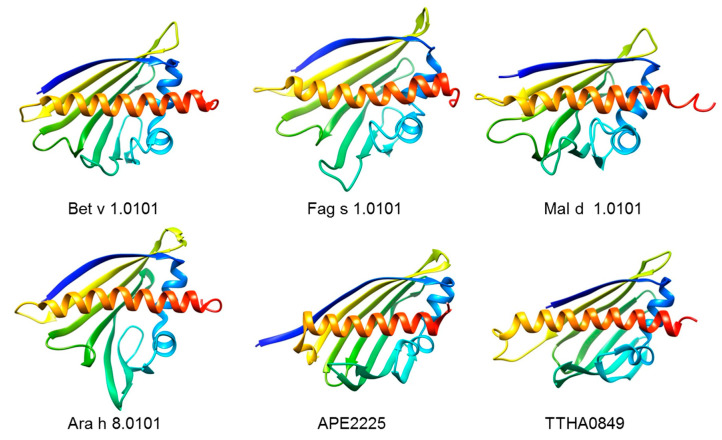
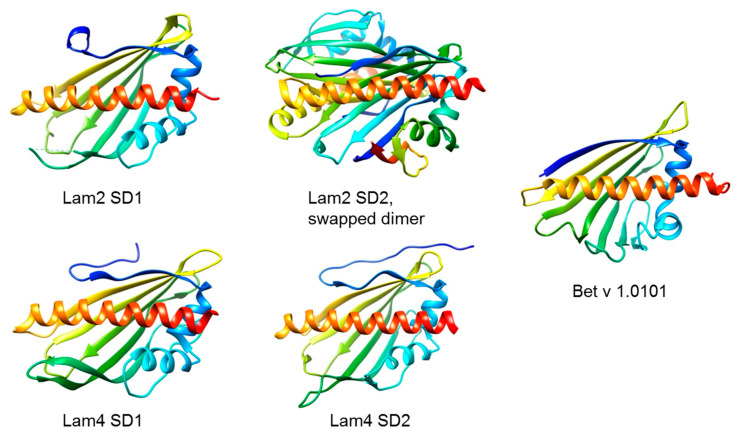
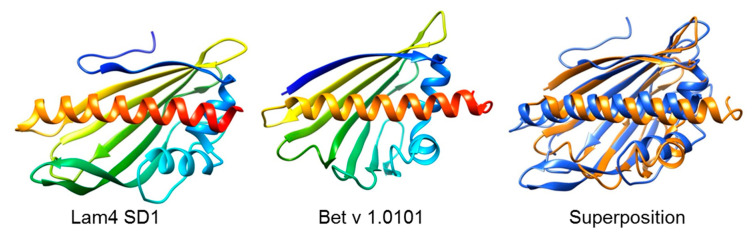
Verification
Claims the paper makes
The claims and statistics of this paper haven’t been checked yet.
Run the check — free, no account needed. It reads the open-access text and checks the sources it cites.
Claims other papers make about this one
Each is checked against this paper’s own text: does it say what the citing paper says it does?
In the citing paper
“Birch pollen contains the major allergen Bet v 1, a PR-10 protein known for its strong crossreactivity with homologous proteins in many plant-based foods, such as apples, pears, cherries, carrots, and celery [48].”
From Pollen–Food Allergy Syndrome: Allergens, Clinical Insights, Diagnostic and Therapeutic Challenges (2024) · cites this paper as [48]
In the citing paper
“The PR-10 protein family, with Bet v 1 (17.5 kDa) from birch pollen as its prototype, is one of the most extensively studied allergen families implicated in PFAS [48].”
From Pollen–Food Allergy Syndrome: Allergens, Clinical Insights, Diagnostic and Therapeutic Challenges (2024) · cites this paper as [48]
Self-check
Percentages, sums and reported differences re-computed from the paper’s own numbers.
The self-check needs the paper’s full text.
Citations
Cites
Lipid landscapes and pipelines in membrane homeostasis
Holthuis, J. C. M., & Menon, A. K. (2014) · Nature · doi:10.1038/nature13474 · Cited by 901
Research works printed but not linked: 75
- Breiteneder, 2020, Legends of allergy and immunology: Clemens von Pirquet, Allergy, 75, 1276, 10.1111/all.14115 · DOI
- Breiteneder, 2019, Legends of allergy/immunology: Dietrich Kraft, Allergy, 74, 1591, 10.1111/all.13816 · DOI
- King, 1995, Allergen nomenclature, Allergy, 50, 765, 10.1111/j.1398-9995.1995.tb01222.x · DOI
- Breiteneder, 1988, Physical map and protein gene map of cyanelle DNA from the second known isolate of Cyanophora paradoxa (Kies-strain), Curr. Genet., 13, 199, 10.1007/BF00387765 · DOI
- Breiteneder, 1988, Isolation and characterization of messenger RNA from male inflorescences and pollen of the white birch (Betula verrucosa), Int. Arch. Allergy Appl. Immunol., 87, 19, 10.1159/000234643 · DOI
- Breiteneder, 1989, The gene coding for the major birch pollen allergen Betv1, is highly homologous to a pea disease resistance response gene, EMBO J., 8, 1935, 10.1002/j.1460-2075.1989.tb03597.x · DOI
- Valenta, 1991, Homology of the major birch-pollen allergen, Bet v I, with the major pollen allergens of alder, hazel, and hornbeam at the nucleic acid level as determined by cross-hybridization, J. Allergy Clin. Immunol., 87, 677, 10.1016/0091-6749(91)90388-5 · DOI
- Breiteneder, 1992, Complementary DNA cloning and expression in Escherichia coli of Aln g I, the major allergen in pollen of alder (Alnus glutinosa), J. Allergy Clin. Immunol., 90, 909, 10.1016/0091-6749(92)90463-C · DOI
- Breiteneder, 1993, Four recombinant isoforms of Cor a I, the major allergen of hazel pollen, show different IgE-binding properties, Eur. J. Biochem., 212, 355, 10.1111/j.1432-1033.1993.tb17669.x · DOI
- Susani, 1995, Cloning and sequencing of Mal d 1, the major allergen from apple (Malus domestica), and its immunological relationship to Bet v 1, the major birch pollen allergen, Biochem. Biophys. Res. Commun., 214, 538, 10.1006/bbrc.1995.2320 · DOI
- Breiteneder, 1995, Molecular characterization of Api g 1, the major allergen of celery (Apium graveolens), and its immunological and structural relationships to a group of 17-kDa tree pollen allergens, Eur. J. Biochem., 233, 484, 10.1111/j.1432-1033.1995.484_2.x · DOI
- Antoniw, 1980, Comparison of 3 pathogenesis-related proteins from plants of 2 cultivars of tobacco infected with TMV, J. Gen. Virol., 47, 79, 10.1099/0022-1317-47-1-79 · DOI
- Ali, 2018, Pathogenesis-related proteins and peptides as promising tools for engineering plants with multiple stress tolerance, Microbiol. Res., 212–213, 29, 10.1016/j.micres.2018.04.008 · DOI
- Sancho, 2011, Responsiveness of the major birch allergen Bet v 1 scaffold to the gastric environment: Impact on structure and allergenic activity, Mol. Nutr. Food Res., 55, 1690, 10.1002/mnfr.201100025 · DOI
- Riedl, 2018, pH and heat resistance of the major celery allergen Api g 1, Mol. Nutr. Food Res., 62, e1700886, 10.1002/mnfr.201700886 · DOI
- Jacob, 2020, Food processing does not abolish the allergenicity of the carrot allergen Dau c 1: Influence of pH, temperature, and the food matrix, Mol. Nutr. Food Res., 64, e2000334, 10.1002/mnfr.202000334 · DOI
- Dramburg, 2023, EAACI Molecular Allergology User’s Guide 2.0, Pediatr. Allergy Immunol., 34, e13854, 10.1111/pai.13854 · DOI · Paper page
- Hauser, 2011, Bet v 1-like pollen allergens of multiple Fagales species can sensitize atopic individuals, Clin. Exp. Allergy, 41, 1804, 10.1111/j.1365-2222.2011.03866.x · DOI
- Larsen, 1992, PCR based cloning and sequencing of isogenes encoding the tree pollen major allergen Car b I from Carpinus betulus, hornbeam, Mol. Immunol., 29, 703, 10.1016/0161-5890(92)90180-6 · DOI
- Wallner, 2009, Immunologic characterization of isoforms of Car b 1 and Que a 1, the major hornbeam and oak pollen allergens, Allergy, 64, 452, 10.1111/j.1398-9995.2008.01788.x · DOI
- Jeong, 2021, Sensitization profile to sawtooth oak component allergens and their clinical implications, J. Clin. Lab. Anal., 35, e23825, 10.1002/jcla.23825 · DOI
- Pedrosa, 2020, Quercus ilex pollen allergen, Que i 1, responsible for pollen food allergy syndrome caused by fruits in Spanish allergic patients, Clin. Exp. Allergy, 50, 815, 10.1111/cea.13679 · DOI
- Lee, 2017, Characterization of a major allergen from Mongolian oak, Quercus mongolica, a dominant species of oak in Korea, Int. Arch. Allergy Immunol., 174, 77, 10.1159/000481092 · DOI
- Vieths, 2002, Current understanding of cross-reactivity of food allergens and pollen, Ann. N. Y. Acad. Sci., 964, 47, 10.1111/j.1749-6632.2002.tb04132.x · DOI
- Oberhuber, 2008, Characterization of Bet v 1-related allergens from kiwifruit relevant for patients with combined kiwifruit and birch pollen allergy, Mol. Nutr. Food Res., 52, S230
- Bernardi, 2011, Kiwifruit Act d 11 is the first member of the ripening-related protein family identified as an allergen, Allergy, 66, 870, 10.1111/j.1398-9995.2011.02555.x · DOI
- Zhao, L., Xie, H., Wang, X., Liu, M., Ma, T., Fu, W., Wang, Y., Wu, D., Feng, Y., and Liu, Y. (2023). Molecular characterization of allergens and component-resolved diagnosis of IgE-mediated mango fruit allergy. Allergy. · DOI
- Ahorn, 1999, Molecular characterization of Dau c 1, the Bet v 1 homologous protein from carrot and its cross-reactivity with Bet v 1 and Api g 1, Clin. Exp. Allergy, 29, 840, 10.1046/j.1365-2222.1999.00529.x · DOI
- Ebo, 2021, IgE-binding and mast cell-activating capacity of the homologue of the major birch pollen allergen and profilin from Cannabis sativa, J. Allergy Clin. Immunol. Pract., 9, 2509, 10.1016/j.jaip.2021.02.012 · DOI
- Luttkopf, 2002, Comparison of four variants of a major allergen in hazelnut (Corylus avellana) Cor a 1.04 with the major hazel pollen allergen Cor a 1.01, Mol. Immunol., 38, 515, 10.1016/S0161-5890(01)00087-6 · DOI
- Mittag, 2004, Ara h 8, a Bet v 1-homologous allergen from peanut, is a major allergen in patients with combined birch pollen and peanut allergy, J. Allergy Clin. Immunol., 114, 1410, 10.1016/j.jaci.2004.09.014 · DOI
- Crowell, 1992, Characterization of a stress-induced, developmentally regulated gene family from soybean, Plant Mol. Biol., 18, 459, 10.1007/BF00040662 · DOI
- Mittag, 2005, Birch pollen-related food allergy to legumes: Identification and characterization of the Bet v 1 homologue in mungbean (Vigna radiata), Vig r 1, Clin. Exp. Allergy, 35, 1049, 10.1111/j.1365-2222.2005.02309.x · DOI
- Guhsl, 2014, Vig r 6, the cytokinin-specific binding protein from mung bean (Vigna radiata) sprouts, cross-reacts with Bet v 1-related allergens and binds IgE from birch pollen allergic patients’ sera, Mol. Nutr. Food Res., 58, 625, 10.1002/mnfr.201300153 · DOI
- Wangorsch, 2017, Identification and implication of an allergenic PR-10 protein from walnut in birch pollen associated walnut allergy, Mol. Nutr. Food Res., 61, 1600902, 10.1002/mnfr.201600902 · DOI
- Alm, 2007, Cloning and sequencing of the Bet v 1-homologous allergen Fra a 1 in strawberry (Fragaria ananassa) shows the presence of an intron and little variability in amino acid sequence, Mol. Immunol., 44, 1245, 10.1016/j.molimm.2006.06.004 · DOI
- Scheurer, 2001, Recombinant allergens Pru av 1 and Pru av 4 and a newly identified lipid transfer protein in the in vitro diagnosis of cherry allergy, J. Allergy Clin. Immunol., 107, 724, 10.1067/mai.2001.113864 · DOI
- Kabasser, 2022, Pru du 1, the Bet v 1-homologue from almond, is a major allergen in patients with birch pollen associated almond allergy, Clin. Transl. Allergy, 12, e12177, 10.1002/clt2.12177 · DOI
- Wisniewski, 2004, Distribution and partial characterization of seasonally expressed proteins in different aged shoots and roots of ‘Loring’ peach (Prunus persica), Tree Physiol., 24, 339, 10.1093/treephys/24.3.339 · DOI
- Karamloo, 2001, Pyr c 1, the major allergen from pear (Pyrus communis), is a new member of the Bet v 1 allergen family, J. Chromatogr. B Biomed. Sci. Appl., 756, 281, 10.1016/S0378-4347(01)00087-1 · DOI
- Marzban, 2008, Identification of four IgE-reactive proteins in raspberry (Rubus ideaeus L.), Mol. Nutr. Food Res., 52, 1497, 10.1002/mnfr.200700518 · DOI
- Wangorsch, 2015, Identification of Sola l 4 as Bet v 1 homologous pathogenesis related-10 allergen in tomato fruits, Mol. Nutr. Food Res., 59, 582, 10.1002/mnfr.201300620 · DOI
- Vogel, 2002, Severe oral allergy syndrome and anaphylactic reactions caused by a Bet v 1- related PR-10 protein in soybean, SAM22, J. Allergy Clin. Immunol., 110, 797, 10.1067/mai.2002.128946 · DOI
- Gajhede, 1996, X-ray and NMR structure of Bet v 1, the origin of birch pollen allergy, Nat. Struct. Biol., 3, 1040, 10.1038/nsb1296-1040 · DOI
- Mogensen, 2002, The major birch allergen, Bet v 1, shows affinity for a broad spectrum of physiological ligands, J. Biol. Chem., 277, 23684, 10.1074/jbc.M202065200 · DOI
- Kofler, 2012, Crystallographically mapped ligand binding differs in high and low IgE binding isoforms of birch pollen allergen bet v 1, J. Mol. Biol., 422, 109, 10.1016/j.jmb.2012.05.016 · DOI
- Aglas, 2020, Ligand Binding of PR-10 Proteins with a Particular Focus on the Bet v 1 Allergen Family, Curr. Allergy Asthma Rep., 20, 25, 10.1007/s11882-020-00918-4 · DOI · Paper page
- McBride, J.K., Cheng, H., Maleki, S.J., and Hurlburt, B.K. (2019). Purification and characterization of pathogenesis related class 10 panallergens. Foods, 8. · DOI
- Hoffmann, 2014, Secret of the major birch pollen allergen Bet v 1: Identification of the physiological ligand, Biochem. J., 457, 379, 10.1042/BJ20130413 · DOI
- Brunetti, 2018, Modulation of Phytohormone Signaling: A Primary Function of Flavonoids in Plant-Environment Interactions, Front. Plant Sci., 9, 1042, 10.3389/fpls.2018.01042 · DOI
- Agati, 2013, Functional roles of flavonoids in photoprotection: New evidence, lessons from the past, Plant Physiol. Biochem., 72, 35, 10.1016/j.plaphy.2013.03.014 · DOI
- Grutsch, 2014, Ligand binding modulates the structural dynamics and compactness of the major birch pollen allergen, Biophys. J., 107, 2972, 10.1016/j.bpj.2014.10.062 · DOI
- Asam, 2014, Bet v 1—A Trojan horse for small ligands boosting allergic sensitization?, Clin. Exp. Allergy, 44, 1083, 10.1111/cea.12361 · DOI
- Soh, 2019, Multiple roles of Bet v 1 ligands in allergen stabilization and modulation of endosomal protease activity, Allergy, 74, 2382, 10.1111/all.13948 · DOI
- Freier, 2015, Protease recognition sites in Bet v 1a are cryptic, explaining its slow processing relevant to its allergenicity, Sci. Rep., 5, 12707, 10.1038/srep12707 · DOI
- Seutter von Loetzen, C., Jacob, T., Hartl-Spiegelhauer, O., Vogel, L., Schiller, D., Sporlein-Guttler, C., Schobert, R., Vieths, S., Hartl, M.J., and Rosch, P. (2015). Ligand recognition of the major birch pollen allergen Bet v 1 is isoform dependent. PLoS ONE, 10. · DOI
- Jacob, 2019, Identification of a natural ligand of the hazel allergen Cor a 1, Sci. Rep., 9, 8714, 10.1038/s41598-019-44999-2 · DOI
- Hjerno, 2006, Down-regulation of the strawberry Bet v 1-homologous allergen in concert with the flavonoid biosynthesis pathway in colorless strawberry mutant, Proteomics, 6, 1574, 10.1002/pmic.200500469 · DOI
- Casanal, 2013, The strawberry pathogenesis-related 10 (PR-10) Fra a proteins control flavonoid biosynthesis by binding to metabolic intermediates, J. Biol. Chem., 288, 35322, 10.1074/jbc.M113.501528 · DOI
- Lackner, 2000, ProSup: A refined tool for protein structure alignment, Protein Eng., 13, 745, 10.1093/protein/13.11.745 · DOI
- Radauer, C., Lackner, P., and Breiteneder, H. (2008). The Bet v 1 fold: An ancient, versatile scaffold for binding of large, hydrophobic ligands. BMC Evol. Biol., 8. · DOI
- Sako, 1996, Aeropyrum pernix gen. nov., sp. nov., a novel aerobic hyperthermophilic archaeon growing at temperatures up to 100 degrees C, Int. J. Syst. Bacteriol., 46, 1070, 10.1099/00207713-46-4-1070 · DOI
- Nakabayashi, 2005, Structure of a conserved hypothetical protein, TTHA0849 from Thermus thermophilus HB8, at 2.4 A resolution: A putative member of the StAR-related lipid-transfer (START) domain superfamily, Acta Crystallogr. Sect. F Struct. Biol. Cryst. Commun., 61, 1027, 10.1107/S1744309105035372 · DOI
- Schmalz, 2022, Isotype-specific binding patterns of serum antibodies to multiple conformational epitopes of Bet v 1, J. Allergy Clin. Immunol., 149, 1786, 10.1016/j.jaci.2021.10.026 · DOI
- Berkner, H., Seutter von Loetzen, C., Hartl, M., Randow, S., Gubesch, M., Vogel, L., Husslik, F., Reuter, A., Lidholm, J., and Ballmer-Weber, B. (2014). Enlarging the toolbox for allergen epitope definition with an allergen-type model protein. PLoS ONE, 9. · DOI
- Gatta, 2015, A new family of StART domain proteins at membrane contact sites has a role in ER-PM sterol transport, eLife, 4, e07253, 10.7554/eLife.07253 · DOI · Paper page
- Shinder, 2015, Lam6 regulates the extent of contacts between organelles, Cell Rep., 12, 7, 10.1016/j.celrep.2015.06.022 · DOI
- Murley, 2015, Ltc1 is an ER-localized sterol transporter and a component of ER-mitochondria and ER-vacuole contacts, J. Cell Biol., 209, 539, 10.1083/jcb.201502033 · DOI
- Dresden, 2021, Diverse regulatory mechanisms of StARkin domains in land plants and mammals, Curr. Opin. Plant Biol., 64, 102148, 10.1016/j.pbi.2021.102148 · DOI
- Iyer, 2001, Adaptations of the helix-grip fold for ligand binding and catalysis in the START domain superfamily, Proteins, 43, 134, 10.1002/1097-0134(20010501)43:2<134::AID-PROT1025>3.0.CO;2-I · DOI
- Wong, 2016, Lipid transfer proteins do their thing anchored at membrane contact sites… but what is their thing?, Biochem. Soc. Trans., 44, 517, 10.1042/BST20150275 · DOI
- Jentsch, 2018, Structural basis of sterol binding and transport by a yeast StARkin domain, J. Biol. Chem., 293, 5522, 10.1074/jbc.RA118.001881 · DOI · Paper page
- Tong, 2018, Structural basis of sterol recognition and nonvesicular transport by lipid transfer proteins anchored at membrane contact sites, Proc. Natl. Acad. Sci. USA, 115, E856, 10.1073/pnas.1719709115 · DOI
- Gibrat, 1996, Surprising similarities in structure comparison, Curr. Opin. Struct. Biol., 6, 377, 10.1016/S0959-440X(96)80058-3 · DOI
- Madej, 2020, Biological assembly comparison with VAST, Methods Mol. Biol., 2112, 175, 10.1007/978-1-0716-0270-6_13 · DOI
Cited by
Sorted by citations
Kato, Y., Morikawa, T., & Fujieda, S. (2025) · Allergology International · doi:10.1016/j.alit.2024.08.007 · Cited by 45
Pollen–Food Allergy Syndrome: Allergens, Clinical Insights, Diagnostic and Therapeutic Challenges
Haidar, L., Bănărescu, C. F., Uța, C., Moldovan, S. I., Zimbru, E.-L., Zimbru, R.-I., Ciurariu, E., Georgescu, M., & Panaitescu, C. (2024) · Applied Sciences · doi:10.3390/app15010066 · Cited by 21
Metadata
- Authors
- Breiteneder, H., & Kraft, D.
- Venue
- Biomolecules
- Publisher
- MDPI AG
- Published
- 2023-07-19
- Volume
- 13
- Issue
- 7
- Pages
- 1151
- ISSN
- 2218-273X
- PMC
- PMC10377203
- Cited by
- 40
- References
- 1
- Language
- en
About these checks
Registry, retraction, Cites and statistics results are computed, not judged, with one exception: a printed reference that no index lists is read once by a model before it counts as a citation error. Claims are extracted by a model and kept only when their quote appears verbatim in the text; each cited source is then checked, with a model’s help, for whether it says what the claim relies on. Those verdicts can be wrong — read the claim’s quote and the cited source before relying on one.
Statistics and arithmetic are recomputed, not judged.
Confidence bands are shown only for fields calibrated on our annotated test set. None is calibrated yet, so no band is shown.
What counts as a claim ›How we measure confidence ›How we check this ›
Are you an author, or do you see a problem with this page? Request a review
