

Inhibition of Microglial GSK3β Activity Is Common to Different Kinds of Antidepressants: A Proposal for an In Vitro Screen to Detect Novel Antidepressant Principles
Open accessThe DOI matches its Crossref record; 241 of the 244 references it cites were found in a registry or an index.
Abstract
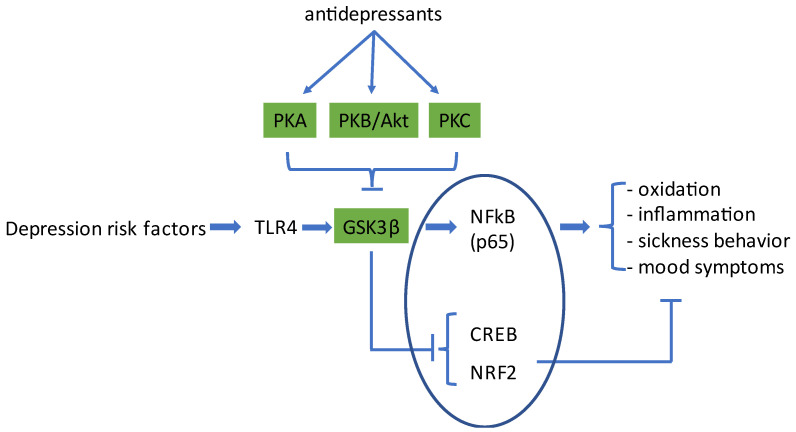
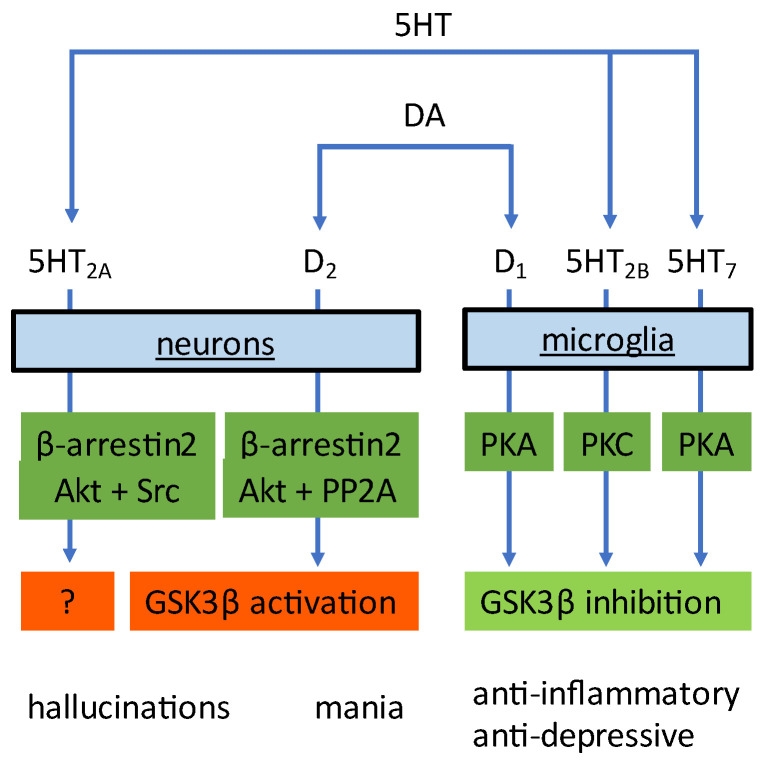
Depression is a major public health concern. Unfortunately, the present antidepressants often are insufficiently effective, whilst the discovery of more effective antidepressants has been extremely sluggish. The objective of this review was to combine the literature on depression with the pharmacology of antidepressant compounds, in order to formulate a conceivable pathophysiological process, allowing proposals how to accelerate the discovery process. Risk factors for depression initiate an infection-like inflammation in the brain that involves activation microglial Toll-like receptors and glycogen synthase kinase-3β (GSK3β). GSK3β activity alters the balance between two competing transcription factors, the pro-inflammatory/pro-oxidative transcription factor NFκB and the neuroprotective, anti-inflammatory and anti-oxidative transcription factor NRF2. The antidepressant activity of tricyclic antidepressants is assumed to involve activation of GS-coupled microglial receptors, raising intracellular cAMP levels and activation of protein kinase A (PKA). PKA and similar kinases inhibit the enzyme activity of GSK3β. Experimental antidepressant principles, including cannabinoid receptor-2 activation, opioid μ receptor agonists, 5HT2 agonists, valproate, ketamine and electrical stimulation of the Vagus nerve, all activate microglial pathways that result in GSK3β-inhibition. An in vitro screen for NRF2-activation in microglial cells with TLR-activated GSK3β activity, might therefore lead to the detection of totally novel antidepressant principles with, hopefully, an improved therapeutic efficacy.
Overview
The claims and statistics of this paper haven’t been checked yet.
Free: it reads the open-access text and checks the first 5 claims that cite a source we can check. Create a free account to check every claim.
Integrity signals
Registry
Cites
Statistics
Figures
Verification
Claims the paper makes
The claims and statistics of this paper haven’t been checked yet.
Free: it reads the open-access text and checks the first 5 claims that cite a source we can check. Create a free account to check every claim.
Claims other papers make about this one
Each is checked against this paper’s own text: does it say what the citing paper says it does?
The source backs part of the claim, not all of it — or backs it for a different population, condition or comparison.
In the citing paper
“Homodimerization of TLR-4 receptors leads to the activation of the enzyme glycogen synthase kinase (GSK-3) and the transcription factor NF-κB, which induce the production of the pro-inflammatory cytokines IL-1β, TNF-α, IL-6, and CXCL10 (56).”
From Chronic stress, neuroinflammation, and depression: an overview of pathophysiological mechanisms and emerging anti-inflammatories (2023) · cites this paper as [56]
Experimental — accuracy not yet measured
Self-check
Percentages, sums and reported differences re-computed from the paper’s own numbers.
The self-check needs the paper’s full text.
Citations
Cites
Items 201–241 of 241
Adrenergic agonists suppress the proliferation of microglia through β2-adrenergic receptor
Fujita, H. M., Tanaka, J., Maeda, N., & Sakanaka, M. (1998) · Neuroscience Letters · doi:10.1016/s0304-3940(98)00003-2 · Cited by 69
Loric, S., Maroteaux, L., Kellermann, O., & Launay, J. (1995) · Molecular Pharmacology · doi:10.1016/s0026-895x(25)08565-7 · Cited by 69
Bansal, Y., Singh, R., Parhar, I., Kuhad, A., & Soga, T. (2019) · Frontiers in Pharmacology · doi:10.3389/fphar.2019.00452 · Cited by 68
Glycogen Synthase Kinase-3 is an Intermediate Modulator of Serotonin Neurotransmission
Polter, A. M., & Li, X. (2011) · Frontiers in Molecular Neuroscience · doi:10.3389/fnmol.2011.00031 · Cited by 67
Lee, B.-H., & Kim, Y. (2010) · Journal of Affective Disorders · doi:10.1016/j.jad.2010.01.074 · Cited by 67
Crosstalk between endocannabinoid and immune systems: a potential dysregulation in depression?
Boorman, E., Zajkowska, Z., Ahmed, R., Pariante, C. M., & Zunszain, P. A. (2016) · Psychopharmacology · doi:10.1007/s00213-015-4105-9 · Cited by 66
Bhandari, S., Larson, M. E., Kumar, N., & Stein, D. (2017) · Gut and Liver · doi:10.5009/gnl16347 · Cited by 66 · cited 1×
“Infection [18] and inflammatory disorders such as IBD (inflammatory bowel disease) [19], metabolic disorders [19,20], cardiovascular disorders [21], neurological disorders [22–26], autoimmune diseases [18], and even alcohol abuse [27,28] are among the likely causes of immune dysfunction that contribute to the pathogen…”
BackgroundInvolvement of Central μ- but Not δ- or κ-Opioid Receptors in Immunomodulation
Nelson, C. J., Schneider, G. M., & Lysle, D. T. (2000) · Brain Behavior and Immunity · doi:10.1006/brbi.1999.0575 · Cited by 65
Perreault, M. L., Jones-Tabah, J., O’Dowd, B. F., & George, S. R. (2012) · The International Journal of Neuropsychopharmacology · doi:10.1017/s1461145712000685 · Cited by 65
Welters, I. D., Hafer, G., Menzebach, A., Mühling, J., Neuhäuser, C., Browning, P., & Goumon, Y. (2010) · Anesthesia & Analgesia · doi:10.1213/ane.0b013e3181c95cfa · Cited by 63
GPCRomics of homeostatic and disease-associated human microglia
Hsiao, C.-C., Sankowski, R., Prinz, M., Smolders, J., Huitinga, I., & Hamann, J. (2021) · Frontiers in Immunology · doi:10.3389/fimmu.2021.674189 · Cited by 59 · cited 1×
“A good alternative to consider would be to screen induced pluripotent stem cell-derived microglial precursor cells [196].”
BackgroundHung, T., Shyue, S., Wu, C., Chen, C.-C., Lin, C.-C., Chang, C.-F., & Chen, S. (2017) · Oncotarget · doi:10.18632/oncotarget.21139 · Cited by 57
Nishimura, Y., Moriyama, M., Kawabe, K., Satoh, H., Takano, K., Azuma, Y.-T., & Nakamura, Y. (2018) · Neurochemical Research · doi:10.1007/s11064-018-2587-7 · Cited by 56 · cited 1×
“However, a simple screen in mouse BV-2 microglial cells would already detect α-lipoic acid [197], 9-cis-retinoic acid [198], stable cAMP analogues [94,199], PDE4 inhibitors [200,201], agonists of the fatty acid receptor FFAR1/GPR40 [202], the ‘specialized pro-resolving mediators’ lipoxin A4, resolvin D1 and resolvin E…”
BackgroundAntidepressant activity of fingolimod in mice
di Nuzzo, L., Orlando, R., Tognoli, C., Di Pietro, P., Bertini, G., Miele, J., Bucci, D., Motolese, M., Scaccianoce, S., Caruso, A., et al. (2015) · Pharmacology Research & Perspectives · doi:10.1002/prp2.135 · Cited by 55
Stress-Activated Protein Kinases in Spinal Cord Injury: Focus on Roles of p38
Kasuya, Y., Umezawa, H., & Hatano, M. (2018) · International Journal of Molecular Sciences · doi:10.3390/ijms19030867 · Cited by 54
Yang, B., Lin, L., Bazinet, R. P., Chien, Y.-C., Chang, J. P., Satyanarayanan, S. K., Su, H., & Su, K. (2019) · Psychotherapy and Psychosomatics · doi:10.1159/000501158 · Cited by 53
Shimizu, M., Nishida, A., Zensho, H., & Yamawaki, S. (1996) · The Journal of Pharmacology and Experimental Therapeutics · doi:10.1016/s0022-3565(25)21318-0 · Cited by 52
Bioactive lipids as new class of microglial modulators: When nutrition meets neuroimunology
Nadjar, A., Leyrolle, Q., Joffre, C., & Layé, S. (2016) · Progress in Neuro-Psychopharmacology and Biological Psychiatry · doi:10.1016/j.pnpbp.2016.07.004 · Cited by 52
Zhou, W., Dong, L., Wang, N., Shi, J.-Y., Yang, J.-J., Zuo, Z.-Y., & Zhou, Z.-Q. (2014) · Neuroimmunomodulation · doi:10.1159/000356517 · Cited by 49
Bielecka, A., Paul-Samojedny, M., & Obuchowicz, E. (2010) · Naunyn-Schmiedeberg s Archives of Pharmacology · doi:10.1007/s00210-010-0535-4 · Cited by 46
Choi, M., Lee, S. H., Park, M. H., Kim, Y.-S., & Son, H. (2017) · Biochemical and Biophysical Research Communications · doi:10.1016/j.bbrc.2017.05.157 · Cited by 44
Qu, Y., Shan, J., Wang, S., Chang, L., Pu, Y., Wang, X., Tan, Y., Yamamoto, M. P., & Hashimoto, K. (2020) · European Archives of Psychiatry and Clinical Neuroscience · doi:10.1007/s00406-020-01208-w · Cited by 44
Desouza, L. A., Benekareddy, M., Fanibunda, S. E., Mohammad, F., Janakiraman, B., Ghai, U., Gur, T., Blendy, J. A., & Vaidya, V. A. (2021) · Frontiers in Molecular Neuroscience · doi:10.3389/fnmol.2021.790213 · Cited by 44
Antidepressant-like effect of valproic acid—Possible involvement of PI3K/Akt/mTOR pathway
Lima, I. V. D. A., Almeida-Santos, A. F., Ferreira-Vieira, T. H., Aguiar, D. C., Ribeiro, F. M., Campos, A. C., & de Oliveira, A. C. P. (2017) · Behavioural Brain Research · doi:10.1016/j.bbr.2017.04.015 · Cited by 43
Tylek, K., Trojan, E., Leśkiewicz, M., Regulska, M., Bryniarska, N., Curzytek, K., Lacivita, E., Leopoldo, M., & Basta‐Kaim, A. (2021) · Cells · doi:10.3390/cells10092373 · Cited by 41
Cox, D. A., & Cohen, M. L. (1995) · Behavioural Brain Research · doi:10.1016/0166-4328(96)00125-8 · Cited by 40
Inflammation in the Alzheimer's disease cascade: culprit or innocent bystander?
Tan, Z. S., & Seshadri, S. (2010) · Alzheimer's Research & Therapy · doi:10.1186/alzrt29 · Cited by 39
Speculations on the mechanism of action of hallucinogenic indolealkylamines
Glennon, R. A., & Rosecrans, J. A. (1981) · Neuroscience & Biobehavioral Reviews · doi:10.1016/0149-7634(81)90002-6 · Cited by 38
The Role of Alpha-Lipoic Acid in the Pathomechanism of Acute Ischemic Stroke
Wang, Q., Lv, C., Sun, Y., Han, X., Wang, S., Mao, Z., Xin, Y., & Zhang, B. (2018) · Cellular Physiology and Biochemistry · doi:10.1159/000491661 · Cited by 36
Endocannabinoid signaling pathways: beyond CB1R and CB2R
Biringer, R. G. (2021) · Journal of Cell Communication and Signaling · doi:10.1007/s12079-021-00622-6 · Cited by 35
Kalkman, H. O. (2020) · Pharmaceuticals · doi:10.3390/ph13050092 · Cited by 34
Self-citationWang, B., Chen, T., Li, G., Jia, Y., Wang, J., Li, X., & Chen, Y. (2019) · Neurochemical Research · doi:10.1007/s11064-019-02730-7 · Cited by 31
VanderZwaag, J., Halvorson, T., Dolhan, K., Šimončičová, E., Ben‐Azu, B., & Tremblay, M. (2022) · Neurochemical Research · doi:10.1007/s11064-022-03772-0 · Cited by 30
Regulatory Role of Anesthetics on Heme Oxygenase-1
Hoetzel, A., & Schmidt, R. (2010) · Current Drug Targets · doi:10.2174/1389450111009011495 · Cited by 28
Tyrtyshnaia, A. A., Konovalova, S. P., Bondar, A., Ermolenko, E. V., Sultanov, R. M., & Manzhulo, I. (2021) · International Journal of Molecular Sciences · doi:10.3390/ijms221910728 · Cited by 28
Antinociceptive and Analgesic Effects of (2 R,6 R)-Hydroxynorketamine
Yost, J. G., Wulf, H. A., Browne, C. A., & Lucki, I. (2022) · Journal of Pharmacology and Experimental Therapeutics · doi:10.1124/jpet.122.001278 · Cited by 18
Savage, K. M., Gogarty, L., Lea, A., Deleuil, S., Nolidin, K., Croft, K. D., & Stough, C. K. K. (2022) · Antioxidants · doi:10.3390/antiox11050822 · Cited by 17
The Importance of Brain Serotonergic Receptor Mechanisms for the Action of Antidepressant Drugs
Ögren, S. O., Fuxé, K., & Agnati, L. F. (1985) · Pharmacopsychiatry · doi:10.1055/s-2007-1017366 · Cited by 16
Naito, K., Tanaka, C., Mitsuhashi, M., Moteki, H., Kimura, M., Natsume, H., & Ogihara, M. (2015) · Biological and Pharmaceutical Bulletin · doi:10.1248/bpb.b15-00735 · Cited by 16
Gαs, adenylyl cyclase, and their relationship to the diagnosis and treatment of depression
Schappi, J. M., & Rasenick, M. M. (2022) · Frontiers in Pharmacology · doi:10.3389/fphar.2022.1012778 · Cited by 11
Palazidou, E., Beer, M. S., Checkley, S., & Stahl, S. M. (1988) · PubMed · Cited by 3
Cited by
Hassamal, S. (2023) · Frontiers in Psychiatry · doi:10.3389/fpsyt.2023.1130989 · Cited by 578
Krystal, J. H., Kaye, A. P., Jefferson, S., Girgenti, M. J., Wilkinson, S. T., Sanacora, G., & Esterlis, I. (2023) · Proceedings of the National Academy of Sciences · doi:10.1073/pnas.2305772120 · Cited by 91
Innovation at the Intersection: Emerging Translational Research in Neurology and Psychiatry
Tanaka, M., Battaglia, S., Giménez-Llort, L., Chen, C., Hepsomali, P., Avenanti, A., & Vécsei, L. (2024) · Cells · doi:10.3390/cells13100790 · Cited by 44
cAMP-PKA signaling pathway and anxiety: Where do we go next?
Chen, D., Wang, J., Cao, J., & Zhu, G. (2024) · Cellular Signalling · doi:10.1016/j.cellsig.2024.111311 · Cited by 49
The Antinociceptive Role of Nrf2 in Neuropathic Pain: From Mechanisms to Clinical Perspectives
Petrikonis, K., Bernatonienė, J., Kopustinskienė, D. M., Casale, R., Davinelli, S., & Saso, L. (2024) · Pharmaceutics · doi:10.3390/pharmaceutics16081068 · Cited by 39
Metadata
- Authors
- Kalkman, H. O.
- Affiliations
- University of Zurich (CH)
- Corresponding author
- Kalkman, Hans O.
- Venue
- Biomedicines
- Publisher
- MDPI AG
- Published
- 2023-03-07
- Volume
- 11
- Issue
- 3
- Pages
- 806
- ISSN
- 2227-9059 (ISSN-L)
- PMC
- PMC10045655
- OpenAlex
- W4323361230
- Cited by
- 18
- References
- 244
- Citations by year
- 2026: 5 · 2025: 1 · 2024: 6 · 2023: 6
- FWCI
- 0.65
- Type
- journal article
- Language
- en
- Open access
- gold
- doi.org
- Licence
- Locations
- Biomedicines (publishedVersion, cc-by)
- PubMed Central (publishedVersion, cc-by)
- PubMed (publishedVersion)
- Zurich Open Repository and Archive (University of Zurich) (acceptedVersion, cc-by-nc-nd)
- DOAJ (DOAJ: Directory of Open Access Journals) (submittedVersion, cc-by-sa)
- Zurich Open Repository and Archive (University of Zurich) (submittedVersion, cc-by)
- Zurich Open Repository and Archive (University of Zurich)
- Topics
- Health Sciences › Medicine › Pharmacology (medical) › Treatment of Major Depression
- Life Sciences › Neuroscience › Biological Psychiatry › Tryptophan and brain disorders
- Life Sciences › Neuroscience › Neurology › Neuroinflammation and Neurodegeneration Mechanisms
- Keywords
- depression, antidepressants, microglia, glycogen synthase kinase-3β, GSK-3β inhibition, Toll-like receptors, neuroinflammation, NF-κB, Nrf2, protein kinase A, cAMP signaling, tricyclic antidepressants, CB2 receptor, valproic acid, ketamine, vagus nerve stimulation, in vitro screening
About these checks
Registry, retraction, Cites and statistics results are computed, not judged, with one exception: a printed reference that no index lists is read once by a model before it counts as a citation error. Claims are extracted by a model and kept only when their quote appears verbatim in the text; each cited source is then checked, with a model’s help, for whether it says what the claim relies on. Those verdicts can be wrong — read the claim’s quote and the cited source before relying on one.
Statistics and arithmetic are recomputed, not judged.
Confidence bands are shown only for fields calibrated on our annotated test set. None is calibrated yet, so no band is shown.
What counts as a claim ›How we measure confidence ›How we check this ›
Are you an author, or do you see a problem with this page? Request a review
Data sources
Bibliographic data: Semantic Scholar, OpenAlex, Crossref.
Contains information from the Semantic Scholar Academic Graph Datasets, made available under the ODC Attribution License (ODC-BY 1.0).
Semantic Scholar’s data is described in: Kinney, R., et al. (2023). The Semantic Scholar Open Data Platform. arXiv:2301.10140.
